
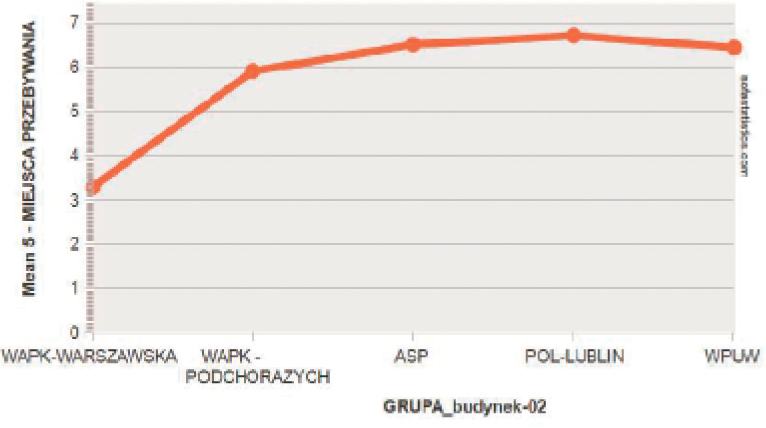
Figure 1.
Chart of the average number of marked “hang-out places” for individual buildings [1]
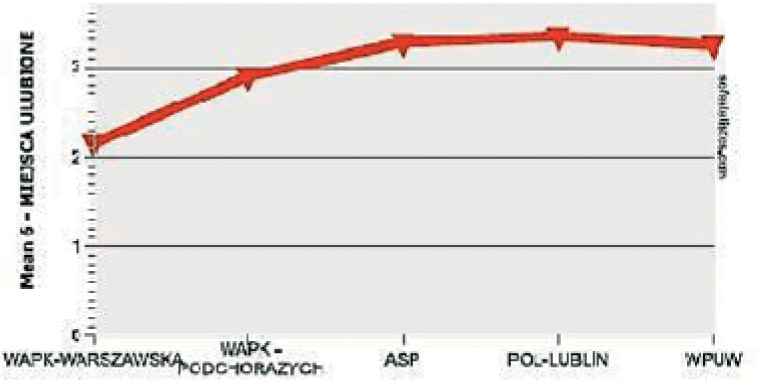
Figure 2.
Average number of “liked/favourite” places [1]
Table 1.
Summary of the number of places marked on the building plans
| Building | “Hang-out” places | “Favourite” places | “Disliked” places | “Important” places | Sum of “places” | |||
|---|---|---|---|---|---|---|---|---|
| MEAN | MODE | MEAN | MODE | MEAN | MODE | MEAN | MEAN | |
| B1 | 3.29 | 3 (N = 12) | 2.15 | 1 (N = 23) | 2.25 | 1 (N-22) | 0.71 | 8.4 |
| B2 | 5.91 | 3, 4 (N = 9) | 2.89 | 2 (N = 10) | 2.16 | 1 (N = 13) | 1.05 | 12.02 |
| B3 | 6.51 | 5 (N = 9) | 3.27 | 2. 3. 4 (N = 8) | 2.05 | 0 (N = 12) | 1.1 | 12.9 |
| B4 | 6.71 | 2, 8 (N = 4) | 3.35 | 1 (N = 8) | 2.39 | 1 (N = 13) | 0.74 | 13.19 |
| B5 | 6.44 | 3 (N = 4) | 3.25 | 2 (N = 6) | 1.94 | 1 (N = 16) | 1.13 | 12.25 |
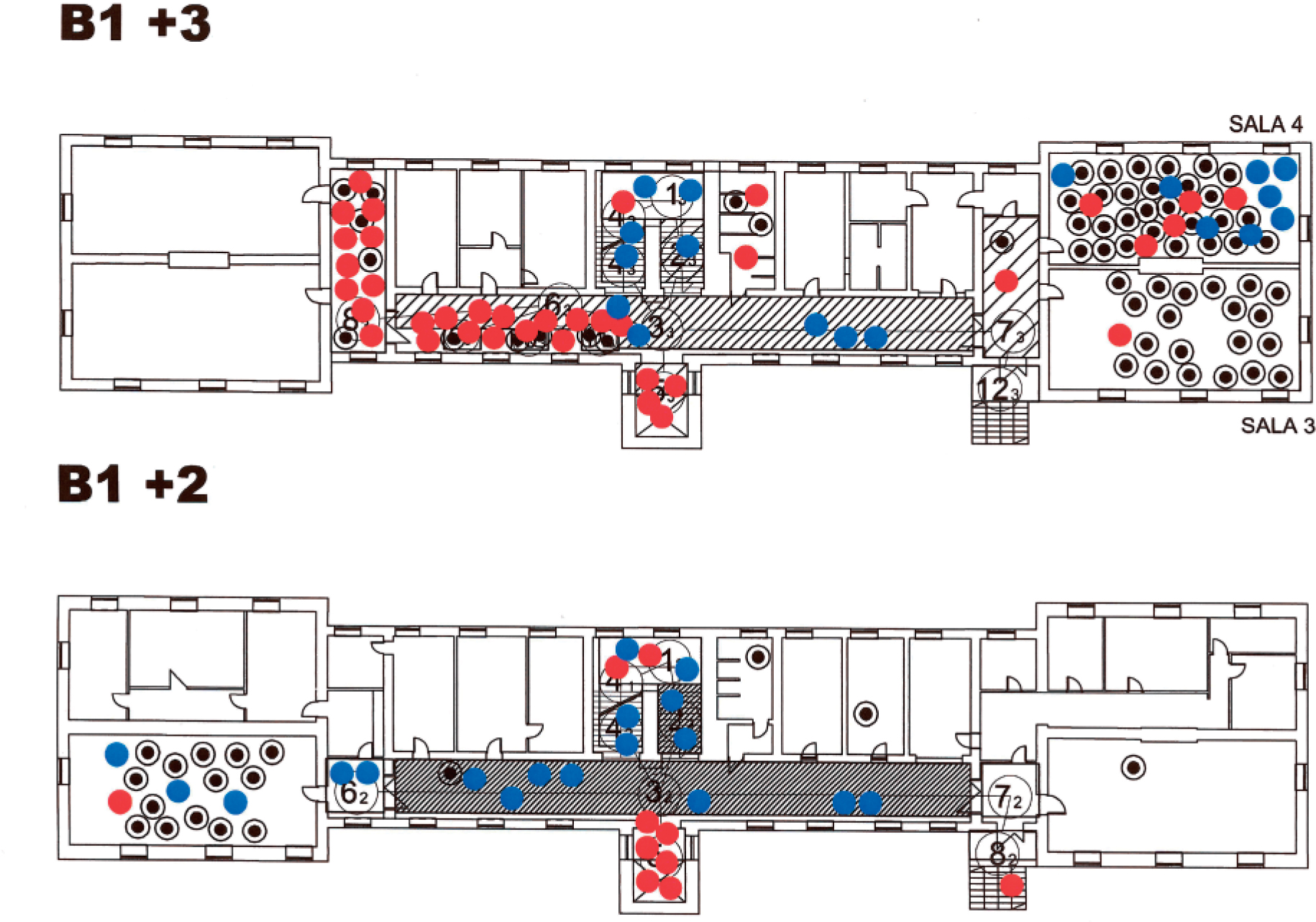
Figure 3.
Exemplary aggregate behavioural maps showing places of “activity/ remaining in a place” (black), “favourite” places (red) and “disliked” places (blue) for two selected floors (+2, +3) of B1 building
Table 2.
The emotional engagement with places – “positivity” is a measure of the mean number of favourite places and positive associations with the buildings
| Building | FP: Favourite places MEAN | POS: Positive associations | NEG: Negative associations | NEU: Neutral associations | POS-A: POS/ POS+NEU+NEG | POSITIVITY POS-A + FP/10 |
|---|---|---|---|---|---|---|
| B1 | 2.15 | 13 | 23 | 44 | 0.16 | 0.375 |
| B2 | 2.89 | 22 | 27 | 36 | 0.25 | 0.54 |
| B3 | 3.27 | 14 | 12 | 39 | 0.21 | 0.54 |
| B4 | 3.35 | 13 | 4 | 40 | 0.22 | 0.55 |
| B5 | 3.25 | 17 | 18 | 8 | 0.39 | 0.72 |
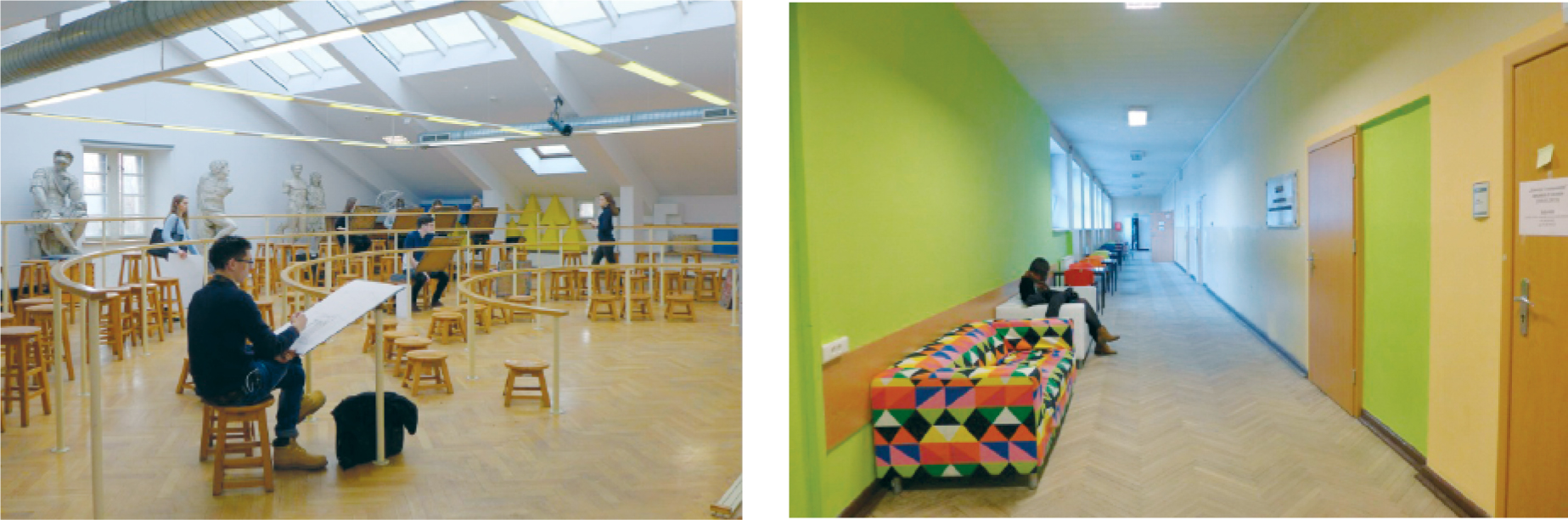
Figure 4-5.
Examples of the most liked places in buildings under study: (4) drawing room in the building of FA CUT (B2) and (5) the corridor with sofas in the Faculty of Psychology (B5) [1]
Table 3.
Aggregate adjective list describing the buildings with respect to “positivity” factor and “content” factor
| POS | NEU | NEG | TOTAL | ||
| B1 | Shape and size | 1 | 23 | 0 | 24 |
| Form | 11 | 19 | 8 | 38 | |
| Performance | 12 | 1 | 14 | 27 | |
| General impressions | 14 | 13 | 34 | 61 | |
| TOTAL | 38 | 56 | 56 | 150 | |
| Mean number of words | 0.73 | 1.08 | 1.08 | 2.89 | |
| T/N (N1=52) | 25. 3% | 37.35% | 37.35% | 100% | |
| B2 | Shape and size | - | 13 | 2 | 15 |
| Form | 28 | 2 | 1 | 31 | |
| Performance | 15 | - | 7 | 22 | |
| General impressions | 30 | 6 | 20 | 56 | |
| TOTAL | 73 | 21 | 30 | 124 | |
| Mean number of words | 1.59 | 0.46 | 0.65 | 2.7 | |
| T/N (N2=44) | 58.87% | 16.94% | 24.19% | 100.00% | |
| B3 | Shape and size | 0 | 16 | 1 | 17 |
| Form | 18 | 7 | 2 | 27 | |
| Performance | 5 | 0 | 30 | 35 | |
| General impressions | 25 | 22 | 19 | 66 | |
| TOTAL | 48 | 45 | 52 | 145 | |
| Mean number of words | 1.17 | 1.09 | 1.27 | 3.53 | |
| T/N (N3=41) | 33.11% | 31.03% | 35.86% | 100.00% | |
| B4 | Shape and size | 0 | 19 | 0 | 19 |
| Form | 14 | 25 | 0 | 39 | |
| Performance | 17 | 0 | 5 | 22 | |
| General impressions | 24 | 23 | 7 | 54 | |
| TOTAL | 55 | 67 | 12 | 134 | |
| Mean number of words | 1.77 | 2.16 | 0.39 | 4.32% | |
| T/N (N4=31) | 41.04% | 50.00% | 8.96% | 100.00% | |
| B5 | Shape and size | 0 | 1 | 1 | 2 |
| Form | 1 | 0 | 5 | 6 | |
| Performance | 1 | 0 | 6 | 7 | |
| General impressions | 10 | 10 | 27 | 47 | |
| TOTAL | 12 | 11 | 39 | 62 | |
| Mean number of words | 0.75 | 0.69 | 2.44 | 3.88 | |
| T/N (N5=16) | 19.35% | 17.75% | 62.90% | 100.00% |
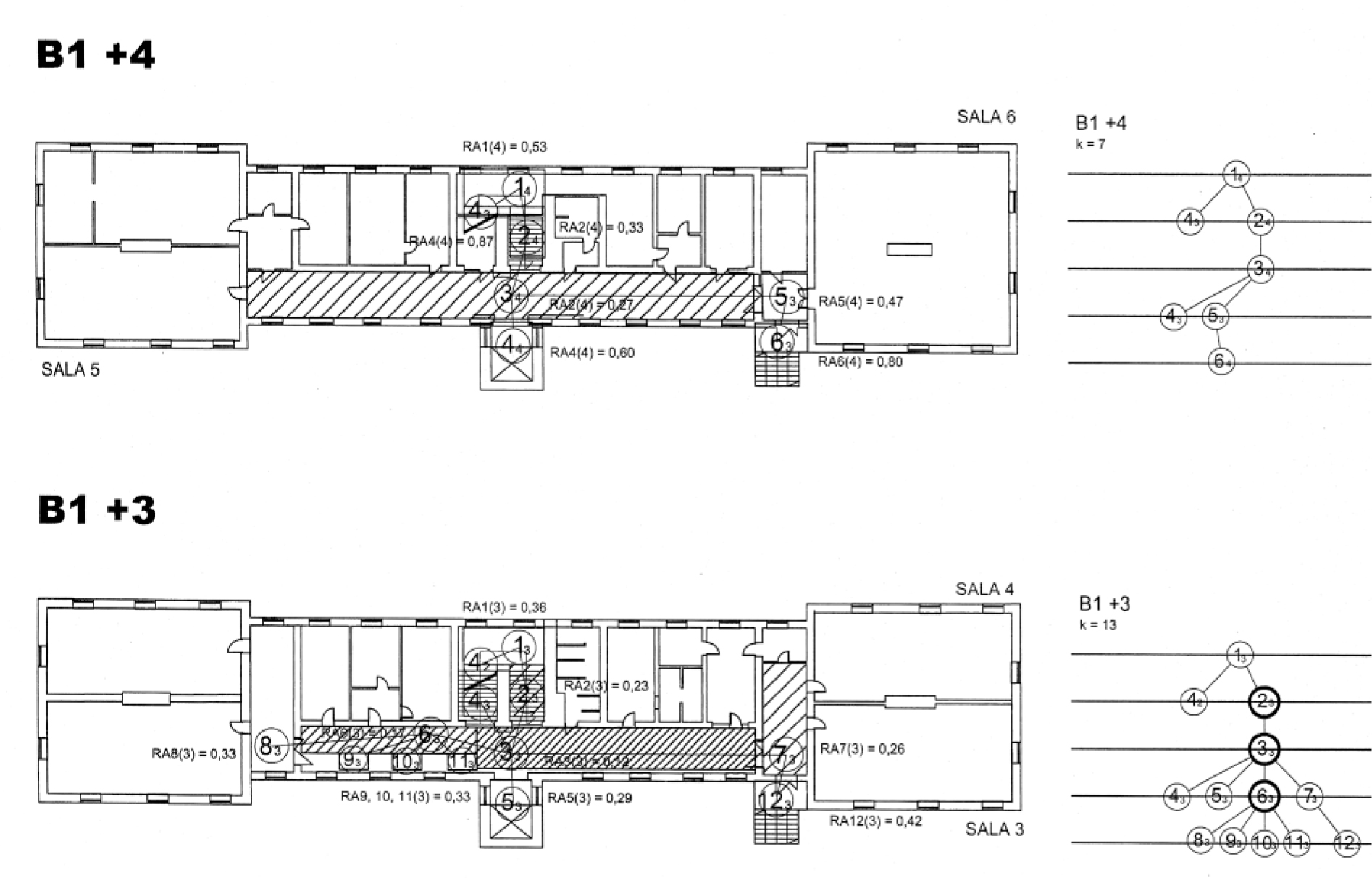
Figure 6.
An example of a space syntax analysis – map of the most “integrated” spaces in the building plan (B1 – level 3rd and 4th of the building). The presented plans differ with the arrangement of left end of the corridor which is sub-divided with a glass door and furnishing (on the 3rd floor). It makes a spatial model more complexed and discriminated offering more opportunities for individual behaviour (spaces described as “8/3”, “9/3” and “10/3”).
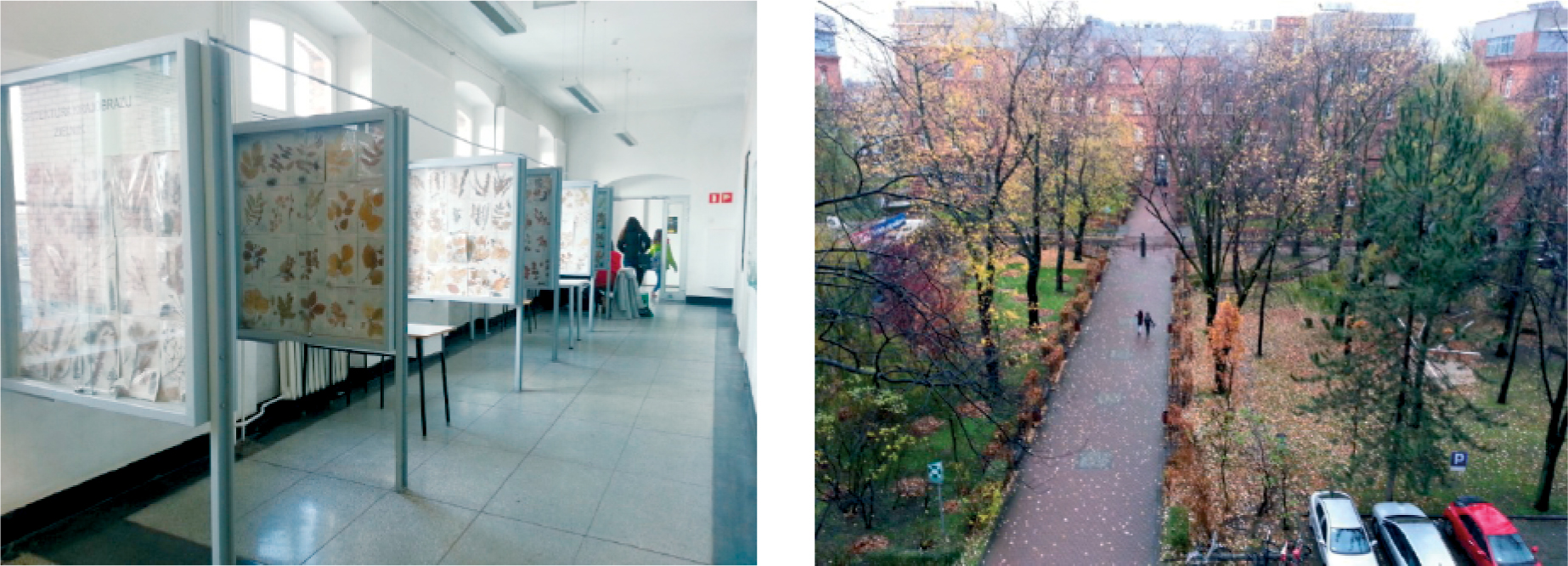
Figure 7–8.
Examples of favourite places in building B1: (7) the place on the edge of the most possible integrated space (in floor +3) as related to space-syntax and behavioral analysis (shown in Fig. 3 and 6); (8) favourite area in front of B1
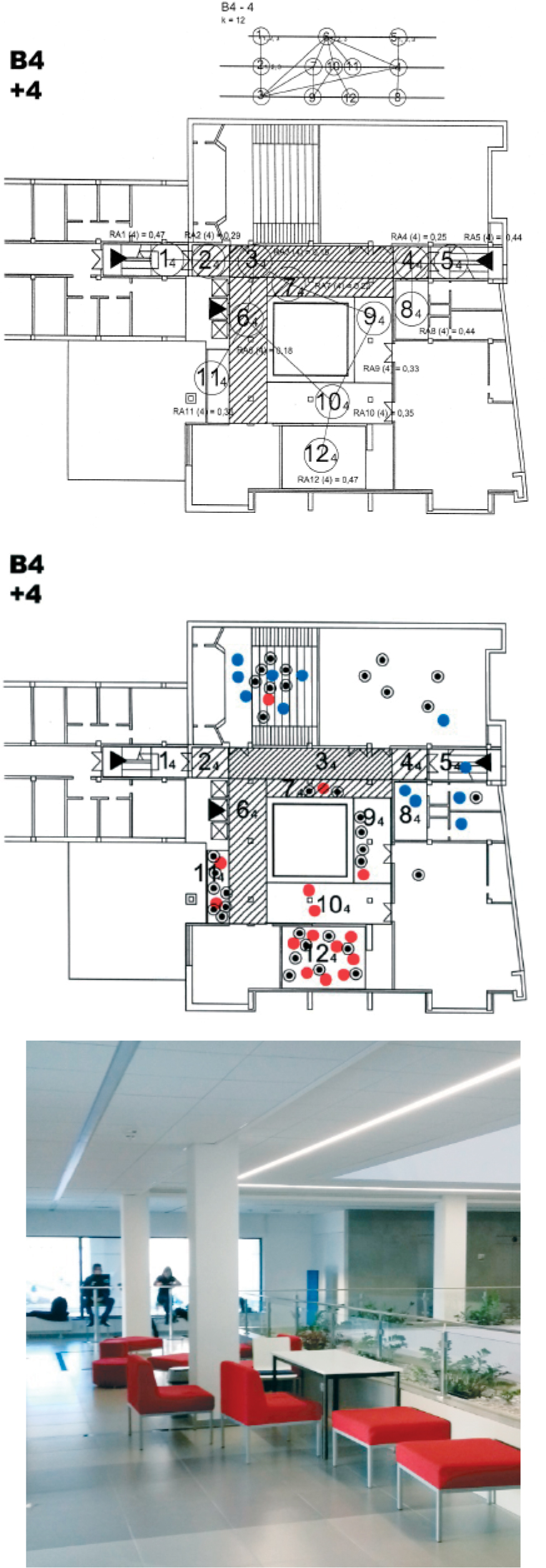
Figure 9–11.
An example of one of the most liked places in building B4 as related to space syntax analysis (B4 - floor +4)