
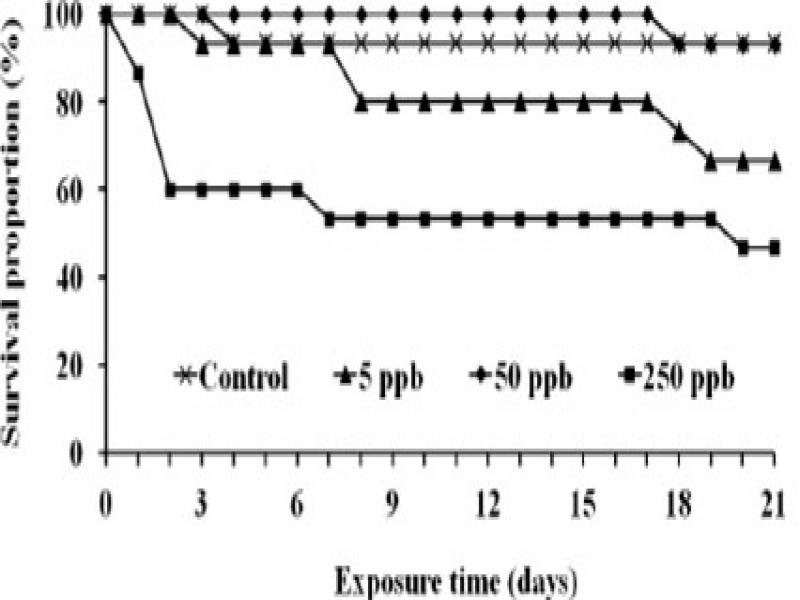
Figure 1.
Survival of Daphnia magna chronically exposed to Ampicillin
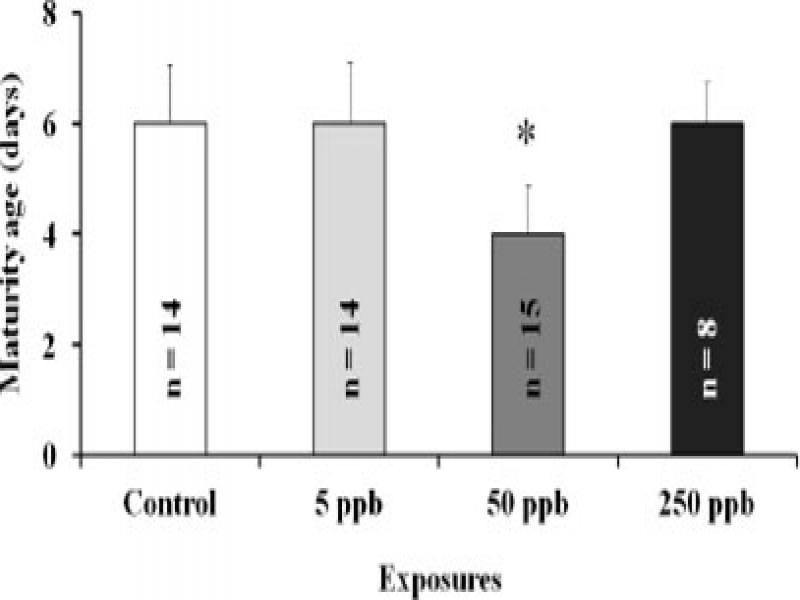
Figure 2.
Maturity age of Daphnia magna (mean value ± SD) chronically exposed to Ampicillin. Asterisk indicates significant difference between control and exposures by Kruskal-Wallis test (*, P < 0.001)
Table 1.
Reproduction of Daphnia magna exposed to Ampicillin at several exposures in 21 days. Asterisk indicates significant difference between control and exposures by Kruskal-Wallis test (*, P < 0.05; **, P < 0.01; ***, P < 0.001)
| Exposures | Total offspring | Number of broods per mother daphnid | Number of neonates per clutch |
|---|---|---|---|
| Control | 602 | 5 ± 1.5 | 8 ± 2.94 |
| 5 ppb | 452 | 3 ± 1.8** | 9 ± 2.81* |
| 50 ppb | 783 | 6 ± 1.0 | 9 ± 3.66* |
| 250 ppb | 193 | 2 ± 1.9*** | 7 ± 3.57 |
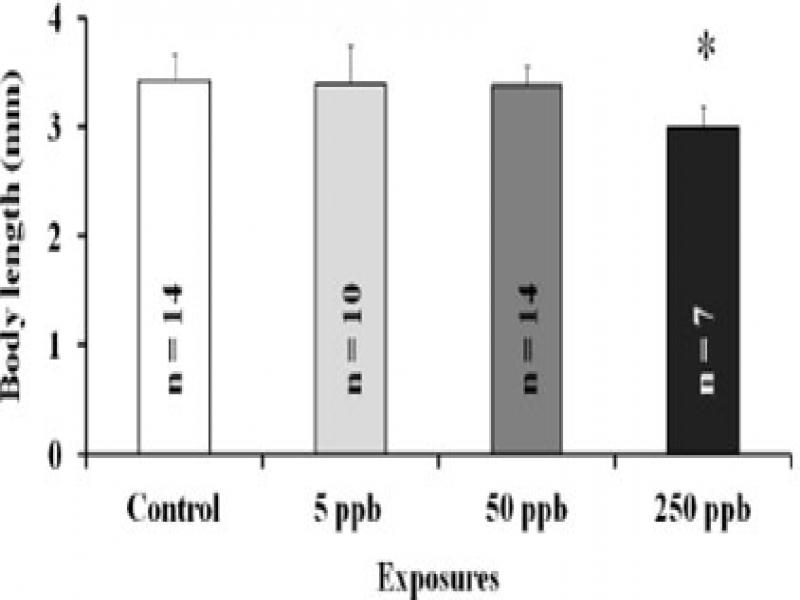
Figure 3.
Growth of Daphnia magna (mean value ± SD) chronically exposed to Ampicillin. The asterisk indicated significant difference between control and exposures by Kruskal-Wallis test (*, P < 0.001).
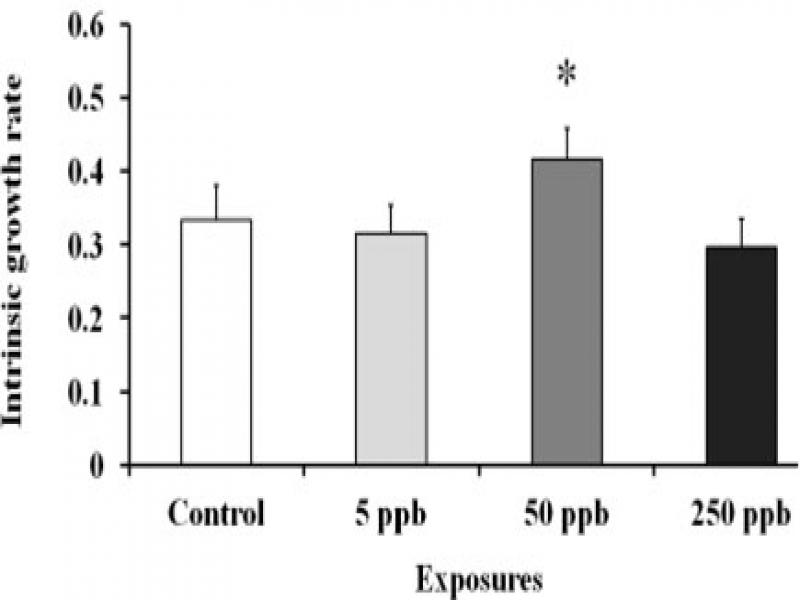
Figure 4.
The intrinsic growth rate of Daphnia magna (mean value ± SD) chronically exposed to ampicillin. Asterisk indicates significant difference between control and exposures by Kruskal-Wallis test (*, P < 0.001).