
Caley Cannon asserts “the library plays a key role as incubator for the arts.”1 Access to the arts throughout childhood and adolescence helps young people develop critical academic, creative, and social-emotional skills that will contribute to positive outcomes all throughout their lives. In the absence of equal access to visual and performing arts education programs in schools and other societal settings, public librarians across the country have explored many ways of bridging these gaps to offer a wide variety of arts education programming—from exploring community partnerships, adapting opportunities traditionally present in other institutions to suit the needs of their communities, and re-imagining the possibilities of traditional library program formats.
Arts Programming in Public Libraries
The ALA affirms the importance of the library’s role in the arts with an interpretation of the Library Bill of Rights. According to this interpretation, “visual and performing arts can be powerful components of library collections and services” and “the arts play a vital role in our ability to communicate a broad spectrum of ideas to all people.”2 One of the most common ways public libraries engage patrons with the arts is through community partnerships with arts-focused organizations. For example, the Omaha Public Library system partners with local foundation, Why Arts?, to bring an afterschool arts book club to a local school district. A post on the Omaha Public Library’s blog describes a typical club session: “[OPL Outreach Specialist Janeth] Hernandez Islas and her group of a dozen students worked with several local artists dramatizing the book [Anya’s Ghost] in order to understand the nuances of the plot more intimately. The session…culminated…with a lesson on stage make-up taught by Josh Mulladdy.”3 The blog post also describes the benefits students derived from the experience, not the least of which were social: “the students expressed their excitement about the lesson by talking about the book, movies they saw last weekend, their home lives, and more. Conversation topics bounced around, and it was obvious that the environment was really allowing their dialogue to flourish.”4 With this program, the library system is “helping to play a vital role…[by offering] opportunities for art education, especially within the lower socioeconomic regions of Omaha.”5 These students may have limited or no access to arts education during the school day. To remedy this, the Omaha Public Library system has reached out to experts in order to offer a variety of arts experiences that also support literacy skills and foster a sense of community amongst participants.
In New York City, libraries are partnering with nonprofit, Project Art, to “[provide] art classes in public libraries…targeting neighborhoods where local schools have had to cut art classes.”6 Vanessa Arnold, a program teacher, says participating kids are “excited to get into the materials, to try new things,… to express what…their experience is, and to be able to play and have a lot of fun.”7 In this case, the NYPL system has identified a problem in the community—an uneven landscape of arts opportunities in local schools—and has positioned themselves as a key part of the solution. Participants also reap creative benefits: being excited to communicate and express themselves through various forms of art.
Organizational partnerships can also prove beneficial for librarians seeking to offer the performing arts at their libraries, as these organizations help provide access to specialized equipment or subject matter experts that the library itself may lack. One example of how such partnerships can manifest is the program, Jammin’ @ the Library. This program was offered jointly by the San Diego Public Library and San Diego State University, which coordinated to offer “free beginning guitar instruction for teens and adults” weekly at the Central Library branch.8 Patrons who did not have access to guitars were able to borrow them with their library cards. The program description does not specify whether the guitars are from the university’s collection or part of a library special collection such as a Library of Things. Either of these two options, however, is an intriguing possibility depending on what resources are accessible to the library. Music programs such as these not only provide extra support to patrons who may be learning music in school, but also give access to these skills to patrons who may not have the money or opportunity to engage with music outside of the library.
Organizational partnerships are not the only way librarians can offer access to the arts. The concept of an artist-in-residence is not unfamiliar to universities and museums, but the Carmel Clay Library in Indiana is providing a new twist to this idea by pioneering a teen artist-in-residence program. Three teens were selected from a pool of 30 applicants, then given use of the library’s art studio as well as access to funding from the library’s foundation to “host…community classes on how to turn still drawings into motion graphics and how to make alebrijes, colorful Mexican sculptures of mythical creatures.”9 The experience culminated in a combined art show for all three participants, and a piece of each artist’s work will remain permanently on display. Mike Cherry, the program’s coordinator, said “You’re connected now to creative people and [to] a sense of community support for your work and skill development,” adding that the program “opens a multitude of opportunities for young artists.”10 Cherry also asserted the program “allowed students to realize how much they are interested in art” as a personal method of telling their story to their community.11 An artist-in-residence program not only allows teen participants to see themselves as serious artists with important messages to convey, it also facilitates their community’s ability to engage with them on this premise—creating new opportunities for participants and community stakeholders.
Librarians have also explored a more passive way of accessing arts education—the gallery show. In the Bridges Library System in Wisconsin, librarians have collaborated with schools in order to coordinate exhibitions in multiple library branches. The goal of these exhibitions is to support the library’s commitment to “celebrating, promoting, and helping people learn about the arts.”12 Having works exhibited “is a great confidence boost for…students to see their work displayed outside of the confines of their own building.”13 These exhibitions also provide an example of what Cannon calls libraries’ ability to “shape patronage of the arts and engage future generations by addressing social diversity and inciting inclusive participation in the arts” by inviting children across demographic groups to act both as artist and observer.14 Similar to the Carmel Clay Library’s artist-in-residence program, this exhibition gives young participants the opportunity to participate in artistic communication with their peers and communities.
And of course, the traditional programming formula of active, in-library scheduled activities can be harnessed to provide access to innovative arts opportunities. One example comes from Carli Spina’s School Library Journal article “All the World’s a Stage: Bringing Improv to Your Library.”15 According to the librarians interviewed, improvisational comedy, or “improv” is “easy to offer at almost any library and can be adapted for a range of settings and age groups…Props can be integrated into the exercises if they are available, but are far from necessary. [Librarian Shelley] Headrick has kids imagine their props.”16 The article also asserts these programs help build a myriad of skills, from collaboration, active listening, and communication to confidence and social skills. Headrick shares an example of a patron who has experienced these benefits: “I think the best example is probably a boy who started coming when he was six…he was very shy and didn’t want to do any of the on-stage acting. He became my assistant and would shout, ‘action,’ ‘cut,’ ‘freeze’ etc. After about a year, he would sometimes act when there was a group on stage. He is now nine, and he is one of the star performers.”17 Performing arts programming helps participants build skills that visual arts programming may not—such as social skills, verbal communication, or collaboration—and this example shows these programs can be adapted to diverse patron needs in order to develop these skills.
Benefits of the Arts
In their 2021 report Art for Life’s Sake, the American Academy of Arts and Sciences asserts “the arts are a fundamentally important part of culture, and an education without them is an impoverished education leading to an impoverished society.”18 The National Endowment for the Arts further states access to the arts helps “educat[e], engag[e], and empower…youth, while also supporting the social and emotional learning needs of students, helping them to succeed both in and out of school.”19 Research seems to confirm access to the arts enriches students’ education. A study by the National Longitudinal Study of Adolescent Health found “arts students were more likely than their non-arts peers to find school engaging, to attend a postsecondary school, and to earn a four-year college degree,” as well as less likely to be suspended and less likely to be involved with the criminal justice system as adults.20 Furthermore, a 2015 study suggests a correlation between arts education and a decreased risk of dropping out of high school: “cumulative credits in the arts are consistently associated with reduced dropout, even after controlling for prior achievement and contemporaneous course completion in core subjects.”21 The available evidence suggests young people are able to derive some degree of academic benefit from the arts that is transferable to greater achievement both in core subjects and in life. In many instances, including in the case of some example programs, school districts are unable to provide access to the arts. Libraries are often already engaged in partnerships with their local schools, and offering arts programs can be a natural extension of this existing relationship—thereby facilitating student access to these important secondary benefits.
The benefits of the arts outside of educational settings are also notable. In a 2012 research study, Lomira County Community Library Director Shannon Crawford Barniskis asserts that teens who participated in six library arts programs experienced an increase in civic engagement-related thoughts and behaviors. These thoughts included themes such as an increased feeling that libraries can make a difference for teens and affect positive changes in their self-image, art opening their minds about themselves and their communities, and participation in these art activities getting teens out of their comfort zones to connect with community members who are different from them. One example of some of these themes comes from a teen quoted as saying, “I definitely do feel closer to the libraries that I go to after going through a program…the more programs that you go, to [sic] the more it feels kind of like home in a way. Not a real home but like a really comforting awesome place.”22 Libraries are widely recognized as a valuable “third space” where a diverse array of community members can come to connect without needing to spend money. Arts-based programming provides these community members with an activity that can help serve as an important connection point between patrons or even between patron and librarian that may lead them to form lasting bonds.
Furthermore, participation in the arts is correlated with significant benefits for mental health. A 2016 study published in the Journal of the American Art Therapy Association measured the effects of participation in a 45-minute art-making activity on the level of cortisol, or stress hormone, in participants’ saliva. For 75% of participants, their levels of cortisol were significantly lower, even after controlling for factors such as “age, gender, race/ethnicity, time of day, prior experience with art-making, or type of art media used.”23 There is also evidence to suggest that arts participation can affect more than these physiological aspects—it can even change people’s subjective awareness of their mental health. These outcomes were examined in a 2024 study published in the journal Frontiers in Public Health. Researchers examined a selection of 7,000 random responses to the Taking Part Survey—a survey carried out from 2019 to 2020 in England that examined culture and sports participation. They then used this data to examine the correlation between arts participation and aspects of participants’ subjective wellbeing. This study found “engaging in [the arts] significantly predicted increased life satisfaction, a sense that life is worthwhile and happiness, above and beyond known sociodemographic predictors.”24 Participants additionally rated themselves lower on anxiety and loneliness. These results are especially significant given the survey was carried out during the beginning of the COVID-19 pandemic—a period where many people were extremely isolated, lonely, and anxious. If arts participation can ease mental burdens during a period of unprecedented stress, it may be able to confer similar benefits under more ordinary circumstances as well. Patrons visit the library experiencing all kinds of life situations and moods; while arts programs will not be able to solve every problem, they can provide a small but important way to lift patrons’ spirits.
Perhaps the most obvious benefit of arts education is its encouragement of creativity. Experiencing the arts and the “decisions people make as they paint, sculpt, write and think” is integral to helping people access this benefit.25 Creativity is a concept that may seem hard to define, but the Center for Childhood Creativity (CCC) has proposed a definition that includes seven skill areas: imagination and originality, flexibility, decision making, communication and self-expression, motivation, collaboration, and action and movement. While these skills address all parts of the artistic process—from the motivation behind exploration of an idea, the changes the idea undergoes during the development process, to even the specific communication or manner in which these changes are made—its architects are careful to pass no judgement on the quality of artistic skills or products developed during the creative process. In this way, the CCC makes clear their position on the importance of the process over the final product in all creative endeavors. The CCC also states “creativity is strongly influenced by environmental factors such as explicit instructions, positive process-oriented feedback from important adults (e.g., teachers and parents), and active involvement in novel experiences”—all things that can be provided in a library’s instructional environment.26 And indeed, the CCC places particular emphasis on “[offering] practical applications of the research on how to best promote creativity through the development of these [creative] skills for youth in out-of-school programs.”27 The strength of this definition lies not only in its ability to define the wide array of creativity’s manifestations, but also the way it enumerates how best to encourage development of these skills. Even though the CCC provides general advice for intentionally nurturing these skills, they also make clear that, just as there is no single “correct” way creativity manifests, no “wrong” approach to encouraging this development exists either. This lack of a specified approach ensures that all communities may access these benefits, even those served by libraries who may not have access to funding or resources for large-scale or elaborate arts programming.
Barriers to Arts Access
It is evident that participation in the arts confers some degree of benefit in many areas. However, these benefits are not always easy for young people to access. A report published in 2022 by the Arts Education Data Project (AEDP) revealed that of the 30,633 schools included in the survey, 2,739 of these had no access to arts courses at all—nearly 9% of the sample. A more optimistic reading of this study shows the vast majority of schools included in the survey do have access to the arts in some form—but this access is still highly uneven with 91.8% of schools surveyed offering music programs, followed by 90.5% offering visual arts, 35.2% offering theater, and only 15.3% offering dance.28 With the help of the South Arts foundation’s survey of arts education in the 9-state South Arts Region, it is possible to zoom in further to examine arts access only in the Southern states. Of the 15,000 schools included in this sample, 80% of them offer music, followed by 71% offering visual arts, 22% offering theater, and 14% offering dance.29 At the state level, for the closest overall look at arts access, the Virginia Coalition for Fine Arts Education (VCFAE) maintains an Arts Education Dashboard. This data indicates, of the 1,839 schools surveyed, 96.6% offer access to music programs, 95.5% offer visual arts, 21.7% offer theater, and only 4% offer dance.30 While the actual percentages vary, the comparison in Table 1 makes clear most schools offer music and visual arts programs, while access to theater and dance programs is comparatively rarer.
Table 1
Percent of schools surveyed in the U.S., the South Arts region, and the state of Virginia that offer each of four types of arts programming. Sources: Morrison et al., Status Report 2019.; Bell, Arts Education in the South Phase I; “Virginia Arts Education Data Project Interactive Dashboards,” AEDP, VCFEA.
| MUSIC | VISUAL ARTS | THEATER | DANCE | |
|---|---|---|---|---|
| United States | 91.8% | 90.5% | 35.2% | 15.3% |
| South Arts Region | 80% | 71% | 22% | 14% |
| Virginia | 96.6% | 95.5% | 21.7% | 4% |
To investigate some potential contributions to this unevenness of access at the national, regional, and state levels, it is necessary to further examine data aggregated by both the AEDP and VCFAE. Both reports suggest many barriers to access seem to correspond with a variety of socioeconomic and demographic factors—for example, a school’s racial and ethnic makeup. The AEDP’s data, illustrated in Figure 1, indicates that while students at majority Native American schools make up only 0.3% of the total sample, 26% of this population have no access to the arts at all.31 Conversely, students at majority-white schools make up 43.7% of the total sample, and only 3.1% have no access to the arts.32 Students at majority-Black schools constitute 8.5% of the sample with 6.9% of them having no arts access, and students at majority-Hispanic/Latino schools make up 16.7% of the sample, with 4.3% without arts access.33 However, this particular correlation may not be as strong in Virginia, as the VCFAE’s data in Figure 2 indicates that, despite making up 51.9% of the total sample, 88% of students without access are at majority-white schools, compared to 7.9% at majority-Black schools and 0.5% at majority-Hispanic or Latino schools.34 A school’s location also matters: 29% of rural schools in the U.S. have no access to arts programs.35 An area’s economic status can also play a role—10.3% of U.S. schools serving mid-high to high proportions of students eligible for free or reduced price meals have no arts access, compared to 5.5% of schools with low to mid-low proportions of eligible students.36 In Virginia, 78% of schools with no access serve mid-high to high proportions of eligible students, compared to 9.5% that serve low to mid-low proportions of students eligible for the program.37 While the exact statistics may vary in a given area, the data shows that there is some degree of correlation between the presence of at-risk or minority populations and decreased availability of arts opportunities.
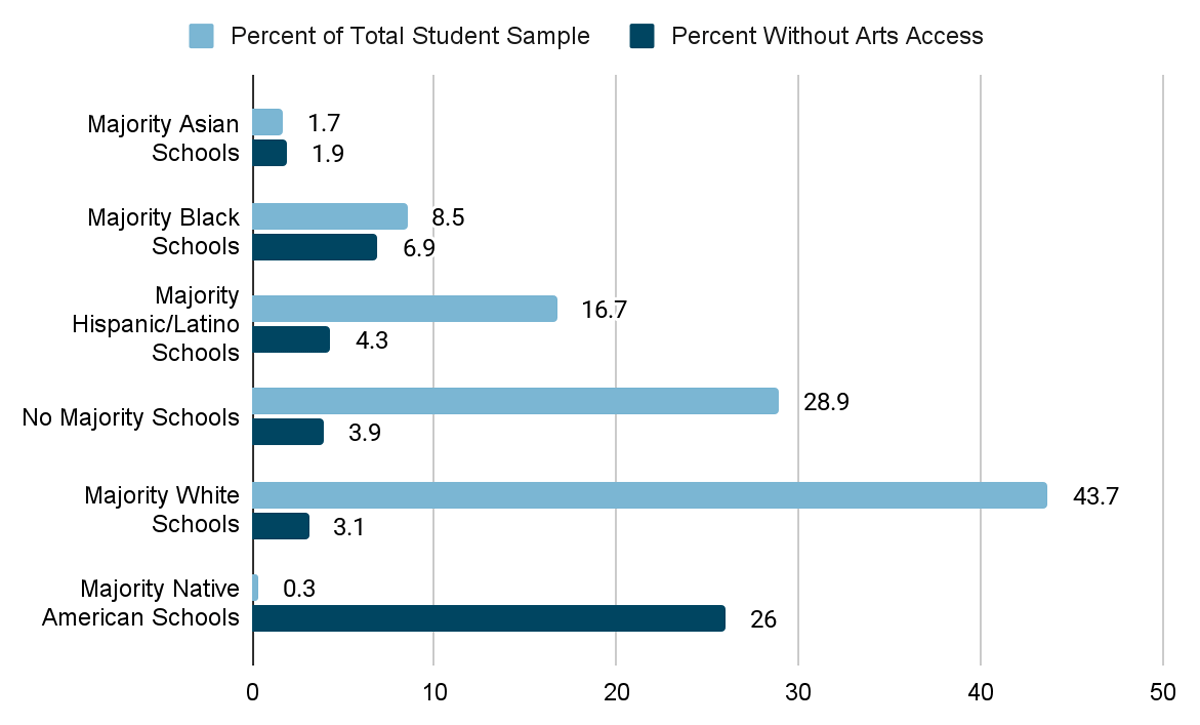
Figure 1
Comparison of the percentage of students in the United States that attend schools with racial or ethnic majorities, versus the percentage of students in each school category without access to the arts. Source: Morrison et al., Status Report 2019.
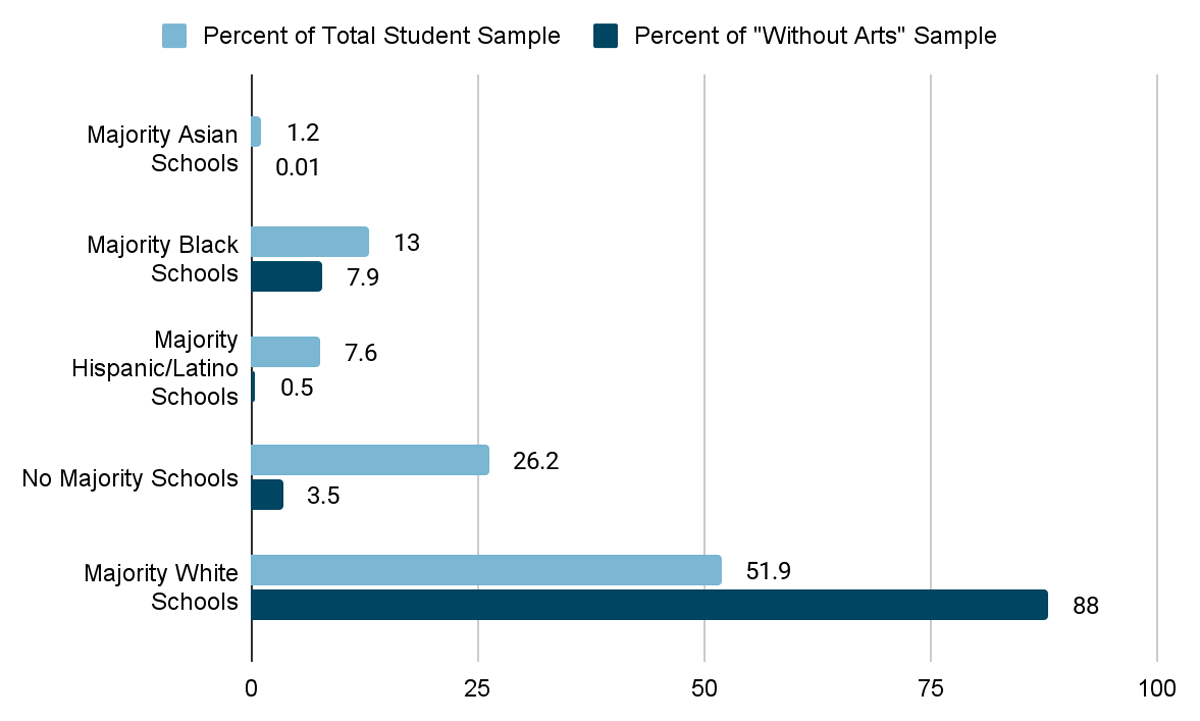
Figure 2
Comparison of the percentage of students in Virginia that attend schools with racial or ethnic majorities, versus the percentage of each school category without arts access out of the total number of schools without arts access. Source: Arts Education Data Project, Interactive Dashboards.
Much of the reason why these access gaps persist is the fact that, as Dr. Jelena Trkulja explains, “Arts education is still perceived as an add-on, rather than an essential field creating essential 21st-century skills.”38 In addition, school stakeholders may be reluctant to expand arts access in schools because “the arts don’t lend themselves well to hard data, something educators and policymakers need to justify classes in those disciplines in their budgets.”39 Standardized tests, the most important way schools gather data about academic performance, don’t cover the arts. This means, even in the case of underprivileged populations who may be able to benefit from an expansion in access to arts education, a lack of testing-related data may pose a significant roadblock for education stakeholders who are under pressure to improve academic outcomes in ways that are measurable. While libraries are also accountable to stakeholders, success metrics are not directly determined by state testing data—meaning that library staff have much more freedom to decide their approach to expanding arts access.
Outside of schools, engagement with the arts is still a complicated subject. A 2021 public health study asked different cohorts over the course of 23 years whether they attended any arts events or participated in any arts activities in the last 12 months. Much like the AEDP and VCFAE’s data, this study suggests individuals’ likelihood of engagement with the arts may be influenced by the demographic groups to which they belong. While this study was conducted solely with adult participants, it is possible to draw certain conclusions about the arts engagement of families belonging to the demographic groups analyzed within, with the aid of some of the odds ratios (OR) presented in Table 2. For example, Black study participants had a 34% lower chance than white participants of attending at least one arts event in the last year.40 Socioeconomic status was also a major determining factor; “compared to those with a family income of less than $10,000, participants in all other income groups had higher odds of attendance,” with the highest rate of attendance corresponding to those in the highest income group of $50,000 and above.41 In addition, study participants living in larger cities were much more likely to engage with arts events than those living in rural areas, and each additional year of education reported by respondents increased their odds of arts engagement and participation by a factor of 1.19.42 While not all gaps in arts access can be explained by these factors, the available data indicates that an area’s overall demographics are indeed highly correlated with the degree of access available to residents.
Table 2
Odds ratios (OR) of different demographic groups’ participation in arts events and arts activities in the United States in the last calendar year. Source: Bone et al., “Who engages in the arts?”.
| OR: ARTS EVENTS (n = 8684) | OR: ARTS ACTIVITIES (n = 4372) | |
|---|---|---|
| Female | 1.24 | 1.71 |
| White | 1 | 1 |
| Black | 0.66 | 0.48 |
| Income $0–$9,999 | 1 | 1 |
| Income $10,000–$19,999 | 1.27 | 0.84 |
| Income $20,000–$29,999 | 1.58 | 0.96 |
| Income $30,000–$49,999 | 1.80 | 0.87 |
| Income $50,000+ | 2.78 | 0.81 |
| Years of education | 1.19 | 1.08 |
| Med-large city | 1 | 1 |
| Suburb | 0.92 | 1.18 |
| Unincorporated area | 0.79 | 0.96 |
| Small city or town | 0.69 | 1.08 |
| Smaller areas | 0.57 | 0.98 |
It is highly likely that many young people fall into at least one of the gaps explored by the preceding studies—students at schools with little to no quality arts education, and/or members of families who do not or cannot engage with community arts events. However, it is also evident that libraries are well-positioned to serve these community members and provide increased access to quality arts education programming. For one, art is already within the library’s domain—think of crafts done with storytime, STEAM programs, or library makerspaces. Libraries are also familiar with the importance of community partnerships, and may already have established relationships with organizations that can either provide arts education to patrons, or serve populations who would benefit from increased access to the arts. Additionally, given the many educational, social-emotional, and mental health benefits of the arts, these programs can also serve as a complement to existing goals or initiatives, such as teen outreach or tutoring programs. Though there are numerous examples herein of innovative and successful arts education programs, libraries should by no means be limited to these exact approaches. Leveraging factors such as library staff members’ artistic passions in conjunction with knowledge of patron interests, access gaps, and demographics can lead libraries towards getting creative and expanding access to arts education in their communities.
Notes
[1] Caley Cannon, “The Visual and Performing Arts in Libraries,” in Hope and a Future: Perspectives on the Impact that Librarians and Libraries Have on Our World, ed. R. F. Hill, vol. 48, Advances in Librarianship (Emerald Publishing Limited, 2021), 91–99, https://doi.org/10.1108/S0065-283020210000048010.
[2] “Visual and Performing Arts in Libraries: An Interpretation of the Library Bill of Rights,” American Library Association, February 13, 2018, https://www.ala.org/advocacy/intfreedom/librarybill/interpretations/arts.
[3] Brigette Dugas, “Why Arts Belong at the Library,” Omaha Public Library (blog), July 15, 2016, https://omahalibrary.org/blogs/post/why-arts-belong-at-the-library/.
[6] “Art Education Students and Working Artists Teach Art in NYC Libraries,” Teachers College Columbia University, April 27, 2016, https://www.tc.columbia.edu/articles/2016/april/art-education-students-and-working-artists-teach-art-in-nyc-libraries/.
[8] “Jammin’@ the Library: Guitar Instruction,” San Diego Public Library, January 9, 2023, https://sandiego.librarymarket.com/event/jammin-library-guitar-instruction-24.
[9] Stephi Smith, “True Colors: Libraries spark creativity with teen artist-in-residence programs,” American Libraries 54, no. 11–12 (2023): 10–13, https://americanlibrariesmagazine.org/2023/11/01/true-colors/.
[12] Jill Fuller, “Libraries As Art Galleries: Libraries Support Local Artists with Youth Art Month Shows.” Bridges Library System, accessed October 22, 2024, https://bridgeslibrarysystem.org/libraries-as-art-galleries/.
[15] Carli Spina, “All the World’s a Stage: Bringing Improv to Your Library,” School Library Journal, December 28, 2018, https://www.slj.com/story/all-the-worlds-stage-bringing-improv-to-your-library.
[18] Art for Life’s Sake: The Case for Arts Education (American Academy of Arts and Sciences, September 2021), https://www.amacad.org/publication/case-for-arts-education.
[19] “Back to School with Arts Education,” National Endowment for the Arts, accessed October 22, 2024, https://www.arts.gov/back-school-arts-education.
[20] Kenneth Elpus, “Arts Education and Positive Youth Development: Cognitive, Behavioral, and Social Outcomes of Adolescents Who Study the Arts,” National Endowment for the Arts, 2013, https://www.arts.gov/sites/default/files/Research-Art-Works-Maryland.pdf.
[21] M. Kathleen Thomas et al., “Arts Education and the High School Dropout Problem,” Journal of Cultural Economics 39 (2015): 327–339, https://doi.org/10.1007/s10824-014-9238-x.
[22] Shannon Crawford Barniskis, “Graffiti, Poetry, Dance: How Public Library Art Programs Affect Teens Part 2: The Research Study and its Practical Implications,” The Journal of Research on Libraries and Young Adults 2, no. 3 (September 2012), https://www.yalsa.ala.org/jrlya/2012/09/graffiti-poetry-dance-how-public-library-art-programs-affect-teens-part-2-the-research-study-and-its-practical-implications/.
[23] Girija Kaimal et al., “Reduction of Cortisol Levels and Participants’ Responses Following Art Making,” Art Therapy 33, no.2 (2016): 74–80, https://doi.org/10.1080/07421656.2016.1166832.
[24] Helen Keyes et. al., “Creating Arts and Crafting Positively Predicts Subjective Wellbeing.” Frontiers in Public Health 12 (2024), https://doi.org/10.3389/fpubh.2024.1417997.
[25] Kathy Dothage and Sara Gable, “Creativity in Young Children.” University of Missouri Extension, April 2022, https://extension.missouri.edu/publications/gh6041.
[26] Helen Hadani and Garrett J. Jaeger, “Inspiring a generation to create: 7 critical components of creativity in children,” Center for Childhood Creativity, March 2015. https://www.researchgate.net/publication/277301842_Inspiring_a_generation_to_create_7_critical_components_of_creativity_in_children.
[28] R.B. Morrison et al., National Arts Education Status Report 2019, Arts Education Data Project (Quadrant Research, State Education Agency Directors of Arts Education, 2022), https://artseddata.org/national_report_2019/.
[29] Alan Bell, Arts Education in the South Phase I: Public School Data and Principals’ Perspectives (South Arts, 2014), https://www.americansforthearts.org/sites/default/files/Arts%20Education%20in%20the%20South%20Phase%20I%20-%20Full%20Report.pdf.
[30] “Virginia Arts Education Data Project Interactive Dashboards,” Arts Education Data Project, Virginia Coalition for Fine Arts Education, 2024, https://sites.google.com/view/virginia-coalition-for-fine-ar/arts-ed-data-dashboard/va-arts-ed-dashboard.
[38] Ginanne Brownell, “The Mind-Expanding Value of Arts Education,” The New York Times, May 2, 2023, https://www.nytimes.com/2023/05/02/arts/design/arts-education-necessary.html.
[40] Jessica K. Bone et. al., “Who engages in the arts in the United States? A comparison of several types of engagement using data from The General Social Survey,” BMC Public Health 21, 1349 (2021), https://doi.org/10.1186/s12889-021-11263-0.