
ceci n’est pas un début – this is not a beginning
homebody
I got a tattoo today in Giles County, VA, not far from one of the areas slated to be heavily impacted by the Mountain Valley Pipeline. On the drive to their studio, I pass houses displaying excessive American flags alongside “stop the pipeline” signs.
The artist’s studio is in an old high school that’s been converted to a community center and is filled with spaces occupied by artists and theatres. The building, hardly touched and still filled with rusting lockers and institutional off-green cinderblocks and cheap worn linoleum floors, bearing the traces of the school it once was, is directly next to a small emergency response station, with two fire trucks parked inside and a police car positioned out front.
The tattoo artist, S, is queer too, and their space and demeanor made me the most comfortable I’ve ever felt coming into someone else’s space for the first time. The walls are covered in paintings and drawings of surreal, grotesque, impossible queer physicalities – hands with eyes and winding vines growing out of them, normally not-connected body parts twisted and fading into one another, inanimate objects and structures very much animated by genitals and facial features and bird wings and insect parts. We chat casually about tattoos as an aesthetic-affective experiential resistance to capitalism’s alienation of ourselves and our bodies, and as a way of processing emotions. We bond over our shared queerness and the challenges of existing as non-straight and genderfucked in rural southwest Virginia, the premature deaths of our mothers and the societal causes thereof, our social anxieties and tendencies to stay in, our mutual love of old buildings like this one – with drafty windows that rattle and floors that creak and groan that make us feel at home.
The tattoo I chose months ago when I made the appointment is a tall, thin house with a singular eye, a leafed tendril emerging from a round window above it, human arms and legs sprouting from its sides, a door between the legs where genitals would be. Homebody.
As I lay on the table, staring up at the ceiling while the tattoo gun buzzes and its needles penetrate my skin, a stink bug ambles around on the wall above my head, and ladybugs gather in the upper corners of the tall windows that nearly reach the ceiling, casually piling and crawling over each other. They just feel like moving, breathing parts of the space, as did I and S for the hour and a half that we inhabited the room together, connected by the buzzing machine and the sensation of the transmission of their art.
So much of my life has centered around having needles in my body, or awaiting the next needle that will penetrate the barrier of my epidermis. In part, this is from having my blood drawn often for the routine tests familiar to so many chronically ill folks – intended to help find a diagnosis, but which usually lead to more questions than answers.
But more prominently, my experience with needles has been in the form of injectable pharmaceuticals. Weekly allergy shots into my twenties, and quarterly injections of 200 units of Botox into sites on my face, around my head, and down my neck and shoulders for most of my adult life to treat chronic migraines. I associate the sharp pinch of a needle and the sting of its contents entering my body with impending relief. Though the Botox injections have always started to wear off for me after about two months, insurance only covers injections every three months. I always spend the third month anxiously awaiting my next injection of the most toxic naturally-occurring substance to humans – the feeling of the needles almost like acupuncture, the sensation of my muscles becoming increasingly paralyzed in the days following the treatment.
Like any drug, the body gradually builds up tolerance to botulinum toxins. Now, as I write this in the final year of my doctoral program, my body has developed considerable tolerance to the Botox, rendering its efficacy greatly diminished. Over time, I find myself anticipating the next shot after less and less time – craving the feeling of needles in familiar places in my skin by one and a half months, one month, three weeks, two weeks in.
Now, to prolong the effectiveness of Botox and tide me over in the agonizing period between injections, I receive additional monthly nerve blocks of anesthetic medication injected into the occipital nerves at the base of the skull, eyebrows, and temples. The clear fluid entering my body is easily the most acutely painful sensation I’ve ever experienced – I feel each pathway of the liquid traversing through the flesh of my head from the injection site, each excruciating trail incomparably sharp and searing as if it were singeing the branches of nerves along the way. The pain of administering them would be intolerable would it last any longer. But then the instant numbing effect of the nerve blocks radiates out from the injection site, the pain dissipating as quickly as it comes, and in seconds I’m no longer able to feel pain or anything at all – even touch – in the space between my neck and my eyebrows. That wave of nothingness that comes from such a punishing, ungodly pairing of sharp metal and goop washes over me like something divine, and I feel transformed, transmuted. The first time I received nerve blocks, I shed a singular tear in the neurologist’s office, and when I made it out to my car after barely being able to keep composure, I openly sobbed at the relief and freedom from the confines of my own ill body that I felt in what is ultimately a void of sensation, in nothingness. This transcendent depravity of feeling generated by the nerve blocks is, too, short-lived, dissolving each time in a matter of days, and I cry each time as sensation returns to my skull and I’m inevitably struck by the devastating pain of migraine once again. But even in its fleetingness, I’m still nearly brought to tears of joy each time I feel the harrowing burn of the nerve blocks coursing through me.
Post-injection, I ritually examine the amalgamated goo of blood and traces of toxins and medication and plasma that oozes from the injection sites on my face in the rear-view mirror, and I find myself beaming with almost villainous glee at my mutant state, the seeping wounds signifying my transformation through/transcendence of the pain. I observe the Botox injections slowly transmogrifying my face, the ways the positioning of my eyebrows on my visage changes and the range of facial expressions I’m capable of producing becomes increasingly limited as the days pass, then begins to open back up again as the injections wear off. I revel in the more debaucherous embodiments and performances of self not generally afforded to me that the injections allow me in the ephemeral transcendence of the ways in which the exploitative structures of global capitalism violently encounter and perpetuate my debilitated and disabled embodiment.
aura
I loathe refrigerators and dishwashers concealed behind oddly proportioned faux-cabinetry, often housed in the carbon copy mcmansions of upper-middle-class suburban white people. It serves no purpose, functional or aesthetic. It’s ugly, but not in an interesting way, it’s displeasing to the eye precisely in its boringness and slight off-ness. As if signs of life and functional items in a home were so gauche, so tacky, signaling a lack of wealth and class – as if to say “We have no use for appliances. We don’t need food on hand, and we certainly don’t clean.” They would rather have out-of-place oblong cabinet faces adorned with molding than insinuate even for a moment that there are foods to chill and dishes to wash. It’s insulting to the intelligence – the strange shapes and placements of these faux-cabinets are always more jarring than a bare refrigerator or dishwasher would’ve been. The striking stainless-steel finish their double-doored fridges inevitably have underneath their molded wooden facades is utterly wasted – even when purchased with the intent to cover them with white-painted masks, they wouldn’t dare buy a fridge in renter’s white. Never mind that owning something like a dishwasher is a luxury many don’t have to begin with, as is affixing ornamental cabinet faces to such “unsightly” appliances. Even the fridge is essentially alienated from its labor.
I find something beautiful and delightful in the decided un-pristineness of an appliance, its perceived unsightliness both inside and out, its obtrusiveness and harsh lines and brazen purposefulness. I feel comforted by the cool touch of the refrigerator exterior, the low hum of the refrigeration coming on, the simplicity and practicality with which it is designed, the din of the icemaker dropping freshly-frozen cubes still slick on their exterior into the tray, the slightly sticky residues resting at the base of a well-loved jar of jam. An artificially chilled container of tastes and textures and smells in varying stages of expiry. I exist in worship of the ice that I fill my water bottle to the top with when all I can bear to consume through the nausea is water so cold it’s nearly frozen; chilled aluminum cans of peach or grapefruit-flavored sparkling water or alcohol I rarely drink but always have on hand that I can press forcefully against my browbone to ease the sharpness of the pain of a migraine making its home in my eye socket; the preventative medication, a cold fluid, that seers intensely but briefly when I inject it monthly into my own left thigh (which hasn’t yet helped, but I hold out hope for each time). Edit 31 July 2023: it never did.
When my cheeks burn hot and red from hours of laying with my face on a heating pad, I insert my head in the open mouth of the freezer for a moment, breathing in the cold tranquil air, allowing myself to be consumed by this glacial square of space. Sometimes I mime closing my head in the door, imagining I could leave my disembodied excruciatingly pained head behind inside it, swallowed by the frigid beast. I emerge and close it and press my face up against the chill exterior door of the freezer, aged milky white almost like my own flesh, to soothe my irritated skin, almost in an embrace. I feel comfortable and safe here, and I rest there long enough that when I pull away from the crisp white exterior, my skin – tacky with layers of skincare that offer an illusion that I might have some miniscule amount of control over my body and environment and world – peels off the surface of the fridge like warm bodies damp with sweat, disentangling their limbs from one another; a palpable trace of the animacies, queer ill affective attachments and relations between myself and my fridge when I have a migraine.1 Even when I extract myself, I leave behind pieces of my microbiome, bits of my epidermis, lingering residues of the oils and creams still sinking into my skin, a warm spot in the shape of my profile scented fleetingly of my perfume that slowly becomes cooled again after the warm impression of my face becomes smaller and smaller, disappearing into nothing.
As much as the outside of the fridge and even the concept of a fridge and what lies within is a comfort, something which makes life with my chronic condition livable, the actuality of its insides is simultaneously a site of wonder and great anxiety. Food I’d hoped to make threatening to expire if it goes uneaten, begging to be picked out, staring me down in my panicked indecision as I close the door and walk away without having retrieved anything from it once again. A collection of foodstuffs that need to be prepared by a person who is in chronic pain and often not in a physical state capable of preparing or consuming a meal. Foods I can’t bear to even smell, nonetheless eat, during a migraine. It is a contained space of frantic anxiety, obsessions, compulsions, shame, tiny decisions like “yogurt or cottage cheese?” that inexplicably feel as if the weight of the world rests upon them. Foods that I know might spark or worsen an existing migraine that day and be regurgitated rather than digested, though going without causes migraines, too. Already-rotting foods, a single blackberry in a full container growing mold in the little depression where its stem once was, wilted sprigs of arugula heavy with condensation, leftovers morphing in texture stored in plastic containers in which the food and microplastics mutually engage in a horrid osmosis, a package of fresh mozzarella swimming in whey…taunting, wasting away in their containers or on the shelves, reminding me in their stages of rot of how many times I’ve not been physically and/or mentally well enough to cook or eat, or obsessive-compulsively concluded that “I can’t decide what is best, I guess I’ll just have nothing.” Things sitting in purgatory, food I don’t want to throw away because they might still be good but can’t bring myself to eat because they might not be. It ultimately doesn’t matter whether they’re actually expired – it only matters that I’ve perceived they might be.
The fridge, in its intensely synthetic self-environ, becomes itself a microcosmic representation of my state of overwhelm – indeed marked by chronic illness and chronic pain, but also the chronicity of global structures of inequity which consume my thoughts and, in turn, my body. The closed fridge, when the fridge and its contents are little more than an abstraction, is an object/space of beauty, possibility, atemporality, potential potions and tonics and nourishments to be synthesized and consumed, emulsions at present and to-be, indeed a thing of magic; but being faced with the open fridge, uncontained, deeply affected by time, revealing its grotesqueries (my grotesqueries) and letting them spill out monstrously into the living space, made liminal by the eerie illumination of its single fluorescent bulb that extinguishes when closed, is an entirely different affective sensation.
It’s not irrelevant to these obsessions and anxieties that I inhabit a fat and disabled body. The early stages of my obsessive-compulsive tendencies to place irrational importance on choosing the “right” food emerged out of immense societal and familial pressures that turned into years of unhealthy dieting as a teen – I was thirteen when I first joined Weight Watchers (which ads fronted by Oprah inform me have now rebranded to just “WW”) at the pressing of my parents, though there was no indication that I was unhealthy due to my weight. It was there and at that young age that I learned not just to be ashamed of my body, but to obsessively count, keep track of, and restrict calories and assign points to everything I consumed. Things like artificial sugars were zero points or “free,” and therefore heavily encouraged as alternatives to “fattening foods” – but those same artificial sugars were also a huge trigger of my migraines, which had first started to develop when I was eleven. What was allegedly in the name of health was decidedly to the detriment of my actual health, both physical and mental. My rapidly deteriorating neurological condition was of no concern, so long as I was on the way to being skinny. Weight became a scapegoat that doctors would blame my chronic migraines on, an excuse to ignore my concerns and fail to provide me with the treatment that, as was later confirmed, I direly needed. My body was worth more when the numbers associated with it and consumed by it and the space taken up by it were less, at all costs. Between tracking points in effort to achieve a notion of health as skinniness and tracking trigger foods for my migraines (even minor levels of caffeine, certain red and yellow dyes, artificial sweeteners, meats, high levels of sodium, alcohol, most artificial flavorings, among others), food and the spaces in which it was contained became one of the primary objects of my anxious obsessive-compulsive behaviors. I would obsess for hours over what the correct things were to eat, what I couldn’t/shouldn’t eat, how many points each food would cost, negotiating the tradeoff of eating a food that costs more points but won’t trigger a migraine, being proud of not eating at all when my migraines prevented it because it meant I hadn’t spent any points.
While the behaviors themselves may be “irrational,” they also come out of very real, material, and deeply-felt social-political-economic power structures impressing upon the body, my body – conceptions of health and “correct” bodies as necessarily skinny, (in)access to quality medical care, dismissal of concerns because of my young, feminine-read, and fat body, much more concern among the family and friends around me about my weight – the ideological indicator of health – than about the worsening neurological and mental health I continually expressed concern about, both of which went largely dismissed for years. Even in my adolescence, I heard the message loud and clear that my body, in its fatness, its perceived femininity, and its disability, was not a societally desirable one. Such discursive dynamics exist precisely within structures of global capitalism, its insistence upon linear progress and efficiency and dependence upon bodies rendered exploitable in the name thereof.2 The message here was that I needed to take up less space and time – quite literally physically, as well as the space and time taken up by the “burden” of my body on society and in the lives of others – so that I could proceed on the assumed correct route of becoming the ideal capitalist heteronormative (re)productive citizen. One of my earliest and most distinct memories of having my concerns dismissed by a doctor (cis-male, white, and able-bodied) entails my pediatrician informing me that I was getting to the age where I’d want to attract boys (specifically boys), and that boys weren’t attracted to fat girls, so I should be more focused on addressing that than my “headaches” – possibly even to the detriment of them. My already-present queerness and disability were so casually erased and dismissed in one fell swoop at the age of twelve, eschewed by a medical professional in service of cis-heteronormative fatphobia. Maybe I should try going vegan, he said.
I’ve never lived anywhere with a fancy refrigerator. I grew up with a pristine black fridge in my dad’s home – when they bought the home, my parents viewed black fridges as more elegant than creamy white fridges they associated with their youth, my mom’s poverty, the trailer they lived in when they first married; while they still couldn’t afford a gleaming steel fridge, the black fridge was a symbol of social climbing and wealth, and that same fridge remained there for twenty years, nearly as old as I was when my dad sold the house. My mom and stepdad, in a less financially stable position, had a vertically split fridge from the 80s that you could barely fit anything in, with wood veneer handles, once white but stained cream and amber from age and years of cigarette smoke. When it eventually stopped working, they replaced it with a simple off-white fridge, the affordable kind often purchased by landlords for their rentals; it, too, quickly became a shade of cigarette-smoke-stained beige. The fridges in apartments I’ve inhabited on my own have been much like this one, save for the cigarette stains – just worn, not-quite-white “renters white” no-frills boxes, probably hardly cleaned in the many years and tenants that have passed since they were procured by the property manager. I used to feel some sadness about that, some wistfulness for the sharp stainless-steel double-doored fridge, but I’ve come to find something endearing and comfortable and some sense of solidarity in the simplicity and lack of class-posturing of the wonky off-white fridges with doors that open in the wrong direction and butter compartments with the covers long broken off and without ice makers with which the US-based precariat are all familiar. I can still poke my head pulsating with migraine in the freezer all the same.
I used to dream – and sometimes still do – of a walk-in stainless steel commercial freezer, smooth and cold outside and in, one in which I could lay down my pained and overwhelmed body and allow it to be completely swallowed for even a moment, embraced, and healed by the frigidity and silence and lack of other overwhelming stimuli save for the gentle whir of the cooling and fans. The first time I saw a stainless-steel fridge in someone’s home rather than a hardware store showroom where I would go down the line and open each one and run my hands over the gleaming metal finish and dream of owning one, I was a young teen – I was in complete awe of its sleek argentic presence. The second time I ever saw one, it was covered in those bizarre, whitewashed faux-distressed cabinet faces, and inconsequential as it may seem, in them I saw a violent manifestation of white upper-middle-class displays of wealth to which I knew I did not belong but was supposed to aspire. And I knew, too, that I didn’t aspire to or want to aspire to whatever it was. This, I thought, was a simulation of an altogether false capitalist utopia. Now they make fridges with screens that show you what’s inside without ever having to open them – in a Baudrillardian sense, the simulacra of this feels somehow more disturbing than simply facing the textures and smells and lively decay of the actual contents of my own fridge.3 In the years since I’ve lived on my own, my dad and stepmom purchased and moved into a new-build mcmansion – it feels cold and clinical like a model home that no one actually lives in, and somehow still smells like vague wafts of wood planks and chemicals of a hardware store years after they’ve moved in. The kitchen houses a stainless-steel double-doored refrigerator like the ones I’d pined after for so long, but when I use it when I visit, mostly the in-door ice dispenser that seems to spurt ice on the floor as much as in the glass, I feel like I’m engaging in a strange,  performance of class that is not my own. I sense that I wouldn’t be welcome to house a part of myself in the freezer drawer inconveniently situated at the base of this fridge, even if I were able to – this fridge/all it symbolizes and my embodied self are not compatible. I long for the feeling of plunging my hand into the plastic box of ice cubes I cracked out of too-rigid plastic ice cube trays; I miss the queer, affective animacies, sensations, indeed relationship and embrace of my own shitty renter-white fridge.
I have been extremely overwhelmed of late, both mentally and physically. To what extent can the “mental” and the “physical” even be considered two different experiences, when the physical bleeds into the mental (sometimes quite literally) and vice versa? The lens of chronic illness/disability highlights the inextricability of each from the other – when I am stressed, it manifests in my body, and when I feel out of control of my body and my pain, it in turn manifests mentally, and the two compound ad infinitum. In my own case, the sensation of feeling overwhelmed by the daily activities of life, by work, and by sociopolitical subjugation contributes to migraines and inflammation, and said migraines and inflammation and those sensations which contribute to them in turn feel overwhelming.
So much of the “treatment” for chronic intractable migraine is tracking triggers and avoiding them. Some of these things I have some extent of control over when I’m in my own space – caffeine, certain artificial flavors and dyes, fluorescent lights, alcohol, strong perfumes, warm temperatures, air quality and allergens, the buzzing sound of the motor in my cat’s water fountain, the scent of meat that hangs thick in the air after an evening spent cooking. But life under Euroheteropatriarchal capitalism so often requires  to be in settings and (Berlantian) situations that are out of
  control – the fluorescent lights that illuminate every corner of campus and the grocery store and the post office and the pharmacy, the lingering smell in the air of perfume on a person I walk past, the work space with no air conditioning, a roommate buying a new air freshener, sunlight reflecting off cars when I walk or drive somewhere I have no choice but to be, extended time working on screens, the sound of a lawnmower in the distance, forced interactions (professional, social, and familial) with people that cause discomfort, the weight of preventable and yet un-prevented pandemic, the feeling of subjugation and exploitation, the sounds of the construction across the street from the apartment that I can neither afford nor afford to move out of due to rapid and severe inflation in cost of housing in response to manufactured scarcity.
No amount of avoidance of the few triggers I have control over prevents my ultimately having to subject myself to them, nor does doing so truly “prevent” my migraines – it’s just a matter of often-futilely attempting to have some amount of control over which point of the day I get the worst of one. It’s hard to tell sometimes what has caused or worsened a migraine – was it staring at a screen as I wrote this, or was it the linear notion of progress that creates a need for deadlines that necessitated that staring at the screen whether I have a migraine or not, or was it the stress involved in doing so? Can these things even be separated? Does it even matter?
Migraine, too, does not have a discrete start/stop – so many of notions of chronic illness are defined around more tangible symptoms and/or pain, but the symptoms of migraine exist too in the stages of prodrome and postdrome, the leadup to and comedown from the migraine itself. This includes symptoms such as nausea and vomiting, light and sound sensitivity, dizziness, neuralgia, brain fog, drowsiness, extreme fatigue, and what’s called aura, which encompasses symptoms ranging from phantom audio/visual/physical sensations such as flashes of light, blurry vision, blind spots or temporary blindness in one or both eyes, buzzing sounds, sounds that seem as if someone were whispering or humming in the background, numbness or tingling in certain parts of the body, and difficulty forming and processing language. And yet, a diagnosis of chronic migraine – which, along with having unsuccessfully tried all other less expensive medications (which often come with severe side effects), is required by insurance to cover newer and more expensive/experimental treatments – is defined as having no fewer than 15 migraine pain days a month for at least three consecutive months. The linear categorization necessary to maintain global capitalist power structures can be felt here, too.
In my own experience of chronic intractable migraine, to the extent that diagnosis is useful, I am always in some stage of that migraine cycle and experience migraine pain daily – the question is not if I will get a migraine, but when I will be in each stage, when the worst of the pain will hit, and negotiating what I will be able to do given the respective symptoms of each part of the cycle. Often, I can do nothing but lay in silence in the dark, heating pads on my neck and face, feeling the unbearable and overwhelming urge to stab an ice pick through my eye socket and peel my scalp back off my skull so I can no longer feel piercing pain in each individual hair follicle. But even during the times I’m not in pain, I am (and many others are) faced with other severe challenges such as extremely unfocused vision, brain fog, difficulty orienting oneself in space-time – why should the basis of life-changing treatment be on only the pain and the duration thereof, which must be documented over time and many expensive visits with a neurological specialist? Many cannot afford to lose the time and resources that this requires, to take days off work or school because  are trying medications that drastically alter microbiomes and balances of neurotransmitters and microscopic embodied compositions, often leaving even less functional than
  already were. These issues are familiar to those experiencing similarly invisible diseases/disorders/syndromes which are illegible to the quantifying and categorizing demands of the predatory for-profit health insurance system in the United States, ultimately designed precisely in service of marginalization and exploitation of the disabled under capitalism while placating
  under the guise of providing medical treatment.
The overwhelming sensation of (chronic) illness, and indeed of the weight of subjugation under global capitalist power structures and the resistance thereto, is that of overwhelm itself. It is not just the exploitation itself that overwhelms , which would alone be enough, but further the ways in which the nature of that exploitation prevents us from mobilizing within traditional notions of resistance – as Johanna Hedva asks in their work “Sick Woman Theory,” “How do you throw a brick through the window of a bank if you can’t get out of bed?”4 This applies not just to (chronic) illness and disability, but to any number of intersections of marginalized, minoritized, and subjugated identities broadly speaking, the processes of which pointedly deny time, resources, and physical and mental energy/capacity necessary to push back against those power dynamics in the typical notions of resistance and protest.
To be chronically ill is to perpetually play a game of catch-up with the goalposts of linear capitalist time that will never reach the end of, and which I indeed feel increasingly far from. It is the panicked stagnation, dissociation, in response to the sheer number of things that must be done regardless of the ebbing and flowing of one’s physical and mental state. It is having to weigh the choice between being in severe pain and making minor “progress,” or taking medication that (sometimes) helps but makes too foggy to work or drive. It is in the time lost to doctor’s appointments, the months waiting for said appointments and hours spent traveling to receive quality medical care, to dismissive doctors, to making calls to find care and to health insurance (if you have the privilege of access to it), to hours lost spent in line at the pharmacy waiting on essential medications to be filled or treatments to be approved by insurance. It is in having to walk away from potentially life-altering treatments that can’t afford because they aren’t covered by insurance. It is in the time spent trying to get diagnoses for things that need no categorization to treat but do require categorization for insurance to approve and cover it. It is to have no choice but to work to meet deadlines that were set with no regard to said illness(es), to the detriment of  physical and mental health. It is not illness itself that is the “ill,” it is global capitalism’s very active interest in keeping the ill and the disabled in a state of exploitability, portrayed as lazy and morally wrong, undesirable blights that would be eradicable did it not depend upon exploitation.5
Capitalism and the normative, linear spatiotemporalities crucial to its perpetuation are indeed themselves an unfortunate condition, comorbid with and implicit in the biopolitical perpetuation socio-political-economic subjugation of those with (chronic) illness and disabilities, of the continued exploitation of minoritized races and ethnicities under colonial dynamics, of the marginalization of queers, of women, of femmes, of the non-cisgendered and all those deemed hostile to capitalist norms precisely as a justification for their ongoing exploitation, which is necessitated under that very system.
José Esteban Muñoz’s notion of queerness as being “always on the horizon” is not entirely indistinct from this sensation – perhaps queerness is, too, a sense of overwhelm in a way, the moment just before completion under Paul B. Preciado’s theorization of potentia gaudendi – orgasmic potential which is defined in the loss of that very potential by its presumed conclusion of the cis-hetero-masculine and indeed capitalist-commodified cumshot.6 And yet, there is potential for resistance and revolt in this particular moment of overwhelm – a vessel over-filled with myriad fluids forming a convex bubble at the top held together only by surface tension, not-quite-overflowing but brimming with all the lively, teeming with emulsive possibilities of queer cum – made possible only in the invisible space created by that very presumption of cis-hetero masculinity.
The open off-white fridge and all the space captured within its proximity to the body and its fluids is indeed a site of such overwhelming horrors/pleasures, from the microbial to the global, perceived and real alike. When my worldly anxieties are high, the felt weight of subjugating power structures is at its most pressing, and/or my body at its least functional, I find myself least capable of overcoming my obsessions, my sense of overwhelm, and approaching the open fridge oriented toward possibilities in the exquisite messiness and uncertainty and grotesqueness. In all of that slippery complexity, the fridge is indeed a space of impossible potentialities – a space of horizonality, as Muñoz would put it. It’s feels important that I/we continue to open the fridge, sense and consume its contents, synthesizing them and ourselves otherwise in the very act of their mixing/emulsifying/fermenting/consumption, even (especially) when concealed by the molded panels of the upper-middle-class suburban home. This is how we sustain ourselves, finding modes of existence with/alongside/in simultaneous liveliness and rot.
By virtue of the chronicity of my condition, I wrote this piece during a particularly debilitating migraine characterized by aura, the strange ephemeral surreal hallucinations that often come with migraine, with/without and before/during/after migraine pain. During the times that I’m experiencing those symptoms, I also struggle the most with overwhelm and the task of facing the fridge or feeding myself in any capacity. Many symptoms of aura can be debilitating in and of themselves, whether or not they coincide with the pain most commonly associated with migraine – its audiovisual effects make it physically more difficult for me to read or write or work or eat or subject myself to the fluorescence of the fridge lightbulb, sometimes more than the migraine pain itself. While there are common types or genres of aura, no one person experiences aura the same as another, and the first few times you experience them, you might feel afraid and distraught, anxious that you’re having a stroke or irretrievably losing grasp of reality or “proper” sensory functions – at least I did. But you adjust to them over time, and I’ve come to know the visual and auditory spectres that come and go as part of my lived reality, part of my embodiment of self, no less real an experience of reality than that of a non-migraineur or the periods of time in which I’m aura-less.
And amid the frustrations of it all, there’s a sort of magic that happens in those moments of aura – my senses of time and space become distorted and warped and the auras haunt, mapping their audio and visual and sensory aesthetic manifestations onto given spatiotempo-realities. Textures and noises and smells and tastes feel different. Depth perception is distorted and vision is blurred and objects I know to be still seem to move and sway, and I hear low hums in the background that feel almost like ritualistic chants – sometimes I absentmindedly hum along to them, the rhythmic vibrations soothing me. My own body/control thereof within space feels different – I find myself misjudging distances and colliding with objects that feel far, my lips tingle and swell and uninjured patches of skin sear with pain at the touch as if burnt, the grip of my hand on an object releases suddenly without warning or intent to do so, an eye twitches and waters uncontrollably, and when I look in the mirror, I feel far closer or more distant from it than my image seems to reflect, and I’m not sure I look like what I expected to see. Little blips and flashes of light and distortions flit in and out of my field of vision, and I feel almost comforted by the presence of these phantoms that once terrified me, like visits from an old friend, happily and harmlessly coming and going as they please – maybe they are the ones who hum.
Within the aura, time can seem to pass impossibly slowly, but when my migraines are at their worst and I’m at work or on a deadline or have no choice but to keep functioning, I dissociate and hours pass in an instant – often these queer temporalities paradoxically occur simultaneously. Within the queer space-time of the aura, I’m experiencing very real ephemeral worlds and temporalities within my own that no one else can see or feel, my experiential material realities mapped onto those determined by the normative linear spatiotemporalities of global capitalist structures. I feel a deep sense of my own queer, disabled experiential embodiment sinking into Jenny Hval’s description of the black magic that emerges from within the migraine aura, sinking into it like a comforting embrace – “It’s as if we’re caught in the aura, that phase before the migraine when you hallucinate or see multiple worlds on top of each other…two worlds on top of each other, the real and the waste of the real”7 In the glow of the aura, the sensed experiences of embodied spatiotemporalities become figured as the real, and linear capitalist spatiotemporality the waste thereof. In the aura, the real, can sense palpable queer horizons, can see and hear and smell and touch the possibilities present on endless cold, molded plastic plateaus upon which synthesizable, objects in various states/capacities of nourishment and rot rest, ripe for  .
.
On obliteration, aberration, and abhorrence / or, rejecting generativity
I abhor the word “generative.” I do mean abhor, in a full range of ire. I didn’t always feel that way – I understand its emergence as a term to describe making something without necessarily producing in a way which is indebted to the classical and indeed capitalist sense of the term. There was a time that I didn’t feel this detest of the term, where utterances of “generative” felt like a space/state of possibility where something beautiful and radical could emerge. But after seeing the decidedly non-radical ways it’s been wielded time and time again by even the most critical academics, I’ve come to view “generative” as just another way of saying “productive” that makes academics feel less guilty about engaging in or succumbing to or demanding performance of capitalist logics. Its tone of finding something more or less “positive” to take from all this muck conceals this violence. It is academic terminology wielded as linear progress-making disguising itself as being radical. I’m so tired – sick, even – of “generativity” being asked of me, demanded of me. Work need not be “generative” to be worthwhile, or to be considered work at all. There is (non-capitalistic) value in destruction as itself an end. There is solidarity and imagination and black magic8 and joy and grotesqueness and beauty and life and entire surreal worldbuilding that happens in the moments and spaces voided by hatred and annihilation. It is productive in a Foucauldian sense, not a capitalistic one, or a “generative” one. Obliteration, aberration, abhorrence – these are deeply meaningful ephemeral affects and acts and work, powerful ends in and of themselves. I do not want this work to be generative – I want it to be obliterative of structures, of borders, of self. I want to “dissolve into desires that were not made for me,”9 and to synthesize in the very act of this obliteration, not merely have to do so in the wake of it.
This aside was originally furiously and aimlessly scrawled in a notebook in inky black script over a period of about two minutes as I became angered, maybe even incensed, reading a text I otherwise love, which I will leave unnamed. I wasn’t intending to write anything at all, just to read for its own sake – I wasn’t prepared or sat at my desk, ready to make anything I wrote productive and utilizable for some completed work. I was reclining on my baby blue velvet sofa while a woodsmoke scented candle burned, drinking a blood red mocktail out of a weighty vintage onyx glass goblet that feels medieval and gothic but is probably just from the 70s. The consignment store I bought them from didn’t seem to know, and they sold the set of glasses to me for next to nothing because it was an odd number, seven. Drinking glasses are only worth anything if they come in an even number – they would’ve been worth at least four times more had they just tossed the odd glass and sold them as a set of six.
In any case, this is an occasional ritual for me when I feel too ill or depressed or anxious or overwhelmed to do work. This hidden ceremonial performance makes me feel for a moment like the archetype of a glamorous (always white, always beautiful, always thin, always visibly wealthy in her opulent garments and jewels) woman dying of consumption, who at any moment may without warning cough spots of bright red blood onto a crisp ivory handkerchief, topple her drink, drop her book which falls open to a poetic page on the floor under her hand, draped artfully over the side of the chaise – rather than a queer with a debilitating migraine and existential dread dying a slow, painful, unglamorous death of my own body attacking itself. It’s a dissociative performance, one of simultaneous necessity and choice. I had to cease the performance I was all too happy to escape into and get up (at times a difficult task for the chronically ill) to find my worn red notebook with an increasingly broken spine and my preferred pen so I could release this vitriolic word vomit, sticky and dark on the page like tar. This moment itself becomes a demonic conjuring of black magic – it feels right, to me, as both a standalone moment and a part of this work. In its aimlessness, its informality, in its darkness, it is full of life and theory and praxis.
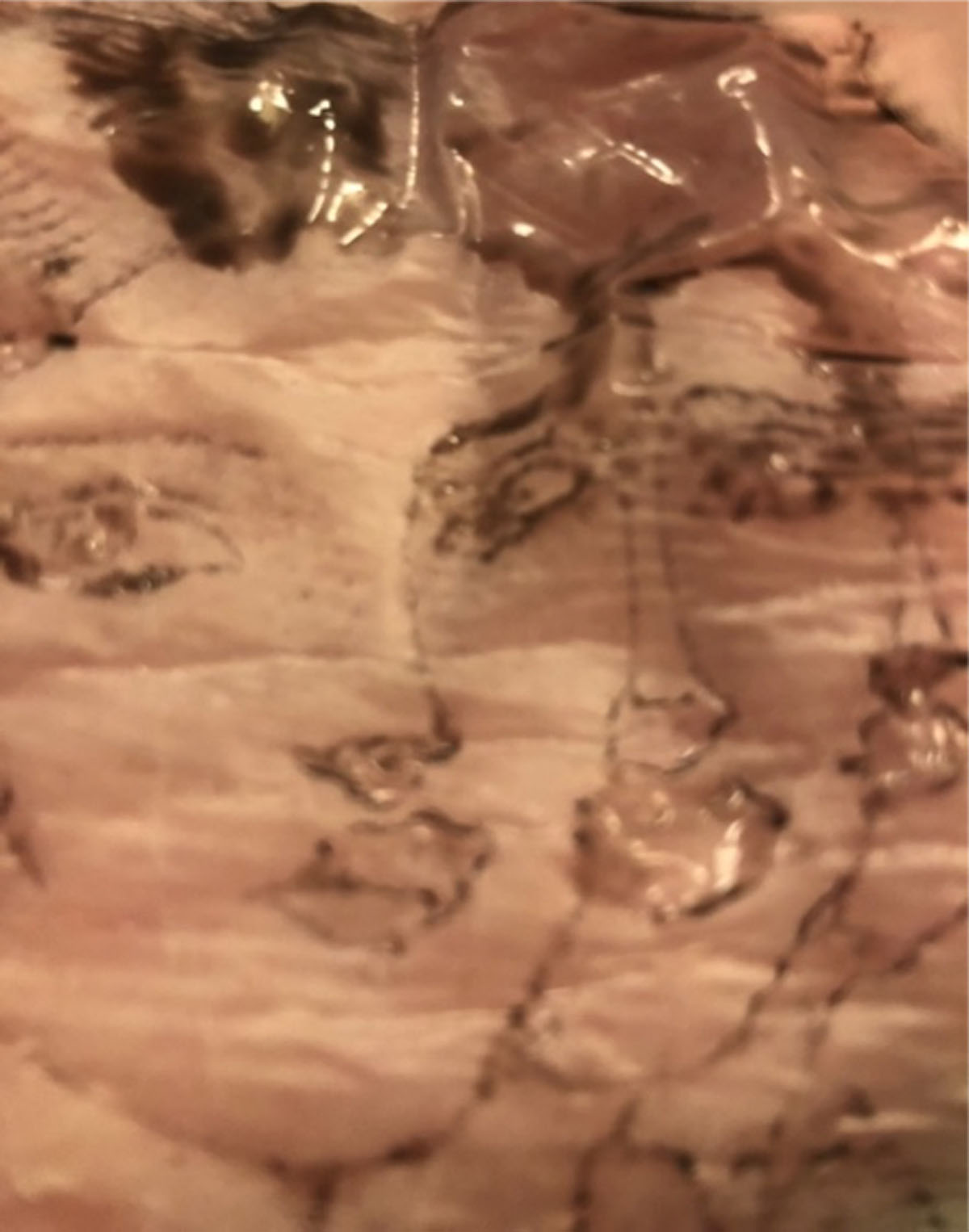
This is not a ‘pipe’ – there is no fucking pipe.
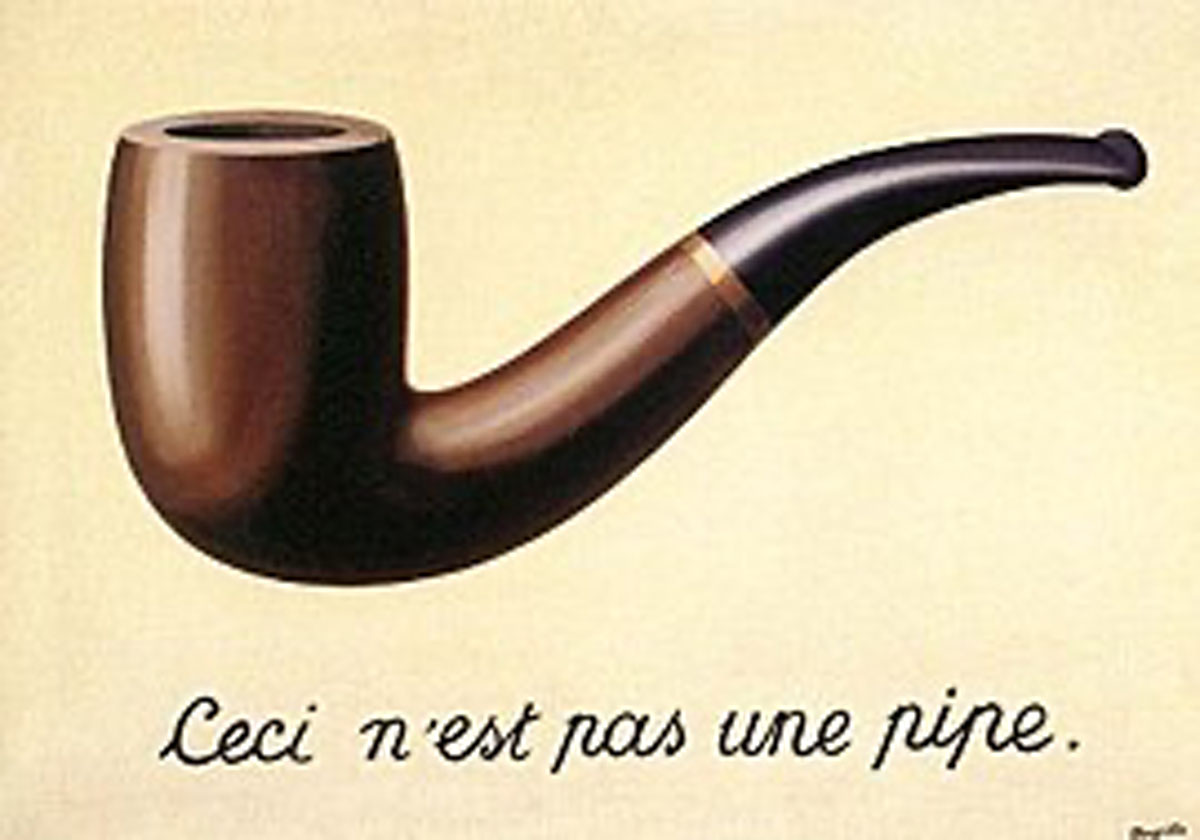
This is not a “we” – there is no fucking we, there has never been a we. What looks to be a pipe is not a pipe, what looks to be an us or a we is not, it is a representation built on a false assumption. The wielding of we, in its at best ill-informed and at worst violently disingenuous attempts to include, has historically excluded the most marginalized identities from access to certain spaces and places and temporalities, futurities/pasts/presents. The insurmountability of the language of “we/us,” all the while its use to denote some sort of multitude of embodied people being unavoidable in conversations around solidarity across disparate identities, is precisely what negates the possible existence of some such meaningfully nuanced category.
But this need not be felt as a lack or absence or meaninglessness – rather it is an opening/many openings for playfulness to communicate different, surreal, indeed blasphemous meanings altogether, to  a
a  , one (or many) that are already here and have long been here (wherever and whenever “here” is), but are not yet articulated or mobilized.
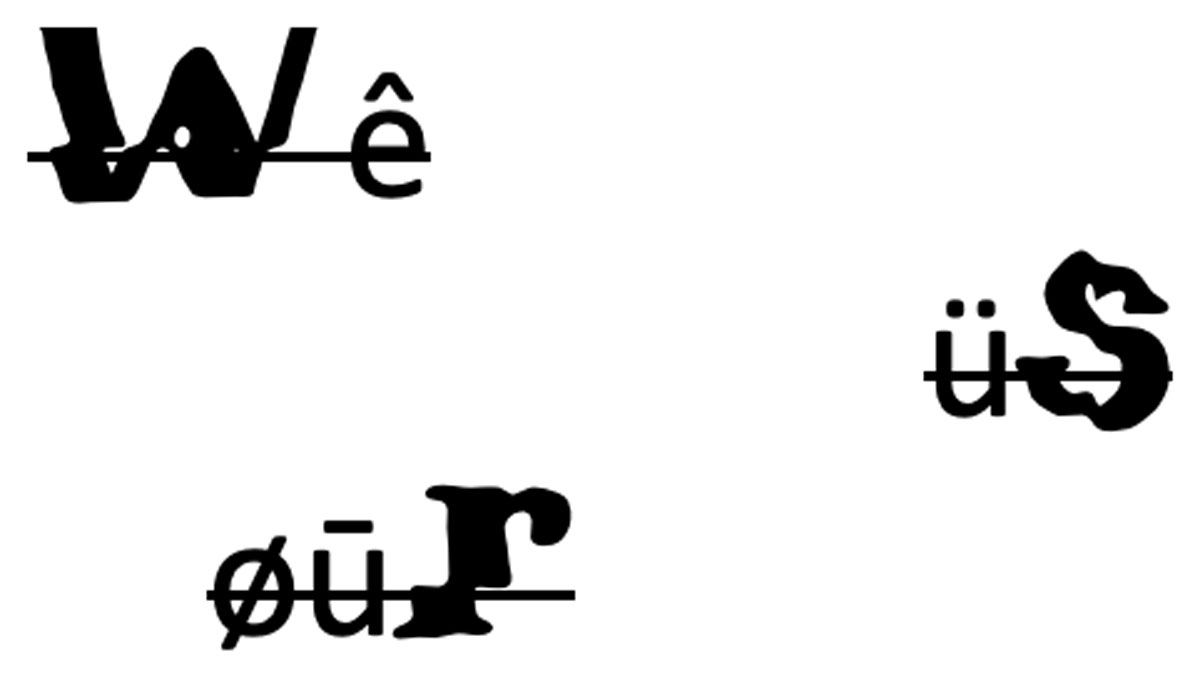
The synthetic , the emulsified  .
.
I cross these terms out as a negation, rejection, active destruction of their original, uncritical, violent form. But crucially, I also add accents with reckless abandon, deploying them illogically as what Jenny Hval calls “impossible letters” in an act of (gender/space/time)fuckery, a radical act of what she refers to as “black magic,” of transforming language and concept and their relation to the embodied affected self by blaspheming both the intended use of accents themselves and the language/words which they alter, finding comfort and feeling at home in symbols generally associated with the designation of (undesirable) foreignness, in words associated with  exclusion from them.12 I use sans-serifs and warped fonts juxtaposed against the institutionally standard Times New Roman in a very visceral, visible differentiation that communicates both the violent grotesqueries underlying their uncritical deployment, as well as those beautiful ones which exist in their blasphemous rearticulation. In this moment is creation, synthesis, anticapitalist antiproduction through destruction.
Hval writes,
“In blasphemy there’s a secret pact, a desire for community that isn’t rooted in the Christian, Southern [Norwegian] spirit. Blasphemy protects us against the moral fables we grew up with; blasphemy renounces anything that requires our submission. It shows us a crack in this reality, through which we can pass into another, more open meeting place. Blasphemy has not forgotten where it came from; it maintains that defiance and energy. Blasphemy looks for new ways of saying we…a community that happens without anyone asking. It’s an unknown communal place, an impossible place. In a place like that, we can make art magic.”13
Wê might liken this “communal, impossible place” of the band/bond to what Katherine McKittrick theorizes as “the last place they thought of.”14 To blaspheme this language is to deny the very institutions and structures which function on set use of language, universal understandings of meaning and form and pronunciation. It makes  illegible within that framework by refusing its intended form and engagement, while establishing queer legibility, community, and the transgression of spatiotemporality with one another in plain sight, a sacrilegious synthetic language of own.
To synthesize is to combine ideas, parts, elements into a complex/ideal/abstract united/coherent whole.15 In grammar, it refers to constructing a sentence “according to the sense, in violation of strict syntax.” In biology, it refers to “build[ing] up (a new species or form) by the mating of like mutants.”16  .
.
In the vernacular, that which is “synthetic” is commonly connoted negatively as being fake, characterized by falsity, inferiority, artificiality, inauthenticity or insincerity, pretending to be that which it is not, chemical, plastic, abhorrent, unnatural, grotesque, not real. Such connotations reflect what I point to as a misplaced preoccupation with authenticity and purity, a refusal of messiness and nuance and confounding of easy categorization which often plagues efforts at resistance. But those “negative” associations of synthesis/synthetic(s) are also precisely what make it useful as a radical mode of operating in the trans-scalar spatiotemporalities of that which is perceived as “not real” or “unreal” – the impossible (surreal) places and utterances where God, where capital, can’t find , the last places they thought to look.17 Normative structures and those who uphold them can’t look in the times and places they can’t figure as real.
I would suggest that much of the beauty of this synthesis is that it is an inherently messy and experimental process, never-concluded, uncontained/uncategorizable, ripe with endless undefined possibilities, and is in fact marked by failures (the queer art thereof). Synthesis as a radical process has the capacity to make antinormative stuff and goop and affects and performances which are not valued by or are hostile to (gunking up) capitalist normative spatiotemporal performativities out of that which already exists within its structures.
Embodied emulsification presents a way of organizing and thinking through what such radical synthesis into a meaningful might look (and feel) like, of organizing and existing/performing archipelagically18 and rhizomatically,19 in relationality to importantly-varied embodied others at transnational and intensely local sub-bodily scales alike – articulating into being, summoning, a which is organized precisely around the meaningful variabilities in embodied, affective experiences of the subjugating structures of global capitalism from differing occupancies of marginality.
Emulsions, fluids which appear and act and function homogenously (and in ways simultaneously distinctive from but retaining key properties of their constituent parts, synthesized together into something new) when zoomed out, are in fact composed of insoluble particles that remain discrete on the micro level – moving/feeling/working as a conglomerate whole while each particle which comprises it remains distinct, never reducible/dissolvable/collapsible into violent homogeneity. These emulsified particles are engaged in deeply intimate relationalities (animacies) within these multiplicitous, synthetic, fluid, queer, trans*formative environs of mutual care. In mutual emulsification, are capable of pouring, spilling messily together over the edges and out of the structures of its vessel, breaking through the surface tension and trans*gressing the borders with which it would hope to contain .
The textural sensation of successful emulsification on the flesh or the tongue or in the mouth or on the tip of a paintbrush is unmistakable – fluid, but in that fluidity lush and thick, viscous, smooth and sticky and slick and slippery and sensual and sumptuous in a way which verges into the disgusting, the repulsive, the revolting. It’s hard to think of a more intensely queer substance.
To feel emulsified is to feel at once embodied in oneself and in relation to embodied others, and transcendent of those embodiments as one of many, many parts of some sense(s) of – “knowing ourselves as part and as crowd.”20 To feel emulsified is to revel in that blasphemous, impossible form, that queer trans-scalar slippery-stickiness, to feel multiple, to feel dispersed. To me, emulsion feels something like being erotically, divinely dissolved into the embodiment and fluids of another during and after overflowing, overwhelmingly queer sex.
Later in Girls Against God, Hval describes a semi-fictional experience of studying old copies of the very real text Malleus Maleficarum / The Hammer of Witches procured from libraries with her two bandmates/bondmates in their quest for “a new way of saying we.” Rather than reading for textual analysis, they opt to study instead its textures, tones, sounds, feelings –
“The physical content of this book hasn’t received the same depth of analysis as the textual…the confession and punishment scenes have attracted the most diligent attention and therefore have the stickiest paper. It’s impossible to determine what the stains are composed of…if it’s spilled wine, coffee, milk, sweat, or semen. Venke, Terese and I reckon it’s the effluence of excited genitalia. What is certain is that the stains are part of a conversation, a comment section that transgresses time, place, and dimension. A stain is also an imprint, an imprint from one person’s situation,21 something that stretches out of the body and is projected, involuntarily, into the future, where another body in another time, in another space, will open that same page and study the stain. We can pick up a print copy…and assume it contains traces of another reader’s kinks, the mounting desire, the climax, and that pathetic moral dread that follows. The absorbent paper soaks up the body’s signature, the musical notations of desire. The stains symbolize what the book itself describes with the utmost empathy and precision: The Way Whereby a Formal Pact with Evil Is Made.”22
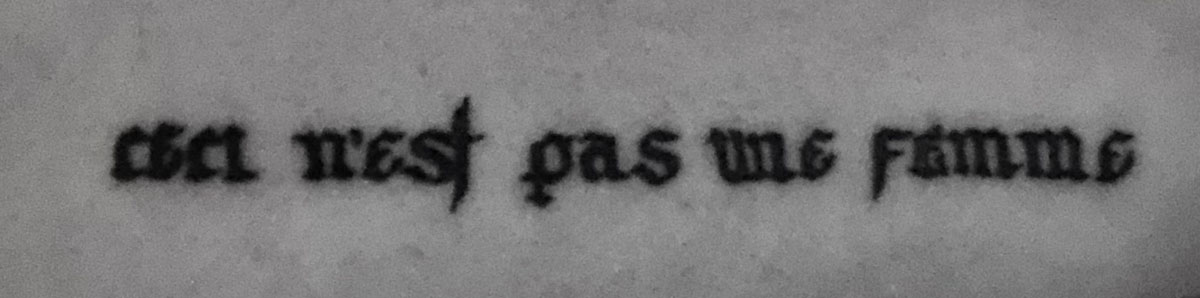
A few months before writing this piece when I was grappling with how to fuck with the form of “we” and “us” and why this act of praxis via form in text felt so important and urgent, I had a queer tattoo artist in my new locale tattoo a play on Magritte’s The treachery of images along my right forearm in gothic text: “ceci n’est pas une femme” – this is not a woman. You may see a woman when you look at me, but that image betrays you – there is no universal concept of a woman, and to the extent that such a category exists, I am not it. This is not a woman – there is no fucking woman.
Since its presence on my body, I’ve experienced a sense of gender euphoria that I had not known was missing or possible for me. I find myself running my fingers along it absentmindedly. Having this phrase etched into my arm feels like a constant act of crossing out of my own form and adding senseless accents to my body in such a way as to synthesize meaning in the space of a destruction, a blasphemy, a treachery. As queer artist Red/Chris behind Christine and the Queens once wrote in the caption of a long since lost Instagram selfie, “genderfucking as always.” The ephemeral offhandedness of Red’s expression of identity and experience, and the way in which that phrase in that passing moment nevertheless stuck to me like a goop and became an inextricable part of how I understand queerness and myself within it, makes it all the more resonant in the context of the simultaneity of slipperiness-stickiness of queer, non-linear anticapitalist spatiotemporalities. This passing utterance, “genderfucking as always,” is an integral part of my own embodied synthesis of  . Affect-laden secretions of Magritte and Red find their way
  and reinterpreted across dimensions, spatiotemporalities, languages, nation-states and articulated in a stain on the skin along my arm and in the way I occupy space and time in my newfound euphoria. In this synthetic, surreal skin that feels more meaningfully always-having-been-mine than my unaltered corporeal form, I feel like part of a that’s simultaneously already here and that the mere act of having “ceci n’est pas une femme” etched onto my arm, a black magic ritual or incantation of sorts, contributes to further articulation and summoning into materiality.
ceci n’est pas un conclusion – this is not a conclusion
Homebody, cont.
The injectable migraine treatments which afford me such transcendent, synthetic, emulsified, indeed revolting embodiments are often administered to me by someone that makes me actively uncomfortable. Even with relief that I know is on the horizon, it’s an odd thing to look forward to driving five hours to a specialist to get prodded with needles by a person you find repugnant. My longtime (now-former) neurologist, an older white man in my hometown who only stopped exclusively playing Fox News on his waiting room TV several months into the Trump presidency, has been making comments on how much he likes my hair color or my glasses or some other facet of my appearance at nearly every appointment since I first started seeing him at age fourteen. Now, the waiting room television screen always plays picture perfect white heteronormative families conducting carbon copy home renovation projects on properties so few people will ever be able to afford.
I had a virtual appointment with him the week before my tattoo appointment with S – even over a video call in which his video was so dark that I could barely make out his face, he felt it appropriate to comment on how much he loves my natural shade of brunette. Curiously, he liked when my hair was dyed bleach blonde and pink, too – always making sure to note that he usually doesn’t like bottle blondes or “unnatural” colors. He tells me about his travels to Thailand and China and makes racist generalizations about the people of color in the places in which he’s a tourist. But he’s one of the only doctors that’s ever been willing to listen to me and consistently try to find treatments that work. And so, I continued to see him until about two years ago, when it became clear that my condition had morphed into something he no longer had the expertise to treat. Unlike the experience of being on the table in S’s studio, each time I lay in the neurologist’s office on his exam table atop a layer of white crinkly sanitary paper identical to that laid across the tattoo table, awaiting the puncture of the needles, I can’t wait to get out of the enclosed space I have no choice but to inhabit with him. I always feel an urge to hold my breath.
As I’ve discovered over the past five months, during which the years of Botox have increasingly worn off after stopping Botox injections to try some recently developed medications, the Botox still had some effect. Though there is no medical reason that I can’t continue getting the Botox alongside these medications for the remaining effect it has, however reduced it may be, insurance won’t cover both the Botox and these newer name brand drugs due to the high cost. The new medications (self-administered injectables, some in the form of an Epi-pen style auto-injector, others via a traditional syringe) ultimately had no effect on my migraines, and instead came with a slew of adverse side effects.
Despite their lack of and/or negative effect on my body, I love the bodily autonomy and sense of control I feel in the process of injecting myself each month, rather than having to see my neurologist for relief. Each time I feel the syringe plunge into my thigh and the sharp sensation of the cold fluid as it enters my body, I want nothing more than for it to work this time. I thought at first that I might struggle to inject myself, but instead I find myself drawn to the feeling and the embodied performance I inhabit every time I penetrate myself with the needle, wishing I could do it more frequently than just once a month, daydreaming of having the disposable income to take up stick-and-poke tattooing so I can dig around in my own skin and leave traces behind in the form of tiny art pieces. I think of Preciado’s account of rubbing testosterone gel emulsion on his skin in Testo Junkie – the sensual experience of the ritual of it, the changes in the way he inhabited and performed in his own body, and the power he felt in administering it to himself as he desired it, rather than being prescribed a set dose on a set schedule.24 But the self-administered treatments never did work, and I return to driving five hours to receive largely ineffective Botox from my neurologist every three months. I find myself craving the sensation again, aching for any sense of relief, even if delivered by a racist and misogynistic conservative that makes me feel so intensely uncomfortable.
Getting tattooed is a form of relief – treatment for my ailing body, even – for me, too. I got my first tattoo the day after my mom died. I’d scheduled the appointment and decided what I was getting months prior and made the decision to go through with it anyway rather than cancelling, having some sense that the dull burn of the needles entering and exiting my skin might give me some sense of control and release in a circumstance in which I felt I had so little, and was struggling to process much of anything. And it did – I didn’t tell that artist about the circumstances, and just let myself watch it, feel it, run my fingers over the sore and warm lines on my skin after, raised as if my body had just been embossed. I thought then of Preciado too, deciding in his grief following his close friend’s death to take some power over his body, his mind, his experiences and sensations. After a new tattoo, when it grows itchy and hot as my immune system attacks the ink/injury as part of the process which enables tattoo ink to rest in the skin indefinitely, I consistently feel my body to be in less pain and inflamed elsewhere until the tattoo begins to smooth and soften and meld with the normal texture of my skin. I have always theorized that this effect on my body occurs because, for once, my immune system is attacking something other than my own body.25 In my grief, in my isolation, and in a chronically ill/in pain body over which I increasingly feel I have so little control, tattoos are a form of pain I can decide on, choose when and how to experience it, and from which I receive things I desire – connection and art that I can feel and that moves with me, allowing me to feel more embodied and at home in my own physical form, with which I have a very complex relationship. Homebody.
As Preciado’s theorization of pharmaceuticals like testosterone as having been coopted by dominant (hegemonic) structures reveals, costly name-brand migraine preventatives which often aren’t covered by insurance and have their own dystopian commercial advertisements and meaningless names like Ajovy, Aimovig, Emgality, Vyepti, and indeed Botox have been coopted and commodified by capitalists in ways which uphold binary categories of embodied identities necessary to the continuation of capitalism; the once-subversive signaling of tattoos (in the Eurocentric West) has, too, greatly eroded and been commodified in recent years. And yet, there remains some distinct notion of aesthetic-affective resistance, in the embodied connection to self in the act of self-administering, or that of the collaborative intimacy of the exchange of art with someone with whom you feel some solidarity, in a space that, for once, feels like it was made with you and others like you in mind – emulsification into some sense of .
When I see the completed tattoo, this peculiar little house with appendages and organs and orifices teeming with liveliness and possibility, it feels simultaneously special and comfortable, as if it were always a part of my body – I feel more intensely emulsified into my corpus now than I had before. Homebody. I’m overcome with gratefulness for the opportunity to meet and interact with S, share the erotic intimacy of existing in their space with them and having their work live on my body.26 Like the next Botox or nerve block injection, I’m already thinking about the next time I get to feel their art being embedded in my skin.
As I move towards the door to exit the building, I cross paths with an older white man who seems apprehensive about my presence. It feels jarring to see him just outside a space that feels so queer and safe, feels so much like home. But this time I feel at ease, as if we both sense that he encroached on my space rather than me encroaching on his. It’s only once I get in my car to drive back to town and pass the police car parked next door head-on that I notice that feeling of being at home dissipate.
Notes
[1] Mel Y. Chen, Animacies: Biopolitics, Racial Mattering, and Queer Affect. Duke University Press, 2012.
[2] Elsewhere, I have theorized the structures of global capitalism as being comprised of assemblages of linear capital- space-time, which act to exploit embodied subjects – disproportionately acting on/experienced by historically marginalized and minoritized bodies – across scale, space, and time in order to maintain capitalist structures and ensure its perpetuation into futurity. See: Madison Jeanette Tepper. “Synthetic Solidarities: Theorizing Queer Affectivity and Trans*national/Temporal Emulsification as Embodied Resistance to Global Capitalism.” Virginia Tech, 2024.
[3] Jean Baudrillard, Simulacra and Simulation. Translated by Sheila Faria Glaser. The Body, in Theory. Ann Arbor: University of Michigan Press, 1994.
[4] Johanna Hedva, “Sick Woman Theory.” Topical Cream, Topical Cream Organization, March 12, 2023, originally published in Mask Magazine on January 16, 2020. https://topicalcream.org/features/sick-woman-theory/.
[5] Jasbir K. Puar. The Right to Maim: Debility, Capacity, Disability. New York, USA: Duke University Press, 2017. https://doi-org.ezproxy.lib.vt.edu/10.1515/9780822372530.
[6] Paul B. Preciado. Testo Junkie: Sex, Drugs, and Biopolitics in the Pharmacopornographic Era. New York, NY: Feminist Press at the City University of New York, 2017.
[7] Jenny Hval, Girls against God: A Novel. Translated by Marjam Idriss. English language ed. New York: Verso, 2020, 51.
[8] Hval, 105. I invoke the term “black magic” in specific reference to pagan and wiccan deployments of the term, in particular drawing upon the ways in which Jenny Hval utilizes the concept alongside Norwegian black metal music/media and culture in her book, Girls Against God. It’s important to acknowledge here that I do not do so without awareness/attentiveness to the fact that black magic has particular relevance for Black people (especially in the US and broader West) – the ways in which “black magic” and voodoo have been wielded violently against Black people and especially Black women and queer folks, and also the ways that terms like “Black Girl Magic” which were intended by Black communities to celebrate and empower Black women ultimately become coopted in service of the inherently white and Western power structures of global capitalism.
[9] Christine and the Queens, Full of Life, Because Music, 2023.
[11] Here, I reference the surrealist-dadaist artist René Magritte’s most famous piece, “La trahison des images,” or “The treachery of images,” more colloquially known as “this is not a pipe,” generally considered to have been produced in late 1928 or early 1929. René Magritte, La trahison des images, 1929, oil on canvas, 23 3⁄4” × 31 15/16” × 1”, Belgium; Los Angeles County Museum of Art (LACMA), Los Angeles, California.
[12] Hval, 2020.
[14] Katherine McKittrick. Demonic Grounds: Black Women and the Cartographies of Struggle. Minneapolis, MN: University of Minnesota Press, 2006.
[15] Oxford English Dictionary, s.v. “synthesis, n.”, September 2023. https://doi.org/10.1093/OED/9003088362. Oxford English Dictionary, s.v. “synthesis, n.”, September 2023. https://doi.org/10.1093/OED/2026259240. Emphasis mine. See also: Oxford English Dictionary, s.v. “synthesize, v.”, July 2023. https://doi.org/10.1093/OED/9738195628.
[16] Oxford English Dictionary, s.v. “synthesize, v., sense 3”, July 2023. https://doi.org/10.1093/OED/5049455971, emphasis mine.
[17] McKittrick, 2006.
[18] Sylvia Wynter. “Unsettling the Coloniality of Being/Power/Truth/Freedom: Towards the Human, After Man, Its Overrepresentation—An Argument.” CR: The New Centennial Review 3, no. 3 (2003): 257–337.
[19] Gilles Deleuze and Félix Guattari. A Thousand Plateaus: Capitalism and Schizophrenia. Translated by Brian Massumi. Minneapolis, MN: University of Minnesota Press, 1987.
[20] Édouard Glissant, Poetics of Relation. Translated by Betsy Wing. Ann Arbor, MI: The University of Michigan Press, 2010.
[21] See: Lauren Berlant, Cruel Optimism. Durham, NC: Duke University Press, 2012.
[24] Preciado, 2017.
[25] This phenomenon of tattooing having an impact on immune response has been observed by others and has been supported by some scientific research, though there is no consensus about what causes this effect, or why some experience it but not others. See: Christopher D. Lynn, Michaela Howells, David Herdrich, Joseph Ioane, Duffy Hudson, and Su’a Tupuola U Fitiao. “The Evolutionary Adaptation of Body Art: Tattooing as Costly Honest Signaling of Enhanced Immune Response in American Samoa.” American Journal of Human Biology 32, no. 4 (2020): e23347–n/a. doi: 10.1002/ajhb.23347. See also: Katherine J. Wu. “Tattoos Do Odd Things to the Immune System.” The Atlantic, March 22, 2023. https://www.theatlantic.com/science/archive/2023/03/tattoo-science-immune-system-effects/673462/.
Competing Interests
The author has no competing interests to declare.