
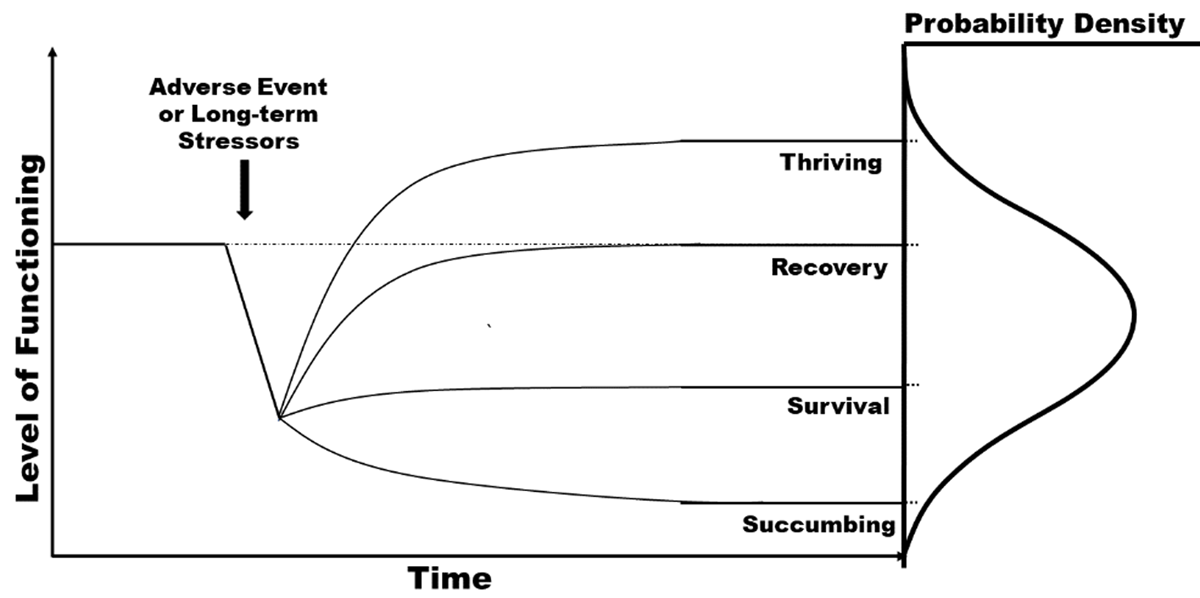
Figure 1
Model of outcomes to adverse events or long-term stressors and distribution of these outcomes, adapted from O’Leary and Ickovics (1995).
Table 1
Selection criteria for determining relevant papers for the final review, with justification for each step.
| Selection Criteria | Justification |
|---|---|
| Success is explicitly defined and operationalized in the paper. | This criterion is directly relevant to the research question. The paper must define what success means or looks like for undergraduate engineering students. |
| The study participants include undergraduate engineering students, which includes computer science students. | This criterion is directly relevant to the research question. Engineering in the context of our study includes all engineering majors and computer science, a major that is included in several Colleges of Engineering (such as Arizona State University and the University of Illinois Urbana-Champaign). However, our definition of engineering excludes engineering technology (ET). ET departments are often not in the College of Engineering, and ET culture differs significantly from engineering, with most ET graduates not considered engineers (Lucietto, 2016). This criterion excludes youth clinics, family enrichment programs, religious services, or 4-H programs. This criterion also excludes studies that do not have results specific to engineering students, such as generalized findings from samples that include non-engineering students. |
| The paper is published in English. | Due to limited resources for translation, we included only documents published in English. |
| The location of the study is in the United States. | We restrict study location to the United States to align our study with the visions set forth by U.S. national reports, such as the National Academy of Engineering and the ABET report. |
| The study is a research study (quantitative, qualitative, or mixed methods) or intervention study. | Since the desired outcome for this scoping study is to develop an understanding of engineering thriving, this criterion excludes descriptions of courses, programs, or activities. This criterion also excludes papers on instrument development, personal opinions (e.g., book reviews), program evaluations, incomplete studies, and literature reviews. |
| The paper explicitly mentions enabling, positive, or asset-based competencies (including knowledge, skills, abilities, attitudes, and other characteristics that enable a person to perform skillfully, make sound decisions, and take effective action). | This criterion is directly relevant to the research question. This criterion excludes approaches that solely focus on addressing disabling conditions, such as using race/ethnicity or genders as causal variables. |
| The paper explicitly discusses relationships (both theoretical and empirical) between competencies or between competencies and student success. | This criterion is directly relevant to the research question. Since the purpose of this study is to develop an understanding of engineering thriving, it is crucial to investigate the relationships between competencies (especially those with empirical support). |
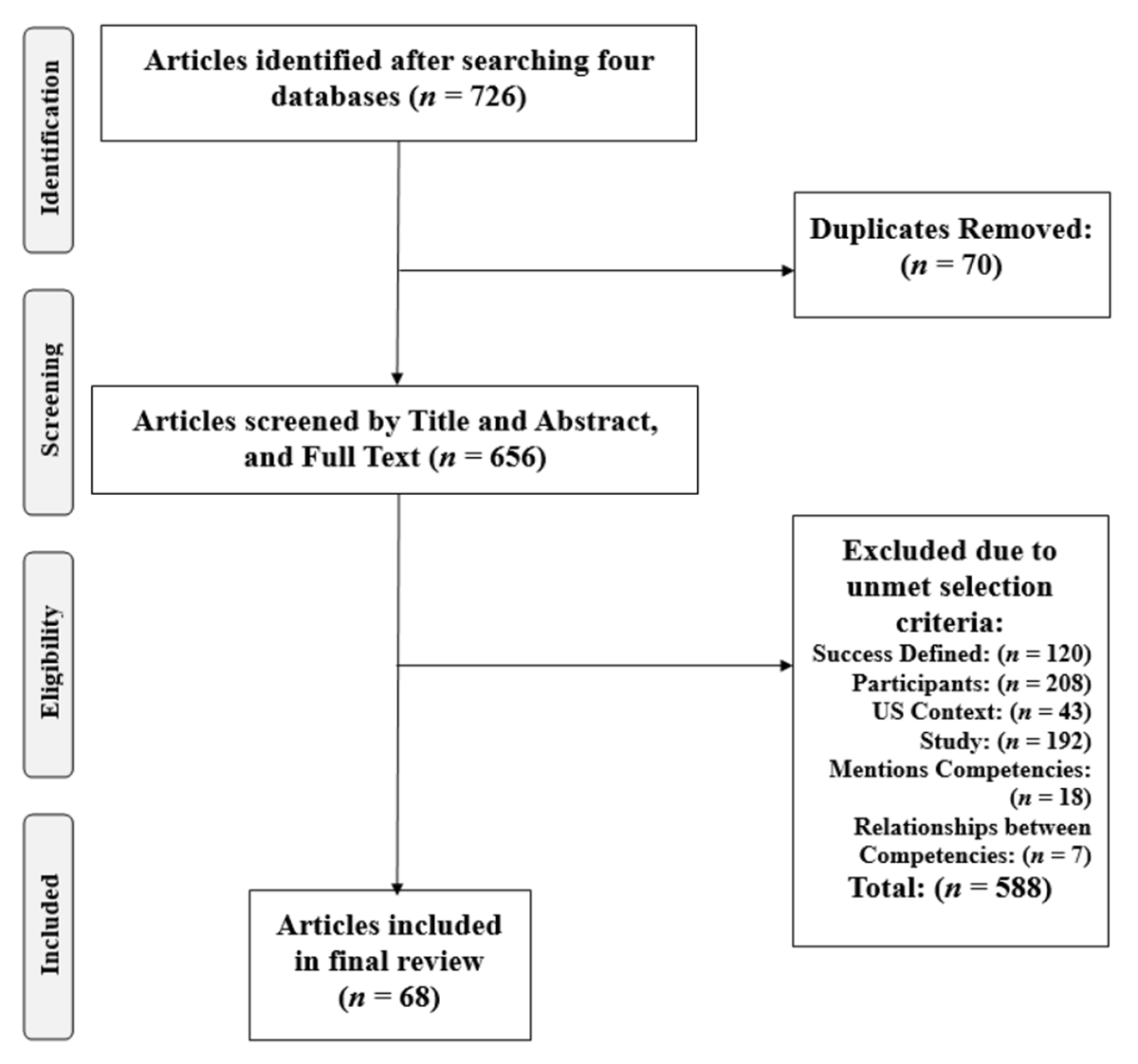
Figure 2
A PRISMA flow chart illustrating the screening process used in this review, as well as the inclusion or exclusion of papers at each step of the screening process.
Table 2
Competencies that contribute to engineering student success.
| Competency and Definition | Competencies Reported by Papers in Our Review |
|---|---|
| Intrapersonal competencies involve one’s relationship with oneself and how one interprets external situations and stimuli. |
|
| Interpersonal competencies involve expressing information to others, social skills, as well as interpreting others’ messages and responding appropriately. |
|
| Cognitive competencies involve thinking, reasoning, knowledge transfer, and related mental processes. |
|
| Behavioral competencies involve specific actions and habits in response to situations and stimuli. |
|
Table 3
External factors important to engineering student success.
| External Factors Important to Success | Factors Reported by Reviewed Studies |
|---|---|
| Entry Characteristics involve student characteristics that we do not expect to change within the bounded undergraduate engineering academic experience. |
|
| University Resources involve opportunities and assets that the university or program provide to help engineering students succeed. |
|
| Context and Situation involve life circumstances and contexts that may trigger students’ experiences and responses during the undergraduate engineering experience. |
|
Table 4
Outcomes important to engineering student success.
| Outcome and Definition | Outcomes Reported by Papers in Our Review |
|---|---|
| Course Grades refer to students’ final grade in a technical or required course. |
|
| GPA refers to students’ grade point average. |
|
| Retention refers to whether students persisted either in their specific engineering degree program, the college of engineering, or the university. |
|
| Graduation refers to students successfully completion their undergraduate engineering degree. |
|
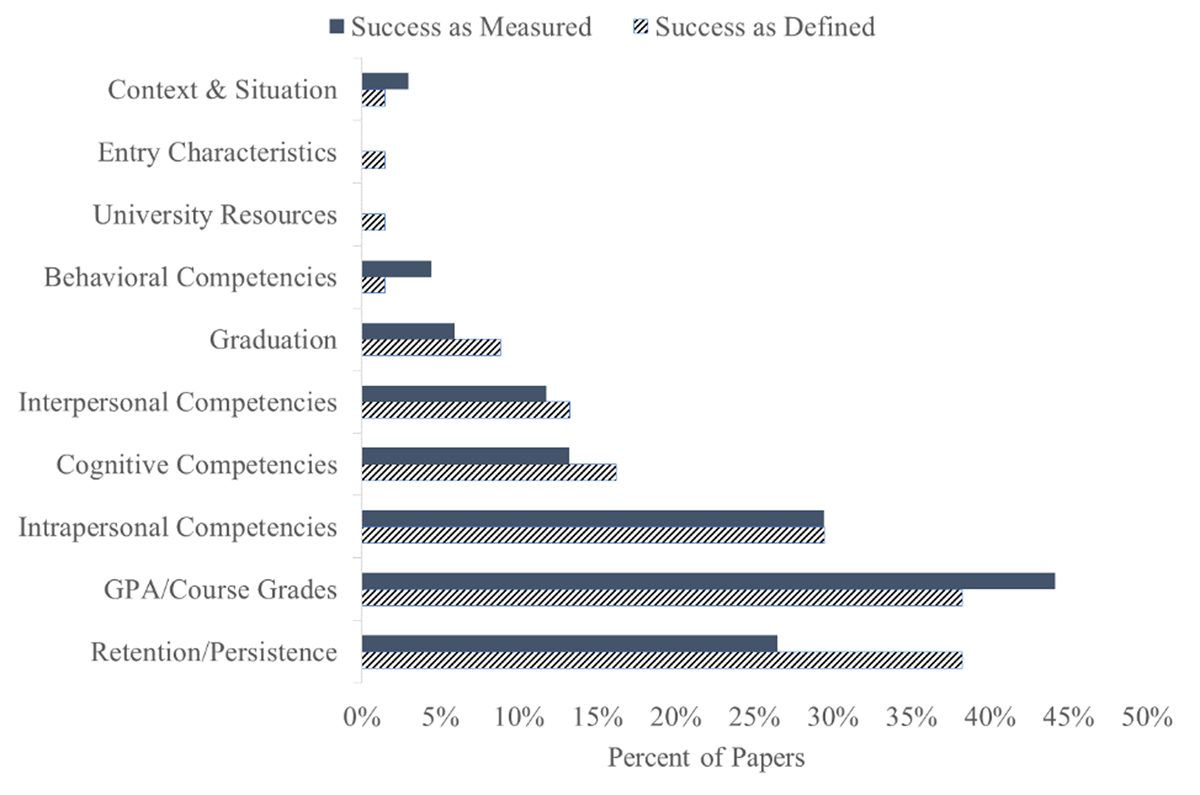
Figure 3
A comparison of the distributions of the measured and defined success factors for the papers in this review, grouped into categories explained in Tables 2 and 3. Indicated by the unequal percentage bars within each category, 24.5% of papers in our review defined and measured success differently.