
The process by which individuals become researchers is known as researcher development. This process can include the development of skills, attitudes, and behaviors that are necessary for conducting research and choosing research as a career. Prior exploration of researcher development has often focused on more advanced researchers and or taken a high-level view of the process over the course of a career (e.g., Åkerlind 2008; Brew et al. 2016; Browning et al. 2017; Evans 2011; Kahn et al. 2012). Within the engineering education community, we typically focus on how this process starts at the undergraduate and graduate levels and explore the experiences and events that may initiate students’ researcher development. Literature on undergraduate research experiences within engineering education has explored students’ perceptions of research (Faber et al. 2020; Woodcock et al. 2012), student outcomes from research experiences (Ro et al. 2017; Zydney et al. 2002), and students’ epistemic cognition in a research environment (Faber et al. 2016). These studies focus primarily on students’ perceptions and outcomes of specific experiences rather than the process of researcher development itself. The purpose of our study was to build on this existing literature by exploring narratives of researcher development based on the summer international research experiences of undergraduate and graduate students in civil engineering. Through these narratives, we sought to identify significant experiences that characterize the early stage of researcher development.
Our study was framed by an overarching research question: How do undergraduate and graduate students in a civil engineering international research experience describe their experiences conducting research abroad? In exploring this question, we also addressed the following sub-questions:
What are the significant experiences related to researcher development that appear across student narratives?
How do student narratives of researcher development demonstrate their assessment of Person-Environment Fit in the research environment?
In this paper, we share students’ narratives describing their research experiences, present an analysis of significant experiences that appear across narratives, and interpret the narratives using Person-Environment Fit (PE Fit) theory. This theoretical framing emerged as a useful interpretation tool for the researcher development process when we considered the students’ narratives collectively. Although this theory did not inform our original study design, our intellectual contribution in this paper is identifying how students’ assessment of their fit with different levels of the research environment can play an important role in their development as researchers. We demonstrate how students’ interpretations and assessment of their fit influence their views of research and potential to engage in similar research activities in the future.
Literature Review
Researcher development has been broadly defined as the process through which people’s capacity and willingness to conduct research is enhanced (Evans 2011), but several conceptualizations have been suggested about what this process entails. Willison and O’Regan, (2007) proposed a conceptual framework describing several stages of skill development, demonstrating a shift from closed-ended inquiry with significant guidance to self-determined, open inquiry. Their focus on skills is contrasted by Evans’s (2011) view that researcher development is the process of becoming a researcher, and this process entails a combination of attitudinal, behavioral, and intellectual development. In addition to providing a detailed characterization of these different aspects of development, Evans (2011) also proposed a process of “micro-level” development where researchers grow through small episodes of discovering better approaches to research (p. 87). This perspective aligns with one of the four ways of thinking about researcher development identified by Åkerlind (2008) through interviews with academics. Åkerlind found that some academics viewed researcher development as primarily occurring during doctoral studies, but others recognized continuing qualitative improvement throughout researchers’ careers. Although our study focused on student researchers, we drew on this perspective that small episodes are significant in the process of becoming a researcher and sought to identify such significant experiences in students’ narratives in this study.
Undergraduate research programs have been a growing trend in United States higher education since the 1980s (Streitwieser 2009; Taraban 2008). Research of these programs has often focused on their success in helping students achieve a variety of learning outcomes ranging from basic research skills such as data analysis (Kardash 2000; Seymour et al. 2004) to the attitudes necessary to conduct research (Hunter et al. 2006; Seymour et al. 2004; Thiry et al. 2011). These attitudes include characteristics such as taking responsibility for a project or engaging intellectually in research discussions. Extended participation in undergraduate research experiences leads to more significant skill development (Thiry et al. 2012), and other program elements, such as time spent with academic mentors, have also been associated with improved learning outcomes (Taraban et al. 2008). Participating in undergraduate research programs can also help students confirm, clarify, or explore a potential interest in attending graduate school (Seymour et al. 2004). Although most of these studies have focused on student outcomes from research experiences, a few have explored the process of gaining confidence as a researcher in terms of shifting from novice to expert in the research environment (Faber et al. 2016; Thiry et al. 2011, 2012) or moving from peripheral to full participation in a research community (Hunter et al. 2006). Our study built on this line of research by focusing specifically on narratives of researcher development to characterize this process in greater depth than previous studies.
A related line of research has explored researcher identity development, primarily in undergraduate and graduate students (e.g., Baker & Pifer 2011; Benishek & Chessler 2005; Coryell et al. 2013; Thiry et al. 2012). Researcher identity refers to a perspective where an individual thinks of themself as a researcher. A variety of experiences have been identified as significant in the process of developing a researcher identity, including having responsibility on research projects, receiving recognition from research mentors, publishing or presenting research work, and talking knowledgeably about research with others (Coryell et al. 2013; Faber & Benson 2015; Mantai 2017; Thiry et al. 2011). Relationships and interactions with other researchers are often cited as central to the researcher identity development process (e.g., Baker & Pifer 2011). Several prior studies of undergraduate researchers within the field of engineering education have been grounded in the researcher identity framework (Faber et al. 2016, 2020; Faber & Benson 2015). These studies have focused on students’ perceptions of research, researchers, and themselves as researchers (Faber & Benson 2015; Faber et al. 2020). Most related to the current study is the work from Faber et al. (2016), which explored how students conceptualized their goals in research projects and the processes they used to make research decisions. Based on the findings of this study, the authors identified four researcher profiles describing the autonomy and time students had demonstrated in their research experiences (Faber et al. 2016). Although these profiles do not describe the process of researcher development, they may indicate notable stages or milestones within that process. Our study extended this prior work by identifying significant experiences in the narratives of researcher development of undergraduate and graduate students.
Furthermore, our work built upon prior research by highlighting how students consider various aspects of the research environment—extending beyond their interactions with mentors and peers—during the process of their development as researchers. This element of our analysis was emergent as we constructed narratives of students’ experiences. Although prior research has noted that aspects of the environment are important (e.g., student relationships and interactions with other researchers), there has been less focus on the environment as a whole and the process by which students assess their alignment with environmental factors. Our findings suggest that students are assessing their fit in real time during research experiences and that these assessments are an important part of the researcher development process. This insight can inform the design of research experiences for students that support their ability to make accurate assessments of their fit with the research environment.
Theoretical Framework
As we began interpreting narratives and noticing variation in how students described different responses to significant experiences, we noticed that students discussed how well they “fit” or felt comfortable with different aspects of the research environment. We began making sense of the data through Person-Environment Fit (PE Fit) theory, which broadly refers to the level of alignment or match between an individual and their environment where the environment is comprised of multiple dimensions. PE Fit has been identified as a multidimensional construct based on a meta-analysis of the existing research, which indicated that different dimensions of an environment have different influences on an individuals’ job satisfaction, attitudes, and organizational satisfaction (Kristof-Brown et al. 2005).
The conceptualization of PE Fit that we applied to the narratives presents two dimensions that characterize the different ways a person can fit in their environment: 1) level of the environment, and 2) type of fit (Edwards & Shipp 2007). The level of environment dimension describes the different components of a professional environment with which a person can fit or not fit, including an individual, a job, a group, an organization, or a vocation. These components are referred to as “levels” to indicate the range in the granularity of the environment represented at each level (e.g., fit with a specific individual versus fit with an entire organization). The type of fit dimension presents three different ways that a person can fit with an environment. Supplementary fit describes similarities between a person and their environment, such as alignment of values or practices. Needs-supplies fit is found when a person’s needs are met by their environment, for example through professional development or mentoring opportunities. Demands-abilities fit occurs when a person can use their abilities to meet needs demanded by the environment, for example contributing meaningfully to a project. Each type of fit can be experienced (or not) at each level of the environment, creating a matrix of possible components of an individual’s overall assessment of PE Fit (Edwards & Shipp 2007). Figure 1 depicts this matrix and how we operationalized the theoretical dimensions to interpret the narratives. We have filled in the matrix with an example “fit profile” to show how an individual may assess fit differently along different dimensions and how some dimensions may not be prominent in their experience (i.e., those left blank in Figure 1).
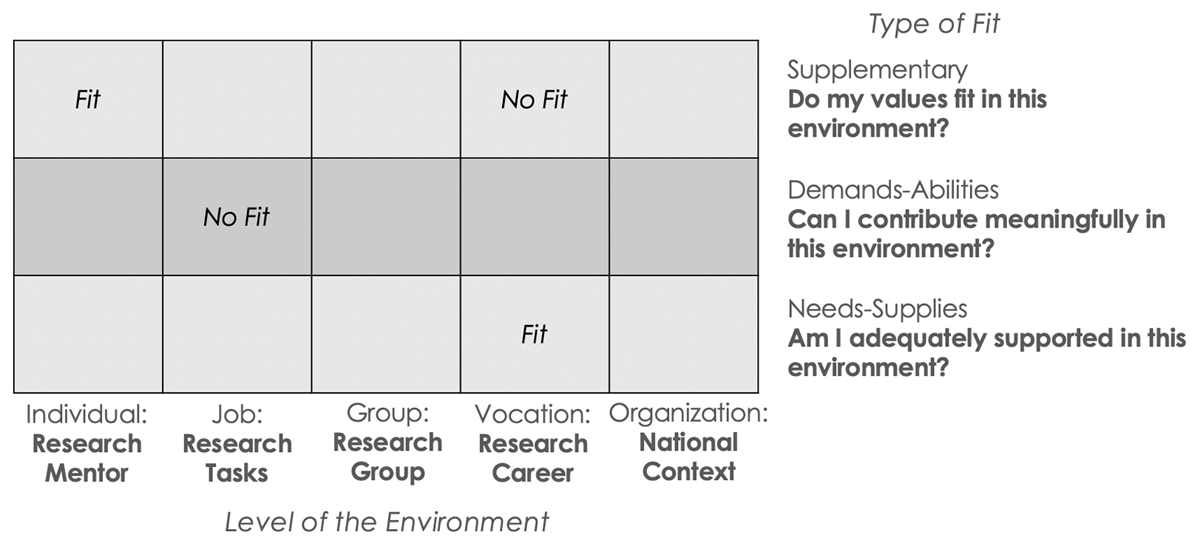
Figure 1
Dimensions of the PE Fit framework as operationalized in this study.
Methods
Our study used narrative analysis to explore seven US students’ narratives of researcher development during a summer research program in Australia. Narrative analysis refers to a “family of methods for interpreting texts that have in common a storied form” (Riessman 2008, p. 11). Riessman (2008) suggests that there are four analytic strategies to narrative analysis; we draw on thematic analysis in that we analyzed “what” participants said during interviews, rather than “how” they told their stories. We chose this approach to gain a holistic picture of students’ development as researchers over the course of a summer-long research experience. We used a series of interviews from across the research experience to construct narratives for each student about their engagement in their research environment.
Program Description and Participants
The International Research Experiences for Students (IRES) program funded by the National Science Foundation (NSF) facilitates opportunities for US undergraduate and graduate students to conduct research with colleagues overseas. US-based researchers and administrators submit funding proposals to arrange cohort-style experiences for students to travel to a partner institution or network of institutions. This funding covers costs such as students’ travel, accommodations, stipends, and in some cases tuition, but may not be spent to support international mentoring teams directly. IRES programs generally take place over the summer for a duration of four to twelve weeks during which participants engage with international researchers, postdocs, graduate students, and undergraduates on existing research projects or specially designed projects for this experience. In addition to developing learning outcomes for students, such as research skills and global competence, IRES programs also aim to support research and collaboration outcomes for academic researchers and broader internationalization activities on campuses (refer to Davis et al. 2022; Knight et al. 2020; and Sanderlin et al. 2020, for a more complete description of IRES programs).
The IRES program that is the study context for our project took place within a school of civil engineering at a globally ranked research university in Australia. Students were recruited through the civil engineering department at their home US institution (all students came from the same predominantly White home institution) and were selected for the program based on an application involving submission of a research interest statement, a CV, and a transcript. During the program, the students were paired with a researcher or researchers at the host university in Australia who mentored them in conducting their summer research project. Research mentors included academics, postdocs, and graduate students, which fluctuated based on project availability, student needs, and available time capacity. Projects typically included data collection (often via fieldwork) and data analysis tasks, although the nature of the project work varied considerably across students. Although known for strong research outputs, graduate and postdoctoral work, and undergraduate teaching and learning, the host university did not have a pervasive undergraduate research culture relative to what is common in US universities with programs such as the NSF-sponsored Research Experiences for Undergraduates (REUs). This context is important in interpreting some of our findings. Mentors did not undergo training in preparation for hosting students—as our prior work has shown (Maul et al. 2022; Sanderlin et al. 2020), US-based principal investigator teams of IRES programs consistently point to NSF’s policies that funds cannot be spent to support international collaborators as a major limitation of the program that forces principal investigators to minimize time-intensive asks of collaborators.
Participants for this study included five undergraduate (three identifying as women and two men) and two early-stage graduate (both identifying as men) civil engineering students who completed an eight-week summer research experience in Australia. We included both undergraduate and graduate students in the analysis to be inclusive of all program participants and to explore whether their narratives of researcher development differ during the program. Students’ prior research experiences are captured in their narratives, and we consider differences between the undergraduate and graduate students in our discussion of researcher development. The narratives highlighted gender as being an important factor in students’ experiences within the program—each student narrative notes the participant’s gender, and we present a summary of participants in the Results section. The participants were from two different summer cohorts of this IRES program. All students were required to participate in the data collection processes as part of the IRES program evaluation plan, but we obtained their consent to use these data for research as approved by the Virginia Tech Institutional Review Board.
Data Collection
We collected data for this study through a series of semi-structured interviews with each student that spanned their summer research experience. The first four students (Cohort 1) were interviewed four times (pre-program, pre-fieldwork, post-fieldwork, and post-program), and the latter three (Cohort 2) were interviewed three times (pre-program, mid-program, and post-program). A doctoral student researcher on the project conducted the interviews, which lasted around 30 minutes and were transcribed for analysis. The topics of discussion for each interview in the series are shown in Table 1.
Table 1
Interview topics across the interview sequence.
| INTERVIEW # | TIMING | TOPICS OF DISCUSSION |
|---|---|---|
| 1 | 1 month pre-program | Prior research and global experiences, expectations, concerns, understanding of research processes, career goals |
| 2 & 3 | Mid-program | Both Cohorts – Research experience to this point, achievements, challenges, lessons learned, goals for remainder of summer |
| Cohort 1 – An extra interview was conducted after a major fieldwork experience which focused on fieldwork challenges and learning | ||
| 4 | 1 month post-program | Overall research experience, transition back to school, learning outcomes, significant experiences, career goals |
Narrative Construction
Using the transcripts from each student’s interviews, we developed individual narratives for each student. Our method for constructing narratives drew on Polkinghorne’s (1995) narrative mode of analysis and Mishler’s (1995) method for reconstructing the told from the telling. Both of these approaches focus on reordering the data into a coherent whole that follows a storyline by organizing significant events and using narrative smoothing to fill in gaps. The purpose of constructing a narrative this way is to help the reader connect with the participant and to develop a reconstructed story for further analysis (Kim 2016). To construct each narrative, we identified significant experiences within an individual student’s interviews and arranged those events chronologically to construct a story (i.e., the narrative) that “unites and gives meaning to the data” (Polkinghorne 2015, p. 15). We built the narrative around those significant experiences using direct quotes from the transcripts. The narratives are written in the first-person without using quotation marks to help them read more naturally like stories. We present two of the narratives in the Results section and the remaining five in online supplementary materials.
Each of the narratives in this project was constructed by one of the authors and reviewed by at least one other for trustworthiness. We began by reading through a single student’s interview transcripts, then read through again and identified quotes where the student talked about significant events and their responses to those events. Events were identified as significant when a student mentioned them multiple times (especially across interviews) or the student stated explicitly that an experience was significant. The quotes were moved to a spreadsheet and grouped by the significant experiences they referenced. We built narratives around these events, moving both chronologically and from general to more specific through the student’s experiences.
Narrative Analysis and Interpretation
After constructing a narrative for each participant, we reviewed these narratives holistically and collectively to identify narrative meaning. Kim (2016) describes narrative analysis as an act of finding narrative meaning by understanding human experiences through stories. Kim also suggests that narrative analysis and interpretation work in tandem, where the purpose of interpretation is both to understand the phenomenon under study and facilitate understanding of the phenomenon for the reader. To this end, we followed two approaches in our narrative analysis and interpretation process, which allowed us to answer our two research questions. To address sub-question 1, we followed a paradigmatic analysis of narratives to identify significant experiences that were common across participants (Kim 2016; Polkinghorne 1995). Kim (2016) describes a form of paradigmatic analysis where the predetermined focus of the study shapes the derivation of concepts from the data. In this study, we focused on experiences in the narratives that related to the process of researcher development. To carry out this analysis, the entire research team reviewed the final narratives to identify commonalities and patterns in significant experiences across student narratives, then we met as a group to discuss and refine our analysis and interpretation.
In reviewing the narratives and the patterns of significant experiences that we identified, it became evident that PE Fit theory was a useful way to interpret researcher development within these data. To explore this interpretation and address sub-question 2, we categorized each of the narratives using the PE Fit framework as a priori codes. We operationalized the levels of fit from the theory in the following ways: individual (i.e., research mentor), job (i.e., research tasks), group (i.e., interactions within research groups and on project teams), vocation (i.e., research as a component of future professional work), and organization (i.e., Australian national context). We also considered the different kinds of fit (i.e., supplementary, demands-abilities, needs-supplies as defined in Figure 1). Finally, we looked for evidence in the narratives to reach an evaluative code to characterize each student’s interpretations of their fit for each level-fit type combination (i.e., positive, negative, changing over time, not addressed; Saldaña 2016). All evaluative codes were discussed with the entire research team until we reached consensus. We present summary findings of the evaluative codes to demonstrate how this theoretical perspective aligned with the seven students’ narratives and incorporate textual examples using two narratives that are presented in the Results section.
Limitations
This project was limited in that it focused on a single research program connected to a single US-international collaborative partnership. Summer research experiences may differ from those that occur during a typical semester in the time and focus the students can dedicate to them. Thus, some of the findings of this study may not apply to student research in other formats. Similarly, institutional context is relevant to students’ experiences, so our findings are not intended to generalize to other locations or programs. Finally, we conducted only three interviews with the second cohort of students in our study, which means their narratives were shorter than those for the first cohort where we conducted four interviews with each student. The research team made this decision because of a unique opportunity to learn about a field experience that was available for the first cohort during their summer abroad but not for the second cohort. Although we identified similar significant experiences in the narratives across both cohorts, we may have weighted the first cohort’s stories more heavily because we had an additional data collection point from this group.
Results
We present our results in three sections that align with our research questions. First, we share two complete student narratives to answer the overarching research question: How do undergraduate and graduate students in a civil engineering international research experience describe their experiences conducting research abroad? These narratives also highlight the narrative construction process we followed in developing and interpreting the student narratives. Second, we present a summary of the significant experiences related to researcher development that were highlighted across the seven narratives to address sub-question 1. Finally, we describe how students’ interpretations of their experiences align with the PE Fit framework with supporting quotes to address sub-question 2.
Overarching Research Question: Two Student Narratives
We selected two narratives to include within the main text of the paper to highlight variation in both student backgrounds and how different students can experience the same kind of research program. The other five narratives are available in the online supplementary material. The significant experiences identified in each of these narratives are indicated in the sub-headings, and each narrative begins with a short section summarizing the student’s prior research and international experiences. As we discuss in greater detail in a subsequent section where we interpret these results using PE Fit theory, these narratives also provide examples of how students assess their fit differently across different organizational levels.
Participant 3’s Narrative
Participant 3 was a woman undergraduate student who had participated in a short-term study abroad program and a summer research experience within the United States before joining the IRES program. Her narrative follows.
Prior Experiences
Last summer I did a research experience in [U.S. State] that I really enjoyed, so that inspired me to look for another summer research program. That program was pretty intense: we had super long days doing tests on the beach, digging holes, and taking measurements. It really taught me a lot about fieldwork and how things can go wrong because nature is so unexpected. You have to be prepared for tides and strong currents and stuff like that. I learned about the importance of curiosity and observation in the research process. You have to be willing to ask questions and be patient as you run the tests and experiments necessary to try to find answers. Having this research experience and talking to the professors and other students on the trip made me realize that I wanted to go through grad school and do research. That was a big change for me because I came into college thinking I was just going to graduate in four years and go work for a company.
When I applied for this summer’s program, I was specifically looking for a research experience in another country because I did a short-term study abroad program earlier in college, so I was hoping to combine my two favorite things (traveling and research). I traveled to Europe for the short-term program and I had also traveled a lot with my parents growing up to both the Caribbean and parts of Europe. I am really open to traveling and I know that I want to travel a lot as part of my future job. I do get anxious when traveling sometimes, so I think that continuous exposure is really good for me because that’s the best way to overcome it. One of the reasons I sometimes get nervous when I am traveling is because of the need to communicate with people in another language—I don’t want to embarrass myself or insult anybody. But I think I am getting a lot better because of my travel experiences. I am also better able to recognize differences across cultures and accept that how I grew up is different from how other people grew up, and that’s not necessarily bad. This is particularly important in engineering, because even though two people may have the same “engineer” title, what they do and how they do it may be really different. So, I think it’s really important to acknowledge the differences and make everyone comfortable. This is not easy or quick to do, you need to work on being patient and having an open mind. I think traveling is an experience that everyone should have because you learn a lot about yourself, your major, and your career path.
Experiencing the Research Process
One of my favorite experiences from this summer was working on a project that was trying to measure pesticide concentrations in different areas. This project was really interesting to me, something that I am genuinely passionate about. I had really wanted to do something with farming and water, so this project fit perfectly. Because this was my main project, I got to help out with several steps of the research process, including choosing sample sites, collecting the samples, and then compiling the data and putting it into ArcGIS. This was a high point from the summer for me.
Based on this experience, I discovered that research is much vaguer and more flexible than I expected. I used to have this idea that in research you started with a distinct problem and came up with a distinct solution, like in the labs we do as students. Instead, I learned that research is open-ended and you can be gathering data just to achieve a better understanding of something. It’s also not perfect. You make mistakes, your experiments don’t work out, or you don’t learn anything from the results. I also learned that research is a continuous process, it just keeps going. In general, it’s not as rigid as I thought it was.
Working Closely with a Professor
One of the best parts of my project was having the opportunity to develop a relationship with a colleague who treated me as an equal. It was just me working on this project with a professor, so we spent a lot of time in the car together collecting samples. He would just talk about anything he wanted to and I felt free to talk about what I wanted to. It was really interesting because we had similar ideas and I enjoyed hearing what he had to say. This experience kind of humanized professors a little bit for me—I realized they have a sense of humor too, which was really helpful for me. Here when I talk to professors or even TAs, I try to be very respectful and it feels uncomfortable to have a casual conversation. My experience at [Australian University] has motivated me to try to have more conversations with professors, despite being a little intimidated. I think most of the time they are willing to talk and people usually like to talk about their opinions.
The other important part of my relationship with my supervisor was that he trusted me and didn’t give me a lot of guidance when we went out to do fieldwork. For the pesticide project, we were climbing into holes and collecting dirt and my supervisor was very nonchalant about it. He never asked, “Are you OK? Can you climb down this?” He just did it and so I felt like I had to keep up. Eventually he would just stay in the car and let me take the samples. In my prior experiences, I had a lot of supervision from a professor and her graduate students, who were always working with us. I wasn’t used to having someone trust me with such an important task and I had to adjust to that, but I think it was beneficial. It was crazy to have this person I really admired just letting me collect data for this project, which made me more confident in myself. Confidence is something I struggle with, and I think that’s a pattern with female engineers. It’s something my professors have brought up with me in the past, that I don’t talk even if I know the answer. So, it was nice to have a little ego boost and I am a little more confident in my answers now. This experience also made me more excited to do similar things in the future.
Observing Project Leadership
Outside of working on the pesticide project, I also helped out with fieldwork on other projects going on over the summer. This gave me a variety of examples of how projects can be led, including by students who haven’t been doing research for a really long time. It was beneficial for me to see that the project leaders were allowed to make mistakes sometimes and that it’s natural to not always have the right answer. It wasn’t like they lost everyone’s respect for making one mistake. I would consider myself a perfectionist, so it was helpful to see how people in different leadership positions adjusted to different situations. For example, one of the graduate students got the wrong sand one day and instead of having a meltdown we just tried to find other sand. It wasn’t what I expected, but it ended up being a really simple solution, and eventually I noticed a pattern in these situations: sometimes the simplest solution is the best solution and sometimes it takes a lot of trial and error to figure that out. But it’s not the end of the world if you take a while to get there.
My personal preference is for pretty strict organization in my life, so I was interested to see how the students organizing the projects were able to do that. I wanted to learn what it takes to organize a large-scale fieldwork project. I expected everyone to have a specific plan for when we got out into the field, but I found that you can’t plan for everything. There will be mistakes and you have to be flexible. I learned that you shouldn’t stress out about planning because that could potentially be a waste of your time. On the other hand, I do think that if I were planning fieldwork, I would have had a plan for what everyone would work on while we were on site. I noticed that there were points when we were just sitting around doing nothing and that was frustrating. I always wanted to be doing something, especially because on the way there everyone gave the impression of needing to be efficient. But then on site they were kind of relaxed, which was confusing to me. I hadn’t received a lot of details before the trip, and if I had been planning, I would have given everyone a clear itinerary. It was just interesting to see how they approached the project planning process differently from how I would do it.
The other important component of project leadership that I observed was how group dynamics were handled. In some cases, I felt like there wasn’t sufficient communication between the leaders and the rest of the group, which left me feeling confused about what I was supposed to be doing. Based on these experiences, I came to really value communication in a group context. I learned that being comfortable talking to different people is a good skill to have and most of the time you’re going to have really interesting conversations. I’m a pretty quiet person, so this is something I have struggled with. But I’m trying to put this into action in my group projects even this semester. I want to talk to everyone, to get everyone’s opinion, and to learn their life story.
In some projects over the summer, I noticed that researchers collaborated well together and people were able to voice their opinions and everyone respected and listened to that. This worked well because these researchers knew each other well and respected each other, so there wasn’t a lot of conflict. I really liked the style of group work where everyone is treated as an equal, even if you have someone who is your supervisor. I think it was more beneficial for everyone and everyone felt more comfortable. Overall, it was really beneficial for me to identify the things that I did and didn’t like in different leadership styles. If I do go into research and become a project leader, it is good to know what I want to do and what I want to avoid.
Doing Fieldwork
Having so many opportunities to do fieldwork over the summer, on my project and the other projects, was really exciting to me. I really looked forward to doing lots of physical activity and developing my technical skills in using different instruments. I am really glad I got first-hand experience on so many different projects because it is my favorite part of research. The stuff we did at the office is pretty similar to classes, but fieldwork is really different, which is beneficial. The high point was going out to do the pesticide sampling because I understood it more and had more context for the project. But I was excited to work on the other projects and felt confident that I could do whatever I was asked.
One of the main things I learned from my fieldwork experiences is that everything is connected, especially water. It moves in so many different ways, making it easy to mess it up, pollute it, or lose it. Now that I am back in classes, I am connecting back to this fact and thinking about what we’re learning more deeply. I often think back to things we did in the field or something that my supervisor said about pesticides. There are a lot of connections I am making, which is interesting. I also learned some technical skills over the summer that I am already using in assignments, such as how to use ArcGIS and certain instruments. It’s nice to be like, “oh yeah, I recognize that.” Sometimes it’s intimidating to go into research because they have all these fancy instruments. Since I came back, even if I don’t totally know what I am doing, I am confident that I can handle it.
One negative aspect of fieldwork was that sometimes people underestimated girls and their strength and determination. Some people seemed more concerned for girls’ safety, when I think I’m capable of doing the same things as the guys. I noticed in a few cases they would give the stuff that was heavier or seemed “harder” to the guys first, but I wanted to say, “no I can dig a hole.” I compared it to my research in [U.S. State], where we were all girls, and we were digging holes a lot. Based on that experience, I always expect fieldwork to involve lifting heavy things and digging holes, so I was prepared to get dirty and stuff like that. I was just glad that for the pesticide project my supervisor didn’t baby me at all. That was a nice experience, just to see what a normal day of fieldwork could be like.
Working Abroad
I was looking forward to working in Australia specifically because I knew the culture is more laid back than it is here and I thought that would be good for me. I am pretty controlling with my own life and like to have things planned, but I know I can’t have control over everything. Even though I came in expecting this, their relaxed approach to research still surprised me. The way fieldwork experiences were planned was just less organized than I was expecting. There was also an uncomfortable period at the beginning of the summer where they asked us to learn about all the projects and think for a while about which one we wanted to work on. I would have preferred if they had everything prepared for us so we could get a quicker start. At the same time, I saw some benefits of the more casual Australian work environment. Students there communicated with professors in a more casual way, whereas here I try to talk to them very respectfully. Australians also had a different sense of time. In Australia, if you are early, then you’re crazy. If you’re on time, you’re very early. If you’re late, you’re early. I had to adjust to that in Australia because I am an early person normally. And now coming back has really messed me up because I have to go back to my old habits.
I discovered that you don’t have to go to an extremely different culture to have to pay attention to your choices and habits. It almost felt harder because when I go to a place that speaks a different language, I’m expecting differences and try to do a lot of research before going. In Australia, the culture was similar to the US, but I still had to adapt. In addition to our different approaches to time, the Australian sense of humor is very different. It seems like such a basic thing that you could potentially overlook, but I’m glad I experienced it because their sense of humor is not my sense of humor. I don’t think I could live in a place where everyone’s sense of humor is different than mine. It’s just something you experience in your day-to-day life and it just starts to feel really weird and uncomfortable sometimes.
My experience working in a different culture has given me a lot more understanding of what day-to-day life is like. When I have traveled before on family vacations it often focused on tourism, so it was interesting to see basic life in a different place. This has made me appreciate the fact that people’s culture is their culture and even if I don’t understand something, that doesn’t make it wrong or weird or inappropriate. I understand that if that’s how they are happy living, then it’s fine because it’s not hurting anyone. In the end, I learned to go with the flow and maintain a façade that I was comfortable with everything, that I understood what was going on, and that I thought all their jokes were funny.
In general, this work experience was more collaborative in nature than my prior internships. I had to interact with people more, especially people who were my superiors. In an internship, they often give you menial labor tasks and you’re not always interacting. In that setting, you don’t learn how to interact with your superiors because you just do whatever they say. In the research environment, you have to collaborate more, so communication occurs more often. The skills I learned through working with researchers can be applied in a lot of different areas. I think research experiences would be beneficial for everyone because you learn a lot about yourself and about how to do professional work.
Planning for Graduate School
I started the summer thinking that I might apply to [Australian University] for graduate school to get my master’s. Their program focuses on topics that I wanted to study, so I was excited to visit the university and talk to the professors. Just looking at the pictures, I felt sure that I wanted to go there for grad school. At the time, I was approaching research with the assumption that it was going to be fun and interesting no matter what. What I discovered over the summer is that the topic area, the people that you are working with, and their approach to research can make a big difference.
I came away from this experience knowing what I want and what I don’t want in research. First, it is really important to choose your research topic wisely. I really enjoyed the pesticide project because I was passionate about that topic, but the other fieldwork, although still cool, was just not as enjoyable for me. I observed throughout the summer how successful people are when they are passionate about something. I have realized I don’t want to go into research until I find someone who is working on a project that I am really passionate about. I have been trying to find different avenues to do this, which might be research, but I am also considering law school. I learned that I like interacting with people a little more than I thought and a law degree might provide more opportunities for that. It has always been in the back of my mind and seeing everyone else being really passionate about what they were doing made me realize that if I can’t find something in engineering that I feel strongly about, then I should probably look somewhere else.
Second, the people you are working with are also important, so I have realized I need to look up cultural information about the schools I am considering. I am looking at schools abroad and I have realized that even small cultural differences can make or break how comfortable I am. The Australian approach to research isn’t really my style, I am just a little more Type A. I want to pursue school in a place that has the same mindset as me, so I am considering Germany as an option. I need something a little stricter. Based on my experience this summer, I have a clear understanding of what I’m comfortable with, what I think is best for me, and what I think is best for my career.
Participant 4’s Narrative
Participant 4 was a graduate student identifying as a man who had experienced international environments previously and was an experienced researcher. His narrative follows.
Prior Experiences
I have had several research experiences during my time in college. I started by working in the structures lab for a semester, although all I did was tighten bolts so it wasn’t really a research experience. Then I went to [Country] over spring break and did a coastal engineering study abroad, which was connected to a mid-term project for one of my classes. It was a research field experience where the professor gave us a broad topic and we had to design experiments to conduct while we were there. I got exposed to fieldwork there, with lots of guidance from the professor who taught us the schedule and ins and outs of fieldwork. I learned that you have to be able to fix things on the fly and that can be stressful if you have never done it before. That experience made me decide I wanted to do research, because I had done two internships before and that hadn’t really interested me.
My biggest research experience was last summer, when I did my first summer research abroad program. I had the opportunity to work with the top people in the field of coastal engineering and had access to all their resources and equipment. This experience gave me a definition of what it means to be a researcher. I had a preconceived notion of what research was, but it turned out to be more human than what I had in mind. There is more human interaction than I thought: a lot more teamwork, a lot more people willing to help you. I thought research was something you did on your own—and you do have to work independently or you won’t have anything to talk to other people about. But there are a lot of people involved and they all have ideas and are willing to help. I also learned how to set goals for a project, which was not something I knew how to do before. I gained a lot of confidence in my ability to do research through this experience. Since then, I have done some more research work on campus with one of the professors and been out in the field a couple times related to that work.
Leading a Project
The majority of my summer was spent planning, organizing, and running an extended fieldwork project on an island near [Australian City]. My supervisor told me he wanted me to spend a few weeks out there, gave me a few things to measure, and left the rest of the project up to me. That was probably two or three weeks before we left for the island, so it was kind of tight to get everything organized, but I think for the time I had it worked out pretty well. It was a good experience to learn how the administrative and financial side of things works. There are so many facets to managing a project that I had never thought of because other people have always taken care of them before. I had to get everyone together to come to the island, prepare the equipment, coordinate all the logistics, and actually execute the study. This was my first time being in charge of organizing it all and I was the sole person in charge. It was very fun, but it was very difficult.
Leading a trip was totally different than going on a trip. I was going to the island with a group of my peers, so I wanted to have fun, but in the back of my mind I kept remembering that I was responsible. There was a bit of extra stress associated with that and I had to strike a balance between remembering why we were out there and trying to have fun at the same time. I also had to manage the stress and pressure I put on myself to get a good job done, especially when things went wrong. I was tempted to feel personally responsible for everything that happened, which was difficult at times. I had to be a leader and that was something I had to figure out along the way. The other students working with me had never done extended fieldwork before, so they were looking to me for guidance sometimes and I didn’t always know what to do. I now have an understanding that if you are going to be in a leadership position, you should have a good amount of experience because people are going to look to you when no one knows what to do. If you don’t know what to do, that can cause problems. I have realized that it really is a lot of responsibility to lead a research project.
I learned a lot through this experience, especially about organizational skills and team management. These were the things I recognized that I needed as the project went along and then made attempts to get better at. At times, my lack of experience in these areas started to hinder us and then I needed to change my approach so that we could be more efficient. Essentially, I learned that I needed to learn these skills and that there is always more to learn. No matter how much you think you know, there is always going to be something that will come out of left field and smack you around. So, I learned to be adaptive more than anything. After last year’s summer research experience, I knew I liked research. After this year, I realized there is so much more to research than I thought: not only being able to do it, but being able to plan things and all the aspects that go with that. There is a lot more to it than you see from the outside.
Conducting a Long-Term Research Project
I have been working on this project for about a year and a half now and my research skills continue to improve as I get more experience. One part of that is developing more expertise in coastal engineering. I have a theoretical understanding of the project because I have been reading background on it for so long. I would never have been able to design and lead a project like this last year because this background was necessary for me to understand what needed to be done. I feel that this project was a small version of what I will be dealing with for the next few years in grad school. Of course, more facets will keep getting added the further along I go, but I feel more prepared now. I have grown in confidence based on the fact that I have now done a variety of research tasks. If I get stuck while working on something, I don’t have to freak out. I can look back on all those experiences where I wasn’t sure what to do, then try a different angle. I know that I have done it before and I can probably do it again.
Beyond just leading the project, I also learned a lot from the experience of completing an extended fieldwork trip. It was a lot of fun to just get out there and spend a month on the island doing research. It takes the right kind of person to put up with that situation—it was pretty isolating. You have to want to do it or you will be miserable. I found out that I want to be more field-focused in my research, rather than numerical modeling-focused. I took a class in numerical modeling last semester and didn’t enjoy it that much, so this experience really cemented for me that I definitely prefer working with field data over modeling. I think this was a really cool opportunity that I probably wouldn’t have had elsewhere and I would not have been able to do this last year. I definitely needed last year to develop the relationships and the research confidence to be able to do this project.
Providing and Experiencing Mentorship
During this summer experience, I felt like it was part of my role to mentor some of the other students who worked with me on the island. It was difficult to do because this was my first time leading a project and it was their first time being on a project. So, I felt like we were all fumbling together for a few weeks. It was hard to give them feedback because we were the same age and people don’t always like taking advice from someone their age. If I came across as unsure, they would be less likely to take me seriously, and there were a lot of things I was unsure about. It would have been nice if I had another person with experience who I could turn to when I had a leadership question when the other students had fieldwork questions, because it was hard to balance that out sometimes. I could have used mentorship on how to be a leader, someone to just provide feedback so I could feel more confident when I was mentoring the other students. This lack of support never severely affected the project, but it would probably have made things smoother.
Aside from the time on the island, though, I feel that the mentorship at [Australian University] was really good. My supervisor was really hands-off, but I think I learned a lot through that approach because when you get tossed into the deep end you learn how to swim. I feel that I have gained more through this approach than I have in other experiences. If I had a question, I always felt like I could go to my supervisor, but he definitely preferred that I try to figure things out on my own. That is why he gave me the reins on the island project, which I think would never have happened at [US University]. I am so grateful to have had that experience because otherwise I don’t think I would get to do that until I graduated.
I also got to be pretty good friends with one of the graduate students who works with my supervisor and he is the main mentor I had over the summer. I was constantly walking over and asking him questions and I often found that asking him what to do was the best way to learn. He was especially helpful in the week leading up to the island trip. I remember it was a few days before we were supposed to leave for the island and I still didn’t have the kayak or any of the equipment because I couldn’t get funding approval and I didn’t know how I was going to get refunded. I didn’t have a car so I couldn’t go buy anything and I was freaking out about what to do. This graduate student came up and told me he was going to drive me everywhere I needed to go and he would put everything on his card because it was easier for him to get a refund. We spent about three to four hours that day getting everything I needed and he did all the refunds for me, which was so helpful.
I told him he didn’t have to do all that for me because I knew he was really busy as a grad student. He told me that although graduate school is busy, he thinks that people like to make themselves busier than they need to be. He said that taking three hours to help someone out should not be that big of a deal, that it wasn’t going to kill you in a four-year degree. He felt that there were really only two or three weeks over the course of his three years in grad school where he was actually really, really busy. His advice was to try to stay relaxed and stay humble. This made me think about taking his perspective into grad school with me. If I can help someone out, it is not going to kill me to lose a few hours of my time. The fact that he was willing to help me out like that and give me that piece of advice was a really meaningful experience for me. It was a cool mentoring moment and I loved working with that grad student throughout the summer.
Working Abroad
Being able to do research in another country has given me more of an understanding that I am a global researcher. I have connections in another country now; my network has expanded. I now understand that there are a lot more researchers out there than I thought and they are willing to help me out because it’s one big community. A lot of people I know seem to assume that they will just work in DC and never have to deal with people outside of that region. They don’t think of themselves as being engineers on earth. Having gone to another place and talked to people who are engineers in a different country showed me that this is something I may have to do as a part of my career.
Through working abroad, I learned that it is important to know what I am getting into when traveling abroad. You need to learn about where you are going and do your homework because it will probably be different. Even in a country like Australia there is a slight difference and you have to be aware of those things. They are much more laid back than we are. If you are an uptight 8–5 kind of guy, working every day, you may have to adjust a little bit because they are so relaxed. I would approach people in Australia a lot more casually than I would a professor here, because the professors in Australia asked me to call them by their first names, but here it is always Dr. Whoever. If I travel somewhere new, I would go in asking, “how do they do things here?” I think this is a skill that you would have to go abroad to learn.
These past two summers were my first time on my own in a foreign country, and I think that caused me to grow as a person. I had to figure stuff out on my own, compared to earlier trips where everything was planned out for me. Just getting dropped off in [Australian City], there was a lot more to figure out, much more independence. Because of this, I feel like if I had to go abroad to do work, I have the confidence now that I could figure out what I need to do in any situation.
Thinking about Future Career
I am not exactly sure what I want to do after I graduate with my PhD I figure I can put off that decision for another four years. I would be fine going into academia, although I think the stats are pretty low for PhDs going into academia. Taking on more of a leadership role in the project this summer definitely made me think about what it would be like to be a professor, especially how I would work with graduate students that I would supervise. But I have never seen the other side—what it would be like to be a researcher in the corporate world. I would probably have to get some experience at that before I would make a firm decision.
Sub-Question 1: Significant Experiences across Narratives
As we were developing the student researcher narratives, we structured them around experiences that were significant within the student interviews. Events were identified as significant when students mentioned them multiple times (especially across interviews) or the student stated explicitly that an experience was significant. Although no two experiences were exactly alike, there was notable overlap in the general types of experiences that we identified across narratives. As one way to explore commonalities across student narratives and understand how their researcher development processes were similar and different, we grouped similar significant experiences into seven categories. Table 2 lists these categories, provides a descriptive summary of the types of incidents that fall within a category, and indicates which participants had experiences in their narratives aligned with each category.
Table 2
Categories of Significant Experiences Identified Across Student Narratives.
| CATEGORY | DESCRIPTION | PARTICIPANT NUMBER1 | ||||||
|---|---|---|---|---|---|---|---|---|
| 1 | 2 | 3 | 4 | 5 | 6 | 7 | ||
| Project Management & Leadership | Students lead or manage their own project or observe the planning/leading of a project by a mentor or peer. | X | X | X | X | |||
| Learning How to Do Research | Students learn about the process of doing research and/or develop independence in carrying out that process. | X | X | X | X | X | X | |
| Mentoring & Relationships | Students develop relationships with a mentor or other researchers, or struggle to form these connections. | X | X | X | X | X | ||
| International Experiences | Students experience benefits and challenges of the international work environment or interact with local culture. | X | X | X | X | X | X | X |
| Fieldwork | Students gain hands on experience of collecting data in the field, or miss out on this experience. | X | X | X | X | X | ||
| Challenges | Students struggle with research roadblocks, unwelcoming colleagues, or lack of support and communication. | X | X | X | X | |||
| Future | Students build on their experiences to reflect on their future research, international, and career interests. | X | X | X | X | X | X | X |
[i] 1 Participants 1 and 4 were graduate students and identified as men. Participants 2, 3, and 5 were undergraduates who identified as women. Participants 6 and 7 were undergraduates who identified as men.
Exploring these categories allowed us to see that although each narrative had a unique combination of significant experiences, most of the experiences fell within one of these categories. The fact that a student did not focus on one of the categories may not mean that they did not have that experience, but rather that it was less significant for them than other experiences. Although developing these categories provided us with an initial step in interpreting the student narratives, there remained notable variation within categories that we still wanted to capture. For example, some students had a positive experience within a category, but others had a negative experience. Similarly, students with different prior experiences interpreted these categories of significant researcher development experiences in different ways or at different levels. In the Project Management & Leadership category, for example, some students were leading their own project, while others were observing the leadership process. We felt it was important to find a way to describe more of this variation in interpreting the narratives, and eventually identified alignment between these initial categories and the PE Fit framework, which helped us characterize more of the nuances across narratives.
Sub-Question 2: Interpreting the Narratives through Person-Environment Fit Theory
To characterize the alignment between students’ narratives of researcher development and the PE Fit framework, we identified which aspects of the model appeared in each narrative. Figure 2 summarizes our findings and also indicates whether the student identified a fit or no fit in a particular dimension. In some cases, a student would maintain a similar assessment of fit (or no fit) across their entire narrative, whereas in other cases, this assessment varied across the longitudinal interviews as they moved through the experience. The different shadings in the figure demonstrate these differences. In the following sections, we provide examples of how the different dimensions of the framework were reflected within the student narratives.
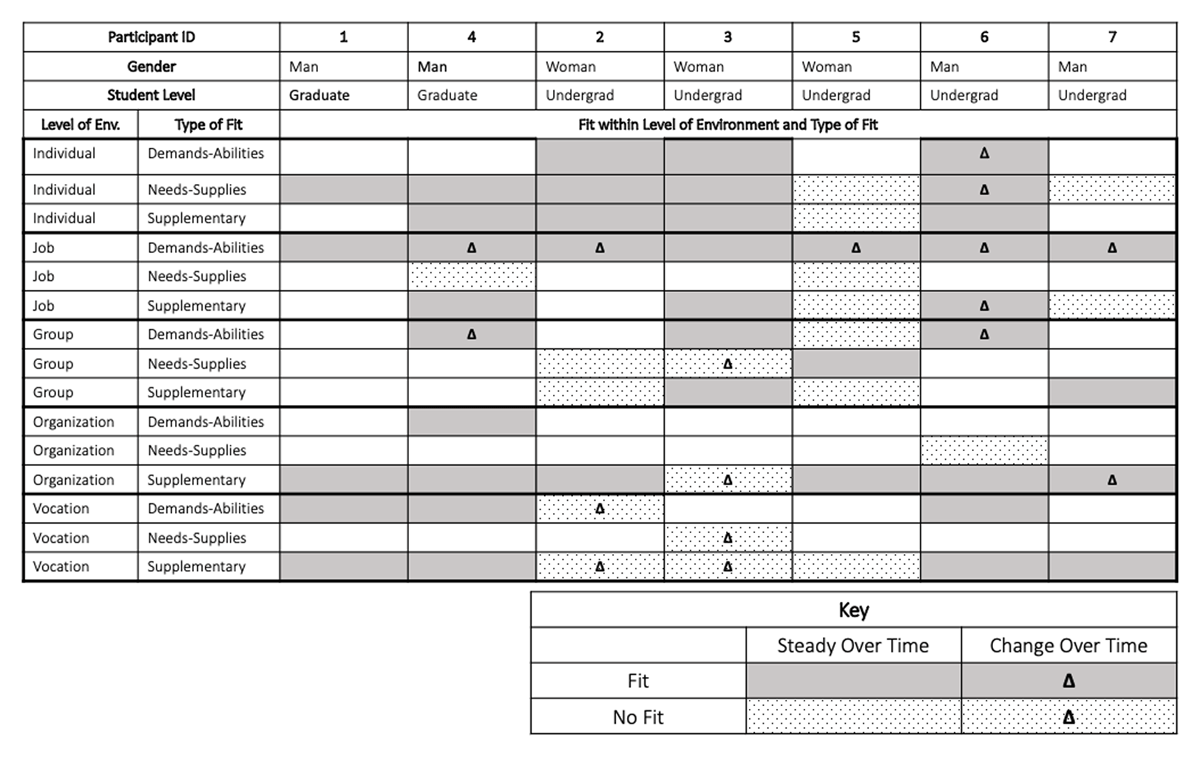
Figure 2
Summary of PE Fit constructs as they appear across narratives.
Person-Individual Fit
All the participants discussed their relationships with their assigned research mentors and, in some cases, mentoring relationships they forged on their own as a central part of their narratives. The narratives described how they assessed their fit with these individuals and how these relationships influenced their overall experience. For example, several students assessed needs-supplies fit within the whole research experience based on whether their assigned research mentor was consistently available and provided guidance on their projects. Some students with more hands-off mentors described this situation as a negative experience which led them to assess a lack of fit within the overall program. Other students’ narratives reflected changes over time because they were able to find more consistent support from someone other than their assigned mentor, such as another principal investigator or a graduate student. Participant 2’s narrative represents this mentoring challenge well:
One of the highlights of my summer was working closely with the PhD student on my project. I remember the moment where he came up to my desk and asked, “Hey would you want to work on this for me?” It was so satisfying to have that acknowledgement, because I didn’t ever talk to the faculty advisor I had been assigned, which was very upsetting. But this PhD student took me under his wing, explained everything to me, and really went out of his way to make me feel like I was working towards something. I would have had a miserable time if he had not stepped up to that role.
This excerpt captures Participant 2’s frustration with a hands-off faculty mentor, and the impact that a supportive, hands-on mentor can have on a students’ experience. Participant 2 went on to reflect: “I realized that which project I worked on didn’t matter as much as having a supportive mentor. Getting that one-on-one interaction where he could answer my questions was way more important than being on a specific project.”
Most participants also described supplementary fit with their research mentors in their narratives, where most of them assessed a successful fit. Students experienced supplementary fit when their beliefs about mentorship aligned with the researcher or graduate student’s approach to mentorship. For example, in Participant 3’s narrative (shared previously), they described a positive experience with a research mentor who gave them responsibility for essential research tasks, allowed them space to make mistakes, and got to know them personally. The student described how having the trust of their research mentor to collect data made the student feel more confident in their abilities. In contrast, another student (Participant 5) cited a negative interaction where they felt unwelcomed and judged by a research mentor:
The first week we were in Australia, we met all the mentors and supervisors and they encouraged us to go to every meeting we could. So, we went to two different research group meetings. In the second week, me and [Participant 7] were walking in to one of the meetings and one of the supervisors asked us, “Why are you guys here? Why are you coming to this meeting?” Me and [Participant 7] were shocked, because I felt like we were encouraged to go to every meeting and go to everything. After that, me and [Participant 7] never went to the meetings again because we just didn’t feel welcome. It was really frustrating, because they were the ones who were telling us to attend meetings and then they shut us down. I was really frustrated and I just tried to avoid this person for the rest of the program, because, not to be stereotypical, but he was a man. Sometimes I felt like when we were in groups, this man wouldn’t look me in the eyes, he wouldn’t really acknowledge me, and I felt like I wasn’t wanted in that situation.
This experience discouraged the student from attending research group meetings, which demonstrates how students’ perceptions of fit with one level of the environment (i.e., individual) can intersect with their experiences at another level (i.e., group). Further, this experience demonstrates how a negative experience can activate stereotypes and lead students to feel like they don’t belong or fit. In summary, every participant discussed person-individual fit in some capacity, reflecting on both positive and negative experiences of working with their assigned research mentors.
Person-Job Fit
Short-term research experiences allow students to try out research, often discovering for the first time what the job of research entails. In this study, we define job as the research tasks that students completed. Within this level of the environment, all the students described demands-abilities fit, meaning they felt that they could successfully complete their research tasks. Although many participants described feeling overwhelmed or intimidated by their assigned tasks early in the program, they all gained confidence as the summer progressed. For example, students who completed fieldwork (such as Participant 3) developed more confidence in their fieldwork skills (e.g., conducting data collection in the field, coordinating fieldwork logistics, analyzing field data) by the end of the program. For example, Participant 3 said:
I also learned some technical skills over the summer that I am already using in assignments, such as how to use ArcGIS and certain instruments. It’s nice to be like, “oh yeah, I recognize that.” Sometimes it’s intimidating to go into research because they have all these fancy instruments. Since I came back, even if I don’t totally know what I am doing, I am confident that I can handle it.
A few students identified a supplementary fit with their assigned research tasks because they were interested in and passionate about the projects and tasks on which they were working. These students, including Participant 3, enjoyed their research tasks and felt that their personal values and interests aligned with their work. As Participant 3 said:
One of my favorite experiences from this summer was working on a project that was trying to measure pesticide concentrations in different areas. This project was really interesting to me, something that I am genuinely passionate about. I had really wanted to do something with farming and water, so this project fit perfectly.
On the other hand, a few students experienced a lack of supplementary fit with their research tasks. For example, Participant 5 realized that they prefer being assigned tasks with deadlines rather than setting their own schedule and priorities:
You decided what your work was. You got a project and then you had to figure out how to approach it. No one was going to say, here, do this task, this task, this task, this task. You had to decide that on your own. […] I think I learned that I like having tasks with deadlines. I think it motivates me a little more than them saying, “Oh, go do whatever you want. Here are six papers. Go read them in your free time.” I tended to think, “I have time to do that,” and then I got kind of discombobulated. So definitely having tasks and deadlines is something that I’ve realized is more for me.
Another student had hoped for fieldwork experience going into the program, and not getting that experience led them to feel ill-equipped to assess whether their interests aligned with fieldwork tasks. Similarly, a few students described wanting more support in completing specific research tasks, which led them to identify a lack of needs-supplies fit. For example, Participant 4 (narrative shared previously) was tasked with organizing a fieldwork project but had little support in figuring out how to take the lead on this type of research project. Participant 5 also struggled with a lack of support, saying, “I expected a little more guidance, given that this was my first research experience.” These students ultimately found that they could contribute meaningfully to their projects (i.e., they identified demands-abilities fit) but wished the process of achieving these contributions had been more supported. In summary, every student narrative reflected an assessment of person-job fit with the research tasks they were assigned during the program. The program provided students with opportunities to assess what types of research tasks they enjoyed and the kinds of tasks they felt confident carrying out.
Person-Group Fit
The IRES program aimed to connect participants with existing research groups at the host institution and students also participated in smaller groups focused on specific research projects. Because of the program’s structure, we defined the group level of the environment as encompassing both interactions within research groups and specific project teams. Several participants commented on demands-abilities fit within the context of their research groups, primarily reflecting on the collaborative nature of research work. The participants who experienced fit in this environment enjoyed working with graduate students in their research groups (as demonstrated in Participant 4’s narrative) and credited their collaborations with helping them gain confidence in their ability to do research. For other participants, like Participant 5, working with graduate students was helpful but ultimately not enough to establish fit:
I was told when we got there that the PhD students didn’t really know we were coming until about a day or two before we came. The PhD students seemed really eager to help us and it wasn’t hard for them to take us along out in the field. But it just didn’t really work out. I think working with the PhD students was a highlight of the program. The supervisors seemed really busy, and the PhD students were more accessible.
Interactions with graduate students also contributed to some participants’ assessments of needs-supplies fit. Developing these connections helped the IRES participants integrate with the larger research groups professionally and socially. In contrast, some students experienced a lack of needs-supplies fit during group projects where they felt their project leaders did not provide enough information for them to be able to meaningfully contribute to the project (as in Participant 3’s narrative). It is notable that although these positive and negative assessments of fit both stem from interactions with individuals, they led IRES participants to make assessments about the level of support within the larger research or project group.
Several participants also commented on supplementary fit within their research and project groups. The students who experienced fit found that their values aligned with the group dynamics they experienced, such as Participant 3 who enjoyed being part of a project group where communication was clear and everyone was treated as an equal. In contrast, some students found that their values clashed with their perceptions of certain groups. For example, one student described wanting to be more involved with brainstorming and decision-making for a group project where they observed the leader trying to do it all themself. This experience did not align with the student’s desires to be treated as a trusted and valued member of the team and to gain a deeper understanding of the project. Nearly all students’ narratives reflected an assessment of person-group fit within either a formal research group or a specific project team. Students’ experiences varied in these settings, frequently based on interactions students had with individuals (especially those perceived as group leaders).
Person-Vocation Fit
Undergraduate research experiences often serve as a way for students to test out the idea of going to graduate school and determine whether research as a vocation appeals to them. Every student in our study described assessing their supplementary fit with research as a vocation, questioning whether their personal interests and values fit with research as a future career. Most of the students described how the IRES program helped them understand that the purpose of research was generating new knowledge and exploring questions no one had answered before. For some students, this conception of research excited them and confirmed that graduate school would be a good path. For example, Participant 1 said: “My summer research experience also reinforced my choice to go to grad school. I gained an appreciation for the research process and how it positively affects the real world.” This assessment of supplementary fit often aligned with experiences of demands-ability fit, where students shared feelings of accomplishment and pride about the work they had completed over the summer. Students in this group described successfully carrying out fieldwork data collection, independently managing a project, and coordinating a team of students on a project (as in Participant 4’s narrative). Their success at completing these tasks and enjoyment in doing so affirmed their plans to attend graduate school and in some cases led them to discuss a potential career in academia (including Participant 4).
On the other hand, some students found the uncertainty of pursuing unexplored questions uncomfortable or simply not aligned with their interests. Although these students had entered the program intending to pursue graduate school, by the end of the program they had concluded that they would prefer an industry career, at least in the near term. For example, Participant 2 reflected:
I had always planned on going to graduate school with the idea that I would end up working in industry. On my project this summer we collaborated with an engineer at a government agency and now I have a better understanding of the roles of researcher versus engineer. I definitely feel like I would prefer to be in the engineering role because you have more power to take action rather than spending so much time asking questions. Some people are able to deal with all those open-ended research questions, but I would rather have more discrete answers. I see the benefits of research, but I would rather be the one getting the answers from the researchers and then figuring out the solutions from there.
In some cases, students made this supplementary fit assessment based on a desire for a more structured work environment, describing a desire for more specific tasks to complete rather than open-ended problems to solve. In another case, Participant 3 connected their assessment of supplementary fit with a discussion of needs-supplies fit. This student felt that they could hypothetically fit with research as a vocation if they could identify a research topic that they were passionate about. The work completed during the IRES program did not meet this need, so the student began thinking about other research topics that might be a better fit. In summary, every student narrative reflected an assessment of person-vocation fit with research as a potential vocation based on their developing understanding of the purpose and process of research.
Person-Organization Fit
Given the nature of the program and how students described macro-layers of their experience, we defined the organization level of the environment as the Australian national context instead of the specific university environment. Given the relatively short-term nature of the experience (i.e., only one stint of approximately eight weeks), students had few opportunities to connect with other entities within the university. Rather, students were encouraged to spend their free time interacting with the broader Australian context, and nearly all students engaged throughout the community. Only a few students commented on demands-abilities fit or needs-supplies fit at this level of the environment. Each of these cases can likely be explained by longer durations in-country or multiple years of engagement in the program for these individuals. For example, Participant 4 indicated that they experienced demands-abilities fit in that they felt comfortable navigating an international research environment, which may be related to the fact that this was their second time participating in an international research experience.
All students commented on supplementary fit, although these assessments are relatively surface-level observations of fit with the Australian culture. Generally speaking, students perceived a fit with the Australian culture and particularly appreciated the pervasive view of a work-life balance that prioritized “life” more than what they were familiar with in the US context. Only Participant 3 did not ultimately identify supplementary fit, which the student largely attributed to differences in humor between the US and Australian contexts that they did not appreciate. Students by and large appreciated the less structured, more casual way of life that they perceived permeated across Australian culture. Many pointed to changes in rigidity that they hoped to make in their own routines upon returning to the United States. However, there was a clear paradox between this observation and students’ comments about their work time, during which nearly all commented on preferring more structure and direction. We cannot speak to whether this perception of work is a function of relatively new researchers who are still learning to adjust to ambiguity, flatter organizational hierarchies, and an ill-structured problem environment or if there is a disconnect between the students’ expressed preferences within “work” culture compared to “work-life balance” culture.
Patterns across Narratives
In addition to considering the extent to which participants’ narratives suggested a fit within each level and type of the PE Fit framework, we also observed two distinct patterns across participants based on individuals’ characteristics. First, in our sample, women students’ narratives were most consistently characterized as lacking fit or a shift in the negative direction within the group and vocation categories (we note that all the research mentors directly engaging with these students were men). This pattern seems to reflect negative, gendered situations that the women experienced while abroad. For example, Participant 5 experienced a supervisor who would not look her in the eyes and would not acknowledge her. This behavior from the supervisor led the student to feel that she was unwelcome. This participant decided to “be the bigger person and move on,” but continued to experience a lack of mentorship that persisted throughout her time abroad. Importantly, we are not claiming that experiences within these particular research groups directly led to any decisions about a future desire to engage in industry or graduate school—indeed, some participants alluded to the nature of open-ended research work being more or less aligned with their work preferences. However, this pattern of gender and fit along with the instances of sexism that the women in our sample described is important to acknowledge. This pattern is aligned with decades of research findings documenting a “chilly climate” towards women in engineering, wherein women experience “negative interpersonal relations, subtle and overt denigration of skills, attribution of attainment to affirmative action policies, avoidance of eye contact, favoritism toward male and majority students, sexual harassment, and, in the workplace, a dearth of opportunities to advance, failure to be recognized for contributions, and wage disparities” (Lichtenstein et al. 2013, p. 321).
Second, we observed differences in perceptions of fit based on whether students were graduate students or undergraduates. The graduate students tended to identify a fit with each level of the environment. These more seasoned researchers seemed to be more accustomed to the open-endedness of research tasks in this kind of unstructured environment. Undergraduate students, however, were more likely to perceive a lack of fit and had wider gaps between their past educational experiences and their experiences within this environment. There appeared to be a much greater need for scaffolding and adjusting, which happened for a few undergraduates but not to the same extent across participants. These differences in experiences based on students’ characteristics suggest several implications for the design of future programs.
Discussion
In this study, we sought to identify narratives of researcher development for students participating in a summer research program in Australia. After constructing the seven narratives, identifying categories of significant experiences, and considering the variation across students, our major finding in this analysis is the recognition that PE Fit is important for understanding researcher development. Interpreting the narratives through this framework provided structure for understanding how students’ varied interactions with different levels of their environment influenced their overall perceptions of research and future career plans. For example, some students felt that having a strong research mentor outweighed challenges at other levels, whereas others found that conducting specific research tasks was more significant for learning about research. Our findings suggest that assessing fit with the research environment is part of the researcher development process. We contribute a new perspective on researcher development by considering the environment, which has not been explored explicitly in previous work.
Overall, these narratives of researcher development present an in-depth view into the different kinds of experiences that can be significant in research programs like IRES and suggest several implications for the design of future programs. At a high-level, our study suggests that it is important to consider the various levels of a student’s experience when designing programs. Although prior research has addressed the importance of research mentors in undergraduate and graduate research experiences (e.g., Taraban et al. 2008; Thiry et al. 2011), there has been less focus on research groups or specific research tasks (e.g., fieldwork) as significant experiences in researcher development. The significant experiences we identified in our participants’ narratives align with findings from Evans (2011) indicating that small episodes can spark researcher development as well as research from Åkerlind (2008) highlighting the importance of viewing researcher development as a series of processes over time. Our results join findings from prior research indicating that these research experiences are highly formative for students’ considerations of further graduate study (Seymour et al. 2004) and development of confidence as a researcher (Faber et al. 2016; Thiry et al. 2011, 2012). As in previous work, the narratives illuminate how a range of activities support students’ researcher development (Coryell et al. 2013; Faber & Benson 2015; Mantai 2017; Thiry et al. 2011), with a particular emphasis on relationships and interactions with other researchers (e.g., Baker & Pifer 2011).
Our findings move beyond some of the prior engineering education work grounded in researcher identity frameworks that have focused on research projects and processes (Faber et al. 2016) or students’ perceptions of research (Faber et al. 2020; Faber & Benson 2015) and illuminate the process of researcher development more holistically to consider the broader contexts within which students work. Research of such programs tends to view the program in isolation rather than as situated within a larger environment. Our study was set in the Australian national context, which influenced students’ experiences both inside and outside the research environment. Most of the students reported enjoying the more laid-back Australian culture during their free time, but some were uncomfortable when they experienced it within the work environment. Even in programs without an international component, high-level contextual factors such as institutional culture, geographic location within a home country, or a shift between urban and rural settings could contribute to students’ experiences and ultimately their development as researchers. Interpreting these kinds of programs using the PE Fit theoretical framework provides an opportunity to support future research along these lines by characterizing the environment in which an individual will operate. This framework brings a new perspective on researcher development, acknowledging that the development does not happen in a vacuum. Considering both the person and the environmental context informing their development and decision making is essential to understanding, for example, why trends of underrepresentation persist in academic careers (Gibbs et al. 2014).
Our findings also illuminated how student characteristics related to their narratives, where undergraduates and women were less likely to find fit in the research environment relative to graduate students and men. We saw evidence of incremental shifts in researcher development for each student over the course of their longitudinal interviews, which is consistent with Evans’s (2011) view of researcher development that emphasizes a combination of attitudinal, behavioral, and intellectual development. However, the broader pattern of difference between undergraduate and graduate students provides evidence of researcher development as conceptualized by Willison and O’Regan (2007). These differences based on student level and prior research experience may be illuminating participants who were at different stages of skill development along the continuum from closed-ended inquiry with significant guidance to self-determined, open inquiry. For the gender-related patterns, women’s perceptions of a lack of fit in professional group settings within engineering have long been pointed to as problematic and associated with departures from the field (National Academies of Sciences, Engineering, and Medicine 2018). Although none of the women in our study alluded to wanting to leave the field, the distinct gender patterns for group and vocation fit are notable. In addition to research on problematic cultures for women within the field of engineering, there have also been recent spotlights highlighting problematic cultures for women within Australian professional environments, even within the highest levels of government (Australian Human Rights Commission 2020). We did not observe gender differences for the organization category, but it is plausible that the group category captured intersecting factors that affected women students’ perceptions—the specific group culture, the engineering field culture, and the professional work environment within the Australian context. Although our study showed how gender-based marginalization culturally influenced students’ experiences within this international research context, our findings have implications for how researchers and practitioners should consider other forms of marginalization in other research contexts. For example, racially minoritized students engaging in research labs within a predominantly White institution within the United States might face similar environmental fit concerns.
Our study also has several implications for the development of future research experiences for students. First, it was evident in our study that students often use a specific experience (e.g., one IRES program) as an opportunity to assess a potential career path. Thus, we must provide students with insights about how this specific experience does or does not fully represent the options available to them along that career path. Second, we found that a lack of needs-supplies fit or demands-abilities fit could cause a student to conclude that there was also a lack of supplementary fit in their research experience. That is, if there was insufficient support and/or not enough challenge in their IRES experience, some students concluded that they did not enjoy research. It is therefore important to design research programs to align the program activities with the students involved, balancing challenge and support according to their prior experiences and research skills (Sanford 1967; Terenzini 1999). In cases like IRES, ensuring this alignment will require communicating with research mentors to understand their expectations and selecting students based on those requirements and/or providing additional support so that students are prepared. Third, our study emphasizes that although aligning expectations between students and research mentors is important, program designers can also improve students’ experiences by paying attention to other aspects of the research environment, such as access to different research tasks and a supportive research group. Overall, the more research experiences can improve needs-supplies fit and demands-abilities fit through intentional program design, the easier it will be for students to make an accurate assessment of supplementary fit with research as a potential future career path.
Although we recognized after completing the narrative analysis that PE Fit was a useful way to interpret the narratives and explain important elements of researcher development, we believe this theoretical framework can provide useful insights in engineering education more broadly. Future research should consider using it to guide study designs and analysis from the outset. In contrast to other frameworks that consider individuals or environments in isolation, PE Fit focuses on the interactions between these two entities, a perspective which may help address ongoing concerns about diversity, equity, and inclusion in engineering education, for example. By characterizing different levels of an environment, the PE Fit framework provides granularity in assessing potential issues in an environment beyond a vague sense of cold climate. Further, by describing different types of fit, this framework introduces more nuanced terminology that can inform data collection protocols (and subsequent interventions) so that they can become more tailored to all aspects of a specific environment. The greater nuance and granularity of the PE Fit framework in describing environments also allows for more individualized assessments of fit along the various dimensions. Together these characteristics could provide unique insights in future research and practice in engineering education contexts.
Additional File
The additional file for this article can be found as follows:
Supplemental Material. Additional Narratives.
Funding Information
This project was funded through the National Science Foundation grant #OISE-1658604.
Competing Interests
The authors have no competing interests to declare.