
Table 1
Participant demographic information.
| PARTICIPANT DEMOGRAPHIC INFORMATION | N (%) |
|---|---|
| Gender (participants self-identified in response to the question, “What is your gender?”) | |
| Male | 30 (69.8) |
| Female | 13 (30.2) |
| Race/Ethnicity (participants self-identified in response to the question, “What is your race/ethnicity?”) | |
| White or Caucasian | 31 (72.1) |
| Asian | 5 (11.6) |
| African American or Black | 3 (7.0) |
| Prefer not to specify | 2 (4.7) |
| Other | 2 (4.7) |
| Industry/Field | |
| Medical devices | 15 (34.9) |
| Orthopedics | 14 (32.6) |
| Pharmaceuticals | 14 (32.6) |
| Years of Engineering Experience, Overall | |
| 0–9 years | 20 (46.5) |
| 10–19 years | 7 (16.3) |
| 20–29 years | 10 (23.3) |
| 30–39 years | 4 (9.3) |
| 40+ years | 2 (4.7) |
| Years of Engineering Experience, Current Field | |
| 0–9 years | 25 (58.1) |
| 10–19 years | 9 (20.9) |
| 20–29 years | 6 (14.0) |
| 30–39 years | 3 (7.0) |
| 40+ years | 0 (0.0) |
| Job Role | |
| Product development | 20 (46.5) |
| Manufacturing | 12 (27.9) |
| Research | 10 (23.3) |
| Quality assurance | 6 (14.0) |
| Regulatory | 4 (9.3) |
| Other (e.g., distribution, capital projects) | 6 (14.0) |
| Highest Academic Degree | |
| Some college | 2 (4.7) |
| Bachelor’s degree | 15 (34.9) |
| Master’s degree | 18 (41.9) |
| Doctoral degree | 8 (18.6) |
| Academic Major | |
| Biomedical engineering | 15 (34.9) |
| Mechanical engineering | 12 (27.9) |
| Chemical engineering | 6 (14.0) |
| Electrical engineering | 5 (11.6) |
| Other | 5 (11.6) |
Table 2
Critical Incident Categories and Types.
| CATEGORY | DESCRIPTION | INCIDENT TYPES | INCIDENT TYPE DESCRIPTIONS |
|---|---|---|---|
| 1. Cultural Immersions | Learning from working in and observing multiple facets of a culture | Workplace cultures | Experiencing the continuous and interconnected reinforcement of organizational culture throughout one’s company |
| Role immersions | Taking on a specific organizational role and engaging with specific ethical situations, activities, or responsibilities | ||
| Cumulative experiences | Encountering ethics in the workplace in numerous ways and over significant periods of time | ||
| Cultural comparisons | Comparing aspects across multiple organizational cultures, such as norms, practices, or values | ||
| 2. Interpersonal Encounters | Learning from interactions and relationships with others | Questionable behavioral observations | Observing behaviors of colleagues or superiors which are ethically questionable |
| Difficult collaborations | Engaging with distinct perspectives and navigating disagreements | ||
| Distinct perspective observations | Observing distinct ways of thinking about ethics and juxtaposing with one’s own way of thinking | ||
| Non-belonging encounters | Engaging with others who act in ways that make one feel like they do not belong | ||
| 3. Ethical Actions | Learning from acting in ways that represent ethical behavior | Steadfast actions | Staying the course of an action which one perceives to be ethical |
| Uncertain actions | Working through uncertain and (often) novel ethical challenges | ||
| Inconvenient actions | Overcoming internal turmoil and acting in a way that one perceives as ethical | ||
| Critical questions | Asking critical questions about ethics in engineering practice | ||
| 4. Ethical Failures | Learning from actions that led to non-ideal ethical outcomes | Personal failures | Experiencing an inability to act in a way that one perceives as ethical |
| Technical failures | Experiencing technology functioning in unanticipated ways | ||
| 5. Mentorship Events | Learning from mentoring or provisions of guidance | Receiving mentorship | Receiving mentorship to support one in working through ethical challenges |
| Providing mentorship | Providing mentorship to encourage others’ ethical practice | ||
| Managing employees | Making managerial judgment calls pertaining to human resources |
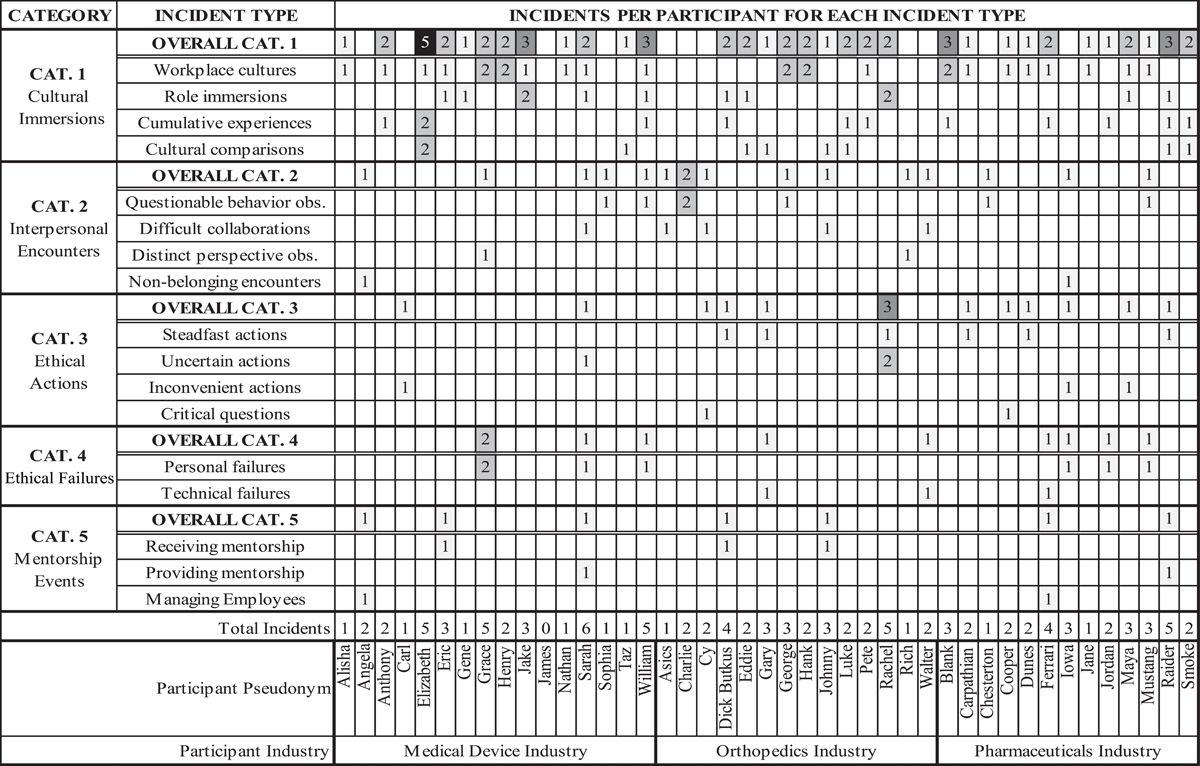
Figure 1
The Frequency of Incidents within Category and Incident Type by Participant. Note 1: Darker cells represent more incidents grouped to the category or type. Note 2: Participants are grouped by industry sub-strector. These findings reveal similar incidents across sub-sector.