
Introduction
Each day, engineers make decisions that will affect the health and well-being of numerous stakeholders. Not surprisingly, then, accredited engineering programs (ABET, n.d.) are required to prepare students to make ethical decisions in their future practice. Scholars have argued that such instruction should account for both micro-ethical and macro-ethical implications of engineers’ work (Herkert, 2005), and ABET (n.d.) accreditation itself emphasizes micro- and macro-ethics. As ABET indicates, programs must prepare students for “an ability to recognize ethical and professional responsibilities in engineering situations and make informed judgments, which must consider the impact of engineering solutions in global, economic, environmental, and societal contexts.” Beyond these requirements, many authors have argued that ethics pedagogy in engineering can be improved to better represent the sociotechnical complexities of engineering practice.
Case studies are one prominent approach to ethics instruction in engineering to meet these goals (Herkert, 2005; Hess & Fore, 2018; Martin, Conlon, & Bowe, 2021b). Case studies, however, often over-simplify the complexity of ethical decisions and thus may not actually address the foundational ABET outcomes or similar learning goals (Bucciarelli, 2008; Conlon & Zandvoort, 2011; Lynch & Kline, 2000). One way to ensure that case studies accurately represent ethical engineering practice is to share and employ empirical data on practitioners’ experiences with this phenomenon. To that end, by synthesizing and sharing critical incidents that informed practitioners’ ethical practice, we hope this research can better position instructors to design cases and curricula more closely aligned with workforce experiences. Instructors can directly use the critical incidents shared in this study to introduce practitioner stories into the curriculum thus integrating perspectives from engineering practice that reflect “real-world” experiences (Huff & Frey, 2005; Martin et al., 2021b).
In this study, we aimed to understand what aspects of workplace experiences influenced how engineers came to view ethics in their practice. To achieve our aim, we employed Critical Incident Technique (CIT). Flanagan (1954) offered CIT as a methodology to identify how individuals come to experience an aspect of reality, such as ethics. Following a discussion of its roots in aviation psychology, Flanagan noted that CIT played a key role in developing the code of ethics for the profession of psychology; he cites the American Psychology Association’s (APA) Committee on Ethical Standards’ claim that “ethical standards must emerge from the day-by-day value commitments made by psychologists in the practice of their profession” (p. 347). Since then, CIT has been used to study individual growth in various ethical dimensions and in various disciplines (e.g., Hess, Strobel, & Brightman, 2017; Papouli, 2016; Silen, Kjellström, Christensson, Sidenvall, & Svantesson, 2012) in order to help ground discussions of ethics in the everyday practices of a discipline or profession.
This study uses CIT to identify what aspects of engineers’ experiences informed their ethical practice. We sought to identify experiences or “critical incidents” that influenced or changed practitioners’ ways of experiencing ethics. We use the term change broadly to refer to any shift, refinement, or reaffirmation in one’s understanding of ethical engineering practice. We addressed the research question, “What types of critical incidents influence engineers’ ways of experiencing ethical engineering practice?” Our focus in this study is primarily on the experiences that prompt change rather than the outcomes resulting from the critical incidents. With this said, we often include individual outcomes via the direct sharing and the thick description of the incidents themselves.
We theorize that promoting the ethical formation of engineering students requires building on how engineering ethics manifests in practice. Thus, in the literature review, we explore contemporary approaches to engineering ethics instruction. In the discussion, we infer alignment between engineering ethics pedagogy and engineers’ critical experiences and offer synergies and opportunities for teaching ethics therefrom.
Literature Review
This literature review includes three parts. First, we identify common instructional goals and strategies for teaching ethics to engineers. Second, we identify potential factors that influence how engineers understand, view, or experience ethics in their practice.
Instructional Strategies in Post-Secondary Engineering Ethics Education
Ethics education is an essential element of engineering education (Mitcham, 2009) and a required student outcome for accredited programs (ABET, n.d.). A recent systematic review of post-secondary ethics interventions in the US found that engineering ethics instructors tend to prioritize learning goals associated with ethical sensitivity and ethical reasoning (Hess & Fore, 2018). Martin, Conlon, and Bowe (2021a) offered a more expansive list of 11 possible learning goals for engineering ethics, including additional behavioral and affective-oriented learning goals, such as moral agency and action, moral character and virtuous development, and moral emotional development. Katz (2019) identified 18 goals of engineering ethics education, which included some of these goals but also more direct goals, such as “disaster avoidance,” “question decisions, practices, and processes,” and “ability to understand ethical issues beyond individual context” (p. 101). Thus, there are numerous goals that engineering ethics instructors aspire towards.
To meet ethics learning goals, the most common strategies for teaching ethics to engineers involve introducing case studies alongside codes, rules, or standards (Haws, 2001; Herkert, 2005; Hess & Fore, 2018; Rottmann & Reeve, 2020). As, the following review illustrates, these approaches, though valuable, often lack sufficient grounding in the factors that influence ethics development in practice, pointing to the need for more practice-based research. Thus in briefly describing these three strategies, we continuously consider, “To what extent do these strategies adequately reflect real-world contexts or experiences?”
Traditionally, as a part of a case study, students practice making individual judgments (Bairaktarova & Woodcock, 2015; Hess & Fore, 2018). For example, students might practice “drawing the line” (Harris, Davis, Pritchard, & Rabins, 1996, p. 94) between acceptable and unacceptable behaviors and resolving conflict between different values. Thus, students might consider tensions between individual, professional, and societal values or needs (Herkert, 2005). Martin et al. (2021b) offered a typology of ethics case studies which included five different scales for designing cases. Their taxonomy described variation based on micro-versus-macro contextual foci. For example, the “sphere” scale calls attention to “individual” versus “societal” issues, which align with micro and macro-contexts, respectively. Other scales included veracity (hypothetical versus factual), timeframe (historical versus real), duration (brief versus lengthy), and student role (predefined versus open). Importantly, other scholars have offered distinct case study taxonomies for engineering ethics instruction (Davis, 1999; Huff & Frey, 2005) that draw attention to numerous other facets.
While case studies are a common instructional strategy, they are oft-critiqued for their simplification of complex situations (Bucciarelli, 2008; Conlon & Zandvoort, 2011; Lynch & Kline, 2000). Lynch and Kline (2000), for example, critiqued case studies that have students analyze actions of individual moral agents, thus omitting a description or discussion regarding how organizational culture shapes practice. To counter that critique, Martin et al. (2021b) found that engineering instructors in Ireland preferred using “immersive case studies” which they defined as “realistic, experiential, relevant, engaging, provocative, facilitated properly, including various stakeholders, integrating ethical alongside technical or legal considerations, [and] based on real or real-time data and documentation.” This preference aligns with recommendations by Bairaktarova and Woodcock (2015) who indicated there is a need for “more complex scenarios with the involvement of practicing engineers who experience ethical issues first hand.” When case studies are sufficiently complex and when they sufficiently account for context, case studies can “promote discussion and alignment with practice” (p. 22). Thus, case studies may be deemed appropriate insofar as they sufficiently represent real-world complexity and engineers’ lived experiences, but research unpacking such real-world complexity remains limited.
This same limitation may apply to another common instructional strategy: having students engage with codes of ethics (Hess & Fore, 2018; Rottmann & Reeve, 2020). Codes of ethics offer a form of ethical guidance for engineers (Davis, 2006). Historically, public safety, health, and welfare have served as foundational ethical standards for engineering professionals (Davis, 1991). Thus, organizations such as the National Society of Professional Engineers (2019) codified these ethical obligations with canons like, “Engineers, in the fulfilment of their professional duties, shall hold paramount the safety, health, and welfare of the public.” Similarly, the first “professional obligation” in the BMES or Biomedical Engineering Society (n.d.) code of ethics stated that engineers shall “use their knowledge, skills, and abilities to enhance the safety, health, and welfare of the public.” While some authors have recognized limitations of codes of ethics (Riley & Lambrinidou, 2015; Smith, 2021), we follow Davis in acknowledging that codes can serve as a guide for practice by enabling engineers to act confidently and with the weight of their discipline behind them. While these codes may have emerged from and are designed to influence practice, in themselves, they often remain abstract rather than concrete.
Finally, ethical theories also play a role in ethics instruction, though findings vary regarding their use. For example, based on a literature review of ASEE papers between 1999–2001, Haws (2001) argued that theoretical grounding was another critical instructional strategy, albeit, he found it was often missing in the manuscripts he reviewed. Katz’s (2019) work on mental models in engineering education explored methods of teaching engineering ethics and, similar to Haws, there was a notable lack of presence of ethical theory. Conversely, Hess and Fore (2018) found that the use of ethical theories as instructional strategies were present in 42% of the articles they reviewed. While ethics codes can enable one to understand norms of the discipline, ethical theories can offer distinct perspectives of resolving ethical problems. Thus, theory has a role in ethics pedagogy, specifically for introducing new ways of thinking about ethical engineering to engineering students. Theories can help students interrogate ethical issues in ways that applying ethical codes alone will likely not (Riley & Lambrinidou, 2015). We argue that theories, like other instructional strategies, also require a deep understanding of practice in order to help students translate theories into meaningful action.
Regardless of which instructional strategy one uses, we argue that it is important to understand the factors that promote ethical engineering practice. In particular, since ethics instruction is intended to support student development, engineering instructors need a better understanding of what types of influences lead to changes in how engineers experience ethical practice. With such an understanding, instructors can design and implement ethical instructional strategies that align with important developmental factors derived from workplace experiences.
Potential Factors Influencing How Engineers Experience Ethics in Practice
While research on ethics in practice is limited, existing research does suggest some potential factors that influence how engineers experience ethics in practice: (1) engineering disciplinary culture; (2) organizational or company culture; and (3) individual attributes.
Disciplinary engineering culture influences how ethics is taught to engineers (Martin et al., 2021a) and is a potential influence on how engineers practice ethics in the workplace (Davis, 1991). While culture is a complex and much debated concept, we use the term here following Schein’s work, which defined the culture of a group as “a pattern of shared” and “taken-for-granted assumptions” that is apparent through “observable artifacts and shared espoused values, norms, and rules of behavior” (Schein, 2010, p. 32). Smith (2021) argued that codes of ethics provide “a clear window from which to observe the coevolution of shifting professional norms for engineers.” Thus, codes of ethics are both a common instructional strategy and a window into engineering culture. Davis (1991) argued that these codes inform what it means to be an engineering profession and, thus, provide “morally permissible” standards by which engineers ought to act. In Davis’s view, the codes offer guidance for practice, and thus serve as a cultural artifact that can influence how engineers act ethically in practice.
Similarly, organizational culture can influence compliance and ethical behavior for any individual within an organization (van Steenbergen, Ellemers, van Rooij, & Sokol, 2021). For example, with respect to engineering, Vaughan (2016) explored the challenger disaster and illustrated how organizational culture ultimately influenced decision-making in this case. Vaughan argued that NASA “normalized” high-risk technology through an early risk assessment wherein an “SRB [solid rocket booster] joint deviated from the performance predicted by the design” (p. 65). Yet, the company “negotiated the risk of the SRB joints” and then “normalized the deviant performance,” wherein what the team “first identified as a technical deviation was subsequently reinterpreted as within the norm for acceptable joint performance, then finally officially labeled as an acceptable risk” (p. 65). This eventually led to “decision-making patterns pertaining to technical components” wherein unacceptable risks were deemed acceptable. Thus, Vaughan highlighted how the organizational culture developed over time and, eventually, led to risk assessment judgments that were less conservative (and, as Vaughan argues, this less conservative decision-making trend was one primary reason the disaster occurred).
Finally, research suggests that ethical practice is also influenced by individual attributes such as moral judgment capacity (Borenstein, Drake, Kirkman, & Swann, 2010), character traits/virtues (Schmidt, 2014), or level of moral development (Gibbs, 2019; Rest, Bebeau, & Thoma, 2014). Moral judgment has historically been oft studied in organizations, and we use this as an example here. Moral judgment involves making decisions based on select frameworks or ethical theories (Van De Poel & Royakkers, 2011). One specific type of moral judgment involves risk assessment. As Whitbeck (2011) argued, risk assessment involves “a judgment about the acceptable level of risk” and “is implicit in any tradeoff of safety against other considerations” (p. 184). Thus, any event that involves risk assessment also involves moral judgment. Judgment, however, is, in part, personal, in the sense that it is based on many factors, including one’s “education and experience” (Davis, 2012, p. 792). Thus, individual judgment (like any individual attribute) can vary based on the diverse experiential histories of individuals.
Each of the above potential influences may act in concert to influence how one might view or practice ethics. For example, organizations may espouse certain norms for ethical practice, but these may require interpretation based on one’s discipline and prior experiences. To this point, Vaughan (2016) argued that engineers in the Challenger case followed “practice rules” which were “operating standards consisting of numerous ad hoc judgments and assumptions that are grounded in evolving engineering practice” and “are experienced driven” (p. 201). Engineers in the Challenger case thus made ethical judgments by balancing risks and company norms, and this balancing act was informed by their individual attributes, such as their perceptions of what constitutes acceptable levels of risk or what they viewed as normal or appropriate behavior within their organizational context.
Like organizational norms, engineering codes of ethics by themselves do not always provide event-specific guidance. For example, in Smith’s study, “[engineers’] professional norms held them accountable to both their corporate employers or clients and the safety, health, and welfare of the public, providing no guidance about what to do when those two accountabilities conflict” (p. 165). Thus, interpretations of a code of ethics may vary by individuals. In the case of a code of ethics, for example, two engineers might reach a different conclusion regarding whether to prioritize one’s employer or society when such a prioritization is needed to move forward in a project.
Aligned with this understanding, Kim (2022) described the dynamic interplay between organizational culture and individual attributes in ethical practice of engineers. Based on a synthesis of the different theories of moral formation (including Haidt, Hoffman, and Kohlberg; see Gibbs, 2019 for an overview of these moral developmental theories), Kim argued that engineers can leverage environmental factors to inform or shape the way they or others practice ethics in their workplace. For example engineers who are in similar career stages and working in similar environments can behave differently, thus reflecting their individual differences.
Summary of Literature Review
There are numerous potential influences that inform how individuals experience ethical engineering practice in the workforce. Yet, there are relatively few studies and contextually rich examples specifically on ethical engineering which are explicitly utilized to inform current ways of teaching ethics to engineering students. Taken together, these challenges support the need for more detailed investigations of ethical development in engineering practice. Through such investigations, we can better align practices for teaching engineering ethics with workforce experiences. To this end, in this study we focus on one specific industry, health products, to address the research question, “What types of critical incidents influence engineers’ ways of experiencing ethical engineering practice?”
Methodology
The following sections describe (1) positionality of authors, (2) context of the study and justification, (3) overview of Critical Incident Technique or CIT, (4) data collection, (5) data analysis, (6) CIT credibility and trustworthiness procedures, and (7) ethics and consent.
Positionality of authors
We designed this positionality statement based on the three themes offered by Hampton, Reeping, and Ozkan (2021), including (1): Disclosing Identities; (2) Disclosing Prior Experiences and Opportunities; and (3) Disclosing Journeys. Each author reflected on questions associated with each theme. Thereafter, we identified similarities and differences in author reflections.
We identified two primary similarities among authors: (1) research perspectives and (2) lack of workforce and health products experiences. First, we each attained (or, at the time of collecting and analyzing data, were currently pursuing) a PhD in Engineering Education from the same university. This training likely influenced our framing of the study scope, methodological strategies, presentation of findings, and direction of implications. To the latter point, we shared an express desire to improve engineering education strategies, both for ourselves and the broader community. Second, we each lacked experiences in the health products industry and had limited engineering workforce experiences. While this is a limitation, we also perceived it as a strength in that we were not overly biased as we did not bring preconceptions of what constitutes ethical engineering practice in this context nor what promotes changes in ethical practice. While we had limited experiences, we each felt that we brought connections and potentially transferable experiences to the study context, such as Hess and Kim who have previously co-taught or assisted teaching in biomedical engineering, Fila who participated in a biomedical engineering course as part of his undergraduate studies, and Kim who had prior training in chemical engineering and which she felt was linked to the biomedical applications.
We identified two primary differences among authors: (1) motivations for conducting this work and (2) demographic and cultural backgrounds. From the outset of the study, Hess expressed a primary desire to identify ways by which engineering ethics manifests both commonly and uniquely across disciplines; Kim expressed a desire for learning to conduct engineering education research, generally, with specific interests in engineering ethics and practice; and Fila served as a lead phenomenographer on the overall study and brought ambitions to apply phenomenography to a new context (health products) and phenomenon (ethical engineering practice). With respect to demographic and cultural backgrounds, two authors (Fila and Hess) were white males from the US and one author (Kim) was a female from South Korea; Fila and Hess were fluent in English whereas Kim was developing English fluency; the authors brought disciplinary backgrounds in civil engineering (Hess, BS & MS), chemical engineering (Kim, BS & MS), and electrical/computer engineering (Fila, BS & MS); and Hess and Fila were investigators on this project whereas Kim was pursuing a PhD and engaged in this work as a graduate research assistant and for graduate funding support.
Context of the Study and Justification
We recruited participants from the health products industry for three reasons. First, ethical issues in the industry are both relevant and prevalent, given their high visibility in the news (De Dobbelaer, Van Leuven, & Raeymaeckers, 2017), the potentially high positive and negative impacts resultant from ethical decision-making in this context (Lipworth, Kerridge, Morrell, Forsyth, & Jordens, 2015), and the necessity of adhering to industry regulations despite their oft-shifting nature (Blakely et al., 2022). Second, the focus on a single industry allows sufficient focus on ethical practice without undue variation across industries. Finally, the health products industry features a variety of engineering disciplines (see Table 1 below). We explored the health products industry by selecting participants from three different companies, each representing a different area of the health products industry (orthopedics, pharmaceuticals, and medical devices). By selecting three companies, we were able to explore a cross-section of the overall industry with variation in topic specialization, job role, and background. While we selected participants from this industry context, many participants brought forth experiences outside of health products. Thus, the critical incidents that we share in this study are primarily but not exclusively from health products.
Table 1
Participant demographic information.
| PARTICIPANT DEMOGRAPHIC INFORMATION | N (%) |
|---|---|
| Gender (participants self-identified in response to the question, “What is your gender?”) | |
| Male | 30 (69.8) |
| Female | 13 (30.2) |
| Race/Ethnicity (participants self-identified in response to the question, “What is your race/ethnicity?”) | |
| White or Caucasian | 31 (72.1) |
| Asian | 5 (11.6) |
| African American or Black | 3 (7.0) |
| Prefer not to specify | 2 (4.7) |
| Other | 2 (4.7) |
| Industry/Field | |
| Medical devices | 15 (34.9) |
| Orthopedics | 14 (32.6) |
| Pharmaceuticals | 14 (32.6) |
| Years of Engineering Experience, Overall | |
| 0–9 years | 20 (46.5) |
| 10–19 years | 7 (16.3) |
| 20–29 years | 10 (23.3) |
| 30–39 years | 4 (9.3) |
| 40+ years | 2 (4.7) |
| Years of Engineering Experience, Current Field | |
| 0–9 years | 25 (58.1) |
| 10–19 years | 9 (20.9) |
| 20–29 years | 6 (14.0) |
| 30–39 years | 3 (7.0) |
| 40+ years | 0 (0.0) |
| Job Role | |
| Product development | 20 (46.5) |
| Manufacturing | 12 (27.9) |
| Research | 10 (23.3) |
| Quality assurance | 6 (14.0) |
| Regulatory | 4 (9.3) |
| Other (e.g., distribution, capital projects) | 6 (14.0) |
| Highest Academic Degree | |
| Some college | 2 (4.7) |
| Bachelor’s degree | 15 (34.9) |
| Master’s degree | 18 (41.9) |
| Doctoral degree | 8 (18.6) |
| Academic Major | |
| Biomedical engineering | 15 (34.9) |
| Mechanical engineering | 12 (27.9) |
| Chemical engineering | 6 (14.0) |
| Electrical engineering | 5 (11.6) |
| Other | 5 (11.6) |
Critical Incident Technique or CIT
We used CIT (Butterfield et al., 2005; Flanagan, 1954) to investigate the research question, “What types of critical incidents influence engineers’ ways of experiencing ethical engineering practice?” CIT focuses on building a “functional description of an activity” (Flanagan, 1954, p. 336) through expert or participant review of experiences or events relevant to that activity and by identifying critical incidents related to this activity. Here, the activity was changing one’s lived understanding or way of experiencing ethical engineering practice in the workplace. Critical incidents represented key events, contextual features, or experiences that influenced such ways of experiencing.
This study builds on a prior phenomenographic study which investigated variation in ways of experiencing a phenomenon, ethical engineering practice. The study was guided by a non-dualist ontology, a key aspect of phenomenography (Bowden & Green, 2005; Marton & Booth, 1997). In this context, a “way of experiencing” exists as a relationship between the individual and a phenomenon and it is informed by individual-phenomenon interactions, including what the individual brings to those interactions and the features of the phenomenon available throughout interactions. Thus, one’s way of experiencing ethical engineering practice is not simply what one understands about the phenomenon (e.g., organizational norms, codes) nor simply the features of their encounters (e.g., types of ethical situations, actions taken), but dialectic between the two. As ethical engineering practice represents a complex relationship between an individual and a phenomenon that evolves over time, critical incidents may take many forms. For example, in a similar study, critical incidents spanned features of environments, outcomes of encounters, and approaches taken by individuals (Fila & Hess, 2018).
In CIT, critical incidents are also noted as events and features that can be determined as critical by expert observers (Butterfield, Borgen, Amundson, & Maglio, 2005; Flanagan, 1954). Often, participants identify critical incidents directly, including incidents that they have experienced or have observed in others. Ways of experiencing are complex and typically best extracted by external analysts through in-depth interviews and rigorous, iterative analysis (Bowden & Green, 2005; Marton & Booth, 1997). As such, participants are not necessarily well-positioned to identify changes in ways of experiencing ethical engineering practice in themselves or others. Given these considerations, this study relies on extraction of critical incidents from interviews with participants.
The interviews in this study featured prominent discussions of experiences related to a phenomenon (ethical engineering practice), thorough discussion of conceptualizations of the phenomenon, and explorations of connections between one’s way of experiencing and conceptualizations. In the context of applying CIT, the “expert observer” was the team of researchers analyzing interviews. The tool that we utilized to observe critical incidents was the interview itself. The critical incidents were thus accounts detailed and synthesized within the interview, wherein participants thoroughly described experiences and encounters with ethical engineering practice.
Data Collection
To recruit study participants, we distributed a short survey inquiring into participants’ background (see Table 1 for requested demographic information), availability to participate in an interview between 60-90 minutes, and contact information. We distributed the survey through contacts representing one of three companies in the health products industry. Company foci included orthopedics, pharmaceuticals, and medical devices (41, 40, and 35 survey responses were recorded from each subsector, respectively).
Among the survey completers, we purposefully selected interview participants with a goal of (1) stratifying demographics and background based on survey responses (refer to Table 1) and (2) capitalizing on potentially important variables not captured via stratification. As our sampling was constrained by the survey respondents, demographic responses do not represent equal distribution across variables.
Three lead interviews engaged in data collection, including two authors (Hess and Fila) and a co-investigator on a grant associated with this study (Zoltowski). As another measure of consistency, a co-interviewer (Kim) participated in most interviews. To facilitate synchrony among interviewers, we performed multiple pilot interviews, with each lead interviewer leading at least one pilot interview and then debriefing as a team. Throughout the process of interviewing, the team continually met and discussed any discrepancies, challenges, or promising aspects.
The interview started with a background section intended to provide a brief history of the participant’s practice. The background section aimed to develop rapport between the interviewers and interviewee. Next, participants described experiences with ethics in their practice. Here, we asked participants to share specific experiences related to ethics in engineering. Most participants shared two to three experiences they had in their workplace and, through an intensive line of question, reflected on these experiences in detail.
Third, participants shared their conceptual understanding of “ethical engineering practice.” We asked a staring question about their conception and several follow-up questions to further unpack this conception. Notably, this is also the section where we systematically asked change-oriented questions, including, “How have your views of ethics in engineering changed over time?” and “What experiences do you believe contributed the most to your understanding of ethics in engineering?” Responses to conceptual questions either elicited new incidents or provided context for incidents described earlier in the interview.
Finally, the interview closed with a summative section, wherein participants shared concluding thoughts, chose a pseudonym, and asked interviewers questions.
The interviews were audio-recorded and later transcribed using a third-party software. These automated transcriptions were later checked for accuracy and anonymity by Kim.
Data Analysis
We started analysis by extracting critical incidents from interview transcripts. To identify incidents, we utilized CIT (Butterfield et al., 2005; Flanagan, 1954). One researcher reviewed all interview transcripts as a whole and identified potential critical incidents. This process was guided by criteria identified by Butterfield et al. (2005), including (1) antecedent information, which provided context for a critical experience, (2) detailed description of influencing factor(s), which illustrated an experience or series of experiences that influenced (i.e., changed or solidified) an individual’s way of experiencing ethical engineering practice, and (3) outcome(s) of the incident, which depicted at least one clear shift, refinement, or reaffirmation in one’s way of experiencing ethical engineering practice. These incidents ranged in detail from one paragraph to multiple pages.
After Kim identified potential critical incidents, Hess or Fila reviewed each potential incident. While reviewing, Hess and Fila identified incidents that were potentially weak, incidents they felt should be removed, or incidents that they felt could be divided into multiple incidents. After discussing suggestions, we chose to retain 135 critical incidents. Later, we reduced these incidents to workforce-related incidents alone, thus omitting 29 incidents from further analysis. Thus, 106 incidents became the final units of analysis for this study.
With these 106 critical incidents, we next performed content analysis (Krippendorff, 2012) to address our research question. One coder (Hess) initially focused on a subset of interviews and began grouping similar critical incidents without relying on existing literature or frameworks. As incidents were grouped together, the coder began narrating incident types, noting common factors present in incidents that influenced how one experienced ethics in their practice. Similar incidents were then grouped into broader categories.
Once coder 1 generated an initial draft of influence types and categories for 25 interviews, coders 2 and 3 (Kim and Fila) utilized the suggested categories and types as a deductive framework and coded incidents from these interviews without looking at coder 1’s application of codes. Next, all researchers discussed discrepancies between their coding of the 25 interviews through several meetings until they reached complete agreement for the grouping and description of incident types and categories. Finally, the research team repeated these steps with the remaining 18 interviews.
Thus, we employed an iterative coding procedure wherein the description of the categories and types evolved throughout the review, re-categorization of incidents in types and categories, and discussion processes. We developed agreement on the categorization of incidents extracted from all 43 interviews into incident types and categories.
In this study, we do not provide a synthesis of outcomes resultant from critical incidents. At least one outcome was a requirement of critical incident retention, but the incident types and categories reported in this study focus on influences. Nonetheless, in the results sections, we report exemplary incidents, and the incidents we describe generally contain outcomes resultant from individual critical incidents.
Credibility and Trustworthiness Procedures
As critical incident technique has moved away from its positivist roots, at least nine methods of checking credibility and trustworthiness of critical incident studies have been developed to ensure critical incidents are authentic to and robustly represent the domain of study (Butterfield et al., 2005). These methods, or what Butterfield et al. (2005) called “checks,” include the following:
Extracting critical incidents from data by an independent expert
Cross-checking critical incidents and incident categorization by participants
Categorizing subsets of critical incidents by independent judge(s)
Ensuring saturation of incident categories
Reviewing incident categories by field experts
Ensuring sufficient participation rate in each incident category
Scrutinizing results based on extant literature and theory
Ensuring accurate data recording/transcription
Checking interview fidelity by independent expert(s)
We employed eight of these nine methods. We omitted check number two, participant cross-checking, as checking critical incident categories and specific incidents was infeasible for every participant. Due to the nature of the target domain (changes in one’s way of experiencing ethical engineering practice), it was more relevant to have the research analysts immersed in the data ensure the relevance of the incident categories and check the fit between participants’ critical incidents and their appropriate classification into incident types and categories.
We generally met the criteria for each check set forth by Butterfield. One exception was to number six, wherein Butterfield et al. (2005) indicated that 25% of participants ought to share incidents associated with a category. For context, in this study, we present both incident categories and incident types, wherein we grouped multiple types within each category. At the category level, Categories 1, 2, and 3 meet the threshold. In contrast, Category 4 (Ethical Failures) included 20% of respondents and Category 5 (Mentorship) included 16% of respondents. The incident types nested within categories generally did not meet this threshold. Thus, the categories that we present in this may be deemed more trustworthy than the individual incident types. Nonetheless, we present incident types as they offer what we feel is important specificity and they convey the variation of influences associated with each category.
In addition to the traditional checks of CIT credibility identified above, we employed two additional methods: pragmatic validation (Walther, Sochacka, & Kellam, 2013), communicative validation (Walther et al., 2013), and persistent team approach. To achieve pragmatic validation, we employed a consistent lens throughout analysis by focusing on the practical use of the findings in engineering education. To achieve communicative validation, we elicited feedback from members of our research team and advisory board. Moreover, we reported early results from a subset of participants and received feedback from the engineering education community (Kim, Fila, & Hess, 2020). With respect to persistent team approach, we continuously and iteratively tasked three researchers with coding data independently. We were able to collaboratively reach agreement among all coders for any discrepancies and the identification and categorization of incidents thus represents shared agreement across all three authors.
Ethics and consent
This work involves research on human subjects and was reviewed and approved by an ethics committee at Purdue University, IRB Protocol #1706019324.
Results
We identified 106 critical incidents, which represent specific workforce experiences that led to a change or reinforcement in engineers’ understanding of ethical engineering practice. As a first-order classification scheme, we grouped critical incidents into 17 incident types which represent common contextual details, types of events, or types of behaviors that led to a change or reinforcement. As a second-order classification scheme, we grouped incident types into five incident categories, which represent key characteristics of learning experiences across similar incident types.
In Table 2, we describe the categories and associated incident types. The five categories included: (1) Cultural Immersions, (2) Interpersonal Encounters, (3) Ethical Actions, (4) Ethical Failures, and (5) Mentorship Events. Each category included two to four incident types.
Table 2
Critical Incident Categories and Types.
| CATEGORY | DESCRIPTION | INCIDENT TYPES | INCIDENT TYPE DESCRIPTIONS |
|---|---|---|---|
| 1. Cultural Immersions | Learning from working in and observing multiple facets of a culture | Workplace cultures | Experiencing the continuous and interconnected reinforcement of organizational culture throughout one’s company |
| Role immersions | Taking on a specific organizational role and engaging with specific ethical situations, activities, or responsibilities | ||
| Cumulative experiences | Encountering ethics in the workplace in numerous ways and over significant periods of time | ||
| Cultural comparisons | Comparing aspects across multiple organizational cultures, such as norms, practices, or values | ||
| 2. Interpersonal Encounters | Learning from interactions and relationships with others | Questionable behavioral observations | Observing behaviors of colleagues or superiors which are ethically questionable |
| Difficult collaborations | Engaging with distinct perspectives and navigating disagreements | ||
| Distinct perspective observations | Observing distinct ways of thinking about ethics and juxtaposing with one’s own way of thinking | ||
| Non-belonging encounters | Engaging with others who act in ways that make one feel like they do not belong | ||
| 3. Ethical Actions | Learning from acting in ways that represent ethical behavior | Steadfast actions | Staying the course of an action which one perceives to be ethical |
| Uncertain actions | Working through uncertain and (often) novel ethical challenges | ||
| Inconvenient actions | Overcoming internal turmoil and acting in a way that one perceives as ethical | ||
| Critical questions | Asking critical questions about ethics in engineering practice | ||
| 4. Ethical Failures | Learning from actions that led to non-ideal ethical outcomes | Personal failures | Experiencing an inability to act in a way that one perceives as ethical |
| Technical failures | Experiencing technology functioning in unanticipated ways | ||
| 5. Mentorship Events | Learning from mentoring or provisions of guidance | Receiving mentorship | Receiving mentorship to support one in working through ethical challenges |
| Providing mentorship | Providing mentorship to encourage others’ ethical practice | ||
| Managing employees | Making managerial judgment calls pertaining to human resources |
Figure 1 provides a heat map of incidents as aligned with incident types and categories. In Figure 1, incidents are categorized by industry and, therein, alphabetically by individual’s pseudonyms. Nearly every participant (n = 42 of 43) described at least one critical incident from their workforce experiences. James was the only participant for whom we did not observe a workforce critical incident (note: for James, we observed non-workforce critical incidents, but we omitted such incidents from this study).
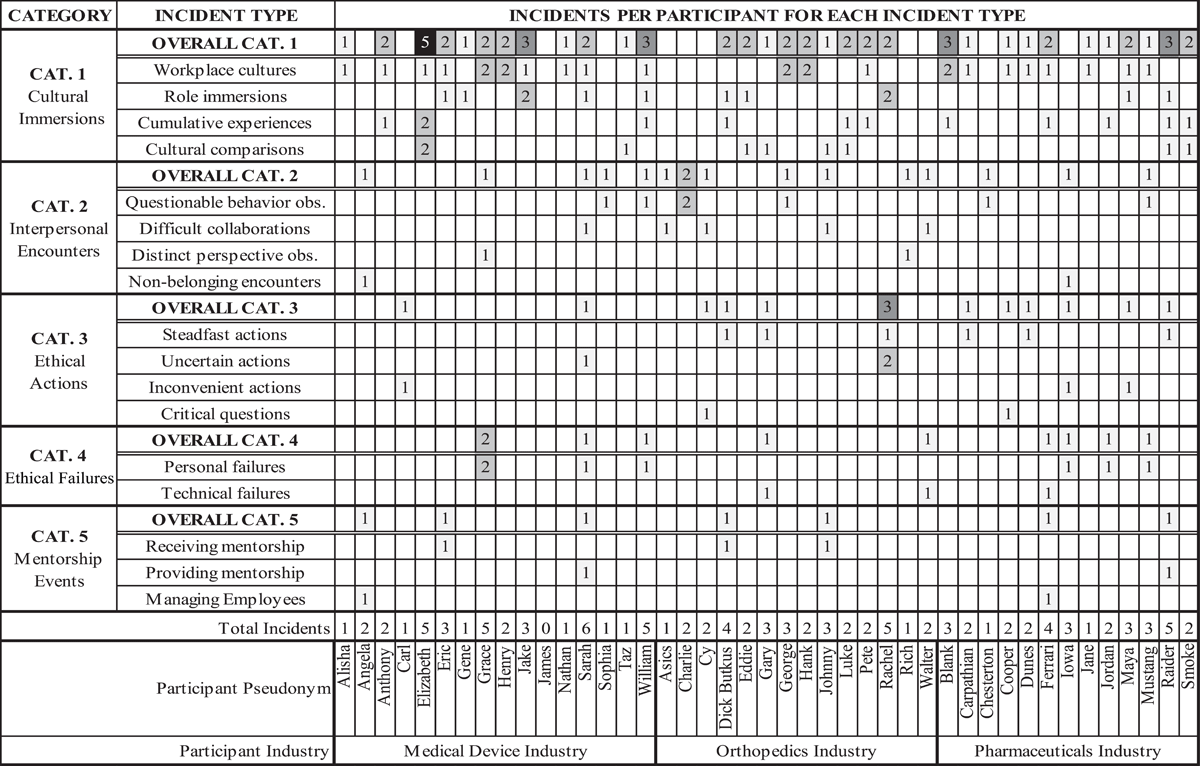
Figure 1
The Frequency of Incidents within Category and Incident Type by Participant. Note 1: Darker cells represent more incidents grouped to the category or type. Note 2: Participants are grouped by industry sub-strector. These findings reveal similar incidents across sub-sector.
Most participants (n = 33 or 77%) described at least one incident in Cultural Immersions. Elizabeth described five incidents in Cultural Immersions, which was the greatest number of incidents that we grouped to a single category for any participant. Multiple participants shared three incidents in Cultural Immersions (Blank, Jake, Rachel, Raider, and William). Rachel reported three incidents in Ethical Actions. Roughly half (n = 21 or 49%) of the participants reported incidents in multiple categories. Sarah, who shared the most workforce-related critical incidents (n = 6), described at least one incident in each of the five categories. Nine participants (21%) described incidents across three or more categories (Dick Butkus, Ferrari, Gary, Grace, Iowa, Johnny, Mustang, Raider, and William). When we compare the frequency of incidents by health products sub-industry, we see relatively equal distribution of incidents across industries.
In the following sub-sections, we describe each category and incident type in detail. Each sub-section includes (1) a description of the incident type, (2) at least one exemplary critical incident, and (3) a brief description of nuances across incidents categorized within the type.
Category 1: Cultural Immersion
This category includes incidents wherein participants learned from working in and observing multiple facets of a culture. We identified and grouped four incident types here: (1) Workplace cultures, (2) Role immersions, (3) Cumulative experiences, and (4) Cultural comparisons.
1.1 Workplace cultures (26 incidents from 21 participants)
Description: This incident type found participants experiencing the continuous and interconnected reinforcement of organizational culture throughout one’s company. The critical aspect of this incident type was an engineer’s recognition of the consistent reinforcement of core values and ethical practices in their organization and the similarity or alignment of these reinforcement events.
Exemplary Incident: Cooper discussed the alignment between what the company preached and what the company practiced. For example, Cooper shared that her company continuously preached “safety first” as an important mantra and she discussed an experience with personal protective equipment that provided an example of this mantra manifesting in the workplace activities:
I came into work one morning, and one of our operations staff let me know that he ran into a contractor out in the manufacturing floor with absolutely no over-gowning on. This is very much not okay in our area. You need to have at least one layer on to be able to enter the building, and we were very confused as to how he got there. Kind of a security issue, and also a quality issue at the same time. […] The follow up out of that was kind of just a gentle reminder, and also additional security to prevent it. A repercussion with him, that he had to speak with his management about what had happened. […] The mindset that’s maybe preached around here in general, the wording they [the company leadership] use is safety first, and quality always. I think a lot of companies use some similar variation of the same phrase. But the idea that both of those things are pretty much solely dependent on your own decisions in most cases, so making sure that I’ve got my steel-toed boots and my safety glasses on when I go anywhere is a conscious decision, maybe a subconscious decision in some cases by me to protect myself, and then watching out when other people don’t is a decision to protect other people. I think it’s a general mindset that has become apparent throughout the company, especially in a manufacturing setting. – Cooper
Nuances: While the criticality of these incidents involved the alignment and consistent reinforcement of core values and acceptable ethical practices, the specific combinations of aspects of organizational culture mentioned by participants varied. Organizational practices included continuity of messaging, overt management or leadership behaviours or discourses, observing others acting on norms or values during meetings or company decisions, interactions with co-workers, reflecting on existing procedures or policies, and workplace training. For example, Alisha described how a core organizational value (patient-centered thinking) was continuously reinforced by organizational discourses (e.g., putting patients first) and leaderships decisions (e.g., recalling devices that did not meet reliability standards) and how her individual decision-making was thereafter guided by company resources (e.g., transparent and accessible policies). Anthony similarly shared many examples of cultural resources that supported his ethical behavior, such as an ethics hotline and role-specific ethics training. Anthony emphasized how ethics language was consistent between these resources and his observations of individuals throughout the organization “from the top down.” This sentiment was expressed by Blank, who indicated that his organizations’ leaders shared consistent ethical messaging from “CEO down to divisional leadership down to the site leadership.”
1.2 Role immersions (12 incidents from 10 participants)
Description: This incident type found participants taking on a specific organizational role and engaging with specific ethical situations, activities, or responsibilities. The critical aspect of these incidents involved immersion in specific roles and the associated unique responsibilities or activities, especially when these immersive experiences brought to light novel considerations for participants.
Exemplary Incidents: Jake shared an incident wherein he led FDA remediation. This activity, including his role as the leader of the remediation process, led him to consider quality and safety regulations for the first time:
I think that having work experience prior to entering full-time is, I would argue, necessary to understanding all the different aspects that go into everyday work. And so, through co-ops, you just … The big one that I saw is that I got pulled in last summer to work on the … I mentioned the FDA remediation work that was going on. I got pulled in to assist with a company that wasn’t even my own because they were trying to deal with this issue. So, I was living ethics. I was living doing the right thing, correcting wrongs. So, by doing that for a whole summer, it really opened my eyes to the importance of ensuring that you’re following … Again, I’ve said this probably a hundred times now, but you’re following the regulations which are based in quality and safety, which are based in ethics. So, I guess it was just, it didn’t dawn on me until I lived it myself. – Jake
Nuances: The roles described in this incident type varied widely. Roles included serving as a continuous problem fixer (Dick Butkus), needing to respond to “big problems” in animal testing (Eric), serving as an officer of the company (Gene), assessing customer complaints (Rachel), serving as a leader for difficult ethical company decisions (Eddie, Jake), working in development (Maya), or simply taking on the role of an engineering professional (Raider).
1.3 Cumulative experiences (12 incidents from 11 participants)
Description: This incident type found participants encountering ethics in the workplace in numerous ways and over significant periods of time. The critical aspect of these incidents involved the attainment of a more expansive set of experiences which, in turn, could support engineers’ future ethical practice.
Exemplary Incident: Dick spoke of the importance of diverse cumulative experiences by sharing a story regarding his origins in the company, focusing on the import of his time as a new engineer, and his lack of understanding of cultural norms. At the time of the interview, he had experienced numerous ethical issues, including in product development and product recalls. These experiences helped him reach an “elevated state,” thus understanding the import of ethics in daily activities. As Dick stated:
When I started ten years ago, I was just an engineer working in a new position, for a new company, to me a new company, and I didn’t really understand the full impact or anything, because I hadn’t experienced it yet. So, the more I’ve been there over these past ten years, the more I’ve been there, the more I’ve experienced it, the more I’ve seen what the impact has on people, both good and bad. You know, I’ve been through great experiences where I can see products that I developed changing people’s lives, changing patient’s lives, improving their quality of life in a great way. And I’ve been in situations where I see product that we developed have to get recalled from the field because something was missed. Right? So, you go through all that, just the growing pains, and it always ends you up in an elevated state of, what you’re doing on a daily basis, how much it really does matter. – Dick Butkus
Nuances: The criticality of cumulative experiences varied in two primary ways. Several participants emphasized the importance of similar experiences over time. For example, Blank spoke of the importance of documentation and how, when relatively mundane errors in documentation occurred, both he and his company consistently followed the correct procedures to rectify the error (including appropriately documenting their approach to rectifying the error). Others discussed the importance of foundationally unique experiences. Here, participants generally compared unique experiences to similar prior experiences, and the criticality was the uniqueness of said unique experience when compared to cumulative prior experiences. For example, Elizabeth described the research practices and values she learned in school and how, when engaging in a work force role which involved animal research, “Everything kind of came together.” Elizabeth thus brought forth experiences in university studies to her novel role in the workplace, which helped her recognize the import of respecting animal sacrifice and realizing how these sacrifices can benefit human lives.
1.4 Cultural comparisons (9 incidents from 8 participants)
Description: This incident type found participants comparing elements across organizational cultures, such as norms, practices, or values. The critical aspect of these incidents was the vast differences that participants observed when engaging in such comparative reflections.
Exemplary Incident: Raider compared cultural changes over time. He emphasized his general view of how safety was prioritized to a greater extent today than in the past in his organization. As Raider stated:
I would say there are things that we would not do today that we would do 10 years ago. An example would be … Now, we do very, very little work on electrical equipment that’s energized. Almost everything gets shut down before we do work. I would say 10 years ago, that’s not the case. 10 years ago, it might be, “Well, this is a production issue, and we have to shut down production to make this repair, so we’re going to do it while it’s energized. We’re going to take some safety precautions that’s going to minimize the risk, but we’d be willing to do it.” Today, most of those things wouldn’t happen. We would say, “Safety is more important than production, so we’re going to make arrangements to shut down our production to do this in a safer manner.” Some of that’s been driven by, in industry in general, a bigger concern for safety, but I think some of it’s driven just by our company having a greater and greater concern for safety. – Raider
Nuances: While the critical aspect of these incidents was the act of comparison, the cultures being compared varied from (1) distinct domains within a company, (2) different companies in the health products industry, (3) the health products industry and other engineering cultures, or (4) like in Raider’s incident, the current culture of an organization compared to its past. More specifically, individual participants compared cultures of companies within health products (Elizabeth), the culture of the health products industry with other industries such as automotive (Gary) or HVAC (Luke), cultures across nationalities (Grace), cultural variations due to company size (Johnny), or cultural changes over time (e.g., Eddie on legal procedures, Smoke on conflicts of interests, Taz on culture in general).
Category 2: Interpersonal Encounters
This category included incidents wherein engineers learned from interactions and relationships with others in the workplace. This category included five incident types: (1) Questionable behavioral observations; (2) Difficult collaborations; (3) Distinct perspective observations; and (4) Non-belonging encounters.
2.1 Questionable behavioral observations (7 incidents from 6 participants)
Description: These incidents found participants observing behaviors of colleagues or superiors which they perceived to be ethically questionable or, in some instances, unethical. The behavior itself was usually surprising to participants. Upon reflection, participants questioned whether they responded appropriately and, if not, how they wished they would have acted.
Exemplary Incidents: Charlie discussed an experience where her team opted not to report something that she felt ought to be reported. As Charlie stated, “There was an instance, going over certain risks that could be involved with a certain design.” In meetings, different individuals on the team chose to speak about certain risks off record, “Just so that there would never be any questions about it.” Charlie acted in accordance with more senior engineers at her company, because, as she indicated, “This is what they tell me. You can’t write these things down. You can’t say these things, just in case. So, I just kind of, initially assume that’s how the business works.” Charlie indicated she felt “uncomfortable” because the company is “dealing with things that impact people’s lives” and her perception that “anything that you think could possibly be a risk should be accounted for.” As a result, Charlie indicated how her views of engineering changed:
Before I started working in industry, I had a different idea of how things work. You know, I think, okay, we’re just going to go make these great things that are going to help people. But then, you realize, everything’s still a business. – Charlie
Nuances: In these incidents, participants questioned the practices of distinct groups of actors. Sophia shared an example where colleagues omitted “bad data,” thus not sharing the whole story of their research. Other participants generally spoke about leaders. For example, in a separate incident, Charlie described how a leader’s “aggressiveness” stymied conversation and thus inhibited responses from others in team meetings, essentially halting dialogue. Mustang described an incident that also involved a leader, but this leader lied to a potential contractor to win a bid. Mustang and a fellow colleague observed the interaction between the manager and the president of the contracting company and felt uncomfortable but did not take action. At the time of the interview, Mustang still struggled to find an ideal response to the specific incident but expressed regret in not taking action.
2.2 Difficult collaborations (5 incidents from 5 participants)
Description: This incident type found participants engaging with distinct perspectives and navigating disagreements. The process of engaging perspectives usually involved overcoming initial resistance (internal or external), thus remaining open to other possibilities. In turn, through collaboration, engineers found a unique and mutually agreed upon ethically viable path forward.
Exemplary Incident: Cy shared an experience regarding a testing procedure. Here, he and a colleague held different perceptions regarding what constituted the most ethical testing procedures for a product. They eventually came to a consensus amidst disagreement to employ “standard” testing methods rather than “more rigorous testing standards.” In addition, they developed a plan to monitor implementation in the field, and eventually they revisited their disagreement based on monitoring. As Cy shared:
There are more rigorous testing standards that ISTA has out there in terms of packaging, kind of running it through a sample transit test, so to speak. So you’re dropping it from different angles, thinking there’s a box on a top shelf in a UPS truck. If it were to fall from the top shelf, it could land on various corners. […] From my internal point of view, I feel like I always want to know as much information as possible. If there is additional testing that can be done where we learn something new, I do want to do that testing. But I understand additional testing, if it’s not necessarily required, obviously depending on the length of the testing, more dollars, more resources, that sort of thing. […] The debate [a debate with a colleague regarding the appropriate test] kind of took place, would have been about a year and a half ago, maybe almost two years now. After understanding both sides and where we were at in the project, we still had time, we still had money, but we decided to stay with the standard test method. The product was released and launched, and within the first few months there were a couple complaints that came back, formally filed complaints in our system, so it was something where I kind of sat down with the appropriate stakeholders and I said, “Hey, we talked about doing this testing a long time ago, we never did because of X and Y decision that I had formally logged and documented and all that sort of thing, but why don’t we revisit this? At least to understand how this is happening, kind of trying to understand a root cause?” So we did go back and do that testing, and we made a design change and we wanted to confirm that design change did what we said it needed to do, it solved the problem. – Cy
Nuances: When conversations around uncertainty regarding the ethicality of different courses of action arose, negotiation became especially difficult. While each incident in this type involved some form of difficulty, each incident did not involve negotiation. For example, Asics discussed an incident wherein he bluntly stated his observation and caused turmoil amidst his team. He viewed his decision as correct but realized that his collaborative style made the overall collaborative process challenging. Sarah described an experience wherein her company had no clear path forward amidst regulations of a company product. As she stated, rather than negotiating a resolution, “We’ve fought everyone. We still have lawyers on staff doing that still. We will not settle. We’ll let them continue going to court.” Finally, Walter discussed difficult collaborations at a meta-level by describing the import of having the right people at the table. Walter shared experiences with people who perceive ethical issues “so black-and-white, that they can’t entertain thought of the best choice for the greatest goog.” Given this reality, Walter felt that “you need people who have some moral compass to help try to judge [ethical issues].”
2.3 Distinct perspective observations (2 incidents from 2 participants)
Description: This incident type found participants observing distinct ways of thinking about ethics and juxtaposing such perspectives with one’s own. The critical aspect of these incidents involved actively seeing and engaging with different way of looking at ethical issues, especially perspectives that the participant had not previously considered.
Exemplary Incident: Grace shared an experience wherein she realized that engineering decisions involve balancing multiple criteria. Specifically, while Grace generally prioritized patient benefits, she recognized that economic considerations were important when making organizational decisions. As she stated:
We were trying to revive a project that had been put on an indefinite hold. It was hard. Ultimately, I wasn’t able to revive it because of the cost, but it was kind of hard, because I could see the use of this product. […] I and another person I was with had seen the benefit of trying to revive this project and see how it could be used by patients, and how many people it would help. We were just not able to do it financially and that’s kind of where my whole … I never really had business experience, industry experience, and management experience to kind of decide which products are put on hold and which projects aren’t put on hold, and which ones we’re going to proceed with, […] I was kind of like a little bummed out, because I had seen how this product could impact people and how it would do really well, but just from a financial standpoint our company wasn’t able to revive the projects and provide funding for right now to [do] it. – Grace
Nuances: Overall, these incidents involved observing distinct perspectives, but these perspectives generally involved individuals in a company or the company itself. For example, like Grace, Rich described an example of company decision-making while he was an intern. He overheard a conversation among his supervisors wherein he learned of their perspectives regarding the ethical importance of assigning resources (here, a quality engineer) to a Biologics department.
2.4 Non-belonging encounters (2 incidents from 2 participants)
Description: These incident types involved encounters with others who made one feel like they did not belong. These incidents first involved a dissonant experience based on interactions with others who made one feel alone or in a minority, followed by the engineer responding to overcome and mitigate resultant negative feelings.
Exemplary Incident: Angela shared an experience in the automotive industry wherein a customer overtly requested to work with a “male engineer.” Angela felt that the customer was asserting that male engineers would “be better.” As Angela stated:
I was working on helping a customer with suggested design of the fuel sock, so looking at altering the angles at which the sock was attached […] I was, I think, either the only engineer or the only full-time engineer, which was kind of bad because I was an intern, but they had limited engineers available. […] I was working with this customer to talk to with them about some of the challenges they were having with their design. I remember so vividly, the customer asked me, “Can you assign an engineer to this project?” I said, “I am that engineer on the project.” He said to me, “Don’t you have any male engineers that you could assign to me?” I said, “No, if you want an engineer on the project, I’m it.” […] that customer’s perception was that reportedly [there would] be a degree of engineering that would be available [which] would be better from a man perhaps, but I think we resolved the problem to their expectation. […] It seems really funny … not funny, but that was, I don’t know, 18 years ago or so. It seems so long ago, but every day … Well, that’s such a drastic example in my mind. It’s something that is completely not acceptable today, or ever. But it makes me think, are there times when I would discount an individual contribution based on any number of extraneous factors? To me, it just [leads me to] make sure that we’re a tuned to the ideas of … and contributions of all our team members. – Angela
Nuances: We only grouped two workforce critical incidents to this category. While the two varied widely, each shared a common foundation of making the engineer feel like they did not belong. Angela’s experience involved gender discrimination from a customer, whereas Iowa discovered that her personal values were at odds with supervisors, company decision-makers, and the company culture. Iowa shared multiple examples of her politically liberal and environmental values and how, as a result, she felt like a “contrarian a lot of time at the company” and “always being defensive.”
Category 3: Ethical Actions
This category represents engineers responding to challenging ethical situations. The four incident types that we grouped to this category included: (1) Steadfast actions, (2) Uncertain actions, (3) Inconvenient actions, and (4) Critical questions.
3.1 Steadfast actions (6 incidents from 6 participants)
Description: This incident type found participants staying the course of an action which they perceived to be ethical. The critical aspect of these incidents was their steadfast nature, wherein engineers brought forth a perception of what constituted the right or best way of acting and, in turn, held their ground to act in accordance with this right way.
Exemplary Incident: Gary shared an experience where he sought to improve a design, but his project manager felt the design was already satisfactory. Gary continued to make “last-minute changes” up to the point of product launch, with the ultimate objective of doing “what was right for the patient,” defined in terms of the best product possible. While Gary acted steadfastly, he also left this experience with questions regarding the worth and ethicality of his steadfastness:
I pushed back on that and continued to make changes up until the formal product launch and added in a few alignment features that helped improve that a little bit. [It] wasn’t the perfect solution, but it gave them something that they can come back to and have it specifically identified the next time to improve on if there’s time and budget the next time to make a product change. […] I would say that it’s such a minor improvement that the debate was, was it worth weeks and weeks of extra hours to push through all the paperwork for another change on this after it’d already been through god knows how many changes already? Was it really worth it to myself if I was already working Saturdays and Sundays and doing everything I can to launch this entire system of instruments and implants? I’d say that was the difficult decision there to say, “Yeah, I guess I want to put myself this one more round, and yes, I want to put the rest of the team through it as well.” – Gary
Nuances: Participants’ steadfast actions were motivated by miscellaneous aspects, such as personal values, professional values, or organizational artifacts. For example, Carpathian shared experiences negotiating risk and benefit based on his personal comfortability and in contrast to others’ perspectives in his company. As another example, Dunes shared inner turmoil he experienced when needing to appropriately rectify mundane documentation errors, such as an incorrect date.
3.2 Uncertain actions (3 incidents from 2 participants)
Description: These incidents found participants working through uncertain ethical challenges. Uncertainty manifested due to the novelty of the situation and, generally, a lack of existing procedures on how to ethically respond due to its novelty.
Exemplary Incident: Rachel shared an experience at the outset of her career when she had to create and justify a procedure. She was unaware of prior procedures that could be used to help her create this new procedure. Thus, she integrated other akin procedures to rationalize her feelings and judgments, but she remained uncertain whether they appropriately (and ethically) mapped to this new project. As she described:
When I came in here, they were hiring for this big project. I was actually, this is actually the first swap out that’s happened in the last ten years, and I was tasked to handle it, there’s no procedure on it. […] So being a young engineer, I had no idea what I was doing to be honest with you, but I did what I thought was right and I made decisions and if I was wrong I fixed them. […] not having procedures and complying with all these different procedures [that do exist] and trying to say hey this is what I think it is, but I think there’s a lot of ethics into that right because you really have to question yourself and say hey, I know for this situation you would do this, but this is a little bit different so should I be doing this or that, or should I be doing a combination of them? What am I picking and choosing? – Rachel
Nuances: In each incident, uncertainty was largely a product of novelty, but sometimes it was also due to the ethical issue feeling grey. For example, Sarah shared uncertainty around how to respond to improper labelling of Instructions for Use (IFU). With guidance from her boss, based on her understanding of ethics as grey, and with some unease, Sarah chose not to report a minor issue to regulatory bodies.
3.3 Inconvenient actions (3 incidents from 3 participants)
Description: This incident type found participants overcoming internal turmoil to act in a way that one perceived as ethical. While participants brought a perception of the most ethical course of action, the actions themselves were inconvenient and personally challenging, particularly as participants reasoned from a customer or company perspective and considered potential concerns from these points of view.
Exemplary Incident: Maya described an experience wherein she found an issue during an early product development phase and shared this prospective issue with her management team. Maya anticipated the management team would be upset but, after sharing the issue, she felt “surprise” when they were “on board in fixing it.” As Maya stated, “I was surprised when they were okay with it. Because I was expecting them to be really upset that we didn’t meet their expectations.”
Nuances: The initial “gut” challenge experienced by participants in these incidents was often overcome in short-order. Carl described an incident where he felt the customer might “throw a fit” based on data which would postpone a project timeline, but he found otherwise. Iowa shared an incident wherein her company needed to initiate a short-term shutdown, and Iowa, who was in a “temporary leadership role to coordinate this shutdown,” recognized that the company was omitting the employee perspective in their decision-making. All three individuals found that once they shared their perspectives with others, they unanimously received positive support.
3.4 Critical questions (2 incidents from 2 participants)
Description: This incident type involved the practice of continually asking critical questions of ethics in engineering practice. Most often, by asking “why,” participants found themselves able to personally establish a better understanding of and comfortability with ethical decisions.
Exemplary Incident: Cooper shared how she became more interested and comfortable in asking “why.” As an intern, she was nervous about this action, but over time, she felt the behavior was normal and conducive to ethical practice. As Cooper stated:
Each internship you’re working with new groups, new people. I was maybe nervous to ask questions to begin with. I’m an engineer. I like to understand things. I don’t like to blindly follow rules just because they’re rules. I wanna know why, and what I can do to help embrace that why, and make things better. […] Eventually you get to the point where you feel comfortable asking about just about anything, but I’ve tried very hard in this new role to use this time that I have to be a sponge, to ask people why, why, why, and if I don’t get it, who can I follow up with to help me understand this better? It helps me in a technical perspective day to day, but I would say it also applies to the ethics of what you’re doing, and what the why is behind it. – Cooper
Nuances: Critically questioning seemed to be a personal disposition that individuals applied to their workplace context. Like Cooper, Cy described his desire to understand the full scope of the ethicality of his company’s decisions, and thus he critically questioned nearly all organizational decisions. This process enabled him to be confident that decisions were acceptably safe and met all internal and external guidelines.
Category 4: Ethical Failures
Incident types in this category reflected participants grappling with an unexpected event that led to (1) Personal failures or (2) Technical failures.
4.1 Personal failures (7 incidents from 6 participants)
Description: This incident type involved one experiencing or perceiving an inability to act in a way that one perceived to be ethical. These incidents generally found participants reflecting on experiences wherein they did not effectively enact their personal or professional values.
Exemplary Incident: Iowa experienced a situation wherein her company had a potential issue with water contamination and discovered the source might be a “certain section of sewer piping.” Iowa developed a solution that “lined that entire section of sewer with fiberglass lining, a fiberglass coating.” The company opted not to proceed with Iowa’s solution. Iowa perceived the final solution the company chose as an ethically acceptable, albeit, not ethically ideal solution. It was not ethically ideal based on her prioritization of environmental considerations. As she stated:
There was a situation where we had a certain section of sewer piping, and we knew that the wastewater in that piping had a pH outside of the range of what we allow. […] I was pushing for a project that would have lined that entire section of sewer with fiberglass lining, a fiberglass coating. I did a big study and everything, and I said, “You know, once this water mixes with the other wastewater streams, it tends to attenuate the pH profile, and it’s good from here on out. So from here to here, we should line it just to make sure.” It’s expensive, I got a bunch of push back, we ended up not doing that. Because it ended up being deemed not necessary. We had other engineers who were also utilities engineers who do sewers and things like that supporting it, some for some against. It became a discussion, and in the end, we decided not to do this lining. But for me I felt like I was really trying to fight the good fight, and better safe than sorry. There’s a lot of things we spend a lot of money on here at the plant, I saw that expenditure as not only being the right thing to do from an environmental standpoint, but also just acting as an insurance policy against an accidental release in the future. […] for me that felt like not an unethical decision at all, because we had plenty of technical information to back up that everything was totally fine, but it wasn’t ethically ideal. […] I do want to reiterate, it wasn’t an ethically bad decision, it was very technically sound, but I think for me it was a very … It felt very personal because the reason that I was pursuing that so aggressively in the first place is that for me, environmental protection, that’s a personal value. That’s more of a moral thing. – Iowa
Nuances: In some incidents, like in Iowa’s example above, personal failures resulted from a misalignment between personal values and company decisions. Some incidents also involved a lack of knowledge or awareness. For example, William described an incident where he unintentionally responded to a question for which he did not “know” the answer. Similarly, Grace made an engineering decision but retroactively realized she had insufficient knowledge to make said decision. Mustang described an example wherein he unintentionally made a co-worker feel uncomfortable and harassed. These examples highlight that one can unintentionally enact what they perceive to be unethical decisions. Upon realizing these unintentional ethical failure experiences, engineers revealed particularly strong intentions to act in ways to avoid such failure in the future.
4.2 Technical failures (3 incidents from 3 participants)
Description: This incident type found participants’ experiencing technology functioning in unanticipated ways. As a result, participants reviewed technological performance in light of performance expectations. The engineers acted promptly to generate appropriate and ethically acceptable responses to these technical failures.
Exemplary Incident: Ferrari shared an experience wherein a staggered vial testing system for producing pharmaceuticals was mis-functioning. Vials were automatically tested and, if deemed unacceptable, the system alerted the operator to an unacceptable vial. Alas, the identified unacceptable vial tended to be the wrong vial, or a vial a few “pockets down the line.” As Ferrari stated:
There are times when you will find that equipment is not working the way you thought it was. An example would be, as the medicine leaves the sterile area, or aseptic area, we have vision systems that make sure that the rubber stopper is completely seated before it leaves the aseptic area. The equipment is supposed to work such that if it detected an issue, the machine was stopped. […] We have found that we were not rejecting the correct vial, and it was a potential that though the risk is low, you’re not following your own designed control system on how to handle that product. […] The short-term, within three days, we had presented to senior quality and said, “Okay, here’s the scope of impact. We think it’s under control, and we think the product that we’re sending out is still good,” but that was on one production line. The machine to seal the vials at the end of the line, we have half a dozen of them at this site. There are others around the world at other production facilities, so then the question quickly becomes, “Are those other machines programmed in the same way? How do we reprogram them so that we don’t have this as we continue to make medicine, going forward?” And then lastly, it’s, “Is there a design standard?” Or, “How do you get this knowledge into the rest of the company’s head to make sure that this kind of problem doesn’t happen again anywhere else?” That’s the path forward out of that. […] I think it [this experience] changed what it takes for me to have that higher confidence in our systems. Instead of reading the words, “Immediate stop,” and thinking, “Well, that’s an immediate stop,” to know that in the background, the computer may be doing something different, or processing that in a different way, I think it’s been a step change in my mind of what it takes to prove that the equipment is operating properly. – Ferrari
Nuances: In these incidents, observing the unanticipated technological behavior was critical for participants, but the nature of technological failure varied. For Gary, the incident involved the company releasing a technology to the field before he felt it was ready, but also monitoring its implementation and eventually revisiting this decision down the road based on continuous monitoring and empirical data. Walter discussed a divergent perspective on appropriate design procedures and what he perceived to be a failure in his team’s approach to validating a product. Participants all experienced mental dissonance and uncertainty, but they responded quickly, sought perspectives from others, and developed a satisfactory response for all involved parties.
Category 5: Mentorship Events
Incidents in this category found individuals learning from mentoring or provisions of guidance through (1) Receiving mentorship, (2) Providing mentorship, or (3) Managing employees.
5.1 Receiving mentorship (3 incidents from 3 participants)
Description: This incident type found participants receiving mentorship to support one while working through ethical challenges. Incidents generally reflected the import of having an accessible mentor at critical junctures. During these events, mentors might provide direct guidance or literally demonstrate viable approaches to ethical challenges.
Exemplary Incident: Dick described the importance of receiving mentorship in times of uncertainty. As part of these uncertain experiences, Dick’s mentor afforded him the opportunity to struggle through ethical challenges and even experience micro-failures. Dick illustrated how this taught him to ethically navigate engineering problems in a complex organizational system:
I struggled with some stuff and didn’t really know what to do a lot of times, and probably did things wrong. But at the end of the day, I’m thankful that I work for a company where I was… and my mentor was good enough to not let a lot of that slip by. [Interviewer: I haven’t really heard about the mentor before. Can you talk a bit about the role the mentor played?] Well sure. I mean, he just kind of showed me what it’s like to look at an engineering problem in our industry, or for our company, and to look at our procedures differently than … Well, to look at our procedures in the context of, what is truly trying to be conveyed, what is truly trying to be solved? […] He really taught me how to break things down, whether it be an engineering problem, or a procedural problem, or a relationship problem within the company, and to really, truly problem solve what the problem really was. Not problem solve for a solution, but problem solve for the problem. I kind of mentioned that before. The big battle I think, especially in really complex systems is, do you really have the right problem identified? – Dick Butkus
Nuances: These participants expressed the import of mentorship. While two participants discussed a specific and one-to-one mentor, Johnny described continuous mentorship from many others throughout his career. Over time, he internalized mentors’ values and beliefs while simultaneously becoming more confident to act on his beliefs.
5.2 Providing mentorship (2 incidents from 2 participants)
Description: This incident type indicates that the act of providing mentorship reciprocally promoted one’s ethical growth. Mentors supported the personal and ethical growth of mentees in informal and formal ways.
Exemplar Incident: Raider shared a relatively informal mentorship event wherein he visited a Chinese manufacturing facility and observed an engineer who did not act in compliance with US electrical safety codes. Raider perceived this to be dangerous and unsafe and advised the engineer to adapt a different approach. This experience heightened Raiders’ ethical sensitivity and sparked Raider to continually ask questions, such as, “Are there things going on around me that I am not sensitive to, or not paying attention to?” As Raider stated:
One of the times I worked on a project in China … We put in a new insulin manufacturing facility, so I was there working with the electrical engineer. He started to do something that would have been unsafe for our standards, and so started to do that. I had to stop him and say, “Hey, this is something we wouldn’t normally do. There’s a risk here. There’s a safety issue,” then have that discussion on why it’s unsafe to do this, and what the expectation from the Company E expectations and the standards standpoint. […] any time something like that happens, it probably makes me more sensitive to, say … Should I be more observant or look … This was an obvious one for me. I’m right there with him. He’s doing something. But are there things going on around me that I am not sensitive to, or not paying attention to? It may increase my level of sensitivity of, “I should be looking for those sort of things.” – Raider
Nuances: This category included two incident types. The second came from Sarah, who described her experiences with mentoring young engineers overall and from the perspective of regulations in the company. Over time, Sarah came to recognize humility as an important ethical virtue that engineers should possess, but which she perceived engineers (especially new engineers) were often missing. Thus, she came to view the import of helping engineers develop humility.
5.3 Managing employees (2 incidents from 2 participants)
Description: This incident type found engineers making managerial judgment calls pertaining to human resources. The incidents involved uncertainty regarding how to move forward, but eventually managers made a satisfactory decision for all parties.
Exemplary Incident: Angela observed an employee struggling in an engineering role. Angela worked with a colleague to find a new role for the employee. Rather than changing Angela’s understanding drastically, this experience reconfirmed the importance of finding creative solutions to ethical challenges, including challenges that involve employee management.
We’ve got this individual that works on purchasing now. Actually, she worked kind of under my area for a little bit. She really wasn’t performing in a way that we would expect so we moved her to the manufacturing side and she had some challenges there, then we moved her into [another role which involved improving employee actions] and [she was] not quite a fit. This was a bit of dilemma, because I was corresponding with my counterpart and my counterpart asked me, “What should I do? She’s been with us eight years and we’re really struggling to find a spot here. What are we gonna do?” My gut was, “Hey, we’ve given this a good shot that eight years in, it’s … We need to let her go if we haven’t really seen the performance from her that we expect.” What happened was actually really beneficial and again, eye-opening to me, but we had … My counterpart went to the employee and said, “This isn’t working out.” The employee’s like, “I know. I’m so glad you’re bringing this up. This is really not working for me.” At the end of the day, although the employee had a degree in engineering, that person said, “I really don’t feel comfortable making decisions. I wish to have a job in which the decision-making burden is taken off.” So, great. So we looked at that as an engineering collective. What we decided to do was to assign that person a role that was not an engineering role. It was more of a technician type of role so that this person is receiving tasks their executing on a schedule, and then providing the data to an engineer who then would make the decision. So, I thought that nicely illustrated in my mind, one, a situation where this long tenured employee was struggling with fit. We found a role for her where she accepted maybe a different type of role that was a non-engineering role but still had value to the company, but to me that underscored the importance of decision-making process on engineering, I think as it relates to the discussion that we’ve had, the importance of being able to be confident in our decision and the burden that we put on making the best decisions to our patients. That person just wasn’t comfortable in that situation. So, we found a role that better suited her. – Angela
Nuances: This incident type only included two incidents. In the second, Ferrari shared his struggles with responding to poor employee performance and considerations of how to discipline said employee. As he stated, he struggled because “there’s not an obvious line” regarding “what we’re going to accept” in terms of employee performance. Thus, both incidents found engineers taking on management roles wherein responding to employee performance was a challenge. Angela developed a solution she felt worked well, whereas Ferrari exhibited ongoing uncertainty.
Discussion and Implications
In this study, we explored and identified factors that promote ethical growth in engineering practice. The five categories of critical incidents that emerged from this study reflect aspects of the three potential influences depicted in our literature review (i.e., disciplinary culture, organizational culture, and individual attributes). Cultural immersion was the most pervasive category of influence. Cultural immersion depicts the macro-scale influences of organizational culture at large. Conversely, interpersonal encounters, ethical actions, ethical failures, and mentorship events highlight the different ways distinct types of interactions shaped participants’ ethical practices. As our examples show, experiences in these four categories tend to be informed by organizational culture; across these four categories of influence, workplace culture seemed to play a prominent role.
Most notably, perhaps, our categories reflect limited influence from disciplinary culture. This gap points to the need for educators to more systematically consider how to help students develop as ethical practitioners in ways that are contextually rich enough to help students see beyond the influences of a single discipline or organization. The remainder of this discussion focuses on potential teaching strategies which build from the categories derived in this study.
Cultural Immersions
Our findings indicated that contextualized and immersive experiences in workplace cultures were the most common type of critical incident described by participants. Many authors have critiqued the decontextualized nature of instructional approaches in engineering ethics education, particularly when approaches oversimplify the complexity of practice (Bucciarelli, 2008; Conlon & Zandvoort, 2011; Lynch & Kline, 2000). The pervasiveness of the workplace cultures incident type highlights the import of guiding students to become aware of the influence of context and culture undergirding their learning experiences. Thus, in engineering ethics education, it is important to design and implement instructional strategies that authentically integrate the sociotechnical complexities of engineering practice and help students become aware of the potential influence of overarching cultures on their ethical views and practices (Cech, 2014; Martin et al., 2021a).
Engineering faculty members’ mental models suggest that workplace experiences are a primary domain where students learn ethics (Katz, 2019). Thus, engineering courses and programs can promote student awareness of the import of workplace cultures by encouraging internship and co-op experiences and ensuring these experiences provide opportunities for critical incidents to manifest. For example, in alignment with the role immersions incident type, universities might encourage students to participate in co-ops/internships across different branches of an organization (e.g., regulatory versus validation versus manufacturing). These role shifts will also position students to (1) compare cultures by enabling reflection on the sub-cultures in a single company and across organizational branches and (2) develop cumulative experiences which can help them become more confident in their future ethical engineering practice.
Engineering courses and programs may also apply the above considerations by intentionally fostering student reflection on sub-cultures in and across their institution. Feister, Zoltowski, Buzzanell, Zhu, and Oakes (2014) found that student groups across four institutions approached ethical reasoning in different ways, albeit, in large alignment with their respective institutional norms and values. Similarly, Martin et al. (2021a) argued that “the beliefs and practices of individual instructors are impacted by institutional measures and policies set by accrediting bodies, as well as by the cultural milieu in which they were educated or currently teach” (p. 59). Thus, instructors might prompt students to reflect on how the sub-cultures they experience within and across their organization, including at the institutional, departmental, and course levels, influence their ways of thinking about ethics.
Engineering courses and programs can also merge incident types nested within Cultural Immersions with common engineering ethics instructional strategies. For example, case studies have been a common strategy for teaching engineering ethics for decades (Haws, 2001; Herkert, 2000; Hess & Fore, 2018). Instructors may prefer more complex and immersive case studies (Martin et al., 2021b), but, when lacking industry experience, engineering faculty may feel unable to effectively include ethics into engineering curriclum (Bielefeldt, Polmear, Knight, Swan, & Canney, 2018). Thus, faculty tend to teach ethics in alignment with their own beliefs (Martin et al., 2021a) or mental models (Katz, 2019). Hence, integrating real-world complexity in sufficient ways can be a challenge, particularly if faculty bring limited workforce experiences. We suggest that instructors employ the thick description of engineers’ experiences with ethics (i.e., the incidents in this study) to design and implement engineering ethics case studies. We propose different ways to facilitate the design of such case studies below.
Instructors may build on role immersions by employing role-play within case studies, a common strategy utilized in the delivery of engineering ethics case studies already (Boudreau et al., 2016; Brummel, Gunsalus, Anderson, & Loui, 2010; Prince, 2006). Similarly, instructors may directly share the critical incidents with students, prompt students to form groups of two or three, task individual students to take on the role of a primary stakeholder, and then task students to reason through how their stakeholders might collaborate through the issue. If instructors find incidents in this study are not applicable to their instructional contexts, they could follow our same research procedures to elicit workforce incidents from practitioners in their discipline. Other scholars have extracted incidents and used them to inform ethical teaching. For example, Rottman and Reeve (2020) extracted incidents associated with equity and ethics among practitioners and designed pedagogy therefrom. Instructors might even have practitioners share their critical incidents via stories directly with students.
Role-play can be time-intensive to design and implement, and thus related but less intensive “participatory” approaches to case studies, wherein students imagine stakeholder perspectives (Huff & Frey, 2005), can be utilized. To this end, in two contexts (a graduate-level biomedical engineering ethics course and a multidisciplinary engineering ethics courses) we have developed and implemented a brief (i.e., around five-minute) participatory case based on Iowa’s personal failure incident. We provided a one-paragraph summary of the case, emphasized that it was based on a workforce critical incident, and prompted students to imagine what they would do if they were in Iowa’s situation. Students seemed to find the framing of the case (i.e., a real-world critical incident with tensions between personal and organizational values) salient and quickly became engaged.
While role-play may facilitate a greater depth of engagement with individual stakeholders, participatory case studies and perspective-taking activities can facilitate a greater breadth of engagement with stakeholder perspectives or values. With either instructional strategy, by embedding multiple role-play or participatory experiences across a program or course, instructors will help students imaginatively experience a multitude of ethical issues, thereby providing students with cumulative experiences.
Cultural comparisons also manifested when individuals compared cultural norms over time. To this end, instructors may prompt students to reflect on their personal views of ethics and compare how these views have shifted during their collegiate career. Such reflections might also be captured in a way to generate assessment evidence that can guide formative programmatic decision-making. Such assessment might also be beneficial if assessment data indicates shifts in unanticipated or undesirable directions. For example, if institutions find that learners tend to disconnect ethical engineering from public concerns (Cech, 2014), and if this is an ethical value that the institution aspires to cultivate, the institution can then identify important time points that require refinement. As many instructors have uncertainty regarding how best to address the ABET ethics criterion (Barry & Ohland, 2012), such assessment and resultant improvements would also be invaluable for accreditation.
Interpersonal Encounters
Interpersonal Encounters found participants observing questionable behaviors, engaging in difficult collaborations, observing distinct perspectives, and experiencing non-belonging events. Each of these incident types can be harnessed in engineering curriculums by prompting student engagement with how professionals’ experience ethical engineering practice. Like the considerations described in the preceding section, one can literally observe ethical engineering practice through co-ops or through real-world case study materials (Huff & Frey, 2005) or instructors can design case studies to foster collaborative decision-making (Loui, 2000). To ensure that such collaborative acts require difficult collaborations, instructors can imbue dissonance by requiring that students attend to challenging or non-normative facets of a case. In tandem, instructors may extend the non-belonging encounters by encouraging students to consider the perspective of a minority in a case study. For example, to continue the personal failure incident shared by Iowa, instructors might task students to consider how an environmentalist in a company which deprioritizes environmental impacts might respond when the environment is deprioritized. Alternatively, building on the Angela non-belonging encounter, companies might prompt students to consider how a female engineer might respond to a client’s request for support from a male engineer or, conversely, how a male engineer may respond to a request for a female engineer.
Acting Ethically
This category highlights the import of creating opportunities for students to behave or act ethically. Many extant instructional modalities require students to act and thus provide ripe opportunities to replicate incident types identified in this category. Embedding ethical frameworks and reflection in extant experiential curricular components, such as capstone design or service-learning, can be a relatively straightforward modality for embedding ethical action in engineering curriculum. Within these events, instructors might make space for students to reflect on ethical experiences before-action, in-action, or even on-action (Schön, 1987). Instructors might even encourage such reflection-on-ethical-action outside of the curriculum by encouraging students to first engage in an extra-curricular engineering organization and second reflect on extra-curricular engineering experiences. To this point, Wittig (2013) found that students who engaged in Engineers Without Borders found it to be a more influential ethical learning experience compared to course-based engineering curricula.
Finally, similar to above, instructors might also encourage students to engage in co-op or internship and reflect on the ethical implications of their work, including how they can behave more ethically. Howland, Kim, and Jesiek (2022) found such work experiences provide critical opportunities for students to learn engineering ethics even without specific guidance. We expect that with more experiences to act ethically, coupled with targeted guidance and mentorship, students will be able to learn how to practice ethical engineering more effectively.
Ethical Failures
Ethical Failures found participants grappling with technical systems that performed in unexpected ways (thus experiencing technical failure) or engaging in behaviors that did not align with one’s personal values (thus experiencing personal failure). No participants discussed extreme failure experiences, and few incidents involved severe misconduct, which is perhaps due to the sensitive nature of such types of failure and participants’ reluctance or inability to share such sensitive incidents. Nonetheless, the few instances of failure that participants described seemed to have a powerful influence on participant’s ways of experiencing, thus supporting calls for focusing on or fostering ethical failure in engineering classrooms (Colby & Sullivan, 2008; Eyler, 2018). Connecting back to earlier suggestions, instructors may consider utilizing role plays or participatory case-based instruction to help students take on practitioner perspectives and imagine how they might fail and then react in these scenarios (Huff & Frey, 2005).
Mentorship Events
Finally, Mentorship Events found participants receiving mentorship, providing mentorship, or struggling to identify how best to manage employees. Building on the receiving mentorship incident type, engineering courses and programs might purposefully design strategies to help students communicate ethical challenges and receive guidance in safe ways and at critical junctures. Engineering curriculums offer no shortage of potential mentors or mentees, but we encourage instructors to harness these potential roles by considering students as both potential mentors and mentees. While such mentoring structures can be informal, instructors seeking to promote and celebrate more widespread mentoring opportunities could emulate extant peer mentoring ethics initiatives such as the Ethics Bowl (Cruz, Frey, & Sanchez, 2004).
Limitations and Future Work
The ultimate motivation for this work was to better align post-secondary engineering ethics instruction with workplace experiences. Additional levels of analyses with these data can continue to support such efforts. For example, in the future we intend to identify resultant outcomes of critical incidents and map the outcomes to incident types and categories. We also recognize that this study was situated within the health products industry. Additional research is needed to identify transferability of findings to other industrial contexts and to other engineering disciplines not represented in our sample. Third, we did not account for differences by demographic factors. While the recruitment procedures sought participant diversity, a focus on how critical incidents vary along select demographic factors was beyond the scope of this study. Finally, we observed that incidents often overlapped, but we did not systematically code for such overlap. For example, interpersonal considerations, individual actions, failure experiences, and mentorship events seemed to be common aspects throughout the incident types associated with Cultural Immersions. Future research is needed to better understand and empirically support category-category and type-type interconnections.
Conclusion
This study synthesized critical incidents that influenced engineers’ experiences with and understanding of ethics in engineering practice. As many participants brought forth experiences from a diverse set of engineering disciplines, and many participants reflected on experiences in other industries, we positioned findings to inform instructional strategies in engineering ethics education. We generated 17 critical incident types and grouped these to five categories. Our findings revealed that Cultural Immersions was the most common category of critical incidents. In the discussion, we extended findings from all incident categories to consider how engineering practice might sufficiently contextualize engineering student learning. Here, we considered oft-used pedagogical strategies, including case studies and role-play. Given the variation of influence types that were critical for practitioners, we anticipate that a variety of approaches to promoting ethical formation among students is warranted and can help increase the likelihood that students experience critical incidents in post-secondary contexts, which they can later use to guide ethical engineering practice in their career.
Acknowledgements
We would like to thank members of our NSF Research team for their contributions to this work. We thank our project contributors and collaborators, Dr. Andrew Brightman, Dr. Alison Kerr, Athena Lin, Dr. Michael Loui, and Dr. Carla Zoltwoski, for their critical feedback and endless support for this work. We are especially grateful for the 43 participants in this study who graciously and candidly shared their experiences with our team. This work would not be possible without these participants. This material is based upon work supported by the National Science Foundation under Grant No. 1737303. Any opinions, findings, and conclusions or recommendations expressed in this material are those of the authors and do not necessarily reflect the views of the.
Competing Interests
The authors have no competing interests to declare.
Author Contributions
All three authors participated in data collection, data analysis, and writing of the results reported in this study. Throughout the methods section, we identify specific roles throughout the research process that each author engaged in.