
Table 1
Coding for levels of control, from highest agency to lowest agency, as a combination of Konopasky and Sheridan’s autonomy and intentional causation. Each row represents a unique score assigned first-pass, but interpretation depends on context.
| Speaker agency | Subject | Verbal control from subject point of view | Example |
|---|---|---|---|
| High | First-person singular | Full control | I will do that |
| High, tentative | First-person singular | Potential control | I could do that |
| High | Second-person singular | Full control | You do that |
| High, tentative | Second-person singular | Potential control | You could do that |
| High | Second-person singular | No control | You must do that |
| Moderate, shared with others | First-person plural | Full control | We do that |
| Moderate, shared with others, tentative | First-person plural | Potential control | We could do that |
| Moderate, objects/others hold tentative locus of control | Third-person | Potential control | It could be |
| Low, others, objects, environment hold locus of control | Third-person | No control | It must be / It is |
| None, external locus of control | First-person singular or plural | No control | I must do that / We must do that |
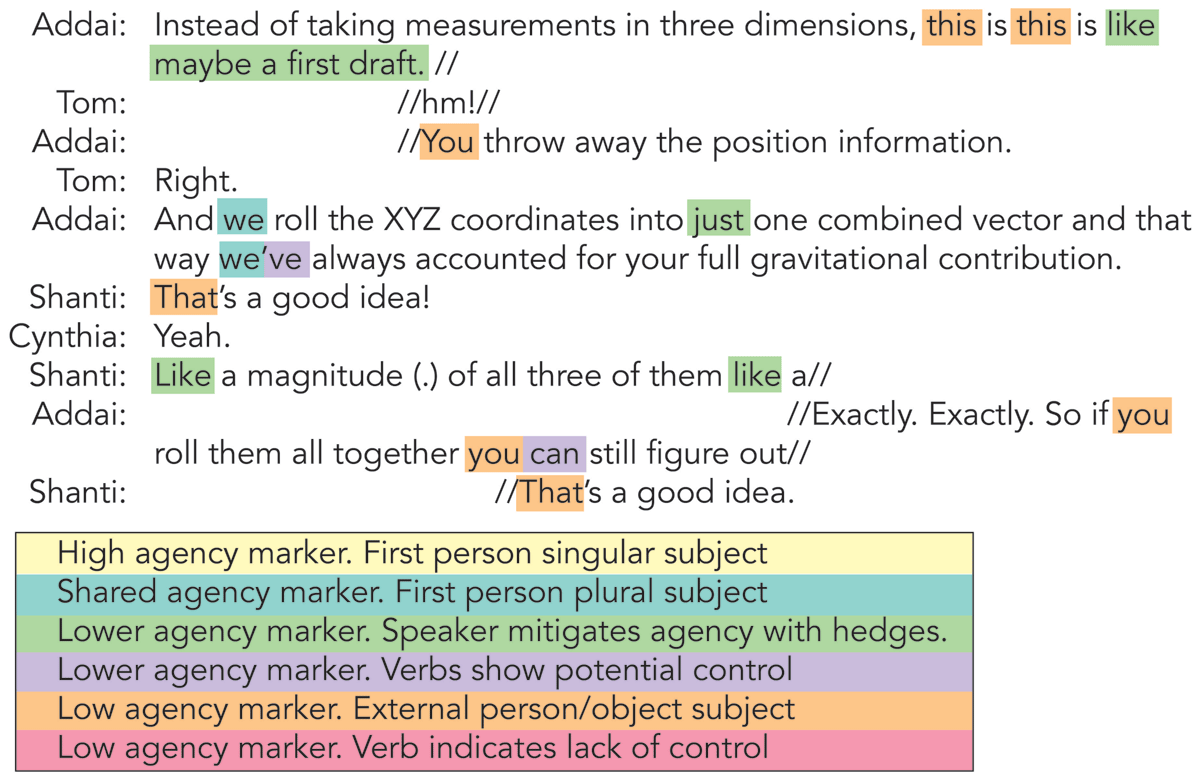
Figure 1
Addai tentatively put forth an idea in response to “Tom’s special case”.
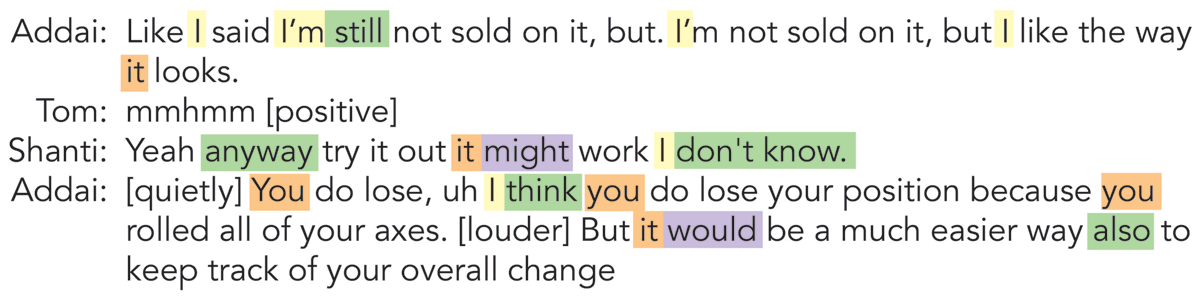
Figure 2
Addai, encouraged by Tom, Cynthia, and Shanti, continued to consider his idea. Color-coded as defined in Figure 1.
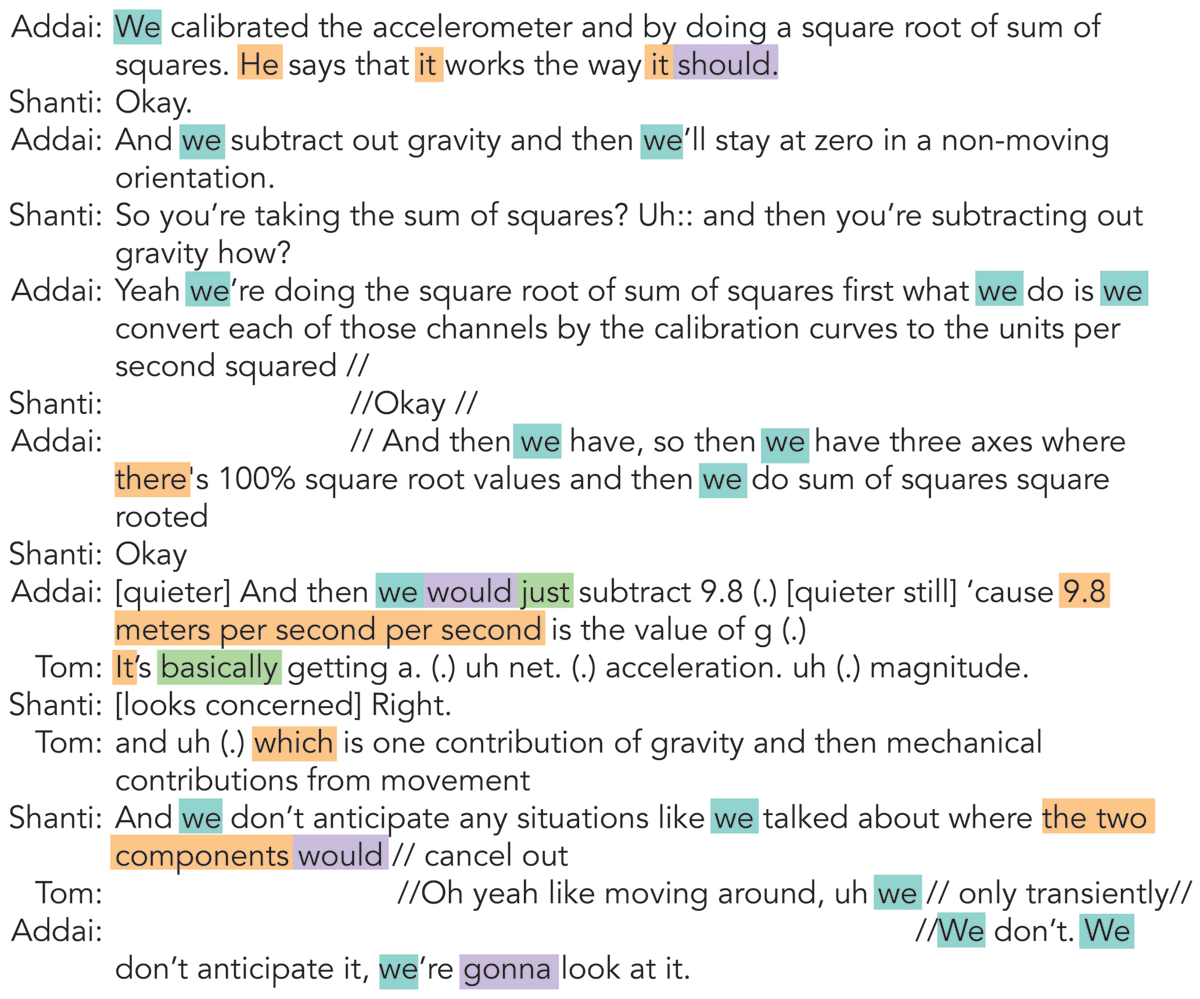
Figure 3
Near the end of their project, after finally testing Addai’s idea, the team demonstrated shared agency yet remained open to revision. Color-coded as defined in Figure 1.
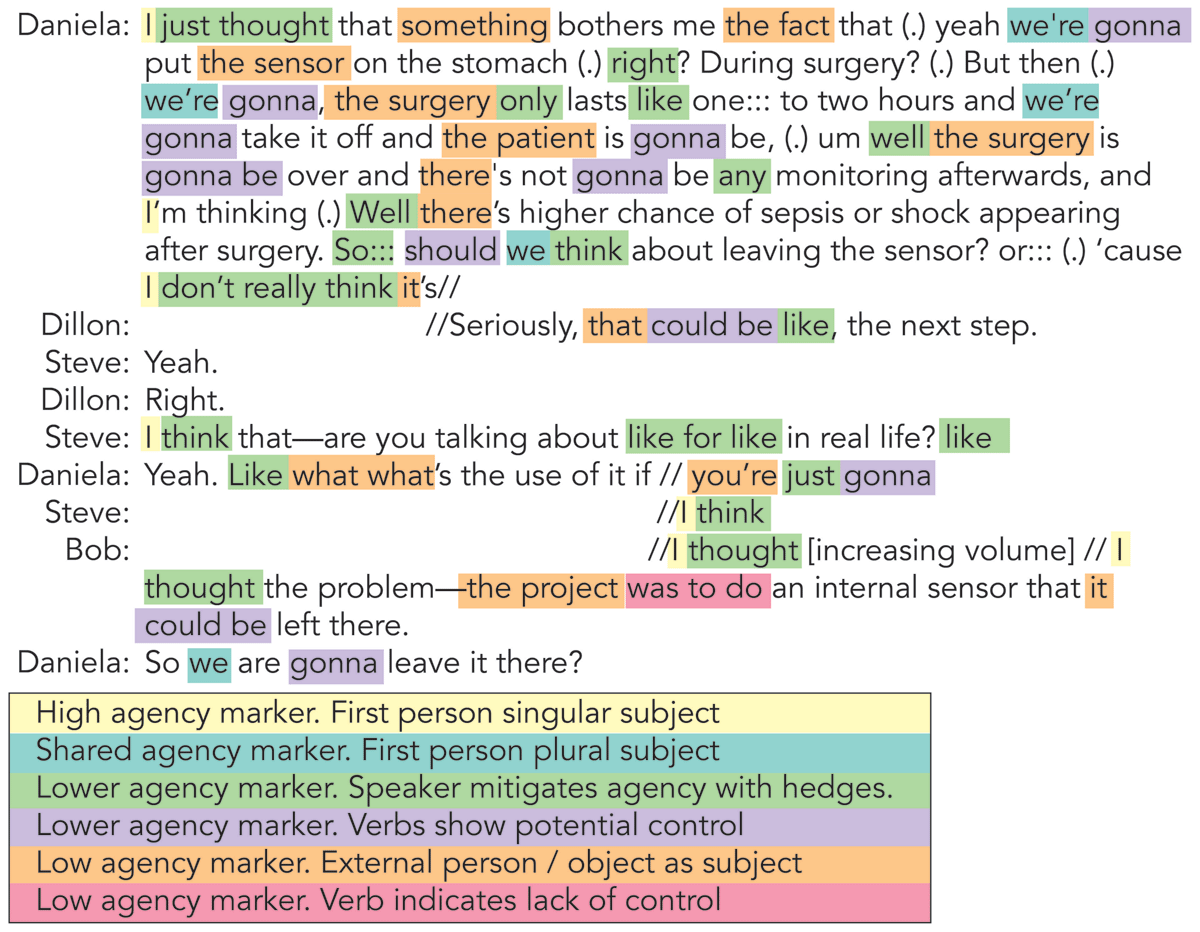
Figure 4
Daniela raised concerns about the utility of testing sensors during surgery given that their project was based in providing early warning systems of sepsis following surgery.
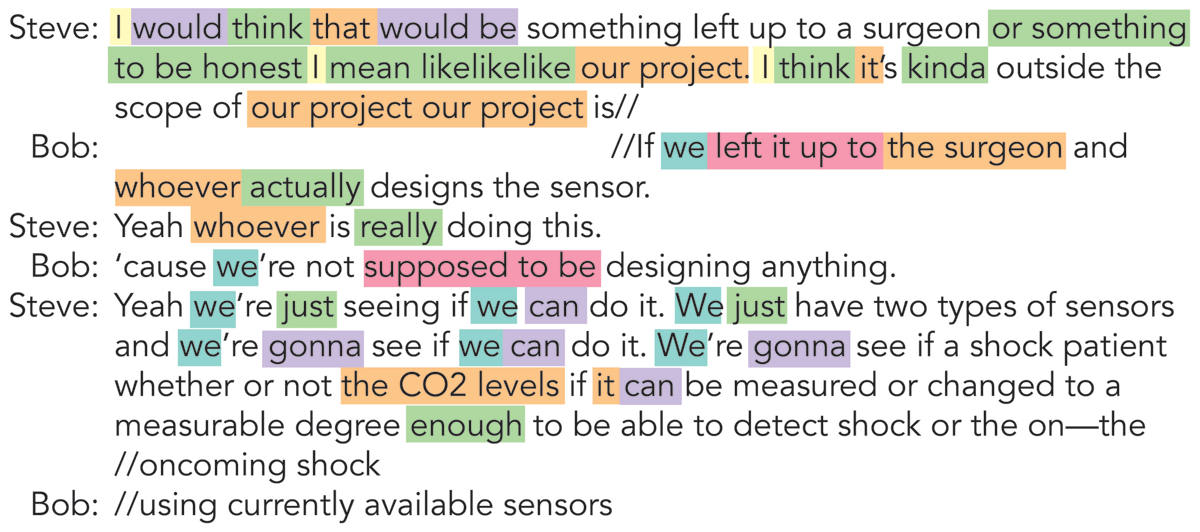
Figure 5
During the meeting with the TA, the team maintained a focus on a narrow, technical problem. Color-coded as defined in Figures 1 and 4.
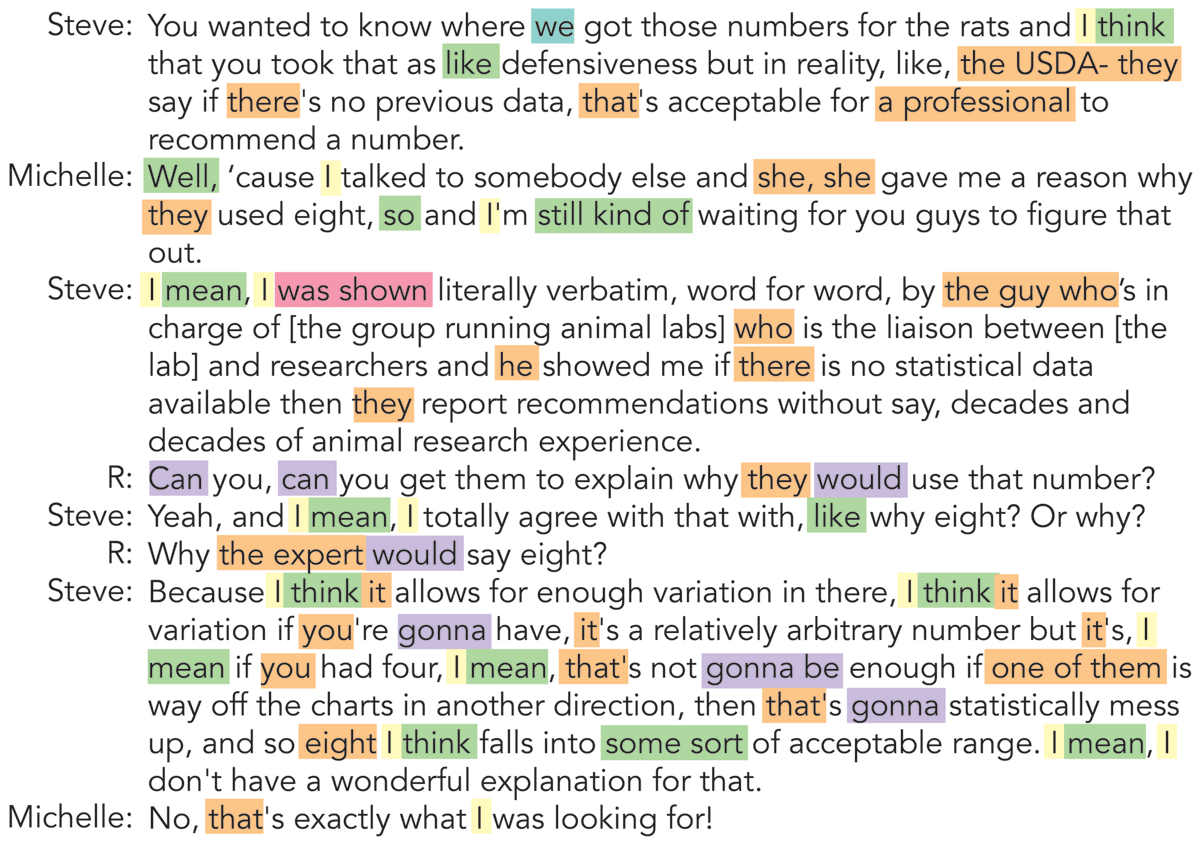
Figure 6
After TA Michelle repeatedly asked the team to justify the number of rats in their study, the researcher (R) reframed the question. Color-coded as defined in Figures 1 and 4.
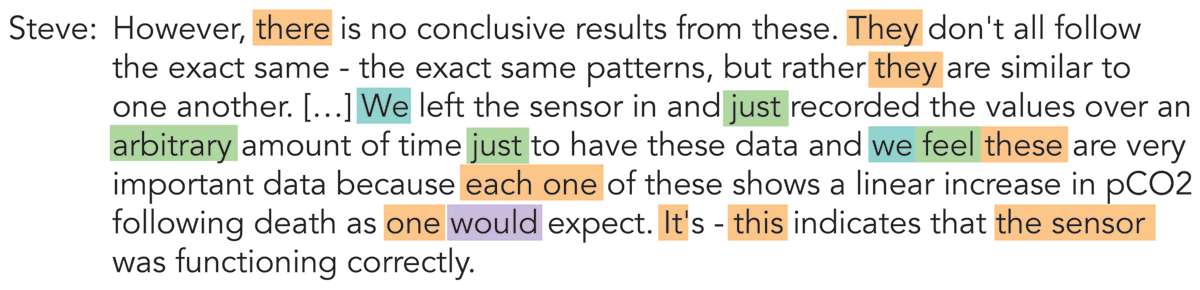
Figure 7
At their final presentation, Steve summarized the results of their testing and modeling of data. Color-coded as defined in Figures 1 and 4.
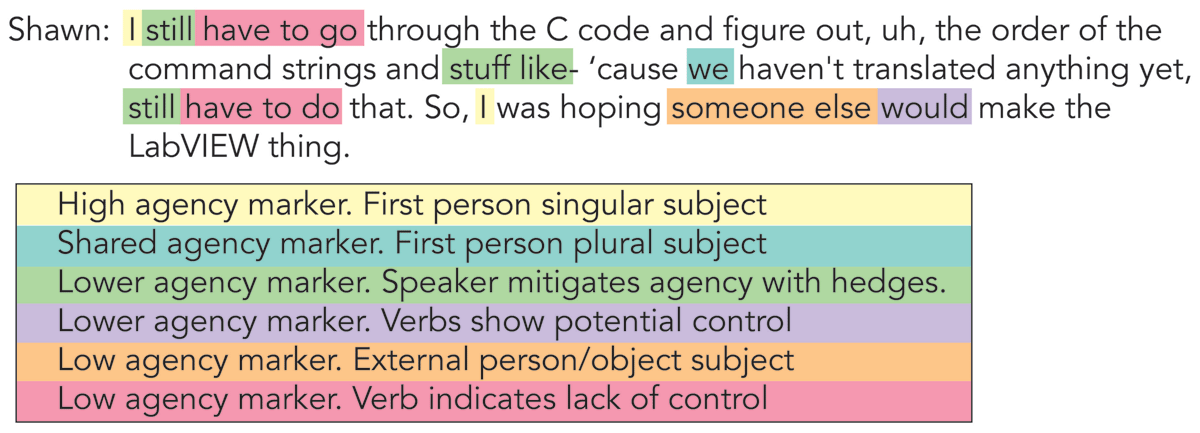
Figure 8
Shawn reported his progress.
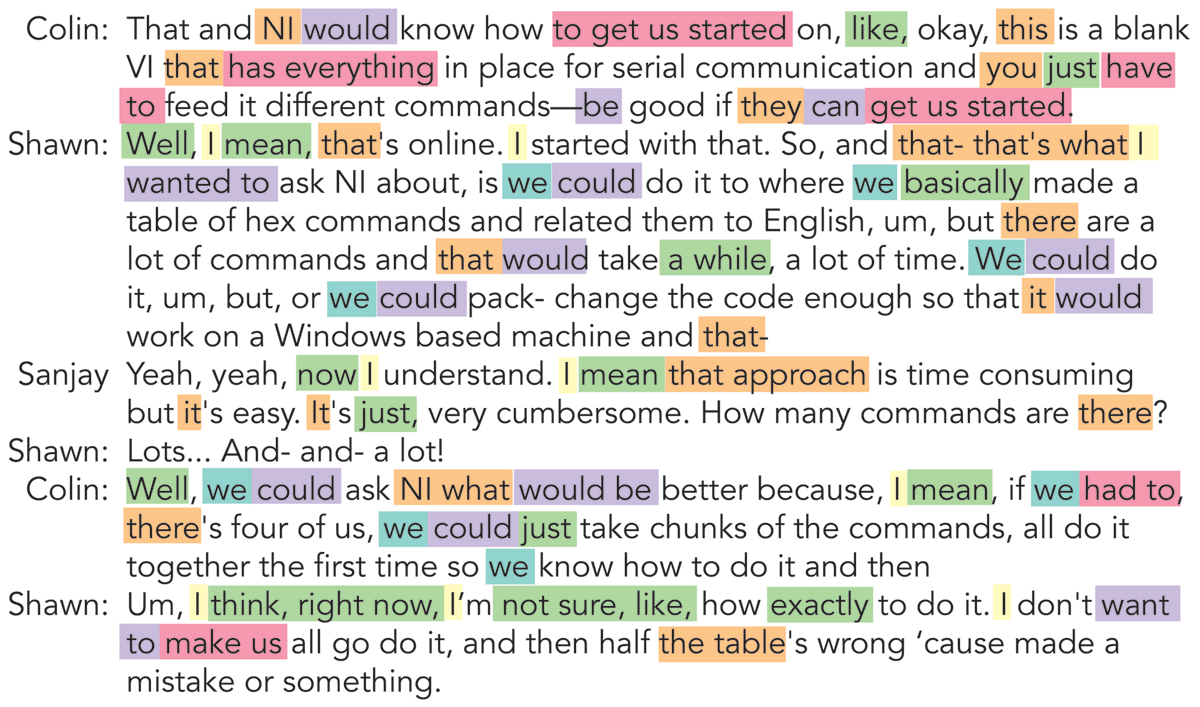
Figure 9
Shawn and Colin, facing difficulties, considered external help during a meeting with their TA. Color-coded as defined in Figures 1, 4, and 8.
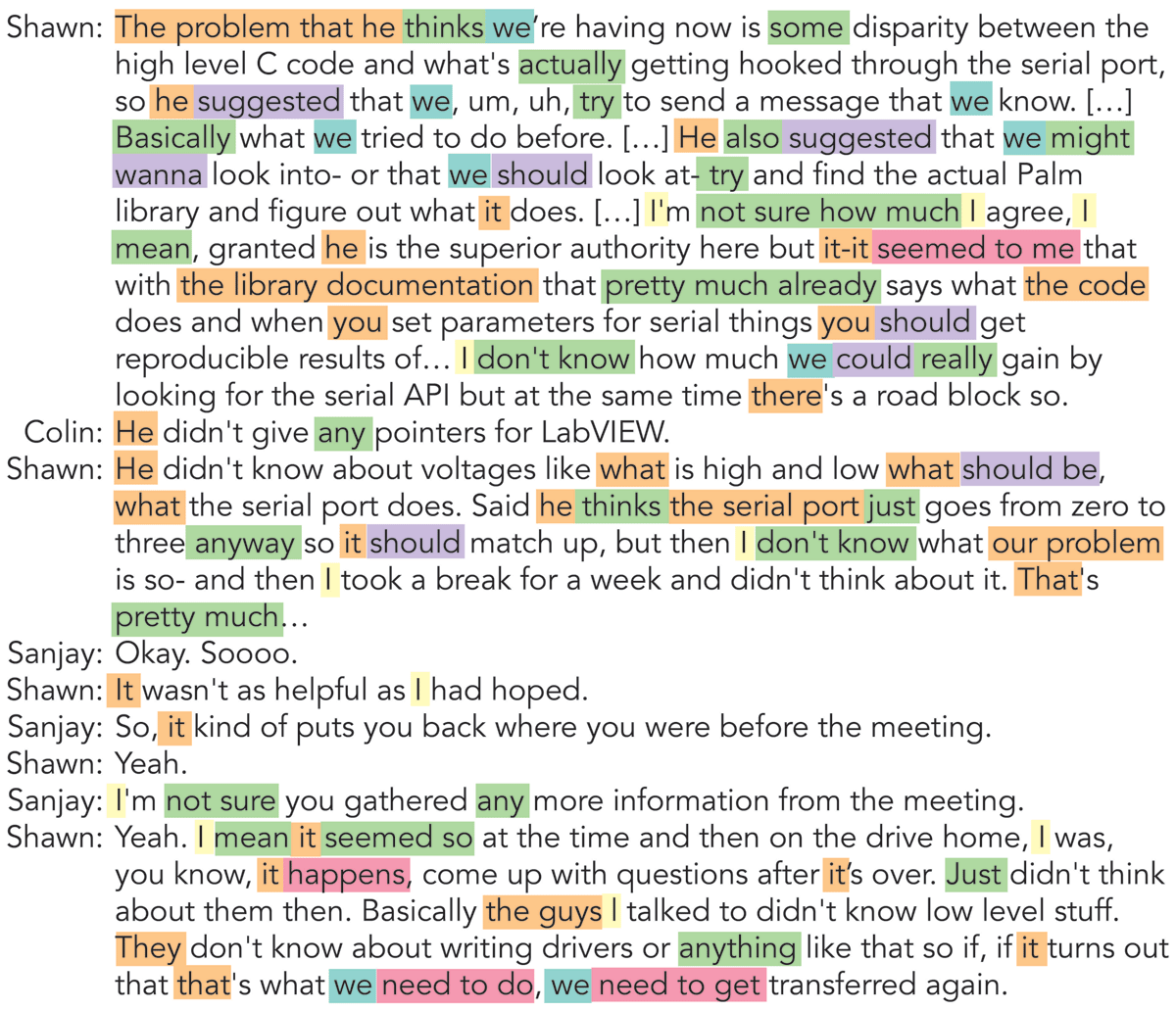
Figure 10
Shawn and Colin reported on their meeting with external experts. Color-coded as defined in Figures 1, 4, and 8.

Figure 11
Shawn explained solving the problem. Color-coded as defined in Figures 1, 4, and 8.
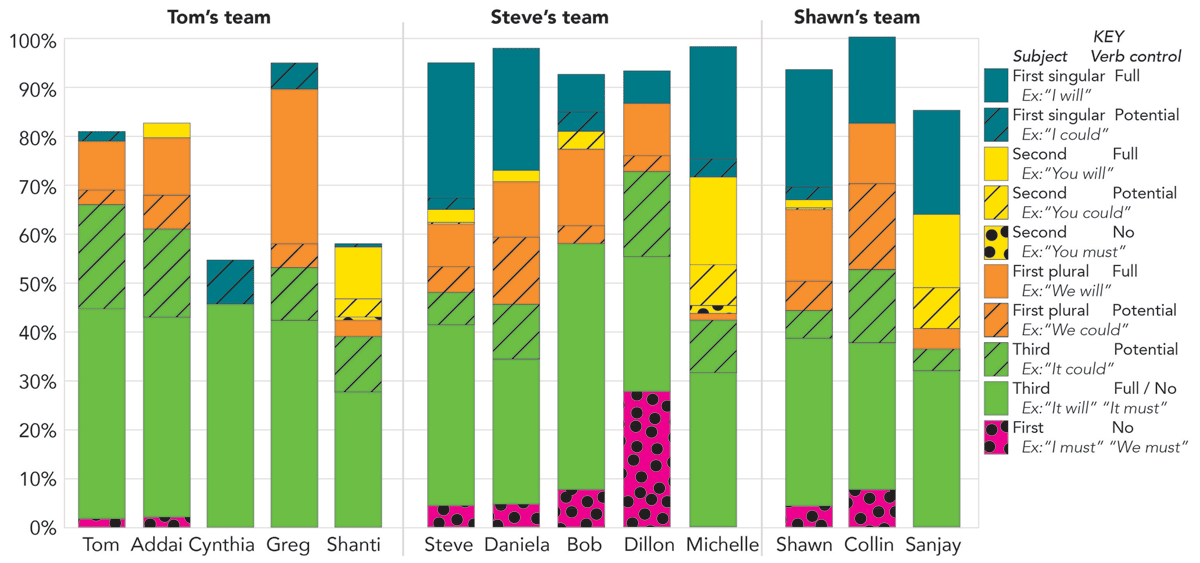
Figure 12
Team member discourse, aggregate over time, characterized in terms of framing agency. Clauses coded as containing verbs showing potential control are denoted with diagonal lines and showing no control with dots. Some utterances were not codable using this scheme, resulting in totals less than 100%.
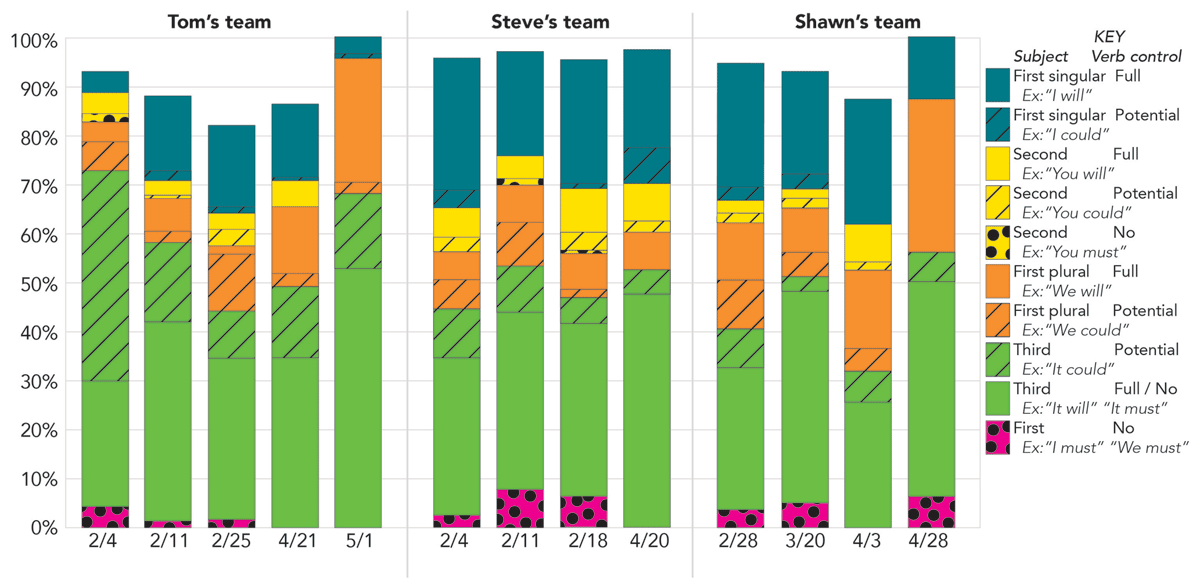
Figure 13
Team discourse over time, aggregated across members include TAs. Note that a majority of second-person clauses originated from TAs, as seen in Figure 13.
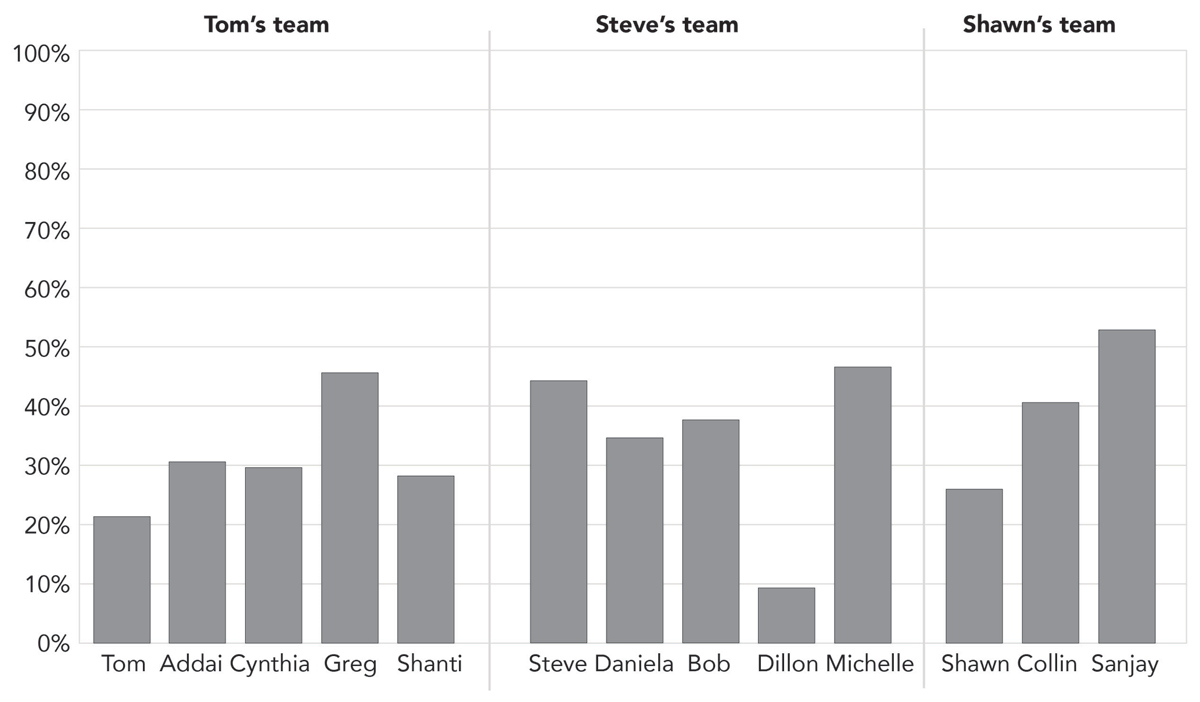
Figure 14
Percent of clauses containing a hedge, within teams and across members, including teaching assistants (Shanti, Michelle, Sanjay). Speakers displayed variable tendency to use hedges.