

Figure 1
Illustration of the three units of analysis in Harré and Van Langenhove’s (1999) description of positioning theory.

Figure 2
Interview setup for Excerpt 1, with the student (S2) to the left and the interviewer (I) to the right.

Figure 3
Interview setup for Excerpt 2, with the student (S4) to the left and the interviewer (I) to the right.

Figure 4
Interview setup for Excerpt 3, with the student (S7) to the left and the interviewer (I) to the right.
Table 1
Formatting conventions for the multimodal transcripts.
| Formatting | Meaning |
|---|---|
| S | Student |
| I | Interviewer |
| […] | Parts of the transcript are omitted |
| [ ] | Text added for clarity or to describe non-verbal communication |
| Bolded | Emotion labels and anti-emotion labels |
| Italics | Verbal stress |
| Underlined | Aspects of emotion acts other than (anti-)emotion labels and verbal stress: Linguistic features (e.g., hedging, pronouns), paralanguage (e.g., pitch, speed, laughter), facial expressions, and gestures |
Table 2
Multimodal transcript for Excerpt 1.
| Line | Speech | Gestures and facial expressions | Line drawing and sound patterns |
|---|---|---|---|
| 1 | I: But is it possible to develop technology without taking a stance on those questions? | I looks at S2 and smiles slightly. S2 looks at I with their left hand at their left hip. |  |
| 2 | (.) | S2 swallows. | |
| 3 | S2: Uhm (.) no. (.) But if it’s based on (.) basic theory (.) | S2 moves their right hand from their shoulder downward so that their lower arm comes to rest slightly above the table. S2 repeats the gesture, but with a smaller movement than before. S2 then keeps the open hand still in front of themselves with the thumb pointing upward. |  |
| 4 | S2: Then, then you can (.) do (.) uhm then you can see the effects | S2 nods their head slightly. S2 moves their right hand from their shoulder downward again in an even smaller movement. | |
| 5 | S2: of the technology, (.) maybe before you’ve implemented it. | S2 moves their hand towards the right (the thumb pointing upward) and back towards the left. S2 closes their hand and lowers it so that it comes to rest on the table. |  |
| [lines omitted] | |||
| 6 | S2: So solve the problem (.) and then | S2 moves their right hand from their shoulder downward with thumb and index finger touching, then closes their hand and lets it rest on the table. I takes notes. | |
| 7 | S2: you can present it to others (.) | S2 lifts their right hand from the table and moves it towards the right, still with thumb and index finger touching. | |
| 8 | S2: how how you would solve it. | S2 scratches their forehead. | |
| 9 | S2: And uhm, if they think you sacrifice too many animals (.) in (.) how you solve (.) the problem (.) then they’ll probably vote against | I stops taking notes, puts their hands in their lap, and looks at S2. S2 moves their right hand from their shoulder downward, then toward the right, and back toward the left. I nods slightly. | See lines 3 & 5 |
| 10 | S2: your proposal. (.) | S2 lifts their eyebrows. |  |
| 11 | S2: But in that case, it has to be said that (.) there may not be any | S2 moves their right hand from their shoulder downward. | See line 3 |
| 12 | S2: other (.) | S2 moves their right hand toward the right | See line 5 |
| 13 | S2: good (.) | S2 moves their right hand back toward the left and the toward the right again | |
| 14 | S2: proposals. (.) | S2 holds their right hand around the corner of the table-top and drums lightly with their index finger on its edge. | |
| [lines omitted] | |||
| 15 | S2: Uhm, so I think that it should be more of a (.) cold | S2 moves their tensed and fully open right hand from their shoulder downward. S2 frowns. |  |
| 16 | S2: cold | S2 moves their tensed and fully open right hand up and down quickly several times with the thumb pointing upward. S2 frowns. | |
| 17 | S2: analysis (.) of (.) what actually happens | S2 rests their still tensed and fully open right hand on the table with the thumb pointing upward. | |
| 18 | S2: (.) u:hm (.) maybe (.) based | S2 moves their right hand toward the right and directly back toward the left. | See line 5 |
| 19 | S2: on (.) economics (.) | S2 moves their right hand from their shoulder downward, then places their open hand on the table with the thumb pointing upward. | See line 3 |
| [lines omitted] | |||
| 20 | S2: So it’s not up to me to decide what I think (.) about nature and (.) how (.) society should be organized. | I takes notes. S2 points towards their breast and keeps their hand there for a few seconds. |  |
Table 3
Multimodal transcript for Excerpt 2.
| Line | Speech | Gestures and facial expressions | Line drawings and sound patterns |
|---|---|---|---|
| 1 | I: You said that (.) it is awful (.) this question. | S4 looks at I, hands in front of their body, left elbow resting on the back of their chair, right elbow resting on the table. I has their hands in their lap and looks at their notebook on the table. S4 slightly tosses their head. I turns to look at S4 and smiles and speaks with a slight tone of laughter. |  |
| 2 | S4: [laughs] Yes. | S4 smiles and looks at the problem description. |  |
| 3 | I: What is it that is so awful about it? | I looks at S4 and smiles. S4 smiles and moves their body forward and then back again. | |
| 4 | S4: Uhm (.) the social aspect, that (.) it affects people. (.) | S4 looks at the problem description, then slightly tosses their head and looks at I. I nods. |  |
| 5 | And uh. No, it’s a difficult situation to be in. (.) | S4 looks at the problem description and nods slightly while saying “difficult situation”. “To be in” is spoken with a soft voice and falling intonation. | Pitch analysis for “to be in”
 |
| 6 | I: Morally? | I looks at S4 and nods slightly. | |
| 7 | S4: Morally, yes, exactly. (.) | S4 looks at the problem description and nods. | |
| 8 | S4: Uhm. [exhaling] (.) | S4 tilts head to the left and supports head with the left hand, left elbow resting on the chair’s backrest. |  |
| 9 | S4: I mean, like (.) ecological sustainability (.) sure that’s [exhaling, inhaling] (.) | S4 lifts head back up into neutral position, looks at I, brings left hand in front of their body and fingers with the sleeve of their shirt. S4 moves their left hand towards and away from their body twice in small movements, then lowers hand and gaze, smiles slightly. |  |
| 10 | how should I say this? (.) | S4 rests head on their left hand and looks up over the table (but not towards I). |  |
| 11 | S4: Humans, that’s our own species after all. | S4 lifts head back up into neutral position, looks at I, and brings the left hand to a position close in front of their mouth. The left hand is tense but open and kept still in front of S4’s mouth. S4 slightly nods with each word in the phrase “our own species”. |  |
| 12 | S4: But we may not value (.) a (.) bird differently than a (.) cat or an (.) an algae or whatever. | S4 smiles slightly, then moves their open hand to the left while saying “bird”, to the right while saying “cat”, back to the right (but not as far as the first time) while saying “algae”. |  |
| 13 | S4: Well, maybe we do (.) but (.) | S4 nods slightly, and slightly moves the hand down and up, looking at I. S4 then moves their left hand back to the right when saying “but”, palm facing down, fingers spread, and looks down at the problem description. |  |
| 14 | S4: But it’s not [exhaling] (.) | S4 looks up (but not at I), smiles slightly, then closes hand into a fist. |  |
| 15 | S4: it doesn’t involve as much emotion | S4 looks at I, opens hand while moving it away from the body, back toward the body and away again. S4 moves hand back towards the body. |  |
| 16 | S4: as when (.) you discuss which people should be affected by it. | S4 looks slightly away from I. I takes notes. S4 moves hand slightly down and up several times, then brings the hand to their chin. |  |
Table 4
Multimodal transcript for Excerpt 3.
| Line | Speech | Gestures and facial expressions | Line drawings and sound patterns |
|---|---|---|---|
| 1 | I: So (.) as an engineer, you would try to be as value-neutral as possible? | I stops taking notes in their notebook, puts down their pen, looks at S7, and puts their hands in their lap. S7 has the fingers of their left hand on the table. S7’s right wrist rests on the edge of the table, the rest of the hand is lifted a few centimeters above the table and S7 holds a ball pen between the right hand’s index finger and long finger. S7 bites their lower lip and wiggles the pen up and down between their fingers. |  |
| 2 | S7: (.) | S7 turns their gaze upwards and to the right (away from I) for a moment, then back towards I. | 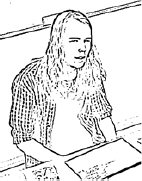 |
| 3 | S7: Uhm (.) in some ways, yes (.) but at the same time (.) I’d try to discuss (.) problems (.) uhm (.) objectively. (.) But (.) which problems I’d (.) maybe think of to discuss, (.) | S7 lifts their right hand a few centimeters above the table. S7 moves the hand slightly forward but keeps it above the table. I nods slightly. |  |
| 4 | S7: I’d expect that to be influenced (.) by my values. | S7 moves their hand towards the left and then holds it still in front of their body, the ball pen in their hand pointing towards I. I nods slightly. |  |
| 5 | S7: And that’s maybe something you wouldn’t want to avoid completely. | S7 moves their body forward slightly and lowers their hand, still keeping it above the table. I nods slightly. | |
| 6 | S7: Like if I (.) care a lot about (.) uhm (.) a certain animal species [inaudible], then I’d maybe (.) have invested some time to (.) | S7 turns the palm of their right hand upwards, lifts the hand slightly, and lowers it again. S7 shakes their head several times in very small movements. I nods slightly. S7 lowers their right hand to the table. | |
| 7 | S7: highlight (.) some points there. | S7 lifts their right hand again and taps the table with the back of the ballpoint pen five times, moving the hand slightly towards their body for each tap. I nods several times. |  |
| 8 | (.) | S7 closes their hand, lowers it, and lets it rest on the table, close to their body. S7 bites their lower lip for a few seconds. I continues nodding. | |
| 9 | S7: Uhm (.) And it’s not the same as, uhm (.) what you shou- shou- (.) | S7 lifts both hands and turns their palms upwards. |  |
| 10 | S7: ideally, I suppose you should try to, uhm (.) highlight all important problems. (.) | S7 lowers their hands to the table, both thumbs pointing upwards. S7 raises and lowers their hands three times. Each time S7 lowers their hands, they move their hands slightly away from each other, still with both thumbs pointing upwards. S7 then lets their hands rest in that position for a few seconds. |  |
| 11 | S7: But I suppose you can’t expect to be able to (.) think of everything (.) but (.) you should think about (.) about the big questions and then, like | S7 first keeps hands in the same position.I nods slightly. S7 then lifts both hands from the table with the palms of their hands pointing downwards with spread fingers. S7 moves their hands slightly forward and backward several times. When the right hand moves forward, the left hand moves backward and vice versa. |  |
| 12 | S7: (.) Well, what should I say? | S7 rests their hands in their lap and turns their gaze upwards and to the right (away from I), squinting. |  |
| 13 | S7: Which areas you choose to consider, that will be influenced by who you are as a person. (.) But I suppose you can expect that that’s done in an objective way, and that you try (.) to get (.) some kind of holistic understanding of it. | S7 turns their gaze back towards I. I nods slightly. | |
| 14 | (.) | I starts taking notes. S7 turns their gaze upwards and to the right (away from I) | See line 12 |
Table 5
Emotional storylines (ESs, white background) and emotional positions (EPs, grey background) identified by each analyst (across all three excerpts) compared to the overall results in which we combined the individual analysts’ descriptions.
| Overall | Analyst JL | Analyst TA | Analyst MB | |
|---|---|---|---|---|
| ES1 | Emotions are irrelevant and/or detrimental to engineering problem solving | Emotions are irrelevant to engineering
work. Emotions are detrimental to engineering problem solving. | Engineering is a rational business. It is possible and desirable to bracket emotions in engineering work. | Engineers solve problems rationally and without emotions. |
| EP1a | Engineers as rational problem solvers | Engineers as rational problem solvers Self as a rational problem solver | Self (engineer?) as rational, promoting engineering theories that are grounded in economics | Engineers solve problems. Engineers make rational choices that are not based on individuals’ opinions or values (ethics). |
| EP1b | Others (non-engineers) as influenced by emotions and therefore not as capable of solving problems as engineers | Others (non-engineers) as people who are influenced by emotions | Others as emotional and therefore not able to solve problems | |
| ES2 | Emotions are relevant and/or important for engineering problem solving | Emotions are relevant and/or important for engineering work. | It is not possible nor desirable to bracket emotions in engineering work. | |
| EP2 | Engineers as empathetic human beings | Engineers as influenced by personal values Self as influenced by personal values Self as someone who is empathetic | Engineers have personal opinions and can therefore not be fully
objective. Engineers should sometimes have personal opinions. |