
Table 1
Adapted SDoMH Areas and Definitions.
| SDoMH AREA | OPERATIONALIZATION WITHIN THE TUMAINI CONTEXT AND PROGRAMMING |
|---|---|
| Parents, Families, and Households (PFH) | Access to basic needs (food/nutrition, water, sanitation, housing), housing and employment conditions (street-connectedness), parental employment and household income, parental physical and mental health, pregnancy and maternal care, social support, exposure to substance use |
| Community | Trust and safety among students and staff in the school environment, community-based participation in extracurricular clubs and sports at the school |
| Local Services | Education provision, social services (financial support, housing aid, childcare, job-placement support), SEL programs (Guidance & Counseling, courses: Mentorship, Life Skills, and Communication Skills) |
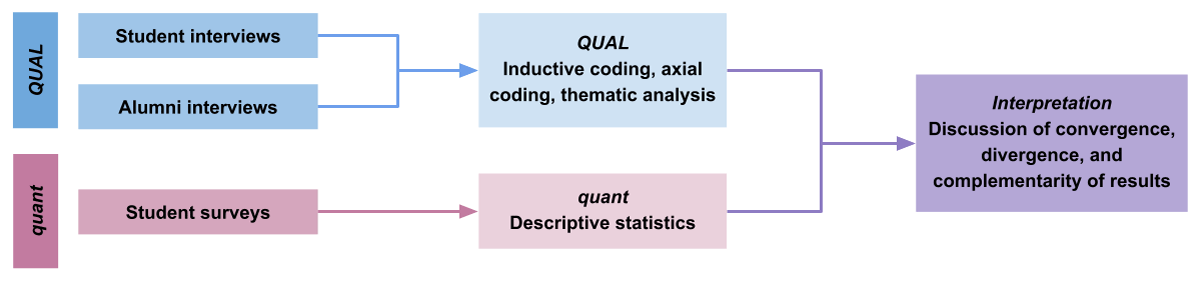
Figure 1
Mixed Methods Diagram.
Table 2
Outline of Student Interview Protocol.
| CATEGORY | PURPOSE |
|---|---|
| Perceived Mental Wellbeing | Asked students to provide a direct account of their mental health journey |
| Stress and Coping Mechanisms | Directly addressed perceived causes, symptoms, and methods for managing stress |
| Community | Requested students discuss how they relate to the Tumaini community |
| Local Services | Addressed the impact of services offered at Tumaini |
| Substance Use | Specifically addressed students’ experiences with substance use from their own histories or peers’ histories |
Table 3
Outline of Student Survey.
| SDoMH AREA | QUESTION TOPICS |
|---|---|
| Parents, Families, and Households (PFH) | Family background, parental employment status, housing status before arriving at the institution, exposure to substance use |
| Community | Difficulty making friends, access to social support systems, feelings of belonging in the community, trust in peers, exposure to bullying at the institution, exposure to crime at the institution |
| Local Services | Educational background, perceived effectiveness of the TVET institution’s mental health resources, access to healthcare and sanitation services, parental status |
| Other Topics | Demographics (gender, age, tribal identity), self-assessments of mental wellbeing (self-esteem and confidence, coping mechanisms, suicidality) |
Table 4
Quality Management Framework.
| TYPE | PROCEDURES FOR THIS STUDY |
|---|---|
| Theoretical validation | We prioritized key concepts that we then tailored to local contexts and used purposive sampling under authority of Kenyan co-authors. |
| Procedural validation | We used constant comparative method via open then axial coding; we repeatedly checked interpretive awareness through cross-national team conversations. |
| Communicative validation | We collaborated in a USA-Kenyan team to establish genuine dialogue and develop the USA team’s contextual awareness; we explored respondents’ contrasting accounts through probes in semi-structured interviews. |
| Pragmatic validation | Our collaborative research design aligned with precedent from the decade of practice between the Kenyan and USA PIs; we had a diverse set of respondents including students and alumni. |
| Process reliability | We documented interview protocols; we practiced mock interviews before conducting actual interviews; we conducted member checking; we reviewed transcripts for accuracy; we separated descriptive and interpretive coding across sub-teams focused on qualitative and quantitative data. |
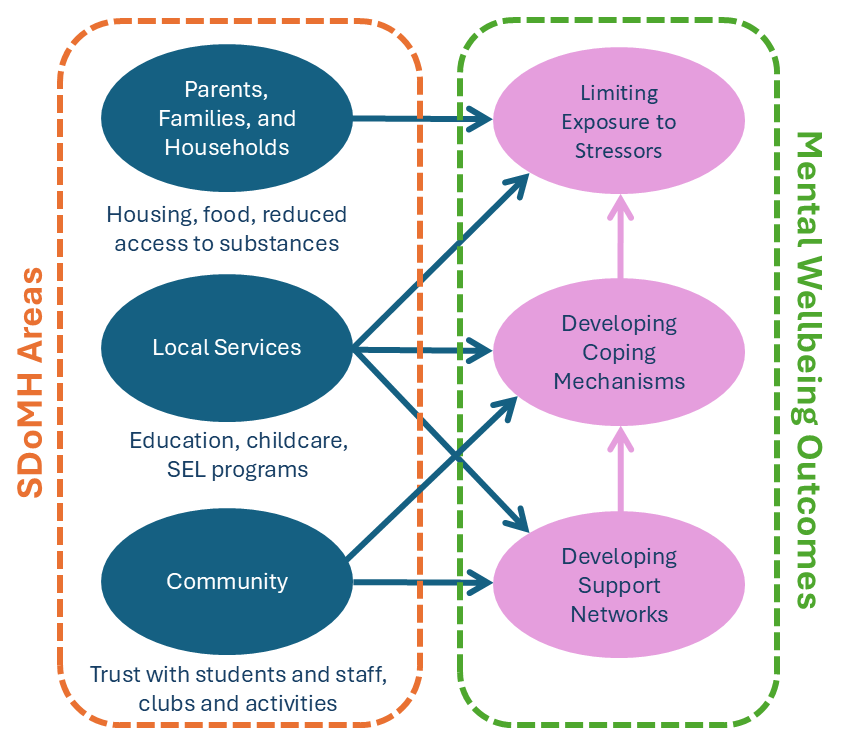
Figure 2
Summary Map of Key Themes.