
Introduction
Engineering students around the world face demanding academic expectations, competitive environments, and high rates of stress (Jensen & Cross, 2021). Such challenges can negatively affect mental health and wellbeing, which in turn are associated with worse academic outcomes (Bork & Mondisa, 2022; Danowitz & Beddoes, 2022). Social-emotional learning, if incorporated in engineering education, can benefit engineering students’ wellbeing and educational outcomes (Elmi, 2020; Jobel et al., 2024; LaBelle, 2019; Riemer, 2003).
Research on the interplay of mental wellbeing and STEM education is limited, especially in low and middle-income countries (LMICs) (Deitz et al., 2021). Additionally, evidence-based SEL programs have typically been designed for Western educational settings and may not have the same impact elsewhere (Jones et al., 2020; Raisch et al., 2024). Emerging work suggests “decolonizing” engineering education by recentering localized, indigenous engineering methods that develop contextually appropriate problem-solving approaches and foster the self-determination of local communities (DeBoer et al., 2022; Forrest & Seniuk Cicek, 2021; Hess & Strobel, 2013; Seniuk Cicek et al., 2023).
Kenya is a non-Western LMIC with a large youth population. TVET may hold great potential for helping propel Kenya’s economic development, and the Kenyan government has recently undertaken efforts to make these programs more accessible for its youth (Odhiambo & Wario, 2015; UNESCO-UNEVOC International Centre for Technical and Vocational Education and Training, 2018).
The existing, though limited, research indicates that Kenyan youth face numerous mental health challenges (Kumar et al., 2024; Ndetei et al., 2022; Obinna et al., 2021). Underdiagnosis and gaps in resources and mental health literacy have led to inadequate treatment (Wado & Wekesah, 2022). In particular, street-connected youth (SCY) in Kenya disproportionately experience mental health challenges and limited healthcare access (Embleton et al., 2012, 2013, 2018). Addressing such challenges would reduce social barriers and improve the wellbeing, resilience, and life skills of SCY in Kenya (Embleton et al., 2020b; Sitienei & Pillay, 2019).
In this work, we present a mixed-methods study of students and alumni from a TVET institution in Western Kenya to evaluate the impact of the institution’s SEL programs on students’ mental wellbeing and post-graduation outcomes. We used the “social determinants of mental health (SDoMH)” (World Health Organization [WHO], 2014) to situate our key concepts of social-emotional outcomes, well-being, and mental health, which we clarify in the Framework section below.
This work provides empirical evidence on the largely positive effect of culturally grounded SEL on students’ preparation for long-term success in engineering pathways within non-dominant contexts underrepresented in engineering education research. Our work contributes to the decolonization of engineering education in Sub-Saharan Africa (SSA) by analyzing key wellbeing outcomes of culturally appropriate SEL interventions and localized engineering education in a TVET center for adolescents and young people, many of whom are former SCY. Furthermore, our work provides an example of developing a contextually appropriate approach for studying engineering education in marginalized contexts.
Background
To understand the experiences of TVET students, including former SCY, in Western Kenya, we first examine the state of student mental wellbeing in engineering education broadly and the educational approaches that support wellbeing outcomes. We also present the limited research on wellbeing, mental health, and social-emotional learning in LMICs. We then focus on the role TVET has within Kenya’s engineering education landscape and the wellbeing challenges faced by Kenyan youth and SCY in particular.
Mental Wellbeing in Engineering Education
Globally, engineering students face high rates of mental health and wellbeing challenges (Gabriel et al., 2025; Reta et al., 2020; Singh & Jha, 2013). A review of 23 studies on engineering students across 10 countries found that 33.1% of all students had moderate or higher depressive symptoms (Gabriel et al., 2025). In the US, engineering students report high levels of stress, anxiety, and depression, yet consistently underutilize treatment services (Asghar et al., 2024; Whitwer et al., 2025). These patterns are often reinforced by a culture within engineering education that normalizes overwork, discourages emotional vulnerability, and stigmatizes help-seeking (Bork & Mondisa, 2022; Jensen & Cross, 2021). Furthermore, the relationship between mental wellbeing and academic success is cyclical: educational access and quality support wellbeing, while untreated mental health concerns can impair cognitive function, academic performance, degree completion, and weaken peer relationships (Atkins et al., 2010; Fergusson & Woodward, 2002; Fletcher, 2008; Hale & Viner, 2018).
Social and Emotional Learning and Its Impact on Student Outcomes
The link between mental wellbeing and academic success highlights the need for proactive, embedded support within engineering programs. Given the role of school climate in shaping wellbeing (Viner et al., 2012), engineering education may benefit from making wellbeing resources more visible, accessible, and culturally responsive. Educational resources have now become standard to support student development of SEL competencies such as self-awareness, self-management, social awareness, relationship skills, and responsible decision-making (Collaborative for Academic, Social, and Emotional Learning [CASEL], 2020; Jobel et al., 2024; Prothero, 2026) to improve academic and mental health outcomes (Elmi, 2020; LaBelle, 2019; Riemer, 2003).
In engineering education, SEL can be fostered through various pedagogical strategies, including project-based learning (Lee, 2022), integration into lab-based and team activities (Jobel et al., 2024), and curricular frameworks like Social Emotional cum Active Learning (SEAL) (Sri & Bhavani, 2024). Faculty training, reflective practices, and experiential learning environments further reinforce SEL competencies (Elmi, 2020; Garner et al., 2018). These methods have improved students’ resilience, collaborative capacity, and communication skills, especially for students from underrepresented backgrounds. Emotional regulation and relationship skills help students manage setbacks and reduce anxiety, leading to greater persistence and retention in engineering programs (Jobel et al., 2024). SEL also enhances cognitive engagement, classroom belonging, and long-term wellbeing (Elmi, 2020; Garner et al., 2018).
Research Gaps in STEM Education and SEL in Kenya
LMICs are underrepresented in both STEM education research and in research on learning and psychosocial factors at large. A prior analysis found STEM education research focused predominantly on the United States, Australia, China, and Spain (Cai et al., 2023). Similarly, most evidence-based SEL programs were developed in Western contexts and thus may not be relevant to other cultures (Jones et al., 2020; Raisch et al., 2024). The methods used in STEM education and SEL research from Western, Educated, Industrialized, Rich, and Democratic (WEIRD) country contexts also may be inappropriate in other settings (Broesch et al., 2020). Additionally, LMIC adolescent and child mental health comprises just 2% of mental health data globally (Zhang et al., 2025). We narrow in on Kenya as a non-WEIRD country where studying both engineering education, particularly TVET, and youth mental wellbeing is highly relevant.
TVET in Kenya
In TVET programs, students receive general knowledge and study the technologies, sciences, and practical skills related to a particular sector in the country’s labor market. This training may involve apprenticeship and/or on-the-job training (Tripney & Hombrados, 2013). The Kenyan government has focused on promoting TVET to help the country’s “youth bulge,” its large and growing population of adolescents and young people (AYP), attain employment and pursue entrepreneurship (Odhiambo & Wario, 2015). TVET programs also increase educational access, giving students second chances at secondary education (UNESCO-UNEVOC International Centre for Technical and Vocational Education and Training, 2018). TVET further has the potential for expanding educational access and local economic opportunities in rural communities across Kenya (Achoka et al., 2007; Heti, 2013).
Mental Wellbeing & Street-Connected Youth in Kenya
Mental wellbeing is understudied in Kenya and SSA (Osborn et al., 2021) despite the few existing studies signaling that mental health challenges substantially burden AYP in the region (e.g., Kumar et al., 2024). Mental disorders were the second leading cause of disability among AYP in Kenya in 2019 (Kumar et al., 2024), with depression, anxiety, substance use, and academic stress contributing to mental health challenges (Ndetei et al., 2022; Obinna et al., 2021). Treatment gaps persist due to stigma, lack of mental health literacy, resource constraints, and underdiagnosis, leaving one in eight adolescents with a diagnosable disorder but fewer than one in 10 accessing care (Wado & Wekesah, 2022). Culturally appropriate interventions, including school-based programs, are recognized as essential to addressing these gaps (Memiah et al., 2022; Ministry of Health, Kenya, 2020).
SCY in Kenya face extreme risks to their mental wellbeing. Many SCY are working or living on the streets due to poverty, family breakdown, abuse, or political violence which exposes them to further trauma (Doornbos et al., 2017; Sitienei & Pillay, 2019; Sorber et al., 2014). Lacking access to healthcare, they disproportionately experience untreated mental health disorders, substance abuse, and other preventable morbidities (Embleton et al., 2012, 2013, 2018). SCY experience persistent fear, anxiety, hopelessness, and social stigma, often facing verbal and physical abuse (Embleton et al., 2020a; Sitienei & Pillay, 2019).
Despite these hardships, many SCY in Kenya express a strong desire to return to school, secure employment, and improve their lives (Sorber et al., 2014). However, interventions that simply placed SCY in schools or homes frequently failed because they neglected the youths’ perspectives and holistic needs; effective solutions integrated shelter, poverty alleviation, counseling, and empowerment programs focused on building life skills and resilience to support social reintegration (Sitienei & Pillay, 2019). Additionally, addressing the mental wellbeing complexities faced by SCY is crucial to breaking cycles of stigma, discrimination, and instability while promoting long-term wellbeing and inclusion (Embleton et al., 2020b).
Purpose & Research Questions
To address these gaps, this study investigates the impact of a Kenyan TVET institution’s SEL programs and environment on students’ mental wellbeing during their studies and following graduation. Many of the institution’s students are also former SCY. In this study, the SEL programs, social services, engineering curricula, community, and residential environment at the institution are recognized as social determinants of mental health (SDoMH) for students. We explore students’ exposure and access to three critical areas of the SDoMH framework (Parents, Families, and Households; Local Services; and Community) to better understand how institutional determinants impact and mediate students’ mental wellbeing. This research contributes to the limited body of literature discussing the role of SEL in supporting engineering students in LMICs. To achieve these objectives, we address two research questions:
RQ1: How do social determinants of mental health at a localized engineering-focused TVET institution impact student mental wellbeing?
RQ2: How do social determinants of mental health at a localized engineering-focused TVET institution impact alumni mental wellbeing after graduation?
Conceptual Framework: Social Determinants of Mental Health (SDoMH)
We use the World Health Organization (WHO)’s definition of mental health: “a state of well-being in which every individual realizes his or her own potential, can cope with the normal stresses of life, can work productively and fruitfully, and is able to make a contribution to her or his community” (WHO, 2014, p. 12). Throughout this paper, we also refer to mental wellbeing, which we consider a broader concept than mental health. The National Academies of Sciences, Engineering, and Medicine (NASEM) defines mental wellbeing as including “a sense of personal safety and security, emotional support and connection, mechanisms to cope with stressors, and access to services when appropriate for short- and long-term care” (NASEM, 2021, p. 28). While mental health focuses on a person’s psychological functioning (WHO, 2014), mental wellbeing goes beyond mental health to account for their interpersonal relationships, access to care, and overall life satisfaction (NASEM, 2021).
In this study, we explore wellbeing through the SDoMH framework (WHO, 2014). Rather than identifying symptoms of mental illnesses, which can be culturally dependent, the SDoMH framework identifies external circumstances and events in a person’s life that contribute to their mental wellbeing. The WHO defines SDoMH as “those conditions in which people are born, grow, live, work and age that impact health and well-being, and the health systems that they can access, which are shaped by economic, social, environmental policies and politics” (Carod-Artal, 2017, p. 35). The SDoMH framework also accounts for how an individual leverages stress management and social-emotional tools to respond to stressors (Osborn et al., 2021; WHO, 2014). The WHO categorizes SDoMH into five areas: Life-course (i.e., life stages such as childhood or adolescence), Parents, Families and Households (i.e., parenting behaviors and material conditions), Community (e.g., safety and attributes of the natural and built environment), Local Services (e.g., education, health care), and Country Level Factors (e.g., inequality, governance, conflict) (WHO, 2014, p. 17).
The SDoMH framework aligns well with our study for several reasons. First, prior work has demonstrated that these social determinants are associated with mental health in SSA and specifically in Kenya (Magige et al., 2025; Mũrage et al., 2023; Osborn et al., 2020). SDoMH also supports the linkage between mental health and educational outcomes. Children who are socio-economically disadvantaged are more likely to have obstacles to mental and physical health, and these conditions are direct predictors of worse educational and occupational success. As a result, SDoMH factors continue compounding, reinforcing disparities in health, education, and employment across generations (Hale et al., 2015; Osborn et al., 2020).
We adapted the framework to address SDoMH relevant to Tumaini. The Kenyan co-authors of this report led the framework adaptation process to ensure alignment with the local context. We determined that Life-course and CLF were not within the scope of the institution’s research goals; however, the remaining three SDoMH areas aligned clearly with the institution’s scope of work. We tailored the definitions of these three areas to focus on the community, environment, and services at the institution. Our adapted definitions are included in Table 1.
Table 1
Adapted SDoMH Areas and Definitions.
| SDoMH AREA | OPERATIONALIZATION WITHIN THE TUMAINI CONTEXT AND PROGRAMMING |
|---|---|
| Parents, Families, and Households (PFH) | Access to basic needs (food/nutrition, water, sanitation, housing), housing and employment conditions (street-connectedness), parental employment and household income, parental physical and mental health, pregnancy and maternal care, social support, exposure to substance use |
| Community | Trust and safety among students and staff in the school environment, community-based participation in extracurricular clubs and sports at the school |
| Local Services | Education provision, social services (financial support, housing aid, childcare, job-placement support), SEL programs (Guidance & Counseling, courses: Mentorship, Life Skills, and Communication Skills) |
Study Context and Collaboration
Our study participants were from Tumaini Innovation Center, a TVET center located outside of Nairobi but in an urban center in Kenya; some coauthors of this manuscript were leadership, staff, and instructors at Tumaini. As of the time of publication, the institution focuses on training its students in six accredited vocational tracks (referred to as “courses”): motor vehicle technology, hairdressing, beauty therapy, food and beverage technology, electrical wiring, and arc welding and fabrication. Across these tracks, students also take foundational courses in literacy, numeracy, communication, and Localized Engineering. The Localized Engineering Education curriculum evolved over a decade of collaboration and was co-developed by some members of the author team at the institution by tailoring and applying the Localized Engineering in Displacement (LED) framework to enhance learner engagement and agency by focusing learning activities in each TVET course on student-identified needs and indigenous knowledge (DeBoer et al., 2022; Radhakrishnan et al., 2021). As demonstrated in ongoing LED research, the localized engineering course itself includes SEL activities (e.g., reflection and social awareness) and SEL outcomes (e.g., learner agency and self-actualization) through its focus on student leadership and student-driven solutions for local problems (DeBoer et al., 2022). The students complete one year of classes, including a summer “attachment” (akin to an internship) before returning to the institution for graduation.
In addition to technical education, Tumaini’s mission comprises four objectives: rescue, rehabilitation, reintegration, and resocialization. To support students’ holistic development, Tumaini offers social services (e.g., financial aid, job-placement support, and childcare services) and SEL programs, which fall under the Local Services area of SDoMH. Tumaini employs a team of social workers to support these services and lead community outreach and recruitment initiatives. Social workers also contribute to the PFH area by reconnecting SCY with family members.
SEL programs at the institution include standardized SEL courses and Guidance & Counseling services; the standardized SEL courses include Life Skills and Communication Skills which are part of the NITA Grade III TVET Curricula. To complement standardized courses, the institution developed a Mentorship course to offer guidance and help students develop confidence, creativity, innovation skills, and goals for their future. Mentorship offers a flexible lesson plan to address students’ needs and interests including mental health awareness, stress management, and family planning.
Guidance & Counseling (G&C) is an essential part of the TVET institution’s student supports. While studying, students meet with G&C staff as needed; some students regularly meet one-on-one with a guidance counselor while other students benefit from group counseling. All students participate in the G&C course, which covers topics such as substance use awareness, stress management, and anger management. Guidance counselors are not only a significant local service for students, but they also act as a critical part of the community at the TVET institution. G&C also supports students who are coping with stressors related to PFH including substance use and parental relationships.
Additionally, while the institution accepts day scholars from the nearby community, it was designed first to serve as a boarding school for former SCY and students whose primary residence is located far from the school. This residential setting and the provision of other basic needs contribute to the Community and PFH areas of SDoMH.
By centering the technical curriculum around community-based engineering projects, integrating SEL activities into engineering activities, providing standard and individualized SEL resources, students learn the skills and knowledge needed to lead successful, sustainable lives in which they can contribute to their community in meaningful ways.
Positionality
This study was conducted as a part of an ongoing partnership between the leadership and teachers at the Tumaini Innovation Center and researchers from two universities in the U.S. (Purdue University and San Francisco State University). The author team for this paper includes authors from all institutions in the cross-national partnership. The U.S. author team is led by undergraduate students in engineering (co-authors 1–4) who participated in an international research program funded through the National Science Foundation (NSF). They were mentored by faculty members at the two U.S. institutions (co-authors 5–7) who coordinated this program. Our Kenyan co-authors include instructors, guidance counselors, and social workers (co-authors 8–14) at Tumaini.
The Kenyan and U.S. faculty co-authors acted as research advisors for the undergraduate engineering student researchers. The undergraduate research team worked closely with Kenyan authors on-site to develop relevant research questions and culturally appropriate data collection methods. This study was developed to address the needs and interests of the TVET institution (as identified by the Kenyan co-authors) while engaging undergraduate engineering students in educational research and intercultural learning. Our team aimed to build on the strengths offered by our diverse team, including the expertise of the Kenyan co-authors in teaching and supporting the students at the TVET institution, the research methods expertise of the U.S. faculty members, and the engineering and data analysis skills of the undergraduate research team.
Methods
This study used a convergent mixed methods approach with a primary emphasis on qualitative data (Crede & Borrego, 2010; Creswell & Plano Clark, 2017). In interviews with students and alumni, participants described their personal experiences and perceived mental wellbeing and spoke about specific SDoMH (as categorized in Table 1). The quantitative survey complemented the qualitative data by assessing students’ access and exposure to SDoMH, which provided us with important context for interpreting our qualitative results. Figure 1 depicts the steps of our mixed methods design, per recommendations for engineering education researchers using mixed methods (Crede & Borrego, 2010). We use the term “students” to refer to participants enrolled at the institution at the time of data collection and “alumni” to refer to participants who had completed their year of coursework at the institution by the time of data collection.
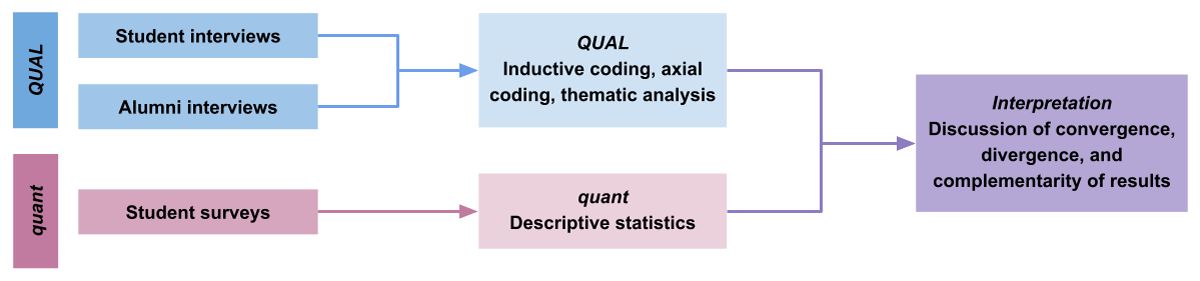
Figure 1
Mixed Methods Diagram.
Data Collection
In total, 38 students—28 boys/men and 10 girls/women—completed the survey. (As AYP, we will subsequently use men and women as shorthand to describe adolescent and youth boys/men and girls/women.) We conducted semi-structured interviews with 21 students, including 17 men and four women; 16 of the student interviewees also completed the survey. Additionally, 16 student interviewees consented to being recorded during the interview, four declined to being recorded, and one wished to stop the recording towards the end of their interview. During each unrecorded interview or part of the interview, the interviewee consented to the interviewer taking notes on responses for analysis.
We also interviewed seven alumni from the 2022–2023 graduation cohort of the TVET institution. Six of these interviews were conducted over the phone with alumni who were unable to meet at the school. Given our human-subject protocols, we could not ask for consent over the phone. Therefore, interviews could only be conducted with alumni who had signed consent forms to participate in the research study in previous years. Alumni were also asked to answer questions related to career development and job-placement for an adjacent study under the same research program and Principal Investigators (PIs).
Interview Protocol for Students
We developed a semi-structured interview protocol to allow interviews to be tailored to each participant while also being aligned with five main categories (shown in Table 2); example questions are included in Appendix A. We developed the first two categories based on the research interests of the TVET institution and the remaining three categories aligned to the three SDoMH areas identified as priorities. We narrowed the PFH area to Substance Use to focus on the specific research interests of the G&C staff at Tumaini; we included a broader set of PFH questions in the student survey. The interview protocol did not include a demographics section; however, we recorded the gender of each interviewee and any additional demographic information (e.g., age, Kenyan ethnic/tribal identity) that they discussed during the interview. At the end of the protocol, participants were asked if they had any suggestions for the institution or comments about the research study.
Table 2
Outline of Student Interview Protocol.
| CATEGORY | PURPOSE |
|---|---|
| Perceived Mental Wellbeing | Asked students to provide a direct account of their mental health journey |
| Stress and Coping Mechanisms | Directly addressed perceived causes, symptoms, and methods for managing stress |
| Community | Requested students discuss how they relate to the Tumaini community |
| Local Services | Addressed the impact of services offered at Tumaini |
| Substance Use | Specifically addressed students’ experiences with substance use from their own histories or peers’ histories |
Interview Protocol for Alumni
To better understand the trajectory of students’ wellbeing after graduation, we interviewed recent alumni. We used a semi-structured interview protocol similar to Table 2, which we developed in collaboration with a second research team to reduce respondent fatigue and answer both teams’ research questions in one conversation. Demographic questions were included in the interview protocol because the alumni did not participate in the survey. An outline of this protocol is included in Appendix B.
Student Surveys
Our full team developed and localized survey questions related to wellbeing and SDoMH for this study; these questions were not from an existing assessment tool. Table 3 presents a list of topics addressed in the survey and their alignment to the SDoMH framework. The full survey is included in Appendix C.
Table 3
Outline of Student Survey.
| SDoMH AREA | QUESTION TOPICS |
|---|---|
| Parents, Families, and Households (PFH) | Family background, parental employment status, housing status before arriving at the institution, exposure to substance use |
| Community | Difficulty making friends, access to social support systems, feelings of belonging in the community, trust in peers, exposure to bullying at the institution, exposure to crime at the institution |
| Local Services | Educational background, perceived effectiveness of the TVET institution’s mental health resources, access to healthcare and sanitation services, parental status |
| Other Topics | Demographics (gender, age, tribal identity), self-assessments of mental wellbeing (self-esteem and confidence, coping mechanisms, suicidality) |
When developing questions related to perceived wellbeing, we chose to explore self-esteem and confidence because these factors are associated with social-emotional as well as mental wellbeing in adolescents (Masselink et al., 2018; Trajković et al., 2023). The final survey section provided space for students to write any additional symptoms, thoughts, or feelings that they wanted to share with the research team.
All survey questions were presented both in English and Kiswahili. We first developed the survey in English. A Kiswahili teacher translated the English text to Kiswahili, and other Kenyan co-authors validated the translations. During the survey administration, students who consented to participate in the study took the survey in an exam-like classroom setting. Participants took between five and 45 minutes to respond to the survey.
Ethical Conduct of Research
Ethical approval for this study was granted by the Purdue University Institutional Review Board (Approval No. 1512016897) and Kenyan NACOSTI [AIU/IERC/EXT030/2021]. To ensure that we followed a culturally appropriate consent process, we worked with Kenyan mentors and co-authors to schedule an in-class presentation of the research purpose, data collection methods, and data sharing and privacy policies. A Kenyan instructor also explained these methods in Kiswahili and students were given time to ask questions to research team members before signing the consent form.
Data Analysis
In the first stage of data analysis, the quantitative survey data and qualitative interview data were analyzed separately by different research team members. After this initial data analysis, we conducted the interpretation phase of the data analysis together, identifying connections between data sets to address both research questions.
Qualitative Data Analysis
The majority of interview recordings were transcribed using an automatic transcribing software, Otter.ai. We did not use the Otter.ai software for the four interviews that were conducted in Kiswahili; the recordings for these interviews were translated and directly transcribed by a Kenyan co-author.
After transcription, we analyzed qualitative data through multiple rounds of coding (Saldaña, 2013). In our first round, a minimum of two researchers individually read each interview and performed a combination of descriptive and in vivo coding. The descriptive coding allowed us to generate a list of topics that students were bringing up, while the in vivo coding allowed us to capture participants’ exact words to describe their lived experiences, which is particularly important for participants in marginalized groups (Saldaña, 2013). In our second round of coding, we then applied a priori coding to explore the alignment of our interview data with the SDoMH framework. We used the three areas of SDoMH (defined in Table 1) as three of our a priori codes and a fourth code for self-assessments of overall mental wellbeing.
In our third round of coding, one researcher conducted axial coding to identify common categories across these two data sets and to link codes from Round 1 and Round 2 into categories and sub-categories (Saldaña, 2013). The definitions and organization of these categories were refined through ongoing discussion with the larger research team, resulting in three central themes that captured the impact of the institution’s SEL programs on students’ development.
Quantitative Data Analysis
We calculated descriptive statistics for participant demographics and student exposure to SDoMH such as healthcare access, social support, gender, and substance abuse exposure, providing insight into students’ wellbeing and demographic trends.
Interpretation
In the interpretation stage of analysis, we identified key quantitative results that helped us draw or situate inferences regarding the themes developed during the qualitative data analysis (Creamer, 2018). For example, we integrated statistics describing parental employment rates with qualitative data describing participants’ access to basic needs and financial stability to better describe student exposure to financial stressors at home. This integration also follows Crede and Borrego (2010)’s recommendations.
Research Quality
Throughout our study, we abided by and revisited several aspects of the process-aligned framework for exhibiting research quality that Walther et al. (2013) developed for interpretive engineering education research. We describe how we leveraged Walther et al.’s framework in our study in Table 4.
Table 4
Quality Management Framework.
| TYPE | PROCEDURES FOR THIS STUDY |
|---|---|
| Theoretical validation | We prioritized key concepts that we then tailored to local contexts and used purposive sampling under authority of Kenyan co-authors. |
| Procedural validation | We used constant comparative method via open then axial coding; we repeatedly checked interpretive awareness through cross-national team conversations. |
| Communicative validation | We collaborated in a USA-Kenyan team to establish genuine dialogue and develop the USA team’s contextual awareness; we explored respondents’ contrasting accounts through probes in semi-structured interviews. |
| Pragmatic validation | Our collaborative research design aligned with precedent from the decade of practice between the Kenyan and USA PIs; we had a diverse set of respondents including students and alumni. |
| Process reliability | We documented interview protocols; we practiced mock interviews before conducting actual interviews; we conducted member checking; we reviewed transcripts for accuracy; we separated descriptive and interpretive coding across sub-teams focused on qualitative and quantitative data. |
Limitations
Our study’s gender demographics were skewed (10 women out of 38 students; four women out of 21 in student interview), but this distribution reflects the institution’s male-dominated student population. Additionally, we had a limited alumni sample size (n = 7). Contacting and interviewing alumni was logistically more difficult than interviewing students at Tumaini. Therefore, this study may underrepresent alumni who were working full-time and could not make time for an interview or who could not afford the cost of cell service or transportation for an interview. More robust methods for TVET alumni engagement and follow-up are necessary for future research that is representative of the varied transitions of former SCY from TVET institutions. Lastly, the institution’s student population was linguistically diverse and had a wide range of literacy levels in English, Kiswahili, and numerous local languages. The student survey was given in both English and Kiswahili but student comfort in written responses varied in both languages.
Results
Our research findings yielded one important message: the SEL implemented in the TVET curriculum improved students’ abilities to cope with the stresses of life and pursue academic and professional aspirations. The students expressed positive opinions of self-development that they ascribed to their time at Tumaini. These expressed changes are categorized into three themes and related subthemes: Developing Coping Mechanisms, Limiting Exposure to Stressors, and Developing Support Networks. Each theme was constructed using a combination of qualitative and quantitative data from the student and alumni datasets. All three themes are used to answer our research questions.
Figure 2 provides a map of our key themes responding to RQ1 and RQ2. Local Services serve as the central thread throughout our Results as we characterize the impact of various services on students’ mental wellbeing. The first theme, Developing Coping Mechanisms, characterizes a key outcome of both the Local Services and Community areas of SDoMH. The second theme, Limiting Exposure to Stressors, addresses risk factors primarily related to PFH and the impact of the Local Services on students’ exposure to these risk factors. The last theme, Developing Support Networks, addresses factors primarily related to Community and the impact of Local Services on the development of trust in social networks. The Developing Coping Mechanisms theme connected with the latter two themes in the sense that coping mechanisms were developed through support networks at Tumaini, and coping mechanisms then helped alumni navigate stressors after graduation. We therefore present this theme first and then highlight connections throughout descriptions of subsequent themes.
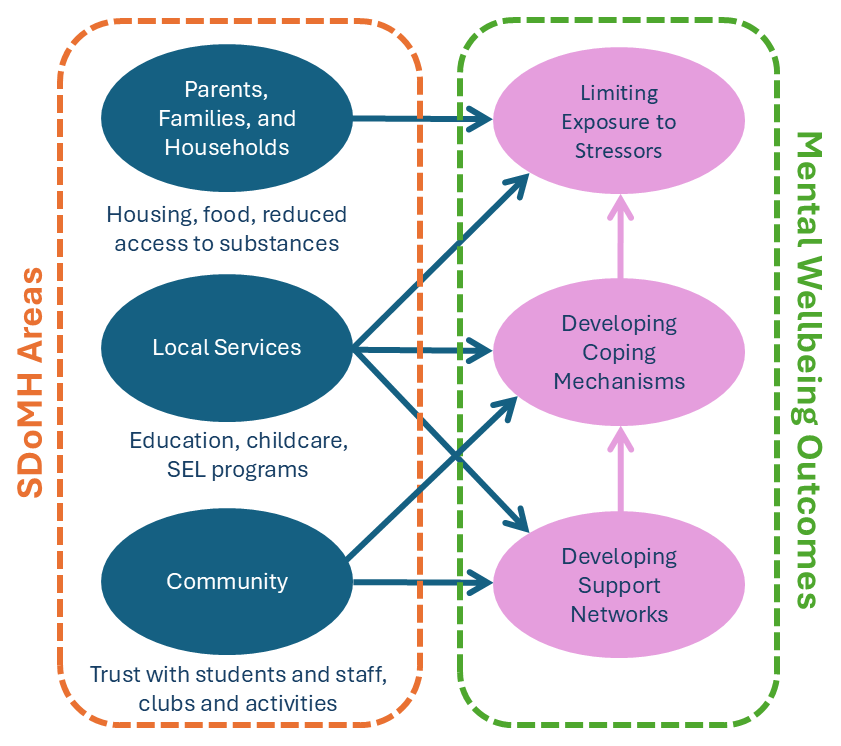
Figure 2
Summary Map of Key Themes.
Throughout our reporting of these themes, we answer RQ1 by outlining factors that contributed to student mental wellbeing with explicit reference to the role of SEL, academic, and residential services at the institution. We highlight examples of students describing their mental wellbeing outcomes within each theme. We address RQ2 through alumni perspectives on the stressors, support networks, and coping mechanisms that were most significant during their transition to post-graduation life. We report quantitative results within the themes and subthemes that they align with to provide additional context for the qualitative findings.
Theme 1: Developing Coping Mechanisms
Tumaini’s Local Services played an important role in promoting student development of coping mechanisms for managing stress and avoiding substance use. In our analysis, we defined coping mechanisms as any skill the students mentioned developing that helped them navigate stress and improve their wellbeing. In the survey, 95% of students agreed or strongly agreed with the statement, “I have strategies and methods to deal with stressful, negative, or nervous thoughts and feelings.” Students frequently referenced coping mechanisms such as praying, reading the Bible, listening to music, exercising, participating in extracurriculars, spending time with friends, and talking with guidance counselors. These strategies were often essential for alumni after moving away from Tumaini. For example, an alum who began additional studies at another institution and encountered new stressors spoke about using coping mechanisms they learned at Tumaini, such as searching for someone to talk to, writing things down, listening to music, taking a walk, and running every morning.
How Coping Mechanisms Were Developed
Through Guidance & Counseling services, Life Skills, and Mentorship courses, students learned how to identify sources of stress and problem-solve using strategies for stress and anger management. Students frequently reached out to guidance counselors to help navigate challenges and embrace new coping strategies. From group and individual counseling, students learned about the effects of substances and strategies for avoiding substance use. A student highlighted these learning outcomes: “Firstly, Tumaini, it has really showed me I can do my hobbies if I’m stressed out. I don’t need to do drugs” (S5).
Peer relationships, a pillar of the Community SDoMH area, were especially conducive to coping strategy development. For instance, a student shared how they manage stress: “So I just make my mind busy by associating with friends. Playing with friends, playing football” (S12). Students expressed that their friends had helped them manage stress and motivated them to not give up, specifically when overcoming substance use:
Sharing my personal stories to [my friends] that’s what we do most of the time. And this makes us very happy. Because when you hear someone’s story and you had something like stress about your story, your past when you hear someone someone’s story and gives you motivation to not give up. (S13)
By sharing their histories, students were able to build reciprocal relationships in which they supported each other’s social-emotional learning and mental wellbeing.
Developing Social and Communication Skills
Support from the Guidance & Counseling staff was especially critical during the beginning of the school year when students were adjusting to the new environment. Notably, 47% of students reported that it was difficult to make friends when they first arrived at Tumaini, but only 24% of students found it difficult to make friends at the time they were surveyed ten months later. Encouragement from guidance counselors during this transition mitigated students’ stress and motivated socialization. A student recounted, “I tried to start alone, and then a teacher of guiding and counseling told me to stay with people so I can get more interactive with them” (S15). Support from G&C helped students begin building critical support networks.
Alumni attributed interpersonal communication skills as being among the most influential learning outcomes from their time at Tumaini. One alum described these skills:
Tumaini taught me how to accommodate everyone, I learned about temperament and so many things about psychology… It really taught me a lot about reading people, learning how to handle the way they are and how to live peacefully with every person and also leadership skills. (A3)
Alumni noted how their improved social-emotional aptitude helped them navigate interpersonal relationships after graduation such as living with others. These learning outcomes helped alumni succeed in life beyond their technical careers.
Connection to Other Themes
The Coping Mechanisms theme does not have any sub-themes, but rather, it connects to the next two themes (as shown in Figure 2), and therefore additional examples of how this theme appeared in our interviews are included in the next two sections.
Theme 2: Limiting Exposure to Stressors
Tumaini’s residential setting and provision of stable housing and basic needs limited students’ exposure to PFH stressors during their year of study. Such stressors included financial instability, lack of access to basic needs, and exposure to substance use as a negative coping strategy throughout adolescence. After graduation, alumni were reintroduced to these stressors, which they navigated using the coping mechanisms they learned at Tumaini.
Access to Basic Needs and Educational Opportunities
Aligned with PFH, Tumaini provided students with access to food, water, clothing, housing, health and hygienic care, and academic support, protecting them from financial stressors. During interviews, students frequently cited access to basic needs as one of the most influential resources offered at the school. For example, one student explained:
Before coming to Tumaini, there were a lot of things that I had in mind. Like, I have stress or something like that. Some things like that. Because of the challenges I was facing. But after enrolling in this school, I was just okay. Because I find everything, food, everything I need, so I’m good mentally. (S12)
As this quote shows, students experienced reduced stress related to accessing basic needs and improved mental wellbeing.
For students with challenging or unsafe home environments, living at Tumaini distanced them from this stressor and improved their perceived safety. However, students who lived at the school were not completely protected from family-related stressors. One student shared that they were sometimes called home from school to address family-related challenges.
Tumaini also limited students’ stress related to their lack of education and job prospects. Access to affordable or free education was a primary reason students attended Tumaini. Most of the students surveyed had not completed secondary school prior to enrolling at Tumaini. Family history and parental employment significantly impacted students’ financial stability and educational access. One student explained, “When I was out of school, my high school, I was very stressed because no one wanted to, to pay my school fees. It gave me a lot of stress” (S13). As this student indicates, lack of financial support for education was a major stressor prior to enrollment at Tumaini.
Succeeding in their courses helped students relieve stress and prevent suicidal ideation. One student spoke about how engaging in their coursework helped them overcome feelings of shame about their history as a former SCY because education was an equalizing factor among the students. Students and alumni derived feelings of pride and achievement from their studies, illustrating how educational opportunity and persistence in technical coursework positively contributed to their mental wellbeing.
Substance Use
Tumaini also limited students’ exposure to substance use while supporting students with histories of such use as they navigated sobriety. One student described, “We started guiding and counseling lesson[s] on every Wednesday. So we [were] taught, on the effects [of drugs], and […] it changed my mind about how I felt about drugs. I think it has changed me” (S21). Even students who expressed having no history of substance use shared that they had learned about substance use at the institution and saw changes in the students who had a history of drug use.
This learning environment was especially conducive for students becoming sober because their exposure to peer pressure was significantly limited. For example, one student admitted, “I never did like [using drugs]. But the pressure from my friends, and my environment and surroundings just pushed me to do it” (S5). Another student described the significant influence that peer pressure had on their drug use before their TVET studies; they later stated that they came to the institution to “escape from drugs” (S1). It was difficult, however, for Tumaini to eliminate these stressors entirely. There were instances of students using substances while at the school, and in some cases, students experienced related peer pressure.
Of the participants we interviewed, those with histories of substance use shared how they became sober while at the institution, and the alumni reported maintaining their sobriety after graduation. Several students also expressed wanting to help others learn how to cope with addiction by bringing them to the institution, underscoring the impact of the institution’s substance use prevention and awareness programs.
Exposure to Stressors after Graduation
The transitions that students experienced after graduation were both exciting and challenging as students pursued their career goals but were reintroduced to financial and family-related stressors. Overwhelmingly, students felt prepared for attachment, and 92% of students agreed or strongly agreed with the statement, “I feel confident in my academic abilities.” Although students were confident in their engineering skills, some students and alumni felt stress about finding a job to financially support themselves and their family members.
Some alumni described early challenges after graduation that eventually smoothed out. One alum explained that they struggled with the transition from Tumaini to their attachment: “I went to somewhere to do the attachment in town, and I was not familiar with the environment, so I was scared a little bit” (A7). They overcame this fear as they became familiar with the company’s staff and location. They explained that this experience prepared them to succeed in their subsequent studies at another TVET institute: “I was not prepared [for attachment], but…I think from the experience I had here at Tumaini, I think it helped me because I helped myself get the attachment in [second TVET institution]” (A7). The electrical wiring coursework and the attachment experience at Tumaini prepared them to study electrical engineering and find additional internships after graduation. The same alum shared that focusing in class and sleeping were difficult after graduation due to food instability, the lack of a regimented schedule, and unfamiliarity with their teachers. To manage these new stressors, they used coping mechanisms they learned at Tumaini, including seeking emotional support, journaling, and physical activity.
Theme 3: Developing Support Networks
Tumaini’s Local Services explicitly helped students develop support networks (also aligned with SDoMH’s Community area). Students worked with guidance counselors, social workers, teachers, and community partners to learn about social and emotional wellbeing, develop stress-management strategies, and build effective communication skills. Students and alumni cited group and individual counseling as one of the most impactful resources at Tumaini. Through these local services, students built support networks with peers and staff members that were critical to their mental wellbeing development.
Connecting with Peers
Building trust was essential to developing peer support networks. Most students shared feelings of belonging in the Tumaini community. Many students reported having one or a few close friends or a partner that they could trust when discussing their feelings or personal information. However, many students found it challenging to trust their broader group of friends with personal stories. 61% of students disagreed or strongly disagreed with the statement “I would feel comfortable telling my friends my personal feelings and private information.” A student commented on the pervasiveness of gossip among the students: “Yeah, yeah gossip, gossip spreads more than fire” (S2). Women shared specific challenges with making other female friends and in some cases preferred to be friends with men to avoid gossip. Another student shared her experience with gossip among her friends:
They are my friend, yes, but there is something I cannot tell them because when you tell them, now, by tomorrow all that you tell them is out. How? So that I hate. I hate sitting with girls. Yeah, I love to sit with boys. (S8)
One student explained how it was harder to trust friends that they had not known for long enough:
Here at Tumaini I have just been here for only a year here doing work and we don’t come so close together. My friends like here at Tumaini don’t come from [City] and me I’m from [City]. They come from the other counties. So no, I cannot trust them with all my issues. But my home friends who have been there with them the high school. The primary school yeah, we trust each other mostly. (S21)
This student explained that they trusted friends from their hometown whom they had known throughout adolescence but struggled to develop trust with newer friends at Tumaini.
Another student explained that it was initially difficult to make friends because they had low self-esteem about being a former SCY, and they feared the other students at the beginning of the year. However, after learning that others had overcome similar challenges, this student began thinking of themself more positively. They bonded with another student over their shared history, and they made an agreement to grow and do well in school together. Sharing these experiences with peers was a critical step in developing meaningful and trust-based friendships.
Connecting with Guidance Counselors
Although students faced challenges when developing trust with peers, they overwhelmingly expressed trust in the guidance counselors and teaching staff at Tumaini. 55% of students agreed or strongly agreed with the statement, “There is a staff member at Tumaini who I would feel comfortable telling my personal feelings and private information.” Most students reported benefiting from one-on-one and group counseling and most students reported actively seeking out guidance counselors for advice and support. One student explained:
I can give information to them, because I think they are well, they are well equipped with the skills to help me. Like if I’m having a stress, and I go tell counselor. That this is the thing that is giving me the stress. I know that he can find a solution. (S13)
Students trusted that when they sought support from guidance counselors, they would be received with a confidential and non-judgmental space.
During their time at the school, students formed meaningful relationships with peers and staff members. After graduation, alumni dealt with separation from their support networks. One alum described the challenges they faced after leaving their community at the institution:
Being at Tumaini really shaped me and changed me especially emotionally. It was not easy but leaving Tumaini I was really affected, yea I was really affected [unintelligible] because I was leaving my friend, I knew it would be hard. I also miss the teachers there. (A3)
Some alumni remained connected with friends after graduation. However, other alumni struggled to stay in touch and felt alone and disconnected from their support network at Tumaini. One student also expressed wanting to stay connected with G&C services during attachment.
Connecting with Family
The institution also facilitated students’ reintegration with their families and home communities before and after their year of study. Former SCY were reconnected with parents or next of kin whenever possible and safe. Students were encouraged to live at home for at least three months before enrolling in the school. After graduation, students returned to their home communities.
An alum shared how reintegration was a positive experience after graduation:
But then reconnecting with the community, it was actually better than before because I came back feeling like I was much more than before. Reconnecting with the community felt really good it was really easy. Having went into Tumaini after considering committing suicide so coming from Tumaini and back into the community it felt really good. It was very easy. Just I had to find ways to make ends meet. (A3)
Reintegration was an opportunity for students to reflect on the growth and achievements they made while at Tumaini. It was also an opportunity for students to apply their new coping strategies to manage stress related to financial instability and family environments.
Discussion
This study contributes to engineering education literature by examining the impact of SEL programs on mental wellbeing for students at a TVET center in SSA using the SDoMH framework. We present two key contributions: (1) empirical evidence showing SEL in engineering curricula that is both (a) authentically integrated and (b) thoughtfully localized can support student mental wellbeing, and (2) demonstration of how culturally tailored SEL prepares technical students for positive post-graduate wellbeing in a non-WEIRD context.
Mental Wellbeing Development Through Localized SEL Methods
The SDoMH framework was an essential tool for evaluating student and alumni mental wellbeing in connection to educational access, SEL programs, social support, and financial stability. This aligns with calls in engineering education to recognize the role of emotional wellbeing in fostering academic persistence, especially for marginalized learners (Lichtenstein et al., 2009; Secules et al., 2021). Our findings highlight a strong link between students’ access to basic needs and their wellbeing, echoing prior research (Broton et al., 2022; Coakley et al., 2022; Martinez et al., 2020).
Students expressed feelings of belonging in the Tumaini community. Prior research shows that fostering a sense of belonging in school environments supports youth resilience and mental health. Emotionally supportive peer and adult relationships protect against risky behaviors and psychological distress (Bond et al., 2007; Govender et al., 2013; Newman et al., 2007). Despite this, many students struggled to trust their peers, a pattern that has been found in other student populations. Ayiro et al. (2023) reported that in Kenya, male students were less likely to express emotional vulnerability due to cultural expectations equating emotional openness with weakness, while female students faced stigma and feared gossip.
Participants also described the influence of peer pressure on substance use which aligns with findings from Sitienei and Pillay (2019), who noted that for SCY in Kenya, substance use is often a tool for social inclusion—helping adolescents bond with peers and survive hostile environments—rather than deviance.
G&C services gave students a safe space to express themselves, manage emotions, and develop an engineering identity—fostering the kind of collaborative learning environment that supports retention in team-based technical education and engineering design contexts (Wang, 2013). During their year of study, students spoke of significant improvements in their self-esteem, self-awareness, and ability to self-regulate. They frequently expressed a sense of hope and purpose given by the institution. An alum described how their mental wellbeing changed: “Starting at Tumaini I was depressed and I was really negative and I had given up in life and everything. But coming to Tumaini gave me a sense of hope” (A3). Another student shared what they would say to adolescents currently living on the streets: “I would tell them that Tumaini is the best place to be… Even my parents see, can see… a bright future… I can see that there is hope… as long as I live” (S1).
Preparation for Livelihood and Independent Living Through LED and SEL Methods
Alumni expressed that communication skills have supported their personal and professional success in collaborative engineering environments. Research has shown that SEL interventions—particularly when authentically embedded in technical or team-based learning environments—can improve students’ classroom belonging, resilience, and workplace readiness (Elmi, 2020; Jobel et al., 2024; LaBelle, 2019). Tumaini’s application of LED coursework promotes SEL and centers students’ needs, offering an example of a contextually appropriate model for engineering education in non-dominant contexts.
Although students were optimistic about their futures, many alumni faced challenges after graduation including unemployment, family conflict, and separation from support networks. These findings mirror the challenges faced by graduates around the globe navigating engineering pathways; research notes that these transitions are especially challenging when technical preparation is not paired with strong psychosocial and community support (Litzler et al., 2014). These findings highlight the importance of extending support networks post-graduation and considering how institutions might maintain relationships with alumni to support continuous growth.
Conclusion
Tumaini’s motto is Jenga Vijana [to build up youth]. In addition to providing youth with engineering knowledge and technical training, the institution empowers its students by fostering positive wellbeing and preparing them for life after graduation through the SEL resources in its localized curriculum and community.
Our findings shed light on the social and emotional growth students achieved through community-based engineering integrated with SEL programming. Students navigated challenges related to stress and anger management, trust in peers, and overcoming substance use while persisting through localized engineering studies. Students frequently attributed their mental wellbeing development to the school’s Guidance & Counseling and SEL courses where they learned stress and anger management tools, built social support networks, and fostered confidence in their ability to continue their education and succeed as engineers in their communities. Alumni similarly cited the school’s SEL programs when describing the coping mechanisms, communication skills, and self-confidence that they used to navigate new lifestyles and careers after graduation. This study illustrates the importance of SEL in engineering and technical education. SEL support is especially critical for SCY as they manage high exposure to stressors related to employment, financial stability, social support, and reintegration with their families and communities.
The insights gained in this study reveal powerful patterns of integrated SEL practices supporting technical learners in a large and growing youth demographic, which deserve further investigation. Future research might:
Investigate how culturally grounded SEL programs influence engineering identity development over time.
Investigate the role of gender in shaping peer trust and community dynamics.
Examine how localized education and training programs support retention for students navigating structural barriers to employment.
Examine how community-based substance use and mental health awareness programs support sobriety and address peer pressure for SCY.
Examine how students’ support systems and coping strategies evolve after graduation.
By exploring these areas, we can deepen our understanding of how SEL interventions and related holistic support systems promote resilience, wellness, and opportunity for engineering students, particularly those from marginalized backgrounds.
Additional Files
The additional files for this article can be found as follows:
Acknowledgements
The authors thank the participants for sharing their perspectives and reflections on their experiences at Tumaini Innovation Center. This material is based upon work supported by the NSF under Collaborative Grant Numbers 2153641 and 2153675. Any opinions, findings, and conclusions or recommendations expressed in this material are those of the authors and do not necessarily reflect the views of the NSF.