
Table 1
Cognitive and Affective Empathy versus Self- and Other-Oriented Empathy.
| EMPATHY | TENSION 2: SELF VS OTHER-ORIENTED | ||
|---|---|---|---|
| SELF-ORIENTED | OTHER-ORIENTED | ||
| Tension 1: Cognitive vs Affective | Cognitive | Perspective-taking: imagine-self, thinking as another | Perspective-taking: imagine-other, thinking of another |
| Affective | Emotional caring, feeling with | Emotional concern, feeling for | |
Table 2
Conceptual illustration of dominant sympathetic, empathic, and compassionate orientations in an engineering design scenario.
| SYMPATHY | EMPATHY | COMPASSION | |
|---|---|---|---|
| EXAMPLE PROBLEM | UNDERDEVELOPED COMMUNITY LACKS CLEAN DRINKING WATER | ||
| Example solution | Donate water to the community | Visit the community and assist them in implementing a solution that seems appropriate to you, such as digging a well, to ensure access to water for the community | Work with community to educate/train them on identifying, designing, and implementing a solution that works best for the community (co-design, participatory design) |
| Defining characteristics | Reactive, visceral, ego-based, guilt-laden | Perspective-taking, affective response, understanding the people, relates to the suffering | Altruistic, virtuous, action-oriented, selfless, proactive |
| Response to suffering | Acknowledgement | Acknowledge, understand, and emotional resonance | Acknowledge, understand, and action aimed at understanding and ameliorating suffering |
| Type of response | Reactive, feeling for the other | Objective, affective, feeling with the other | Proactive, targeted, and aimed to empower the other |
| Motivator of response | Pity, ego, obligation | Helping, duty, deservedness of client | Virtue, altruism, and a desire to alleviate suffering |
| Relation to For, With, As framework | Working FOR Others to satisfy Individual (AS) need to alleviate pity | Working WITH Others to satisfy Individual (AS) need to alleviate Others’ suffering | Working WITH others to empower them to end their suffering, where the individual (AS) is selfless |

Figure 1
Stages of compassion development through the arts.
Table 3
Course students’ characteristics.
| PARTICIPANT ID | GENDER | MAJOR | YEAR | TEAM |
|---|---|---|---|---|
| Student 1 (S1) | Female | Interdisciplinary Engineering | Junior | Typewriter (TW) |
| Student 2 (S2) | Female | First-Year Engineering | Freshman | Typewriter (TW) |
| Student 3 (S3) | Male | Chemical Engineering | Senior | Typewriter (TW) |
| Student 4 (S4) | Female | Aeronautical and Astronautical Engineering | Sophomore | Water Bottle (WB) |
| Student 5 (S5) | Female | Biological Engineering | Junior | Water Bottle (WB) |
| Student 6 (S6) | Male | Computer Engineering | Senior | Water Bottle (WB) |
| Student 7 (S7) | Female | Agricultural Engineering | Freshman | Coffee Maker (CM) |
| Student 8 (S8) | Male | Mechanical Engineering | Senior | Coffee Maker (CM) |
Table 4
Compassionate Engineering course structure.
| ACTIVITY | TYPE | WEEK 1 | WEEK 2 | WEEK 3 | WEEK 4 | WEEK 5 | WEEK 6 | WEEK 7 | WEEK 8 |
|---|---|---|---|---|---|---|---|---|---|
| Introductions (IN) | Individual | x | Thanksgiving Break (No Class) | ||||||
| Pre-class reflection (PCR) | Individual | x | x | x | x | x | x | ||
| In-class activity (ICA) | Individual or team | x | x | x | x | x | x | ||
| In-class reflection (ICR) | Individual or team | x | x | x | x | x | x | ||
| Distance activities (DA) | Individual | x | x | x | x | x | |||
| Course project (CP) | Team | x | x | x | x | x | |||
| Final reflection (FR) | Team | x |
Table 5
Interpretive themes derived from student artifacts and reflections (RQ1).
| THEME | THEME DESCRIPTION | SUB-THEME | SUB-THEME DESCRIPTION | CODES | EXAMPLE OF EVIDENCE |
|---|---|---|---|---|---|
| 1. Seeing Systems and People Together. | Students linked people, contexts, and technical systems in their own language and artifacts; course elements made these links visible. | 1.1. Attending to Sociotechnical Relationships. | Students approached problems with an understanding of engineering systems, including the interrelation between social and technical aspects. | 7, 11, 12 | Week4 system maps; CP Week5 reflections on typewriter labor, coffee maker aesthetics, and stakeholder interdependence; CP Week8 reflection on artistic and political thinking in engineering. |
| 1.2. Using Artistic Making to Externalize Care and Critique. | Students created artwork (e.g., sculptures) that embodied their thoughts and communicated the need for change to improve social realities. | 10, 11 | CP Week8 artwork captions and artifact images from Coffee Maker, Water Bottle, and Typewriter teams; Instagram/public-facing artwork descriptions. | ||
| 2. Employing a compassionate lens. | Students articulated ethical sensitivity and empathy, scaling judgments from products to societal/ecological consequences and taking others’ perspectives. | 2.1. Recognizing Macroethical Impacts. | Students recognized wider environmental, behavioral, and distributional impacts. | 7, 11, 12 | CP Week5 reflections on mining, deforestation, biodiversity loss, caffeine addiction, and economic displacement; CP Week8 reflection on uneven impacts of global warming. |
| 2.2. Taking Others’ Perspectives (Cognitive Empathy). | Students balanced self/other perspectives and connected new ideas to prior experiences. | 2, 3, 5 | ICR Week5 campus observation; DA Week5 gallery reflection; CP Week8 captions inviting audiences to reconsider hidden consequences of technologies. | ||
| 2.3. Experiencing Felt Responses (Affective Empathy). | Students reported sadness and grief when material and labor harms came into view, disappointment and care in peer contexts, and hope when envisioning alternatives; these feelings were often coupled with specific responses (e.g., design review, reusable adoption, public communication). | 5, 6, 9 | CP Week5 reflections expressing sadness, grief, and concern about environmental harm and child labor; PCR Week5 peer response about competition and care; WB Week5 caption expressing hope. |
Table 6
Cross-cutting configurations of ethical awareness, cognitive empathy, and affective empathy across student work (RQ2).
| THEME | THEME DESCRIPTION | SUB-THEME | SUB-THEME DESCRIPTION | CODES | EXAMPLE OF EVIDENCE |
|---|---|---|---|---|---|
| 3. Negotiating Tensions and Limits | Students named frictions that complicate compassionate practice (competitive norms; cognitive/emotional load). | 3.1. Balancing Competition and Compassion. | Students contrasted cooperative intent with competitive academic/work cultures that disincentivize compassion; several reasserted cooperative norms. | 8, 13 | PCR Week5 reflections on competitive engineering classrooms, workplace cultures, peer withholding of help, and teamwork as an engineering responsibility. |
| 3.2. Managing Cognitive/Emotional Load (Limits of Compassion). | Students articulated feasibility and emotional-burden limits to sustaining compassion alongside other demands; some reported reframing rather than overload. | 4, 5, 6 | ICR Week5 responses to compassion meditation; reflections on emotional burden, feasibility, and sustaining attention to suffering alongside other demands. | ||
| 4. Orienting Practice—Design Goals and Public Communication | Students connected compassion to actionable orientations for engineering (named design goals; addressed publics). | 4.1. Naming Design Goals for Compassionate Practice. | Students adopted dignity, empowerment, and security (and related questions) as goals to guide design reasoning; they also named human-understanding as a needed professional skill. | 2, 9, 13, 14 | PCR/ICR Week7 responses to compassionate design; CP Week8 project documents using dignity, empowerment, security, human understanding, and inclusion as design considerations. |
| 4.2. Using Artistic Communication to Demonstrate, Spread Awareness, and Inspire. | Students used artworks and captions to demonstrate harms, raise awareness (including via social media), and motivate everyday action as part of practice. | 10, 15 | CP Week5 and Week8 artwork captions; Coffee Maker team’s social media dissemination plan; Typewriter team’s appeal for change; Water Bottle team’s “beacon of hope” framing. |
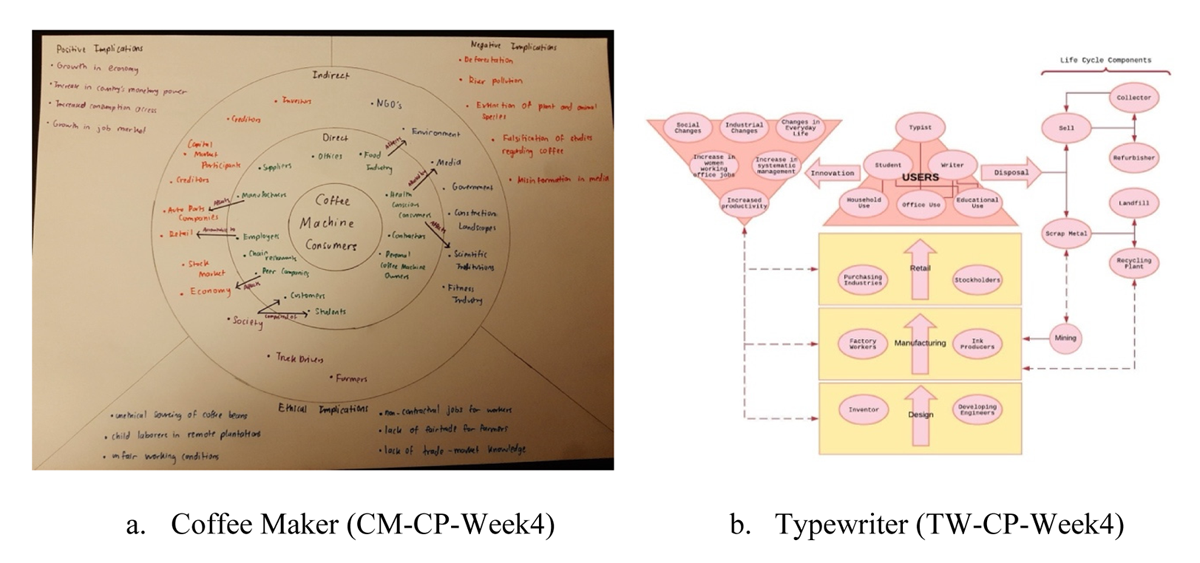
Figure 2
Milestone 2: System maps.
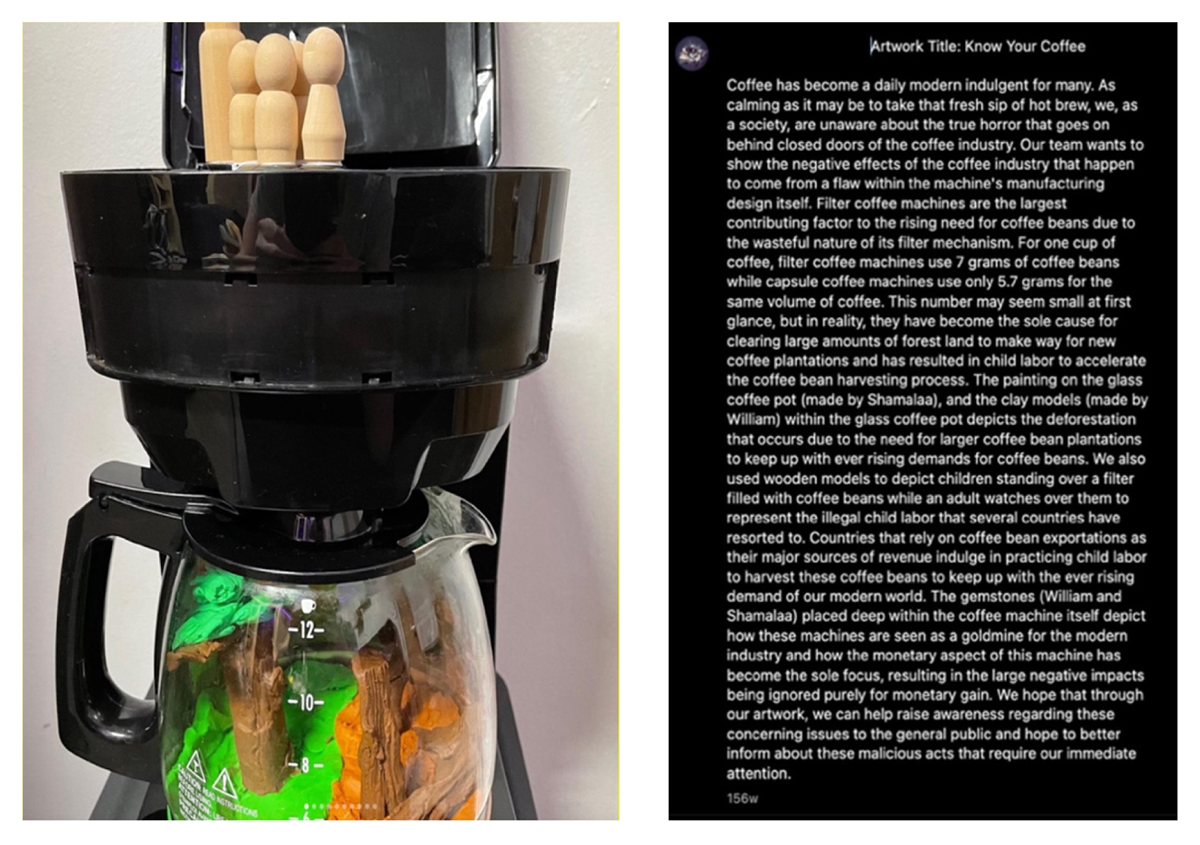
Figure 3
Picture and caption of the coffee maker team artwork.
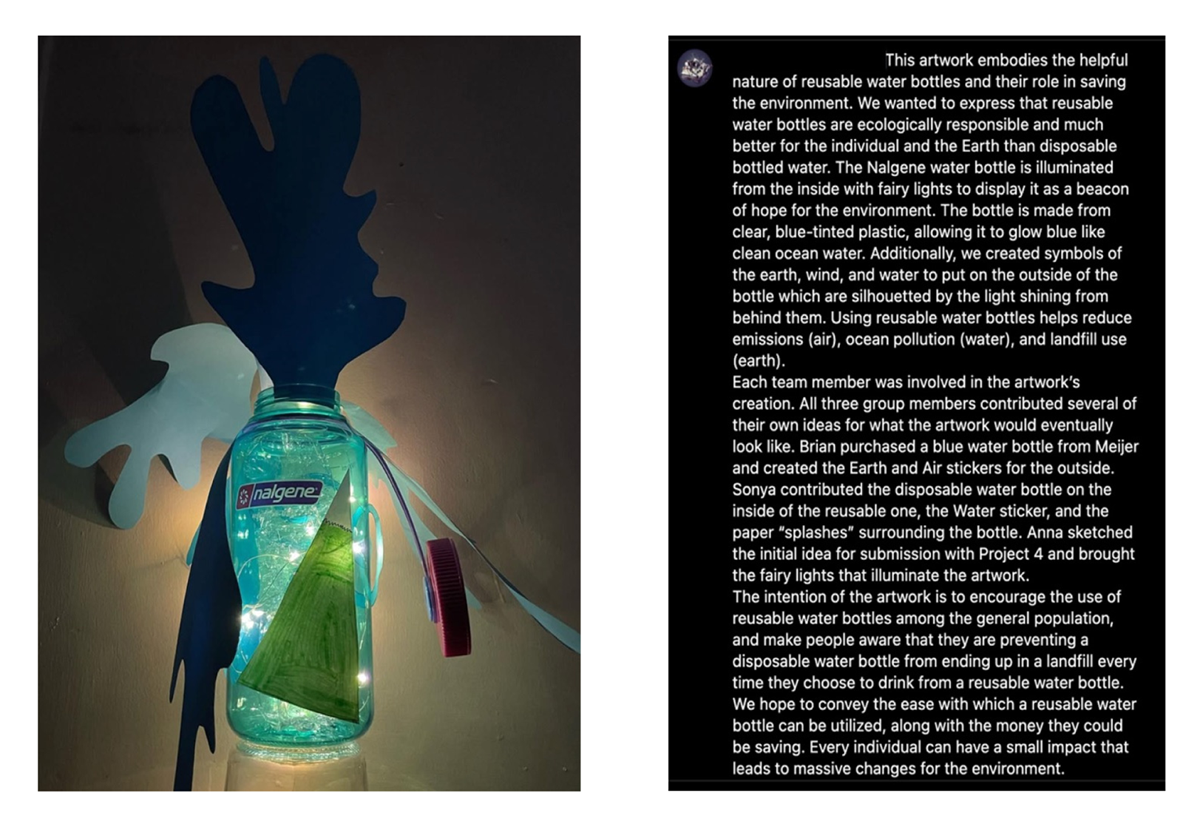
Figure 4
Picture and caption of the water bottle team artwork.
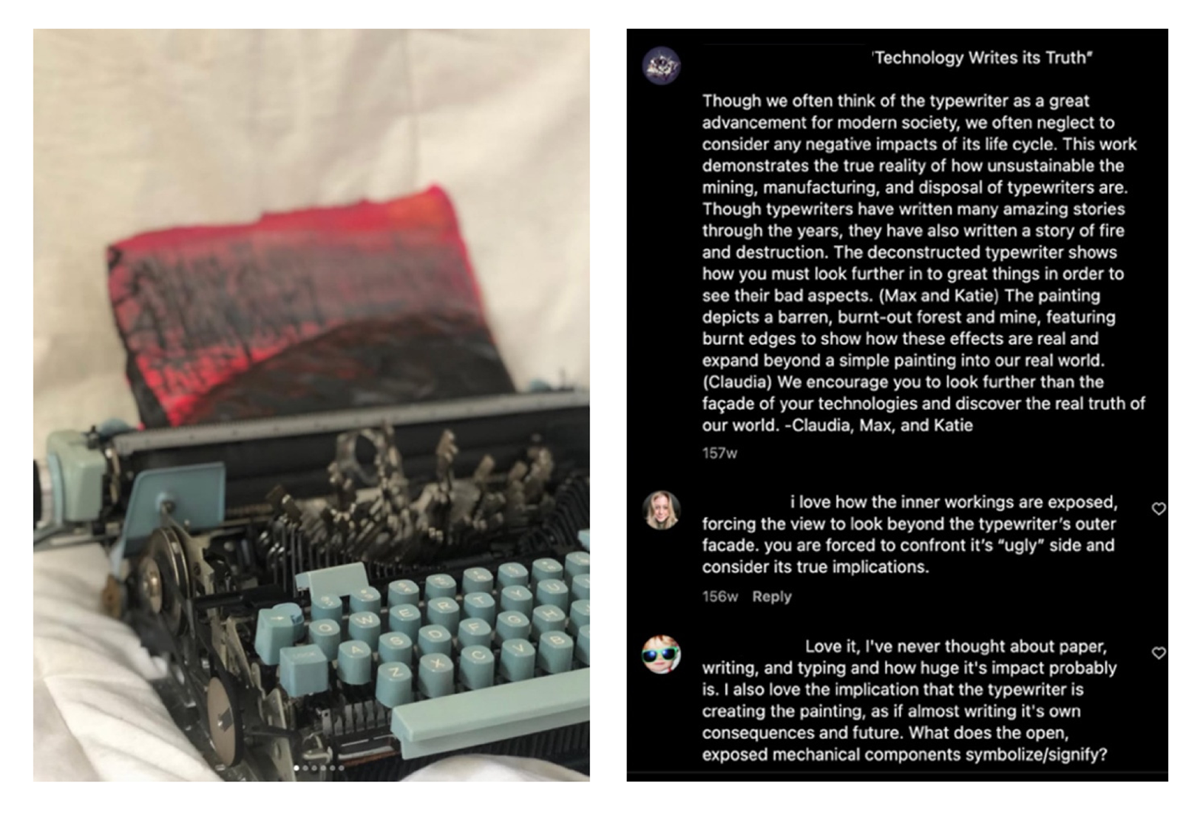
Figure 5
Picture and caption of the typewriter team artwork.
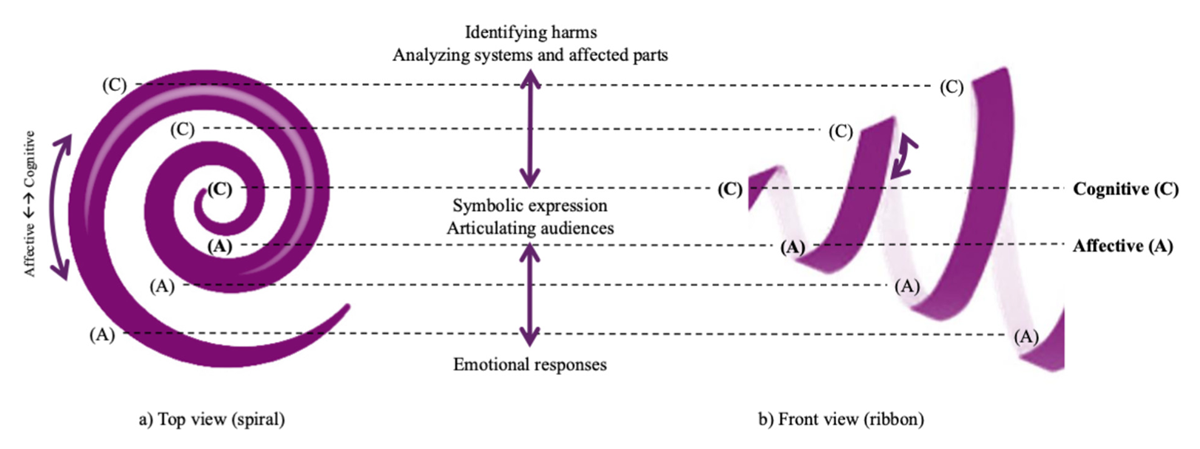
Figure 6
Conceptual heuristic illustrating relationships between cognitive empathy and affective empathy in engineering design contexts.
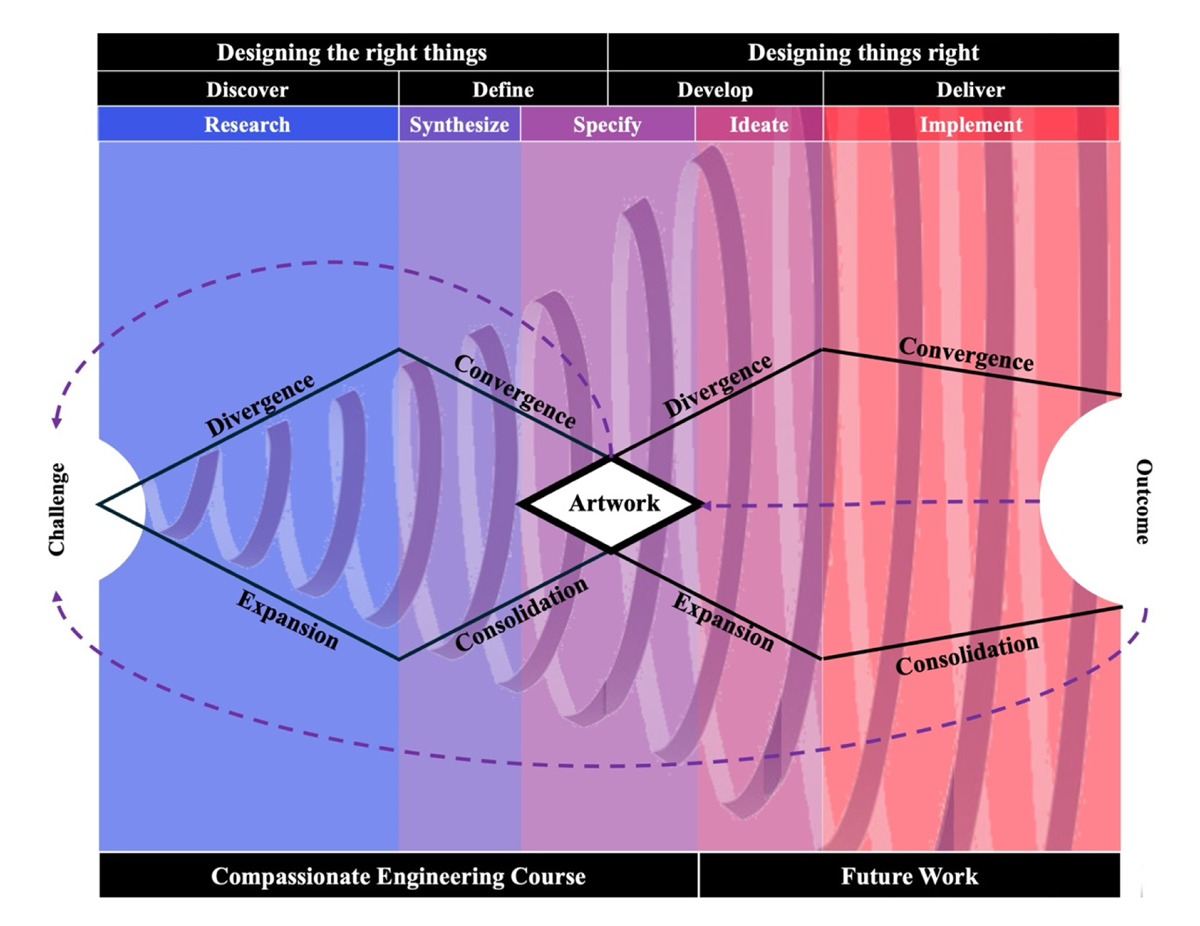
Figure 7
Development of compassion in engineering.