
Introduction
Engineering education has traditionally prioritized technical knowledge and skills over care, often treating emotional awareness, ethical reflection, social responsibility, and compassion as secondary to technical competence. This technocratic orientation can constrain engineers’ ability to address sociotechnical challenges by reinforcing myths of neutrality and limiting attention to bias, inequity, and the broader human consequences of engineering work (Benjamin, 2019; Cech, 2014; Fila et al., 2014; Riley, 2008). These tendencies are reinforced by meritocratic norms that frame success as the result of individual ability and effort while obscuring structural barriers and unequal distributions of harm (Friedmann, 2025; Hynes & Swenson, 2013; Seron et al., 2018). Together, technocratic and meritocratic cultures can narrow how engineers understand responsibility, particularly when design problems require attention to human experience, suffering, and justice.
Preparing engineers for ethical and socially responsive practice therefore requires more than technical competence. Prior work in engineering ethics and humanistic engineering education has emphasized the importance of empathy, moral sensitivity, professional responsibility, and attention to human contexts (Bielefeldt, 2021; Campbell, 2013; J. L. Hess & Fore, 2017; Strobel et al., 2013; Tormey et al., 2025). Yet empathy alone does not necessarily lead to action or responsibility. In this study, we foreground compassion as an analytic lens for examining how students recognize harm, interpret others’ experiences, and imagine responses to suffering through engineering practice.
In response to these limitations, educators and researchers have advocated for more humanistic approaches to engineering education that integrate socioemotional awareness, interdisciplinary knowledge, and attention to human contexts. Hynes and Swenson (2013), for example, highlight both the epistemological and practical importance of incorporating non-technical knowledge and skills into engineering learning. Engineering curricula have also increasingly created opportunities for students to engage professional responsibility and ethics through stand-alone courses, design-based modules, case studies, and community-engaged experiences such as service-learning (Bielefeldt, 2021; Campbell, 2013; J. L. Hess & Fore, 2017; Strobel et al., 2013). These approaches offer important ways for students to grapple with the broader human and ethical dimensions of engineering practice. However, they often remain grounded in text-based, analytical, or experiential frameworks, leaving room to further explore forms of knowing and expression that are embodied, affective, symbolic, and interpretive.
The arts offer one such pathway. In this study, we define the arts as modes of creative practice that materialize experience and make perceptible the human and ethical dimensions of engineering work. This definition draws on perspectives that conceptualize the arts as distinct forms of thought and creation oriented toward expressing and exploring lived experience (Greene, 1995). Through artistic practice, students can represent ideas while also engaging ambiguity, perspective, emotion, and meaning in ways that are difficult to access through purely analytical approaches. Positioned between text-based reflection and full community immersion, the arts create a middle ground where students can critically examine sociotechnical harm while also engaging affectively and symbolically (Tormey et al., 2025).
Prior work in engineering education supports this role for the arts. Sochacka et al. (2016) showed that integrating visual and performing arts into engineering education can create spaces for “active, collaborative search for meaning,” “wide-awakeness,” and social change (p. 15). Their work suggests that arts-integrated engineering education can support empathic perspective-taking and challenge technocentric approaches to problem-solving. This orientation also aligns with compassionate design, particularly Seshadri et al.’s (2019) framework centered on dignity, empowerment, and security. Artistic practices can surface, symbolize, and critically examine these principles by helping students represent sociotechnical issues and communicate their ethical significance. Accordingly, the integration of the arts in this course was not intended as decoration or supplement, but as a central pedagogical strategy for engaging the social, ethical, and experiential dimensions of engineering design. In this study, the term arts refers specifically to students’ use of sculptural assemblages and visual artifacts, accompanied by written captions, to represent sociotechnical issues, interpret human consequences, and propose possible responses.
In this paper, we analyze student work from an eight-week Compassionate Engineering course that integrated arts and engineering. We examine how students expressed compassion through written and artistic assignments and how they connected compassion to engineering practice. The research questions guiding the study are:
In what ways did students in a Compassionate Engineering course express compassion through assignments and artistic work?
How did students connect compassion to engineering practice through their written and artistic reflections?
We situate the study in literature on sympathy, empathy, and compassion. These constructs are often discussed together but are not interchangeable, nor are they equally salient for engineering education. We foreground compassion not as a moral ideal students must reach, but as an analytic lens for examining how care, responsibility, and action become visible in students’ design reasoning and representational practices. Importantly, we do not treat sympathy, empathy, and compassion as a linear developmental sequence; rather, we conceptualize them as overlapping and context-dependent orientations that may co-occur, fluctuate, or manifest unevenly across tasks and moments.
Literature Review
Sympathy, empathy, and compassion are often used interchangeably (Sinclair et al., 2016, 2017), but they have distinct conceptual differences. While one shapes how engineers notice harm, the second explains how engineers interpret experience, and the third defines responsibility in sociotechnical contexts. Scholars have delineated specific characteristics for each, revealing conceptual boundaries that differentiate them and clarifying how they align with ethical reasoning in engineering practice.
What is Sympathy?
Sympathy is often defined as a detached, pity-driven reaction lacking deep understanding of another’s experience (Sinclair et al., 2016). This response may come across as detached, egoistic, or even condescending, as it is generally characterized by a desire for self-preservation on the part of the observer rather than a genuine attempt to connect with the suffering individual.
In engineering contexts, sympathy can be understood as an early stage of microethical and macroethical orientations. At the microethical level, sympathy manifests as interpersonal pity or concern toward an individual affected party (i.e., feeling sorry for a peer who has been negatively affected by a design decision) yet without deeper perspective-taking or sustained moral engagement (Lunn et al., 2022; Strobel et al., 2013). At the macroethical level, sympathy may take the form of a broader but still detached recognition of systemic harms, such as pity for exploited workers or concern about environmental damage, without translating that awareness into meaningful advocacy or systemic action (Hess, 2024; Kotluk & Tormey, 2023). Across both levels, sympathy shares a common limitation: it acknowledges problems or harms but lacks the perspective-taking, emotional resonance, and intentional commitment, which scholars have described as essential features of empathic engagement (Hess, 2024).
What is Empathy?
Empathy has been defined in multiple, often competing ways (Batson, 2009; Cuff et al., 2016; Schimpf et al., 2024). For this study, two distinctions are most relevant: cognitive versus affective empathy, and self-oriented versus other-oriented empathy. Cognitive empathy refers to understanding another’s feelings, perspectives, or situation, whereas affective empathy involves emotional resonance with another’s experience (Cuff et al., 2016; Hess & Fila, 2016). Although these dimensions are distinct, they may interact dynamically in social and ethical contexts (Clark et al., 2019; Decety & Cowell, 2014). The “self/other distinction” further clarifies that empathy requires recognizing the boundary between one’s own perspective and another’s, even though people may experience partial “self/other merging” or emotional sharing when observing another’s pain (Cuff et al., 2016; Decety & Cowell, 2014; Decety & Jackson, 2006). This distinction is reflected in self-oriented and other-oriented forms of empathy, including imagining oneself in another’s position, imagining another’s perspective on its own terms, feeling with another, and feeling for another (Batson, 2009; J. Hess et al., 2022). Table 1 summarizes how these two distinctions intersect.
Table 1
Cognitive and Affective Empathy versus Self- and Other-Oriented Empathy.
| EMPATHY | TENSION 2: SELF VS OTHER-ORIENTED | ||
|---|---|---|---|
| SELF-ORIENTED | OTHER-ORIENTED | ||
| Tension 1: Cognitive vs Affective | Cognitive | Perspective-taking: imagine-self, thinking as another | Perspective-taking: imagine-other, thinking of another |
| Affective | Emotional caring, feeling with | Emotional concern, feeling for | |
This distinction matters for engineering because students may either project their own assumptions onto affected parties or attempt to understand perspectives, constraints, and experiences different from their own. In this study, empathy is therefore treated as a multidimensional orientation that may involve perspective-taking, emotional resonance, and attention to the boundary between self and other.
What is Compassion?
Cuff et al. (2016) note that the distinction between empathy and compassion has often been blurred, with some equating compassion to sympathy or pity. Yet this view is incomplete. Compassion builds upon sympathy and empathy but is best understood as a higher-order construct (Goetz & Simon-Thomas, 2017). Whereas empathy may involve cognitive perspective-taking or affective resonance across a range of emotions, compassion is restricted to contexts of suffering or unmet need and is characterized by a deliberate, action-oriented response to reduce or prevent harm (Singer & Klimecki, 2014).
Some scholars have described compassion as a form of “behavioral empathy” because it involves prosocial actions such as helping (Clark et al., 2019; Davis, 2006). However, this conflation obscures important differences. Behavioral empathy refers broadly to observable outcomes of empathic processes, which may include not only care but also avoidance, such as when one’s empathic distress becomes too powerful (Hoffman, 2008). Compassion, by contrast, denotes a specialized moral orientation that emerges only when empathy is directed toward suffering and combined with a conscious desire to alleviate it. In this sense, compassion is not simply one possible outcome of empathy; rather, it names an ethically grounded commitment that consistently and naturally channels empathic concern into intentional, prosocial action.
Historical perspectives underscore compassion’s unique role in moral life. Schopenhauer (1915) identified compassion as the primary non-egoistic source of ethical action, arguing that it transcends religious or ideological boundaries by embodying justice and unselfish concern for others. Compassion here begins with affective empathy—“feeling with” others in distress—but extends to active efforts to alleviate harm, even when doing so requires confronting the broader systemic forces that generate it. Similarly, C. R. Williams (2008) positions compassion as a fundamental virtue essential to social justice and human flourishing. He highlights compassion’s non-harming benevolence, its capacity to dissolve personal boundaries, and its cultivation of an expanded sense of interconnection. Williams further identifies three judgments that characterize compassion: recognizing another’s hardship as serious, undeserved, and something one could also experience. These judgments reinforce compassion’s dual role: rooted in empathy yet oriented toward moral responsibility.
Taken together, these perspectives clarify that compassion is a specialized, ethically grounded expression of empathy toward suffering, uniting emotional resonance with a sustained commitment to alleviate harm. In engineering contexts, this understanding reframes technical work as inseparable from social responsibility, positioning engineers as moral agents capable of designing with and as communities to uphold dignity, empowerment, and security (Seshadri et al., 2019).
Table 2 uses the familiar engineering challenge of clean water access to illustrate how sympathy, empathy, and compassion may orient different engineering responses. The example draws on humanitarian and community-engaged engineering discussions of aid, participation, and empowerment-oriented approaches (Lucena et al., 2024; Nieusma & Riley, 2010). The table is intentionally simplified: it does not imply that these orientations are mutually exclusive or that specific emotions determine specific design actions. In practice, engineers may experience sympathy, empathy, and compassion in overlapping or shifting ways within the same situation.
Table 2
Conceptual illustration of dominant sympathetic, empathic, and compassionate orientations in an engineering design scenario.
| SYMPATHY | EMPATHY | COMPASSION | |
|---|---|---|---|
| EXAMPLE PROBLEM | UNDERDEVELOPED COMMUNITY LACKS CLEAN DRINKING WATER | ||
| Example solution | Donate water to the community | Visit the community and assist them in implementing a solution that seems appropriate to you, such as digging a well, to ensure access to water for the community | Work with community to educate/train them on identifying, designing, and implementing a solution that works best for the community (co-design, participatory design) |
| Defining characteristics | Reactive, visceral, ego-based, guilt-laden | Perspective-taking, affective response, understanding the people, relates to the suffering | Altruistic, virtuous, action-oriented, selfless, proactive |
| Response to suffering | Acknowledgement | Acknowledge, understand, and emotional resonance | Acknowledge, understand, and action aimed at understanding and ameliorating suffering |
| Type of response | Reactive, feeling for the other | Objective, affective, feeling with the other | Proactive, targeted, and aimed to empower the other |
| Motivator of response | Pity, ego, obligation | Helping, duty, deservedness of client | Virtue, altruism, and a desire to alleviate suffering |
| Relation to For, With, As framework | Working FOR Others to satisfy Individual (AS) need to alleviate pity | Working WITH Others to satisfy Individual (AS) need to alleviate Others’ suffering | Working WITH others to empower them to end their suffering, where the individual (AS) is selfless |
Promoting Compassion in Engineering through Arts and Socioemotional Education
Sympathy, empathy, and compassion represent interconnected but distinct orientations for ethical responsibility in engineering. Sympathy signals an initial awareness of harms, empathy deepens this awareness through perspective-taking and emotional resonance, and compassion unites empathic understanding with an ethically grounded commitment to act. This shift (i.e., from recognition to resonance to responsibility) provides a foundation for cultivating moral responsibility in engineering education.
Socioemotional education challenges the “emotionless engineer” mindset of neutrality and objectivity by inviting learners to navigate the complexity of human experience (Zembylas, 2021). Within this frame, compassion is not a fixed trait but a skill that can be cultivated. The arts provide a powerful and flexible medium for this cultivation, offering spaces where students can express and reflect on emotions, grapple with systemic injustices, and connect intellectually and affectively with others’ experiences (Eisner, 2002; Greene, 1995).
Vargas-Ordóñez (2024) illustrated how artistic practices invite students to situate engineering problems within broader human contexts, nurturing dispositions of care and responsibility. Through their collaborative autoethnography and interdisciplinary STEAM-based studio approach, Sochacka et al. (2016) highlight that engaging as an engineer and an artist in shared creative work cultivates empathic perspective-taking. In this work, arts-based practices such as storytelling, visual journaling, and performative prototyping created opportunities for students to see, feel, and interpret others’ experiences in new ways. In consequence, the findings suggest the arts serve as a counter to engineering’s technocentric culture by prioritizing human, emotional, and ethical dimensions of problem-solving (Goleman, 2007; Nussbaum, 2001).
Learning compassion through the arts engages cognitive understanding, emotional connection, and practical action. Students first recognize harm, then connect affectively, and finally act with intention—a cycle that mirrors socio-emotional learning models (Zembylas, 2021). Prior work in arts-integrated STEM education has shown that artistic practices can support perspective taking, ethical reflection, and systems thinking by engaging learners in interpretive and experiential forms of inquiry (National Academies of Sciences, Engineering, and Medicine, 2018). To illustrate this shift, Figure 1 presents our model of compassion development through the arts, which depicts how artistic engagement enables students to move from initial recognition of harm to deeper empathic resonance and, ultimately, to deliberate compassionate action.

Figure 1
Stages of compassion development through the arts.
We theorize that developing compassion through the arts unfolds as a gradual process. When students engage with artistic works, they first become cognitively aware of others’ experiences and perspectives. As they reflect more deeply, this awareness grows into emotional connection and empathy. In this way, artistic engagement can help students question their assumptions and recognize their responsibilities as engineers (Greene, 1995). This process reflects Nussbaum’s (2001) view that emotional intelligence is central to education, showing how the arts can foster ethical and transformative learning. Beyond shaping individual dispositions, the arts also validate diverse ways of knowing and challenge dominant engineering epistemologies (Eisner, 2002; Taylor, 2016), guiding engineering practice toward compassion, creativity, and social responsibility.
In this study, compassion is not treated as a fixed psychological state or a threshold condition requiring the simultaneous presence of all associated components; rather, it is conceptualized as an orientation toward suffering that may become visible through different configurations of ethical awareness, cognitive empathy, and affective empathy, depending on context.
Methodology
This qualitative study examined how eight engineering students expressed compassion and connected it to engineering practice through artifacts produced in an undergraduate Compassionate Engineering course. The unit of analysis was the set of de-identified student artifacts submitted across the course, including reflections, assignments, team projects, and artistic representations. Table 3 summarizes student characteristics.
Table 3
Course students’ characteristics.
| PARTICIPANT ID | GENDER | MAJOR | YEAR | TEAM |
|---|---|---|---|---|
| Student 1 (S1) | Female | Interdisciplinary Engineering | Junior | Typewriter (TW) |
| Student 2 (S2) | Female | First-Year Engineering | Freshman | Typewriter (TW) |
| Student 3 (S3) | Male | Chemical Engineering | Senior | Typewriter (TW) |
| Student 4 (S4) | Female | Aeronautical and Astronautical Engineering | Sophomore | Water Bottle (WB) |
| Student 5 (S5) | Female | Biological Engineering | Junior | Water Bottle (WB) |
| Student 6 (S6) | Male | Computer Engineering | Senior | Water Bottle (WB) |
| Student 7 (S7) | Female | Agricultural Engineering | Freshman | Coffee Maker (CM) |
| Student 8 (S8) | Male | Mechanical Engineering | Senior | Coffee Maker (CM) |
Positionality
As male researchers from diverse backgrounds, we bring perspectives shaped by our identities, training, and professional roles into conducting this research. Author 1 is a Colombian engineer, yoga teacher, and amateur artist whose interest in human interconnection informed the course design and his role as instructor and researcher. Author 2, an Indian engineering education researcher, contributed an international perspective on collaborative and inclusive learning. Author 3, a U.S.-based design researcher, co-taught the course and brought expertise in human-centered design and integration of the arts and humanities into engineering. Author 4, a U.S.-based engineering education scholar who teaches ethics and design, specializes in researching empathy and relationality, and contributed interpretive insights on empathy frameworks for this research project.
Because Authors 1 and 3 served as instructors, we recognize the dual role we occupied in relation to participants. To reduce bias, data were analyzed only after the course ended and students had graduated. Our positionalities inevitably shaped how we framed the course and interpreted its outcomes, but we see this reflexivity as central to conducting research that is transparent, empathetic, and critically self-aware.
Course Description
The Compassionate Engineering course was taught in Fall 2021 as an eight-week, 2-credit in-person elective offered through the Honors College of a large land-grant university in the United States. The course explored sociotechnical impacts of technology with emphasis on compassionate design. The course learning outcomes included analyzing inequality in technology, understanding the societal effects of engineering design, and exploring arts to practice compassion in designing.
Pedagogically, the course combined pre-class reflections (PCR) on assigned readings, in-class activities (ICA), in-class reflections (ICR), and after-class distance activities (DA). This blended approach aimed to foster reflective thinking, critical discussion, and community practice. Assessment emphasized participation and engagement across asynchronous and synchronous activities, culminating in a major course project (CP). In this project, students analyzed the societal impact of a chosen technology, created an artistic representation of this impact, and shared their artwork publicly to encourage dialogue. The course concluded with a team-based final reflection (FR) in poster format, where students examined their personal growth related to technology, compassion, and social justice (Table 4). Across these activities, students were explicitly prompted to identify perceived harms, affected communities, ethical implications, and possible engineering responsibilities, providing a consistent basis for analyzing how compassion was interpreted and expressed. Additional detail on weekly activities, readings, and the specific prompts guiding student reflections and project work is provided in Supplemental Table S1.
Table 4
Compassionate Engineering course structure.
| ACTIVITY | TYPE | WEEK 1 | WEEK 2 | WEEK 3 | WEEK 4 | WEEK 5 | WEEK 6 | WEEK 7 | WEEK 8 |
|---|---|---|---|---|---|---|---|---|---|
| Introductions (IN) | Individual | x | Thanksgiving Break (No Class) | ||||||
| Pre-class reflection (PCR) | Individual | x | x | x | x | x | x | ||
| In-class activity (ICA) | Individual or team | x | x | x | x | x | x | ||
| In-class reflection (ICR) | Individual or team | x | x | x | x | x | x | ||
| Distance activities (DA) | Individual | x | x | x | x | x | |||
| Course project (CP) | Team | x | x | x | x | x | |||
| Final reflection (FR) | Team | x |
The week-by-week flow was scaffolded to move students from sociotechnical perspectives toward artistic and compassionate engagement. Weeks 2–4 introduced technology and engineering as sociotechnical practices through readings such as The Culture of Technology (Pacey, 1983), games, system-mapping exercises, affected-party mapping, and product archaeology tasks. Weeks 5–7 shifted toward compassion through guided self-compassion meditation and readings on behavioral archaeology and compassionate design. Week 8 served as synthesis, as teams finalized artistic projects, prepared posters, and reflected on compassion, engineering, and social justice.
Supplemental Table S1 provides the detailed weekly outline of learning outcomes, readings, project milestones, and prompts, including prompts asking students to reflect on harms, affected communities, emotional responses, ethical implications, and possible engineering responses. As a pilot offering, the course was intentionally experimental and unfolded week by week; formal rubrics were not used, and assessment focused on engagement with required activities and deliverables.
Data Collection
Data were compiled after the course ended and after grades were submitted. Because the course enrolled eight students, all submitted work was included in the corpus. Artifacts included pre-class reflections, in-class and distance activities, team project materials, artwork images, captions, posters, and final reflections. These materials provided written, visual, and multimedia evidence of how students interpreted compassion, sociotechnical harm, affected communities, ethical implications, and possible engineering responsibilities. Weekly reflections and milestone submissions were guided by structured prompts, which provided context for the interpretations presented in the findings. All data were analyzed retrospectively, ensuring that no interaction with or re-identification of participants was possible.
Ethics and Consent
This study was reviewed and determined exempt under IRB Category 4 “Secondary research for which consent is not required” at Purdue University (IRB #2021-1357). Data were analyzed in Spring 2024, nearly three years after the course was taught (Fall 2021). All student materials were de-identified before analysis, and no contact with students occurred. No identifiable information was collected or retained, and all analyses were conducted on anonymized, previously graded artifacts.
Data Analysis
We used thematic analysis (M. Williams & Moser, 2019) to identify and interpret patterns showing how compassion manifested across students’ course experiences. The dataset included 407 submissions containing reflective content across Weeks 2 through 8 of the course. From these materials, 316 excerpts were coded, along with seven artifact images and three posters that supported interpretation of students’ design representations.
Analysis began with the final project documents, which synthesized students’ learning in a concise, integrative form and offered a holistic view of how compassion was articulated at the end of the course. Insights from this phase informed a more focused examination of earlier milestones, weekly reflections, and visual artifacts, allowing us to interpret students’ work across time and data sources.
Following an annotation phase, Authors 1 and 2 engaged in open inductive coding to identify initial patterns across the dataset. This process generated 15 codes: (1) compassion framed as external to engineering practice; (2) references to dignity, empowerment, and security; (3) distinctions between empathy and compassion; (4) reluctance to acknowledge negative impacts; (5) making problems personal through empathetic engagement; (6) attentiveness to emotional dimensions; (7) identification of broader social causes; (8) tensions between traditional and compassionate engineering; (9) varied interpretations of compassionate design; (10) artistic artifacts and representations as a medium for expressing compassion and surfacing negative impacts; (11) pathways through which students came to recognize harm; (12) connections between compassion and systems thinking; (13) differing conceptions of engineering purpose; (14) questions about who is included in the design process; and (15) expressions of compassion as embodied or action-oriented practice.
During axial coding, Author 3 contributed expertise in compassionate and human-centered design to refine relationships among the codes and develop preliminary themes. In selective coding, Authors 1–3 grouped codes into broader themes, while Author 4 contributed domain expertise in empathy to strengthen the theoretical interpretation. The coding process was guided by our conceptualization of compassion as involving (a) recognition of harm, (b) empathetic engagement, and (c) a commitment to alleviate suffering. These dimensions functioned as analytic lenses rather than discrete developmental stages. Codes related to recognizing harm, including codes 1, 7, 10, 11, and 12, informed themes of sociotechnical awareness and macroethical consideration. Codes related to empathetic engagement, including codes 2, 3, 5, 6, and 9, informed themes of perspective-taking and affective connection. Codes related to action-oriented responses, including codes 2, 10, 13, 14, and 15, informed themes related to artistic expression, design intentions, and compassionate engineering practice.
Some codes contributed to more than one analytic dimension. For example, attention to dignity, empowerment, and security (code 2) appeared both in students’ empathetic engagement with affected parties and in their articulation of design goals for compassionate practice. Similarly, artistic artifacts and representations (code 10) appeared both in how students recognized harm and in how they communicated possible responses to it. These overlaps reflect the iterative and non-linear nature of compassion development rather than discrete stages. Early in the analysis, some students framed compassion as external to engineering practice (code 1); however, this framing was not sustained in later thematic development.
Through this iterative process, themes were refined from descriptive codes into conceptual categories. Rather than treating compassion as a single observable outcome, we inferred compassionate orientations through patterned configurations of ethical awareness, cognitive empathy, affective empathy, and action-oriented expression across students’ written, visual, and reflective work. Tables 5 and 6 summarize how the codes informed each theme and subtheme.
Table 5
Interpretive themes derived from student artifacts and reflections (RQ1).
| THEME | THEME DESCRIPTION | SUB-THEME | SUB-THEME DESCRIPTION | CODES | EXAMPLE OF EVIDENCE |
|---|---|---|---|---|---|
| 1. Seeing Systems and People Together. | Students linked people, contexts, and technical systems in their own language and artifacts; course elements made these links visible. | 1.1. Attending to Sociotechnical Relationships. | Students approached problems with an understanding of engineering systems, including the interrelation between social and technical aspects. | 7, 11, 12 | Week4 system maps; CP Week5 reflections on typewriter labor, coffee maker aesthetics, and stakeholder interdependence; CP Week8 reflection on artistic and political thinking in engineering. |
| 1.2. Using Artistic Making to Externalize Care and Critique. | Students created artwork (e.g., sculptures) that embodied their thoughts and communicated the need for change to improve social realities. | 10, 11 | CP Week8 artwork captions and artifact images from Coffee Maker, Water Bottle, and Typewriter teams; Instagram/public-facing artwork descriptions. | ||
| 2. Employing a compassionate lens. | Students articulated ethical sensitivity and empathy, scaling judgments from products to societal/ecological consequences and taking others’ perspectives. | 2.1. Recognizing Macroethical Impacts. | Students recognized wider environmental, behavioral, and distributional impacts. | 7, 11, 12 | CP Week5 reflections on mining, deforestation, biodiversity loss, caffeine addiction, and economic displacement; CP Week8 reflection on uneven impacts of global warming. |
| 2.2. Taking Others’ Perspectives (Cognitive Empathy). | Students balanced self/other perspectives and connected new ideas to prior experiences. | 2, 3, 5 | ICR Week5 campus observation; DA Week5 gallery reflection; CP Week8 captions inviting audiences to reconsider hidden consequences of technologies. | ||
| 2.3. Experiencing Felt Responses (Affective Empathy). | Students reported sadness and grief when material and labor harms came into view, disappointment and care in peer contexts, and hope when envisioning alternatives; these feelings were often coupled with specific responses (e.g., design review, reusable adoption, public communication). | 5, 6, 9 | CP Week5 reflections expressing sadness, grief, and concern about environmental harm and child labor; PCR Week5 peer response about competition and care; WB Week5 caption expressing hope. |
Table 6
Cross-cutting configurations of ethical awareness, cognitive empathy, and affective empathy across student work (RQ2).
| THEME | THEME DESCRIPTION | SUB-THEME | SUB-THEME DESCRIPTION | CODES | EXAMPLE OF EVIDENCE |
|---|---|---|---|---|---|
| 3. Negotiating Tensions and Limits | Students named frictions that complicate compassionate practice (competitive norms; cognitive/emotional load). | 3.1. Balancing Competition and Compassion. | Students contrasted cooperative intent with competitive academic/work cultures that disincentivize compassion; several reasserted cooperative norms. | 8, 13 | PCR Week5 reflections on competitive engineering classrooms, workplace cultures, peer withholding of help, and teamwork as an engineering responsibility. |
| 3.2. Managing Cognitive/Emotional Load (Limits of Compassion). | Students articulated feasibility and emotional-burden limits to sustaining compassion alongside other demands; some reported reframing rather than overload. | 4, 5, 6 | ICR Week5 responses to compassion meditation; reflections on emotional burden, feasibility, and sustaining attention to suffering alongside other demands. | ||
| 4. Orienting Practice—Design Goals and Public Communication | Students connected compassion to actionable orientations for engineering (named design goals; addressed publics). | 4.1. Naming Design Goals for Compassionate Practice. | Students adopted dignity, empowerment, and security (and related questions) as goals to guide design reasoning; they also named human-understanding as a needed professional skill. | 2, 9, 13, 14 | PCR/ICR Week7 responses to compassionate design; CP Week8 project documents using dignity, empowerment, security, human understanding, and inclusion as design considerations. |
| 4.2. Using Artistic Communication to Demonstrate, Spread Awareness, and Inspire. | Students used artworks and captions to demonstrate harms, raise awareness (including via social media), and motivate everyday action as part of practice. | 10, 15 | CP Week5 and Week8 artwork captions; Coffee Maker team’s social media dissemination plan; Typewriter team’s appeal for change; Water Bottle team’s “beacon of hope” framing. |
Findings
The findings are organized around the two research questions. For RQ1, we show how students expressed compassion by recognizing sociotechnical harm and interpreting that harm through ethical awareness, cognitive empathy, and affective empathy. For RQ2, we show how students connected compassion to engineering practice by naming tensions within engineering culture and by articulating action-oriented design and communication practices. Tables 5 and 6 summarize the themes and provide examples of evidence associated with each subtheme; these examples are illustrative and do not represent the full set of data used to develop each theme.
RQ1: Expressing Compassion through Assignments and Artistic Work
Across weekly reflections, in-class writings, project milestones, and artwork statements, students expressed compassion in two main ways: by linking technical systems with human and social consequences, and by demonstrating ethical sensitivity and empathic understanding. These themes emerged primarily from artifacts produced in Weeks 4, 5, and 8 and were informed by code clusters related to recognition of harm and empathetic engagement. Table 5 summarizes the themes and sub-themes associated with this question and with students’ recognition of harm and empathetic engagement across written and artistic artifacts.
Theme 1: Seeing Systems and People Together
This theme was informed primarily by codes related to broader social causes, recognition of harm, systems thinking, and artistic expression (e.g., codes 1, 7, 10, 11, and 12).
1.1. Attending to Sociotechnical Relationships
Across reflections and captions (Weeks 4–5), students framed technologies as embedded in social life. One student, writing about the typewriter, noted:
There were also several social impacts that happened as a result of the typewriter’s advancements to industry including the need to form labor unions and the beginning of the stereotype that women solely work desk jobs rather than being placed in positions of power (S1-TW-CP-Week5).
Another group emphasized interdependence: “Stakeholders are also interdependent on one another to ensure the growth and flourish of their respective needs” (CM-CP-Week5).
In another example of sociotechnical coupling, one team tied product aesthetics to social signaling and status:
Aesthetically, the coffee machines ditched the old flashy styled embellishments and took on a sleek-modern look. The most popular look is the black paired with stainless steel (as shown by our coffee machine). This design signifies a level of wealth and status among members of society, as having these coffee machines sends a message of someone being an important, hard-working, and productive member of society. From a technical aspect, the coffee machine is extremely efficient in conducting the work it needs to do (CM-CP-Week5).
Students also highlighted that engineering education has not been a fertile ground to see and experience engineering from this sociotechnical perspective:
As students in engineering, our courses often teach us to steer away from artistic and political thinking and encourage us to rely on science and facts in our work. Yet this course has taught us that (it) doesn’t have to be the case (TW-CP-Week8).
These students’ observations showed us what they were already noticing about people-and-systems. Course elements served to make that noticing visible and evident, not to determine whether students noticed or ignored these cues. In particular, Milestone 2’s affected-party/system maps (Figure 2a–b) offered a canvas to graphically represent the very relationships that students were articulating in prose.
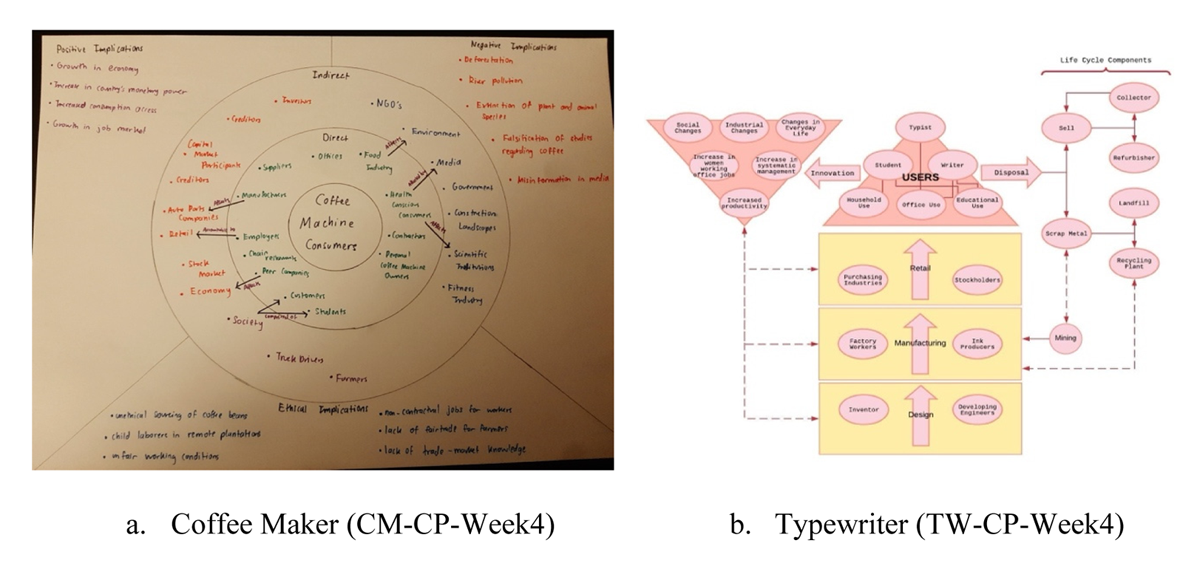
Figure 2
Milestone 2: System maps.
1.2. Using Artistic Making to Externalize Care and Critique
Artistic artifacts played a central role in making harms visible. Students used sculpture, material choices, spatial composition, and captions to connect technical features to social and environmental consequences. Although all teams were asked to create an artwork, they decided which harms to foreground, how to symbolize them, and what forms of change to call for. We therefore treat “artistic making to externalize care and critique” as student-derived rather than merely task-driven. Across pieces, students (a) selected focal technical features (e.g., filter dose, polymer durability, component mass), (b) chose semiotic devices (e.g., gems for profit; light/color for hope; deconstruction and burnt edges for extraction and harm), and (c) addressed audiences through warrants such as quantities, icons, and substitutions.
The Coffee Maker team built a life-cycle diorama inside the machine’s glass pot, pairing a painted forest scene with clay figures to connect everyday brewing to upstream harms (Figure 3). Their description introduced quantification (7 g versus 5.7 g beans per cup) to argue that a seemingly small technical parameter in filter machines scales to a significant impact leading to deforestation and child labor under rising demand. Their sculpture linked everyday brewing to upstream harms, using symbolic materials (wooden figures, gemstones, and forest imagery) to represent hidden labor and environmental costs.
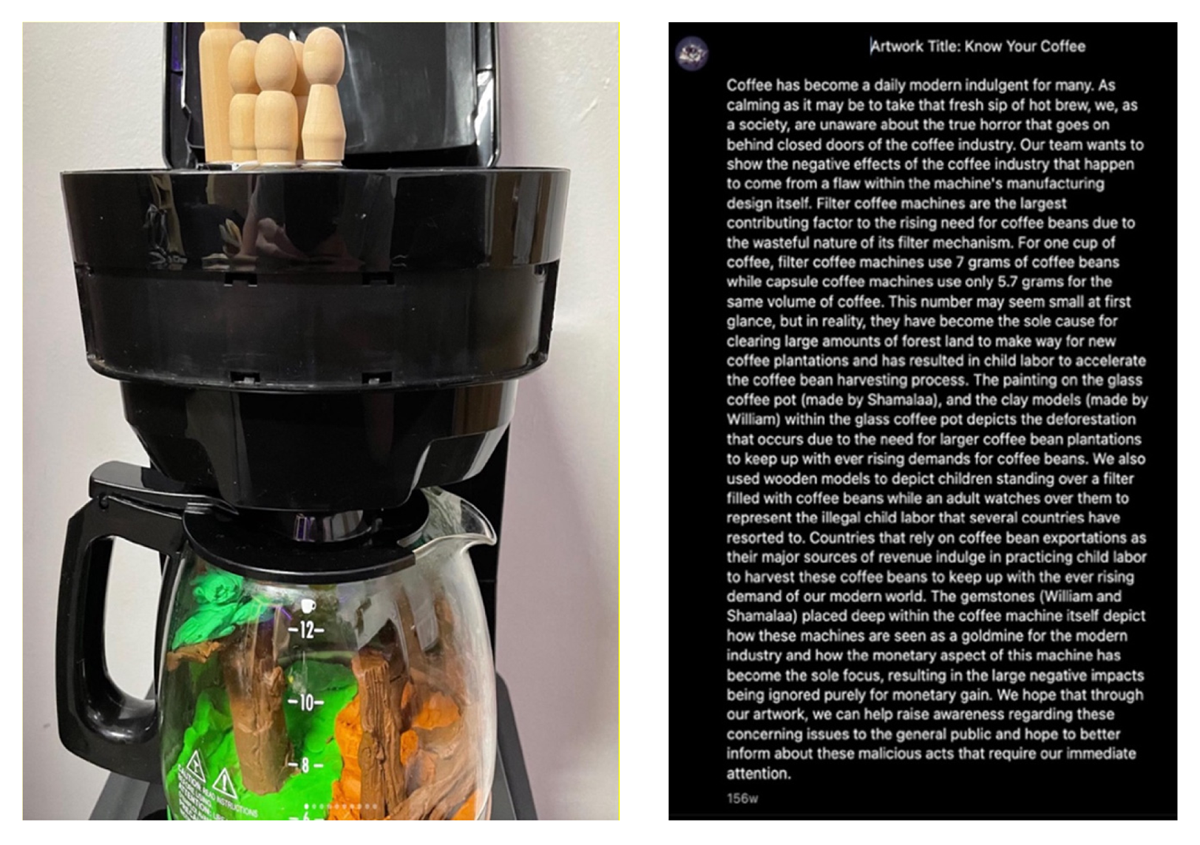
Figure 3
Picture and caption of the coffee maker team artwork.
The piece reframes convenience and efficiency as design values with externalized costs and closes with a direct appeal to the public to attend to malicious acts requiring immediate attention. The team links component-level design (filter mechanism, dose) to system-level consequences, and choreographs materials (glass, wood, gems) to surface who benefits and who pays. As the students shared, they “hope that through [their] artwork, [they] can help raise awareness regarding these concerning issues to the general public and hope to better inform about these malicious acts that require our immediate attention” (CM-CP-Week8).
The Water Bottle team presented the bottle as a “beacon of hope” (Figure 4): internal fairy lights and a blue-tinted shell produce an oceanic glow, while earth/air/water icons silhouetted against the light map design choices onto environmental domains (emissions, ocean pollution, landfill). Nesting a disposable bottle inside the reusable one visualizes a substitution claim—every refill is one fewer bottle in a landfill—bridging product materiality with behavioral practice. The description named a clear audience (general population) and gave a pragmatic rationale (ease, cost savings), positioning compassion as a feeling and an everyday actionable practice. This work thus connected polymer/material selection and form to downstream impacts people can influence in routine use. Their design depicted how choosing certain materials to produce reusable water bottles helps mitigate negative impacts on air, water, and land pollution.
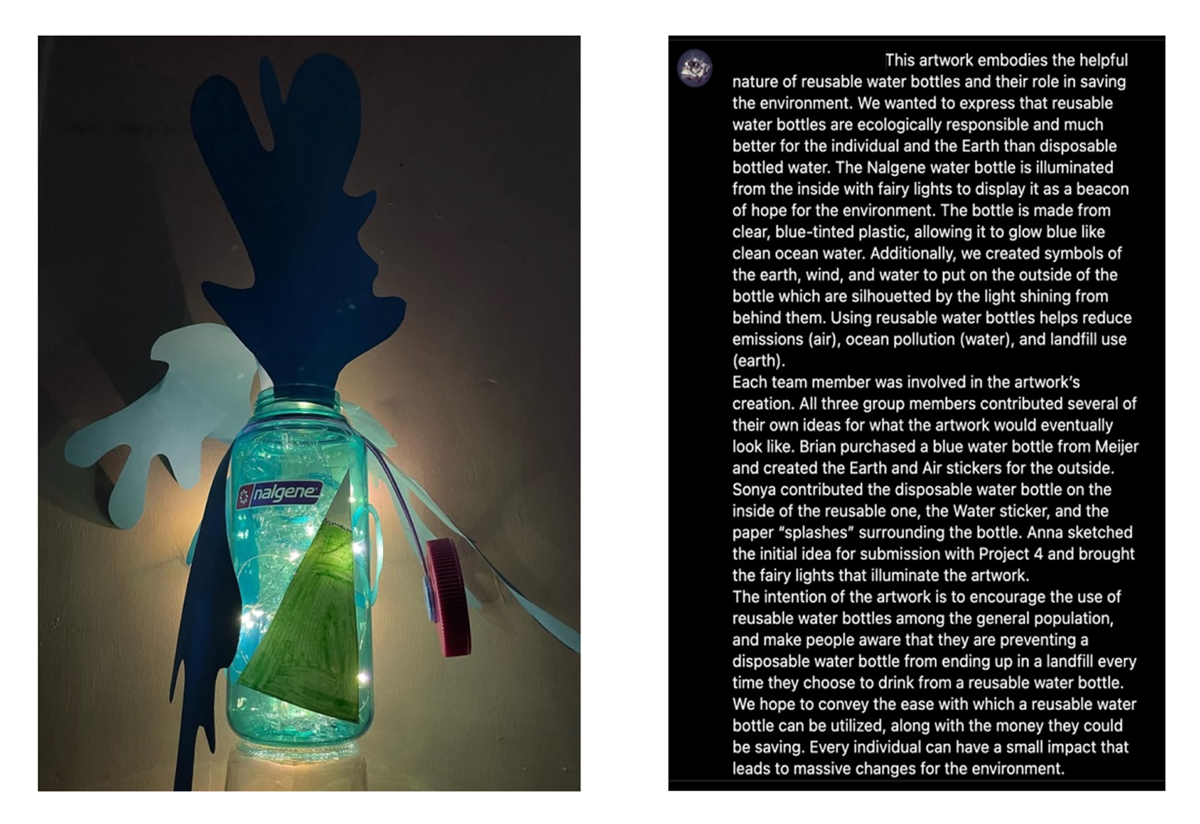
Figure 4
Picture and caption of the water bottle team artwork.
Finally, by deconstructing the machine and revealing its interior, the typewriter team literalizes the call to “look further… to see [the] bad aspects” (Figure 5). The burnt-edge canvas depicting a mine and barren forest extended beyond the frame, a visual claim that extractive impacts exceed the artifact’s boundaries (manufacture → use → end-of-life).
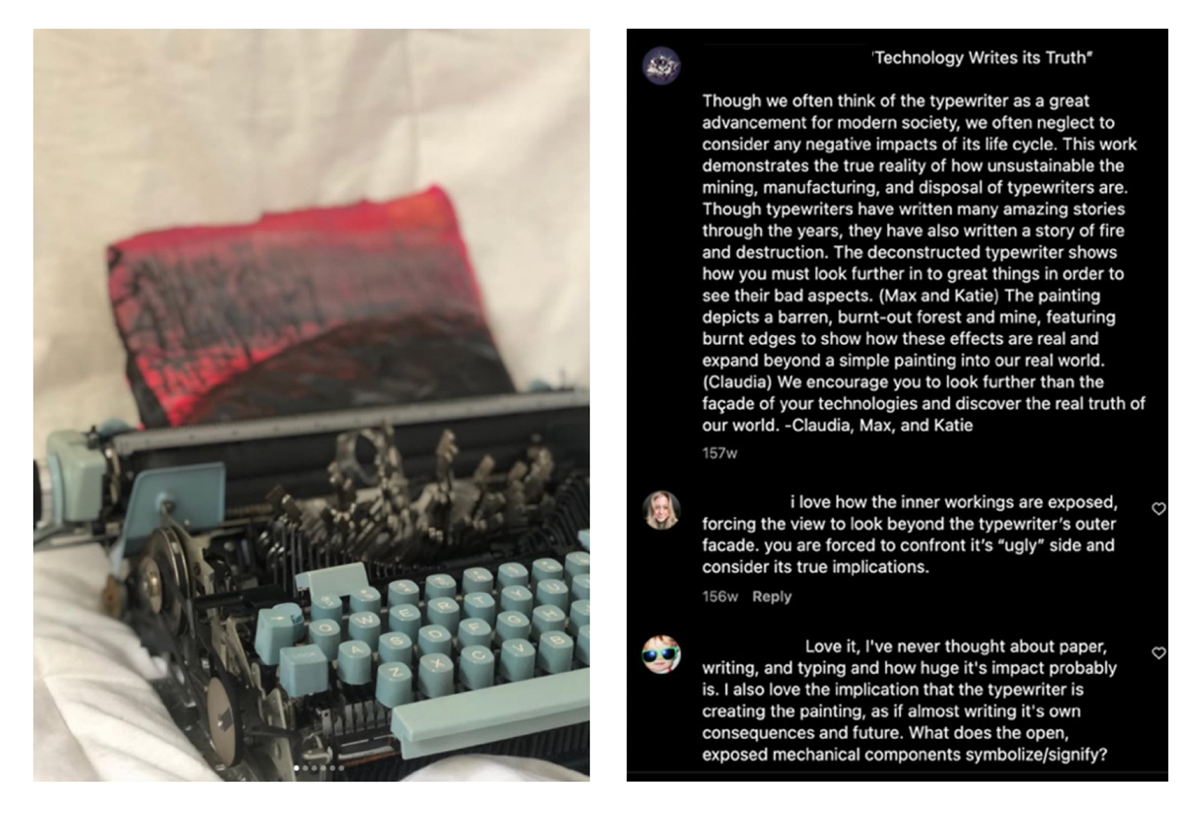
Figure 5
Picture and caption of the typewriter team artwork.
The caption reframed a culturally celebrated technology—“written many amazing stories”—as also writing “a story of fire and destruction,” juxtaposing cultural value with ecological cost (TW-CP-Week8). Together, the exposed mechanisms and scorched canvas operated as an allegory of material/energy flows, inviting viewers to interrogate the unseen infrastructures of familiar devices and to re-prioritize what responsible engineering should count. In that sense, students used art as a medium to express their more complex approaches to engineering solutions.
Together, subthemes 1.1 and 1.2 show how students recognized harm within sociotechnical contexts and used artistic and analytic forms of expression to make that harm visible, corresponding primarily to the recognition-of-harm dimension of compassion.
Theme 2. Employing a compassionate lens
This theme focuses on how students interpreted these relationships through a compassionate lens, including ethical judgment, perspective-taking, and emotional engagement (e.g., codes 2, 3, 5, 6, 7, 9, 11, and 12). While codes such as 7, 11, and 12 also appear in Theme 1, their role differs here: in Theme 1 they support identifying relationships and harms, whereas in Theme 2 they reflect students’ ethical interpretation of those relationships.
2.1. Recognizing Macroethical Impacts
The language used by the students shows attention to wider-than-local consequences of engineering choices. A student examining the typewriter wrote:
I discovered that the mining process to gather the metals used to produce typewriters can be very harmful to the environment. Some negative environmental consequences are deforestation, loss of biodiversity, soil and water contamination, and harm to animals living in the nearby areas (S2-TW-CP-Week5).
This reflection shows that the student recognized the cascading macro-level consequences of typewriter production, linking mineral extraction to ecological harm and broader ethical responsibility in design.
Another student who was reflecting on coffee maker technology, moved beyond functionality and economics to behavioral effects: “[t]he downside to this marvelous invention is the perpetuation of caffeine addiction it has created in society” (CM-CP-Week5). Students also noticed economic ripple effects, e.g., legacy products displaced by new technologies: “The businesses making fountain pens and other such items most likely suffered a decrease in sales as the industrial world moved to the new technology” (TW–CP–Week5). By Week 8, they connected unequal burdens explicitly. A student examining the impact of Water Bottle on the planet wrote:
The world is suffering under the effects of global warming; although everyone on the planet will feel the impact, some are suffering more than others, and it is important that the rest of us do our job to prevent more warming (WB-CP-Week8).
These statements indicated that students scaled their judgments from feature-level design to societal, ecological, and distributional impacts.
2.2. Taking Others’ Perspectives (Cognitive Empathy)
In this course, structured encounters afforded perspective-taking—e.g., a campus observation and discussion, a gallery viewing, peer dialogues in Brightspace, and project captions written in Weeks 5 and 8. Students’ work demonstrated cognitive empathy through shifts in vantage point, attention to others’ contexts and constraints, and reflections showing how such understanding revised their own stance.
About shifting vantage point, one student described a clearer grasp of women’s experiences and how their own view changed after an on-campus observation: I’ve always been compassionate towards women involved in this type of situation [sexual abuse and harassment], but over the past few weeks I have gained an even better sense of understanding towards what they are going through, […] (S8–CM–ICR–Week5).
Gallery reflections show a similar move to the perspective of those depicted: “The whole gallery exemplified compassion towards women, who cannot voice their opinions enough and are looked down-upon for no reason other than them being women” (S6—DA—Week 5). In the Course Project, teams also invited audiences to adopt new vantage points; the Typewriter caption urges viewers to “look further than the façade of your technologies and discover the real truth of our world.” (TW–CP–Week8).
Students also articulated others’ contexts and constraints. For instance, the Coffee Maker team narrated economic dependence and labor pressures in countries exporting coffee beans: “Countries that primarily depend on coffee trade resort to using child labor and unfair trades to maintain a monetary profit. An influx of construction landscapes for plantations occurs resulting in heavy deforestation” (CM–CP–Week8). Finally, students indicated that perspective-taking activities helped them update their understanding and revise their stance from a singular to a more pluralistic one. The Typewriter team reframed a celebrated device, prompting reconsideration of what responsible use and design should entail:
Though typewriters have written many amazing stories through the years, they have also written a story of fire and destruction. The deconstructed typewriter shows how you must look further into great things in order to see their bad aspects (TW–CP–Week8).
2.3. Experiencing Felt Responses (Affective Empathy)
Across reflections and captions, students linked emotion with ethical noticing, describing sadness and grief as material and labor harms came into view. They also expressed disappointment and care in peer contexts, as well as hope when envisioning alternatives and inviting action. These feelings were often paired with specific responses—such as calling for design review, advocating reusable adoption, or communicating with public audiences—suggesting that affective empathy shaped how students understood responsibility and change in engineering practice.
A Coffee Maker team member voiced sadness and grief as they recognized the harm caused to the environment and injustice inflicted by humans on humans. They wrote,
It makes me sad that the profit margins of the industry are more prioritized than the severe consequences being brought on by the manufacturing style and design of the technology. The environmental issues and child labor concerns are colossal issues that require immediate attendance and by having a design review, it may not completely eradicate the issues, but it will definitely help to decrease the scale of them (CM-CP-Week5).
Re-examining the typewriter, another student reflected,
As we continuously dove deeper and deeper into the effects that this one invention […] I had never imagined that the typewriter could be negative, as we all view it as such a crucial product for the advancement of society (S1-TW-CP-Week5).
Affective responses also appeared in peer contexts. Responding to a classmate’s account of competition, one student wrote,
I am saddened to hear that other teams did not offer your group any help on the [course] project…I do remember certain people in [course] being very selective about the people they helped… you will definitely meet people who are compassionate and caring (S5-PCR-Week5).
Here, disappointment is directed at local engineering norms, while care is extended toward a peer’s experience.
Alongside these emotions, students expressed hope oriented toward collective change. The Water Bottle team intentionally framed their piece as “a beacon of hope for the environment,” emphasizing “the ease with which a reusable water bottle can be utilized, along with the money they could be saving. Every individual can have a small impact that leads to massive changes for the environment.” (WB–CP–Week5). In their concluding project document, the Coffee Maker team similarly aimed to reach public audiences and spur attention to harms (CM-CP-Week8). In these cases, affect is paired with a concrete action pathway which involves everyday product choices, communication to wider audiences, and a call for review of design practices.
These statements showed students feeling with others and linking those feelings to judgments about responsibility and possible remedies. Course encounters (observation/walk, gallery visit, peer exchanges, and public captioning of artworks) afforded occasions for these emotions to surface.
RQ2: Students’ Connection between Compassion and Engineering Practices
For RQ2, we identified two student-derived themes: (a) Negotiating Tensions and Limits and (b) Orienting Practice—Design Goals and Public Communication. Together, these themes show how students connected compassion to engineering practice by naming frictions, such as competition and cognitive or emotional burden, while also articulating more practice-facing orientations, such as design goals and public communication. These themes were informed primarily by codes related to tensions in engineering practice and action-oriented understandings of compassion. Course elements (readings, dialogues, project work) provided scaffolding (Weeks 5, 7, and 8). Table 6 summarizes the themes and sub-themes associated primarily with tensions in engineering culture and students’ action-oriented understandings of compassionate practice.
Theme 3: Negotiating Tensions and Limits
This theme was informed primarily by codes related to reluctance to acknowledge harm and tensions between traditional and compassionate engineering (e.g., codes 4 and 8).
3.1. Balancing Competition and Compassion
Reflections on competition appeared in Week 5 materials, where students discussed engineering classrooms, workplace cultures, collaboration, and responsibility. Students contrasted cooperative intent with competitive academic and professional norms that they believed disincentivized compassion (code 8). One student explicitly framed the clash: “The competitive aspect [of engineering] has made us engineers forget our ultimate motive of becoming engineers in the first place, working together to solve the big problems facing our society and planet” (S7-PCR-Week5). Another described engineering workplaces as “cutthroat” environments where engineers compete against co-workers (S6-PCR-Week5).
Students also connected this competitive logic to classroom experience. One student wrote that other groups refused to offer guidance in other engineering courses because they “would rather come out on top as opposed to help another group learn and become better engineers” (S2-PCR-Week5).
Another situated the issue within equity and belonging: “we should be taught to be compassionate and to value teamwork, not to diminish others at any chance we get” (S1-PCR-Week5).
Across these accounts, students treated compassion and competition as competing logics that shape what gets rewarded in engineering education and workplaces.
3.2. Managing Cognitive/Emotional Load (Limits of Compassion)
Students also named the feasibility limits of continually holding others’ suffering in view alongside heavy academic and personal demands. During a compassion-meditation exercise, one student wrote:
If you imagined all the ways in which a given person might be suffering right now, and tried to feel that suffering for yourself, you would be feeling down and depressed a lot of the time. […] I personally simply don’t have room in my head if I’m thinking about everything else I need to take care of in my life (S4-ICR-Week5).
Others reported that the same activity reframed their stance without overwhelming them: “I found a new perspective on self-reflection through compassion.” (S7—ICR—Week 5). By Week 8, some students nevertheless widened the aperture of responsibility while acknowledging unequal burdens:
The world is suffering under the effects of global warming; although everyone on the planet will feel the impact, some are suffering more than others, and it is important that the rest of us do our job to prevent more warming (WB-CP-Week8).
In short, students recognized the burden and necessity of sustained attention to others within engineering work.
Theme 4: Orienting Practice—Design Goals and Public Communication
This theme was informed primarily by codes related to dignity, empowerment, security, engineering purpose, inclusion, and action-oriented compassion (e.g., codes 10, 13, 14, and 15). Artistic artifacts continued to play a role in this phase, not only as tools for recognizing harm but also as vehicles for communicating ideas, raising awareness, and expressing action-oriented commitments.
4.1. Naming Design Goals for Compassionate Practice
Students translated compassion into explicit design goals by drawing on systems thinking (code 10) and Seshadri et al.’s (2019) framework of compassionate design, particularly dignity (code 2), empowerment, and a sense of security. One student explained that designs should not only solve problems but also create positive experiences by “taking into account how to enhance their dignity rather than only utilizing a ‘usability’ perspective” (S5-PCR-Week7). Others noted that breaking compassionate design into categories helped them see dignity and empowerment as design considerations that “should not be left to chance” (S6-PCR-Week7).
Teams also used these goals to frame their projects. The Coffee Maker team stated, “By considering the three key factors of compassionate engineering: dignity, empowerment, and sense of security, we created our artwork to advocate for the labor equality, human rights, and environmental sustainability” affected by coffee machine manufacturing (CM-CP-Week8). The Typewriter team similarly identified compassionate engineering through questions about cultural appropriateness, long-term sustainability, morality, repair, empowerment, dignity, and security (TW-CP-Week8).
Students also connected compassionate engineering to human-centered professional practice. One team concluded that engineers should “keep others at the center of the work we produce” (TW-CP-Week8), while another student argued that engineers need to better understand “who they’re creating things for” (S1-PCR-Week7). By Week 8, compassion was framed not only as a personal virtue but as part of responsible engineering identity and practice. As one student shared, “Showing compassion is sometimes viewed as a negative aspect, or some might even say a weakness… but the act of compassion itself strengthens our inner core of who we are” (S7-PCR-Week5). This highlights compassion as both a strength and part of students’ emerging engineering identity.
4.2. Using Artistic Communication to Demonstrate, Spread Awareness, and Inspire
Students also connected compassion to practice through public-facing communication, treating audience address as part of the engineer’s responsibility. The Typewriter team aimed to demonstrate harms and motivate change:
“We want our artwork to express the dangers of metal mining and evoke concern and desire for change within our audience. We think it is important for a technology that was so innovative for its time and instrumental in society to be sourced sustainably and continue helping society rather than harming it through production consequences” (TW-CP-Week5).
The Coffee Maker team emphasized spreading awareness via social channels: “After completing the artwork, we took ten high-quality photos and videos to showcase our completed project on social media to spread awareness and gather reactions from our peers, friends, and family” (CM-CP-Week8). Finally, the Water Bottle team positioned the piece to inspire everyday action: “This artwork is meant to stand as a symbol of inspiration for younger generations to continue on combating climate change and protecting the environment in any way they can,” (WB-CP-Week5) reflecting a desire to motivate future generations. In each case, students linked communication choices, such as platforms, symbols, and captions, to ethical goals, including making harms visible, naming values, and inviting publics into change. In this way, compassion became connected to concrete practices of representation, persuasion, and influence.
Taken together, Themes 3 and 4 show how students moved from recognizing tensions in engineering culture to articulating more action-oriented understandings of compassionate practice.
Discussion
This discussion interprets how students’ reflections provide evidence of sympathetic awareness, empathic understanding and, finally, compassion-oriented art-based action.
Contours of Compassion in Student Practice
Students in the Compassionate Engineering course expanded their understanding of compassion and connected it to engineering practice through experiences that invited them to examine technologies as sociotechnical systems and themselves as engineers in those systems. First, students became ethically aware of the societal implications of technology and, in many instances, registered sympathetic reactions oriented toward affected groups or “society” in the abstract. Second, as they worked with concrete analytic tools—stakeholder mapping and systems visualization (Stickdorn et al., 2018) and technology life-cycle analysis that renders externalities visible (Skibo & Schiffer, 2008)—they reported discomfort and cognitive dissonance regarding exploitation, inequity, or environmental harm. Cognitive empathy and affective empathy interacted as students tried to understand others’ perspectives and contexts while also feeling sadness, grief, or frustration as harms came into view. Third, many students articulated a desire to help and translated empathic understanding into outward-facing expressions—most tangibly in their culminating artwork—signaling orientations consistent with compassion.
Sympathy initially appeared when students acknowledged harms but positioned themselves as observers rather than co-participants. Across student reflections and artifacts, the analytic practices named above positioned students to internalize and personalize the content. In the dataset, cognitive empathy was visible where students adopted non-default vantage points, identified constraints faced by others, or reasoned about distributions of benefit and burden within a system. Affective empathy was also visible, particularly when students described felt responses (e.g., sadness, fear, and concern in response to perceived harm, as well as love and hope oriented toward care and change). These emotions functioned as moral-affective signals that both sustained attention to sociotechnical harms and oriented students toward possible forms of response consistent with work in engineering ethics that positions emotions as integral to moral perception and action (Tormey et al., 2025). In this sense, emotional responses were not treated as byproducts of reflection but as integral components of how students interpreted, evaluated, and responded to sociotechnical conditions.
The interplay of reflection and feeling is represented schematically in Figure 6 as a spiral, which draws on patterns observed across student reflections, captions, and artifacts from Weeks 4–8. The figure is grounded in students’ documented practices, such as how they identified harms, made symbolic choices (e.g., representing harm through visual metaphors, selecting materials or forms to convey vulnerability or resilience, or depicting specific stakeholders and audiences), and articulated audiences.
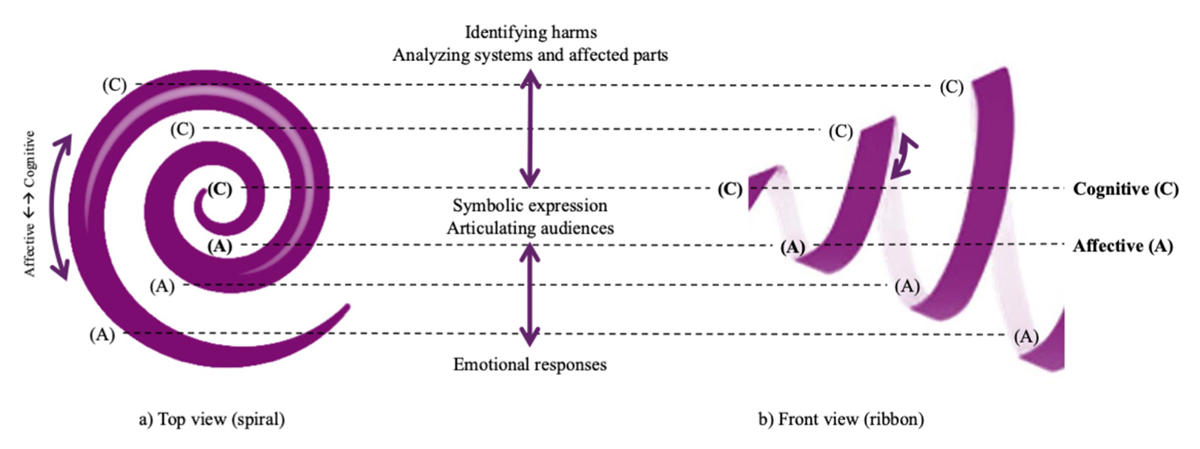
Figure 6
Conceptual heuristic illustrating relationships between cognitive empathy and affective empathy in engineering design contexts.
In this representation, the spiral illustrates how students oscillated between cognitive engagement (e.g., identifying harms, analyzing systems, recognizing distributions of benefit and burden) and affective engagement (e.g., experiencing sadness, concern, or hope in response to those realizations). These forms of engagement did not occur in isolation; rather, they reinforced one another, as cognitive recognition of harm elicited emotional responses, which in turn sustained attention and motivated further analysis or expression. The figure is not intended to represent a measured developmental trajectory or to imply temporal progression over the duration of the course. Instead, the spiral is offered as a conceptual heuristic that captures the dynamic, recursive interplay through which cognitive and affective dimensions of empathy co-occur within student meaning-making.
Students questioned who benefits from engineering solutions and who is excluded, re-examining assumptions about technological progress and efficiency. In several instances, this movement extended from product-level observations to broader institutional and ecological implications, marking a shift from microethical concerns in local, interpersonal contexts toward macroethical analysis of institutional arrangements, policy logics, and environmental externalities (Hess, 2024). We read this as an emergent form of social empathy (Segal, 2011, 2018): perspective-taking paired with contextual understanding of structural conditions shaping harm and responsibility. This lens clarifies how students moved from interpersonal concern toward macroethical attention to institutions, labor relations, and unequal distributions of benefit and burden.
The end of the term makes these contours especially visible. By Week 8, students described engineers as socially responsive and morally engaged. For example, the typewriter team’s statement—“We all want the best for humanity and strive to keep others at the center of the work we produce” (TW-CP-Week8)—illustrates how empathic understanding can be articulated alongside an action-oriented stance. In our interpretation, this is not a conflation of empathy with compassion; rather, it indicates the emergence of a compassionate orientation in which empathic understanding is paired with intent to influence practice and publics.
These patterns clarify why many students articulated orientations consistent with compassion, understood here as concern for suffering joined to a desire to alleviate it (Goetz & Simon-Thomas, 2017). In our corpus, this orientation is visible in calls for design review, in arguments for behavioral shifts such as reuse or substitution, and in public-facing messages crafted to inform or persuade specific audiences. Building on the definitional distinctions summarized in the Literature Review (Table 2), those dispositions can be translated into practice by depicting typical engineering responses associated with each stance: the sympathetic engineer acknowledges suffering yet remains distant; the empathic engineer undertakes perspective-taking and contextual understanding; the compassionate engineer co-defines problems and pursues collaborative, ethically grounded action on root causes. This mapping connects the trajectory from sympathy and empathy to compassion with concrete modes of engineering response, a view consistent with accounts of compassion as non-egoistic and oriented toward justice (Schopenhauer, 1915; C. R. Williams, 2008).
The Role of the Arts in Promoting Compassionate Engineers
The arts played a pivotal role in sustaining the cognitive-affective empathy interplay. As Greene (1995) and Eisner (2002) argue, artistic practice opens space for perspective-taking, emotional engagement, and moral imagination, all of which are capacities central to responsible engineering. In our data, students used sculpture, assemblage, and visual narrative to externalize care and critique, humanize abstract harms, and invite audiences into deliberation. These works functioned as communication and as inquiry. Materials and composition condensed ethical claims: gems embedded in a coffee maker to symbolize profits obscured by convenience; a deconstructed typewriter paired with a scorched canvas to index extractive histories that exceed the device’s frame; nested bottles illuminated with blue light to stage substitution and hope. Such choices align with Taylor’s (2016) emphasis on metaphor as an epistemic resource and with Lambrinidou et al.’s (2014) account of transformational listening, in which creative and ethnographic methods help attune engineers to voices and experiences otherwise peripheral to technical analysis. Students’ captions and social-media postings extended this work beyond the classroom, sharpening the link between affected parties’ attention and public-facing communication.
The arts also supported a broader epistemic expansion. By legitimizing subjective, emotional, and embodied forms of reasoning, the arts complement traditional engineering methods that prioritize control and objectivity. In the context of this course, aesthetic expression helped students visualize uncertainty, interrogate norms, and test value claims—work that Human-Centered Design regards as integral to problem framing (Design Council, 2005). In turn, the arts helped sustain the cognitive–affective cycle depicted in Figure 6 by offering concrete practices for processing emotion and translating it into meaningfully framed questions, design constraints, and communication strategies. As teams adopted dignity, empowerment, and security as evaluative goals (Seshadri et al., 2019), their artworks supplied the evidence base and the rhetorical means for advocating those goals.
At the same time, we do not present the arts as the sole or privileged route to cultivating compassion in engineering. The argument is additive: arts-integration is one pathway among several that can be used singly or in combination. Approaches such as design thinking, value-sensitive design, humanitarian and community-engaged engineering, case-based and role-play ethics education, service-learning, and mindfulness-oriented practices all contribute to promoting empathic and compassionate orientations when thoughtfully implemented in engineering curricula (Berne, 2018; Bielefeldt, 2021; Campbell, 2013; Design Council, 2005; Goetz & Simon-Thomas, 2017; Gordon et al., 2022; J. L. Hess & Fila, 2016; Lucena et al., 2024; Nieusma & Riley, 2010; Strobel et al., 2013; Zoltowski et al., 2012). The distinctive contribution observed here is that the arts furnished methods of reasoning and communication that were especially effective for making values visible, inviting publics into deliberation, and holding open the Define–Develop space for ethical imagination. These forms of engagement not only shaped how students expressed compassion but also informed how they approached engineering problems and responsibilities, as discussed next.
From Empathic Engagement to Design Framing
Students’ articulated understanding of compassion did not remain theoretical; it shaped how they framed design problems and responsibilities. To interpret these patterns, we draw on human-centered design (HCD) as a way to interpret how students translated the cognitive-affective interplay into design framing, stakeholder consideration, and problem definition. Building on the arts-based engagements described earlier, the interplay between cognitive empathy, affective engagement, and systems-oriented reflection helps illuminate how students connected understanding, feeling, and action in their design reasoning.
The course’s design work paralleled the Design Council’s (2005) Double Diamond model, composed of four activities: Discover, Define, Develop, and Deliver. Yet, what students actually did differed in important ways. For students, the Define–Develop space was a locus of ethical imagination and creative exploration. Rather than converging quickly, teams paused to re-surface values, rehearse an individual affected parties’ perspectives, and interrogate default commitments (e.g., efficiency as the primary design value). The artistic component was central in this middle space. The process of making (which involves selecting materials, composing symbols, and crafting captions) functioned as problem (re)definition, where students negotiated trade-offs, rendered externalities visible, and clarified audiences and rationales for their claims. In this reading, art-making was not ornamental but rather an HCD-consistent practice for sense-making and framing.
In Figure 7, we offer a pedagogical model for design based on these adaptations to the double-diamond design model. Our adaptation disrupts the conventional narrowing to a single solution. The process concludes with neither a singular nor a static problem statement but with a more systemic and dynamic problem scope, implying multiple ethical pathways forward and the need to resist complete convergence. This is not indecision, but instead reflects that responsible design in sociotechnical contexts precludes closure and must hold space for ambiguity, contingency, and ongoing negotiation between social needs and technological capabilities.
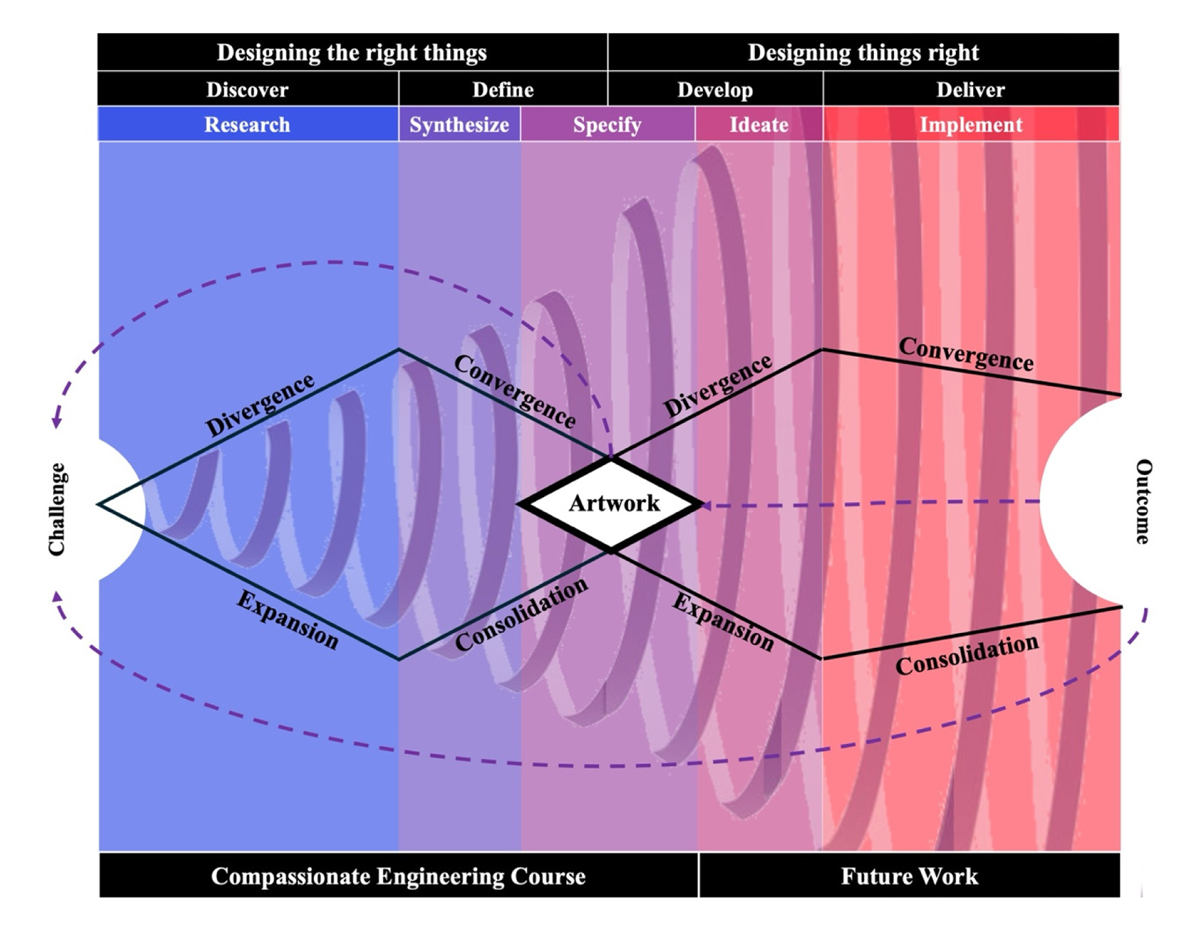
Figure 7
Development of compassion in engineering.
This adaptation of the double diamond design model aligns with calls in engineering education to embrace complex, participatory approaches that center the affected parties and integrate emotional intelligence into design reasoning (Zoltowski et al., 2012), and it resonates with the for/with/as framing (Fila et al., 2014), which shifts practice away from “designing for” passive recipients toward “designing with” communities while recognizing engineers’ embeddedness in the systems they aim to serve. In this sense, the inclusion of artistic reflection and making in our course parallels the role of the arts in fostering perspective-taking and aesthetic inquiry (Eisner, 2002; Greene, 1995), illustrating how creative processes can serve as catalysts for more humanistic, participatory forms of engineering design.
Limitations and Future Work
While this study illustrates promising directions for integrating compassion into engineering education, it also presents limitations. First, the study is based on a small n (eight students), which constrains the generalizability of the findings. The course was also offered a single time, making it difficult to determine whether the patterns we observed would persist across different cohorts or institutional contexts. Second, the course lasted eight weeks, providing limited time for students to move beyond problem definition to solution development. As a result, much of the students’ engagement remained in the reflective and conceptual phases of the design process.
Third, because the artifacts analyzed were graded deliverables, students may have framed their responses in ways that aligned with perceived instructor expectations (Langstraat & Bowdon, 2011). This potential performativity does not negate the insights shared but suggests that future research should include complementary, ungraded data sources—such as interviews, journals, or observational field notes—to provide a fuller account of students’ evolving perspectives.
Future research should also explore how to cultivate social empathy more deliberately in engineering curricula, particularly in relation to structural injustices and systemic inequalities (Segal, 2011). Finally, longitudinal research could validate and refine the modified human-centered design framework by tracking how students carry compassionate orientations into subsequent coursework, professional identity formation, and engineering practice.
Conclusions
Contemporary engineering problems are inherently sociotechnical, requiring attention to human and emotional factors that technical modeling alone cannot address. This study explored how compassionate engineering can offer an alternative to technocratic and meritocratic approaches by integrating ethical responsibility, emotional awareness, and human-centered thinking into engineering education.
Findings show that arts-based practices helped students recognize sociotechnical harms, engage multiple perspectives, and express compassion through material, symbolic, and public-facing forms. By incorporating art into engineering education, students were able to explore uncertainty, critique hidden consequences of technology, and imagine more caring and socially responsive forms of engineering practice. Arts-based pedagogies can therefore broaden engineering education beyond technical competence toward care, justice, and human-centered responsibility.
Additional File
The additional file for this article can be found as follows:
Author Contributions
Conceptualization, C.V.-O. and M.H.; methodology, C.V.-O.; investigation and data curation, C.V.-O. and M.H.; formal analysis, C.V.-O. and Y.G.; interpretation and theoretical framing, C.V.-O., Y.G., M.H., and J.H.; writing—original draft preparation, C.V.-O.; writing—review and editing, C.V.-O., Y.G., M.H., and J.H.; supervision, C.V.-O. All authors have read and agreed to the published version of the manuscript and accept responsibility for its accuracy and integrity.