
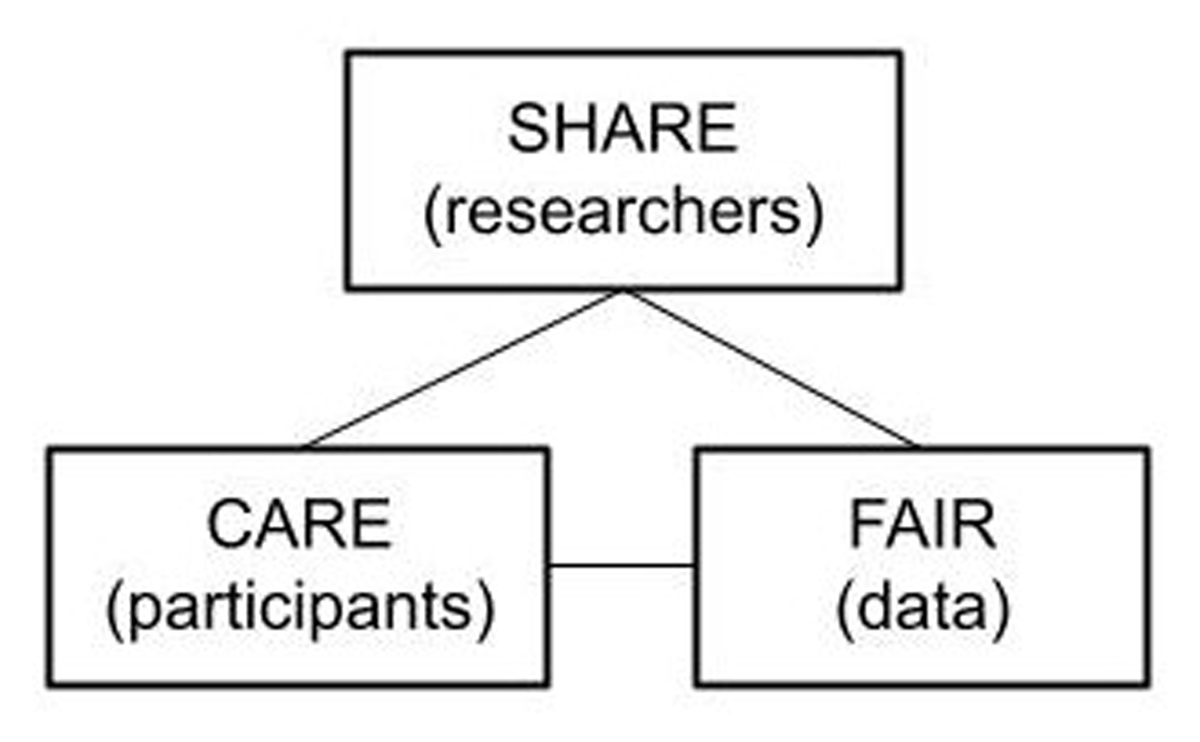
Figure 1
Principles for Data Sharing.
Table 1
SHARE Principles for guiding data sharing and secondary data analysis (SDA).
| PRINCIPLE | EXPLANATION | REFLECTION QUESTIONS |
|---|---|---|
| Stewarding collaborative relationships | The deeply contextualized nature of qualitative data often requires intentional stewardship to facilitate collaborations between researchers who generated the data and those seeking to use it to ensure that the data are used in ways consistent with the participants’ consent and understanding and the larger context in which the data were collected. This consistency typically requires significant dialogue between the original and new researchers about the contexts in which the data were collected, expectations and practices related to confidentiality or anonymity, and the epistemologies and positionalities of all collaborators involved in the work. Where feasible, data originators should serve as collaborators on projects and co-authors on publications. |
|
| Honoring context of data | Data originators and secondary analysts need to consider where, how, when, and by whom data were collected while maintaining necessary protection of participants’ confidentiality and terms of consent. This may include maintaining confidentiality or anonymity or, if the original study was designed to publish identifying information, ensuring that the information is disclosed and used in ways that honor participants’ interests and intents. |
|
| Aligning questions, frameworks, methods, and the data | As with all research studies, research questions should be appropriate to the existing data set, including the framework that guided collection, the data collection methods, and existing analysis. SDA can be approached collaboratively where a researcher with specific questions works with a data originator to determine whether a dataset is amenable to the new questions and approaches, or it can be approached inductively where secondary analyzers review samples of the data in search of potential research questions that could be answered, considering gaps in existing literature. |
|
| Responsibly reusing data | Ethics and trust are critical to any data sharing and analysis project. It is imperative to conduct research that has the potential to benefit the original participants or the population they represent. In sharing data, it is also important to develop a trusting relationship between the data originator and secondary analyzer that acknowledges the vulnerability involved with sharing a data set. |
|
| Expanding capacity and ownership | Sharing data can fulfill the need to acknowledge diverse approaches to capability development and build capacity of the research community by bringing new researchers into the process without requiring them to collect their own data. SDA can also broaden ownership of data so that others can shepherd it as well. The mutuality of sharing the data through SDA can help data originators and secondary data analysts experience the data in meaningful new ways. |
|