
Table 1
Descriptions of participant types and their roles in the I2-module sequence.
| PARTICIPANT TERM | DESCRIPTION | ENGAGEMENT SEMESTER |
|---|---|---|
| I2 participants | Students in the I2 course. Students could be undergraduate students, graduate students, postdoctoral fellows, or faculty in the BME department. | Fall Semesters |
| I2-module sequence instructor | Engineering education focused faculty member who developed and taught the I2 course in the Fall and served as the lead faculty mentor in the teaching apprenticeship experience in the Spring. | Fall and Spring Semesters |
| Teaching apprentices | Undergraduate students, graduate students, and postdoctoral fellows from the I2 course in the Fall who elected to team-teach the module they developed in the I2 course. | Spring Semesters |
Table 2
Module topics by implementation year.
| MODULE TOPIC | TAUGHT YEAR 1 | TAUGHT YEAR 2 | TAUGHT YEAR 3 |
|---|---|---|---|
| tissue engineering | X | X | X |
| medical device development | X | X | X |
| regulations | X | ||
| drug development | X | ||
| neural engineering | X | ||
| medical imaging | X |
Table 3
Element definitions in the Academic Plan (Lattuca & Stark, 2009) and elements added based on data analysis. Added elements are indicated with*.
| ELEMENT | DEFINITION |
|---|---|
| Purposes | knowledge skills and attitudes to be learned |
| Content | subject matter selected to convey specific knowledge skills and attitudes |
| Sequence | an arrangement of the subject matter and experiences intended to lead to specific outcomes for learners |
| Learners | how the plan will address a specific group of learners |
| Instructional Processes | the instructional activities by which learning may be achieved |
| Instructional Resources | the materials and settings to be used in the learning process |
| Evaluation | the strategies used to determine whether decisions about the elements of the academic plan are optimal |
| External Influences | influential factors such as market forces, societal trends, government policies and actions, disciplinary associations, media, funding agencies that support curricular reform, and accrediting agencies |
| Internal Institutional Influences | influential factors such as the college or university mission, financial resources, and governance arrangements |
| Internal Unit Level Influences | influential factors such as unit instructors’ backgrounds, educational beliefs, disciplinary backgrounds, and sometimes student characteristics |
| Timing* | the duration, frequency, cadence, or other related decisions on how time in class is allocated |
| Course Level Influences* | influential factors such as course timing, course enrollment size, instructors, and resources |
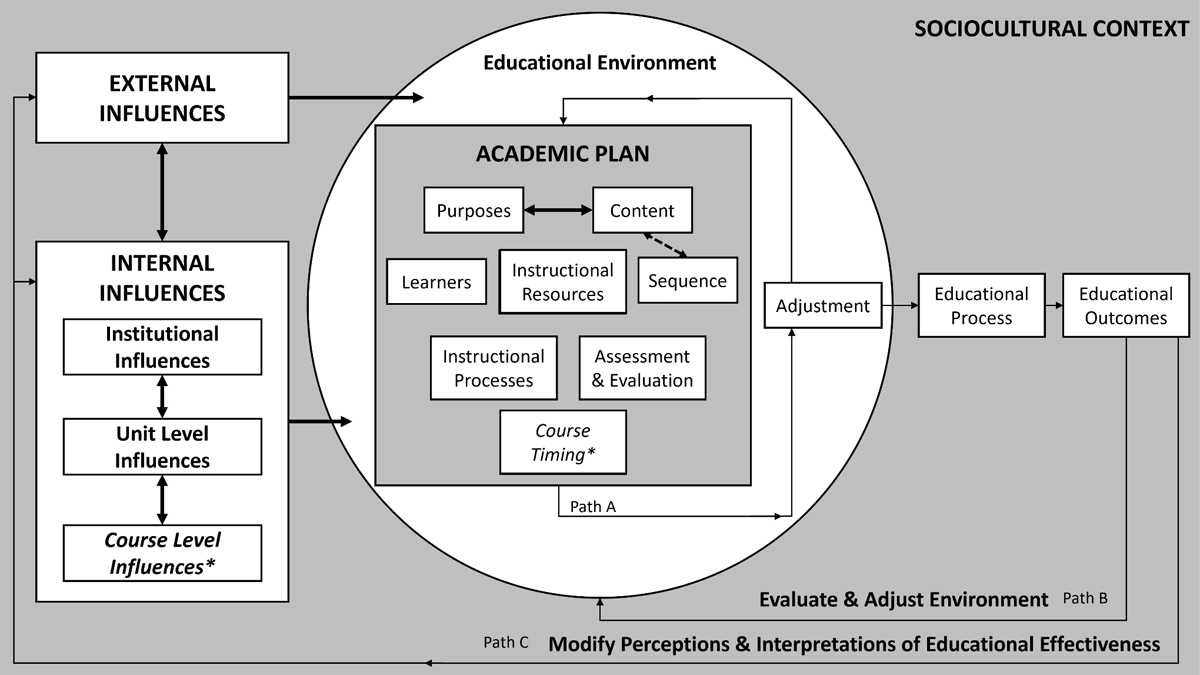
Figure 1
Academic plans in a sociocultural context, adapted to incorporate elements from this study (Lattuca & Stark, 2009).
Table 4
Qualitative Research Quality (Walther et al., 2017) considerations in our work.
| Theoretical Validation |
|
| Procedural Validation |
|
| Communicative Validation |
|
| Pragmatic Validation |
|
| Ethical Validation |
|
| Process Reliability |
|
Table 5
Patterns of discussion across the most frequent codes in our data.
| Change | Content | Changes to content included:
|
| Instructional Processes | Changes to instructional processes included:
| |
| Proposed Change | Assessment and Evaluation | Proposed changes to assessment and evaluation were:
|
| Content | Proposed changes to content included:
| |
| Instructional Processes | Proposed changes to instructional processes included:
| |
| Instructional Resources | Proposed changes to instructional resources included:
| |
| Sequence | Proposed changes to sequence included:
| |
| Reason | Assessment and Evaluation | Assessment and evaluation reasons for change resulted from:
|
| Reason | Course Level Influences | Participants described the following course level influences as reason(s):
|
| Learners | Participants described the following characteristics of learners in the modules as reason(s):
| |
| Purpose | Participants described the following purpose(s) of a module as a reason(s):
|
Table 6
Most salient co-occurrences between changes and reasons for change.
| CHANGE | REASON FOR CHANGE | EXCERPT EXAMPLE |
|---|---|---|
| Instructional Processes | Classroom Influences | “I found that limitations of time and format were such that I simply had to drop a lot of information in a lecture format.” |
| Instructional Processes | Learners | “We had to constantly stop the class for students to catch up, since everyone worked at different paces.” |
| Content | Classroom Influences | “When our first two class sessions ended early, we decided to add two additional topics to the course. While the other course content had been developed and edited over the previous weeks and months, these new lectures had to be organized within a few days.” |