
Introduction
The conversation around informing teaching practice with educational research has been occurring since the 1950s, with consistent growth in the number of resources for faculty to change their teaching practices (e.g., from Teaching and Learning centers on campus) and change in the kinds of practice that are emphasized based on ongoing teaching and learning research (Tiberius, 2002). More recent conversations about instruction in science, technology, engineering, and math (STEM) classrooms have frequently agreed that a shift to more student-centered teaching practices is needed to better support student learning (Smith et al., 2013; Stains et al., 2018). Student-centered teaching practices focus on increasing student-to-student and student-to-instructor interaction and cognitive engagement through a broad range of pedagogical approaches (e.g., active learning practices, flipped classroom, think-pair-share, project-based learning). These practices have consistently shown signs of improved student performance in STEM courses (Freeman et al., 2014; Guimarães & Lima, 2021; Lo & Hew, 2019; Mostrom & Blumberg, 2012), demonstrating one important argument for incorporating student-centered practices to enhance student success. Research exploring the differential impact of these pedagogical approaches on underrepresented students has indicated improved outcomes for students from marginalized backgrounds in student-centered classrooms (Theobald et al., 2020), further illustrating the potential impact these practices can have on STEM education.
Before designing an intervention to enact the change that has been called for, it is important to acknowledge the ways in which institutions have historically sought to effect pedagogical change. In a review, Amundsen and Wilson (2012) summarized the many approaches used to enact educational change in higher education institutions, noting six themes within their review: 1) a focus on the development of concrete teaching skills (e.g., presenting and facilitating discussions), 2) a development of abilities to apply specific teaching methods (e.g., problem-based learning), 3) a focus on the change in teacher conceptions of teaching and learning, 4) a focus on coordinated institutional plans to improve teaching practice, 5) a focus on developing disciplinary knowledge to improve pedagogical knowledge, and 6) a focus on small groups of faculty investigating teaching and learning topics of interest to them. The interactions between these themes in their review demonstrated the complexity of instructional change efforts, highlighting the differing goals of instructional training (e.g., skills development versus a cultural shift) and the contextual influence of the training format (e.g., embedded within a center for teaching and learning versus in a department, or oriented towards individual change or social change). A key takeaway from their review was the importance of acknowledging the situated and social nature of teaching when developing new initiatives to enact instructional change.
In light of these findings, our study centers on encouraging student-centered pedagogical practices in engineering classrooms, specifically seeking to address issues of slow incorporation of such practices in that context (Kim et al., 2019; Nguyen, Kevin A. et al., 2017). This slow adoption remains a critical hurdle for the advancement of engineering education and emphasizes the need to develop new approaches that can improve the incorporation of student-centered teaching practices in engineering classrooms by changing the culture and training around teaching and learning in engineering (Buswell, 2021). Previous research has demonstrated that creating opportunities for faculty instructors to experience curricular change as students can change their beliefs about teaching and learning (Fetters et al., 2002) and that those changes in teaching and learning beliefs can help support sustained changes in their instructional practice (Borrego et al., 2013; Kember, 1997; Moore et al., 2015).
More recent work has similarly explored how graduate school models lack support for students’ teaching training, a critical element of their socialization in and preparation for roles in academic positions, both teaching focused and research focused (Buswell, 2021). Similar to faculty instructional training (Chen et al., 2024), graduate students often receive short-term training, with limited opportunities to apply what they have learned to their own practice for a variety of reasons (e.g., lack of applicability to their discipline) (Tormey et al., 2020). As the research evolves, there is continued emphasis on the need for consistent, long-term training to support sustained changes in graduate students’ pedagogical approaches (Di Benedetti et al., 2023). Given the documented need to help novice educators in particular, we explore the impact of a course sequence—the Instructional Incubator (I2)-Module sequence—for effecting the curricular changes that scholars and practitioners have been calling for. This study explores reflective survey data collected from undergraduate, graduate, and post-doctoral I2-module sequence participants, examining it for evidence of 1) the development of participants’ shared practices and 2) the student-centered and responsive nature of those practices.
Background
Situated Learning: Legitimate Peripheral Participation in Communities of Practice
To frame this study and the instructional change intervention it explores, we draw upon Lave and Wenger’s (1991) work on situated learning and legitimate peripheral participation in communities of practice. Broadly, the situated learning perspective views learning as participation within social contexts. These social contexts shape participation and therefore also shape learning. Lave and Wenger explain that “learning is an integral and inseparable aspect of social practice” (p. 31). That is, “learning is not merely situated in practice—as if it were some independently reifiable process that just happened to be located somewhere; learning is an integral part of generative social practice in the lived-in world” (p. 35). Thus, participation in social practices of various communities is learning, and understanding the social contexts and communities that shape participation are key to understanding both what and how people learn.
Lave and Wenger (1991) call attention to a particular form of community within which learning takes place that they term communities of practice. Broadly defined, communities of practice are groups of people engaged with one another in activity toward a common goal. Wenger (2000) characterizes communities of practice according to three criteria: a) “mutual engagement,” b) “joint enterprise,” and c) “shared repertoire” (p. 77). Mutual engagement refers to the actions of members of a practice community who are engaged in activity that they negotiate with one another, such as performing similar tasks or coordinating the completion of different tasks in concert with one another toward a shared goal. This shared goal is the joint enterprise toward which members of the practice community are working together. A shared repertoire refers to the resources commonly available to members—such as shared language, tools, routines, styles, stories, and artifacts—to which these members have access and knowledge of how to use appropriately.
Lave and Wenger (1991) distinguish communities of practice from traditional classroom spaces in a number of ways, perhaps most notably through the concept of reproduction. They point to reproduction as a key characteristic of communities of practice, explaining that these settings offer new community members opportunities to mutually engage in the shared enterprise of the community alongside its more seasoned members, such that as new members learn practices through this participation, the community reproduces itself over time. Lave and Wenger distinguish communities of practice through this principle of reproduction from traditional classrooms by explaining that “rather than learning by replicating the performances of others or by acquiring knowledge transmitted in instruction, we suggest that learning occurs through centripetal participation in the learning curriculum of the ambient community” (p. 100). That is, where traditional classrooms transfer knowledge from professor to student through instruction or create mock scenarios where students imitate practices they are trying to learn, communities of practice position learners within the real-life environmental contexts where the actual practices they want to learn naturally take place, such that students learn through their participation in these authentic contexts, reproducing the practices they are learning as they learn them.
Related to the concept of reproduction is that of legitimate peripheral participation (Lave & Wenger, 1991; Wenger, 2000). Wenger (2000) explains that legitimate peripheral participation is the process through which newcomers become included in communities of practice as participants in the practices of a community. Peripherality and legitimacy modify learners’ participation to make it possible for newcomers to participate. Legitimacy refers to the actual practices of a community of practice, such that newcomers learn through performing tasks that established members of the practice community actually perform. Peripherality refers to participation that is less intense, less risky, assisted, supervised, carries less responsibility, or carries fewer consequences if not performed to a high standard. Together, opportunities for participation that are both legitimate and peripheral offer entry points for participation in the actual work of a community of practice, but in ways that are more accessible for learners. As their participation progresses, so does their learning and their readiness to participate in increasingly consequential and complex tasks.
Taken together, the concepts of situated learning through legitimate peripheral participation in communities of practice characterize a perspective on learning that stands apart from traditional classroom learning. As Wenger (2000) explains, “practice is a shared history of learning that requires some catching up for joining,” such that practice “is not an object to be handed down from one generation to another,” but rather “an ongoing, social interactional process” (p. 102). Thus, the ways in which new members become a part of communities of practice is through joining in existing practice. As a result, “communities of practice reproduce their membership in the same way that they come about in the first place. They share their competence with new generations through a version of the same process by which they develop” (Wenger, 2000, p. 102).
Designing the Instructional Incubator (I2)-Module Sequence as a Community of Practice
In considering the ways in which an extended community of practice-inspired experience can help novice teachers develop student-centered, responsive practice, we consider the case of the I2-module sequence—a two-semester, course-based, program developed within a biomedical engineering (BME) department at a large, research-oriented, public university which sought to shift the instructional practices of its department towards more student-centered and responsive pedagogies (Huang-Saad et al., 2020) using a model that aligned with elements of situated learning theory (Lave & Wenger, 1991; Wenger, 2000). The I2-module sequence instructor selected student-centered and responsive practice as key tenets in the teaching practices she sought to foster, where student-centered practices meant making and evaluating pedagogical decisions as effective based on whether students were learning, and responsive meant adjusting pedagogy as needed to ensure students were learning.
The I2-module sequence sought to develop this practice community by enlisting as diverse a group of undergraduate education stakeholders as possible, including upper-level undergraduate students, graduate students, postdoctoral fellows, and faculty. The effort was supported by the department by offering credit towards technical electives for undergraduate and graduate students, as concrete teaching experience for interested postdoctoral fellows, and as a course release for faculty interested in improving their teaching practice. I2-module sequence encouraged participants to enact mutual engagement through a semester-long, team-based, design project aimed at building a shared teaching practice and creating half-semester courses called modules. Modules were created by I2 participants and intended to apply what I2 participants had learned about student-centered, responsive pedagogy to deliver content that served the learning needs of early-career BME undergraduates. I2 non-faculty participants then had an opportunity to continue a form of legitimate peripheral participation through a mentored, team-teaching experience with the modules they created, offering the modules to undergraduate students for university credit. Because of the diverse participant pool in the project and the shifting roles of some participants, we created Table 1 to provide key definitions of participants which will be further clarified in the following sections describing the I2-module sequence.
Table 1
Descriptions of participant types and their roles in the I2-module sequence.
| PARTICIPANT TERM | DESCRIPTION | ENGAGEMENT SEMESTER |
|---|---|---|
| I2 participants | Students in the I2 course. Students could be undergraduate students, graduate students, postdoctoral fellows, or faculty in the BME department. | Fall Semesters |
| I2-module sequence instructor | Engineering education focused faculty member who developed and taught the I2 course in the Fall and served as the lead faculty mentor in the teaching apprenticeship experience in the Spring. | Fall and Spring Semesters |
| Teaching apprentices | Undergraduate students, graduate students, and postdoctoral fellows from the I2 course in the Fall who elected to team-teach the module they developed in the I2 course. | Spring Semesters |
First Semester: Instructional Incubator (I2)
Within the first semester of the I2-module sequence called the Instructional Incubator (I2), participants met twice weekly for 80 minutes, and their shared experiences centered around building their teaching practices in multiple ways. For example, participants engaged in the following activities:
collective discussions of literature on evidence-based engineering pedagogical practices (e.g., Barr & Tagg, 1995; McTighe & Thomas, 2003; Mctighe & Wiggins, 2012) and applicable learning theories (e.g., Lave & Wenger, 1991; Newstetter & Svinicki, 2014; Palincsar, 1998; Wenger, 2000) establishing a shared repertoire from which to draw as they designed their modules;
mutual engagement in activities where they worked to collectively identify current problems, cutting-edge research, professional standards, technical tools, industry standards, and new vocabulary that could be built into a BME course module by interviewing a diverse set of individuals influenced by BME education (e.g., BME undergraduates, practicing biomedical engineers, instructors);
legitimate peripheral participation in shared teaching practices through group discussions, rotating teaching demonstrations, and other active learning practices (e.g., think-pair-share, jigsaws, muddiest point) during the semester; and
integration of what they experienced in the rest of the semester to create one-credit (four-week) course modules as part of a joint enterprise aimed at creating student-centered, responsive content for early-career BME students.
Each of the four main activity types was aimed at modeling the I2-module sequence after a teaching community of practice. For example, I2 participants formed groups to develop active learning or student-centered lessons for their peers during class, engaging with a shared repertoire of resources from the I2 course. They could then give and receive feedback on the teaching strategies employed in those lessons, constituting mutual engagement and legitimate peripheral participation in this practice across participant groups. The I2-module sequence engaged members at multiple levels of experience, including the I2-module sequence instructor (a BME professor with over 10 years of teaching experience and an engineering education research background), and the I2-participants: other BME faculty members, postdoctoral fellows with varied years of teaching experience and approaches, and graduate and undergraduate students. By engaging members with varied levels of experience, the I2-module sequence facilitated legitimate peripheral participation, where less experienced members learned alongside more experienced members of the community. Furthermore, engaging students as equal participants in the course likely shaped the conversations and teaching priorities of the community by providing a stakeholder perspective that faculty and postdoctoral fellows were further removed from. Later in the I2 course, I2 participants could work in different groups to develop their own modules that contributed to a joint enterprise of improving BME undergraduate education. I2 participants were expected to meet student learning outcomes related to the needs they collectively identified through BME student, industry, and instructor interviews early in the semester, but had the freedom to design student-centered, responsive module elements in any way they believed would meet students’ learning needs.
Second Semester: Module Teaching Apprenticeship
In the second semester of the sequence, non-faculty I2 participants had the option to team-teach their modules with guided mentorship from the I2-module sequence instructor and other faculty I2 participants, which constituted another form of legitimate peripheral participation. Non-faculty I2 participants who elected to team-teach in the following semester were considered teaching apprentices. Teaching apprentices had the opportunity to act as lead co-instructors, gain mentored teaching experience, and personally pilot the module course they designed with their teaching team. The I2-module sequence instructor attended each module class session and intervened in the class session only if necessary. Throughout the mentored teaching experience, teaching apprentices met weekly with the I2-module sequence instructor outside of class periods to receive advice on necessary adjustments to a class session or receive feedback on their teaching practice.
Finally, the I2-module sequence reproduced the teaching community’s practices through multiple iterations of the I2-module sequence offering. After the development and implementation of each module, teaching apprentices were asked to provide the teaching materials (e.g., slides, assignments, syllabi) for their module along with a reflection on the elements of the module that worked (or did not work) well to the I2-module sequence instructor at the end of their teaching apprenticeship. The I2-module sequence instructor then shared materials with the next cohort of I2 participants to support their learning. Previous teaching apprentices were also invited to future offerings of the I2 course to speak to current I2 participants about lessons learned, thus facilitating reproduction through the sharing of the first-hand knowledge participants gained through various iterations of the course. This intervention feature aimed at facilitating reproduction shaped the re-development of two modules that were reoffered each year of the three years studied, tissue engineering and medical device development.
Methods
This study employed a qualitative approach to examine how teaching apprentices who participated in the I2-module sequence planned and implemented changes to BME modules for undergraduate students under a research protocol that was determined exempt by the institution of study’s Institutional Review Board. Using the Academic Plan (Lattuca & Stark, 2009) as an analytical framework that describes curricular design, we examined the responses of apprentices, looking for evidence of impact of the intervention on teaching practice (Lave & Wenger, 1991; Wenger, 2000) which we characterized by the presence of shared teaching practices related to student-centeredness and responsiveness. This study was guided by the following research question:
To what extent does an instructional training intervention designed as a community of practice enable novice teachers to implement student-centered, responsive teaching?
Participants
We collected anonymous data from 27 teaching apprentices over three years of the I2-module sequence implementation (2018–2020). Teaching apprentices included upper-level undergraduate students (typically in their final year), graduate students (both master’s- and PhD-level), and postdoctoral fellows. Faculty were not able to be offered course release in the second semester of the sequence, so to lower their involvement load and increase the teaching experience opportunities of students and postdoctoral fellows, faculty did not engage in the I2-module sequence as teaching apprentices. As such, they also did not complete the same end of semester survey and are not included in the data pool. The modules that teaching apprentices taught included: tissue engineering (all three years), medical device development (all three years), drug development, regulations, neural engineering, and medical imaging (refer to Table 2 for details).
Table 2
Module topics by implementation year.
| MODULE TOPIC | TAUGHT YEAR 1 | TAUGHT YEAR 2 | TAUGHT YEAR 3 |
|---|---|---|---|
| tissue engineering | X | X | X |
| medical device development | X | X | X |
| regulations | X | ||
| drug development | X | ||
| neural engineering | X | ||
| medical imaging | X |
Because the I2-module sequence instructor was part of the research team on the project, we did not collect participant demographic information to protect their anonymity in the survey and encourage candid responses. Over three years of implementation, the I2-module sequence enrolled a total of 47 participants as students in the first semester incubator course and 28 participants as module teaching apprentices in the second semester of the course sequence, 27 of whom responded to the survey and are represented in this study. The general demographics of the total population of Incubator participants (n = 47) were approximately five undergraduates, 34 graduate students, and four postdoctoral fellows over the span of the three years of implementation (the remaining four participants were BME faculty). Beyond being able to state that faculty incubator participants were not teaching apprentices in the second semester of the I2-module sequence, we do not have data on the titles or positions of the 28 participants who continued in the sequence to become teaching apprentices.
Data Collection
We collected data from the first three years of I2-module sequence implementation using an online survey software, Qualtrics. The post-module teaching apprentice survey consisted of open-ended questions that asked participants to reflect on their experiences, particularly focusing on what they felt went well in their instructional approaches, what they improved, and how they would make changes if they were to implement the module a second time. The questions sought to gain insights behind their teaching processes and the motivations behind them, allowing us to understand if there were shared values that influenced their teaching practice. Specifically, the open-ended questions in the survey included:
In your own words, how did you implement effective teaching in your BME-in-practice module?
In your own words, how did you encourage effective learning in your BME-in-practice module?
What advice would you give students who wish to implement their BME-in-practice modules in the future?
In future teaching opportunities, what role will you play in helping students learn engineering material?
In future teaching opportunities, what role will you expect your students to play in learning engineering material?
Data Analysis
In order to answer our research questions about how the I2-module sequence shaped the student-centered and responsive practices of novice instructors in the sequence, we first analyzed our data looking for aspects of the intervention that aligned with constructs present in a community of practice. Drawing on Lave and Wenger’s (1991) definition, a community of practice should involve groups of people engaged with one another in activity toward a common goal. Specifically, we expected that the common goal of this group of instructors, as specified at the outset of the I2-module sequence, was to practice responsive, student-centered instruction, so our first iteration of data analysis looked for evidence of participants’ teaching practices.
Following this approach, we first focused data analysis on understanding three main elements of teaching practice, which included 1) changes, 2) proposed changes, and 3) reasons for changes that teaching apprentices described regarding modifications they made to their instructional approaches while engaged in their I2 modules. Changes consisted of real-time adjustments teaching apprentices reported in the first implementation of their modules. Proposed changes reflected changes teaching apprentices said they would make if they were given an opportunity to teach the module again. Reasons for change were the explanations participants gave to explain why they made or would make each change or proposed change. We focused on these three elements to capture the degree to which participants’ teaching practice was a) responsive and b) student-centered. Coding for changes and proposed changes provided data on participants’ responsiveness, in that it captured adjustments the participants were making as they taught their courses. Similarly, coding for proposed changes captured the changes participants recognized as necessary during the course of their teaching that they planned to make in future iterations of their classes. Using these codes as a means for assessing responsiveness, coding for the reasons for these changes and proposed changes then allowed us to identify what prompted participants to make these adjustments—the first step in determining whether these reasons were student-centered or stemmed from other purposes.
To begin, the first two authors used an open-coding approach to data analysis (Hsieh & Shannon, 2005) to code data related to these three elements of practice. We coded the data by topic, meaning that open-ended responses could contain multiple topics in one response. Since our goal was to first identify changes or proposed changes, any time a change was mentioned, it was captured and coded accordingly. If a reason for the change was given, it was concurrently coded, allowing us to capture co-occurring changes or proposed changes with the motivation behind the change. This initial round of coding proved useful in capturing general trends in the ways participants were making change and their reasons for doing so. This first round of coding also allowed us to familiarize ourselves with the data.
After the initial round of open-coding, we discussed the patterns that emerged within each of the three main concepts (i.e., changes, proposed changes, and reasons for change). Through collaborative analytical discussions, we found that the Academic Plan model (Lattuca & Stark, 2009), a framework brought to the project by author two who was not part of the course design or data collection planning, provided a useful analytical framework for further identifying themes within and across these three main concepts. Using this framework to guide our elaborative re-coding (Saldaña, 2016) of the dataset, we further categorized changes, proposed changes, and reasons for change according to the elements of the academic plan into which they fit. The Academic Plan is a framework which Lattuca and Stark (2009) developed to encourage instructors and administrators to think about curriculum design as a process and acknowledge the interconnectedness of elements of decision-making in course design, which often necessitates tradeoff considerations between conflicting elements (Lattuca & Stark, 2009). The Academic Plan describes seven elements within the educational environment: purposes, content, sequence, learners, instructional processes, instructional resources, and evaluation (refer to Table 3 for definitions of each element). The model also describes a set of influences—i.e., internal and external—that can effect decisions instructors make, where external influences are external to the institution and internal influences come from within the university (refer to Table 3). Internal influences exist at various levels, such as the institutional level (e.g., institutional mission, governance) and the unit level (e.g., disciplinary background, instructor backgrounds, educational beliefs). Guided by this structure, in our second round of thematic coding, we applied one or more of the seven elements to each of the changes, proposed changes, and reasons for change.
Table 3
Element definitions in the Academic Plan (Lattuca & Stark, 2009) and elements added based on data analysis. Added elements are indicated with*.
| ELEMENT | DEFINITION |
|---|---|
| Purposes | knowledge skills and attitudes to be learned |
| Content | subject matter selected to convey specific knowledge skills and attitudes |
| Sequence | an arrangement of the subject matter and experiences intended to lead to specific outcomes for learners |
| Learners | how the plan will address a specific group of learners |
| Instructional Processes | the instructional activities by which learning may be achieved |
| Instructional Resources | the materials and settings to be used in the learning process |
| Evaluation | the strategies used to determine whether decisions about the elements of the academic plan are optimal |
| External Influences | influential factors such as market forces, societal trends, government policies and actions, disciplinary associations, media, funding agencies that support curricular reform, and accrediting agencies |
| Internal Institutional Influences | influential factors such as the college or university mission, financial resources, and governance arrangements |
| Internal Unit Level Influences | influential factors such as unit instructors’ backgrounds, educational beliefs, disciplinary backgrounds, and sometimes student characteristics |
| Timing* | the duration, frequency, cadence, or other related decisions on how time in class is allocated |
| Course Level Influences* | influential factors such as course timing, course enrollment size, instructors, and resources |
Applying the Academic Plan
Though most of our data corresponded to one of the seven elements already identified in Lattuca and Stark’s (2009) Academic Plan (refer to Table 3), two additional elements—timing and course level influences—emerged from our data that are not a part of the original model. The first element, timing, emerged as both a proposed change and reason for change. For example, when participants proposed a timing change, they often proposed changes to the length of class periods or the total duration of the course. Relatedly, when participants cited timing as a reason for change, it was a constraint that caused the participant to make a change to another element of the course.
The second element, course level influences, emerged from our analysis of participants’ reasons for change. The Lattuca & Stark (2009)’s current Academic Plan includes external influences and internal influences, which are sets of elements that influence the educational environment. Within the current Academic Plan’s internal influences, there are two additional sets of influences, which include institutional influences and unit level influences, which essentially refer to influences at the university level and departmental level, respectively. We position course level influences as an additional set of internal influences alongside institutional and unit level influences. Where internal unit level influences refer to student and instructor characteristics (e.g., backgrounds, educational beliefs, disciplinary backgrounds) at the broader unit or departmental level and may influence larger, curricular changes, our proposed addition of course level influences accounts for some of these same elements at the individual classroom level; that is, course level influences capture the characteristics of the specific instructor or instructors assigned to a course, in combination with the specific students enrolled in that course, which collectively have a more localized and immediate set of influences on classroom spaces. This set of influences emerged from our analysis of participants’ reasons for changes and include elements such as timing of the class sessions, course enrollment size, resources available, and instructor expertise. We propose course level influences as an additional set of internal influences within the Academic Plan. We list these course-level influences in Table 3 to show how our proposed element fits into the Academic Plan in Figure 1.
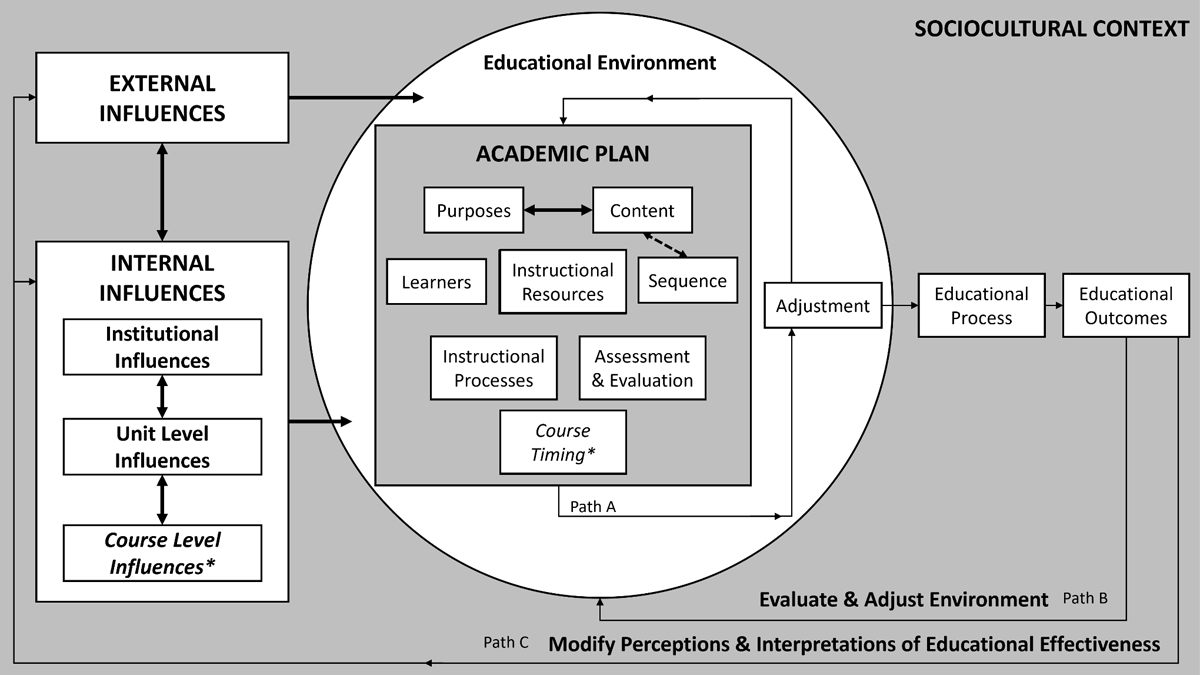
Figure 1
Academic plans in a sociocultural context, adapted to incorporate elements from this study (Lattuca & Stark, 2009).
Finally, to improve the consistency and credibility of our coding, the first two authors coded the data set separately before comparing code applications for the first and second rounds of coding (Elliott, 2018). They then met over a series of weeks to reconcile their coding, discussing discrepancies and further refining their coding scheme until they found agreement for every coded passage in the dataset. This process often included re-reading definitions and explanations of elements and influences from the Academic Plan (Lattuca & Stark, 2009) and taking notes on exemplar coding excerpts to refine their mutual understanding of the codebook.
Research Quality Considerations and Author Positionality
This research was conducted by a team with deep connections to the course sequence studied, albeit in different capacities. The first author was a graduate student at the time of data collection and analysis, leading the development of the survey and research questions posed, the second author was the graduate student teaching assistant in the third year of the course offering, and the last author was the instructor of the I2-module sequence, leading the conceptualization of the course sequence and the implementation each year. While these connections allowed us to deeply understand the context of the study, it also required us to examine how those connections could shape how we interpret the results. Throughout the study, we were intentional in exploring how each study member could contribute to the work to ensure a high-quality research output. Table 4 demonstrates considerations of our study design and implementation in line with the Qualitative Research Quality Framework by Walther et al. (2017).
Table 4
Qualitative Research Quality (Walther et al., 2017) considerations in our work.
| Theoretical Validation |
|
| Procedural Validation |
|
| Communicative Validation |
|
| Pragmatic Validation |
|
| Ethical Validation |
|
| Process Reliability |
|
The study team brought a diverse set of theoretical and disciplinary backgrounds to the project as well, shaping the use of Situated Learning Theory (Lave & Wenger, 1991; Wenger, 2000) to develop the course and data collection and subsequent leveraging of The Academic Plan (Lattuca & Stark, 2009) for more detailed analysis after data had been collected. The first and third authors had leveraged Situated Learning Theory in previous work and were part of the project conceptualization, whereas, the second author, who also had a used Situated Learning Theory previously, also brought a wealth of knowledge of curriculum design and evaluation, bringing The Academic Plan to the project as a potential analytical lens for the work.
Limitations
While our study provides a rich dataset from which to explore how the course sequence influenced participants’ teaching practice, it is not without limitations. Beginning with data collection, to mitigate the potential of survey participants responding in ways they expected the instructor to desire, we elected an anonymous response format, limiting the participant background data to only which module they taught to eliminate the possibility of the data becoming identifiable through combined demographic characteristics. This prevented us from being able to explore patterns in how the sequence impacted participants from different gender, race/ethnicity, career stage, or other demographic groups. This feature of the study design also does not allow us to follow up with participants, which could be interesting to investigate the long-term impact of the sequence on teaching practice. Since faculty did not participate in the sequence as teaching apprentices, we also did not collect survey data from them. It would be interesting in future work to explore how faculty I2 participants have leveraged what they learned in their own teaching practice. Finally, the use of The Academic Plan (Lattuca & Stark, 2009) as an analytical framework after data collection was completed allowed us to explore more detailed relationships between the changes teaching apprentices made in their practice and their reasons for doing so; however, more detailed data could have been collected if it were used as a framework to inform course sequence design and data collection. We provide suggestions for doing so in the discussion section.
Results
In this section, we first discuss emergent themes regarding the types of changes, proposed changes, and reasons for change that participants described, which provide insights into how participants were adapting their courses as they taught. We then present themes around the most salient combinations of changes by reasons for change in order to show what motivated participants to make modifications. Themes regarding what participants changed and why provide insights into how this group of participants demonstrated shared values and priorities that informed a shared set of instructional practices.
Table 5 shows the most salient changes, proposed changes, and reasons for change that participants shared. The first column identifies the type of element (i.e., change, proposed change, or reason for change), while the second column identifies the element of the academic plan participants discussed. The third column summarizes the specific ways each element appeared in the context of the I2 module.
Table 5
Patterns of discussion across the most frequent codes in our data.
| Change | Content | Changes to content included:
|
| Instructional Processes | Changes to instructional processes included:
| |
| Proposed Change | Assessment and Evaluation | Proposed changes to assessment and evaluation were:
|
| Content | Proposed changes to content included:
| |
| Instructional Processes | Proposed changes to instructional processes included:
| |
| Instructional Resources | Proposed changes to instructional resources included:
| |
| Sequence | Proposed changes to sequence included:
| |
| Reason | Assessment and Evaluation | Assessment and evaluation reasons for change resulted from:
|
| Reason | Course Level Influences | Participants described the following course level influences as reason(s):
|
| Learners | Participants described the following characteristics of learners in the modules as reason(s):
| |
| Purpose | Participants described the following purpose(s) of a module as a reason(s):
|
Co-Occurrences Between Changes and Reasons for Change
Our analysis of the most salient co-occurrences between changes and reasons for change shows patterns across modules that illustrate the ways in which participants adapted their academic plans during the semester. When we explored the co-occurrence data, we again observed student-centered and responsive themes that related participants’ changes to their reasons for change. The three most salient co-occurrences appear in Table 6. In this section, we explain how these co-occurrences appeared in the data, interpret them through the lens of our theoretical frameworks which informed the I2-module sequence design (Lave & Wenger, 1991; Wenger, 2000) and the analysis of the data (Lattuca & Stark, 2009), and explore themes across the co-occurrence pairs.
Table 6
Most salient co-occurrences between changes and reasons for change.
| CHANGE | REASON FOR CHANGE | EXCERPT EXAMPLE |
|---|---|---|
| Instructional Processes | Classroom Influences | “I found that limitations of time and format were such that I simply had to drop a lot of information in a lecture format.” |
| Instructional Processes | Learners | “We had to constantly stop the class for students to catch up, since everyone worked at different paces.” |
| Content | Classroom Influences | “When our first two class sessions ended early, we decided to add two additional topics to the course. While the other course content had been developed and edited over the previous weeks and months, these new lectures had to be organized within a few days.” |
Changing Instructional Processes due to Classroom Influences
The most salient co-occurrence between change and reason for change showed that participants were changing instructional processes due to classroom influences. That is, instructors changed the ways in which they delivered material in response to a number of different influences within the classroom.
The most salient type of classroom influence that triggered a change in instructional processes was time, such that instructors changed their instructional methods in order to fit their lessons into the given time constraints of the course. One participant explained,
One of my primary intentions for the students was for them to build neural engineering knowledge using mathematical and biological backgrounds. However, in simply trying to get to the starting point of the class, I found that limitations of time and format were such that I simply had to drop a lot of information in a lecture format. As such, I tried to solicit student dialogue and (mis)concepts throughout every lecture so as to pull the students into the material, or at least prompt them to remember (out loud and in class) information from previous class sessions.
In this example, the participant did not change the content of the course but rather modified the content delivery method when they “dropped a lot of information into lecture format” to meet time constraints. Another participant described a similar approach, stating, “we did not engage in most of the slow and time-consuming activities that I had designed and [instead] borrowed from other classes.” Like in the previous example, rather than modifying content, this participant changed the content delivery methods to fit within course time constraints. Interestingly, in these cases, using lecture format was in fact responsive to student needs. This suggests that, rather than a set of specific instructional methods (e.g., “jigsaw” activities, think-pair-share), student-centered teaching could instead be described as an approach to teaching, such that when student learning needs call for more traditional teaching methods (e.g., lecture), a responsive instructor may appropriately choose to change methods from more active to passive methods to ensure student engagement with the material needed for success in the course.
Another theme in this cross-section of data is that instructors viewed their classrooms as dynamic. They described having created detailed lesson plans in preparation for the course and each class specifically, but they recognized the need to be adaptable in their content delivery to teach most effectively. One participant said, “Even though the slides were static and couldn’t be modified during the lecture, the content delivery was very dynamic.” Similarly, another participant explained that their instructional team worked together to give “dynamic suggestions from co-instructors on things that might be clarified/addressed,” such that “each class felt much more like a dialogue with dynamic co-instructor feedback [incorporated] into the lectures.” One participant described having seen the I2 instructor model dynamic instructional practices, stating,
I learned how to be [adaptive] to the timing of the lecture from [instructor’s name] at the very first lecture. She used the remaining time to talk to the students and understand their backgrounds and needs. I was then able to (or be more comfortable) adapt my time for further discussions in the lecture.
In looking at how the design of the I2-module sequence as a community of practice may have shaped these findings, we see participants’ adjustment of instructional practices due to classroom influences is a common instructional practice that resulted from instructors’ participation in the I2-module sequence. The fact that this approach to instruction is repeated across modules and over time suggests that it is an instructional practice common to the teaching community the I2 aimed to foster. Moreover, one participant stated explicitly that they saw dynamic instruction modeled by the I2 instructor who stepped in to help while the participant was teaching a module class, which provides a direct example of this participant’s learning through a form of legitimate peripheral participation facilitated by a more senior member of the designed practice community. Together, these excerpts elucidate patterns of responsive teaching practices in reaction to classroom influences, as well as general support for dynamic teaching that enables educators to adjust instruction as needed.
Changing Instructional Processes for Learners
The second most salient co-occurrence between change and reason for change was participants’ changing instructional processes based on the specific learners in their classroom. The definition of learners in the Academic Plan (Lattuca & Stark, 2009) is more distinct than learners in the general sense; rather, learners refers to the specific individuals in a specific course and their individual characteristics. Thus, this section examines the ways in which instructors modified their instructional practices based on the prior experiences, prior knowledge, classroom learning, behaviors, and interests of the specific students in their classrooms.
Though participants planned their courses with an idea of the background experiences with which students would enter their courses, they described a need to adjust their teaching practices based on the actual experiences of the students who enrolled in their courses. One participant explained,
I was also expecting students to all be at a similar level [first- and second-year students], but we had a range of experiences with some students show a significant cell culture background. This was a learning exercise for us, as we had to provide enough content so that inexperienced students were able to learn the material but also leave room in the discussions and lab experiments so that experienced students could still get something out of the class.
This participant had already prepared the course with a general student body in mind, but needed to adjust their content and delivery methods—leaving the room in discussions and lab experiments for students with more experience—to further tailor their teaching to the specific students in their classroom.
Similarly, participants also adjusted their instruction based on the range of prior knowledge students brought to the classroom. One instructor explained,
Going into our second lab, I thought students would be more excited because we’d be covering CAD, the first of the technical skills, with each student getting a 3D printed [institutional name] briefcase. However…it took almost the entire lab session to make the CAD model of the briefcase and was so much harder than we thought it would be for students; we didn’t have time for having them make a practice model from a 2D sketch as we had hoped. I felt a little discouraged that we had so poorly underestimated their ability to follow along for the CAD part and that the lab had turned almost entirely into a lecture.
In this excerpt, the participant explained how they changed their instruction based on students’ knowledge and therefore abilities to complete the lab, transforming a lab activity into lecture so that the students learned the necessary content. This participant added, “We had to constantly stop the class for students to catch up, since everyone worked at different paces.” This shows how the instructors not only modified their instructional practices based on the overall needs of the learners in their classroom, but also adapted to meet the needs of individual learners according to the pace at which each learner worked. Another instructor stated similarly,
I also found that I fumbled around with the explanation of spheroids and non-adherent cell culture when giving my lecture. While these are concepts that I understand very well, I found that I needed to explain them in more than one way to get everyone in the class to understand. Just because you know a concept well does not mean you can teach it to everyone; you must be prepared as an instructor to explain the same thing two or three different ways. If I was to teach this course again knowing what I know now, I think this would be my greatest area of improvement.
Like the excerpt before it, this excerpt shows instructors’ awareness that individual students learn differently and need instructors to be flexible enough in their delivery to help all learners grasp the material. As this participant demonstrates, the ability to be flexible in their instructional delivery is not just a method they used in this course but a method they would use teaching future classes—pointing toward the impact of the I2-module sequence on their teaching practice more broadly.
Similarly, some instructors also solicited student feedback in real time so that they could adjust their instruction based on learners’ knowledge. One explained, “I tried to solicit student dialogue and (mis)concepts throughout every lecture,” which helped them engage students while also gaining a working understanding of what they did and did not understand. Another echoed this approach, stating, “Learning students’ need[s] helped us to shape ou[r] conversation with them during the lectures.” These two examples show that instructors were adjusting their instructional practices in real time based on learners’ needs and understanding of the material.
In addition to changing instructional practices based on learners’ knowledge and understanding, they also adapted instructional practices based on the specific interests of the learners in their courses to further engage their students. One instructor described how even though their lecture slide content could not be modified, their delivery varied depending on student interest, stating, “Based on the time constraints and interest of the students, I could determine what concepts to emphasize, and even provide more detailed information while skimming through some of the other concepts.” Another instructor stated similarly, “I was surprised that even these demonstrably motivated students (self-selected, given their enrollment in this experimental course) showed periods of disengagement. But it was very valuable for me to learn to change my delivery tactics to try to bring these students back into the fold.” Both instructors demonstrate responsive teaching practices informed by learners’ interests to help them engage with the material.
These data illustrate a variety of ways in which instructors are responsive to learners’ prior experiences, current knowledge or understanding, interests, and engagement in class. Because these excerpts include examples from multiple courses over multiple years of the module courses, they also offer evidence that learner-responsive teaching is a component of the teaching practice that was developed among I2-module sequence participants.
Changing Content due to Classroom Influences
The third-most salient co-occurrence was instructors’ changing content due to classroom influences. Looking within these co-occurrences shows that instructors changed their content due to time constraints (e.g., getting through content in lecture by going over time) or labs that did not go according to plan. An important finding that emerges from this analysis is how several instructors explicitly noted having learned and developed as instructors as they navigated and found solutions to challenges posed by classroom influences, thus developing instructional practices as a result.
Similar to the relationships we saw in the data presented in the Changing Instructional Processes due to Classroom Influences section, instructors in this data subsection also explained that they engaged in extensive course planning prior to the start of their module courses; however, the pace of their material did not go according to plan—mostly due to the timing or tempo of the course. One participant explained, “All in all, my expectations were too high,” which meant, “some teaching lessons needed to be lengthened, some needed to be cut and improvised, and some ended earlier than anticipated, and so we needed to fill that time gap.” Another participant similarly stated that their teaching team’s “CAD walkthrough went over the allotted time, which, in turn, forced some of the remaining lessons from that day (i.e., creating a CAD model from a 2D sketch) to be omitted from the curriculum entirely.” These changes in timing resulted in direct changes to content as instructors adjusted the course accordingly.
In their reflections on these unexpected content changes, instructors note two major ways in which these experiences shaped their teaching practice. First, it helped them develop skills in adapting, as one participant stated, “I realized that most days will not go exactly as planned, and that we have to be willing to make the changes necessary for it to be a successful course for the students,” concluding, “I was able to gain the ability to change things on the fly.”
Second, participants noted how the experience drove home for them the importance of preparation in their teaching practice. One instructor explained, “I also expected to be challenged and asked to be flexible when things needed to be changed, although I did not expect the degree to which adjustments would need to be made,” continuing, “Perhaps the most important lesson I learned from teaching the short-course regarded prep time.” Another echoed, “I extremely appreciated having thought in advance how to run each session, including timing, through creation of facilitation guides.” Similarly, another participant said, “without this extensive prep work, I think our class would’ve gone less to plan.”
In at least one course, instructors changed course content in response to unexpected lab results. One instructor explained, “We also had to change a few of our lab experiments with little time to prepare based on failures [and] unexpected results in our planning sessions.” This instructor therefore changed the nature of the post-lab discussion, explaining,
Everything that was unexpected on our end turned into a great discussion with the students, especially our discussion on the last lab when our calcium deposition assay did not give us the results we predicted and we were able to walk students through an interpretation of those results and what the next steps could be.
This instructor not only adapted as needed, but they also turned this challenge into an educational moment through discussion, thus also demonstrating the ability to find learning opportunities as they respond to classroom influences. Taken together, these passages illustrate how changes in curricular content due to classroom influences shaped practice by teaching participants how to better adapt in the classroom as needed and by helping them appreciate the value of preparation work before a course begins.
Given that participants were novice engineering instructors, and that the modules were designed from scratch in many cases, the evidence of change seen in the data is expected. The promising aspects of the most common co-occurring changes and reasons for change were their indication of participants’ responsiveness to student needs—a practice that the I2-module sequence sought to foster. Looking at the change, proposed change, and reasons for change separately but across module contexts, we saw further evidence of the impact of the I2-module sequence’s design on participants’ practice.
Shared Teaching Practices Present Across Modules
We also noticed patterns in the change and proposed change code applications that indicate these shared teaching values (i.e., student-centered strategies and student responsiveness) were present across modules and topics (i.e., tissue engineering, medical device development, drug development, regulations, neural engineering, and medical imaging). Based on data collection methods, we were not able to identify what year a participant taught a module, so both tissue engineering and medical device data contain perspectives from teaching apprentices across all three iterations. The modules with multiple years of iteration had the most variation in the codes applied, which demonstrated to us that participants considered a wide range of changes and reasons for changes. What was more interesting though, was the patterns of the commonly applied codes across module topics. Regardless of the year in which they taught their module or the module topic, we saw several instances of the same two to three change and reason for change codes in the data, which we interpret to indicate some level of shared practice developed through I2-module sequence participation. As an example, both changes and proposed changes to the instructional process were consistently coded in data from participants in all of the module topics, indicating that participants were considering how to change their instructional process during their I2-module sequence participation. Similarly, the reason for change codes classroom influences, learners, and purpose consistently appeared in participant responses regardless of their module topics, and frequently by a great deal more than any of the other codes. Classroom influences and learners codes as reasons for change suggest an emphasis on responsiveness, and we interpret as further evidence of responsiveness as a shared practice of the I2-module participants (refer to Table 6 for some examples).
We also explored how practices might be shared in similar module topics through an exploration of common code applications. We noticed that modules with a lab component (wet lab or CAD lab tutorials) also had some unique similarities in the types of changes made in the course. Participants leading these modules frequently discussed changes they made to instructional resources, which appeared to relate to the resources developed to facilitate labs (e.g., experiment protocols, tutorial resources). Despite very different lab contexts, participants leading these modules appear to have developed a shared appreciation for the complexity of designing laboratory materials.
By exploring how consistently codes did or did not appear in our participants’ discussions across module topics, we were able to further examine the extent to which shared practices were developing through the I2-module sequence. We interpret the evidence of the same two to three changes and reasons for change that participants consistently discussed across module context and module implementation years as an indicators that the I2-module shaped participants’ practice as responsive and student-centered.
Discussion
Situated Learning as a Means for Enacting Instructional Change
Based on the findings in this study, we see great potential for change if others adapt a similar model for instructional training for future and junior engineering faculty. Beyond serving as a way to create student-centered, responsive curriculum for undergraduate engineering populations, this analysis demonstrated how the I2-module sequence could meaningfully train a group of engineering future faculty in a way that shapes their teaching practices and priorities in specific and intentional ways (i.e., towards responsive and student-centered practices). In particular, our data show that the I2 course played a significant role in establishing the preliminary teaching practices of the participants, and that the participants’ opportunities to engage in a model of legitimate peripheral participation as teaching apprentices in their modules helped solidify these practices. Furthermore, we believe the forms of legitimate peripheral participation that the I2-module sequence offered as part of the design helped shape the teaching apprentices’ teaching practices in line with the practices of the faculty member who designed the sequence. Alongside other work that suggests that changes in beliefs are crucial for supporting instructional change (Borrego et al., 2013; Kember, 1997; Moore et al., 2015), this study suggests a strategy for deeply affecting the beliefs of current and future instructors through a course sequence that acknowledges that learning, including learning about instructional practice, is situated and social.
The Academic Plan: Updates and Usefulness in Our Context
In our use of the Academic Plan (Lattuca & Stark, 2009) as a guide for our coding scheme, we surfaced two additional elements we propose adding to the Academic Plan—i.e., timing and course level influences. These elements emerged as useful concepts in understanding what instructors change in their course and why, which we felt the existing elements of the model did not fully encompass. We offer these additional elements as potential supplemental components of the Academic Plan model, which may prove useful to scholars and practitioners.
In particular, we found that course timing could serve as a reason for change by influencing on how content was taught or what content was included in a course based on class period length and when a class was offered. Participants also articulated timing as a change or proposed change when they felt adjustments were needed to the time spent on a given topic or activity in order to better serve students’ learning.
We also found that by adding the course-level influences element to our coding scheme, we were able to better relate our data to practices that the I2-module instructor sought to foster in participants. By including course-level influences, we were better able to capture reasons for change that participants gave that might have related more closely with their priorities around creating a teaching environment that was responsive to each unique classroom cohort. Lattuca and Stark describe the elements within the Academic Plan as applicable across multiple levels of planning (e.g., for a single lesson, a single course, or an aggregate of related courses), however they focus their discussion of internal influences at the level of a unit (e.g., department), while our data suggested the importance of capturing influences at a course level. Potentially unique to the I2-module sequence context, we saw participants describe iteration throughout the 4-week modules based on inputs from surveys that collected information about the students that would enroll in the module, student mid-module feedback, and/or student performance and engagement. This finding further demonstrated to us the priorities of course-level responsiveness the I2-module sequence instructor likely instilled in the I2-module sequence participants.
Finally, we see the Academic Plan (Lattuca & Stark, 2009) as potentially informative for future offerings of the I2-module sequence. Though the I2-module sequence instructor did not use the Academic Plan model as a resource for teaching apprentices to consider when developing their modules, I2-module participants frequently discussed design elements during their planning and execution of their courses that could align with elements in the Academic Plan model. This suggests the potential usefulness of incorporating the Academic Plan model as a resource for developing a reflective and responsive teaching practice for participants in future implementations of the I2-module sequence or a similar course.
Conclusion
Based on this study, we believe that the I2-module sequence model provides a promising avenue for supporting the kind of cultural shift scholars (e.g., Anderson et al., 2011; Burd et al., 2015; Herman et al., 2018) argue is needed to enact changes in instructional approaches. A key piece of the I2-module sequence that we think helped support the development of these student-centered and responsive practices was the attention to situated learning in designing the pedagogical approaches of the I2-module sequence itself. In particular, the I2-module sequence instructor leveraged community of practice concepts to reinforce the importance of iteration in curriculum design and prioritize a responsive teaching practice in both the I2 and module semesters of the sequence. These practices were then evident during module implementations and after as part of participants reflection on their experiences. Furthermore, the instructor focused on selecting literature and community of practice-informed classroom exercises that emphasized the positive impacts of student-centered and active learning pedagogical approaches which likely link to the strong presence of these approaches as a priority for the participants.
In thinking about how this model might transfer to other contexts, I2 curriculum designers could reflect on what their priorities are as an instructor and how that might show up and influence the teaching practices of their participants. For instance, if an I2 designer wanted to focus attention on creating more inclusive pedagogies in engineering classrooms, another critical area for improvement in the field (Farrell et al., 2021), they might focus on incorporating literature and classroom exercises that would facilitate legitimate peripheral participation experiences with those practices.
In future work related to the I2-module sequence studied here, we would like to explore how the practices of participants might look different based on those incorporated by the I2 course designer. While it was not possible to follow up with any of the participants in this study because of their anonymous participation, we would have also liked to explore how the teaching practices that participants established during their I2 participation have or have not carried their current teaching practices if they have entered an instructional role after graduation. A study like this could provide further insights into the usefulness of this model for creating and sustaining instructional change in STEM education.
Data Accessibility Statement
Raw data from this study are not published on a publicly available site. Data may be made available upon request by contacting the corresponding author.
Ethics and Consent
Research in this study was approved by the University of Michigan Institutional Review Board in exempt protocol HUM00120328.
Competing Interests
The authors have no competing interests to declare.
Author Contributions
The third author developed and ran the course sequence studied in this manuscript. The first and third authors developed and distributed the survey through which data were collected. The first and second authors lead the analysis and writing of this manuscript with interpretive and editing support from the third author.