
1. Introduction
Engineers, educators, and policymakers throughout the United States have been trying to diversify engineering for decades (Holloman et al., 2018; Gale et al., n.d.). Throughout this time, a variety of reasons have been offered for the need to shift the compositional makeup of people associated with engineering education and practice, including business cases, concerns about underrepresentation, and social justice. As part of the business case, people justify a focus on diversity and diversity management with a fact-based business argument intended to convince upper management that there are tangible and profitable business reasons for such a pursuit (Robinson & Dechant, 1997). Innovative solutions, for example, are often presented as potential benefits for engineering firms that are able to hire and effectively manage diverse teams (Smith-Doerr et al., 2017). On the other hand, the underrepresentation argument is based on people using the demographic makeup of engineering to illustrate a lack of parity when compared to national demographics. Leveraging the untapped workforce, for example, is often presented as a solution for the impending workforce shortage and the need to maintain global competitiveness (e.g., Dasgupta & Stout, 2014). Lastly, social justice reasoning establishes a focus on diversity as a moral imperative with the intention of shifting focus from the potential benefits for the engineering field to potential benefits for the people themselves, including their families and communities. Ignoring barriers to engineering education, for instance, can be framed as an injustice due to people being denied access to the lucrative salaries, prestige, and stability often associated with engineering careers in a high-tech society (e.g., Bettencourt et al., 2020). While the specific motives may vary, the aspiration to diversify engineering is widespread.
In response to this shared aspiration, engineering and other STEM fields (science, technology, engineering, and mathematics) have constructed Broadening Participation as a sociopolitical phenomenon involving both engineers and engineering educators focusing their individual and collective efforts, in the form of both research and practice, toward pursuing these goals. By sociopolitical, we mean that Broadening Participation is not an objective reality, but rather the result of social, political, and historical influences (e.g., Leggon, 2018). (To denote this widely endorsed naming, we capitalize the term Broadening Participation throughout the paper). Broadening Participation manifests itself through significant investments of both time and resources (e.g., human capital, financial awards, research funding, indirect investments), resulting in the advancement of knowledge, the creation of policies, and notable pockets of progress across the country. Despite these investments, insufficient progress has been made regarding both quantitative and qualitative indicators of success. For example, people of color continually account for a fractional portion of the bachelor’s degrees awarded in engineering (American Society of Engineering Education, 2020); and the ongoing negative experiences of students from these groups and other underrepresented populations (e.g., Cech & Waidzunas, 2011; Foor et al., 2007; Smith & Lucena, 2016; Zongrone et al., 2021) remains far too common. As such, calls to diversify engineering persist, expanding the sociopolitical phenomenon of Broadening Participation to also include issues of justice, equity, and inclusion.
Despite Broadening Participation being so familiar as a concept, current perceptions of it seldom extend beyond the language and prominent metaphors used to describe the phenomenon. According to Lee (2019), engineers use the imagery of pipelines, pathways, and ecosystems to “conceptualize what we mean by participation in the context of broadening participation” (p. 2). Collectively, these metaphors represent issues associated with retention, persistence, and negative experiences. They capture what it means to “participate” in engineering but, as with all metaphors, they strip out the messiness and oversimplify the phenomenon. We posit that the engineering field’s over-reliance on metaphorical language that focuses on modes of participation has generated dominant narratives that reflect an inaccurate, incomplete, and insufficient understanding of Broadening Participation.
There are two reasons this over-reliance is worth addressing. First, language is a proxy for understanding (Lakoff & Johnson, 1980); as the engineering community’s language improves so can our understanding. Second, engineers (broadly construed to include those who align professionally with the engineering disciplines) are primarily responsible for Broadening Participation in engineering due to disciplinary and organizational boundaries that influence who has enough power to make changes: diversifying engineering cannot be outsourced. Combined, these challenges point to a need to advance understanding and better communicate the complex realities of Broadening Participation.
1.1. Purpose
The purpose of this paper is to advance the science of Broadening Participation by explaining the relationship between research and practice in this context. By addressing this purpose, we extend the field’s use of metaphorical language.
1.2. Scope
Before proceeding, we will disclose components of our positionality (Hampton et al., 2021; Merriam et al., 2001; Milner, 2007; Secules et al., 2021) that influenced the scope of this paper—which is primarily written from the perspective of Black engineers.
First and foremost, Broadening Participation is of personal and professional interest to each author of this paper. As part of a larger project in which this paper was situated, our goal was to understand efforts to diversify engineering as it relates to Black Americans across the entire education-to-workforce pathway. Our interest in this problem was primarily motivated by the lack of Black American representation among degrees awarded, despite decades of investments made in this area. For example, we have seen a decline in the percentage of Black Americans earning undergraduate engineering degrees, accounting for 5.6% in 2000 and only 4.4% in 2019 (American Society of Engineering Education, 2020; Gibbons, 2010). At the same time, we have seen an upward trend in the number of publications focused on this problem (London et al., 2020). For us, these proportions continuing in spite of growing research highlighted how imperative it is to make a concerted effort, sooner rather than later, to reevaluate our approaches to Broadening Participation as it relates to Black Americans.
Herein, we use Ecological Systems Theory (Bronfenbrenner, 1977) to organize insights from literature, interviews with subject matter experts (SMEs), and the collective sensemaking of our author team. Existing literature was incorporated through a series of review papers (Boyd-Sinkler et al., 2022; Holloman et al., 2018; Holloman et al., 2021a; Holloman et al., 2021b; London et al., 2020; London et al., 2021; Pee et al., 2019) and the interviews focused on the beliefs, insights, experiences, and recommendations of 40 SMEs involved in Broadening Participation efforts. To visually illustrate these insights, we propose a conceptual model of knowledge production and problem-solving (as opposed to research and practice) that encourages systems thinking and enables a more holistic understanding of Broadening Participation.
We posit that focusing on research-to-practice is advantageous due to the centrality of both activities in Broadening Participation as it is currently constructed. We also posit that focusing on Black Americans also provides an opportunity to advance the field’s understanding of the impediments to diversifying engineering in general. According to the National Science Foundation (NSF), “BPE [Broadening Participation in Engineering] focuses on enhancing the diversity and inclusion of all underrepresented populations in engineering, including gender identity and expression, race and ethnicity (African Americans/Blacks, Hispanic Americans, American Indians, Alaska Natives, Native Hawaiians, and Native Pacific Islanders), disability, LGBTQ +, first generation college and socio-economic status.” (National Science Foundation, 2019, Synopsis section, para. 1). Based on this description, many other underrepresented groups have the potential to benefit from our insights.
1.3. A Note on Sampling
Purposive selection (Krathwohl, 2009) and snowball sampling (Merriam & Tisdell, 2016) were used to identify SMEs. We first leveraged our professional networks, considered authors of existing literature, and sought recommendations from members of the project’s advisory board. We subsequently used snowball sampling and information sampling, asking each participant to recommend 2–3 people that we should interview for this study and/or share the email invitation with other SMEs. We allowed everyone who responded to the invitation to participate in the study and the interview itself was used as a filtering mechanism to ensure that information pertinent to the study was captured. This process yielded 40 participants, most identifying as Black or African American and working in various roles, such as deans, program evaluators, minority engineering program directors, professors, researchers, minority organizational leaders, practicing engineers, directors of informal education programs, K–12 teachers, and mentors to underrepresented students.
1.4. A Note on Language
While the dominant rhetoric of engineering education includes the phrase “research-to-practice,” bridging the relationship between the two entities is an ongoing effort in many other fields, and scholars use a wide array of language to describe work in this area. For example, the terms knowledge to action, innovation translation, implementation, evidence-based, diffusion, and dissemination have all been used in literature focused on guiding change (Graham et al., 2007). Herein, we will use the term research-to-practice to encompass this larger body of literature.
Several approaches to research-to-practice have developed over time, including linear models, relationship models, and systems models (Best & Holmes, 2010). In engineering education, the relationship between research and practice is often depicted as a double-arced circle, with one arc flowing to and from each entity. Given that linear and relationship models have been ineffective at diversifying engineering, we are proposing a systems-thinking approach to research-and-practice. Systems thinking entails investigating factors and the interactions between those factors. A systems-thinking approach views the world as a series of interconnected systems, where change is possible when stakeholders gain a critical amount of knowledge to understand the system (Arnold & Wade, 2015; Meadows, 2008; Morganelli, 2020). Systems thinking has proven effective across a variety of fields including business, nursing, ecology, and education. We believe that it can be similarly effective in Broadening Participation.
2. Theoretical Foundation: Systems Thinking
Our selection of a theoretical foundation was guided by the premise that diversifying engineering and thus Broadening Participation should be viewed as a wicked problem. Wicked problems can be thought of as complex social issues that are open-ended, ill-defined, unpredictable, and reliant on political judgments (Alford & Head, 2017; Grohs et al., 2018; Rittel & Weber, 1973). According to Alford & Head (2017), what distinguishes very wicked problems from other complex problems is that (1) neither the problem nor solution is clear, and (2) solving the problem requires multiple parties with conflicting values and interests. Both of these conditions apply to Broadening Participation for three primary reasons.
Firstly, Broadening Participation has historically focused on challenges that are situated within societal problems (e.g., advancing diversity, equity, access, accessibility, and inclusion), making it both an expensive and massive undertaking that is difficult for most people to comprehend. Secondly, Broadening Participation has expanded to focus on a wide range of groups (e.g., race/ethnicity, gender, low-income/first-generation, and sexual orientation), making it concerned with a myriad of objectives that lead to a myriad of proposed solutions. Lastly, Broadening Participation encompasses interdependent systems that span the entire education-to-workforce pathway (Holloman et al., 2018), making it involve a significant number of stakeholders with conflicting priorities and interests. These reasons support our assertion that Broadening Participation is a sociopolitical phenomenon that requires systems thinking.
2.1. Adopting a Systems Mindset
Given the complexity of issues with which we must grapple to diversify engineering, it is imperative that the engineering community develop a systems mindset when it comes to Broadening Participation. Developing a systems mindset entails considering the wider context and underlying, interconnected structures (Bensberg, 2021). We explicitly make this point to an engineering audience because, though holism is emphasized in some engineering sub-fields (e.g., systems engineering, environmental engineering), this perspective is not adopted by all engineers, a characterization often referred to as technical-social dualism (e.g., Faulkner, 2000). The common disconnect between the technical and the social is partially a result of engineering problem-solving exercises, replete throughout formal undergraduate engineering education, that strip away the complexities (i.e., socio-political context) of problems to make them more solvable. This approach to teaching problem solving is one way that technical-social dualism is perpetuated in the training and socialization of engineers and does not work in our favor when approaching a complex challenge such as Broadening Participation.
In adopting a systems mindset, it is important to not oversimplify the actual problem(s) being addressed. Instead, we must use the holistic approach, which often comes with systems thinking, to address components of the larger system. Informed by the work of Behl and Ferreira (2014), this approach will require: a) understanding engineering and engineering education systems and their surrounding context, b) understanding the relationships and interdependencies between various elements of these systems, and c) leveraging multiple disciplinary and personal perspectives. Adopting systems thinking will help the engineering community develop a more complete, accurate, and nuanced understanding of Broadening Participation.
2.2. A Systems Approach to Researc-Hto-Practice
In light of Broadening Participation being concerned with such a wicked problem, it is imperative to adopt a systems model of research-to-practice, as opposed to a linear or relationship model. Linear models describe one-way processes where knowledge, seen as the product, is produced by researchers and then translated to end users. This process happens in discrete stages, and it is effective when there is a strong structure in place to support the process and relatively low risk and complexity. Broadening Participation does not exist in this type of environment, given its complexity and lack of universal support across institutions; consequently, it is of no surprise that a linear approach lacks efficacy in producing a concrete change in this context or other domains (Gale et al., n.d.; Steering Committee of the National Engineering Education Research Colloquies, 2006).
Relationship models emphasize sharing knowledge, presuming a close relationship between the knowledge producers and knowledge users, as well as a strong network with stakeholders (Best et al., 2010). A relationship model is likely to be effective for research-to-practice when stakeholders understand the relevance of local context and knowledge, there is organizational support for evidence-informed planning, and stakeholders recognize that the problem requires systems change (Best et al., 2010). This approach is reflected in the dominant approach that took hold in engineering education over a decade ago: the Innovation Cycle of Educational Practice and Research, put forth by Jamieson and Lohman (Jamieson & Lohmann, 2009). In introducing this model to the field of engineering education, Jamieson and Lohmann established the dominant way of thinking in engineering education about how research and practice work (2009).
Jamieson and Lohman adapted a research-to-practice model (e.g., Booth et al., 2008) that was designed for basic research. The model hypothesizes a smooth cyclical relationship between research and practice, where the two mutually inform one another. Jamieson and Lohmann (2009) articulated the interrelationships between what needs to be changed in engineering education, how to drive change in this context, and who should drive change. Furthermore, they proposed a model of systematic engineering education innovation that is based on a continual cycle of research and practice, which, if adopted, would “both continually advance the body of knowledge on engineering learning and result in the implementation of more effective and replicable educational innovations, with the end result being better-educated students” (Jamieson & Lohmann, 2009, p. 1). Though an improvement from a linear approach, this relationship model has similarly lacked efficacy in producing concrete change. In fact, prior work in Broadening Participation adopting a linear and/or relationship approach has produced little change in the field (American Society of Engineering Education, 2020; Gale et al., n.d.). Accordingly, we proposed the adoption of a systems approach.
Systems models recognize that systems are constantly changing and that the parts that make up the system are complex and interdependent, often intersecting with other systems (Best et al., 2010). In a systems approach, key stakeholders shape the system and are shaped by it. These models consider phenomena at multiple levels of interest simultaneously and postulate how phenomena at each level interact. A systems model is effective when it is possible for all stakeholders to be actively involved in shaping the problem-solving process, time and resources are available to contribute to developing the model, and research-to-practice can be integrated with the organizational change strategy (Best et al., 2010). Though additional work is needed to integrate Broadening Participation research-to-practice into organizational strategy, herein we argue that a systems approach—for example, the Iceberg Model (Goodman, 2002) and social ecological model (McLeroy et al., 1988)—is more appropriate for Broadening Participation than both the linear and relationship approaches.
2.3. Ecological Systems Theory
We situate the rest of this paper in the Ecological Systems Theory (Bronfenbrenner, 1977; Bronfenbrenner, 1979) because it best explained our key findings/insights. The Ecological Systems Theory (Figure 1) is a more general version of the social ecological model, where the simultaneous levels of chronosystem, macrosystem, exosystem, mesosystem, and microsystem exist (Bronfenbrenner, 1977; Bronfenbrenner, 1979). It is a human development theory developed by Urie Bronfenbrenner to emphasize the central role environmental factors play in development. While the theory was introduced in the context of child development, where each level of the system contains roles and norms that shape psychological development (Bronfenbrenner, 1977), it has since been used in a variety of fields and for a variety of purposes. Of particular relevance, the theory has been previously used in equity work (e.g., Hurtado et al., 2012; Liu, 2015; Noursi et al., 2021) and in a variety of studies on education (e.g., Hurtado et al., 2012; Kamenopoulou, 2016; Morton & Parsons, 2018; Savitz-Romer & Nicola, 2021; Sochaka et al., 2020). Most notably, Hurtado et al. (2012) demonstrate the utility of this theory at the intersection of both equity work and education, proposing a multi-contextual model for diverse learning environments.
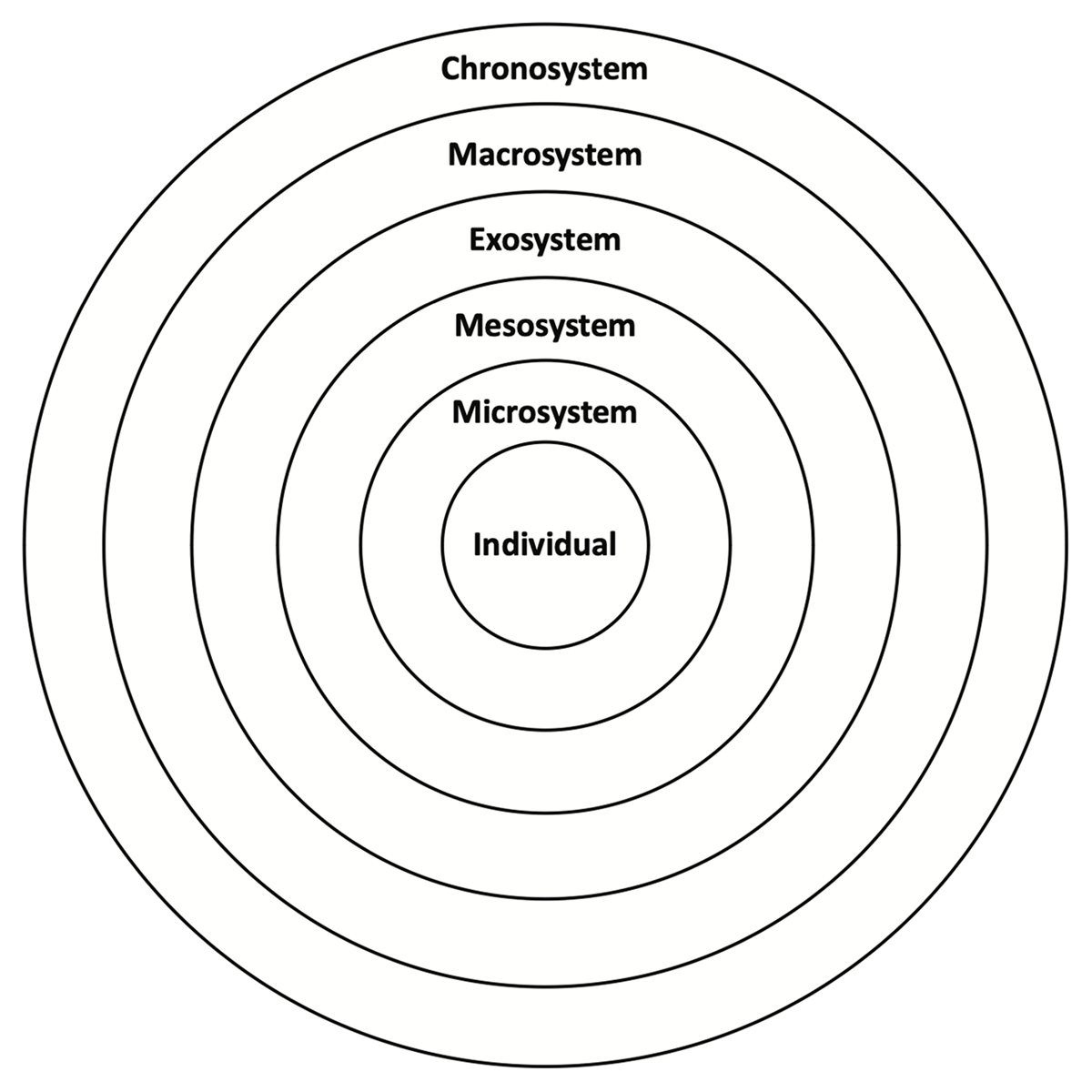
Figure 1
A Simplified Version of Bronfenbrenner’s (1977; 1979) Ecological Systems Theory.
Because the theory was developed to focus on human development, the individual is at the center of the model, with an individual’s characteristics all existing within the context of the five layers of the model. The chronosystem encompasses the changes occurring over the individual’s lifetime, including individual-specific events, historical events, and sociocultural events. The macrosystem is cultural elements that influence the individual, in addition to the micro and mesosystems within those cultures. These cultural elements are not specific to the individual, but rather are specific to the context that the individual exists in (e.g., geographic place). The exosystem contains social systems that do not directly involve the individual but exert influence on the individual through their influence on the microsystems. Individuals perceive events through this cultural layer and thus are influenced by the culture they are embedded in. The mesosystem encompasses the interconnections and influences between the individual’s microsystems. Lastly, the microsystem, the most influential level on the individual’s development, contains the immediate groups and institutions that the individual interacts with (Bronfenbrenner, 1977). Interactions within this level are bidirectional, where the individual is influenced by entities in the microsystem and can influence the entities in the microsystem as well. Although Bronfenbrenner’s model includes five levels, only three were used to organize our findings (i.e., macrosystems, mesosystem, and microsystem.)
By forefronting the influence of contextual layers, Ecological Systems Theory supports a) conceptualizing phenomena at multiple levels of abstraction simultaneously, b) relating those phenomena with each other, and c) exploring a wide range of factors at each level of abstraction. We used this theory to contextualize Broadening Participation at multiple levels. As Hurtado et al. (2012) noted:
new conceptions are needed [emphasis added] that can emphasize the microsystem that include individuals and roles; mesosystems, or spheres of interaction; as well as the exosystem (e.g., external communities and associative networks) or concrete social structures that influence and constrain what goes on in mesosystems; and how macrosystems (larger policy and sociohistorical change contexts) exert an equally powerful influence over all (p. 48).
We answer this call and extend their work by applying this ecological lens in a related context. More specifically, we considered how research-to-practice efforts, and the people these efforts focus on—herein, Black Americans—exist within the layers emphasized in the model to explore a wide range of factors at each level that could explain why field-level patterns of participation are reproduced. In doing so, we offer the field an ecological perspective of Broadening Participation.
3. An Ecological Perspective of Broadening Participation
In establishing an ecological perspective of Broadening Participation, we focus on why Broadening Participation came about, which cultures and norms most actively shape it, and which efforts it entails. In the following section, we first discuss the macrosystem. We then provide an overview of germane mesosytems. Lastly, we highlight key components of the microsystem. Collectively, the levels paint a more complete picture, which we construct along the way, of Broadening Participation and its respective social, political, and historical influences.
As a reminder, these insights come from literature, interviews with subject matter experts, and the collective sensemaking of our author team. When the words of SME are used directly, we indicate so using italics and quotation marks. Otherwise, basic citation practices are used to denote our sources.
3.1. The Macrosystem
“If you don’t understand White Supremacy (Racism)—what it is, and how it works, everything else that you do understand will only confuse you.” – Neely Fuller, Jr.
We begin our discussion of the macrosystem with structural racism. Structural racism is of central importance for Broadening Participation in relation to Black Americans. Though multiple definitions exist, structural racism generally refers to the totality of ways in which society promotes the disenfranchisement of people based on their race via mutually reinforcing inequitable systems (e.g., housing, education, employment, media, health care, criminal justice) (Bailey et al., 2017; Lawrence et al. 2004). As a consequence of these systems, Black people are continually impacted through various mechanisms of discrimination, which Link and Phelan (2001) conceptualize as (1) individual discrimination, (2) structural discrimination, and (3) discrimination that results from the impacted person’s beliefs and behaviors.
Each of these mechanisms shapes the educational system as well as other organizations. For example, subject matter experts discussed educators having low expectations of Black American students (i.e., individual discrimination), the low availability of resources in the community (i.e., structural discrimination), and stereotype threat (i.e., discrimination resulting from a Black person’s beliefs) (Steele, 2011). Across SMEs, these mechanisms of discrimination were described as being interrelated, particularly structural and individual discrimination. For example, in the K–12 segment, inequitable school funding influences the quality of instruction that students receive (e.g., Adamson & Darling-Hammond, 2012; Knight et al., 2020), which influences the extent to which teachers and guidance counselors discourage Black students from pursuing engineering and/or higher education broadly. In the industry and higher education segments, SMEs similarly discussed a chilly climate that cannot be solely attributed to the behavior of individuals or the structure of an environment. Building on this premise, the macrosystem (Figure 2) can be conceptualized as three central elements that shape Broadening Participation: 1) U.S. history, 2) systems of oppression, and 3) national policies.
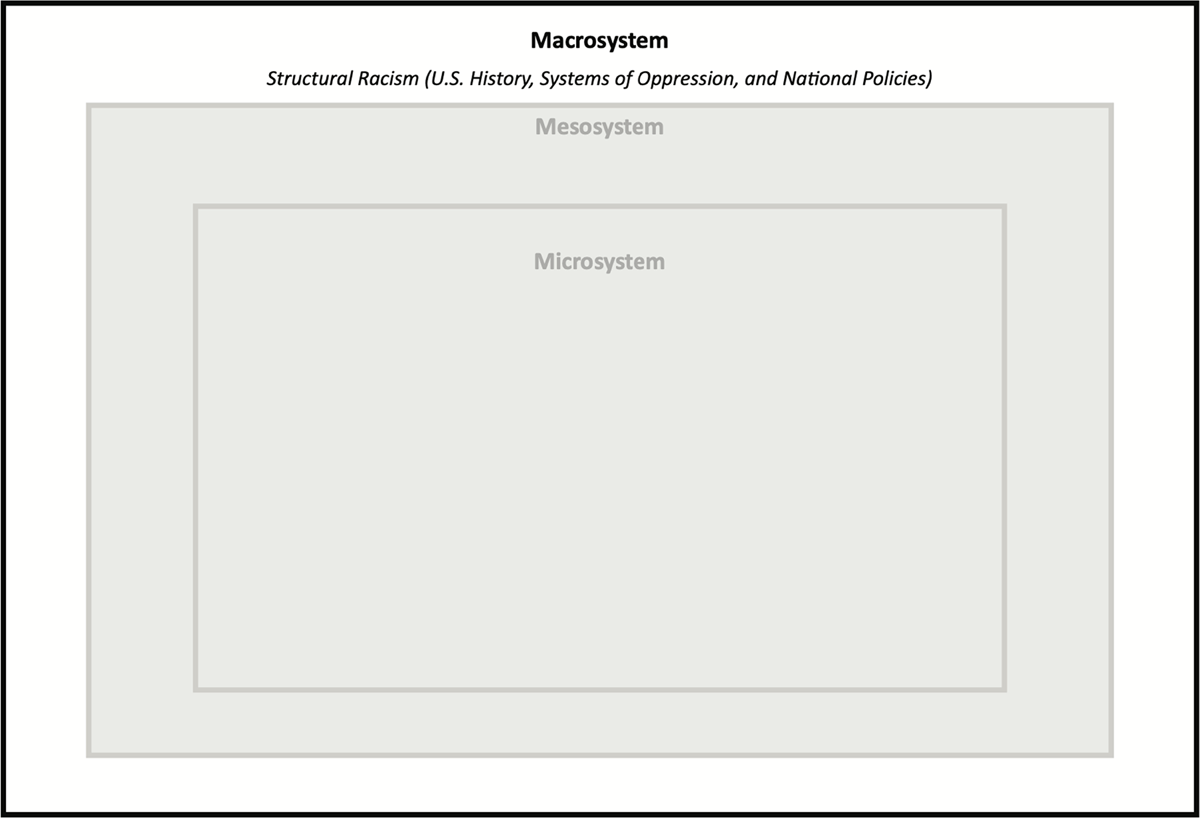
Figure 2
Macrosystem Elements (Part 1 of 3) That Shape Broadening Participation.
3.1.1. U.S. History
Broadening Participation is shaped by U.S. history. We posit that Broadening Participation is a sociopolitical phenomenon best understood in relation to both bottom-up and top-down efforts that began shortly after the Civil Rights Movements of the 1960s. Broadening Participation historically emerged from 1) university-led initiatives focused on supporting Black students, and 2) the availability of federal funding focused on improving engineering education. It is important to note that the desire to expand access to engineering occurred within a political context shaped by Black citizens’ frustration with the racism/racial inequality that permeated the United States, with both higher education and the U.S. workforce being no exception. It is also important to note that while Historically Black Colleges and Universities (HBCUs) were and remain responsible for educating an overwhelming majority of Black engineers (Weinberger, 2017), efforts to diversity engineering largely focused on the initiatives of white institutions in response to desegregation. As universities desegregated and Black students began matriculating into these hostile and inhospitable environments, the need for programs focused on the recruitment and retention of previously excluded students, particularly Black students, became evident, resulting in Minority Engineering Programs (MEPs) being created by engineering faculty at several institutions (Morrison & Williams, 1993). Though not explicitly labeled with the Broadening Participation moniker, MEPs housed at historically white institutions are widely thought of as the first organized efforts toward diversifying engineering. The field’s initial focus was on increasing Black students’ access to and representation in engineering via white institutions. Though one might disagree with whether or not this focus was most advantageous or appropriately aligned with the system, this historical context continues to shape the sociopolitical phenomenon.
3.1.2. Systems of Oppression
Broadening Participation is shaped by the interlocking nature of oppressive systems. This consideration is important because conversations about Broadening Participation are often based on how stakeholders view socially constructed human differences. The social constructs that provide a foundation for these differences are dynamic and political (e.g., Mora, 2021; Smedley & Smedley, 2018), resulting in people having different experiences in large part due to their demographic characteristics. In talking to SMEs, we found the most salient constructs to be race, class, and gender. These constructs, and others, were prioritized differently by SMEs depending on how they associated the challenges that arise with each. In other words, these constructs became salient depending upon which systems of oppression (e.g., racism, sexism, classism) were most relevant from an SME’s perspective. For example, SMEs commonly discussed how race and gender could influence a person’s decision to enter engineering and how one’s socioeconomic status could affect one’s access to resources.
Though sometimes discussed in isolation, SMEs oftentimes discussed how the effects of these constructs were interlocking, an idea that is becoming more regularly reflected in the engineering education literature, particularly as it relates to race and gender (e.g., Ong et al., 2011; Rodriguez et al., 2019; Ross et al., 2017). In short, the challenges that Black people experience as a result of how society views and responds to their race, class, and/or gender impact their relationship with engineering. Though variation existed in how SMEs viewed the role and importance of these categories, they generally discussed how if an intervention focused on only one of these categories (i.e., race, class, or gender) “you’d be missing factors that contribute to student persistence of STEM and engineering” and noted an understanding that each of the constructs “behave differently” in reality. SMEs generally recognized that even though race, class, and gender were prioritized in different situations, all three factors were important.
3.1.3. National Policies
Broadening Participation is shaped by the policy context in which it originated. Whereas national laws and the engineering community’s responses to these laws shaped the historical context of Broadening Participation, the work of the National Science Foundation (NSF) can largely be credited with institutionalizing these efforts (James & Singer, 2016). Though the NSF was created before the Civil Rights Movement, the directorates of today were not established until 1975 (NSF, n.d.). Organizations were focused on improving engineering education prior to this point, but it was not until after the creation of the Engineering Directorate that financial investments and incentives explicitly focused on improving engineering education existed at the federal level on this scale. Today, the Engineering Directorate houses the Broadening Participation in Engineering (BPE) program. Recent examples highlighting NSF’s emphasis on diversity include Broadening Participation being an explicit investment area in the NSF Strategic Plan for Fiscal Years (FY) 2018–2022 (National Science Foundation, 2018) and the Inclusion across the Nation of Communities of Learners of Underrepresented Discoverers in Engineering and Science (INCLUDES) initiative being one of NSF’s 10 Big Ideas for future investment (National Science Foundation, n.d.). Although other programs similarly support the goal of diversifying engineering, NSF’s BPE program, in a sense, outlined the boundaries of Broadening Participation through its request for proposals and establishing the unifying discourse through its naming. The moniker Broadening Participation can be attributed to the creation of this program, though the name is now used to encapsulate efforts that extend beyond NSF. The field initially adopted a deficit-oriented approach that focused on recruiting and retaining Black students at historically white institutions. Despite recent calls to shift towards more critical and asset-based approaches, this policy context continues to shape the sociopolitical phenomenon.
Broadening Participation—and engineering education broadly—is also shaped by the U.S. education system context. The structure of the U.S. education system is what determines how resources are allocated (e.g., property taxes being a source of funding for public schools), education standards, and exposure to opportunities (e.g., Russo et al., 1994; Thattai, 2001). National policies set directives that have the potential to make the education system more (or less) equitable in the U.S. SMEs used examples, such as racially segregated schooling (e.g., Rothstein, 2015) and attacks on racialized affirmative action policies (e.g., Petts, 2021). They also discussed the impact of inequitable school funding, negative perceptions of community colleges, the lack of role models, and local practices and policies. An example of inadequate community resources is inequitable school funding, demonstrated through the lack of access to advanced placement courses in the K–12 segment. An example of inadequate personal resources is lacking sufficient funds to attend university. It is particularly important to consider educational resource disparities that result from structural racism. By resource disparities, we are referring to the disproportionate allocation of resources (e.g., fiscal resources, physical resources) that negatively impact the access of Black Americans to education and professional opportunities (e.g., Assari, 2008). In various segments, resource disparities impact both the resources available in communities as well as the resources available to individuals. Though we present these examples as either situated with the community or an individual, some resource issues illustrate the relationship between the two. For example, SMEs discussed the lack of transportation as well as insufficient involvement from parents, both of which could be viewed from the community or individual level (e.g., public vs. private transportation). When a person lacks resources, it impacts their ability to develop and represent their skills and abilities, ultimately influencing their educational and professional trajectory.
3.2. The Mesosystem
Next, we discuss the mesosystem (Figure 3). Broadening Participation is shaped by interactions within and across 1) engineering as a discipline, 2) organizational differences, and 3) dominant social groups.
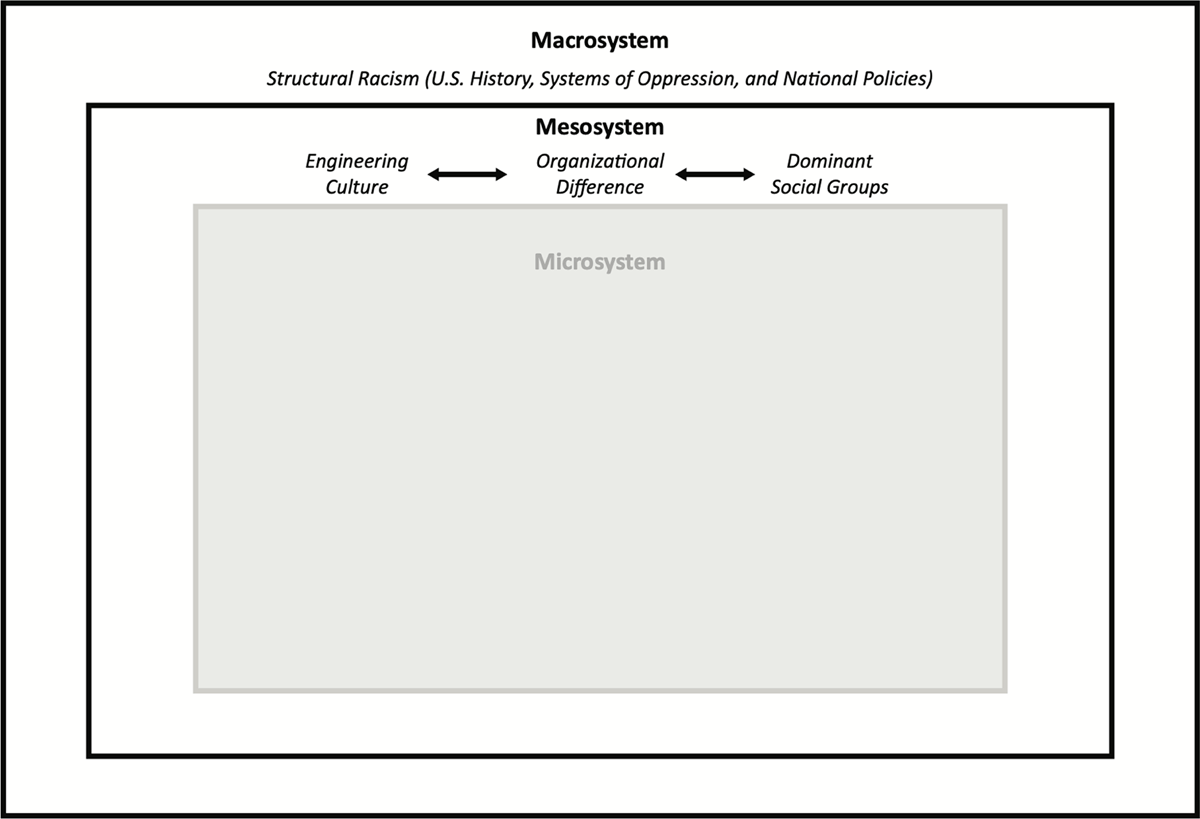
Figure 3
Mesosystem Interactions (Part 2 of 3) That Shape Broadening Participation.
3.2.1. Engineering Culture
Broadening Participation is shaped by the disciplinary background of those doing much of the work in this domain—namely engineers and computer scientists. The disciplinary background of those working to diversify engineering is important because, in addition to being taught how to solve problems, engineers are also taught how to perceive them, largely educated through curricula heavily influenced by mathematics and the engineering sciences (Case, 2017; Seely, 1999). For example, despite disciplinary differences, there is general agreement in the engineering community that engineering design, and consequently engineering design processes, is the approach to problem-solving that unifies engineers (e.g., Dym et al., 2005; Jonassen, 2014; Mosborg et. al, 2005). Not only that, but engineers are also immersed in cultural myths about STEM, which often present the disciplines as meritocratic, where failure is the fault of individuals as opposed to the consequence of unfair or oppressive systems (e.g., Conefrey, 2001; Rohde et al., 2020). Through training and socialization, engineers experience cultural cues that are laden with implicit and explicit messages about what constitutes a problem worth solving and the appropriate ways of doing so. Although this culture has served the engineering profession well in addressing some problems, it falls far short of what is needed for solving others, as has been noted by scholars from a variety of fields (e.g., Benjamin, 2019; Cech, 2012; Cech, 2013; Cross, 2020; Eubanks, 2018; Riley, 2008; Sochacka et al., 2021). For example, Cech (2012) published a critique of how engineers understand the role of engineering in society, while Sochacka et al. (2021) published a critique of the dominant narratives about engineering in public discourse. These are but recent examples critiquing engineering, engineering education, and the limited nature of the typical approaches to preparing engineers.
Broadening Participation is also shaped by differences in disciplinary/field norms, such as those between engineering and computer science (CS). Despite CS often being included in engineering, it is important to recognize the distinct differences between the two fields. This distinction is easily overlooked because STEM is often treated as a monolith when it comes to enacting change (Reinholz et al., 2019). However, as Henderson et al. (2017) note, a central reason for needing discipline-based education research (DBER) is because “[e]ach discipline has bodies of disciplinary content, a culture that shapes how members of the discipline think about and approach their work, and established research methods and tools that practitioners use” (p. 349). Considering these differences is important. For example, SMEs expressed how engineering and CS disciplines differ in cultures, the accessibility of the resources and curriculum required, and the demands along the education-to-workforce pipeline. SMEs also explained how the accessibility of the resources required for engineering and CS impacts the numerical diversity within each discipline. For example, while some SMEs discussed math and science as gateway courses for both engineering and CS, they generally considered CS more accessible to students who were not exposed to the formal engineering curriculum because CS education or training is available through more informal channels than engineering. For example, an SME expressed, “I love to code. I love to program. I have a computer at home, right?” Though this description of access is oversimplified, it paints a picture that is in stark contrast to engineering education, where students usually need to be “exposed to certain technical competencies” and have access to the “physical components” required for certain engineering disciplines. We note that these differences could be attributed to the disciplines sometimes being in separate colleges, though CS departments are sometimes housed within engineering.
Lastly, Broadening Participation is also shaped by the relationship between engineering and the public. By relationship, we are referring to society’s awareness, understanding, and interest in engineering (National Academy of Engineering, 2008). The public’s relationship with engineering impacts how people engage with engineering, which affects the “pipeline” of potential engineers (London et al., 2021). For example, SMEs described the field as “rigorous” and discussed how the foundation of engineering concepts (i.e., math and science) influences a person’s decision to pursue engineering. The idea of overemphasizing the math and science portion of engineering is also reflected in prior research (Degenhart et al., 2007; Knight et al. 2022) and linked to U.S. education. SMEs also expressed that the lack of engineers portrayed in the media, particularly Black engineers, negatively impacts the amount of exposure that students have to engineering concepts. Visibility can help students to visualize what is attainable and to persist through engineering. This is inextricably linked to public perceptions of engineering and is one means by which we overcome some of the structural barriers imposed by the U.S. education system.
3.2.2. Organizational Differences
Broadening Participation is shaped by organizational differences between each segment of the education-to-workforce pathway. Accordingly, it is important to consider where in the education-to-workforce pathway an effort is being implemented (e.g., K–12, higher education, industry). The importance of considering organizational differences is reflected in literature focused on change management and strategies, where, for example, organization theories have been developed by studying colleges, universities, community colleges, and K–12 schools (Bastedo, 2012). According to Borrego and Henderson (2014), change agents should choose a strategy that “fits their situation best (in terms of resources, goals, locus of change, and implicit assumptions about change already being followed)” (p. 225). In our work, this consideration translated into SMEs focusing on the capacity of essential stakeholders (or gatekeepers) in their local education and/or engineering environments. Their perspectives provide insights into which people are perceived as key to change within different segments, and which people are capable of inducing change within these environments. Regarding implicit assumptions about change, SMEs also discussed how change occurs at a different rate within each segment due to the buy-in needed from stakeholders in different segments.
In the K–12 segment, for example, SMEs posited that there is a lack of change because the workload and overly prescriptive parameters of K–12 educators make it hard for engineering concepts to be integrated into the curriculum. For example, an SME discussed how teachers in K–12 “want to know what the best practices are, but they feel like they got to do so much to embed that into what they’re already doing.” This tension can create a cycle of maintaining current practices that do not often include a robust engineering curriculum. In the higher education segment, SMEs discussed how change is slow due to the nature of the institutions. They attributed this inertia to faculty, administration, and other professionals being resistant to change. SMEs expressed how even though best practices are known within this segment, “leadership does not institutionalize best practices that we know work” because “they want to do what they’re comfortable doing and they don’t want to try anything new, so they don’t.” Lastly, in the industry segment, SMEs acknowledge that change can happen if there is buy-in from upper management to set the tone and expectations. The tone and expectations for change need to be communicated transparently so that employees did not feel like they were “fighting against a wall.” An SME noted that the transparency among supervisors and employees helped employees know that issues are “being talked about enough that the people in power are aware.”
3.2.3. Dominant Social Groups
Broadening Participation is shaped by the awareness, will, and interest of dominant groups (i.e., social groups that significantly shape society’s norms and values). As prior scholars have noted, considering dominant groups can either come in the form of building public will (e.g., Kania & Kramer, 2013), anticipating resistance (e.g., Kidder et al., 2004), or accounting for interest-convergence (e.g., Baber, 2015). Anticipating resistance is particularly important because history has shown us that change efforts seldom exist without resistance and opposition, particularly change efforts focused on racial justice. In the context of our work, SMEs often discussed Black Americans’ relationship with White Americans. More specifically, SMEs noted that White Americans often lacked the awareness of, or interest in, certain issues that marginalized communities face within society. For example, an SME expressed that “there are issues around family, there are issues around diversity that our White male, our male colleagues in general, have not thought about and do not tend to think about.” SMEs also expressed the reality that White people often have preconceived notions about demographic characteristics (i.e., race, class, and gender) based on stereotypes and biases. For example, when speaking about their experiences consulting with White people on increasing diversity, another SME said, “[White people] start talking about quality, they start talking about lowering the bar. This very unconscious, maybe even a little bit conscious, bias that members of [Black American] groups inherently cannot do the science that they are so proud to do.”
The tendency to bring up meritocratic values when discussing the accessibility or exclusivity of engineering has also been shown in prior research by Rohde et al. (2020). In their study, they interviewed 20 undergraduate engineering students and found similar beliefs when analyzing their longitudinal responses about who can do engineering. “That is, students began their responses to the question, ‘Who can do engineering?’ by asserting that anyone, or at least most people, could participate in engineering, but then immediately qualified this statement by highlighting qualities [e.g., ‘passion’, ‘drive’, a certain ‘engineering mindset’] that were necessary to be successful in engineering.” (p. 89). As discussed by these researchers, claims related to equal opportunity come into conflict with claims related to worthiness and rigor when members of the engineering education community discuss diversifying engineering, even if they are not prompted to think about race specifically. As Baber (2015) notes, “diversity program efforts are supported only as long as they do not interfere with other institutional priorities and norms” (p. 265). It is important to be fully aware of this engineering norm and its tendency to appear in confrontation with Broadening Participation.
3.3. The Microsystem
Lastly, we discuss the microsystem. This level includes activities embodied by the groups most immediately involved in Broadening Participation, that is, both practitioners and researchers.
As it relates to practice, Broadening Participation efforts originate from both within and beyond universities, dating as far back as the mid-1970s (e.g., DeYoung, 1975; National Society of Black Engineers, n.d). From within universities, MEPs and similar student support centers often focus on recruitment and retention through an array of programs, activities, and services (Lee & Matusovich, 2016). For example, it is not uncommon to find outreach initiatives, mentoring programs, living-learning communities, and summer bridge programs focused on supporting students from historically underrepresented groups within engineering. One can also find student chapters of diversity-focused organizations on university campuses, such as the National Society of Black Engineers (NSBE), whose mission is to “increase the number of culturally responsive Black engineers that excel academically, succeed professionally, and positively impact the community” (NSBE, n.d.). NSBE works towards this mission through a combination of K–12, collegiate, and professional programs. For example, in 2007, NSBE created Summer Engineering Experience for Kids (SEEK) to address the underrepresentation of Black students in STEM fields; and NSBE continued to expand SEEK to cities throughout the country (Edwards et al., 2018; 2021).
Organizations that operate outside of universities also focus their work on diversifying engineering. Some notable organizations as it relates to Black Americans include the National Action Council for Minorities in Engineering (NACME), the National Association of Multicultural Engineering Program Advocates (NAMEPA), the National Society of Blacks in Computing (NSBC), and the institute for African-American Mentoring in Computing Sciences (iAAMCS). Though the efforts of such organizations may not immediately come to mind when engineering work is envisioned, it is important to note that these efforts are largely driven by engineers and computer scientists.
Broadening Participation is also recognizably shaped by the involvement of researchers. As it relates to research, Broadening Participation often focuses on phenomena such as preparedness, awareness, motivation, interest, identity, recruitment, and retention (e.g., Atadero et al., 2018; Holloman et al., 2018; Rusk et al., 2008). Though educational researchers may have examined such topics without financial incentives, one should not overlook the impact of early decisions from NSF regarding what types of investments would be made towards this goal. There are some funding opportunities that prioritize practice in the research-to-practice relationship (e.g., the Scholarships in Science, Technology, Engineering, and Mathematics Program, or S-STEM), but funding agencies have traditionally focused on basic research, that is, projects motivated by gaps in the literature as opposed to material needs. This focus should not come as a surprise due to the widely held perception that research is the mechanism by which transformative change in engineering education will happen. “Business, academic, and government leaders across the engineering enterprise have repeatedly remarked that systematic research [emphasis added] of how we educate engineers must be the path [emphasis added] by which we transition from episodic cycles of educational reforms and move to continuous, long-lasting improvements in our education system” (The Steering Committee of the National Engineering Education Research Colloquies, 2006, p. 259). However, despite its presumed importance, several publications (e.g., Altamirano et al., 2019; Jamieson & Lohmann, 2009; London, 2018) have commented on the disconnect between research and practice in engineering education and offered recommendations regarding what should be done.
As it relates to research, Broadening Participation efforts are often led by people trained as education researchers or social scientists. Acknowledging the involvement of trained researchers is important because, regardless of the disciplinary focus, there are shared elements of a researcher’s idealized approaches to solving problems as well. For example, research projects are often self-contained, generally begin with the interest and expertise of the researcher(s), and most NSF-funded projects tend to range from three to five years in duration. The research process is a familiar one (Booth et al., 2008; Creswell & Creswell, 2017). Research projects typically begin with a point of inquiry that is cloaked in a question, hypothesis, or purpose statement that is largely intended to advance knowledge. Once this aim is established, researchers pursue methods that will lead them to gather evidence and make claims. The research process, and thus research projects, tend to wrap up once the claims and corresponding insights are published or shared with the intended audience(s). Once the scholarship is disseminated, this usually marks the end of the project itself. We recognize that this is a simplified explanation, but generally speaking, it summarizes the process researchers use to solve problems.
The work herein aims to build upon our understanding of this process and problematize idealized conceptions about how research-to-practice leads to change. Building on this premise, the microsystem (Figure 4) can be conceptualized as four elements that shape Broadening Participation: 1) time, 2) communication, 3) funding-related expectations, and 4) progress measures.
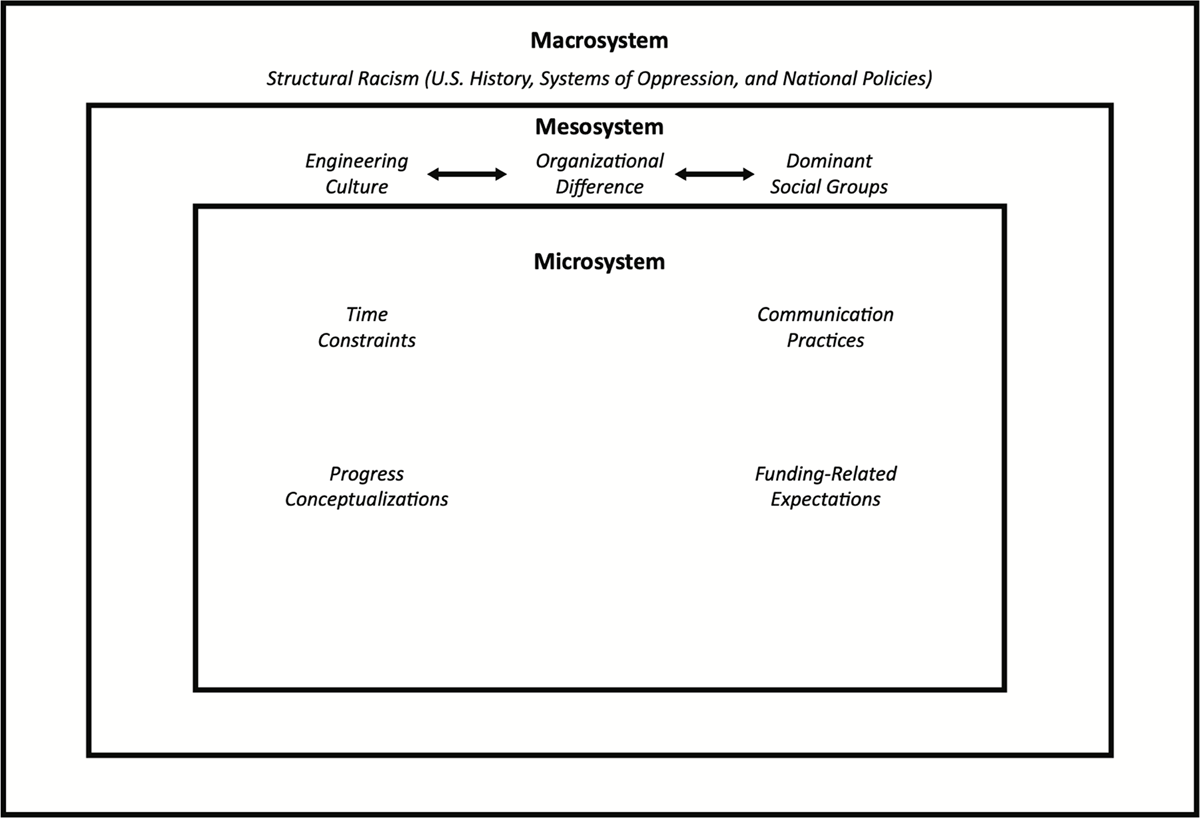
Figure 4
Microsystem Elements (Part 3 of 3) That Shape Broadening Participation.
3.3.1. Time Constraints
Broadening Participation is shaped by researchers and practitioners having different constraints related to time and time delays. This difference is primarily because researchers focus on knowledge generation whereas practitioners focuse on maximizing the impact that they can have on people and communities. Due to the varying focus of each group, the time that they have to conduct their respective processes differs. This point was expressed by SMEs when they were explaining how they focus their efforts to do their respective jobs. Some practitioner efforts, for example, included building community among historically minoritized students; developing programs that address student needs; and collaborating with multiple stakeholders to design, implement, and retain resources for programs. Practitioners discussed how they must make real-time decisions and utilize data that they have readily available. Practitioners used this data to understand how to best spend their time as well as to inform their programming efforts to foster interest and facilitate retention in STEM. The availability of this data was sometimes subject to the frequency of research outputs, as well as the type of data that is collected and analyzed by researchers.
Because engineering education research is expected to follow a process or a method that includes the use of “formal research questions, theoretical grounding, [and] appropriate methodologies” (Riley, 2017, p. 250), the research process often takes longer: engineering education research is expected to demonstrate “rigor” in the generation of knowledge (Riley, 2017). Consequently, the time that the research process takes can result in data not being readily available to practitioners. An SME shared that researchers “[work] on proposals to get money so that they can collect data to generate results that they go basically publish in journals that take two years to be made available.” By the time researchers share results, the data may not be relevant to practitioners. Additionally, the focus of a researcher’s study may not coincide with the type of data that practitioners need to conduct their job. SMEs noted that researchers study “what they believe is unknown” or what they can get funded.
3.3.2. Communication Practices
Broadening Participation is shaped by the communication practices of researchers and practitioners not readily facilitating dialogue between groups. Communication practices are the main factors that facilitate researchers and practitioners working together (Gainforth et al., 2014; Mosher et al., 2014; Nguyen et al., 2019; Suarez-Balcazar et al., 2005). SMEs noted that the purpose of research as it relates to practice is documentation and that the purpose of practice, as it relates to research, is filling in/addressing the knowledge gaps for researchers. However, the communication practices of researchers do not readily facilitate dialogue between these groups. For example, practitioners are not the main subscribers of the journals where researchers publish, resulting in education research not always reaching its intended audience. An SME expressed that practitioners are “looking for quick training workshops or presentations or something that’s going to help them implement something,” which they do not look for in journal articles. Similarly, SMEs noted that practitioners mainly present their work at conferences where researchers are seldom in attendance. SMEs expressed that to enhance the efforts of practitioners, they should collaborate with researchers to assess the impact of the programs that they are developing and performing. Collaboration with researchers can enhance a practitioner’s understanding of what aspects of programs need to be changed or altered.
3.3.3. Funding-Related Expectations
Broadening Participation is shaped by stakeholders having different expectations about how researchers and practitioners demonstrate their contributions toward progress. There are notable differences in how individual SMEs think about their contributions. This divergence can be attributed to researchers and practitioners having different external stakeholders and sources of resources. The primary resource discussed by SMEs was funding. To receive and maintain funding, these groups (i.e., researchers and practitioners) have to collect and report impact measures to track and report progress toward Broadening Participation in divergent ways. SMEs discussed how researchers demonstrate the value of their work through developing publications and their ability to get their projects funded by grants. Researchers are held accountable by funding agencies as it relates to what they decide to study and how they choose to disseminate their results. For example, SMEs expressed that in order to seek funding from agencies, studies have to be “preplanned” and if the agency determines that they “don’t have a good plan, they’re not going to fund you.” Similarly, the magnitude of practitioners’ work is partially based on the financial support they are able to gain. Funding for practitioners’ work usually goes towards maintenance of programs (i.e., learning resources, student participation fees, etc.). Programs that practitioners put in place have financial support from corporations, DEI (diversity, equity, and inclusion) initiatives, and so on.
3.3.4. Progress Conceptualizations
Broadening Participation is shaped by researchers and practitioners having different approaches to monitoring and conceptualizing progress. As the field of engineering continues to work towards diversifying, it is important that efforts not begin under the assumption that a common view of how to monitor progress already exists. Illustrating the importance of monitoring progress, an SME posited that “evaluation has to be built into how these programs are designed and it can’t just be an afterthought. It has to be part of the thinking behind the execution of the work.” Situated in London’s (2018) impact framework, we identified both societal impact and contextual impact measures; scientific impact measures were not discussed. At times, SMEs discussed these measures as both independently valuable (i.e., stand-alone metrics) and comparatively valuable (i.e., reference points or achievement comparisons).
At the societal level, SMEs discussed what we refer to as global measures. Global measures are ideals or perceptions that would serve as indicators of progress being made at a societal, aggregate level. For example, SMEs referenced changes to systemic structures, attitudes toward participating in engineering and computer science, access and accessibility, the portrayal of engineering in the media and the classroom, ideas about engineering climate and culture, as well as demographic representation.
At a contextual level, SMEs discussed measures that focus on people and on local efforts. We refer to the two types of measures focused on people as cohort measures and student measures, while the measures focused on local efforts include program measures. Cohort Measures track the progress toward Broadening Participation among a group of students enrolled at a single institution. For example, SMEs referenced measures such as the number of applicants, matriculants, and graduates; rates associated with graduation, workforce placement, and retention; and achievement metrics based on GPA and other indicators of STEM proficiency. On the other hand, Student Measures reflect the day-to-day impact of Broadening Participation stakeholders by focusing on students as holistic individuals—including their mental well-being, academics, and career clarity. For example, SMEs referenced psychological factors (e.g., engineering identity, self-efficacy, and sense of belonging), test scores, and their participation in high-impact experiences (e.g., research, innovation/entrepreneurial endeavors).
Program Measures result from the evaluation of a program. Examples of program measures include participants’ GPA and repeated participation; and demographic data about the people who apply, attend, and get a job after finishing the program.
4. A Proposed Conceptual Model of Knowledge Production and Problem-Solving
An overarching insight from our work is the importance of understanding the central role that ecological systems play in shaping efforts to diversify engineering. Accordingly, in Figure 5, we propose a conceptual model of ecological systems that shape knowledge production and problem solving for broadening participation in engineering. By providing this alternative research-to-practice model for Broadening Participation efforts, our aim is shifting the community’s language from research and practice to knowledge production and problem-solving to a) more accurately describe the range of efforts associated with Broadening Participation and b) avoid the research-practice dichotomy that often suggests people are one or the other. The proposed model addresses our purpose by offering the engineering education community an additional lens for understanding Broadening Participation that is informed by the perspectives and experiences of subject-matter experts working across the education-to-workforce pathway. The most notable distinction between the Innovation Cycle of Educational Practice and Research (Jamieson & Lohmann, 2009) and the proposed model is that the proposed model explicitly acknowledges the complex system formed by and surrounding research, practice, and assessment efforts in pursuit of progress. Apart from depicting a new way to think about the relationship between research and practice, the proposed model sheds light on why field-level patterns of participation in engineering are reproduced, despite consistent research and practice efforts to change them.
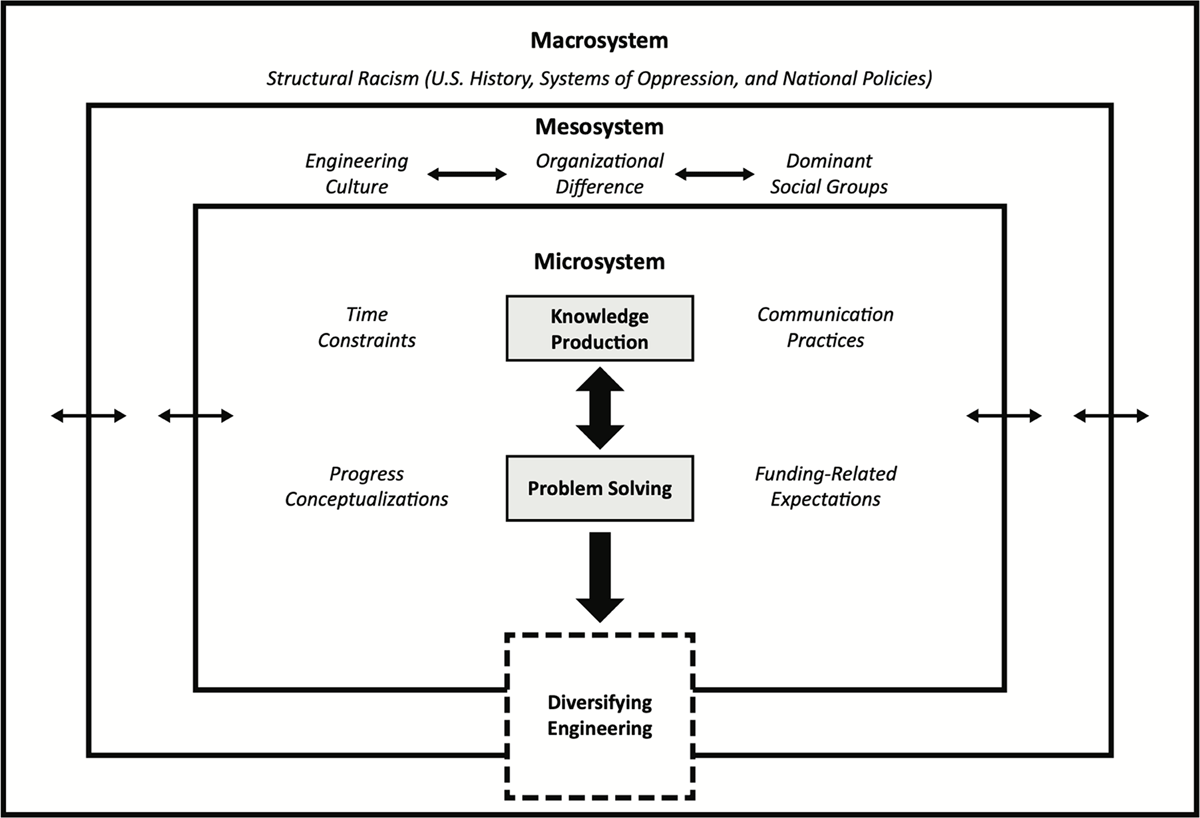
Figure 5
A Conceptual Model of Ecological Systems That Shape Knowledge Production and Problem Solving for Broadening Participation in Engineering.
5. Implications
The insights of this work suggest that Broadening Participation efforts connect local issues to societal problems; use context-appropriate models of change; involve forming authentic partnerships; and aim to disrupt traditional power dynamics. Each implication is discussed in the subsequent sections.
5.1 Connecting Local Issues to Societal Problems
Broadening Participation efforts should focus on addressing underlying issues. The importance of focusing on underlying causes instead of symptoms (Alford & Head, 2017) is put into perspective when Broadening Participation is viewed through a systems lens. Accordingly, we join other scholars (e.g., Cross, 2020; Holly Jr., 2020; Mejia et al., 2020) and encourage the engineering community to adopt this perspective and confront the racialized (and other oppressive) ways in which the United States has been historically organized. In particular, as it relates to the participation of Black Americans, we posit that the field must grapple with the relationship between structural racism, resource disparities, the U.S. education system, and the public’s understanding of engineering. Harper (2010) similarly called upon the STEM education community to stop amplifying “minority student failure” in the name of “narrowing achievement gaps and attainment disparities in STEM” (p. 64). It is in this same spirit that we call on the engineering community to direct its attention, resources, and efforts on addressing the underlying causes behind said gaps and disparities instead of solely focusing on the more localized, readily identifiable symptoms.
The complexity of Broadening Participation and the breadth of context that shapes this sociopolitical phenomenon and the problem(s) it aims to address cannot be overstated. As noted by Jonassen (2014), “problem complexity is a function of external factors, such as the number of issues, functions, or variables involved in the problem; the number of interactions among those issues, functions, or variables; and the predictability of the behavior of those issues, functions, or variables” (p. 106). When external factors are ignored, people tend to focus on surface issues, confusing symptoms with their root causes. In the context of Broadening Participation, for instance, issues such as unequal distribution of resources (e.g., Lee, 2004; Smith et al., 2013), interpersonal racism (e.g., McGee at al., 2019), and unwelcoming climates (e.g., Brown et al., 2005) are easily identified throughout the education-to-workforce pathway and rightfully attract the engineering community’s attention. However, if the engineering community focuses on addressing these symptoms in isolation, it will continue to oversimplify challenges associated with Broadening Participation as opposed to identifying systemic solutions.
Prior work by Su (2010) drives home the importance of being honest about the underlying (i.e., macro-level) issues when it comes to Broadening Participation. This work focused on quantifying the gender and racial diversity of bachelor’s degree recipients in engineering by applying a metric (i.e., engineering yield) that described the probability that an earned bachelor’s degree from a member in a demographic group would be in an engineering subject. Their reasoning for taking this approach was to “isolate trends in the engineering yield from trends related to overall college-degree attainment” (p. 163). As a result of this analysis, Su (2010) concluded that the “underrepresentation of non-Asian minorities is general to all fields and is symptomatic of a larger problem of a lack of racial diversity in higher education, whereas the underrepresentation of women is specific to engineering” (p. 173). We agree with Su’s assertion that “this is not to suggest that the engineering education establishment, or the engineering profession, has no responsibility or role in increasing the number of underrepresented minorities among the ranks of engineers” (p. 173), but instead makes it clear that the field’s actions must address the unique challenges associated with structural racism if it wishes to broaden the participation of Black Americans in engineering.
Lastly, given the recent surge of anti-DEI legislation, the significance of societal problems and their impact on higher education cannot be overstated. As we think about the political context that has long surrounded Broadening Participation (e.g., Malcom et al., 2004) and the responsibility of the engineering education establishment, we must acknowledge the political context in which Broadening Participation work is currently being done. We must proactively challenge these political attacks (e.g., bills targeting DEI programming, decries against theories about systematic racism, book bans, and reversing race-conscious policies) and find ways to wisely navigate existing boundaries, never giving up advocacy for change. It is only by taking a comprehensive, nuanced, and sophisticated approach to connecting local and societal problems that we can hope to see links between research and practice that result in both local and national impact.
5.2 Using Context-Appropriate Models of Change
Broadening Participation efforts should consider the context in which the problem occurs. As Jonassen notes, “any situation or context may be constrained by cultural (history, belief systems, customs), sociopolitical (power relations), or organizational factors (administration, budgets, etc.)” (p. 107). For example, addressing an ill-structured problem requires navigating conflicting goals, multiple solution methods, non-engineering success standards, and non-engineering constraints (Jonassen, 2014), to name a few. The engineering community often fails to sufficiently acknowledge the contextual complexity associated with Broadening Participation. For example, implementing an initiative in the context of K–12 is not the same as implementing a solution in higher education or industry. Moreover, there are also contextual differences within each of these contexts (e.g., what works in one school district may not work in another). Mesosystems and microsystems are important to consider because the “structuredness of problems is significantly related to the context in which the problem is encountered” (Jonassen, 2014, p. 107). It is within these contexts that solutions are often implemented.
As a community, we must use contextualized approaches to change. When Broadening Participation is viewed through a systems lens, it is easier to anticipate the constraints (and moderators) associated with context because wicked problems rely on public participation (i.e., attracting and maintaining support) more so than less complex problems, which might be more readily solved using authoritative or competitive strategies (Alford & Head, 2017). Accordingly, we join prior scholars in emphasizing the importance of solution paths being discipline-based (Henderson et al., 2017); situated in context-appropriate models of change (e.g., Biddle & Nigg, 2000; By, 2005; Grol et al., 2013; Kezar et al., 2015; Stein, 2019; Trowler, 2008); include building public support (Kania & Kramer, 2013); and account for the “interest-convergence dilemma” in STEM education (Baber, 2015). In emphasizing these points, we hope to encourage stakeholders to grapple with questions for understanding disciplinary culture offered by Reinholz and colleagues (2019). More specifically, the field must ask the following question: “Which change strategies work most effectively in particular STEM disciplines?” (p. 12).
5.3. Forming Authentic Researc-HPractice Partnerships
Broadening Participation efforts should involve stakeholders effectively working together and exchanging information. In the same spirit as the recent call from Secules and McCall (2023) about “Rethinking Qualitative Research Designs to Promote Change Towards Equity and Inclusion,” we highlight the need for the community to form authentic partnerships between researchers and practitioners in the context of Broadening Participation. Whereas Secules and McCall urged the community to consider research designs that push toward changes, we are encouraging the community to go a step further by forming authentic partnerships. One way of doing this is to conceptualize research-practice partnership “as a form of joint work requiring mutual engagement across multiple boundaries” (Penuel et al., 2015, p. 192), as opposed to focusing solely on the translation of research into practice. Conceptualizing the work this way moves the field away from a focus on a group of people doing research (researchers) helping a group of people doing practice (practitioners) and instead highlights the reality of it often being a group of Broadening Participation stakeholders engaging in both knowledge production and problem-solving across multiple boundaries. If we are to overcome the time constraints, misaligned communication practices, divergent expectations, and varied conceptions of progress held among Broadening Participation stakeholders, we need to establish more shared routines that draw from familiar tools and routines and can be stabilized and shared over time (Penuel et al., 2015; Farrell et al., 2022).
We also join the National Science Foundation in emphasizing the importance of achieving the conditions of Collective Impact (Kania & Kramer, 2013), reiterating some points and expanding others. In particular, we wish to reiterate the importance of Shared Measurements, and to expand the conversation about Mutually Reinforcing Activities to include understanding how different conceptions of contributions, time, and communication practices make it difficult to simultaneously engage both researchers and practitioners.
First, Shared Measurements refer to the need for stakeholders to use a common set of measures to monitor progress. Our insights emphasize the importance of this condition by highlighting the extent to which people have different perspectives about progress. As a community, we must develop a shared philosophy for monitoring progress. Multifaceted indicators of progress (Onat et al., 2017) and shared measurement systems (Kania & Kramer, 2013) are needed to determine impact and facilitate the alignment of Broadening Participation stakeholders’ actions. A set of multifaceted indicators facilitates evaluation at multiple levels (e.g., global/societal, institutional, and individual) and would ensure stakeholders do not overemphasize the extent to which certain metrics capture the state of Broadening Participation overall. For instance, consider the data needed to answer the following questions: What is the status of Broadening Participation at the national level? How are individual universities performing? How impactful are individual programs? How are people from marginalized groups experiencing engineering? Each of these questions is worth considering and would necessitate different data to be answered. Having a suite of indicators would help the field keep a holistic view of the problem in mind and interrogate the problem from multiple angles.
Second, Mutually Reinforcing Activities refers to the need for stakeholders to focus on activities in which they excel in a manner that is coordinated with the actions of others. The involvement of both researchers and practitioners in Broadening Participation aligns with this philosophy, calling on researchers to focus on actions associated with advancing knowledge and practitioners to focus on actions associated with solving problems. However, our insights highlight several ways in which ensuring that these activities are in fact mutually reinforcing can be a challenge. In particular, we note the importance of focusing on the different ways in which contributions are understood, project timelines are perceived, and information is communicated. As Kania and Kramer (2013) note, “Collective impact poses many challenges, of course: the difficulty of bringing together people who have never collaborated before, the competition and mistrust among funders and grantees, the struggle of agreeing on shared metrics, the risk of multiple self-anointed backbone organizations, and the perennial obstacles of local politics” (para. 2).
5.4. Disrupting Traditional Power Dynamics
Lastly, as a community, we must disrupt current power dynamics. A central impediment to Broadening Participation-related progress is a lack of awareness of and interest in central issues that Black people and other marginalized communities face within society. This ignorance negatively impacts the cultural context (i.e., norms, values, explicit & implicit messages, and reward structures). Additionally, this ignorance influences who has the power to make decisions, the substance of the decisions themselves, and the rate at which change can happen. This ignorance will also impact the flow of human and financial resources that are necessary for making progress. When structure, culture, power, and resources work in favor of diversifying engineering, lasting change is likely to occur. Alternatively, these elements can also impede progress when disregarded or directed by an opposition force. Though SMEs primarily focused their comments in this area on White people, the lessons learned here can be applied to other dominant groups (e.g., men, and non-disabled people) as it relates to Broadening Participation.
6. Closing Thoughts
As a reminder, the purpose of this paper was to extend the field’s use of metaphorical language and advance the science of Broadening Participation. Our insights highlight how Broadening Participation is a sociopolitical phenomenon focused on addressing dynamic and ill-structured problems related to diversifying engineering, that is, a wicked problem. We share these insights in language familiar to engineers in hopes to advance future and novice stakeholders’ understanding of Broadening Participation. In doing so, our aim was to give the field of engineering an alternative heuristic for conceptualizing, discussing, and approaching Broadening Participation. We also aimed to emphasize the importance of appropriately situating Broadening Participation in the context of the larger societal problems that have produced the field-level patterns of representation we see today. If we are to diversify engineering, we need to apply systems thinking to this problem, rethink the role of engineering education research in addressing it, be well-positioned to respond to gatekeepers impeding progress, and accept the ongoing nature of this work.
Lastly, because Broadening Participation is focused on problems that result from interlocking systems of oppression, we must acknowledge that there will be work to do as long as these societal ills are present. We end on this point not to be discouraging and demotivating, but to more accurately reflect the challenges we are up against. Engineers tend to “solve problems,” and the word solve has connotations of finality. This finality is not how we should view Broadening Participation. There will always be more work worth doing.
Funding Information
This material is based on work supported by the National Science Foundation under Award Numbers 1647327 and 1926935. Any opinions, findings, and conclusions or recommendations expressed in this material are those of the author(s) and do not necessarily reflect the views of the National Science Foundation.
Competing Interests
The authors have no competing interests to declare.