
1. Introduction
Hidden curriculum (HC) refers to unwritten, unofficial, and often unintended assumptions, lessons, values, beliefs, attitudes, and perspectives not openly acknowledged in an environment (Gelles et al., 2020; Kentli, 2009; Nieto, 1992; Villanueva, Carothers et al., 2018; Villanueva et al., 2020; Villanueva, Gelles, Di Stefano et al., 2018; Villanueva, Gelles, Youmans et al., 2018). Institutional engineering messages, in the form of norms and values, include masculinity, competitiveness, and individualism (Fouad et al., 2011; Riley, 2017; Robinson & McIlwee, 1991; Secules, 2019). In addition, reports of HC suggest other forms of negative interpersonal messages, or expressions of bias that include microaggressions, slurs, or hateful words (Camacho & Lord, 2011; National Museum of African American History and Culture, n.d.). Researchers have tied HC to a chilly engineering climate (Hall & Sandler, 1982; Wilkins-Yel et al., 2019).
HC can be positive or negative (Villanueva et al., 2020). However, negative messages can contribute to attrition (Margolis, 2001), namely those that suggest required prior educational preparation to become an engineer, encourage a competitive or individualistic academic environment, and communicate sexism and racism (Geisinger & Raman, 2013). If a goal of engineering education is to “create and foster environments where every individual is respected and no one feels marginalized” (ASEE, 2022), then a comprehensive characterization of positive and negative HC messages, and who receives them, is critical to informing professional development, curricular change, and support for a more inclusive discipline.
Additionally, this paper aims to connect HC messages in engineering with how individuals navigate these messages. Engineering education scholars have extensively published on various structural issues related to HC, which are issues that impact various groups and “social relations at social, political, economic, and ideological levels” (Bonilla-Silva, 2015, p. 1360). These structural issues include sexism (Fouad et al., 2011), racism (McGee, 2020), and ableism (McCall et al., 2022), amongst others. We posit that these structural issues become HC messages within engineering when administrators, faculty, and students operationalize the issues into institutional and interpersonal messages. Rather than focus solely on the content and mode of these messages, we want to connect this discussion to how individuals navigate these messages. Education researchers have utilized frameworks of social and cultural capital (Smith, 2013) and coping self-efficacy (Sellers & Villanueva Alarcón, 2021) to describe how individuals navigate HC-related messages. We also note that scholars have used qualitative methodologies to elicit rich narratives of challenges in engineering with mitigating strategies (Fouad et al., 2011; Martin, 2015; Martin & Garza, 2020) in small numbers (less than 25 participants). However, we argue that to understand the scope and magnitude of HC messages with individuals’ experiences, we needed to use a blended methodological approach (open-ended, multi-modal, and mixed-method survey).
Thus, this work expands upon prior research to connect specific HC messages within engineering education institutions (e.g., departments, colleges, and universities), pathways of how individuals received HC through institutional and interpersonal interactions, with strategies participants utilized in response to HC messages. We also examined how these HC messages and resultant actions vary by individuals’ intersectional identities, granting us valuable insight to how individuals experience HC differently in engineering and allowing us to focus our implications for engineering education.
2. Literature review
2.1. Theoretical framework
HC has primarily focused on the messages of schooling, contrary to education, to learners (Apple, 1980) but has evolved to include a much larger set of structural, systemic, and social issues. Researchers have previously examined HC in ethics and medical education (Hafferty & Franks, 1994) and K–12 school culture (Giroux & Penna, 1979). Early HC scholarship in engineering focused on women’s experiences and began with observations of a gendered curriculum in engineering. Tonso (2001) observed how discussions of gender, appropriation of women’s work, faculty attention to superficial features of engineering practice, and dismissal of women’s experiences diminished how peers and professors view women. HC is more nuanced than discussions of engineering culture because it focuses both on the transmission and pathways of hidden messages within the context of a given working or learning environment. For additional information on the history of HC research, refer to Margolis (2001) and Smith (2013).
Villanueva et al. (2020) described a four-factor pathway model of HC, which includes awareness, emotions, coping self-efficacy, and self-advocacy. An individual is aware of HC when they recognize messages that people, social others, and institutions communicate to them. After an individual is aware of HC, their emotions help them assess the message for future action, such as decision-making, learning, or speaking up (Pekrun & Linnenbrink-Garcia, 2014). Before an individual can act on an HC message, they assess coping self-efficacy, or their ability to cope with messages or situations (Sellers & Villanueva Alarcón, 2021). Previous research indicates that individuals with more coping self-efficacy are more likely to combat HC messages and change engineering; this happens via self-advocacy (Sellers & Villanueva Alarcón, 2021).
HC messages can be either implicit or explicit, as well as intentional or unintentional (Villanueva, Gelles, Youmans et al., 2018). Intentional HC messages can remain hidden because an individual may not be aware (or not want to be aware) or understand the structural and institutional pathways that underly the message or provide paths to enact change. This research thread contributes to the four-factor pathway model of HC by exploring where messages originate and determining the messages that a large group of participants in engineering experience. This research thread also aims to ascertain the actions that individuals with intersectional gender and racial identities do because of HC messages. Refer to our previous research (Sellers et al., 2023; Villanueva Alarcon & Sellers, 2022; Villanueva et al., 2020; Villanueva, Gelles, Di Stefano et al., 2018) for the original rationale of this work, conceptual framework development, and evolving analysis choices.
2.2. Literature on communication of messages
Individuals receive messages from structures through multiple paths (Walden et al., 2018). As we previously noted, we posit that structural issues (e.g., racism) are operationalized into institutional and interpersonal messages. We theorize that individuals identify HC institutionally through norms, values, and beliefs, or interpersonally in conversations or remarks where participants are aware of the individual/s who communicated HC. We propose that institutional messages are more difficult for an individual to perceive than interpersonal messages. We also propose that individuals perceive HC from another individual but may not explicitly name the communicator of it, which we describe as nonspecific messages.
2.2.1. Institutional messages
Institutional messages occur in institutions, departments, classrooms, or engineering-adjacent spaces (e.g., workplaces) where the entities communicate “values, assumptions, beliefs, attitudes, ideologies” (Walden et al., 2018, p. 3) either implicitly or explicitly. An example of an engineering value is meritocracy, or the belief that success is the result of talent, training, and motivation, and those who do not have such characteristics will be less successful than those who do (Cech, 2013). Students’ belief in meritocracy shields them from structural inequities and discriminatory departmental cultures (institutional bias) in engineering (Erickson, 2007). HC occurs institutionally because some individuals receive helpful or harmful messages and others do not. Explicit institutional or departmental policies are sometimes inconsistent, and not everyone interprets the messages similarly (Walden et al., 2018). If an individual does not receive a message, an HC message becomes a null curriculum (Villanueva et al., 2020). This is particularly harmful when individuals need institutional cultural capital, or specialized knowledge required to succeed in a specific environment, and an inability to access this capital impedes an individual’s success (Smith, 2013).
2.2.2. Interpersonal messages
Individuals receive interpersonal messages from others, particularly where they can easily identify HC communicators. These can include overt and covert forms of sexism, racism, ableism, and other forms of discrimination. Sue (2007, p. 271) states, “racial microaggressions are brief and commonplace daily verbal, behavioral, or environmental indignities, whether intentional or unintentional, that communicate hostile, derogatory, or negative racial slights and insults toward people.” Camacho and Lord (2011) documented interpersonal microaggressions that Asian, Latina, and White women experience in engineering. These microaggressions included others insinuating the women were not a good fit for engineering, expressing shock that women are engineers, indicating women’s presence in engineering is only because of their gender (which racial marginalization compounds for many women of color), and men ignoring women.
2.2.3. Nonspecific messages
Individuals perceive nonspecific messages from nonspecific sources or from people’s perceptions about others, whom participants do not name. Examples of nonspecific messages include phrases like “They think…” and “People said….”. An example of HC within nonspecific messages can be an individual who perceives others who think they are not capable of succeeding in a major. However, they do not specifically name the communicators. Nonspecific HC messages differ from institutional messages because nonspecific messages come from an unidentified interpersonal source rather than from norms or values. Nonspecific messages of HC may result in a person feeling threatened about being negatively stereotyped, judged, or having to match a stereotype, which is related to stereotype threat (Cadaret et al., 2017; Eschenbach et al., 2014).
2.3. Strategies to address HC
We mentioned that individuals use their coping self-efficacy to enact strategies to navigate HC (Sellers & Villanueva Alarcón, 2021). Sellers & Villanueva Alarcón (2021) defined three categories of strategies that women in engineering use to challenge or perpetuate the status quo. We expand these strategies to men and non-binary individuals in this paper. Sellers & Villanueva Alarcón (2021) noted that women with more coping self-efficacy change their environments (i.e., challenge the status quo) in engineering by mediating disagreements between group members, addressing HC messages directly, seeking help or resources from others, and looking for/being a representative of marginalized identities in spaces. These strategies align with community cultural wealth, or an asset-based framework where individuals utilize “knowledge, skills, abilities, and contacts” (Yosso, 2005, p. 77) to resist oppression. Aspects of community cultural wealth in this paper also include social capital, or “networks of people and community resources” (Yosso, 2005, p. 79). Sellers and Villanueva Alarcón (2021) described women who have less coping self-efficacy negotiate themselves and do not change their environments (i.e., perpetuate the status quo); these strategies include making no major changes to using problem-solving approaches, developing skills like time management, changing their mentality (e.g., developing confidence), or working harder. Women have also taken no or minimal action to navigate challenges in engineering, and these women had less coping self-efficacy relative to others to address issues in engineering (Sellers & Villanueva Alarcón, 2021). Our goal for this work is to understand the strategies that individuals with intersectional gender and racial and/or ethnic identities use to cope with HC, given our previous work identifying the strategies that women use.
3. Methods
3.1. Data collection
Villanueva Alarcón and her research team (NSF Awards EEC-1653140 and 2123016) created and validated an open-ended, multi-modal, mixed-methods framing survey instrument, Uncovering Previously Hidden Engineering Messages for Empowerment (UPHEME), with quantitative and qualitative items to conceptualize HC as a structural framework that includes several interconnected pathways, as described in prior work (Gelles et al., 2020; Sellers et al., 2023; Sellers & Villanueva Alarcón, 2021; Villanueva, Gelles, Youmans et al., 2018): awareness, emotions, coping self-efficacy, and self-advocacy. Thus, the purpose of this instrument was to extend identifying HC messages but determine how individuals internalized and acted on the messages. This is an important distinction to make for this work as the end goal of identifying these pathways is to develop both counternarratives and person-centered interventions.
3.1.1. Survey instrument
The survey instrument contains 43 quantitative and 7 qualitative items and a 7.5-minute video vignette. The order of the survey instrument is described in Table 1. The research team published a similar survey description in Villanueva et al. (2020).
Table 1
Description and order of the mixed-methods survey instrument. For more details on the items of the instrument, refer to Villanueva et al. (2020).
| SURVEY SECTION | DESCRIPTION | TYPE OF QUESTIONS |
|---|---|---|
| (1) Raw engineering perceptions | Participants were asked their perceptions of engineering and who belongs in engineering before definitions of HC were provided to them. | Qualitative (QUAL) |
| (2) Hidden curriculum awareness | Participants were given a written definition of HC followed by six HC statements. Participants were asked whether they agreed with the HC provided in the context of engineering | Quantitative (QUAN) & QUAL |
| (3) Video vignette | Participants watched a 7.5-minute video, which highlighted several examples of HC involving a marginalized Latino student and faculty member. The video vignette contains layers of HC, including racism, sexism, first-generation student status, as well as professionalism and success in engineering. The video does not focus on a single HC issue, and the participant likely interpreted the video based on their salient issues. Participants then defined HC in their own words and provided personal examples of engineering HC. | QUAL |
| (4) Emotions | Participants selected an emotion they felt corresponded to six HC assumptions and whether their emotion was positive or negative. They also recalled a personal experience with HC and the emotions they experienced in that situation. | QUAN & QUAL |
| (7) Self-efficacy (coping) | Participants were given a definition of self-efficacy and indicated their belief that they can succeed in engineering if six HC assumptions were present in their education. They also described an obstacle they have had to overcome in engineering. | QUAN & QUAL |
| (8) Self-advocacy | Participants were given a definition of self-advocacy and identified their willingness to ignite an action on behalf of themselves and others around six HC assumptions. They provided a personal example highlighting what they have self-advocated for in engineering. | QUAN & QUAL |
| (9) Wrap-up | These questions inquired about the major lessons learned about HC through this survey and asked participants to reflect on their major passions for pursuing a degree in engineering. | QUAL |
| (10) Demographics | Participants were asked to enter information about their axes of inequity, such as age, role (student versus faculty), university of study or employment, race, gender, ethnicity, and first-generation status. | QUAL |
Villanueva Alarcón and colleagues designed the instrument in 2017 before the engineering education community regularly utilized the term hidden curriculum (see Villanueva, 2017; Villanueva, Gelles, Di Stefano et al., 2018). As such, Villanueva Alarcón and colleagues presented six assumptions about engineering to participants in the survey instrument (Villanueva et al., 2020; Villanueva, Gelles, Di Stefano et al., 2018). The six assumptions included topics such as the difficult nature of engineering, the overfocus on technical versus sociotechnical content, gender equity, diversity, drop-out, and who belongs in engineering (Villanueva et al., 2020; Villanueva, Gelles, Di Stefano, et al., 2018). These six assumptions, in addition to the video vignette in the survey instrument, primed the participants to answer Likert-type and open-ended questions about their experiences with HC. For the open-ended question about participants’ coping self-efficacy, the research team chose the term personal obstacle to reduce jargon and for participants to think about other issues related to HC in engineering they may not have broached with the six assumptions.
3.1.2. Participant sampling
The research team collected data in two stages. The first stage involved a purposeful sampling strategy (Creswell & Plano Clark, 2017) utilizing five institutional liaisons affiliated with the grant (see Acknowledgements). Participants had to be: 1) currently attending an ABET-accredited engineering college in the US or Puerto Rico, 2) students or faculty enrolled or employed in an engineering college, 3) over the age of 18, and 4) a US citizen or permanent resident. This recruitment was purposeful to oversample traditionally marginalized populations in engineering (e.g., Latino, Black). The research team collected 564 responses from the first stage. The second recruitment stage used probabilistic sampling (Creswell & Plano Clark, 2017) to capture other regions of the US and Puerto Rico across multiple colleges of engineering and institution types. The research team collected an additional 420 responses in the second stage for a total number of 984 participants. The research team paid participants with an Amazon gift card ($25) for their entries to the UPHEME survey, which took approximately 20 minutes to complete. All procedures followed Institutional Review Board-approved protocols (University of Florida IRB #202003266).
Of participants’ (N = 984) responses to the coping self-efficacy question, a third (n = 330, 34%) described interpersonal, nonspecific, or institutional HC and mentioned strategies to address HC. We excluded responses to the coping self-efficacy qualitative item that were blank (n = 131, 13%). We also excluded participants who stated that they did not have an obstacle related to HC (n = 13, 1%), did not name who communicated an HC (n = 2, <1%), or noted they did not have a strategy (n = 206, 21%). We further excluded participants who did not have clear, complete, or relevant responses that would have allowed us to interpret an HC experience (n = 395, 40%), interaction (n = 337, 34%), or strategy (n = 308, 31%). Some participants (n = 6, <1%) who experienced an HC message from any source did not have a strategy, and some participants (n = 2, <1%) experienced a message and used a strategy to mitigate it, but the message was unrelated to HC in engineering. While the focus of this paper was on participants who recognized HC, we have published work on participants’ responses that did not describe HC, believed that HC-related issues were not a problem in engineering, or believed that uncovering hidden messages in engineering undermined perceived fairness in engineering. We explored participants who did not experience HC or were resistant to self-/advocacy around HC and recently presented these finding (Sellers et al., 2023). The demographics of the participants who we later discuss in the findings are shown in Table 2. We focused on these participants to show how individuals, especially those with intersectional identities, navigate the messages.
Table 2
Demographics of participants (n = 330).
| DEMOGRAPHIC | n | % |
|---|---|---|
| Gender | ||
| Men | 188 | 57 |
| Women and Non-Binary | 142 | 43 |
| Age | ||
| 18-29 years of age | 276 | 84 |
| 30-39 years of age | 23 | 7 |
| 40 years of age or older | 31 | 9 |
| Racial and/or Ethnic Identity | ||
| Native American or Alaska Native | 2 | 1 |
| Asian | 23 | 7 |
| Black or African American | 15 | 5 |
| Hispanic, Latina/o, Chicana/o/ | 101 | 31 |
| White/Middle Easterna | 160 | 48 |
| Two or more races or ethnicities or Race and/or ethnicity not listed | 29 | 8 |
| Engineering Role | ||
| Undergraduate and graduate students | 204 | 91 |
| Professors and other professionals | 19 | 9 |
| Concentration | ||
| Aerospace/Mechanical/Automotive/Nuclear Engineering | 76 | 23 |
| Architectural/Civil/Environmental Engineering | 121 | 37 |
| Biological/Biomedical/Agricultural Engineering | 25 | 8 |
| Chemical/Petroleum/Materials Engineering | 31 | 9 |
| Computer/Electrical/Electronics/Audio Engineering | 52 | 16 |
| Engineering Education | 3 | 1 |
| Industrial/Process Engineering | 15 | 5 |
| Concentration not listed | 7 | 2 |
| First-generation undergraduate studentb | ||
| Yes | 108 | 33 |
| No/Not sure | 222 | 67 |
[i] a Please note that the White racial and/or ethnic category in the UPHEME survey includes participants from countries of origin outside the United States, e.g., Ireland or Poland.
b We defined first-generation in the instrument as individuals who are the first person to attend college from their immediate family and are aware of other terminologies that are surfacing in the literature (e.g., post-traditional).
3.2. Data analysis
We examined participants’ responses to a single qualitative item about participants’ coping self-efficacy. We used individuals’ responses to the coping self-efficacy item to signify a thread of the greater HC awareness-emotions-coping self-efficacy-self-advocacy pathway (Villanueva et al., 2020), and it is through coping self-efficacy that an outcome (self-advocacy) is mediated (Villanueva, Gelles, Di Stefano et al., 2018). Participants responded to the following coping self-efficacy item:
Please provide an example of a personal obstacle you overcame successfully in engineering, related to the hidden curriculum. Briefly explain what caused you to consider it a personal obstacle.
Participants’ responses ranged in length from a sentence to multiple paragraphs.
3.2.1. Coding
We performed a round of initial, descriptive coding (Saldaña, 2016) to inform our coding approach within Microsoft (MS) Excel. We utilized Excel after exploring MAXQDA (MAXQDA, n.d.) and NVIVO (NVIVO, 2023) qualitative analysis software but determined that Excel would allow us to manage a large dataset of open-ended responses more easily.
We performed secondary, inductive coding to determine: 1) the salient HC that participants described and 2) the strategy/ies they used to navigate the issue(s). After we identified strategies individuals used to cope with HC, we performed an initial round of coding to determine the HC message(s); secondary coding involved grouping the initial HC messages. We then organized these secondary codes using MS OneNote because of its ubiquity and functionality for flexible grouping, notetaking, and information display. In MS OneNote, we grouped similar HC messages together and then recategorized these HC messages in MS Excel to establish new and connected thematic codes (Saldaña, 2016). We used a similar approach to code for participants’ strategies to navigate HC issues.
After we coded HC and strategies, the data compelled us to identify who communicated the messages, or the sources of these messages (from individuals directly or from systems) and to what aspects of the individuals’ identities sources directed HC messages. We performed an initial round of descriptive coding to identify the communicators of HC and tracked participants’ impacted identities in MS Excel. We organized similar communicator and participant identities (interactions) into thematic codes and added those codes to MS Excel. As shown in Figure 1, the quote represents a powerful but representative communication from a person who was intimidated initially by the lack of representation of women in engineering and learned to self-advocate. We coded the quote example in initial, secondary, and thematic rounds for strategies, HC messages, and interactions between communicators and receivers. We used MS Excel to develop a pathway to situate communicators, receivers, and participant strategies. After Sellers completed coding, she shared the codebook with Villanueva Alarcón, who then independently coded 50 individuals’ responses with detailed themes and codes, definitions, and inclusion/exclusion criteria. Sellers and Villanueva Alarcón held three sessions to discuss and refine the codebook. As a result, we recoded items, and Sellers adjusted code definitions based on discussed agreements with Villanueva Alarcón until consensus was reached. We note that because individuals may have described more than one HC, interaction, or strategy in their survey responses, there are more examples than participants.
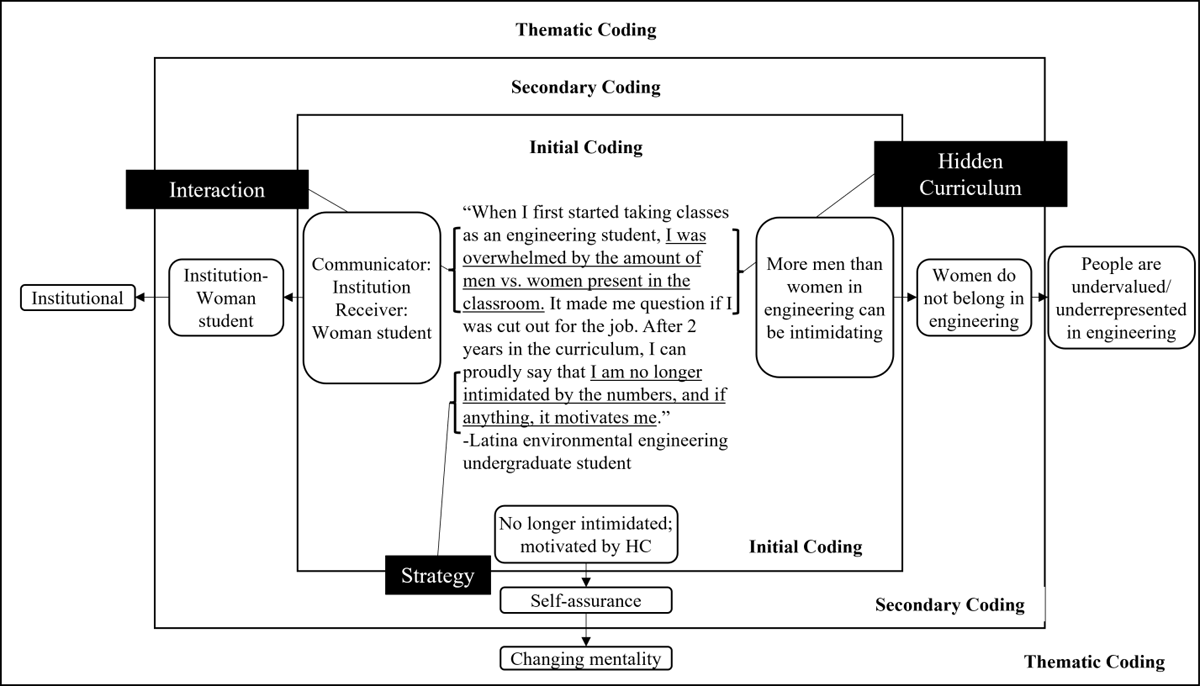
Figure 1
Diagram of the coding scheme, showing initial, secondary, and thematic codes of participant’s interaction, HC, and strategy from sample quote. In order, we coded for strategies, HC, and interactions.
3.2.2. Research quality
Since this inquiry focuses on a qualitative aspect of a larger study, we considered both qualitative and mixed-methods quality. We utilized the Qualifying Qualitative Research Quality (Q3) Framework (Walther et al., 2017) to guide our research and writing process. Because we used short, open-ended responses from participants as our unit of analysis, this could be a potential threat to theoretical validation, which concerns the fit between reality and knowledge generated (Walther et al., 2017). We know that this research does not reflect a handful of individuals’ “thick descriptions” (Creswell, 2007; Miles et al., 2014)—portraits of their social and cultural situations. Rather, this data source research represents a snapshot of the living realities of many individuals in engineering. We argue that the strength of the description of HC that individuals experience, whom it comes from, and the strategies they use to navigate HC, comes from the quantity and variety of descriptions. Onwuegbuzie et al. (2011) refers to this as conversion in mixed-methods research, or quantitizing qualitative data. If HC, interactions, and strategies had not been quantitized, we could have assumed that each instance was equally common, which was not the case in our study. Understanding the pathways, rather than limiting the study to demographic counts, is crucial for our approach.
On a related note, some individuals experienced more than one HC in engineering. These shared experiences include details about more than one communicator and/or more than one strategy to navigate HC. To mitigate this concern, in each section, we note the number of individuals who described multiple interactions, HC, and strategy. Onwuegbuzie and others (2011) cautioned against comparing individuals and their quantitized data against each other for statistical purposes (e.g., counting). We addressed this concern by connecting individuals’ pathways by their gender and racial categories and presenting them in the context of their self-identified intersectional identities.
We had ethical validation concerns or impacts to potential sources of biases in our data analysis and reporting (Walther et al., 2017) because Sellers was also the primary data analyst with Villanueva Alarcón serving as the secondary. To mitigate theoretical concerns, Villanueva Alarcón emphasized coding consistency during the initial and secondary coding passes, particularly with code names, definitions, and inclusion/exclusion criteria. The two authors also held intercoder agreement sessions to refine aspects of the analysis process. The authors discussed initial impressions, coding processes, generation of a codebook, and preliminary findings. Sellers continued or adjusted her approach, as necessary, after discussion with Villanueva Alarcón. To mitigate ethical validation concerns, Sellers and Villanueva Alarcón used their positionality to discuss their worldview and relevant life experiences that would impact the authentic co-construction of the findings. Using positionality also ensured greater accountability to each other while analyzing and interpreting data (Secules et al., 2021). Additionally, this research is part of a larger mixed-methods study, and the engineering education community has peer-reviewed aspects of the study design and work-in-progress reports (Sellers et al., 2023; Sellers & Villanueva Alarcón, 2021; Villanueva et al., 2020), thus improving communicative validity (Walther et al., 2017).
3.3. Positionality
Both authors are cisgender women, first-generation college graduates, and first-generation PhD earners. Sellers has geology and geoscience education research backgrounds but has recently published on community cultural wealth of marginalized populations in engineering (Sellers et al., 2021), in addition to HC (Sellers & Villanueva Alarcón, 2021). Sellers feels that because she does not have an engineering undergraduate degree, she can interrogate the norms in engineering from an outsider’s perspective. Villanueva Alarcón (both are her last names from birth and is the same author as “Villanueva”) is a Latina who has had many firsts and as a result, has developed a keen awareness of HC in environments. Her training in science and engineering and her engineering education research expertise allows her to see trends, patterns, and pathways that may not be obvious to others. She offers an insider-outsider perspective in that although much of her career and education has been in engineering, she recognizes the cultural and language differences of her home and early engineering education may differentiate from the US mainland context.
Both authors recognize the potential detrimental effects that oppressive forms of communication can have on the subsequent decisions and actions of marginalized and marginalized students in disciplines in and out of engineering. Thus, we opted to use active voice in our findings to identify who communicated HC to the participants.
3.4. Research questions
In this work, we present a mixed-methods approach to HC, where we unify who received what messages and what they do about them. The following research questions (RQ) guided our work:
| RQ1: | What are salient HC messages in engineering? |
| RQ2: | How are HC messages communicated in engineering? |
| RQ3: | What strategies do individuals in engineering use to mitigate HC? |
| RQ3a: | What strategies do demographic groups in engineering use to mitigate HC? |
4. Findings
4.1. General
In the following sections, we present: 1) HC communicated to participants, 2) interactions between communicators and participants’ identities, and 3) strategies participants used to cope with or address HC. Lastly, we present common pathways linking participants’ intersectional identities to HC they received, interaction type, and strategy they utilized. We introduce participants with their identities that are relevant to understanding their experiences.
4.2. HC messages: The “what”
We describe four HC messages that engineering participants (n = 330) received from others in engineering and within engineering structures (see Interactions for more details).
Engineering is difficult.
Engineering is inflexible.
Engineering threatens representation and equity.
Engineering fosters support and growth.
Most participants (n = 293) described only one example of HC, whereas others mentioned two (n = 31) and three (n = 6) examples. Consequently, we report more instances of HC than the number of participants. A summary of HC findings is in Table 3.
Table 3
HC message by participant identity. Bolded values indicate the HC message with the highest percentage for each demographic category.
| N | # OF INSTANCES | ENGINEERING IS DIFFICULT | ENGINEERING IS INFLEXIBLE | PEOPLE ARE UNDER- VALUED/REPRESENTED | ENGINEERING FOSTERS SUPPORT/GROWTH | |||||
|---|---|---|---|---|---|---|---|---|---|---|
| # | % | # | % | # | % | # | % | |||
| Interaction total | 330 | 374 | 134 | 36 | 128 | 34 | 107 | 29 | 5 | 1 |
| Gender | ||||||||||
| Men | 188 | 221 | 94 | 43 | 105 | 48 | 17 | 8 | 5 | 2 |
| Women and Non-Binary | 142 | 153 | 40 | 26 | 23 | 15 | 90 | 59 | 0 | 0 |
| Racial Category | ||||||||||
| Majoritya | 186 | 207 | 86 | 42 | 69 | 33 | 50 | 24 | 2 | 1 |
| Marginalizedb | 144 | 167 | 48 | 29 | 59 | 35 | 57 | 34 | 3 | 2 |
| Gender X Racial Category | ||||||||||
| Majority Men | 108 | 125 | 60 | 48 | 56 | 45 | 7 | 6 | 2 | 2 |
| Marginalized Men | 80 | 96 | 34 | 35 | 49 | 51 | 10 | 10 | 3 | 3 |
| Majority Women and Non-Binary | 78 | 82 | 26 | 32 | 13 | 16 | 43 | 52 | 0 | 0 |
| Marginalized Women and Non-Binary | 64 | 71 | 14 | 20 | 10 | 14 | 47 | 66 | 0 | 0 |
[i] a “Majority” indicates participants’ racial and/or ethnic identities, including those who identify as Asian, Middle Eastern, or White, and are overrepresented in engineering, according to the National Science Foundation (National Center for Science and Engineering Statistics & National Science Foundation, 2021).
b “Marginalized” indicates participants’ racial and/or ethnic identities who identified as Black or African/African American, Native American and Alaska Native, Hispanic or Latin American, and Native Hawaiian and Pacific Islander and are historically underrepresented in STEM (National Center for Science and Engineering Statistics & National Science Foundation, 2021).
4.2.1. Engineering is difficult
The most common HC message that participants described (n = 131, 134 examples, 36% of examples) is that engineering is difficult, which is related to grade point average and expectations of preparedness and ability.
A Latino and civil engineering undergraduate student mentioned, “Teachers and students told me that because of my grade point average [GPA], maybe I would not get very far in engineering…” The student implied that faculty members and peers relate engineering grades to how likely a person is to become a successful engineer. We note that the focus on GPA and grades in engineering as a metric for knowledge or ability does not account for individuals’ community cultural wealth, or “knowledge, skills, abilities, and contacts possessed and utilized by communities to survive and resist” institutional and interpersonal forms of oppression (Yosso, 2005). Peers and teachers who emphasize grades as a measure of knowledge do not consider other assets that contribute to a successful engineering career, such as an individual’s effort and dedication, engineering interest, or their professional skillset. Even though this participant may not have had the highest GPA, he “…was selected for [an] engineering internship…” anyway. Thus, a company selected this participant for an internship based on factors other than his GPA, but he did not specify what those factors may have been.
There is a similar HC message that suggests that an individual should know how to be successful in engineering. A Latino computer engineering undergraduate student described a class where he “…couldn’t understand due to the complexity of it and thought of it as a personal obstacle due to everyone else understanding it…” The participant described an expectation that you should know how to be a successful engineer and not knowing how to succeed in engineering is a sign of a personal failure or deficiency. However, this individual’s perception does not consider engineering programs that rely on a student’s educational preparation for their ability to succeed; other students may have had access to social capital to navigate HC, such as preparatory high school programs or family members who are engineers that helped prepare them for difficult courses.
Also, participants reported an HC message that there is an expectation for math ability when entering and during engineering. A White man and civil engineering student commented that he had to start in the “…lowest possible math class and take multiple math courses to catch up.” He further noted: “Because of this, I felt behind and, at times, not as smart as other students who started with higher math courses.” This student described two math tracks at his institution that were dependent upon a math placement test. Inevitably, this test caused the participant to relate his math acuity to intelligence and compare both tracks to others’ performance in engineering. Previous literature has pointed to the role that math education plays in limiting students’ progress in engineering. For example, a study from a university in the Southeastern United States found that an engineering student starting their math requirements in Calculus I is almost 3.5 times more likely to graduate with an engineering degree than one starting in precalculus (Dyken & Benson, 2019).
Taken together, a HC of difficulty in engineering extends beyond challenging curriculum. Engineering rigor includes how good you are at technical science, math, and engineering science capabilities. Engineering rigor is also the pace at which you can learn engineering, evidenced by the participants’ comparisons of their learning to others and their math track. Engineering HC includes preparation that engineering programs expect students to have prior to beginning engineering, as exhibited by different math tracks. Thus, messages that others communicate to individuals are that engineering is rigorous, fast-paced, and technical, leaving individuals to compare their metrics to each other, regardless of the resources and capital involved in preparing students for engineering.
4.2.2. Engineering is inflexible
Another common HC communicated to participants (n = 119, 128 examples, 34% of examples) is that engineering is inflexible. According to participants, engineering is inflexible with time and financial obligations, as well as social capital and personality traits needed for students to persist to become engineers.
There is a message that engineering privileges those who can accommodate financial inflexibility to pursue an engineering degree. Some marginalized participants said they do not have adequate financial resources to succeed in engineering. A Latina and non-traditional chemical engineering undergraduate student (defined in the survey instrument as a student who is at least 25 years of age or older and/or has a spouse, committed partner, or dependents) stated:
I’m a mother of two, and I’m 34 years old, so a lot of this classes that I’m taking are completely new for me, so it’s a little frustrating not catching quickly like others … Being married, having two kids and a job had been a little difficult for my studies.
This participant is enrolled in challenging engineering courses while addressing responsibilities outside of engineering, specifically being employed, a partner, and a parent. She compared herself to her peers and is frustrated that she does not learn as quickly as others. Thus, engineering is challenging to her and others like her who do not have the flexibility to commit all their time and money to it. This also speaks to the double bind that marginalized, non-traditional students have in navigating their degrees compared to traditional undergraduate students (Ong et al., 2020).
Engineering inflexibility also privileges those who can use social relationships to access resources and information. A White man and mechanical engineer noted, “People will take your work but not return the favor,” which is an issue “…because people pretending to be your friend to get work from you are toxic and create a toxic environment.” This participant indicated that his peers build one-sided relationships in which he volunteers effort without assistance in exchange, causing him to use the one-sided relationship “…for motivation to study and do better than them.” Rather than contribute effort in an egalitarian manner, this participant’s peers would rather take information, causing him to become competitive to prove to others that he can succeed in engineering while remaining ethical. This speaks to individualism in engineering, as reported by other researchers (Secules, 2019).
Similarly, participants reported needing social connections or resource access to become successful engineers. A White, first-generation American citizen and environmental engineering undergraduate student stated, “…I don’t feel as prepared, or even as smart, as my peers who have a lineage of engineers in their family.” This undergraduate student compared his background with his peers who had engineering family members and noted their advantages, such as intellectual and educational support, that he did not possess. Even though participants indicated that social relationships are a critical component of becoming a successful engineer, other participants explained that the engineering curriculum does not support professional skills, or ways to build social relationships. An Asian woman and mechanical engineering undergraduate noted, “soft (professional) skills aren’t taught as much in engineering classes,” and she further stated, “…I practice teamwork by doing group projects…so that I do have the skill set.” This student is aware that it will be useful for her future to develop professional skills but is conscious that they are not a central focus in engineering courses.
4.2.3. Engineering threatens representation and equity
Participants (n = 101, 107 examples, 29% of examples) received HC that engineering marginalizes them, and others undervalue them, because of their gender, racial identities, and nationality.
Women and non-binary participants stated that engineering programs and workplaces marginalize them. A White woman and biomedical engineering professor noted that she “…often found myself the only female engineer in research meetings” and had to “…make sure my voice is heard and my opinion valued.” She described having to assert herself so colleagues who are men will value her research contributions. Participants reported being underrepresented in engineering and discussed how others undervalue them. A Black woman who is a biomedical engineering undergraduate noted, “Being Black and a woman, people sometimes give me the vibe that my character is not enough to be an engineer.” The participant perceived others undervalue her abilities because of her intersectional, underrepresented identities; she also revealed that there is an imagined self within engineering programs that others visualize as the ideal engineer (e.g., smart, technically brilliant, masculine, White), which she feels others do not see her as.
Additionally, men reported that others undervalue them in engineering programs, especially if they also have marginalized identities in engineering. A Latinx (self-described) man and computer engineering undergraduate stated, “The fact that I needed to perform at a standard because people didn’t think I was good enough because I came from the Latinx community.” This participant noted that he had to work at a higher standard to overcome others’ perceptions of his abilities, implying that others relate his competence to his ethnic identity. The relationship between perceived engineering competence and racial or gender identity also appears with other marginalized identities. For example, a White man and international undergraduate civil engineering student remarked, “Being an exchange student, my skills are often under-evaluated even though I am a senior in my home university.” He further remarked, “This often leads me to end up in group projects with other international students or students from a different background.” This participant described how students who are not American or have non-White identities become grouped, either intentionally or unintentionally, excluding other groups because they are not from the same background. This implies that in many engineering classrooms, students are grouped apart (un)intentionally from those who have majority (White, man) identities. We argue that if students are excluded from those with majority identities, they find themselves in marginalized spaces where access to social capital, and cultural capital by extension, is limited (Smith, 2013). This may make it difficult for these students to become aware of HC and develop strategies to address it.
4.2.4. Engineering fosters support and growth
A few participants noted positive HC in engineering, specifically messages that encourage support. This is the least common HC that participants (n = 5, 5 examples, 1% of examples) identified. A White man and civil engineering undergraduate stated that their engineering obstacle was “…learning how to learn from different viewpoints.” Thus, challenges associated with engineering lend themselves to diverse ways of solving programs, which counters HC that engineering is inflexible. This could indicate that engineering values flexibility in solving problems but discounts any flexibility in the technical ability, speed, or other qualities that keep participants from solving problems optimally. A Native American man and [engineering concentration redacted for privacy] engineering professor noted that he “…picked up a lot of additional work…” to help his coworker out after a car accident. He further commented that “…he would’ve done the same for me, and it’s important for me to have that kind of trust along the members of my work group.” This participant framed supporting his coworker as necessary extra effort because he would return the favor in a similar situation, indicating that his support to his work group members is transactional and dependent upon the possibility that they may support him in the future. We note that there are only a few examples of how engineering fosters growth and support. We also remind readers that we framed the context of participants’ experiences by their obstacles. So, while individuals classify these as hurdles in their engineering paths, they are flexibly solving problems and helping their friends. Additionally, there may be other positive examples of HC that we could elicit by a question that asks participants about the norms, values, and beliefs that support their engineering education paths. However, at the time of the survey creation, there were no knowledge about HC, its pathways, and its origins, other than the literature at that time (Villanueva, Gelles, Di Stefano et al., 2018).
4.3. Interactions: The “who” and “how” of HC
We found that institutions communicate HC indirectly to participants through norms, values, and beliefs (institutional), participants perceive HC messages from nonspecific communicators, and individuals communicate HC directly (interpersonal). Thus, participants are less aware of who or what is responsible for communicating HC in institutional interactions than interpersonal interactions. A summary of participants’ interactions is found in Table 4.
Table 4
Types of HC interactions (institutional, nonspecific, interpersonal) among participants. Bolded values indicate the highest percentage of strategies used by demographic category (row).
| N | # OF INSTANCES | INSTITUTIONAL HC | INTERPERSONAL HC | NONSPECIFIC HC | ||||
|---|---|---|---|---|---|---|---|---|
| # | % | # | % | # | % | |||
| Interaction total | 330 | 353 | 234 | 66 | 82 | 23 | 37 | 10 |
| Gender | ||||||||
| Men | 188 | 198 | 151 | 76 | 39 | 20 | 8 | 4 |
| Women and Non-Binary | 142 | 155 | 83 | 54 | 43 | 28 | 29 | 19 |
| Racial Category | ||||||||
| Majority | 186 | 199 | 138 | 69 | 46 | 23 | 15 | 8 |
| Marginalized | 144 | 154 | 96 | 62 | 36 | 23 | 22 | 14 |
| Gender X Racial Category | ||||||||
| Men Majority | 108 | 112 | 86 | 77 | 22 | 20 | 4 | 4 |
| Men Marginalized | 80 | 86 | 65 | 76 | 17 | 20 | 4 | 5 |
| Women and Non-Binary Majority | 78 | 87 | 52 | 60 | 24 | 28 | 11 | 13 |
| Women and Non-Binary Marginalized | 64 | 68 | 31 | 46 | 19 | 28 | 18 | 26 |
4.3.1. Institutional interactions
Most participants (n = 232, 234 examples, 66% of examples) experienced HC messages institutionally, either within engineering in higher education (n = 226, 228 examples, 65% of examples) or in industry (n = 6, 6 examples, 1% of examples). We theorize that institutional interactions are ubiquitous in engineering and are the norms, values, and beliefs that people learn in engineering structures.
We note the presence of beliefs and values communicated to participants in the engineering education system. For example, a White man and civil engineering student mentioned that he struggled with the belief that “…soft skills [sic] are undervalued in engineering…” and that he does not fit the “…engineer type…” or the “…assumption that I may not be as smart as other people.” This participant describes personality traits that are common and associated with engineering ability. However, he does not mention the source of this belief (i.e., a professor or peer). Students with marginalized gender racial and/or ethnic identities, especially those with intersectional identities (Crenshaw, 2017), also experienced institutional interactions (n = 14, 14 examples, 4% of examples) in engineering education and industry systems. A Latina and computer engineering undergraduate student stated: “There is an assumption that women and minorities do not do as well as White men in the engineering field.” She noted that there is an assumption that women and marginalized people underperform White men in engineering. Like the previous participant, she does not indicate a specific communicator of HC, but it is common enough to be an assumption that she encounters in her engineering program because of her identities. A Black woman and construction engineer stated that she “…overcame going to social functions for work that were intimidating by being a woman and brown skin,” and she went to show that “…stereotypes aren’t always real.” The participant is aware of stereotypes related to her visible identities (Black and woman) that persist in the engineering industry.
Institutional interactions are not only assumptions and beliefs communicated in engineering but are the norms that participants experience in engineering. A Latina and computer engineering undergraduate student noted that she experienced a norm that engineering marginalizes women by “having classes with a big group of only male students.” No individual specifically commented to her that she did not belong in engineering, but she was aware that she was the lone woman in her classes. This participant provided a personal example of an institutional norm that students who are women are underrepresented compared to men in STEM and comprise only 23% of total bachelor’s degrees awarded for all women and only 6% for women engineers of color (American Society for Engineering Education, 2019; Society of Women Engineers, 2018). This norm is also persistent in the engineering industry as only 13% of professional engineers are women (Society of Women Engineers, 2018). A White civil engineering intern described that she was the only woman at “…every meeting with the government agencies, clients, etc. …” and “…everyone shook hands and introduced themselves professionally…” except with her. The participant illustrated how an institutional norm, such as when most meeting attendees are men and engineers, can devolve into an assumption that the only woman in the room is not an engineer, thus assigning a lack of engineering competency because of her gender.
4.3.2. Interpersonal interactions
A quarter of participants (n = 82, 82 examples, 23% of examples) experienced interpersonal interactions. Interpersonal interactions involve HC that individuals in the engineering education system and industry communicated to participants, who could easily identify the communicators of HC. Interpersonal interactions differ from institutional and nonspecific interactions where participants did not identify who communicated HC.
Individual actors who most communicated HC to students were professors (n = 38, 38 examples, 11% of examples). A Latino mechanical engineering undergraduate student described how his professor “…said that almost no one was gonna pass his class.” Although the professor may have intended to motivate students to succeed, the students’ identities and previous experiences influenced how they interpreted the message (e.g., professor who promotes ableism, competition, individualism, meritocracy, or other issues). Similarly, a Latina mechanical engineering undergraduate student stated that a professor “…who thought that because I was a girl, I wouldn’t be able to approve [sic] the class because women shouldn’t be engineers.” The participant’s professor communicated HC to her that she would not be able to pass his course because he thought that only men have engineering abilities.
As with professors, peers communicated HC messages to participants (n = 31, 31 examples, 9% of examples). Peers commonly communicated HC to participants in team or group settings. A Latina industrial engineering student explained that her peers often think they are more intelligent than her, do not take her seriously, or just completely ignore her, and she was “…in a group with three men who did all of these things.” The participant further noted that she “…had to figure out how to communicate with these men who would not even respond to me.” This participant illustrates how HC from peers can be nonverbal, and she had to undertake additional work (e.g., figuring out how to communicate with peers) to finish their project.
It is not surprising that participants reported the most interpersonal interactions coming from professors and peers, possibly because these interactions are salient or memorable. We plan to parse this in future work.
4.3.3. Nonspecific interactions
Some participants (n = 36, 37 examples, 10% of examples) experienced nonspecific messages, which are HC that others communicate to them or are perceptions they think that others have of them, even though they do not name who communicated the messages or triggered the perceptions. Because these participants do not name a specific HC communicator or do not mention norms or values, we decided to describe these interactions separately. However, we tend to imagine nonspecific interactions as an extension of interpersonal interactions more than institutional interactions.
We observed that participants tend to refer to nonspecific interactions using passive voice. A few participants described messages communicated by others using passive voice and did not identify the person/people who communicated HC. A Black woman [engineering concentration redacted for privacy] professor stated: “I graduated, even though I was told to change my field to nursing or other less hectic field.” This participant did not specify who told her to change her major, but someone communicated that she did not belong in engineering. A White man and environmental engineering graduate student stated, “I think sometimes during undergrad I was thought of differently because of the financial aid I needed in order to pay for school.” The graduate student perceived that others undervalued him because he needed financial assistance to pay for his engineering education, but he did not name a specific person who discussed his financial status with him or others. Rather, this participant perceived negative stereotypes, also known as stereotype vulnerability (Cadaret et al., 2017), about his financial status.
Other participants discussed messages relayed to them by nonspecific communicators, such as “people,” “others,” “they,” “everyone,” and “no one.” An Asian woman and mechanical engineering undergraduate student stated: “I also wanted to prove the people who told me that I couldn’t succeed wrong because they didn’t believe in me and were making me feel like I truly couldn’t succeed.” This undergraduate student noted that there were people who told her directly that she would not become an engineer; however, she did not specifically mention who communicated HC to her. A Latina chemical engineering undergraduate student who is neurodivergent discussed difficulty making connections with people in engineering, specifically that if she “…cannot connect with people (in mind/thought) …” due to her autism, “they don’t consider you worthy for the role, despite your capacities.” This participant described how people in her program undervalue her abilities because of signs of her neurodivergent identity, but she did not specifically name those who undervalue her (e.g., peers).
We cannot currently explain why individuals use passive voice when they describe how others communicated HC. It is possible that the participants did not have close ties with the communicators and could not identify them; it is also possible that individuals did not want to name the communicators because of the nature of HC, whether it was hurtful, derogatory, or untrue. Individuals could have also used passive voice because they perceived HC, but others did not communicate verbally or where it they could easily recall who communicated it. We plan to parse this in future research.
4.4. Strategies: The response to HC
We grouped eleven strategies that participants used to cope with or address HC into three themes: 1) changing the environment, 2) negotiating self, and 3) taking minimal action. Of all participants who described using a strategy (n = 330), most used one strategy (n = 287, 87%), some used two strategies (n = 40, 12%), and few used three strategies (n = 3, 1%). A summary of participants’ strategies is in Table 5.
Table 5
HC strategies by demographic category. Bolded values indicate the highest percentage of strategies used by demographic category (row).
| N | CHANGING ENVIRONMENT | NEGOTIATING SELF | NO OR MINIMAL ACTION | ||||
|---|---|---|---|---|---|---|---|
| # | % | # | % | # | % | ||
| Interaction total | 330 | 54 | 14 | 318 | 83 | 54 | 14 |
| Gender | |||||||
| Men | 188 | 8 | 4 | 202 | 94 | 5 | 2 |
| Women and Non-Binary | 142 | 46 | 27 | 116 | 69 | 6 | 4 |
| Racial Category | |||||||
| Majority | 186 | 26 | 12 | 186 | 86 | 5 | 2 |
| Marginalized | 144 | 28 | 17 | 132 | 80 | 6 | 4 |
| Gender X Racial Category | |||||||
| Men | 188 | 8 | 4 | 202 | 94 | 5 | 2 |
| Majority | 108 | 3 | 2 | 118 | 95 | 3 | 2 |
| Marginalized | 80 | 5 | 5 | 84 | 92 | 2 | 2 |
| Women and Non-Binary | 142 | 46 | 27 | 116 | 69 | 6 | 4 |
| Majority | 78 | 23 | 25 | 68 | 73 | 2 | 2 |
| Marginalized | 64 | 23 | 31 | 48 | 64 | 4 | 5 |
4.4.1. Changing the environment
Some participants (n = 52, 54 strategies, 14% strategies) changed their environment, or used outward strategies, to address HC. We argue that individuals who change their environments have more coping self-efficacy than those who negotiate themselves or take minimal action.
Participants used other strategies to address interpersonal and institutional inequities. Some participants (n = 13, 14 strategies, 4% of strategies) challenged HC directly by speaking with professors, going to an academic advisor for help, or bringing awareness to an issue. A Latina engineering student stated, “…professors may sometimes make sexist comments, which can make women uncomfortable…,” and she “…learned to overcome this obstacle by expressing myself and always try to offer my perspective on the matter when there is no one else to do it.” Because this participant is often the only woman in her classes, she felt that addressing sexism in the classroom is her responsibility, even though other students could also address it. Some participants (n = 14, 15 strategies, 4% of strategies) represented and helped others with similar identities. A White woman and biomedical undergraduate student discussed, “…I work hard to be a good representative for women so that they are not assumed to be less useful in engineering than men are.” As a result of being the only woman in many of her classes, this participant felt that she had to be a model woman so that other (men) engineering students would not think less of the women students they would encounter in the future. Therefore, this participant served as a source of social capital for others.
A few participants (n = 4, 1%) mediated team relationships or tried to talk to classmates to challenge HC in their environments. A White woman and environmental engineering undergraduate stated that she “…was working with a group of three guys plus one other girl” and “there was group conflict where the guys were arguing a lot with the other female, and I was able to mediate and calmly explain what we should do moving forward.” This participant mediated a conflict where multiple men were arguing with a student who is a woman, diffused the situation, and planned for the group to move forward with less disagreement.
4.4.2. Negotiating self
Most participants (n = 310, 318 strategies, 83% of strategies) negotiated their values, beliefs, work ethics, or identities when confronted with HC and did not directly address HC. We posit that these participants have less coping self-efficacy than individuals who change their environments because they are not actively challenging the status quo or engaging social capital to change engineering.
Many participants (n = 64, 64 strategies, 17% of strategies) did not change their strategy to cope with HC. While participants did not change their strategy, they still coped with HC by completing assignments, passing classes, persisting in engineering, and returning after challenges to cope with HC. An Asian man and civil engineering graduate student mentioned, “Honestly, I did not get the best grades in my undergraduate course, but that didn’t stop me from pushing forward and graduating.” This participant persisted in engineering despite an HC message that students must earn good grades to be a successful engineer. A Latina and mechanical engineering undergraduate student joined a design club of mostly men who are engineers and received differential treatment because of her gender, so she “left and refused to come back.” However, she returned after she progressed in her engineering career.
Some participants (n = 41, 43 strategies, 11% of strategies) changed their mentality to cope with HC and developed new mental habits. Participants who changed their mentality may disagree with or question HC, but their actions led to them adapting their abilities. For example, an Asian man and mechanical engineering undergraduate stated that he copes with engineering rigor by “waking up early in the morning and having to discipline myself.” Other participants coped with HC by learning how to boost their self-esteem and self-love. A Latina biological engineering undergraduate student stated:
Believing that you aren’t good enough yourself can be detrimental to being a successful engineer, and I learned that, overtime, you must love yourself in order to feel good about the work you are putting in for you goals in life.
Many participants (n = 40, 40 strategies, 10% of strategies) developed skills to cope with HC by balancing study and life priorities. A Black woman and biomedical engineering undergraduate discussed how her grades dropped after transferring from a community college to a university, but as a result, she “…learned that I don’t need to strive for perfection but must learn to balance my work and personal life.” This participant did not agree with the engineering HC about grade expectations, so she balanced her priorities instead to help her cope.
Similarly, many participants (n = 88, 89 strategies, 23% of strategies) increased their effort to cope with HC. Participants may work and study harder, overcome barriers, conquer issues, and retake classes. A White man and mechanical engineering graduate student encountered academic difficulty in his classes, which “…took a redoubling of my efforts, grit, and passion for engineering to overcome those setbacks and continue on in my degree.” Participants work harder to overcome academic barriers in engineering, and they exert more effort to prove that they can perform as well as others. Some participants increased their effort to “prove them wrong,” or work harder to change others’ perceptions of them. A Black woman and non-traditional construction engineering participant described social work functions that were intimidating for her because her salient intersecting identities (Black and woman) stood out, and she attended the functions anyway “…to show that stereotypes aren’t always real.” She implied HC that Black women are not usually (or others assume that they cannot be) engineers, and she is making herself more visible to disprove others’ biased assumptions.
Participants (n = 77, 82 strategies, 21% of strategies) sought resources to mitigate academic and financial strain. Participants who used this strategy may not have challenged HC directly, but they translated their coping self-efficacy into outward changes to mitigate HC’s negative impact on them. Participants sought assistance from professors and department chairs, as well as from friends and study groups. A White woman and computer engineering undergraduate stated, “I realized through a professor that I can do what everyone else is doing as long as I put in the time needed, even if it takes me longer.” The participant’s professor helped her realize that she can work at her own learning pace and be a successful engineering student. Participants also overcame HC by locating financial support, such as scholarships, jobs, and internships. A White man and civil engineering non-traditional student stated, “My biggest personal obstacle has been being a father during undergraduate and graduate work,” which incurred financial burdens that were “…lifted by receiving FAFSA funding, and employer and university scholarships.” This participant had to seek funding to persist in engineering while fulfilling his academic and parental responsibilities.
4.4.3. Minimal action
Few participants (n = 11, 11 strategies, 3% of strategies) chose to take minimal action in response to HC. These participants had low coping self-efficacy to address HC, so they avoided it by switching concentrations, quitting jobs, changing majors, and dropping classes. A Latina and computer engineering professor reflected on her graduate school admissions process when a department head questioned her abilities “…since I come from a country he doesn’t know.” Rather than confront the department head, she “…decided to go to another university, where the values and beliefs were different.” We acknowledge that having low coping self-efficacy to address an issue has as much to do with the scope of the challenge (i.e., the power dynamic of a graduate student challenging a department head’s discrimination) as it does with an individual’s ability to enact strategies to navigate it. Thus, we insist that the onus of change should rest on engineering institutions (e.g., colleges, departments, programs) that have the power to change, rather than on individuals who are learning to navigate them.
4.5. Pathways: Connecting the dots
We viewed participant groups’ experiences with HC from a pathway standpoint according to their salient identities, but for this work, we report the effect HC had on racial and/or ethnic groups at the intersection of their self-identified gender identity. Specifically, we focused on the strategies they used to respond to HC. We acknowledge that intersectionality is beyond the intersection of race, ethnicity, and gender and includes sociocultural, historical, and legal implications (Crenshaw, 2017). However, for this section only, we deemed it necessary to start from race and/or ethnicity and gender considerations to identify the number of instances of HC, interaction level, and strategy used, rather than participant count, because participants could have more than one of each component of the pathway (i.e., one participant may have more than one pathway). Onwuegbuzie and others (2011) cautioned against comparing individuals and their quantitized data against each other for statistical purposes (e.g., counting). Thus, we focused on each intersectional group’s pathway.
4.5.1. Intersectional racial and/or ethnic and gender identities
We compared the pathways of majority and marginalized participants, which we further specified by their gender identities (Figure 2). We note that both majority and marginalized men experienced HC that did not directly target individuals’ personal identities (engineering is difficult, inflexible). Participants who are majority men commonly negotiated their identities to cope with engineering difficulty, whereas participants who are men and marginalized negotiated themselves and changed their environments.
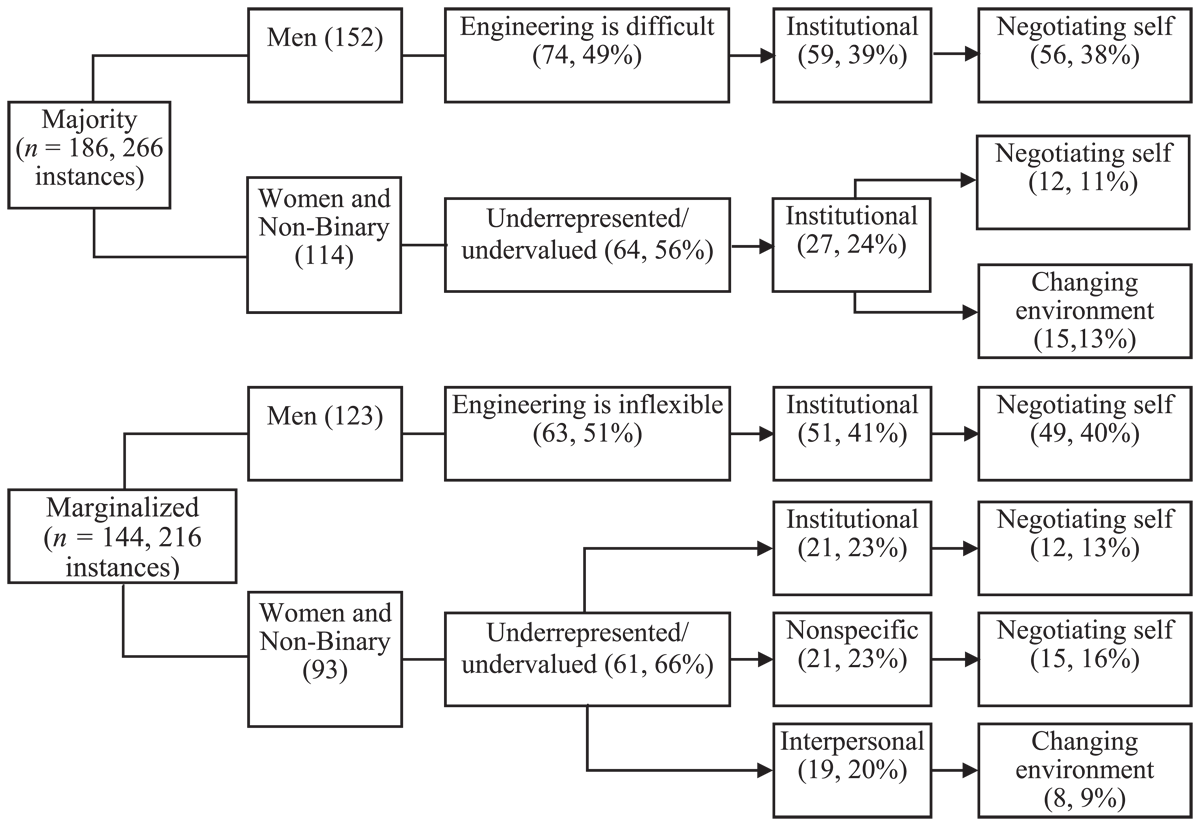
Figure 2
Differences in salient pathways between participants with intersectional racial/ethnic and gender identities.
Women and non-binary participants from both majority and marginalized racial and/or ethnic group also experienced the norm of underrepresentation in engineering or individuals who undervalue them at institutional and interpersonal levels. Majority women and non-binary participants experienced HC at an institutional level, whereas women and non-binary participants from marginalized racial and/or ethnic groups experienced HC similarly at institutional, nonspecific, and interpersonal levels. Women and non-binary participants from majority racial and/or ethnic groups may primarily perceive or experience HC at an institutional level because racialized incidents that contribute to stereotype threat have not primed them to have enhanced awareness (Cadaret et al., 2017). Women and non-binary participants from marginalized racial and/or ethnic groups, on the other hand, may be more perceptive of HC at nonspecific and interpersonal levels and/or experience more HC directly from nonspecific sources in their environments and individuals they can identify (interpersonal) because of their intersectional, marginalized racial and gender identities. Interestingly, women and non-binary participants from majority racial and/or ethnic groups changed their environments because of institutional norms about their gender identities (underrepresentation) slightly more commonly than negotiating their identities to navigate HC. Women and non-binary participants negotiated themselves to navigate both institutional and nonspecific HC. However, women and non-binary participants from marginalized groups changed their environments because of interpersonal HC. Individuals may be more aware of HC directed at their personal identities, especially coming from other individuals, and address HC directly or seek resources to mitigate HC.
5. Discussion
We used an emergent “snapshot” pathway approach to connect HC messages in engineering with the messages’ communicators and strategies to navigate HC. Individuals reported that difficulty, inflexibility, and overt and covert sexism/racism persist in engineering. Only a few individuals reported HC of support and growth in engineering. Participants changed their environments, negotiated themselves, and avoided situations to navigate these HC messages.
Individuals experienced the difficulty of engineering, or rigor, most commonly, particularly in the form of institutional norms, beliefs, and values. This is consistent with previous studies, showing that students find engineering difficult because of a challenging and rigid curriculum (Corbett & Hill, 2015; Erickson, 2007; Simmons & Lord, 2019; Suresh, 2006). Previous research has identified a “survival of the fittest” between students, where only the best students could succeed (Suresh, 2006). The competitiveness in engineering that other studies have described (Secules, 2019) appears in this study as individuals compare their engineering abilities to others’. The “hidden” curriculum is there is a culture to align grades/GPA in engineering and mathematics and the pace at which you can achieve those grades to current and future success. Researchers have noted the consequences of engineering rigor, particularly negative impacts to students’ physical and mental health (Campbell et al., 2018) and students leaving STEM majors (Geisinger & Raman, 2013). This HC was the most common for majority White or Asian, men, where they frequently made no major changes to their strategy or worked harder to overcome HC, aligning with the dominant values of meritocracy in engineering (Erickson, 2007). It is plausible that individuals may not have been completely aware of the source of these messages (e.g., institutional, or historical sources), or may have been unaware of strategies that could challenge messages of engineering difficulty, like curricular changes or simply did not want to make a change. Future research will elucidate the reasons behind their awareness and actions.
We postulate that engineering inflexibility has grown from this rigor in engineering, where responsibilities and interests beyond engineering prevent individuals from fully engaging their abilities in the meritocratic nature of engineering, which research from Riley (2017) supports. Individuals in this study noted a double bind of paying for their engineering education while devoting their focus to their studies. This issue is compounded for individuals who exert additional effort while earning their engineering degrees, like being a parent or juggling stereotype threat (Cadaret et al., 2017). Individuals discussed peers who benefited from social relationships that provided knowledge or insight, yet engineering programs or practitioners did not assist them in developing those relationships. Thus, engineering curriculum privileges those who have existing relationships that lend resources or know how to make those connections, yet engineering does not adequately (or equitably) prepare participants with those skills. Men from both majority racial and/or ethnic groups (e.g., White, Asian, or Middle Eastern) and men from marginalized racial and/or ethnic groups (e.g., Black or Hispanic) commonly reported engineering inflexibility HC from institutional norms, beliefs, and values. These participants developed skills and worked harder to accommodate engineering inflexibility. Therefore, most individuals who experienced inflexibility in engineering placed the burden on themselves to navigate HC, rather than challenge HC itself within engineering. Like those who report HC related to rigor, it may be difficult for individuals to: 1) be aware of where the messages originate, not just the form but also the history and justification of them, and 2) be aware of ways that they can change systems and engineering institutions.
Women and non-binary participants (from both majority and marginalized racial and/or ethnic groups) were commonly marginalized in engineering or undervalued by others. Women and non-binary participants from majority racial and/or ethnic groups are underrepresented through norms and assumptions, yet marginalized women and non-binary participants experience HC from all levels—norms (institutional), interpersonally, and nonspecifically. Women and non-binary individuals from marginalized racial and/or ethnic groups have experiences that could be explained by a couple of different phenomena, such as experiencing more HC because of their intersectional identities. They could also be more perceptive of HC because of stereotype threat from previous racialized and sexist incidents (Cadaret et al., 2017). Regardless, women and non-binary participants from marginalized racial and/or ethnic groups must expend more mental work than others to persist in engineering environments because they carry the mental load of stereotype management (McGee, 2016). Additionally, women and non-binary participants (both from majority and marginalized racial and/or ethnic groups) negotiated themselves and changed their environments to navigate HC. We theorize that because this thread of HC impacts an individual’s personal identity (their racial and/or ethnic or gender identity), rather than their developing professional identity as an engineer, individuals might be more likely to address HC as a self-protective measure. Further, it is likely that participants who receive HC directed at their personal identities, whether institutionally or interpersonally, also experience difficulty and inflexibility in engineering. However, because of the nature of the survey item posed to them, it is difficult to ascertain if they mentioned their experience because it was recent, common, or salient. We will consider analyzing HC experiences this way in the future.
6. Implications and future work
6.1. Implications for administrators and faculty members
The prevalence of institutional messages means that engineering administrators and faculty members can play a significant role in identifying and mitigating harmful values, norms, and beliefs in their programs. Administrators can advocate for more affordable engineering education, support multiple mathematics pathways taken by students, and utilize metrics beyond grades and GPA to denote success, given that we identified these common messages in the participants’ experiences. Faculty members can address the culture in their programs. For example, educational change leaders at the University of Calgary created the Engineering Attributes program for first-year engineering students (Paul et al., 2020). The Engineering Attributes program emphasizes mindfulness, mental wellness, and learning strategies to promote a sense of belonging with other students. By emphasizing a sense of belonging in their institutional culture, they encourage students to collaborate rather than compete, potentially limiting interpersonal HC.
6.2. Implications for researchers
Our pathways approach allowed us to identify the sources of HC, how HC messages impacted participants, and strategies that participants utilized. Others could extend this research to categorize individuals’ navigation strategies to engineering workplaces and in other engineering educational contexts that we did not cover for this work. Further, others could identify communicator-message-strategy pathways to develop targeted professional development for administrators and faculty members, given HC issues in their respective contexts. Additionally, others could use this research to compare with future educational change efforts to determine if institutional change efforts around inequity, for example, permeate into improvements in interpersonal communication of HC over time.
6.3. Implications for engineering students and individuals
From this research, we know that it is common for students to communicate HC to each other, either by comparing themselves to each other or undervaluing peers. We also know that students commonly work harder, change their mentality, develop skills, or do nothing rather than challenge the HC they encounter. Yet, we are aware that individuals challenge HC by addressing issues directly, such as speaking directly with someone who is communicating racist or sexist HC or seeking resources from an academic advisor to overcome an obstacle. So, we encourage those in engineering to become aware of hidden messages in their environments and support each other to commiserate, build solidarity, and challenge these messages. Individuals can do this by constantly asking, reflecting, and questioning the assumptions and intentions behind decisions, norms, and rules.
At the same time, we recognize that individuals who want to change the engineering status quo and unveil HC can face negative consequences and retaliation. We acknowledge that the institutions and administrators should shoulder the principal onus of this cultural shift, rather than individuals.
6.4. Future work
Because this manuscript described responses to the coping self-efficacy item of the UPHEME survey, the next step for our research team is to analyze the self-advocacy items from the UPHEME survey. While some individuals did self-advocate, we need to perform additional work to discuss these connections more in-depth. A limitation of this work was that we excluded approximately two-thirds of participants’ experiences because they were not relevant, or participants did not experience HC. We have begun to address this in ongoing work, where we have published in conference proceedings about participants who are resistant to self-advocacy around HC issues (e.g., Sellers et al., 2023).
Furthermore, we recognize that there may be additional positive HC in engineering if researchers ask participants to respond about values, norms, and attitudes in engineering that have helped them become better or more supportive engineers. This is also a consideration for our future work.
We generated additional research questions from this study. A limitation of our approach was that we could not distinguish whether HC was common or recent. Future research which characterizes HC in engineering would benefit from differentiating these aspects. A future study could ask separate items, such as “What is the most common HC you have experienced in engineering?” and “What is the most memorable HC you have experienced in engineering?” These additional items also may yield more insight into whether participants who experienced nonspecific HC experienced more of it, were more aware of it, or both.
7. Final thoughts
We used a pathways approach to determine that individuals receive HC in engineering in the form of rigor, inflexibility, marginalization, and feeling supported. Individuals experienced HC at the institutional, nonspecific, and interpersonal levels. Some individuals (women and non-binary participants from marginalized racial and/or ethnic groups) reported more HC at interpersonal and nonspecific levels than others (men and women or non-binary individuals from majority racial and/or ethnic groups). Individuals challenged the status quo by enacting strategies to change their environments, perpetuated the status quo by negotiating their abilities or identities, or took minimal action to address a HC message. We hope this research will illuminate opportunities for researchers, administrators and faculty members, and engineering students to be aware of HC messages in their engineering settings and develop strategies to address it.
Acknowledgements
This material is based upon work supported by the National Science Foundation (NSF) No. EEC-1653140 and 2123016 given to the second author. Any opinions, findings, and conclusions or recommendations expressed in this material do not necessarily reflect those of the NSF. We want to give a special thanks to the institutional liaisons, Dr. Hector Cruzado, Dr. Sindia Rivera-Jimenez, Dr. Heather Shipley, Dr. Kimberly Cook-Chennault, and Dr. Paul Barr, who assisted with participant data collection in the first stage of sampling. We also want to thank the participants for sharing their experiences with us and the readers of this work.
Competing Interests
The authors have no competing interests to declare.