
Foreword
The original version of this paper was written between March 2022 and December 2024, with some iterations with the reviewers and editor. At the time of this foreword’s writing and article revision (February–October 2025), the United States (U.S.) was in the midst of a significant paradigm shift in the federal landscape for both research funding and education, allowing us as researchers to see (among many other things) the relevance of federal institutions that provide(d) substantial and stable funding to the U.S.’s academic research and higher education enterprise in general. This relates to an argument we make in this article regarding the (heretofore?) flourishing engineering education research community in the U.S.
As of now, we don’t know how this current political situation is going to play out, nor, of course, the current context in which you are reading this article. Every day brings the announcement of some new nationally or internationally cataclysmic change, so much so that we imagine the heart of this article could seem quaint, trite, maybe even irrelevant. We seem to need to balance acknowledging this moment with remaining grounded in the core goals of the field, such that the current moment does not define our new normal. We have hope that our argument will still have value, even if only as a snapshot of the pre-January 2025 reality perceived when we wrote it.
For readers unfamiliar with the 2025 shifts in U.S. education and funding policies, this year has seen a significant reduction in federal funding for all research areas (Garisto & Nature Magazine, 2025), including educational research, a sharp reduction in the federal workforce (including reductions at agencies that provide funding for engineering and engineering education research) and a sweeping set of changes in research priorities regarding what topics receive funding. At the same time, a series of policies have been enacted that limit or eliminate efforts across all fields and sectors (including education) to address diversity, equity, and inclusion. Both shifts have, obviously, had a significant impact on the U.S. landscape for engineering education research.
In this context, we would like to offer that being in community with one another can help anchor us, can remind us of our shared values, our unshakeable commitments, our collective moral centers. Being in community can give us the strength to do hard things when we are confronted with opportunities to do so. Being in community can help us replace the unsettled and, for many, the unsettling emotions that come with these changes with love, gratitude, and compassion for each other and the natural world, and serve as an antidote to this chaos.
Now, onwards with the paper.
Introduction
Engineering education research (EER) is relatively new in Canada, and there has been a sense among Canadian EER scholars that we are lagging behind EER in the U.S. (Seniuk Cicek, Paul, et al., 2020; Burke et al., 2020). This relative newness, coupled with the epistemological differences between its parent disciplines—engineering and education (Klassen & Case, 2022)—which is endemic to EER, present many internal and external challenges to the community in Canada working within, and trying to develop, the discipline (e.g., Hladik et al., 2023; Hladik et al., Submitted; Paul et al., 2022; Sheridan et al., 2017; Seniuk Cicek & Friesen, 2018; Seniuk Cicek et al., 2016; Seniuk Cicek, Paul, et al., 2020; Seniuk Cicek et al., 2023; Seniuk Cicek et al., 2024; Seniuk Cicek et al., 2017). These difficulties have also been documented in the U.S. (e.g., Allendoerfer et al., 2007; Borrego, 2007a; Coso Strong et al., 2020; Siddiqui et al., 2016). From our Canadian perspective, EER in the U.S. seems to have overcome these challenges, evidenced in their development of EER communities, programs, journals, dedicated funding, and professional pathways (Buckley et al., 2023; London et al., 2021). In areas where EER is still marginalized, like in Australia (Dart et al., 2021) and in Canada, challenges are still present, such as a lack of physical and disciplinary home, dedicated funding, and identity, alongside challenges irrelevant to the U.S. or other regions, such as requirements for professional licensure for engineering faculty. These challenges necessarily impact how the field matures in Canada, and as such, may set the Canadian EER story apart from the U.S.
Comparative research offers nuanced ways to explore, understand, and grow a field (e.g., Case, 2017; Deters et al., 2021, 2023; Klassen et al., 2022; Kumar et al., 2021; Lucena et al., 2008; Strobel et al., 2008; Tang et al., 2023; Valentine & Williams, 2021; Williams et al., 2018). Situating the U.S. as a point of reference for our understanding of EER in Canada is natural due to the U.S.’s geographical and cultural proximity, the national and international EER infrastructure the U.S. has helped establish, and their presence and influence in Canada. Other countries also seem to “gravitate toward, and sometimes look up to, the U.S. models of engineering education” (Tang et al., 2023, p. 31). However, such framing may obscure insights about national contexts that are important to understand the growth of EER both locally and globally, including existing political will and resources, structures and environment, and culture and identity (Kumar et al., 2021). Given Canada’s context and substantially smaller population, this measure may also be unfair and hamper how we advance EER in Canada.
This article offers a nuanced look at EER in Canada and its challenges in its unique context. The central thesis is that because the development of EER in Canada is perceived to lag behind the U.S., EER scholars in Canada should be able to learn from the U.S. experiences to address the challenges in developing the field in Canada. However, the solutions to our challenges must also be contextualized rather than somehow adopted wholesale. We contrast the contextual elements of EER in Canada to the U.S. based on literature, on our scholarship, and on our lived experiences as research and teaching faculty and doctoral students in Canada and, for one of us, as an EER scholar working in the U.S.
We first briefly introduce the major catalysts for the development of EER in the U.S., including organizations, national engineering education projects, funding, accreditation, scholarly research outlets, academic units, career pathways and current EER topics, while discussing their synergies with Canada. We then discuss the challenges of EER in the context of Canada. Drawing on McAlpine’s (2012) identity-trajectory framework, we argue that, in Canada, a lack of home, funding, and identity perpetuates a lack of legitimacy, creating a circular logic that is difficult to break. We observe that while EER in Canada is gradually advancing, it can still benefit by learning from the development of EER in the U.S. We offer ways to help break out of the circular logic and advocate for advancing the unique growth of EER as a legitimate discipline in Canada. Burke et al. (2020) wrote, “a recurring call has been heard for Canadian engineering education to establish its own identity and research agenda, creating spaces to respond to Canada-specific concerns and interests” (p. 90). This article amplifies that call.
Synergies in EER Development between Canada and the U.S.
EER in the U.S. has undergone significant growth in the last 30 years, fueled by changes to organizations, funding, and accreditation, resulting in the development of structures and institutions that secure and advance the field (Borrego & Bernhard, 2011; Haghighi, 2005; Jesiek et al., 2009; Lohmann, 2005; Smith, 2006). Scholars discussing the expansion of disciplines, both generally and engineering education specifically, have argued that the development of entities like professional societies, scholarly research outlets, organizational units within academic institutions, and dedicated external funding sources all serve as growing evidence of, and a foundation for, a maturing field of scientific inquiry (Fensham, 2004; Froyd & Lohmann, 2014; Froyd et al., 2012). EER in the U.S. now demonstrates some of the characteristics of a mature field (Borrego & Bernhard, 2011; London et al., 2021) (although, as we are experiencing currently, these could be tenuous and at risk if/when the supports in place, such as funding and administration, falter).
The surge of EER in the U.S. was propelled by a longstanding desire for change in engineering education, one of several cycles of change in engineering education over the last 150 years (Froyd et al., 2012; Seely, 1999). The recent substantial investments and advancements in EER in the U.S. have established a benchmark for EER scholars in Canada. Here, we discuss EER systems, including organizations, national engineering education projects, funding, accreditation, scholarly research outlets, academic units, career pathways, and current EER topics in the U.S. and Canada.
Organizations
The American Society for Engineering Education (ASEE), founded in 1893 and attracting membership and participation from around the world, prominently supports EER, particularly in the U.S. (ASEE, 2025; Froyd & Lohmann, 2014). ASEE emerged from the Society for the Promotion of Engineering Education (SPEE) to explicitly advance research and innovation (Burke et al. 2020). ASEE funds several publications focused on EER, hosts annual national and regional conferences, and, as early as 1918, commissioned influential reports fundamental in considering engineering education as an area of scholarly inquiry that can be improved through data and analysis (Jamieson & Lohmann, 2009, 2012). Educational Research and Methods (ERM), as the largest division in ASEE, and with its mission focus, has played a prominent organizational role in advancing EER in the U.S. since its evolution in the late 1960s—through co-hosting the Frontiers in Education (FIE) conference with IEEE-Education and associated proceedings, and through its Distinguished Lecture Series, which began in the 1980s (Nawaz et al., 2011)—and can draw hundreds of people at the annual ASEE conference. Scholars in the U.S. and Canada engaged in EER pay specific attention to the ERM Division.
In Canada, we have the Canadian Engineering Education Association—la association Canadienne de l’éducation en genie (CEEA-ACÉG), an organization parallel to ASEE that has been a significant catalyst for the development of EER nationally (2025). CEEA-ACÉG has just over 800 members, in contrast with ASEE’s approximately 9000 members. However, while these numbers are more than an order of magnitude apart, so is the population of Canada to the U.S. (40 million to 340 million as of 2025).
CEEA-ACÉG started in the early 2000s as the Canadian Design Engineering Network (CDEN), primarily focused on creating a national community of practice for engineering design educators (Yellowley et al., 2001). In 2010, CDEN merged with the newly founded CEEA-ACÉG to help engineering educators respond to new Canadian Engineering Education Board (CEAB) outcomes-based accreditation requirements (Burke et al., 2020), which are similar to the ABET learning outcomes (Jesiek et al., 2024) and the Washington Accord graduate attributes (Klassen & Sá, 2020). Consequently, this merger expanded the purpose of the community to include engineering competencies beyond design, and to promote continuous improvement in engineering education across the broader set of knowledge, skills, and behaviors denoted by the 12 CEAB graduate attributes Engineers Canada – ingénieurs canada (n.d.(a)).
Like ASEE, CEEA-ACÉG has an annual conference to stimulate the growth of a vibrant national community and publishes proceedings that are the primary source for EER publications in Canada (Burke et al., 2020). CEEA-ACÉG has grown dramatically over its short lifespan, more than tripling the number of papers from 40 in 2004 to 150 in 2017 (Brennan et al., 2018), with a record-breaking 360+ attendees and 169 peer-reviewed papers in 2025. Despite this growing community, EER activity is unevenly distributed across Canadian educational institutions (Martins-Robalino et al. 2022) and, while most papers have multiple authors, cross-institutional collaborations are not the norm (Bezerra Rodrigues, Paul, et al., 2021). This seems different from the U.S., where, as the discipline was growing, interdisciplinarity served to bridge engineering with education and social science research (Borrego & Newswander, 2008), and growth in EER was supported by federally-funded national multi-institutional projects such as the NSF-funded engineering education coalitions (Borrego, 2007b), and then later, the NSF “Revolutionizing Engineering Departments” (IU.S.E/PFE: RED) program (e.g., Lord et al., 2017; Patrick et al., 2023).
Special Interest Groups (SIGs) (e.g., in design, entrepreneurship, leadership, and development of EER capacity, etc.) are an important component of CEEA-ACÉG and meet throughout the year. SIGs collaborate on different projects and enable the community to be nimble in responding to issues as they emerge. CEEA-ACÉG SIGs are analogous to ASEE Divisions in that they are both groups of people formally organized around common interests and purposes. However, the scale is different: SIGs are generally between 5–30 people and typically rely on the leadership and energy of one or two CEEA-ACÉG members who act as chairs, while Divisions can have hundreds, if not thousands, of people, and leadership positions are generally formal, supported by a professional staff infrastructure of full-time ASEE employees.
National Engineering Education Projects
Given its long history in the U.S.—longer even than the history of the NSF—ASEE (and its precursor, SPEE) has helped begin many important EER-related conversations. In partnership with NSF and other funders, these have resulted in several field-shaping reports and organizational efforts with different lifespans. An illustration of some of these is found in Table 1.
Table 1
ASEE offshoot reports and organizational efforts.
| YEAR | ASEE OFFSHOOT REPORTS & ORGANIZATIONAL EFFORTS | PUBLICATIONS & WEBSITE SOURCES |
|---|---|---|
| 1917 | “A Study of Engineering Education” by Charles R. Mann (“Mann Report”) | https://aseecmsprod.azureedge.net/aseecmsprod/asee/media/content/member%20resources/pdfs/mann_1.pdf |
| 1923 | Wickenden Report | https://aseecmsprod.azureedge.net/aseecmsprod/asee/media/content/member%20resources/pdfs/wickenden-theinvestigationofengred_1.pdf |
| 1939 | “Report of Committee on Aims and Scope of Engineering Curricula” (Hammond Report) | https://aseecmsprod.azureedge.net/aseecmsprod/asee/media/content/member%20resources/reports/hammond-report-1940.pdf |
| 1955 | “Report on the Evaluation of Engineering Education” (Grinter Report) | https://aseecmsprod.azureedge.net/aseecmsprod/asee/media/content/member%20resources/pdfs/the-grinter-report-pdf_1.pdf |
| 1968 | “Goals of Engineering Education” (“ASEE Goals Report”) | https://aseecmsprod.azureedge.net/aseecmsprod/asee/media/content/member%20resources/reports/goals_of_engineering_education.pdf |
| 2006 | Engineering Education Research Colloquies | The National Engineering Education Research Colloquies (2006) |
| 2007 | International Conference on Research in Engineering Education (CREE)—becomes REEN/REES | https://onlinelibrary.wiley.com/doi/pdf/10.1002/j.2168–9830.2007.tb00938.x |
| 2008 | Research in Engineering Education Network and international conference, Research in Engineering Education Symposium (REEN/REES) | https://reen.co |
| 2009–2012 | CCSSIEE—Creating a Culture for Scholarly and Systematic Innovation in Engineering Education | Jamieson & Lohmann (2009, 2012) |
| 2010 | PEER Collaborative (NSF-EEC-1129455) | Pawley et al. (2014) https://sites.google.com/view/peer-collaborative |
| 2011 | Engineering Education Global Community Resource | Carberry & Yasuhara (2025) http://engineeringeducationlist.pbworks.com/w/page/27578912/Engineering%20Education%20Community%20Resource |
| 2017 | Engineering Education Heads and Chairs group | |
| 2019 | Engineering Education Research Mentor Network | https://sites.google.com/view/eermentornetwork/home |
As the CEEA-ACÉG community has grown, offshoot and independent organizations and symposia have also formed (Table 2). These groups, some of which parallel initiatives in the U.S. (e.g., the Harvey Dym Design Workshop and the National Institute for Teaching Effectiveness (NETI)), are also unique to the Canadian EER community and demonstrate its growing interests and needs.
Table 2
CEEA-ACÉG offshoot but independent organizations and symposia.
| YEAR | CEEA-ACÉG OFFSHOOT ORGANIZATIONS/SYMPOSIA | RELEVANT PUBLICATIONS & INTERNET SOURCES |
|---|---|---|
| 2010 | EGAD (Engineering Graduate Attribute Development project) | EGAD (2011a); Frank et al. (2011); Kaupp & Frank (2017) |
| 2014 | Graduate Attribute and Continual Improvement Process Symposium (GACIP) | EGAD (2011b) |
| 2015 | Engineering Change Lab (ECL) | https://engineeringchangelab.ca/ |
| 2015 | Canadian Engineering Education Challenge (CEEC) | Mattucci (2019) |
| 2016 | National Initiative on Capacity Building and Knowledge Creation for Engineering Leadership (NICKEL) | (Troost Institute for Leadership Education in Engineering, 2016) https://news.engineering.utoronto.ca/nickel-national-conversation-engineering-leadership-education/ |
| 2018 | Institute for Engineering Education Research (IEER) and Institute for Engineering Teaching (IET) | https://ceea-aceg.ca/about-ceea-aceg/institute-for-engineering-education-research/ https://ceea-aceg.ca/about-ceea-aceg/institute-for-engineering-teaching/ |
| 2020 | Engineering Collaboration for Online and Remote Education- collaboration pour l’ingénierie enseignée en ligne (E-CORE/CIEL) | Mattucci et al. (2021) https://ceea.ca/about-e-core/ |
| 2021 | Engineering Education Research Snacks | https://ceea.ca/resources-2/ |
| 2022 | Canadian Design Workshop (CDW) | Rennick et al. (2022) https://uwaterloo.ca/canadian-design-workshop/about |
| 2023 | Design Workshop Competency-Based Assessment Symposium | https://smithengineering.queensu.ca/about/teaching-and-learning/events/cba-symposium |
| 2023 | National Engineering Education Ecosystem Project (NEEEP) | Engineering Deans Canada (2023) |
| 2025 | CEEA-ACÉG Future Leaders Academy | https://ceea-aceg.ca/ceea-news/call-for-participants-future-leaders-academy/ |
Funding
A key catalyst to the expansion of EER in the U.S. was increased national-level funding (Lohmann, 2008), specifically from the U.S. National Science Foundation (NSF) (Borrego, 2007b), and its dedicated permanent staff who championed the field (Kemnitzer & Pimmel, 2007). Most NSF funding between 1990–2004 was in the form of awards supporting engineering education coalitions (Borrego, 2007b)—multi-million, multi-institutional, long-term awards to improve undergraduate engineering education. In 2003, the NSF conferred CAREER awards in EER—prestigious, single-investigator awards for early career researchers—paving an important pathway where engineering faculty could conceive of getting tenure doing EER (U.S. National Science Foundation, n.d.). The EER pioneers—by this point, a group of established and prominent faculty from across the globe (Allendoerfer et al., 2016; London et al., 2021)—used the prestige of their national organizations (such as NSF and the National Academy of Engineering) to position EER as legitimate academic work. This support has been noted—and coveted—in Canada. In 2017, Engineers Canada – ingénieurs canada (2017), the national body that supports the provincial and territorial engineering regulators, reported that
…the United States provides U.S.$7 billion annually in federal funding to STEM education, which includes U.S.$105 million through their National Science Foundation for research to improve undergraduate STEM education. In order to remain internationally competitive and better support Canada’s technological aspirations, STEM programs in Canada are seeking to improve their curriculum and program delivery. This is certainly the case for engineering education, a key driver of Canadian competitiveness. Yet the absence of dedicated research funding hinders the ability to study the complex interactions between academia and industry in Canada, the success of Canadian graduates, and the impact of program redevelopment.
Once the EER community in the U.S. had more substantial and regular federal funding, faculty with EER grants could hire graduate students and build associated graduate programs. The impact of steady NSF funding is reflected in the current comparatively large numbers of professional organizations, publishing venues, university departments, researchers, and graduate degrees focused on EER in the U.S. (Klassen et al., 2022).
In contrast, until 2019, EER in Canada was largely indirectly funded by the National Science and Engineering Research Council (NSERC) through the NSERC Chair in Design Engineering (Britton, 2002). NSERC is one of the three national Tri-Council Agency bodies funding federally sponsored research in Canada (the others being the Social Sciences and Humanities Research Council (SSHRC) and the Canadian Institutes of Health Research (CIHR)). The NSERC Design Chair, which started in 2001, awarded $1,000,000 to individual faculty members over five years, intended to improve design pedagogies and outcomes in engineering education in Canada. Design Chairs supported research costs and provided stipends for graduate students, paid for travel to and attendance at the annual CEEA-ACÉG conference, supported the 2009 accreditation transition to the CEAB graduate attributes, and subsequently, spurred the growth of the EER community in Canada. Over its lifecycle (beginning in 2001, ending in 2019, with the final chair expiring in 2023), NSERC supported up to 16 Design Chairs across the country.
In some ways, the Design Chair program was a loophole for EER, as the program was intended to advance design in engineering, but design education could (and did) exist as the context of engineering education. This connection was particularly clear given the change to outcomes-based education for accreditation and the drive to determine how to teach and assess design, one of the 12 CEAB graduate attributes (e.g., Angeles et al., 2011). In response to the discontinuation of the Design Chair program, academic outcry (Evans & Frank, 2018), and Engineers Canada – ingénieurs canada (2017) recommendation to “Ensure better coordination between research granting councils… to support research funding on post-secondary STEM education”, the Tri-Council added a new pilot program that gives researchers the option to choose interdisciplinary peer-review when submitting NSERC or SSHRC applications (B. Frank, personal communication, December 18, 2024) (e.g., Tri-Council Interdisciplinary Peer Review Committee (Government of Canada, 2024)). Whether this interdisciplinary funding pathway works to fund EER remains to be seen. In some institutions, research facilitators warn against choosing the interdisciplinary peer review as it is perceived/experienced as a tougher review process. Overall, even if this pathway for EER funding proves successful, it would be hard-pressed to replace the $16 million available every five years through the 16 NSERC Design Chairs, making the discontinuation of this program a devastating blow to Canadian EER funding pathways.
There are other funding differences between the U.S. and Canada worth noting. In the U.S., teaching assistantships act as the default graduate funding for most early-stage students; in STEM, more senior students tend to move from TA positions into more prestigious, better-paid, and more professionally useful research assistantships. Additionally, most faculty members in the U.S. are paid by their institutions for their work during the academic year, rather than the calendar year (with some institutions breaking that 9- or 10-month salary across 12 months). Academic year faculty do not accrue vacation time but are not expected to be on campus when classes are not in session (or they are not on contract). To be paid over the summer, faculty must find summer funding, including teaching summer classes or acquiring local or federal funding. (Faculty serving administrative roles at large research institutions are usually on 12-month contracts.) These circumstances in the U.S. are different than those in Canada, where faculty members are on 12-month contracts with paid vacation, and graduate student funding comes in a variety of ways (though not guaranteed), including stipends from individual faculty research funds, provincial and national scholarships, and institutional fellowships.
Accreditation
Efforts to mobilize and expand EER gained increased momentum in the U.S. in the late 1990s (Klassen et al., 2022) with ABET’s introduction of new accreditation criteria known as Engineering Criteria 2000 (“EC2000”) in 1996 (Lattuca et al., 2006; Prados et al., 2005). ABET (2021), which accredits natural science, computing, engineering and engineering technology programs in the U.S. and globally, in collaboration with industry and engineering deans, played a crucial role in redefining these essential competencies for future engineers (Case, 2017; Lucena et al., 2008). The reorganization of accreditation shifted engineering degree programs from an input- to an outcomes-based approach; this prompted curricular reforms and scholarly work to assess these changes (Froyd et al., 2012; Volkwein et al., 2004; Volkwein et al., 2007) and explore how to teach and assess engineering outcomes (e.g., Felder et al., 2005; Pfatteicher, 2001; Rogers, 2000; Shuman et al., 2005).
EC2000 had a global impact, influencing, for example, the adoption of the “Graduate Attributes and Competency Profiles” devised by the signatories of the Washington Accord and maintained by the International Engineering Alliance (IEA) (Jesiek et al., 2024, p. 583). This influenced the 12 graduate attributes adopted by the CEAB in 2008 (p. 582). Generally, the “events in the early 1990s sparked a spirit of innovation, a torrent of national meetings and workshops and a worldwide movement toward outcomes-based quality assurance in engineering education” (Passow & Passow, 2017, p. 478). Scholarship of teaching and learning (SoTL) publications (Borrego & Newswander, 2008; Borrego et al., 2008; Prince et al., 2007) were followed by educational research (Olds et al., 2005), the call for the advancement of theoretical understandings (Johri, 2010) and use of robust methods (Case & Light, 2011). The January 2005 issue of the Journal of Engineering Education (JEE) heralded this call to action (Johri & Olds, 2014), echoed in the JEE January 2011 issue (e.g., Borrego & Bernhard, 2011; Johri & Olds, 2011), with a driving emphasis on “rigor” (Borrego, 2007b; Fortenberry, 2006; Steering Committee of the NEERC, 2006; Streveler & Smith, 2006). Indeed, scholars continue to debate the importance of the concept of “rigor” in EER today (Bernhard & Baillie, 2013; Felder & Hadgraft, 2013; Riley, 2017; Buckley et al., 2023).
In Canada, the CEAB adoption of outcomes-based accreditation in 2008 served as an inflection point for EER (Frank et al., 2011). For a generation of engineering educators and researchers, CEAB’s shift brought what was happening with outcomes-based assessment and EC2000 in the U.S. sharply into focus. Similar to the U.S., this marked a departure from the traditional focus on input and course monitoring in Canada, pushing engineering undergraduate programs to focus on student learning and assessment to meet accreditation requirements (Kaupp et al., 2012; Parker et al., 2019; Seniuk Cicek, Renaud, et al., 2020; Seniuk Cicek et al., 2022; Sullivan & Brennan, 2018). However, Canada was the last of the Washington Accord founding members to adopt outcomes-based accreditation (Klassen & Sá, 2020; Lennon & Frank, 2014), and while Canada still grappled with teaching and assessing the 12 CEAB graduate attributes, U.S. engineering educators had transitioned from SoTL supporting outcomes-based assessment to scholarly EER.
Today, another potential inflection point for Canadian EER is on the horizon with the Future of Engineering Accreditation (FEA) project organized by Engineers Canada – ingénieurs canada (2024). This project seeks to investigate and validate the purpose and scope of engineering accreditation in Canada, paving the way for new directions. After several years of diverse national community consultations, considerations included adding Equity, Diversity, Inclusion, and Accessibility (EDIA) language, and/or competencies and ways to advance Truth and Reconciliation with Indigenous Peoples in engineering in Canada (Government of Canada, 2024) to the CEAB graduate attributes.
Scholarly Research Outlets for EER
Several flagship EER journals are published in the U.S., including the Journal of Engineering Education (JEE), Advances in Engineering Education (AEE) (Matusovich & Benson, 2022) and this journal, Studies in Engineering Education (SEE). While these U.S.-based journals theoretically welcome research from across the globe, the majority of research they publish is conducted in the U.S. There are EER journals in other regions, including the European Journal of Engineering Education (EJEE), the International Journal for Engineering Education (IJEE), and the Australasian Journal of Engineering Education, and U.S. research is also published there. The EER field in the U.S. also strongly values the peer-reviewed conference proceedings that come from ASEE’s national and regional conferences (access ASEE PEER (ASEE, n.d.)), and the Frontiers in Education conference (co-hosted by ASEE-ERM and the IEEE Education Society). These conference proceedings are open-source, indexed, and heavily cited in EER scholarship in the U.S. (and other regions, including Canada). EER scholars based in the U.S. have also contributed significantly to the discipline by editing and publishing several foundational textbooks—the Cambridge Handbook of Engineering Education Research (CHEER) (Johri & Olds, 2014) and the International Handbook of Engineering Education Research (Johri, 2023), with the Handbook of Engineering Education Research Methods currently underway.
In contrast, there are few outlets for EER in Canada, and no journals dedicated exclusively to EER. The closest is the Canadian Journal for Science, Mathematics, and Technology Education, in which a special issue on engineering education was published in 2020, advanced by the 2017 CEEA-ACÉG University of Toronto conference committee (see Burke et al., 2020). However, publications seem to focus more on mathematics and pre-secondary education, and it is unclear whether EER scholars in Canada are seeking to publish there. The CEEA-ACÉG conference proceedings are the main source of publication for EER in Canada (access Proceedings of the CEEA, n.d. (a)), although, for many years, authors conducting EER presented their work at ASEE, as there was thought to be no “home” for EER at CEEA-ACÉG. CEEA-ACÉG proceedings are not currently Scopus-indexed, though this is being rectified as part of the duties of the newly appointed CEEA-ACÉG Editor-in-Chief (Proceedings of the CEEA, n.d. (b)).
Academic Programs in EER
While Strobel et al. (2008) reported that the first U.S. PhD in engineering education was issued in 1929 at the University of Iowa, it took until 2009 for there to be four institutions with academic units offering PhDs in engineering education: Purdue, Virginia Tech, Clemson, and Utah State (Benson et al., 2010). (Note: Clemson (2025) has announced that they are awaiting approval to formally close the program, which is unsettling in the current times.) There were more frequent campus-based and national centers supporting EER, with one of the first being the Center for Engineering Learning and Teaching (CELT) at the University of Washington. By 2020, there were 20 U.S. institutions granting degrees in EER (Coso Strong et al., 2020). Seniuk Cicek, Paul, et al. (2020) counted 35 U.S. institutions offering EER or STEM graduate degrees in the Engineering Education Community Resource started by the ASEE Student Division and CELT and maintained by community members (see Carberry & Yasuhara, 2025); by December 2024, this had increased to 41.
In contrast, while there are 44 Canadian institutions with engineering schools, students interested in pursuing a Canadian degree in EER have only two formal options: the Collaborative Specialization in Engineering Education (CSEE) at the University of Toronto (University of Toronto, 2025), effective since 2014, and the Graduate Specialization in Engineering Education (GSEE) at the University of Manitoba (University of Manitoba, n.d.), established in 2020 (Seniuk Cicek et al., 2021) after over five years of effort (e.g., Ingram et al., 2015). The CSEE is offered at both master’s and doctoral levels; the GSEE was initially only offered at the doctoral level due to concerns relating to professional engineering licensure; but in Fall 2024, the GSEE was also formalized at the master’s level (see upcoming section on Professional Engineering (P. Eng.) Licensure).
Both programs are supported by some of the first faculty members who were hired with an explicit mandate to conduct EER in Canada. The University of Manitoba has now opened the first Department of Engineering Education in Canada (Macintosh, 2025). There are faculty at several other institutions in Canada conducting EER (e.g., at Queen’s University, University of Saskatchewan, to name a few), and there are engineering education “areas” and centers contributing to the scholarship of teaching and learning (SoTL) and discipline-based education research (DBER) (e.g., the Universities of British Columbia and Guelph, to name a few). There has also been talk about developing other formal pathways for EER in Canada (e.g., the Universities of Calgary and Alberta); however, change is slow. Nevertheless, despite the small number, newness, and wide geographical distribution of Canadian EER programs, there is a new and active CEEA-ACÉG Student SIG, and in our experience, undergraduate and graduate students have been engaged in EER work across the country for at least two decades (access Friesen (2009) for an early example of doctoral research in EER).
Career Pathways in EER
One of the initial hurdles for U.S. graduate programs was assuring both institutions and potential PhD students that there was a market for graduate degrees in engineering education (Benson et al., 2010). However, since the start, those trained in EER have found numerous potential career paths, including non-academic positions in universities, in government, in not-for-profits, in consulting companies, and as corporate trainers in engineering industries (Coso Strong et al., 2020; McCave et al., 2020). Within higher educational institutions, U.S. graduates are hired into both research and teaching positions, some with additional responsibilities such as student support administration, faculty development, or curriculum development; others go into teaching science and engineering in K–12 settings (Bodnar et al., 2021). Like in other fields, these non-tenure-track faculty positions were not always PhD graduates’ first choices. Scholars continue to report needs for EER pathfinding and fights for legitimacy (Adams et al., 2006; Coso Strong et al., 2023; Giancaspro et al., 2023; Maxey, 2019; Mirabelli et al., 2023).
In Canada, teaching-focused faculty positions in engineering have increased, which Burke et al. (2020) attributed to the growth of EER. These range from “teaching stream or lecturer posts that lead to continuing (or permanent) appointments, to instructor or sessional (temporary) contracts… [and] transdisciplinary teaching-focused positions” (p. 92). Permanent positions come with pathways for promotion and security. Scholars with EER expertise could be at an advantage for these positions since Canadian universities are increasingly requiring broader skills and competencies in addition to traditional, technical engineering expertise. Like their peers in the U.S., recent EER graduates in Canada have found positions in universities, government, not-for-profits, consulting companies, and as corporate trainers in engineering industries. However, as experienced by U.S. EER scholars, career pathways in EER are uncertain, and concerns for offering EER degrees with indeterminate futures have been raised (Seniuk Cicek, Paul, et al., 2020).
EER Publishing Trends
In 2004, participants in the Engineering Education Research Colloquies (EERC) laid out five research areas for engineering education (Table 3). The intent was in part to name both well- and less-established research areas in the U.S. as a guide for the field that was establishing both tenure-track lines and graduate programs.
Table 3
The EERC Research Areas (Special Report, 2006).
| 1. Engineering epistemologies |
| 2. Engineering learning mechanisms |
| 3. Engineering learning systems |
| 4. Engineering diversity and inclusiveness |
| 5. Engineering assessment |
Katz et al. (2023) examined JEE articles from 1993–2022 for evidence of this agenda. They found that, except for the first goal, engineering epistemologies, all research areas were well-covered. They also identified two additional research areas: engineering academic and professional experiences and a catch-all area, encompassing “workforce development and career preparation, community and societal impact, student experiences and perceptions, student support and well-being, and faculty development and experience” (p. 853). They pointed to a growing trend in topics of diversity, equity and inclusion. They noted a decrease in research around engineering assessment and learning systems, though scholars continued to publish work on learning mechanisms (e.g., students’ skills, competencies, cognitive, intellectual development, and student motivation and engagement).
In Canada, Bezerra Rodrigues, Seniuk Cicek, et al. (2021) independently identified seven areas of interest in the CEEA-ACÉG 2019 conference proceedings (e.g., Table 4). The largest area, teaching and learning, accounted for more publications than the other six topics summed together; this trend persisted in 2021 and 2022 (Higher Education and Beyond, 2022). These seven areas map to the five EERC Research Areas plus the two additional areas identified by Katz et al. (2023). Topics of diversity, equity and inclusion, and student well-being have also grown in Canada, and notably different from the U.S. is the growth of the area, Indigenization and decolonization.
Table 4
Areas of Published Research in CEEA-ACÉG 2019 Proceedings (reported from most to least frequent) (Bezerra Rodrigues, Seniuk Cicek, et al., 2021).
| AREA OF RESEARCH | EXAMPLES |
|---|---|
| Teaching and Learning | instructional designs, tools, and methods to improve students’ learning; course, curriculum, or intervention design; project-based, active, and problem-based learning, and flipped classroom; knowledge base for engineering, design, entrepreneurship, diversity, and communication |
| Assessment | self-, formative, and group assessments, and exam formats |
| Students | mental health, recruitment and retention, study behaviors, experiences |
| Faculty | professional development, attitudes, experience |
| Engineering education discipline | current state of the field |
| Organizational | institutional culture and structure, the education system |
| Philosophy of engineering | the nature of engineering and engineering knowledge |
Challenges for EER in the Canadian Context
Bernstein (2000) argued that academic knowledge can be classified as either a singular or region. A singular field, such as mathematics, physics, or sociology, is characterized as being inward-looking and valuing knowledge for knowledge’s sake. Conversely, a region is outward-looking, informed by practice and building on knowledge produced by singulars. Engineering and education are the parent regions of engineering education. EER draws on knowledge, perspectives, tools, norms, epistemologies, values, research methods, and purposes (Adams et al., 2014) from multiple disciplines to answer questions that may not be answered by a singular or region. Klassen and Case (2022) used this Bernsteinian classification to theorize EER as a “second-order region” (p. 4).
Theorizing EER as a second-order region helps us understand some of EER’s internal challenges. Engineering is largely positivist/post-positivist, with singular “truths” being accepted, whereas education draws on a range of epistemologies from positivism to interpretivism to postmodernism, and more. Since the early 2000s, scholars in the U.S. have discussed how these epistemological diversities create internal tensions (e.g., Baillie & Douglas, 2014; Borrego et al., 2009; Koro-Ljungberg & Douglas, 2008), as has EER’s default-position within the positivist engineering paradigm (e.g., Beddoes, 2014; Kellam & Jennings, 2021; Riley, 2017; Yu & Strobel, 2011). Due to this, many newcomers to EER struggle with qualitative methods and quality (Walther et al., 2013).
EER’s position as a second-order region and its inherent epistemological tensions undergird numerous challenges to be navigated, especially in developing EER communities, as is the case in Canada. These challenges include finding a home, funding, identity, and ultimately, legitimacy (Adams et al., 2007; Borrego, 2007b; Coso Strong et al., 2023; Coso Strong et al., 2020; Dart et al., 2019; Dart et al., 2021; Gardner & Willey, 2018; Hladik et al., 2023; Ko et al., 2021; Maxey, 2019; Paul et al., 2022; Seniuk Cicek & Friesen, 2018; Seniuk Cicek et al., 2023; Seniuk Cicek, Paul, et al., 2020; Siddiqui et al., 2016; Streveler et al., 2015; Faber et al., 2017). We argue that EER in Canada is currently caught in a circular logic where, until one of these challenges is resolved, they will continue to perpetuate each other. Additionally, and more optimistically, resolving one has the potential to resolve them all. Either route will impact EER faculty and graduate students. Currently, there are ongoing efforts to emerge from this cycle in Canada, although progress is slow.
We can also apply McAlpine’s (2012) (McAlpine et al., 2014) identity-trajectory framework to think through EER’s tensions. In this framework, graduate student identity is conceptualized through three strands. The intellectual strand focuses on learning within the disciplinary space and the contributions made due to that learning. It consists of past experiences, personal agency, individual ability, and personal circumstances. The institutional strand is defined by the institutional structures and resources, as well as the roles and responsibilities they afford. Theoretically, institutions can both support and constrain students. The networking strand focuses on past and present interpersonal (people, collaborations, and organizations) and intertextual (readings and publications) relationships an individual has or cultivates. Intertwining the intellectual, institutional, and networking strands with an individual’s past and current personal context, agency, and academic development creates an individual’s horizons for action. The horizons for action (i.e., what an individual perceives as possible and/or desirable) and the opportunities that exist (i.e., what an individual knows or understands to be available career opportunities at any given point in time) create an individual’s opportunity structures, ultimately linking the personal and academic components of identity.
In applying McAlpine’s (2012) and McAlpine et al.’s (2014) framework to explore Canadian EER’s constrained legitimacy, we expand Seniuk Cicek et al.’s (2024) argument to theorize that all three identity strands are weak. In contrast with the U.S., EER in Canada does not have a strongly established disciplinary space, which is necessary for the intellectual strand; structures (i.e., physical and disciplinary home) and resources (i.e., funding) are limited or missing, which constrains the institutional strand; and there are few EER scholars, collaborations, communities, and publications, which are important to the networking strand. These missing/weak strands are crucial to identity development, sense of belonging, agency, and perceived opportunities, and we offer, to strengthening the legitimacy of EER scholars and scholarship in Canada.
In the next sections, we ground in evidence our assertions that EER does not have dedicated physical or disciplinary homes, career paths, or funding; we link EER’s identity struggles to these absences, which combine to undermine the legitimacy of EER in Canada.
The Lack of Home
A scholarly community provides essential support to those seeking to become EER scholars (Adams et al., 2006; Bezerra Rodrigues, Paul, et al., 2021; Coso Strong et al., 2020; Cross et al., 2020). In Canada, faculty and graduate students engaging in EER often have appointments and offices or lab space within traditional engineering departments (Seniuk Cicek, Paul, et al., 2020; Seniuk Cicek et al., 2024). They are, therefore, surrounded by other researchers whose day-to-day focus is on conventional engineering research, and who may not understand, appreciate or value EER (Dart et al., 2019; Dart et al., 2021). Coso Strong et al. (2020) and Riley (2017) have described such circumstances in the U.S. as “lone wolf” or “desert island” research, which is familiar to many doing EER in Canada, where, as discussed, there are currently only two institutions with formal homes for EER. Coso Strong et al. (2020) found this lack of community dulls an early career faculty members’ agency, writing, “for those of U.S. who could not find support or felt unsupported by our local communities, the desire to and ability to seek local support faded by the end of our first two years” (p. 112).
Alongside this lack of a physical home, there are few disciplinary homes for EER in Canada. Faculty and graduate students in both the U.S. and Canada come to EER from a variety of fields (Bezerra Rodrigues, Paul, et al., 2021; Seniuk Cicek et al., 2023; Boklage et al., 2019; Coso Strong et al., 2020; Dart et al., 2021), thus bringing diverse philosophical foundations to a discipline already in epistemological tension. This diversity can lead individuals in EER to experience internal tensions, pushing them to re-evaluate their existing ways of understanding/knowing and reconcile them with more unfamiliar ways of knowing supported by unfamiliar methodologies, theories, and terminologies (Hladik et al., 2023; Seniuk Cicek, Paul, et al., 2020). These individual-centered stresses can build into tensions between EER community members who have diverse backgrounds and ways of valuing knowing (Seniuk Cicek et al., 2024), as well as those outside this community. Tensions can be particularly strong between EER and its parent community of engineering, as EER is often housed within engineering faculties (as educating the next generation is part of the moral responsibility of the profession), yet the parent/dominant community may not understand or support the EER community (Hladik et al., 2023; Hladik et al., Submitted; Seniuk Cicek & Friesen, 2018; Seniuk Cicek et al., 2023).
The lack of a disciplinary home also yields a lack of institutionalized policy structures to support EER. To date, in Canada, the authors know of no formally defined processes for tenure and promotion for EER. Faculty housed in traditional engineering departments are likely bound to tenure and promotion processes for traditional engineering disciplines. This mismatch can create stress for EER faculty and exacerbate the potential for unrealistic expectations and/or misunderstandings by tenure and promotion committee members whose norms are very different than those in EER. Burke et al. (2020) described this challenge:
Promotion and review of faculty members in […] teaching positions typically include expectations of teaching excellence and educational leadership. Underlying themes are pedagogical innovation, curricular reform, and contributions and impact through the scholarship of teaching and learning. On the one hand, CEEA-ACÉG conference records indicate that these themes are promoting increased interest and engagement in engineering education research. On the other hand, the housing of engineering education within faculties of engineering highlights the differences between engineering and engineering education research and can create tensions in terms of how engineering education scholarship contributions are understood, perceived, and valued by peers. While scholarship and research activity are not necessarily expected, [they] may become a differentiator at the more senior stages, or in consideration for awards or other recognitions of excellence. (p. 92)
Moreover, in addition to service and teaching, tenure requires the building of a tenable research program that obliges funding and a solid publication record. However, EER does not easily or convincingly live within Canadian national funding agencies’ distinct boundaries (see Lack of Funding, next). Similar to the U.S., EER’s epistemological tensions as the field is developing can pose challenges when disseminating findings across different communities. Researchers in engineering education may be pushed and pulled by the epistemological expectations of EER “gatekeepers,” such as those serving in granting agencies, on research journal editorial boards, or on institutional promotion and tenure committees, as experienced in the U.S. 20 years ago (e.g., Borrego & Newswander, 2008; Douglas et al., 2010; Montfort et al., 2014). Engineering’s positivist epistemological dominance and influence on EER can create expectations for EER to be generalizable, replicable, and predictive, and diminish the value of research approaches based on other epistemologies (Kellam & Jennings, 2021). As such, developing a research program in EER in Canada to support tenure and promotion can be challenging.
As established, there are only two formal pathways for graduate students for EER in Canada; however, these pathways do not (yet) yield EER graduate degrees. As such, processes for EER graduate students may be undefined, and many EER students and their supervisors must adapt to degree programs designed for technical engineering students (Sheridan et al., 2017; Seniuk Cicek & Friesen, 2018; Seniuk Cicek et al., 2024). This mismatch can be challenging for EER students and their supervisors and can result in inadequate EER training (Seniuk Cicek, Paul, et al., 2020).
Further, a positive relationship between students and supervisors can positively influence graduate students’ persistence and success (Cass et al., 2017; Perkins et al., 2019; Stallone, 2004). When an institution does not have a home for EER researchers, graduate students may have to work with supervisors or committee members from different departments or disciplines who may not fully understand EER’s norms, research purposes, or methodologies, which risks negatively impacting the supervisor-student relationship (Seniuk Cicek, Paul, et al., 2020; Siddiqui et al., 2016). Supervisors and committee members who do not recognize the value of EER or the epistemological or research approaches may “encourage” EER students to change their research plans to adjust to their non-EER norms and expectations (Seniuk Cicek & Friesen, 2018), which can thwart innovative EER and the growth of the field. EER students in Canada have been struggling with and fighting for a home and identity within this challenging academic landscape (Paul et al., 2022; Seniuk Cicek, Paul, et al., 2020; Seniuk Cicek et al., 2024).
Absence of Career Pathways
Students who, despite the challenges and informal pathways, stay true to their interests and specialize in EER in Canada face limited and unclear career options. Seniuk Cicek, Paul, et al. (2020) identified the lack of career pathways as one source of tension for students during their programs, arguing, “[al]though we felt a strong personal agency, many of U.S. struggled to imagine possible futures, highlighting the tension between agency and structure” (p. 107). They write, “There is no solid career path—you have to forge your own depending on what you’re passionate about. It is a very risky degree to get…” (p. 107).
There are few explicit academic research positions in Canada focused on EER. To date, the authors know of eight. Many of these are transdisciplinary positions, with researchers evaluated on areas such as communication, leadership, business, entrepreneurship, sustainability, and multidisciplinary design. In such cases, Burke et al. (2020) argue, “there is an even greater potential for disconnection from the expectations, values, norms, and cultures of traditional engineering departments” (p. 92).
As noted, Canada has seen recent growth in teaching-focused faculty positions in engineering programs (Burke et al., 2020) (e.g., the University of Calgary). These sorts of positions can be fulfilling for EER-motivated scholars to improve engineering education; however, they also come with “widely varying career expectations and understandings of how to assess contribution and impact due to the broad teaching agendas” (p. 92). Faculty trained in EER with teaching-focused positions may not have a research mandate and may do EER work “off the side of their desks.” If they do have dedicated research time, the expectations are to engage in “scholarship” (e.g., SoTL) rather than the “scholarship of discovery” (Boyer, 1990) or “rigorous research” (Borrego et al., 2008; Riley, 2017; Streveler et al., 2001; Streveler et al., 2007). Further, regardless of whether they hold the same academic credentials as research faculty, many teaching-focused professors are given only limited ability to supervise graduate students (University of Toronto, n.d.). This further complicates the already varying and/or undefined standards for tenure and promotion.
Professional Engineering (P. Eng.) Licensure
In Canada, academic positions in engineering encourage and sometimes require Professional Engineering (P. Eng.) status, further complicating the pathways into academic careers in EER (Seniuk Cicek et al., 2024). This is in part due to CEAB accreditation, which demands a certain number of credit hours (particularly design credit hours) be taught by P. Engs.
Although P. Eng. requirements vary by Canadian province or territory and are currently undergoing changes, this license had generally required four years of accrued experience as an engineer-in-training (EIT) under the supervision of a P. Eng. Engineers Canada – ingénieurs canada (n.d.(b)). This practice includes hours accumulated while pursuing graduate studies in an engineering technical field; however, for graduate students pursuing EER, these hours typically did not count as EIT work. For example, at the University of Manitoba, when the GSEE was proposed at the master’s level in 2020, the department faculty did not approve this degree because they felt it would dilute the credibility of EIT hours.
Fortunately, in some provinces, acquiring P. Eng. status has recently shifted toward a competency-based system Engineers Canada – ingénieurs canada (2023). This should give EITs more flexibility in acquiring P. Eng. status, and benefit EER graduate students who have engineering degrees and are aiming for academic positions. At the University of Manitoba, this change toward competencies at the provincial level enabled the formalization of the GSEE at the master’s level in 2024.
Lack of Funding
The closure of the NSERC Design Chair program in 2019, discussed earlier in this article, was perceived as a threat to the growth of engineering education and the next generation of EER scholars in Canada by many in the CEEA-ACÉG community. This “defunding” of engineering education and research is/was in stark contrast to the NSF’s intentional and specific EER funding. If we focus on the years after 2000, funding awarded through NSF’s Division of Engineering Education and Centers (EEC) in the Directorate for Engineering (ENG) ranged from approximately $5.7M U.S. in 2001 (the lowest year except for 2025 so far) to $26M in 2017 (the highest amount, except for 2003, when an Engineering Research Center was funded), with $355M U.S. (excluding the ERC) disbursed across almost 25 years (from 2000–June 2025) (see Figure 1).
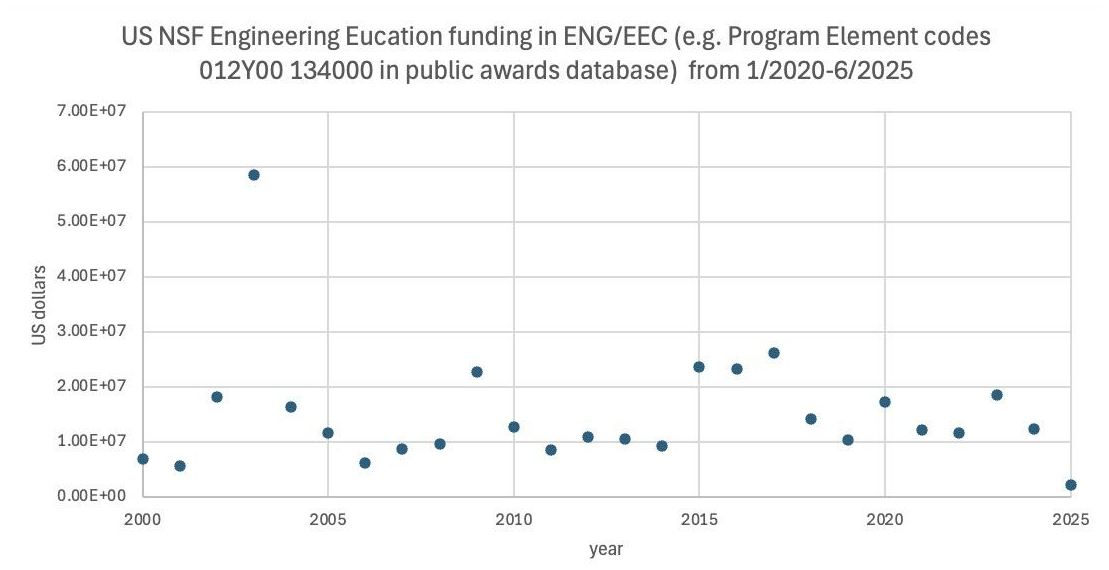
Figure 1
U.S. NSF Engineering Education funding from 2020–2025 in the Directorate for Engineering Education and Centers. (Data drawn from public awards database Using program element codes 012Y00 for the RED program, and 134000 for Engineering Education).
Indeed, federal funding systems for STEM in Canada and the U.S. are patently different:
Canada lags behind many highly industrialized countries in terms of its designated investment in science, technology, engineering, and mathematics (STEM) education research. The U.S.A., in contrast, has recently allocated approximately $100 million annually through the National Science Foundation for research to specifically improve undergraduate STEM education (Engineers Canada—ingénieurs canada, n.d.). At a time in Canadian history when the nature and role of post-secondary education are undergoing substantial transformation, there are few resources and little incentive for engineering education to keep up with the trends, much less innovate. (Burke et al., 2020, p. 92)
When the closure of the NSERC Design Chair was announced, NSERC program officers encouraged engineering education researchers to go to SSHRC (Social Sciences and Humanities Research Council) for funding. While NSERC funds engineering research, SSHRC is responsible for funding education research. This is a challenge for EER, which identifies with both disciplines but resides exclusively in neither, and for EER faculty and students, who conduct research that “may not resonate well with the conventions or perceptions of research excellence of either funding agency” (Burke et al., 2020, p. 92) and are often bypassed by both. Further, SSHRC does not fund the development of practical educational interventions, such as classroom or curriculum innovations, which characterizes much of the work presented at CEEA-ACÉG.
Funding legitimizes and grows a discipline, giving institutions the incentive to provide disciplinary homes and support; the lack of explicit/ targeted EER Tri-Council funding could have far-reaching risks for the discipline in Canada. Engineers Canada – ingénieurs canada sees the risk. The organization published a statement in 2017, urging more funding for Canadian EER:
Despite […] funding challenges, several Canadian universities have established, or are developing, graduate programs and graduate courses in engineering education (e.g. University of Toronto, University of Manitoba and Queen’s University). The majority of these Canadian researchers rely on a patchwork of foundation contracts, donors and industry to support research, and much research is done without any funding whatsoever. It is simply not possible to build engineering education research programs substantively without a consistent and sustainable funding source, so these admirable efforts have limited program development potential. Some schools have created internal funds for educational initiatives; however, these funds are typically small, and they provide little opportunity to learn about how to properly conduct or sustain educational research. Small internal grants also tend to confine knowledge locally and thus limit how widely this knowledge is shared. Most critically, this dearth of funding implies that engineering education research is simply not valued or needed, when in fact the exact opposite is the case, if Canada is to strengthen its world class engineering faculties so as to sustain its global leadership in engineering and a strong economy. (Emphasis added, Engineers Canada—ingénieurs canada, 2017)
Funding remains as critical an issue for EER in Canada in 2025 as it did in 2017.
Lack of Identity in EER
The epistemological tension we described earlier, relating to researchers in EER finding a home in engineering faculties, manifests itself again in the divergent identities with which EER scholars wrestle. As Gardner and Wiley (2018) wrote, “The field of research (FoR) that an academic participates in is both a manifestation of, and a contributor to the development of their identity. When an academic changes that FoR the question then arises as to how they reconcile this change with their identity” (p. 234). This is critical for EER, given that many faculty and students in emergent EER communities come from engineering (Buckley et al., 2023), and engineering has a strong disciplinary identity (Godfrey, 2014; Godwin & Kirn, 2020; Godwin et al., 2016; Tonso, 2014) even as it varies regionally or across different countries (Downey & Lucena, 2004). This strong disciplinary identity can feel in tension with one’s affinity for educational research: Canadian scholars describe how they felt (or were schooled by others to feel) that their EER work was “not engineering enough” and they needed to make their research “more engineering” to appease engineering audiences as well as their own identities (Seniuk Cicek, Paul, et al., 2020). Scholars in the U.S. have argued that this sense that scholars needed to make EER feel more “engineering-y” was part of EER researchers’ efforts to legitimize the field (Borrego, 2007b; Riley, 2017; Streveler & Smith, 2006). In other words, U.S. EER scholars worked hard to intentionally draw analogies between EER and engineering to establish legitimacy with their peers in their established engineering disciplines, as well as to reconcile their own conflicted identities as engineers.
However, this strategy only applies when EER scholars also have identities as engineers; what about EER scholars who came to the field with different disciplinary backgrounds? Tensions in identity development can threaten community members who may have “non-engineering” or “engineering-adjacent” identities or have different perspectives about the prominence engineering should have within EER (Bezerra Rodrigues, Paul, et al., 2021; Hladik et al., 2023; Hladik et al., Submitted; Seniuk Cicek, Paul, et al., 2020). The effect of these tensions risks those without such strong engineering identities feeling they do not belong, or that their work does not have value. EER researchers who are unable to reconcile their existing identities with their new EER identity may experience an “identity crisis” (Allie et al., 2010; Seniuk Cicek, Paul, et al., 2020).
Canadian EER identity development is further slowed by the fact that Canada does not yet support a dedicated EER journal (Burke et al. 2020). This absence limits the impact of EER in Canadian contexts largely to the CEEA-ACÉG conference proceedings, which are not yet Scopus-indexed and therefore difficult for researchers inside or outside the country to learn from. Researchers from Canada must publish EER outside the country, which has occurred infrequently: Wankat (2004) identified only one Canadian author in the 33 most cited JEE articles between 1993 and 2003, and in an analysis of JEE from 1973 to 2003, Wankat et al. (2014) found only 3% of articles included authors from Canada. In an analysis of global trends in EER between 2005–2008, Jesiek et al. (2011) identified 885 papers that qualified as empirical research that were published across four EER journals and three conference proceedings from the U.S., Europe, and Australia; of these, 35% (317) had authors from the U.S., 29% (206) had authors from the European Union, and 23% had authors from Australia, while less than 2% (17) had Canadian authors. This trend has continued: in the Cambridge Handbook of Engineering Education Research, published in 2014, only one author out of 71 was associated with an institution in Canada (with 63 authors working in U.S. institutions), and in the International Handbook of Engineering Education Research, published in 2023, 3 out of 99 were from Canadian institutions. Further, in cross-comparison studies, Canada is rarely identified as an EER region. Such absence of Canadians from the global EER conversation implies there is no Canadian EER at all, potentially discouraging Canadian newcomers to EER, and stunting future growth. These absences all function to challenge Canadian EER identity.
Discussion
As scholars have argued (Jesiek et al., 2009; Nixon, 1967), a discipline’s legitimacy is established when others (e.g., institutions, other disciplines, funding agencies, and publication venues) recognize the uniqueness and importance of the knowledge the discipline produces. By this measure, it appears that EER in the U.S. has established legitimacy (Buckley et al., 2023; London et al., 2021). In contrast, EER in Canada still faces struggles as colleagues and funders question the discipline itself and challenge its value, thereby threatening its growth. These challenges constitute part of a vicious. cycle, a circular logic that reinforces, and in turn is reinforced by, a lack of home, funding, and identity (Figure 2).
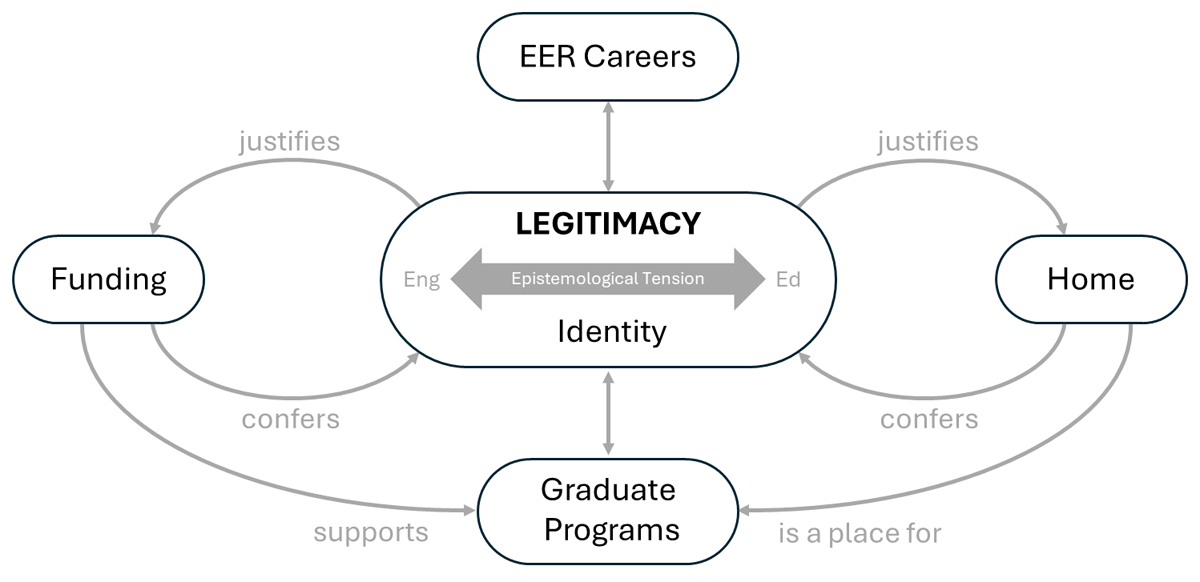
Figure 2
How funding and a home support legitimacy in EER.
We argue that the lack of disciplinary legitimacy for EER in Canada is both affected by and produces institutional and disciplinary homelessness, inadequate funding, and weak identity. This legitimacy tension weighs heavily on graduate students and early career researchers because of the risks they undertake doing underfunded, potentially undervalued work that offers uncertain career pathways and structural barriers of professional evaluation, like misaligned tenure and promotion expectations and attaining P. Eng. status. We see from the case of EER in the U.S. that when a discipline has a “home,” funding, and identity, disciplinary legitimacy can follow, bringing with it a further strengthening of home, funding, and identity. Canadian EER’s absence of stable substantive federal funding, its varied homes for both scholars and the discipline (for many working off the side of their desk), and weak identity continue to (re)produce its disciplinary illegitimacy to others, minimizing the impact it can have on Canadian educators and administrators’ practice of engineering education, and then seeming to justify the continuation of low federal financial support, lack of disciplinary home, and tensions in identity. It is a cycle of illegitimacy that must be interrupted.
Canada’s struggle for legitimacy in EER is not unique (Baillie & Douglas, 2014; Gardner & Wiley, 2019). Interdisciplinary fields have historically faced similar challenges (Christensen et al., 2021; Miller-Young et al., 2025). Are we different in Canada from the U.S., or are we making the same journey, just on a smaller scale? How do we solve Canada’s EER “problem” on our scale and context?
It is for these questions that having other cases of EER development can be helpful, which is why we offer this comparative examination of EER in Canada to the U.S. Despite Canada’s smaller population, the development of EER in Canada follows similar patterns to the development of EER in the U.S. in many ways. Canada’s proximity to the U.S. and the national and international infrastructure of the U.S. can help guide the Canadian EER community to some of the steps required to formalize the field in Canada. Actions, as cited by Burke et al. (2020), can include developing a Canadian EER journal, indexing the CEEA-ACÉG conference proceedings in Scopus (currently underway), continuing to lobby for dedicated EER tri-council funding, seeking other creative avenues for funding (such as through industry partnerships), setting the standards for EER norms and quality to support faculty career pathways and advancement, and increasing the understanding of, and support for, EER within engineering faculties. But Canada still needs strategic directions to develop the intellectual, institutional, and networking strands of EER, and perhaps we can make different choices than the field in the U.S.
A key argument that is made within the paper is the need for EER to have a home. A common route in many of the first engineering education programs that arose in the U.S. was to have a home outside traditional engineering disciplines. However, due to our size, Disciplinary-Based Education Research (DBER) models, with “homes” located inside traditional engineering departments, may provide a legitimizing pathway forward for EER. It is important to acknowledge that this form of “home” for EER exists and perhaps could also be an avenue in Canada (though it does not minimize the educational work that will be necessary to convince other disciplinary colleagues to understand the value of EER).
Additionally, while U.S. EER made choices to argue that EER constituted a type of engineering to gain its legitimacy, perhaps Canadian EER can rely on the legitimacy of EER in the U.S., yet follow paths that better suit the Canadian context. For example, perhaps we do not need to follow the same exclusionary path of EER engineering identity as in the U.S. As well, we can strengthen avenues already mapped toward environmental sustainability and Truth and Reconciliation with Indigenous Peoples, which are arguably unique to, and for whom we can take leadership roles, in Canada. Ultimately, we can seek and strengthen partnerships with community and industry (rather than the military, like in the U.S., Seniuk Cicek et al., 2025), and students and faculty, working together to shape engineering education to benefit those with whom we work, in ways that support our values. As Burke et al. (2020) observed:
Canada needs to develop a stronger and more vibrant community of engineering education researchers if it is to inform and guide the many transitions expected over the coming decade… [there are] compelling justification for engineering education to exist as an identifiable domain within faculties of engineering, [as well as] acute challenge for researchers in the field to mobilize their research to influence activities and actions, even within their own faculty homes. (p. 95)
In many ways, in EER in Canada, we stand in the “shadow of a giant” next to the U.S.: our EER identity is influenced by EER in the U.S., as we draw on U.S.-based journals and conferences supported by U.S. federal funding to advance our research (as we do here). While Canadian EER may never as strongly influence the global EER discipline as does the U.S., or have equivalent funding or comparable infrastructure, it should not be determined by EER in the U.S. If we move out from behind the U.S.’s shadow, perhaps we would learn we do not need the same things. As Buckley and colleagues (2023) argued, “Ultimately, going forward, there is a need to balance the standing on the shoulders of [disciplinary] giants with looking back at our origins and being aware of simultaneously occurring foundational advances” (p. 726). We must (continue to) add our voices and represent Canada on the global EER stage in a way that makes sense to, and is unique for, Canada.
Hopefully, as EER in Canada evolves—by gaining institutional and disciplinary homes, attaining federal and industry funding, and developing identity and legitimacy—those coming into the EER community will not have to go through the same struggles as those who came into an “infant” EER. Building EER capacity is tied to what it means to be an EER researcher: we must work to recognize ourselves. Johri (2010) wrote, “As engineering education scholars, our mission and goals are different than those of practicing engineers. Our scholarly and service objective is to go beyond prescribing solutions to specific problems by developing broader frameworks that can help solve classes of problems and can shed light on global themes of problem-solving” (p. 184). In a mature EER, those new to the field will not have to hold tight to their engineering identity for the sake of legitimacy, nor prove themselves worthy when they come from other disciplines; EER in Canada will exist within its own right. This now seems to be the case for EER in the U.S., where EER scholars have prominent identities on the world stage, and scholars with PhDs in EER have started to grow the next generation (Buckley et al., 2023). This, too, can be the case in Canada.
Conclusion
While the development of EER in Canada has followed some similar patterns as EER in the U.S. due to the countries’ physical and cultural proximity, and the national and international EER infrastructure the U.S. has helped establish, EER in Canada should not follow in lock-step. There are important differences in Canada’s engineering education system compared to the U.S., such as P. Eng. requirements, a different funding climate, and different national interests. Instead, the EER community in Canada can learn from the development of EER in the U.S. and lean on the global EER infrastructure in a way that makes sense to help EER in the Canadian context gain legitimacy, and then further resources and security both for the current and next generation of EER scholars from Canada.
Our aim is for this article to contribute to a national and global understanding of EER in Canada, informed by a comparative look at EER in the U.S. We hope that this understanding inspires the development of a uniquely Canadian strategy to stimulate the growth of EER in Canada, to better support the development of the next generation of EER scholars, and to contribute the Canadian perspective to the global EER stage.
Afterword
In today’s political climate in the U.S., perhaps reading more about the Canadian landscape and the efforts of the Canadian EER community can reaffirm our readers’ confidence in, and hope for, the field in the U.S. and globally. There is much the U.S. and Canada can learn from each other, and much for contemporary EER researchers in the U.S. (who, one might argue, have had it comparatively “easy” in many ways) can learn from the rest of the world.
Academics in Canada, by contrast, should see the U.S. as a cautionary tale, for just as we have been “catching up” to the U.S. in EER, so too we seem to be “catching up” to the U.S. in politics (e.g., Greer, 2025; Liddle, 2025; MacKinnon, 2025). In community with our national and international neighbors, we academics in Canada must resist the growing political state.
Acknowledgements
We are very grateful to the reviewers for their valuable feedback as we developed this article, and to the editors for their patience and support. It is difficult for us to acknowledge that our dear colleague, friend, and for one of us, our dad, Jeffrey W. Paul, is now deceased. Jeff was uncontainably passionate about engineering education and research, and worked tirelessly on cycles of this article from 2022 until his untimely passing in February 2025. It was an honour and a privilege to work with, know, and love, Jeff. We dedicate this article to Jeff, and to all those who are passionate about advancing EER. May you all find joy in this journey.
Competing Interests
Alice L. Pawley is currently serving as a program officer for the Division of Engineering Education and Centers at the U.S. National Science Foundation. Her rotation began in May 2024 and is paid for through the NSF award EEC-2432515 to Purdue University, where Pawley remains a faculty member of the School of Engineering Education. The other authors have no competing interests to declare.
Author Contributions
This paper has undergone multiple revisions and has developed over the years through the authors’ diverse collaborations and intersecting work. Jill, Robyn, and Patricia have collaborated since 2015, initially as graduate students and later as faculty, and much of the research on EER in Canada supporting this work is theirs. Jeff, Renato, and Jill worked closely together on the development and iterations of the first several versions of this article, beginning in 2022. Alice joined the team in 2023 and has worked closely with Jill on the article since then, particularly supporting the elements of the development of EER in the U.S. Grammarly was used to check the final version for mechanical errors.