
In 2020, 580 service members died by suicide (Under Secretary of Defense for Personnel and Readiness, 2021) and in 2019, there was 6,261 veteran suicide deaths (Office of Military Health and Sucide Prevention [OMHSP], 2021). As of 2019, there was 19.8 million veterans in the US (OMHSP, 2021). Veterans between 18–34 years old have the highest rates of suicide, with suicide rates for males being substantially higher than women veterans (OMHSP, 2021). Additionally, research has highlighted that veteran populations experience different risk factors for suicide compared to civilian samples, such as physical health problems or the death of a friend or family member (Wood et al., 2020). Due to the high rates of suicide among veteran populations, and that risk factors differ between civilian and veteran populations, it is necessary to continue studying veteran populations at risk for suicide. Consequently, this study evaluated if affective depression and somatic depression mediates the relationship between posttraumatic stress disorder (PTSD) and suicidal behaviors among a sample of post-9/11 combat veterans.
PTSD and Suicidal Ideation
PTSD is a diagnosable condition that results from experiencing a traumatic event, either directly, witnessing it, learning about the event, or repeated exposure to aversive details of the event. Symptoms of PTSD include intrusive memories, avoidance of stimuli related to the event, negative cognitions or mood, diminished interest, detachment from others, and hypervigilance (American Psychiatric Association [APA], 2013). A meta-analysis found that 23% of Operation Iraqi Freedom and Operation Enduring Freedom veterans suffer from PTSD (Fulton et al., 2015), while 12% of Gulf War and 30% of Vietnam veterans experience PTSD in a given year (National Center for PTSD, 2022; Tanielian & Jaycox, 2008). Due to the nature of their career, veterans who have served in combat, where they are often exposed to life-threatening experiences, were at an increased risk of PTSD (Xue, et al, 2015). Additionally, other factors that influence veterans are politics surrounding the war, location of the war, and who the war was against (National Center for PTSD, 2022). Repeated exposure to traumatic events can also increase the risk for PTSD. Quite often, military members are required to serve in combat for multiple rotations, which can indicate repeated exposure to trauma. With rates of PTSD being twice as high in military populations than in civilians (13.8% versus 6.8%), it is especially important to study the relationship between PTSD and suicidality among service members and veterans (Bullman et al., 2019; Rugo-Cook et al., 2021).
PTSD has been linked to suicide attempts and suicidal ideation (Krysinska & Lester, 2010). Combat-related PTSD and experiencing combat-related guilt are predictors of suicide attempts and suicidal preoccupation (Hendin & Haas, 1991). A systematic review highlighted the need for researchers to continue exploring moderators and mediators of the relationship between PTSD and suicidality (Stanley et al., 2018). Additionally, a narrative review of studies examining the relationship between PTSD and suicidality suggested the need to consider “a complexly interconnected network of risk at multiple levels … in contrast to unidimensional and single-factor approach that has dominated research and practice to date” (Rugo-Cook, 2021, p. 1089). Given that there is a connection between PTSD and suicidal ideation and attempts (e.g., Rugo-Cook et al., 2021), and previous research has called for continued exploration of potential mediators and moderators of the relationship between PTSD and suicidality (Stanley et al., 2018), this study examined somatic and affective depression as potential mediators between PTSD and suicidal behaviors.
Somatic Versus Affective Depression
The National Institute of Mental Health (2023) operationalized depression as “a common, but serious mood disorder” (para. 1) that affects feelings, cognitions, and somatic presentations. Depression has been found to be a significant risk factor for suicidal ideation (Carr et al., 2013). Additionally, approximately half of veterans with PTSD have also met the diagnostic criteria for Major Depressive Disorder (Rytwinski et al., 2013). According to at meta-analysis, depression rates among military personnel were up to five times higher than in the civilian population, with depression mediating the relationship between PTSD and somatic complaints (Sikharulidze et al., 2017).
Depressive symptoms can have a somatic or affective presentation (APA, 2013). Somatic symptoms include fatigue, decreased appetite, uncomfortable body sensations, difficulties with memory and concentration, muscle tension, elevated heart rate, hyperventilation, shaking, and nausea (Carr et al., 2013; Cheng et al., 2018). Affective symptoms include sadness, hopelessness, excessive guilt, and difficulty making decisions (Carr et al., 2013). In other words, somatic depressive symptoms are related to body sensations and presentations, while affective depressive symptoms are associated with feelings and emotions.
Research has connected somatic and affective depression with higher mortality rates in patients with acute coronary syndrome (Roest et al, 2011), cardiovascular disease (de Miranda Azevedo et al., 2014), myocardial infraction (de Jonge et al., 2006), and chronic heart failure (Schiffer et al., 2009). There is limited research that distinguishes affective and somatic depressive symptoms, and their effect on various mental health outcomes. One study that examined PTSD and suicidal ideation in low-income African American women found that affective components of depression, but not the somatic components of depression, mediated the relationship between PTSD and suicidal ideation (Carr et al., 2013). Similarly, a recent study on first responders also found that affective depression mediated the relationship between PTSD and suicidality, whereas somatic depression did not (Whitworth et al., 2023). To date, no study has examined affective and somatic depressive symptoms as a mediator between PTSD and suicidality among a post-9/11 combat veteran population.
Theoretical Framework
Only a fraction of deaths by suicide occurs among people who previously reported suicidal ideation (Bryan et al., 2018). Similar trends can be seen in military populations, with only third of military personnel reporting suicidal ideation before the attempt happens (Pruitt et al., 2015). These findings are striking, as the main tool of national suicide prevention strategies includes suicide assessments that screen for suicidal thoughts as one of the main risk factors preceding suicide attempts (Bryan et al., 2018, Franklin et al., 2017). Thus, there is a need for the framework that can distinguish between suicidal thoughts and desires. Ideation-to-action frameworks address this need by introducing theories that focus on transition from suicidal thoughts to behaviors (Klonsky et al., 2016). Within ideation-to-action theories, Fluid Vulnerability Theory (FVT; Rudd et al., 2006) is one of the most researched frameworks among military populations.
FVT offers a novel view on formation of suicidal behaviors while considering personal and unique vulnerabilities as potential drivers of the transition from suicidal thoughts to suicidal actions. FVT considers the interaction between risk and protective factors that can contribute to, or prevent, that transition. The risk variables in FVT are divided into static risk factors that include multiple characteristics with which the person was born and that are hard or impossible to change (e.g., genetic or racial factors) and dynamic risk factors that are more fluid and changeable throughout the lifespan (e.g., unemployment, involvement in romantic relationship, or social support; Bryan et al., 2018). FVT hypothesizes that the shift from suicidal ideation to suicidal behavior occurs as a result of complex and interconnected “change processes between cognitive, behavioral, affective, and psychological domains of risk” (Bryan & Rudd, 2016, p. 24).
The benefit of FVT is that it views suicidality as a complex and multisystemic phenomenon and distinguishes that every person might be on their own unique “trajectory” from suicidal thoughts to behaviors depending on the vulnerabilities they have. When viewing suicidality from this perspective, “mental health professionals might be able to adjust their interventions based on the severity of risk and the unique combination of static and dynamic risk factors” (Bryan et al., 2018, p. 416). FVT has been used as a framework to study US active-duty soldiers with suicidal ideation (Bryan et al., 2016, 2018; Bryan & Rudd, 2016). By utilizing FVT, one can examine multiple constructs such as PTSD, somatic depression, and affective depression that may relate to suicide, as well as how these factors may influence one another regarding suicidal behaviors.
The Present Study
Given that veterans are at high risk for suicide, and both depression and PTSD have been linked to suicide rates, further examination of the interrelatedness of these symptoms warrants continued scholarship. To that end, FVT highlights the importance of examining multiple factors that may be associated with suicide, as well as the multidimensional aspect of how multiple factors may interact with one another. Past research suggests there may be differences in the effects of somatic and affective depression (Carbajal & Ponder, 2022; Carr et al., 2013), and this is the first study to examine differences among affective and somatic depression among a veteran sample. Therefore, this study seeks to address the following research question: Will affective depression or somatic depression mediate the relationship between PTSD to suicidality in a sample of post-9/11 combat veterans?
Method
Participants
This sample was comprised of 173 treatment seeking post-9/11 combat veterans who served in the US military. The average age was 36.65 years old (SD = 7.38), were mostly white (65.2%), served in the Army (51.5%), male (89.0%), and had an average of 8.48 (SD = 5.99) years of military service. The first deployment 68.7% (n = 119) was to Iraq and 31.2% (n = 54) to Afghanistan. All participants served at least one deployment, 30.1% (n = 52) served two deployments, 13.2% (n = 23) served three deployments, 2.3% (n = 4) served four deployments, and 3.5% (n = 6) served five deployments. The majority of the sample was discharged from the military 71.1% (n = 123). See Table 1 for sample demographics.
Table 1
Sample Demographics.
| POST-9/11 COMBAT VETERANS (N = 173) | |
|---|---|
| Age (Years) | |
| Mean | 36.65 |
| Median | 35.00 |
| SD | 7.38 |
| Range | 37.0 |
| Time in service (years) | |
| Mean | 8.48 |
| Median | 7.00 |
| SD | 5.99 |
| Range | 35.5 |
| Military branch n(%) | |
| Air Force | 16(9.2%) |
| Army | 89(51.5%) |
| Navy | 16(9.2%) |
| Marine Corps | 48(27.8%) |
| Coast Guard | 1(0.6%) |
| Multiple branches | 3(1.7%) |
| Service status n(%) | |
| Active | 11(6.5%) |
| Discharged | 123(71.1%) |
| Reserve | 9(5.2%) |
| Retired | 30(17.2%) |
| Number of deployments n(%) | |
| One | 88(50.9%) |
| Two | 52(30.1%) |
| Three | 23(13.2%) |
| Four | 4(2.3%) |
| Five | 6(3.5%) |
| Gender n(%) | |
| Women | 19(11.0%) |
| Men | 154(89.0%) |
| Ethnicity n(%) | |
| African American/Black | 22(12.7%) |
| Asian American | 2(1.2%) |
| Hawaiian/Pacific Islander | 1(0.6%) |
| Latino(a)/Hispanic | 29(16.8%) |
| Multiple Ethnicities | 5(2.9%) |
| Other | 1(0.6%) |
| White | 113(65.2%) |
Procedure
The data for this manuscript were collected between 2015–2021 at a nonprofit organization that serves veterans, first responders, frontline healthcare workers, and their families. These data were collected at the client’s first appointment with the intake manager before being assigned their therapist. They completed demographic documentation along with standardized assessments. Inclusion criteria for veterans to be included in this manuscript were that there are no missing values, participants had a combat deployment post-9/11, and were over the age of 18. This secondary data analysis was approved by the University of Texas Health Science Center Institutional Review Board (HSC-SPH-20-1264).
Measures
Suicidal Behaviors
Osman et al. (2001) developed and validated the Suicidal Behaviors Questionnaire-Revised (SBQ-R) to screen for suicide. It is a 4-item assessment that produces an aggregated scores that range from 3 to 18, with higher scores indicating greater risk of suicide. An example question is, “Have you ever thought about or attempted to kill yourself?” In the current study, the Cronbach’s alpha of the SBQ-R was α = .82.
PTSD
The PTSD Checklist-5 (PCL-5) was developed and validated to screen for the presence of PTSD (Blevins et al., 2015). The PCL-5 has been validated on treatment seeking veterans (Ahmadi et al., 2023). The PCL-5 has 20-questions that are on a Likert scale ranging from 0 (not at all) to 4 (extremely). The summed scores range from 0 to 80, with higher scores indicating more severe PTSD symptoms. An example question for this scale is, “In the past month, how much were you bothered by: Repeated disturbing, and unwanted memories of the stressful experience?” Aggregated scores of 33 or greater are indicative of a probable PTSD diagnosis (Bovin et al., 2016). In the current study, the Cronbach’s alpha of the PCL-5 was α = .95.
Somatic and Affective Depression
The Patient Health Questionniare-8 (PHQ-8) was developed to assess for the presence of depression (Kroenke et al., 2009). The PHQ-8 item-level responses range from 0 (not at all) to 3 (nearly every day). The summed score ranges from 0 to 24; the higher the aggregated score, the greater severity of depression. An example question from the PHQ-9 includes, “Over the last2 weeks, how often have you been bothered by any of the following problems? Little interest or pleasure in doing things.” Depression scores are considered not significant (0–4), mild (5–9), moderate 10–14, moderately severe 15–19, and severe 20–24 (Kroenke et al., 2009). Questions one, two, and six load onto the latent affective factor, whereas questions three, four, five, seven, and eight load onto the somatic factor. In the current study, the affective factor Cronbach’s alpha of the PHQ-8 was α = .80 and the somatic factor Cronbach’s alpha of the PHQ-8 was α = .83.
Generalized Anxiety Disorder
The Generalized Anxiety Disorder-7 (GAD-7) was developed and validated by Spitzer et al. (2006) to assess for Generalized Anxiety Disorder (GAD). The GAD-7 has been validated on treatment seeking veterans (Ahmadi et al., 2023). Aggregated scores on the GAD-7 can range from 0 to 21 with item level responses range from 0 (not at all) to 3 (nearly every day). The higher the score, the more severe the generalized anxiety. Scores are considered minimal if the aggregated score range between 0–4, mild between 5–9, moderate 10–14, and severe if between 15–21 (Spitzer et al., 2006). In the current study, the Cronbach’s alpha of the GAD-7 was α = .91.
Data Analytic Plan
Statistical analyses were conducted using the Statistical Package for the Social Sciences (SPSS) version 26.0. There were no missing values in this study and the data met the assumptions of normality (Hair et al., 2010). Demographic variables such as length of service, age, gender, race, relationship status, length of relationship, military branch, service status, rank, number of deployments, and deployment location were not statistically significant with suicide (SBQ-R) at the .05 level of significance.
First, we established the bivariate relationship between suicidal behaviors, PTSD, affective depression, and somatic depression by correlational analyses (Pearson’s r) among demographic variables (e.g., age, length of military service, number of combat deployments). None of the variables were statistically significant (p < .05) with suicidal behaviors; consequently, they were not controlled for in the simple mediation models. Next, we tested for mediation, using Hayes’ (2018) PROCESS macro version 3.5. In total, there were two simple mediation models. In the first simple mediation model, PTSD was the predictor variable, affective depression as the mediator, and suicidal behaviors was the dependent variable. In the second simple mediation model, PTSD was the predictor, somatic depression as the mediator, and the dependent variable was suicidal behaviors. In both models, generalized anxiety was controlled for as a covariate because it frequently co-occurs with depression and PTSD (Price & van Stolk-Cooke, 2015). Path coefficients for direct, indirect, and total effects for the relationship between the independent variable (PTSD), mediators (affective depression or somatic depression), and dependent variable (suicidal behaviors) were estimated by the macro command as suggested by Hayes (2018). This macro uses the bootstrap test, which is used to evaluate the indirect effects (5,000 samples) with a confidence interval (CI) set at 95%. All coefficients for the mediation models are standardized.
Results
Descriptive Statistics
The mean score for suicidal behaviors was 6.10 (SD = 3.62) and 28.9% (n = 50) scored 8 or greater, which is the recommended cutoff score in a clinical population. The mean score for generalized anxiety was 12.54 (SD = 5.78). Of the veterans in this sample, 9.8% (n = 17) have minimal, 21.4% (n = 37) mild, 26.0% (n = 45) moderate, and 42.8% (n = 74) have severe generalized anxiety. The mean affective depression score was 4.90 (SD = 2.71) and the mean somatic depression score was 8.44 (SD = 4.14). Of the veterans in this sample, 10.4% (n = 18) have minimal, 20.2% (n = 35) mild, 18.5% (n = 32) moderate, 23.7% (n = 41) moderately severe, and 27.2% (n = 47) have severe depression. The mean PTSD score was 40.82 (SD = 19.83) and applying the recommended cutoff score, 65.9% (n = 114) screen positive for probable PTSD.
Correlations
Suicidal behaviors was significantly correlated with the generalized anxiety r(173) = .38, p < .001, PTSD r(173) = .42, p < .001, affective depression r(173) = .44, p < .001, and somatic depression r(173) = .31, p < .001. See Table 2.
Table 2
Post 9/11 Combat Veterans (n = 173) correlations.
| SBQ-R | GAD-7 | PCL-5 | AFFECTIVE | SOMATIC | |
|---|---|---|---|---|---|
| SBQ-R | 1 | .38*** | .42*** | .44*** | .31*** |
| GAD-7 | 1 | .71*** | .73*** | .79*** | |
| PCL-5 | 1 | .69*** | .73*** | ||
| Affective | 1 | .77*** | |||
| Somatic | 1 |
[i] Note. SBQ-R = Suicidal Behaviors Questionnaire-Revised; GAD-7 = Generalized Anxiety Disorder-7; PCL-5 = PTSD Checklist-5; Affective Depression = Patient Health Questionaire-8 questions 1 [anhedonia], 2 [depressed mood], 6 [feelings of worthlessness]; Somatic Depression (PHQ-8 questions 3 [sleep difficulties], 4 [fatigue], 5 [appetite changes], 7 [concentration difficulties], 8 [psychmotor agitation]). *** < .001, ** < .01, * < .05 (two tailed).
Simple Mediation Models
To determine if affective depression or somatic depression mediate the relationship between PTSD and suicidality in a sample of post-9/11 combat veterans, a simple mediation analysis was preformed using PROCESS. The standardized indirect effect of PTSD through affective depression to suicide was found to be statistically significant (B = .10 [.04], 95% CI [.03, .20]). However, the standardized indirect effect of PTSD through somatic depression to suicide was not statistically significant (B = –.04 [.05], 95% CI [–.15, .05]). See Figure 1.
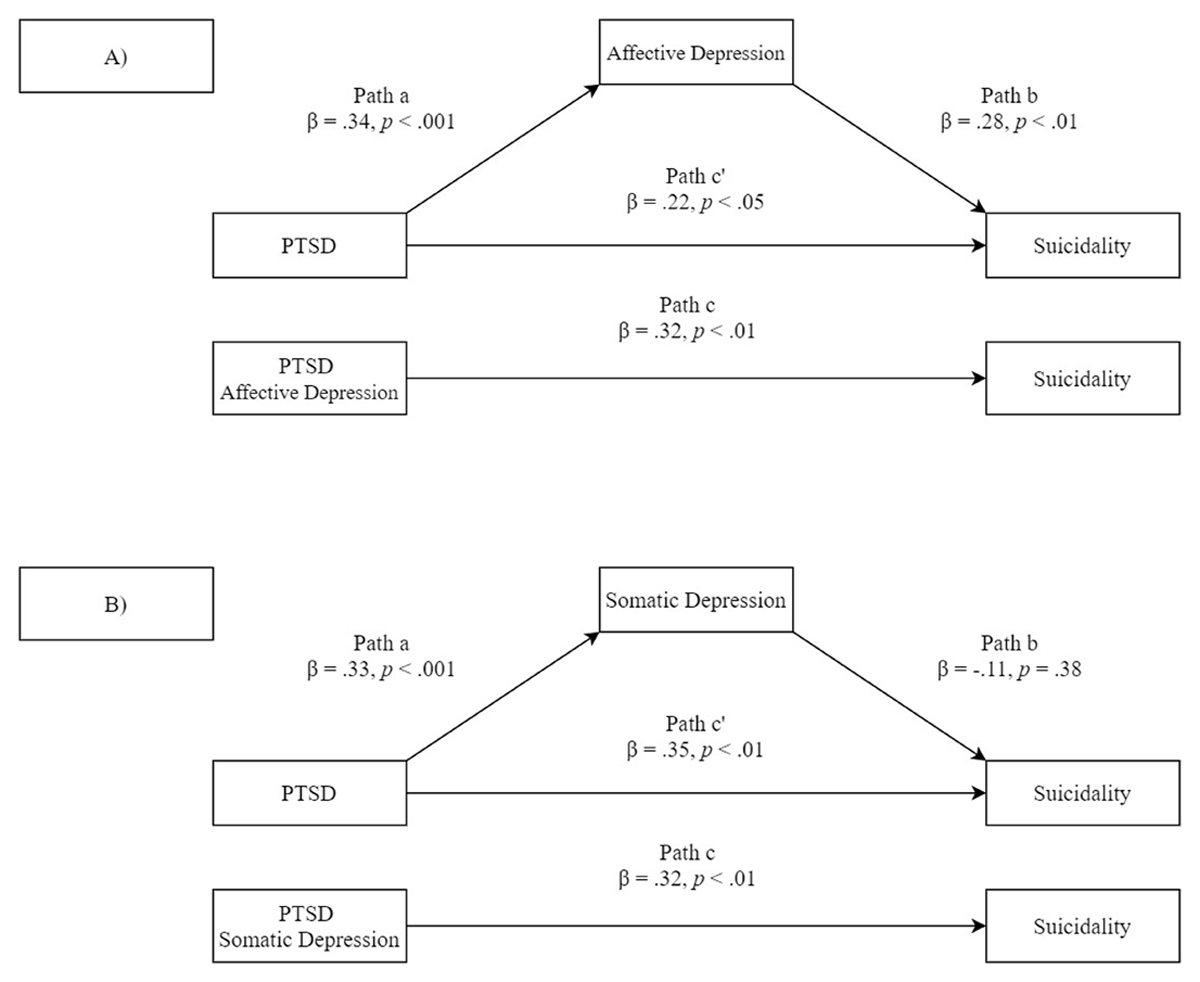
Figure 1
Post-9/11 combat veteran (n = 173) simple mediation model.
Note. PTSD (PCL-5) = the independent variable (X); Suicidality (SBQ-R) = the dependent variable (Y); Affective Depression (PHQ-8 questions 1 [anhedonia], 2 [depressed mood], 6 [feelings of worthlessness] = the mediator (M) on panel A; Somatic Depression (PHQ-8 questions 3 [sleep difficulties], 4 [fatigue], 5 [appetite changes], 7 [concentration difficulties], 8 [psychmotor agitation]) = the mediator (M) on panel B; Path c = the total effect of X on Y; path c’ = the direct effect of X on Y; Path a + Path b = the indirect effect of X on Y through M.
Discussion
This study sought to examine if somatic or affective depression mediated the relationship between PTSD and suicidal behaviors in a sample of post-9/11 combat veterans. This study found that generalized anxiety, PTSD, somatic depression, and affective depression were significantly correlated with suicidal behaviors. Most importantly, results indicate that affective depression symptoms significantly mediated the relationship between PTSD and suicidal behaviors, while somatic depression did not.
We found that among combat veterans, suicidal behaviors were significantly correlated with generalized anxiety, and these findings are in accordance with other studies on the relationship between generalized anxiety and suicidal behaviors in military personnel and war veterans (Conner et al., 2007; Fanning & Pietrzak, 2013; Kanwar et al., 2013; Matarazzo et al., 2014; Stanley et al., 2018). We also found a significant, positive relationship between PTSD and suicidal behaviors, which was not surprising given the research highlighting the relationship between these two variables (Krysinska & Lester, 2010). Our study also found significant correlation between somatic depression, affective depression, and suicidal ideation. Affective depression was found to have a stronger correlation with suicidal ideation compared to somatic depression.
With respect to mediation results, we found that affective depression mediated the relationship between PTSD and suicidal behaviors, while somatic depression symptoms did not. This result is consistent with previous research that found a similar trend in differing populations (Carbajal & Ponder, 2022; Carr et al., 2013; Whitworth et al., 2023). Although prior research suggests clear associations between PTSD and suicidal behavior in service members and veterans, information on mediating and moderating variables on this association is generally lacking (Bryan et al., 2020; Bryan et al., 2015; Sinclair et al., 2016). Our study offers a novel view on the nature of this relationship through the prism of affective depression as an important factor contributing to suicidality in combat veterans. FVT can help explain a significant portion of our findings, as it hypothesizes the transition to suicidal thoughts and behaviors as nonlinear and complex, including a comprehensive interaction between affective, cognitive, behavioral, and psychological risk domains (Bryan et al., 2018). By following the FVT, our study offers further insight into the nature of relationships between affective depression and suicide in combat veterans, and provides a confirmation of the crucial effect of the affective domain in such a transition.
Clinical Implications
Findings from this study can be useful in assessment, treatment, and conceptualizing the relationship between PTSD and suicidal behaviors. In the selection of assessments and questionnaires being utilized in healthcare settings, professionals need to be cognizant of the types of questions being asked. Based on this study, knowing if assessment questions pertain to affective or somatic depression is valuable. The focus on subjective symptoms is important because this can assist the healthcare professional in a patient-centered approach for suicidal ideation (Keilp, et al, 2018), and recognizing that treatment for depression is not universal. Essentially, this study highlights the importance of examining the different types of depressive symptoms, which may be useful when working with veteran populations with PTSD and/or having suicidal ideation/behaviors.
Limitations and Future Research
This study is not without limitations. First, the sample used in the analysis only includes post-9/11 combat veterans who are treatment seeking. The results from this study may not be able to be generalized to veterans from earlier wars, or veterans who are not actively seeking resources or treatment. Another limitation is that the sample was heterogeneous as it was majority White (65.2%), male (89%), and an average age of 36-years-old, which may also limit the generalizability of the findings. Additionally, the data used are cross-sectional and do not follow treatment over time to see if the mediation changes through treatment or time. Future research could utilize longitudinal data to see if the relationship between PTSD, generalized anxiety, affective depression, somatic depression, and suicidal behaviors change over time or treatment status. Lastly, this study only focused on mental health factors and their association with suicidal behaviors. Future research may benefit from examining additional factors or control variables that may be associated with suicidal behaviors. There was an extremely large percentage (65.9%) that screened positive for a probable PTSD diagnosis.
Conclusion
This is the first study to date that examined how both somatic and affective depression mediated the relationship between PTSD and suicidal behaviors among a sample of post-9/11 combat veterans. This study found that generalized anxiety, PTSD, somatic depression, and affective depression were all significantly associated with suicidal behaviors. Most importantly, the study found that affective depressive symptoms, and not somatic depressive symptoms, mediated the relationship between PTSD and suicidal behaviors among veterans. This study highlights the importance of healthcare professionals, particularly those working with veteran populations, to be aware of the different depressive symptoms individuals are experiencing, as it may impact treatment outcomes, such as suicidal behaviors.
Funding Information
We have no funding or financial disclosures related to this study.
Competing Interests
The authors have no competing interests to declare.