
As nature-based approaches to ameliorate stress and increase wellbeing have gained popularity across a variety of disciplines, therapeutic recreation (TR) practitioners have used nature-based interventions and activities to address functional outcomes and provide recreation opportunities for veteran and military populations with PTSD (Craig et al., 2020; Hawkins et al., 2016) and other challenges. Multiple types of nature-based approaches, such as outdoor adventure therapy, wilderness therapy, outdoor experiential therapy, and ecotherapy leverage the natural or outdoors environment for specific therapeutic outcomes (Poulsen et al., 2015). Although this line of research is relatively undeveloped, growing evidence suggests that nature-based recreation approaches merit continued investigation to evaluate efficacy and implementation within the US Department of Veterans Affairs (VA), US Department of Defense (DoD), as well as community based TR and recreation settings serving veterans and military personnel (Townsend et al., 2018).
Outdoor recreation continues to be utilized by organizations and not-for-profits as Alternative Complementary Medicine (Benedek & Wynn, 2016; Wynn, 2015) among veterans and others who have experienced trauma. A popular subset of these outdoor recreation therapeutic outings are conducted as either single event or multiday outings focused on hunting and fishing, as well as the many “backcountry skills” required to succeed in these endeavors. The authors of this article have been involved in therapeutic outdoor recreation outings for veterans, especially hunting and fishing, for over 10 years. During this time, the authors observed participants demonstrating keen interest in processing and preparing the fish and game procured while engaged in a therapeutic outdoor recreation outing. Subsequently, a survey was conducted among veterans engaged in therapeutic outdoor recreation therapy with a specific not-for-profit organization engaged in providing hunting and fishing opportunities for combat-wounded veterans. The point of this survey was to better understand the relationship of food motivations with therapeutic outdoor recreation outings for veterans.
Scope of Outings
Wounded Warriors in Action Foundation1 (WWIA) is a veteran-serving entity that has been in operation since 2009. It focuses on outings that feature the “field sports,” predominantly hunting and fishing (and occasionally trapping). Program offerings are consistent with what Baldwin et al. (2004) argued are the key elements of successful Intentionally Designed Outdoor Recreation Therapy Outings:
Planned and purposive use of adventure-based activities with specific goals,
Real-life learning contexts,
Participant becomes agent of change,
Goal-directed challenges necessitating the use of individual or group generated solutions,
Outdoor or natural environment setting,
Small group (usually 10 or less) context,
Structured facilitation.
Though there is merit in the notion that the efficacy of wilderness programs is derived from simply being in contact with the natural environment itself (Bardwell, 1992; Mitten, 1994), the WWIA program embraces the idea that structured programs work to “focus the power” of nature, especially in the context of veterans, and that highlighting this relationship works to further enhance health-related outcomes (Mitten, 2009). A way of further enhancing the relationship between humans and the natural environments from which they arise while creating subsequent health benefits, is through the active use of Intentionally Designed Experiences (IDEs; Sheard & Golby, 2006). Like Mitten’s (2009) conceptualization that outdoor and nature-based programs serve to provide a focus of the benefits of nature; the idea of IDEs is that programming in the natural environment should be purposeful in its planning and implementation to achieve specific benefits, thus becoming a type of vector, or even multiplier, for the benefits imbued by the more passive theories regarding simple exposure to nature (Ewert & Voight, 2012).
With the above in mind, the WWIA program is an example of Intentionally Designed Therapeutic Hunting and Fishing Experiences (Keith G. Tidball, 2020) characterized by the planned and purposive use of the complex endeavor of hunting and/or fishing with the specific therapeutic goals of reduction of stress and anxiety, feelings of disconnectedness and isolation, feelings of loss or guilt, and impulsiveness or aggressiveness. These therapeutic goals are met via planned and structured participant engagement in field-based “learn-by-doing” contexts among a supporting family and community of mentors and elders wherein the participant is explicitly prepared and situated to be an agent of change. Interlocking and sequential goal-directed challenges are presented during the experience that require both individual and small team generated solutions, all occurring in or near the woods, waters, fields, and mountains that are the habitats of wildlife.
A typical outing will entail an advertisement of an opportunity, recruitment efforts to identify participants and secure their participation, a series of preliminary and preparatory communications, and a meet up and orientation day. Upon the temporary formation of a group or “team” with a discreetly bounded mission (e.g., to hunt or fish for “X” in a specific location and habitat) on meetup day, the group works with guides and mentors from the community to engage in the specific hunting or fishing activity over a period of 3–5 days. Success rates are surprisingly high on these events, owing to extraordinary preparation by host communities. Thus there are ample opportunities for participants to come into contact with meat processing, preserving, and often even preparation. A culminating opportunity sometimes presents itself to engage in an aesthetically pleasing presentation of the wild fish or game meat, usually, but not always instigated by a host of the event.
Examples of contact with meat processing, preserving, and preparation run the gamut from simpler and more basic tasks, such as processing fish caught or uplands birds shot in the field, to more involved and complex tasks of field dressing and later butchering large game. Whether the food motivations involve large or small tasks and knowledge, we have observed a fairly consistent desire to ensure that freezers are filled, and families fed as a result of these therapeutic outdoor recreation outings.
Food Motivations and Field Sports
Reports suggest that interest in consuming food that is grown, raised, produced, or harvested locally has increased substantially (Cotler, 2009; Stedman et al., 2017b; K. G. Tidball et al., 2013). This “locavore” interest has attracted attention in popular circles [see for example Pollan (2006), Cotler (2009), and Cerulli (2012)]. Similar narratives appear in print media such as newspapers (Ruth-McSwain, 2012) and magazines (Andres, 2014). A recent review of popular media and use of the term “locavore” in conjunction with the word “hunting” (using internet search engines) yielded > 53,600 search results (K. G. Tidball, 2016). This growth of interest in local foods has outpaced researchers’ knowledge about who is motivated by local foods and what influences their preferences and behavior. Nevertheless, some important insights are beginning to emerge (Stedman et al., 2017b; K. G. Tidball et al., 2014).
Embedded in a larger food-related movement, local food preferences are expressed by consumers and producers who desire a healthier, more sustainable lifestyle via utilization of localized food systems (see Coit, 2008; DeLind, 2011; Ikerd, 2011; Starr, 2010; K. G. Tidball et al., 2013; Oxford University Press, 2007). For some, eating locally sourced food is related to personal ethical beliefs and a rejection of mass-produced or chemically enhanced produce, meat, fish, and poultry (Cerulli, 2012; Pollan, 2006). Others are attracted by perceived safety and higher nutritional quality (M. M. Tidball et al., 2014) of homegrown foods, and a strong desire to support small farms and rural communities (Byker et al., 2012; Stanton et al., 2012; Zepeda & Li., 2006). However, because some local-food sources can be inconvenient, expensive, or difficult to find, accessibility can be a barrier to local-food consumption (Eastwood et al., 1999; Lockeretz, 1986; Nie & Zepeda, 2011). Increased recognition of the personal health and conservation benefits associated with consumption of wild-caught, locally harvested fish and game has moved thinking about local foods beyond its agricultural crop and livestock roots. Many who prefer eating locally sourced foods, including veterans, add local wild fish and game to their diets (Bruckner, 2007; Pollan, 2006; K. G. Tidball et al., 2014).
Including wild-harvested meat in a veteran’s diet creates opportunities and challenges, especially related to procurement. Elsewhere, the authors have speculated that the locavore movement could be leveraged to help to generate further awareness of, support for, and participation in fishing and hunting (K. G. Tidball et al., 2013). Just as local food consumers prefer to know the source of their fruits and vegetables, personal harvest and subsequent processing of wild animals might provide an additional sense of knowledge and satisfaction for veterans.
Mindful consumption of meat (Cerulli, 2012) may influence public perceptions of hunting (Stedman et al., 2017a). Studies show that “obtaining local, free-range meat” is ranked among the most socially acceptable reasons for hunting (Decker et al., 2015; Duda et al., 2010; Ljung et al., 2012). Food-related hunting motivations may be particularly important to women (Gigliotti & Metcalf, 2016). Mounting evidence suggests that an increased emphasis on local foods may contribute to a recent rise in US fishing and hunting participation and offer enhanced recruitment opportunities for female hunters (Responsive Management, 2013). This connection between hunting and food is obvious to some who have long viewed the limited representation of wildlife management and harvest in the local food literature as a regrettable oversight. As Stedman et al. (2017a) pointed out, and according to authors like Tidball et al. (2013) and Rinella (2007), hunters were the “original locavores” (see also Shepard, 1973).
Across the US several efforts are underway to explore the possibility of expanding hunter recruitment efforts through links to growing food cultures. In New York, for example, initiatives such as New York State’s Wild Harvest Table (Cornell Cooperative Extension, 2022) invite locavores to introduce wild fish and game into their diets and foster ongoing dialogue about the benefits of eating locally harvested meat (Tidball et al., 2013) and the nutritional value of wild game and fish (M. M. Tidball et al., 2017). This program highlights health benefits of eating wild game while also emphasizing its connection to environmental stewardship, sustainability, and conservation. Gourmet Gone Wild (2022) is a Michigan-based “outreach program designed to introduce young professionals to hunting and fishing in an innovative way: tasteful and healthy cuisine” (para. 1). It often goes overlooked that wild meat and fish are some of the most “organic” and “free-range” food choices available. Other examples are found in North Dakota and Pennsylvania3 (North Dakota State., 2010). “Learning to Hunt for Food” workshops geared toward adult-onset hunters have emerged in Wisconsin (Warnke et al., 2013); other states such as Idaho and Michigan explore potential links between fishing, hunting, and new perspectives on food ecology. “Field to Fork” was a program specifically developed by Quality Deer Management Association2 to recruit new deer hunters from local farmer markets through a hands-on mentored hunting program, including learning how to process the deer and a culminating celebration dinner with various venison recipes to sample. This program started in Atlanta and is being replicated in other states. To date, none of these programs specifically target the military servicemember or veteran population.
Conservation professionals are beginning to acknowledge and respond to these efforts. National meetings of the Association of Fish and Wildlife Agencies and The Wildlife Society have convened workshops and panel discussions that focus on connections among “hunting, fishing, and foodies.” For example, in 2013, Michigan State University and the Wisconsin Department of Natural Resources hosted the first “Food for Thought” meeting as a special session at The Wildlife Society Annual Conference (Warnke et al., 2013). Hunters, researchers, managers, and conservation practitioners from across the country discussed ways to develop and coordinate efforts to reach out to those who have become interested in hunting based on the food-oriented motivations described above. However, to date, there is little or no research specifically linking these food motivations with those in the military or veterans. To better understand this, the authors developed a survey tool to elucidate if deeper knowledge about the food aspects of hunting and fishing were/ are important to participants in outdoor recreation therapy outings, specifically events focused on hunting and fishing with veterans.
Survey Method
Survey Sample
Our sampling frame was simply the entire list of WWIA past participants and spouses for which we had an email address. We recognize that this sample represents one particular element of the veterans involved in intentionally designed therapeutic outdoor recreation outings, rather than an assessment of veterans as a whole, or even the subset of veterans that hunt and fish as a whole.
Survey Instrument
A survey was developed using Qualtrics and was distributed to all veterans who had been served by WWIA from 2009 through 2018. Email addresses were available for almost the entire WWIA sample, so we implemented the survey via the web, using Qualtrics survey software. Survey themes and questions were based on input from content matter experts and interviews from an earlier phase of participatory research. The survey included nine questions. The first three questions were demographic in nature; the remaining questions were focused on food motivations. Data analysis was performed using the Qualtrics standard algorithms and reporting features.
Survey Implementation
We sent the survey instrument to the WWIA participants in a three-step process that involved separate email contacts at approximately yearly intervals from 11 April to 10 May 2014. The Cornell University Office of Research Integrity and Assurance (IRB Protocol #1203002920) approved the instrument for use with human subjects. Individuals received an email with a unique link that could be completed only once by that particular individual. Survey links expired 2 weeks after they were first accessed. Once an individual responded to the survey, their unique link was deactivated.
Survey Results
In order to determine validity of the sample, and to assure that we were indeed reaching a veteran audience, the first question asked in the survey was “Are you a veteran?” We received 227 responses to the question, 223 of whom answered in the affirmative (98.24%) and four of whom indicated that they were not veterans. We assume these were spouses or family members taking the survey, but we cannot say so conclusively. The second question drilled down to determine the participation in the survey of combat-wounded veterans. We again received 227 responses, 216 of whom answered in the affirmative (95.15%) and 11 of whom indicated that they were not combat-wounded veterans. Based on the above we can accurately deduce that of the 227 responses we received, 216 respondents were combat-wounded veterans, seven were veterans though not combat-wounded, and four were civilians.
We also inquired regarding gender (third question). We acknowledge that the question asked is binary in nature but given the nature of the audience being polled and the time period, we do not feel that the question and its phrasing greatly impacted the empirical results of the survey. The survey item asked the respondent to “please specify your gender.” There were 226 responses. Two hundred twenty respondents identified as males, and six identified as females.
The fourth question was designed to help better understand current preferences regarding eating what is harvested. The respondents were asked to respond to the following phrase: “Which statement best describes you?” Three possible choices were given: (a) I currently hunt and/or fish and eat what I harvest, (b) I currently hunt and/or fish but rarely or never eat what I harvest, and (c) I currently do not hunt nor fish. There were 227 responses to this question. One hundred ninety-five respondents indicated that the currently hunt and/or fish and eat what they harvest, 11 respondents indicated that though they currently hunt and/or fish, they rarely or never eat what they harvest, and 21 respondents indicated that they currently do not hunt or fish (Table 1).
Table 1
Which statement best describes you.
| # | ANSWER | % | COUNT |
|---|---|---|---|
| 1 | I currently hunt and/or fish and eat what I harvest. | 85.90% | 195 |
| 2 | I currently hunt and/or fish but rarely or never eat what I harvest. | 4.85% | 11 |
| 3 | I currently do not hunt nor fish. | 9.25% | 21 |
| Total | 100% | 227 |
The fifth question asked, “How much satisfaction do you derive from eating what you harvest through hunting and/or fishing?” Possible answers were: (a) A great deal, (b) Some, (c) A little, and (d) Not at all. There were 218 total respondents to this question of which 90.37% or 197 of the respondents answered “A great deal.” Subsequently, 17 answered “Some,” 4 answered “A little,” and there were no responses for the “Not at all” possible answer (Image 1).
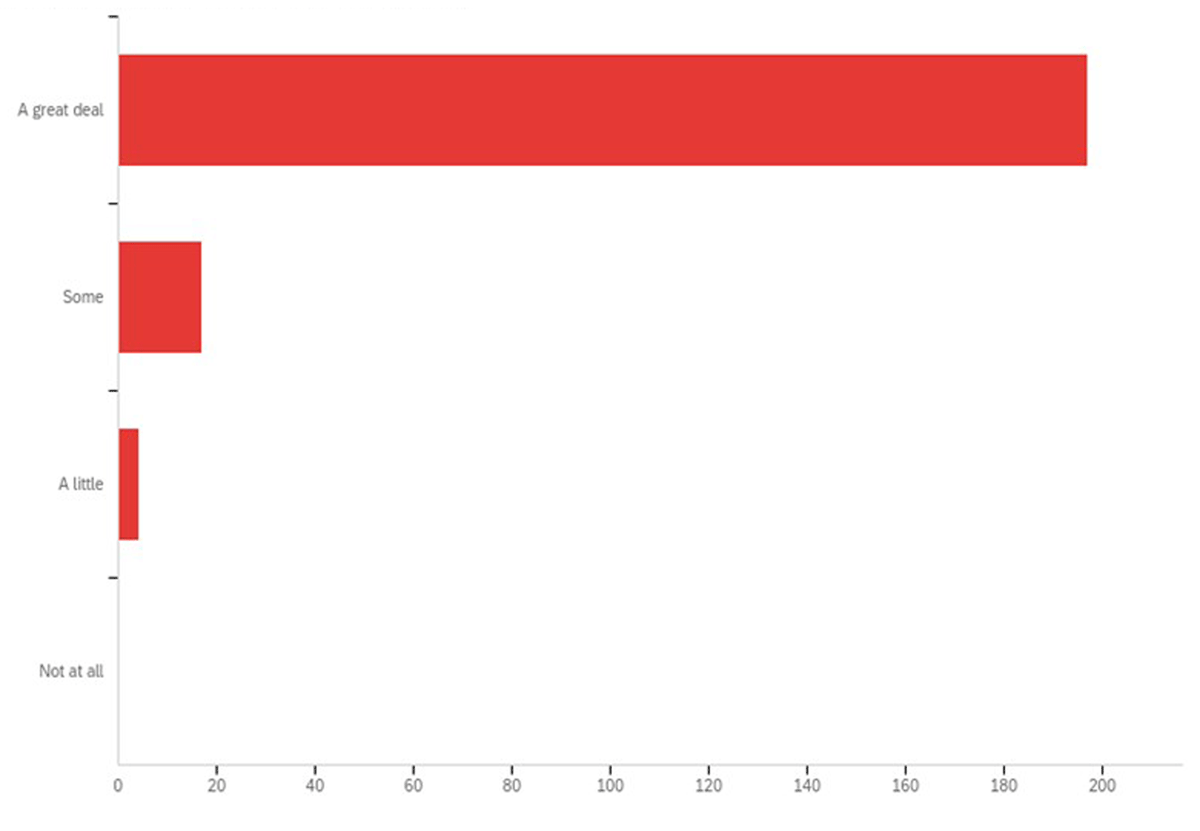
Image 1
Question 5: How much satisfaction do you derive from eating what you harvest through hunting and/or fishing?
The next survey question (sixth question) attempted to identify perceived deficits in know-how regarding processing, preparing, and presenting fish and game meat as food, or a demand signal for increased education on the subject. The statement posed to illicit responses was: “My degree of satisfaction with the preparation and consumption of wild game and fish that I have harvested would increase with more education about processing, preparing, and presenting it as food.” Respondents could choose (a) strongly agree, (b), agree, (c) neither agree nor disagree, (d) disagree, or (e) strongly disagree.
Results for this question were not as lopsided as the previous question. Once again there were 227 respondents in total for the survey item. Of those 129 indicated that they “strongly agree” and 68 respondents indicated that they “agree.” Interestingly, 29 respondents expressed neutrality on the question, indicating that they neither agree nor disagree. There was one individual who strongly disagreed. Thus 86.79 % of survey respondents agreed or strongly agreed that their degree of satisfaction with the preparation and consumption of wild game and fish that they harvested would increase with more education about processing, preparing, and presenting it as food (Image 2).
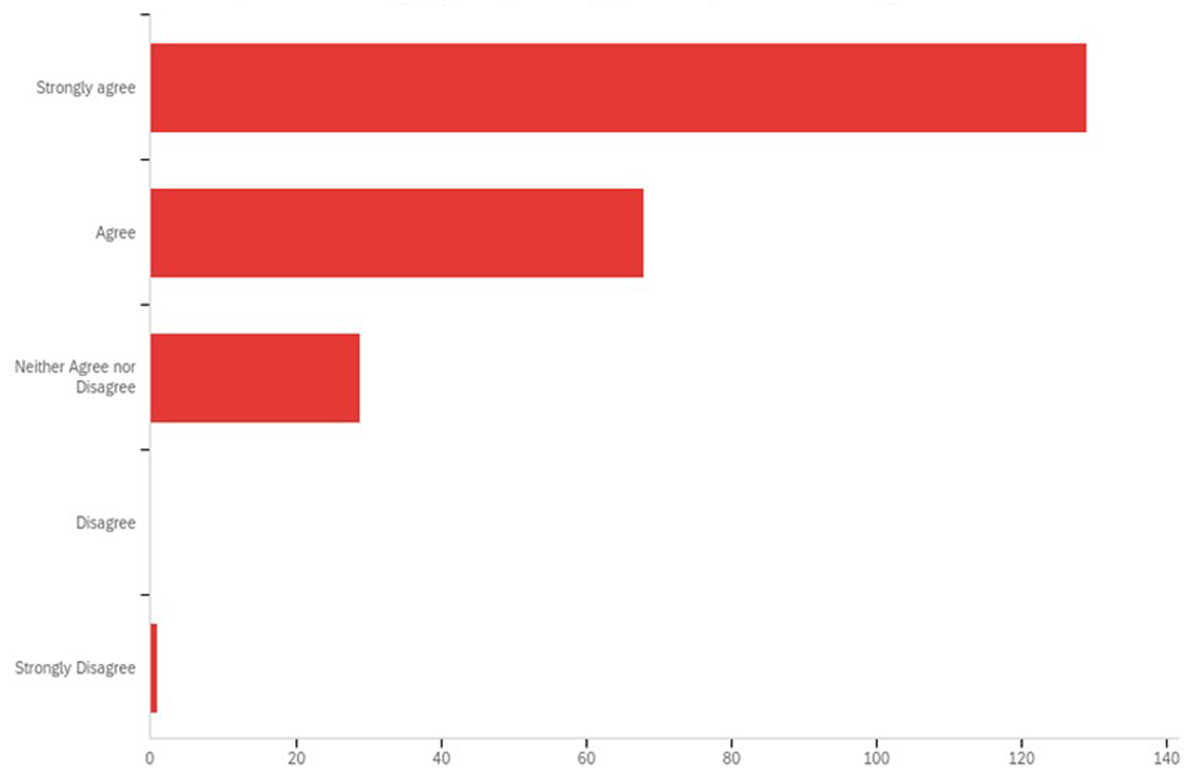
Image 2
Question 6: My degree of satisfaction with the preparation and consumption of wild game and fish that l have harvested would increase with more education about processing, preparing, and presenting it as food.
The seventh question probed more deeply regarding education and training gaps as they relate to wild fish and game processing, preparation, and presentation, by exploring whether there is demand for these education and training gaps to be met during sponsored therapeutic outdoor recreation outings. The survey item was phrased as follows: “Including wild fish and game processing, preparation and presenting in my sponsored expeditions and outings from sporting organizations that support veterans would increase my satisfaction with those outings.” Available responses were (a) greatly increase my satisfaction, (b) somewhat increase my satisfaction, (c) neutral, and (d) would not increase my satisfaction.
There were 226 respondents to this question, 157 of whom indicated that including wild fish and game processing, preparation, and presenting in sponsored expeditions and outings from sporting organizations that support veterans would greatly increase their satisfaction with those outings, and 44 of whom indicated that it would somewhat increase their satisfaction. Twenty-five individuals remained neutral in their responses: 88.94 % of respondents indicated an increase in satisfaction if wild fish and game processing, preparation, and presenting was included in sponsored expeditions and outings from sporting organizations that support veterans (Image 3).
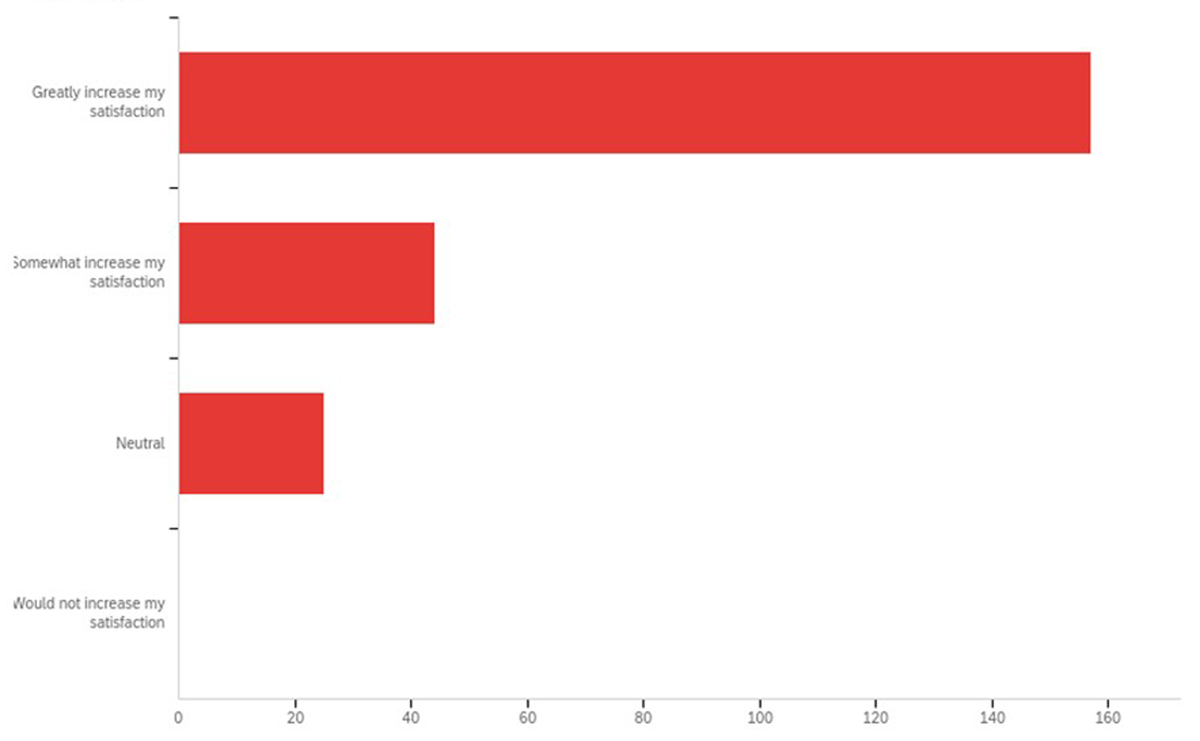
Image 3
Question 7: Including wild fish and game processing, preparation and presenting in my sponsored expeditions and outings from sporting organizations that support veterans would increase my satisfaction with those outings.
The eighth question built upon those before it, pivoting to exploration of the respondents’ perceived linkages between food motivations and participant satisfaction with outings and efforts among veterans to reintegrate and heal from wartime and combat-related wounds. The survey item was: “Increasing my knowledge and skill in wild fish and game processing, preparation, and presentation would be meaningful in my efforts to reintegrate and heal from wartime and combat related wounds.” Available responses were (a) strongly agree, (b), agree, (c) neither agree nor disagree, (d) disagree, or (e) strongly disagree.
Total responses dropped slightly to 225 at this point in the survey. One hundred twenty-eight of the responses indicated “strongly agree” and 59 indicated “agree,” comprising 83.11% of the total responses. About 17% of respondents to this survey item indicated neutrality (38 responses). There were no “disagree” or “strongly disagree” responses to the item (Image 4).
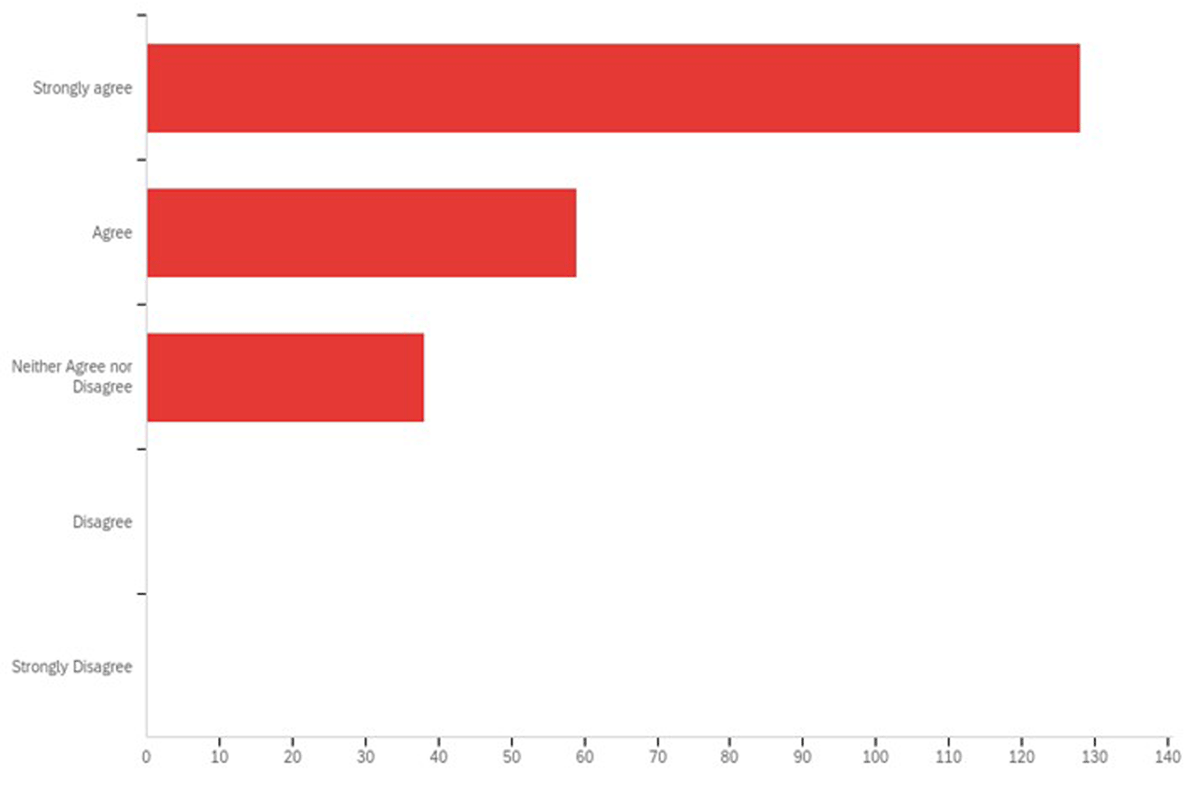
Image 4
Question 8: Increasing my Knowledge and skill in wild fish and game processing, preparation, and presentation would be meaningful in my efforts to reintegrate and heal from wartime and combat related wounds.
The ninth and final survey question was intended to explore the notion of identity and feelings of mastery in the “outdoors person” domain. The survey item read: “Increasing my knowledge and skill in wild fish and game processing, preparation, and presentation would increase my feelings of satisfaction about being an outdoors person.” As in previous questions, response choices were (a) strongly agree, (b), agree, (c) neither agree nor disagree, (d) disagree, or (e) strongly disagree.
Total respondents dipped once again to 223 of which 141 responses indicated “strongly agree,” while 57 indicated “agree,” comprising 88.79% of the total responses. About 11% of respondents indicated neutral responses (24). There was one “disagree” response and no “strongly disagree” responses to the item.
Discussion
The survey design appeared to mostly meet the goal of maintaining participation throughout, though responses shifted from a high of 227 to a low of 223. A loss of four respondents as the survey progressed was regrettable and may have been a result of too many questions, however, this is speculative. Future survey efforts among this population might benefit from streamlined surveys and less perceived redundancy in questions.
In terms of general patterns and observations, it was notable that there was only one “strongly disagree” response (Q6) and one “disagree” response (Q9) across survey questions. We surmise that this respondent was already familiar with game processing and preparation. Though roughly 12% of the respondents reported that they rarely or never consume what they harvest, or don’t hunt or fish at all, only about a half of a percent (.5) of respondents registered disagreement, and on only two questions.
On the other hand, the level of agreement across all questions was remarkable (Table 2). Each question garnered better than 80% agreeable responses, and in some questions those agreeable responses approached 90% of the surveyed populations. Averaging the four Likert-scale questions in the survey, survey results indicate an overall 87% agreement rate. Among those that did not necessarily agree, only a fraction of 1% disagreed, while the remainder maintained neutrality on an average rate of about 13% of those surveyed.
Conclusions
The results of this work point to important perspectives and attitudes held by veterans participating in outdoor recreation therapy that includes procuring wild fish and game. Veteran respondents overwhelmingly and conclusively support the importance of the role of food motivations as a part of the broader therapeutic benefits of intentionally designed therapeutic outdoor recreation outings among the veteran population surveyed. The results indicate, firstly, that veterans derive significant satisfaction from eating what they harvest through hunting and/or fishing, and that the degree of satisfaction with the preparation and consumption of wild game and fish that they have harvested would increase with more education about processing, preparing, and presenting it as food. Thus a key take-away for any would-be provider of veteran hunting and fishing programs would be to explicitly plan in not only the consumption of fish and game harvested, but also the opportunity to provide for the participation of veterans in the processing and preparation of fish and game meals, as both a communal activity and as an educational activity. Of note, respondents clearly indicated that including wild fish and game processing, preparation, and presentation in sponsored expeditions and outings from sporting organizations that support veterans would increase participant satisfaction with those outings.
A second important conclusion derived from analysis of the survey data is that increasing knowledge and skill in wild fish and game processing, preparation, and presentation is meaningful in veteran efforts to reintegrate and heal from wartime and combat-related wounds. Exactly how it is or can be meaningful is unclear but provides opportunity for further research and inquiry. We can say speculatively, but informed by earlier semi-structured interviews, workshops, and listening sessions with this and similar groups, that gaining experience and competence in survival-related skills such as field dressing fish and game and preparing it to be eaten, contribute to the task/purpose/mastery triumvirate so important to servicemembers and veterans. It also brings about many possibilities for completion of tasks in community or team settings.
Finally, it is abundantly clear that a large majority of veterans surveyed connect the efficacy of their therapeutic outdoor recreation in the form of hunting or fishing with development or maintenance of an identity referred to as an “outdoor person.” Thus explicitly increasing the participant’s knowledge and skill in wild fish and game processing, preparation, and presentation is indicated by those surveyed as a means to increasing feelings of satisfaction about being an outdoors person.
In conclusion, a remarkably large majority of veterans surveyed in this study indicate that the food aspect of their hunting and fishing outings is very important. Veterans involved in these activities want to eat their fish and game, and they want to learn new skills and techniques for improving the culinary experience for themselves and their families. For them the closing of the loop in intentionally designed therapeutic outdoor recreation outings represented by bringing the meat “from field to table” is an important part of the therapeutic effect. Practitioners should take note of these findings and integrate them into their respective programs for veterans.
Notes
[1] https://wwiaf.org/.
[2] The Quality Deer Management Association has recently changed names and is now known as the National Deer Association.
[3] See https://www.psu.edu/news/agricultural-sciences/story/after-successful-hunt-venison-butchering-and-preservation/ for more information on Penn State’s Venison 101 and 102 workshops.
Acknowledgements
This work was supported by multiple joint research projects under accession numbers 0227441, 226195, 1001838, 1014720, and 7000574 in conjunction with extension programs funded by the Cornell University Agricultural Experiment Station (Hatch/Multistate funds) and Cornell Cooperative Extension (Smith-Lever funds) received from the National Institutes of Food and Agriculture (NIFA,) US Department of Agriculture (USDA). Any opinions, findings, conclusions, or recommendations expressed in this publication are those of the author(s) and do not necessarily reflect the view of USDA.
We would also like to acknowledge the contributions of multiple project collaborators including Cornell University Cooperative Extension of Seneca County. Finally, and with utmost heartfelt sincerity, we thank Wounded Warriors in Action Foundation, especially Founder and CEO John McDaniel for longstanding support of our work and many years of collaboration.
Competing Interests
The authors have no competing interests to declare.