
Military veterans—defined as former members of a country’s defense force (active or reserve), regardless of service length1—have the potential to make excellent university students. Student veterans—defined as students who have transitioned from the military into higher education2—have several strengths that predict academic achievement, including a highly developed work ethic, goal-setting skills, self-efficacy, persistence, discipline, resilience, time management, and teamwork experience (Dyar, 2019; Harvey et al., 2018). However, there are also barriers to student veterans’ academic achievement, which may not exist for non-veteran students, particularly traditional students. Paradoxically then, veterans have a profile that predicts difficulties and success at university (Cate, 2014).
There are barriers to student veterans’ academic achievement. First, although veterans are a diverse population with some having already experienced tertiary education (i.e., commissioned officers) and some not (i.e., other ranks), student veterans generally have a similar profile to other nontraditional students. Relative to traditional students, student veterans are typically older, financially independent, first-generation, may not have completed high school, and often have family responsibilities (Ford & Vignare, 2014). Nontraditional students generally have lower graduation rates and increased drop-out risk compared to traditional students, even when they have the same entry scores (Richardson, 2015). Among students who do complete their degrees, nontraditional students have lower grades than traditional students from their second to final year (Brändle & Lengfeld, 2017). Second, veterans are more likely to be mentally or physically injured than the general population (Kazis et al., 1998). We know from the higher education literature that, compared to other students, disabled students and students facing mental health issues have increased drop-out rates, take longer to graduate, and achieve lower grades, particularly during the first year (Eisenberg et al., 2009; Foreman et al., 2001). These barriers increase veterans’ risk for facing difficulties at university, but veterans’ strengths may simultaneously mitigate this risk.
One factor that might alter how these risks and protective factors affect student veterans’ university experience is wellbeing, which generally has a small to medium sized correlation with academic achievement (Bücker et al., 2018). There are grounds to expect a stronger correlation between academic achievement and wellbeing among student veterans, relative to other university students because wellbeing could enhance or diminish the risk (e.g., being a nontraditional student) and protective (e.g., a highly developed work ethic) factors facing student veterans. More specifically, while high levels of wellbeing could mitigate the risks and enhance the protective factors facing veterans at university, low levels of wellbeing could enhance the risks and undermine the protective factors. Yet we know little about the role wellbeing plays in veterans’ higher education experiences.
Wellbeing is a multidimensional construct (Linton et al., 2016) rooted in the World Health Organization’s conceptualization of health as not just the absence of disease, but complete physical, mental, and social wellbeing. Though no universally accepted definition of wellbeing exists, there is consensus that wellbeing incorporates an absence of negative (or unpleasant) affect, as well as the presence of positive (or pleasant) affect (Cooke et al., 2016). Wellbeing also incorporates cognitive judgments of life satisfaction, both globally and in personally specific domains (e.g., financial satisfaction; Diener et al., 2013). Thus wellbeing is an inherently subjective trait and state variable that fluctuates alongside personal circumstances (Linton et al., 2016). To gain a complete picture of someone’s wellbeing, we must assess the positive and negative aspects of their mental and physical health as well as how these aspects interact with each other, their social support system, and surrounding environment (Agteren & Iasiello, 2019). For student veterans, factors such as identity loss from transitioning out of the military and resilience may also be relevant to wellbeing (Borsari et al., 2017). In this scoping review, we aim to map how wellbeing has been assessed in the student veteran literature and provide an informed recommendation of how best to quantitatively measure wellbeing in a student-veteran population.
We also aim to review and recommend how to measure academic outcomes in student veterans, which encompasses several indicators of university success. We define academic outcomes as both objective markers of achievement (e.g., grades, completion rates) and persistence (e.g., time enrolled in degree), and self-report ratings of academic function (e.g., academic engagement, academic adjustment, academic impairment). We acknowledge that self-report academic function ratings, particularly academic adjustment and impairment ratings, could also fit into the category of wellbeing rather than academic outcomes. However, we have chosen to classify them as academic outcomes to be consistent with Barry et al. (2014), who conducted a systematic review on student veterans psychological symptoms and educational adjustment difficulties.
We acknowledge there is no universal meaning to the term student veterans. Our definition of student veterans as students who have transitioned from the military to higher education excludes current military members who are simultaneously studying (e.g., via distance education or between deployments) because current and former members face different challenges. For example, former service members might have stronger feelings of identity loss than current service members who can maintain their military identity (Taylor et al., 2019). In the case that current and former service members were inseparable in a study’s sample, we included the study but noted this feature. Because research in this field has been almost exclusively conducted in the US, an overarching goal was to source research and consider the challenges facing non-US, as well as US, veterans.
Existing Reviews
There are four reviews on similar topics. The most extensive was a systematic review by Barry et al. (2014) that focused on psychological symptoms and educational adjustment difficulties (academic functioning/performance, difficulties with peer/faculty) in US student military/veterans. Barry et al. included 13 empirical peer-reviewed studies published in 2000–2012. Academic performance was indexed by four studies, but only one study had quantitative data comparing grade point average (GPA) between veteran and civilian students (Durdella & Kim, 2012). Consequently, Barry et al. provide a limited picture of how veterans’ academic outcomes compare to civilian students’ outcomes. Further, due to substantial growth in this field, several studies have been published since 2012 that warrant inclusion in an updated review. Borsari et al. (2017) partially addressed this gap by including research conducted between 2001–2015. In this comprehensive narrative review, the authors summarized the challenges faced by US student veterans in higher education settings (mental health, physical disabilities, social connection, identity) from 130 quantitative or qualitative studies, theses, or reports. By focusing on challenges, Borsari et al. did not touch on veterans’ strengths or positive affect, an essential component of well-being that can benefit academic achievement (e.g., via resilience; Allan et al., 2014).
There are two more recently published scoping reviews. Dyar (2019) focused on describing the characteristics of student veterans through the lens of their suitability for nursing degrees. Based on 12 papers (published 2008–2018), Dyar outlined the strengths of student veterans (e.g., sense of duty) as well as their barriers to academic success (e.g., personal struggles). Similarly, Ghosh et al. (2019) reviewed the factors that influence student veterans’ reintegration into higher education. Ghosh et al. grouped 24 papers (published 2009–2018) into four themes: mental health, academic and career development, support, and identity. Although both Dyar (2019) and Ghosh et al. (2019) assessed veterans’ mental and physical health more holistically than Barry et al. (2014) and Borsari et al. (2017), all four reviews are limited by the scope of included studies, which focused on the challenges facing veterans more than veterans’ strengths. Similarly, these existing reviews provide a limited picture of academic outcomes, partly due to few journal articles quantitatively investigating academic outcomes. We sought to address both these gaps by including a wider range of publication dates (2000–2020) as well as grey literature and government/agency reports. We searched for studies published since 2000, to focus on the “current-cohort” of student veterans (DiRamio et al., 2008).
Review Question
Our primary question was: How have student veterans’ wellbeing and academic outcomes been quantitatively assessed in existing research? The objectives were: (a) to summarize how existing research has examined student veterans’ wellbeing and academic outcomes, (b) to recommend how best to assess wellbeing and academic outcomes quantitatively, and (c) to assess the limitations of this research area to date. We pre-registered this review on the Open Science Framework (https://osf.io/7tkha); ethics approval was not required.
Method
Inclusion Criteria and Source Type
We included any study (published, unpublished, grey literature, journal articles, government/agency reports) that quantitatively assessed undergraduate or postgraduate student veterans’ wellbeing or academic outcomes, but not necessarily together. We excluded qualitative studies, mixed-method studies, and literature reviews. We excluded studies that focused only on active-duty military students. We also excluded studies that focused purely on online-learning but included studies that had online and face-to-face learning components.
Search Strategy and Information Sources
We aimed to locate published and unpublished studies with three sets of search terms. We intended to source non-US as well as US samples.3 Therefore, the first and second sets of terms included US and non-US terminology for the military and university, respectively. The third set of terms focused on wellbeing and academic outcomes. We limited the results to studies that fulfilled all three sets of terms, published between 2000–2020, and written in English. The search terms used in PsycINFO and ERIC were:
(Veteran or military or soldier or service member or military member or army or navy or air force or marines or seals or armed forces or regular army or defense force).
(Student or academic or education or higher education or college or university or postsecondary or transition or tertiary education or pathway education or studies or degree or undergraduate or postgraduate).
(Well-being or life satisfaction or happiness or quality of life or positive affect or negative affect or mental health or mental illness or psychological disorders or achievement or performance or grade or GPA or scholastic aptitude or academic or academic outcomes or results or completion or persistence or dysfunction).
Due to an unmanageable number of results using the same search terms in Proquest Dissertations and Theses, we used narrower search terms for Proquest and PubMed:4
(noft(student veterans) OR (noft(student military)) AND (noft(well-being OR life satisfaction OR psychological disorders)) OR noft(academic outcomes OR grades OR performance OR completion).
Study Selection
After conducting database searches on March 31, 2020, we exported all results into Endnote X9 and removed internal and external duplicates. Two independent raters (one blind to review aims) screened the studies for inclusion using a two-step process: (a) based on the article’s title and abstract and (b) using the full text. We used a two-phase full-text review process. The reasoning for excluding articles at the full-text stage is reported in Figure 1 below. We initially planned to include studies that measured mental and physical health without explicitly measuring wellbeing (as pre-registered). However, those inclusions made the review scope unmanageable. Therefore, we opted to exclude studies that did not explicitly measure wellbeing in Phase 2 of the full-text review process. Disagreements at any stage of the selection process were resolved by discussion; a third reviewer was not required. Ninety-five studies were included after Phase 2, but we added one more after cross-checking our results with the reference lists of the four reviews on similar topics. The final review included 96 studies; references for all included studies are available online (https://osf.io/6feps/).
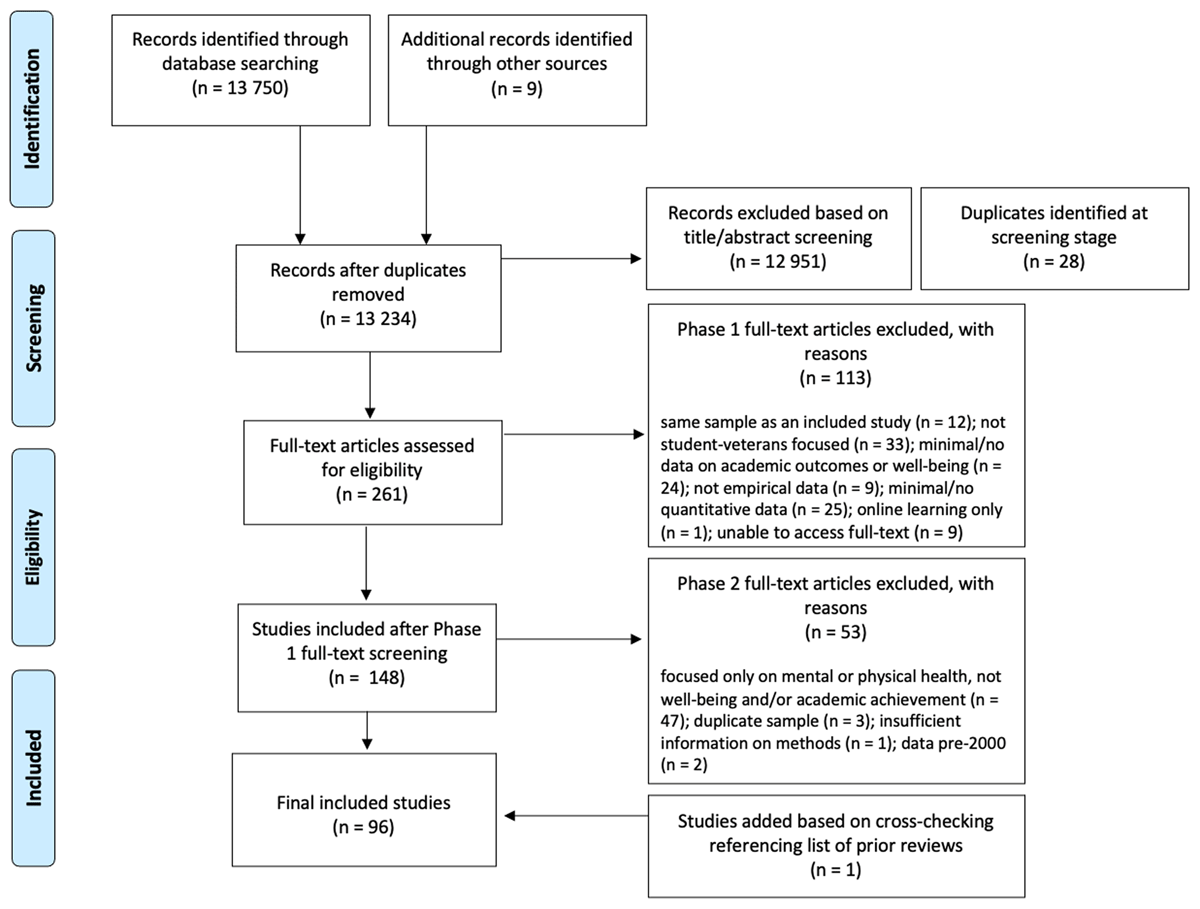
Figure 1
The Flow of Information Through Different Stages of This Scoping Review (Moher et al., 2009).
Data Extraction
We extracted information about the study aim, research type (empirical, re-analysis of existing data), and sample (location [US, non-US], size, and composition). We noted whether a comparison group was included (if so, what type), the study recruitment date, data collection method (e.g., online survey), and types of demographics assessed. We recorded the components of wellbeing and academic outcomes in three stages by identifying: (a) whether wellbeing, academic outcomes, or both were assessed; (b) which constructs were assessed (e.g., subjective wellbeing); and (c) which measures were used (e.g., the Satisfaction with Life Scale) for each construct. We also recorded what other constructs were assessed, outside of academic outcomes and wellbeing (e.g., social support).
Results
Supplementary Tables 1-3 include key details of the 96 studies in the scoping review: we note the source, publication type, aim, research type, sample size and composition, comparison group, wellbeing constructs and measures, academic constructs and measures, and other assessed constructs. Supplementary Table 1 (https://osf.io/5gupe/) includes the studies with wellbeing and academic outcome measures (n = 9). Supplementary Table 2 (https://osf.io/cexm7/) includes studies with wellbeing but not academic outcome measures (n = 10). Supplementary Table 3 (https://osf.io/rnzeh/) includes studies with academic outcome measures only (n = 77).
Summary of Wellbeing Measures
Eighteen studies assessed student veteran wellbeing (and closely related constructs). Seven studies assessed life satisfaction, all using the Satisfaction with Life Scale (Diener et al., 1985) in either its original format (e.g., Beach, 2019) or adapted to assess both life satisfaction in general and specific to family, work, and social life (Aikins et al., 2015). This adaptation of the satisfaction with life scale to incorporate three key components of re-integration demonstrates a way of measuring both global and personally relevant judgments of life satisfaction (Diener et al., 2013). Indeed, satisfaction with family, work, and social life are highly relevant to veterans as they reintegrate into a civilian lifestyle (Borsari et al., 2017). Two studies (Barbour, 2014; Colbow, 2017) combined a life satisfaction measure with positive and negative affect ratings (Watson et al., 1988) to index subjective wellbeing. Subjective wellbeing was operationalized by subtracting negative affect from combined life satisfaction and positive affect (e.g., Elliot et al., 1997). This operationalization fits squarely with the view that wellbeing incorporates an absence of negative affect and a presence of positive affect, as well as life satisfaction judgments (Cooke et al., 2016). Umucu (2017) and Doenges (2011) also combined multiple constructs to reflect the interactive nature of wellbeing. In addition to the Satisfaction with Life Scale, Umucu (2017) had their student veteran sample complete a comprehensive wellbeing measure—the PERMA Profiler (Butler & Kern, 2016), which assesses positive emotion, engagement, relationships, meaning, and accomplishment—and the PROMIS Global Mental and Physical Health Scales (Hays et al., 2009) to assess health-related quality of life. In addition to the satisfaction with life scale, Doenges (2011) measured positive and negative affect, meaning in life and positive relations with others.
Five other studies used part, or all, of the Scales of Psychological Well-being (Ryff & Keyes, 1995). Three used total scores on all six subscales to assess psychological wellbeing in general (e.g., Alfred et al., 2014), while two focused on subscale, not total, scores (Bellotti et al., 2011; Doenges, 2011). For example, Doenges (2011) focused on positive relations with others and used only that single subscale (Ness et al., 2015). Another study (Cacace, 2018) also measured psychological wellbeing, but with the Oxford Happiness Questionnaire (Hills & Argyle, 2002).
Six studies focused on meaningfulness. Three used the Meaning in Life Questionnaire (Steger et al., 2006) to assess general life meaning and purpose (e.g., Kinney et al., 2019). Kinney et al. (2019) accompanied the general life meaning measure with a specific measure of how often student veterans completed activities they found meaningful using the Engagement in Meaningful Activities Survey (Eakman, 2012). Both Eakman et al. (2019) and Kinney et al. (2020) assessed meaningful activity using this measure, but in these two studies, a general life meaning measure was not included. Two studies measured quality of life but using different scales. Williston and Roemer (2017) used the Quality of Life Inventory (Frisch et al., 1992) while Bellotti et al. (2011) used the SF-36 Health Survey (McHorney et al., 1993). Finally, one study (Briggs, 2016) measured “thriving” using the Thriving Quotient Questionnaire (Schreiner, 2010) as well as through self-reported thriving.
Summary of Academic Outcome Measures
Eighty-six studies measured at least one academic outcome (see Supplementary Tables 1 & 3). We grouped these outcomes into eight categories: performance, persistence, completion/retention or dropout/attrition, self-efficacy or self-concept, impairment, adjustment, engagement, attendance or time spent studying, and other outcomes.
The most common construct was academic performance, typically measured by GPA (n = 55). Among the 55 studies that assessed GPA, 48 included cumulative GPA, representing average GPA across students’ college degree. Other studies focused on GPA for a specific period, including the semester in which data were collected (e.g., Kinney & Eakman, 2017) or the first semester (e.g., Briggs, 2016) or year (e.g., Cofield, 2019) of study. GPA was more commonly accessed via participant self-report (n = 39) than via university records (n = 17), presumably due to convenience. One study capitalized on the convenience of self-report and the accuracy of university records by asking participants to self-report GPA and provide copies of their academic transcripts (Ryan, 2019). If there was a discrepancy between the two, Ryan (2019) used GPA from the transcript.
The second most common academic outcome was academic persistence (n = 16). Academic persistence has been assessed in the student veteran literature using three approaches. The first involves tracking students’ continued enrolment at a single institution from one semester/year to the next semester/year (e.g., Nevada System of Higher Education, 2016), which we have termed persistence rates (n = 5). For example, one study calculated the number of students attending both semesters by the number of students who attended the first semester but did not graduate (Lopez, 2011). The second approach involves asking students whether they intend to continue studying at their current institution (e.g., Tilman, 2018), which we have termed intent to persist (n = 4). The third approach involves asking students to complete a questionnaire that predicts persistence, which we have termed predicted persistence (n = 7). Researchers in this field have used, or adapted, two questionnaires to predict persistence. Four studies (e.g., Whiteman et al., 2013) used the 30-item Persistence or Voluntary Dropout Scale (Pascarella & Terenzini, 1980) and three studies (e.g., Mentzer et al., 2014) used the College Persistence Questionnaire (Davidson et al., 2009; Lindheimer, 2011). Some researchers have combined different approaches to capture persistence (e.g., Southwell et al., 2018).
Fifteen studies assessed completion/retention (n = 12) or dropout/attrition (n = 3). Completion/retention measures—used in nine studies—mainly focused on degree completion, indexed by graduation rates (e.g., Griffin, 2019). Two of these nine studies measured on time degree completion; for example, Akerele et al. (2011) divided the number of graduations in a given year by the number of students who entered their freshman year four years prior. The remaining three studies that measured completion/retention focused on course-specific completion (e.g., Shackelford et al., 2019). Of the three studies that measured dropout/attrition, two were degree-related (e.g., Alschuler & Yarab, 2018) and one was course-related (Barnhart, 2011).
Thirteen studies assessed academic impairment. We have divided impairment measures into two categories: measures of academic problems (1) in general (n = 7) and (2) arising from specific factors/health issues (n = 6). General impairment measures do not assess the source of the impairment or require the impairment to stem from a specific source (e.g., psychological symptoms). For example, the Indicator of Academic Problems (Eakman, Kinney, Schierl, et al., 2019) asks participants to indicate how often nine items have occurred in the current semester (e.g., skipped a class, turned in an assignment late; 0: did not occur, 1: occurred once, 2: occurred twice, 3: occurred three times or more). Other general impairment scales used in the student veteran literature follow a similar format, including the Academic Distress subscale from the Counseling Center Assessment of Psychological Symptoms questionnaire (Locke et al., 2011), used in two studies (e.g., Fredman et al., 2019), and the Inventory of Common Problems (Hoffman & Weiss, 1986), used in Umucu (2017).
In specific impairment measures, academic impairments are indexed to particular health or other issue(s) (e.g., financial problems; Grossbard et al., 2014). For example, the American College Health Association National College Health Assessment II (e.g., used by Albright et al., 2019) asks participants to indicate which impediments (e.g., stress, chronic pain) have (or have not) disrupted their academic performance in the last 12 months. Disruption is defined as receiving a lower assignment or course grade, not completing or dropping a course, or significantly disrupting research work (American College Health Association, 2021). Similarly, the Inventory of Psychosocial Functioning Education Subscale (Bovin et al., 2018; e.g., used by Morissette et al., 2021) measures impairment stemming from PTSD symptoms.
Thirteen studies assessed college-related self-efficacy (n = 10) or self-concept (n = 3). While self-efficacy refers to students’ confidence in their ability, self-concept refers to how students regard their academic achievement. Among the 10 studies that assessed self-efficacy, two focused on college self-efficacy (e.g., Whiteman et al., 2013) and eight on academic self-efficacy (e.g., Barry et al., 2012). Four studies used all or part (i.e., just the course efficacy subscale) of the College Self Efficacy Inventory (Solberg et al., 1993). Two studies used the Educational Degree Behaviors Self-Efficacy Scale (Gloria et al., 1999), and three used the Academic Self-Efficacy Scale (Chemers et al., 2001). Two of the three studies that assessed academic self-concept (e.g., Morreale, 2011) used the Academic Self-Concept Scale (Reynolds et al., 1980).
Twelve studies assessed college adjustment. Eight of these studies used formally developed questionnaires (e.g., Campbell & Riggs, 2015), mostly the Student Adaptation to College Questionnaire (Baker & Siryk, 1984). Four studies developed their measures of college adjustment; of note is the 14-item Veterans Adjustment to College Scale (Young, 2017), which aims to assess the unique experience of transitioning from combat to college (Young, 2012).
Nine studies assessed academic engagement. Most measured overall engagement (n = 7) mainly through sourcing data from the 2010–2013 iterations of the National Survey of Student Engagement (e.g., Fraites-Chapes, 2018). The National Survey of Student Engagement (2010) is administered annually to undergraduate students from North American universities. Data sourced from this survey is appealing because it combines survey data (e.g., measures of engagement) with institutional records (e.g., of student veteran status). Other studies (Logan, 2019) assessed overall engagement using the Utrecht Work Engagement Scale for Students (Schaufeli et al., 2002) and a Self-Reported Veterans Engagement Survey (McDonald, 2011). The remaining studies (n = 2) measured course/subject specific engagement. Both of these studies (Quigley, 2015; Williston & Roemer, 2017) used the Student Course Engagement Questionnaire (Handelsman et al., 2005), a 23-item scale that assesses skills, emotions, participation, and performance in an academic course.
The final construct frequently assessed in the student veteran literature was college attendance/time spent studying (n = 6). This construct has been conceptualized in a few ways, including tracking credit hours attained (e.g., Browning, 2015) and the attention given to academic activities (De La Garza et al., 2016). Two studies measured time spent studying (e.g., in a typical week; Sitzes, 2015), while Curtis (2017) was more focused on study-type (e.g., deliberate practice).
Each of the remaining academic outcome constructs were assessed by three (or fewer) studies, and we therefore grouped them into an “other outcomes” category. Constructs assessed by more than one study were academic integration (n = 3; e.g., O’Rourke (2013)), self-regulated learning (n = 2; e.g., Ness & Vroman (2014)), education goals (n = 2; e.g., Barnhart (2011)), and academic satisfaction (n = 2; e.g., Ochonma (2016)). Constructs assessed by single studies include “stopping out”—defined as the percentage of students currently taking time off but intending to return to their degree (Alschuler & Yarab, 2018)—major certainty (Barnhart, 2011), perceived usefulness and interest in a university degree (De La Garza et al., 2016), cognitive ability (Gallagher, 2017), metacognitive strategies (Walker, 2017), and academic driven improvements in self-understanding (Fraites-Chapes, 2018).
Discussion
The main objective of this review was to map how student veterans’ wellbeing and academic outcomes have been quantitatively assessed to date (2000–2020). Of the 96 studies that met screening criteria 18 assessed wellbeing. Consistent with the broader wellbeing literature (Cooke et al., 2016), the way researchers have conceptualized and measured student veterans’ wellbeing is mixed; we grouped the 18 studies into six categories. Academic outcomes were more commonly measured than wellbeing, with 86 studies including an academic outcome measure. There was greater consensus around the conceptualization of academic outcomes relative to wellbeing; we grouped the 86 studies into eight categories. The most common academic outcome measure was academic performance, though there were a range of other academic outcome measures. This wide range of measures demonstrates that researchers are looking beyond performance-based indicators of student veterans’ successes and challenges, which is promising because non-performance-based indicators may positively influence study-related skills (e.g., academic self-efficacy; Putwain et al., 2013).
Only nine (9.4%) studies assessed both wellbeing and academic outcomes, making it difficult to determine whether high levels of wellbeing do mitigate the risks and enhance the protective factors facing veterans at university. The studies that do exist support this possibility; they suggest student veterans’ wellbeing is positively associated with various academic outcomes, including academic self-efficacy (Beach, 2019; Kinney et al., 2019), adjustment (Umucu, 2017), and engagement (Williston & Roemer, 2017), and negatively associated with academic avoidance. Due to the cross-sectional nature of these studies, we cannot determine whether wellbeing boosts academic outcomes or vice versa. Alternatively, the relationship between wellbeing and academic outcomes may be bi-directional, as suggested by recent work on adolescents’ wellbeing and academic achievement (Bortes et al., 2021). Future research should comprehensively investigate the relationship between wellbeing and academic outcomes among student veterans, by following the recommendations and addressing the limitations outlined below.
Summary and Recommendations
Wellbeing
Despite decades of research, there is a lack of consensus regarding how to conceptualize and validly measure wellbeing (Goodman et al., 2018). However, researchers generally agree on the key components of wellbeing as an absence of negative (or unpleasant) affect, the presence of positive (or pleasant) affect, and cognitive judgments of life satisfaction (e.g., Cooke et al., 2016)—termed subjective wellbeing. A recent investigation showed that subjective wellbeing measures and a more comprehensive measure of different wellbeing facets (the PERMA Profiler; Butler & Kern, 2016) loaded onto a single wellbeing factor (Goodman et al., 2018). Therefore, we recommend that researchers measure subjective wellbeing by including life satisfaction and global positive and negative affect measures. After being standardized, scores on these scales can be combined to index subjective wellbeing by subtracting negative affect from combined life satisfaction and positive affect score (Elliot et al., 1997). This specific approach has been used with student veteran samples (Barbour, 2014; Colbow, 2017). Last, we recommend further research exploring how veteran specific factors, like military identity loss (e.g., Mobbs & Bonanno, 2018), might contribute to wellbeing.
Academic Outcomes
We divide this section according to whether the academic outcomes should be assessed by (a) university records or (b) self-report questionnaires. We only recommend measures for constructs that have been assessed in at least two studies included in this review.
University Records
Official records more accurately reflect university performance (e.g., Bachrach & Read, 2012) and attendance (e.g., Kassarnig et al., 2017) than self-report measures. Therefore, we recommend researchers use university records to assess student veterans’ academic performance, completion/retention, dropout/attrition, and attendance. For academic performance, the most common measure is GPA. GPA has been more commonly assessed via participant self-report than university records in the student veteran literature. However, because official records provide the most accurate measure of GPA (e.g., Bachrach & Read, 2012) we recommend obtaining this information from university records, where possible. An alternative, and potentially more efficient, way of accessing this information is to ask participants to self-report GPA and provide copies of their academic transcripts, using only the official transcript to resolve discrepancies (Ryan, 2019).
University completion/retention, dropout/attrition, and attendance are also most accurately assessed via university records. Depending on the focus of the research, these constructs can be adapted to focus on degrees (e.g., Browning, 2015) or specific courses/subjects (e.g., Shackelford et al., 2019). We note that there may be some circumstances where self-reported measures of attendance (e.g., days unable to study) may be better indicators of whether someone is experiencing education-related impairment than university records (Takarangi et al., 2022).
Self-Report Questionnaires
There are several academic outcomes that university records insufficiently capture, including academic persistence, impairment, self-efficacy, and adjustment.
For academic persistence, our recommended measure depends on whether the goal is to assess likely persistence (i.e., whether students are likely to persist with their studies or not) or actual persistence. Likely persistence is most comprehensively assessed by the 53-item College Persistence Questionnaire, which correctly classifies persistence in 66% of students (Davidson et al., 2009; Lindheimer, 2011). Given this questionnaire is quite lengthy, a more efficient way to identify “at risk” students is to rank the mean scores on the 4-item Institutional Commitment subscale of the College Persistence Questionnaire (Davidson et al., 2009), or directly ask students their intent to persist. Actual persistence is best assessed by tracking re-enrolment from one semester to the next, either using university records or through self-report. Although most studies on student veterans define persistence as re-enrolling at the same university (e.g., Briggs, 2016), continuing with the same degree, but at a different university, also constitutes persistence.
For academic impairment, our recommended measure depends on whether the goal is to tie the impairment to a specific source (specific impairment measures) or not (general impairment measures). Both measures have their place in understanding challenges facing student veterans. On the one hand, general impairment items may be easier for people to answer than specific impairment items, particularly for those with comorbid health conditions that are common in veterans (Trivedi et al., 2015). For example, people with comorbidity may find it difficult to attribute impairments (e.g., missing class) to one specific set of symptoms over another (e.g., PTSD over anxiety symptoms). To assess general impairment in student veterans, we recommend using the Indicator of Academic Problems, because this measure is brief (9-items) and negatively associated with GPA, social support, and mental health symptoms (Eakman et al., 2019). On the other hand, specific impairment measures offer researchers a way of elucidating academic impairment associated with one specific factor, and therefore to develop services that target impairments resulting from that factor. We recommend the Education Subscale of the Inventory of Psychosocial Functioning (Bovin et al., 2018) because although this inventory was designed to measure academic impairments stemming from PTSD symptoms, it can be easily adapted to measure student veterans’ impairment arising from disorders other than PTSD (Bovin et al., 2018), and non-health related factors (e.g., financial stress; Grossbard et al., 2014).
Academic self-efficacy encompasses students’ confidence in their academic ability. This construct has commonly been assessed in the student veteran literature by the Academic Self-Efficacy Scale (Chemers et al., 2001) and the College Self Efficacy Inventory (Solberg et al., 1993). We recommend researchers use the College Self Efficacy Inventory (Solberg et al., 1993), because it has strong internal consistency, convergent validity, and discriminant validity (Wernersbach et al., 2014). Academic self-efficacy is associated with student veterans’ engagement in meaningful activities (Kinney et al., 2020). Given meaningfulness is a key aspect of wellbeing (e.g., Goodman et al., 2018), self-efficacy should be included when identifying factors that may affect the relationship between academic outcomes and wellbeing. Academic self-concept assesses how students regard their academic achievement. We recommend researchers use the Academic Self-Concept Scale (Reynolds et al., 1980), because this scale is reliable in student veteran samples (e.g., Morreale, 2011), and has good construct validity (Reynolds, 1988).
In assessing academic adjustment, we recommend using the Student Adaptation to College Questionnaire (Baker & Siryk, 1984), because scores on this measure are an excellent predictor of both academic performance and retention (Credé & Niehorster, 2012). This scale is applicable to both student veterans and civilian students, making it appropriate for comparing academic adjustment between these two types of students. If researchers are only interested in the adjustment of student veterans, then we recommend using the Veteran Adjustment to College Scale (Young, 2017). This scale is appealing because it was specifically designed to help university administrators assess how their veterans are adjusting to life-on-campus, and has high internal consistency (Young, 2017).
Limitations of Student Veteran Literature
Based on this review, we have identified two key limitations: a lack of comparison groups, particularly in published research, and almost exclusive foci on symptoms rather than well-being.
Lack of Comparison Groups
Comparison groups are important because they allow researchers to determine whether the successes and challenges faced by student veterans are unique to student veterans. Alternatively, successes and challenges could be similar to what is faced by any veteran transitioning out of the military (regardless of student status), by all non-traditional university students, or simply part-and-parcel of transitioning to university, regardless of background. Among the studies included in this review, 35.4% included a comparison group. Comparison groups were more common in studies that assessed academic outcomes (38%) than those that assessed well-being (22%), and in dissertations than published articles. The most common comparison group was civilian students. Sometimes the civilian group had certain characteristics, including comprising non-traditional students (Barbour, 2014), first-year community college students (including college athletes; Briggs, 2016), and first-generation college students (Colbow, 2017). Targeting civilian students with these types of characteristics brings the comparison group “closer” in life experience to student veterans in terms of age and background. Other studies compared subtypes of student veterans, including combat vs. non-combat exposed (Barry et al., 2012), being enrolled versus not enrolled in specific programs (Cortez, 2019) or using certain education services (Moore, 2017), and based on similar medical history (Gallagher, 2017; Metcalfe, 2013). A handful of studies compared student veterans with community veterans who had never been to university (Cancio, 2018; Smith-Osborne, 2009).
To establish how veteran status affects students’ wellbeing and academic outcomes, we recommend that future research compare student veterans with traditional and nontraditional civilian students (Chung et al., 2017). Depending on the results of such comparison(s), universities will know which challenges and strengths are unique to student veterans and develop services that target these challenges or enhance these strengths. If student veterans do not differ from nontraditional students, then a better use of university resources might be to develop services aiding transition for all nontraditional students. To establish how student status affects veterans’ wellbeing, we recommend future research compare student veterans with veterans who have transitioned directly into the workforce without first attending university. This comparison will shed light on whether interventions aimed at improving post-service transitions should be pathway-specific—i.e., university versus workforce—or general (Mobbs & Bonanno, 2018).
Predominance of Symptom Focused Research
When veterans transition out of the military and into civilian life, they face challenges and failures, but also rewards and successes (Mobbs & Bonanno, 2018). Yet, existing research has predominantly focused on the challenges, in particular extreme psychopathology like PTSD, and overlooked factors that may buffer against these challenges, like wellbeing. Our review demonstrates this limited focus on challenges also exists in the student veteran literature. Although we initially intended to include studies that had psychological or physical health measures, this inclusion criteria made the scope of the review too large. Therefore, we excluded 47 studies that measured some aspect of psychological or physical health, without also measuring an academic outcome. Among the studies included in this review that assessed academic outcomes, few simultaneously assessed well-being (n = 9), instead mainly focusing on psychological symptoms (n = 39; see Supplementary Tables 1–3 for a list of symptoms). The predominant focus was on PTSD (N = 20) symptoms, consistent with the narrow PTSD focus of the broader veteran transitions literature (Mobbs & Bonanno, 2018). Future research should address this gap and focus more on success indicators, like wellbeing, because the absence of symptoms does not necessarily mean someone has optimal health and functioning, and vice versa (Cooke et al., 2016; Ryff & Keyes, 1995).
Conclusion
Student veterans have a profile that predicts both difficulties, and success, at university. By potentially mitigating the risks, and enhancing the protective factors, wellbeing may predict whether student veterans thrive in higher education. But as this review demonstrates, few studies have assessed wellbeing in student veteran populations and even fewer have assessed wellbeing alongside academic outcomes. Our summary and resulting recommendations for how best to assess wellbeing and academic outcomes in student veterans will guide much-needed research in this area. Universities will then be able to use this research to develop appropriate services for student veterans, ensuring we maximise the unique skillset this population has to offer.
Notes
[1] The definition of how long someone must serve in the military to qualify as a veteran differs internationally, starting from as little as one day.
[2] We note that different populations of student veterans will be attending university as still serving members, as transitioning members or as older veterans returning to study.
[3] Despite our intention to find studies conducted outside the US, no studies included in this review had a non-US sample. Although a limitation of this review, this outcome represents a limitation of the veteran literature at large, which is almost exclusively US-based (e.g., Blais et al., 2021).
Acknowledgements
Thank you to Victoria Bridgland and Olivia Waring for their assistance in preparing this article.
Funding Information
This work was supported by the Department of Veterans’ Affairs Supporting Younger Veterans grant (DVASYVG 42864).
Competing Interests
The authors have no competing interests to declare.
Author Contributions
All authors came up with the study concept. E. K. M conducted the literature search, screening, and review process, with assistance from M. K. T. T. where required. E. K. M. drafted the manuscript, with critical revisions from M. K. T. T. and B. W.