
Background
Complementary and integrative health (CIH) emphasizes self-care management and is the gold standard for improving patient experiences and optimizing health outcomes (Hibbard & Greene, 2013). CIH includes practices and products not typically encountered in Western medicine. Practices may include yoga, meditation, and relaxation techniques. Products may include herbs and supplements. Evidence suggests CIH is a viable approach to improve health outcomes (Elwy et al., 2020; Fan et al., 2017; Giannitrapani et al., 2019; Hartman et al., 2018; Millstine et al., 2017; Portella et al., 2020). Veteran participation in CIH decreases stress, improves physical and mental health functioning, and decreases pain (Donahue et al., 2020; Elwy et al., 2020). With 80% of veterans turning to CIH and nondrug therapy for pain relief (Goldsmith et al., 2020), the Veterans Health Administration (VHA) recognizes the need to respond in an evidence-based, proactive manner. In 2011, the VHA developed the Office of Patient Centered Care and Cultural Transformation (OPCC&CT) to promote and sustain a personalized, patient-driven, proactive approach to health care that focuses on optimizing veteran and family healing, health, and well- being (Krejci et al., 2014). In collaboration with the National Leadership Council’s Whole Health Committee and a wide range of VHA Program Offices, the OPCC&CT developed the Whole Health approach to be implemented in the VHA (Krejci et al., 2014).
The Whole Health approach emphasizes personalized care where the veteran is placed at the center using multidisciplinary healthcare teams to facilitate patient-driven care focusing on personal goals. The Whole Health approach incorporates a three-pronged approach to expand Veteran self-empowerment, self-healing, and self-care: (a) The Pathway; (b) Well-being Programs; and (c) Whole Health Clinical Care (see Figure 1). The Pathway introduces veterans to Whole Health concepts and facilitates identification of life and health goals, and the development of a personal health plan. Well-being programs include CIH approaches (e.g., yoga, T’ai Chi, acupuncture; Kligler, 2017; Krejci et al., 2014), health coaching aimed to help patients’ set and achieve health goals, and skill building groups designed to equip patients to manage their health. Whole Health Clinical Care uses a CIH paradigm for providing care. VA staff are trained to provide care focusing on patients’ personal health plan as a foundation for treatment recommendations (US Department of Veteran Affairs, n.d.)
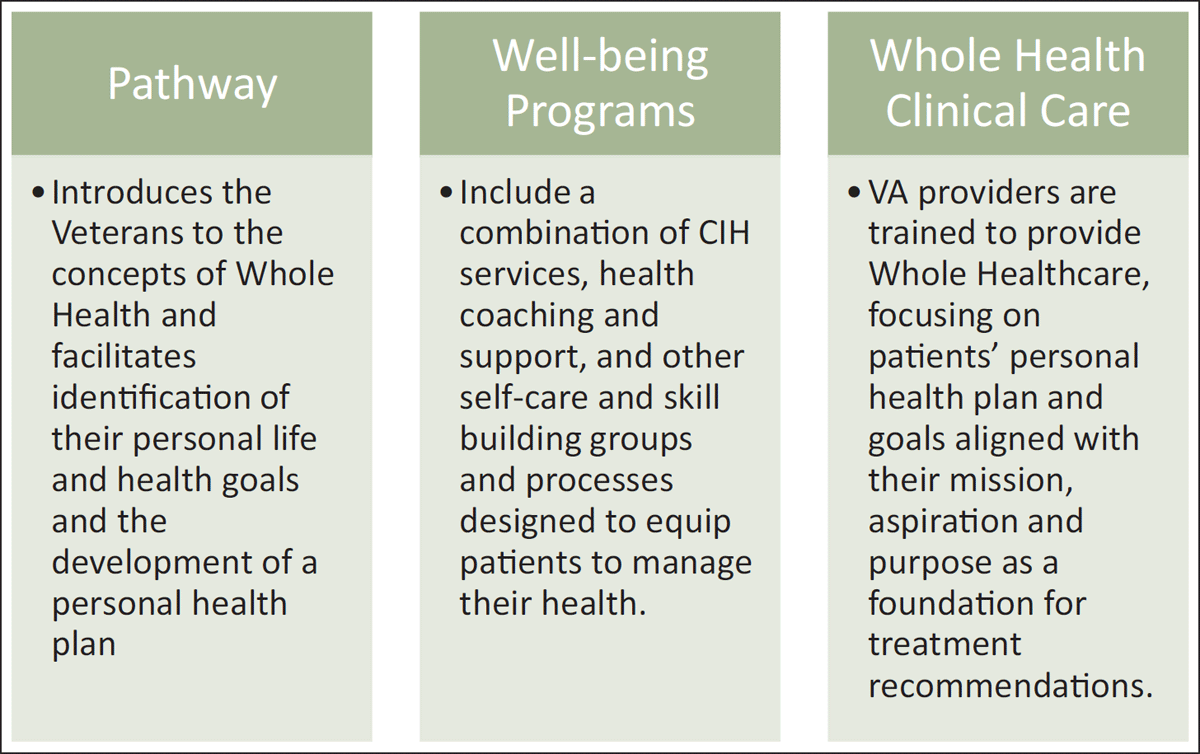
Figure 1
Whole Health Model Three-Pronged Approach is used by multidisciplinary teams to increase Veteran self-healing, self-care, and self-empowerment.
Whole Health model implementation began in 2018 with the announcement of 18 design sites and 18 flagship sites. Design sites implemented specific elements of Whole Health, whereas flagship sites implemented the full three-pronged model (see Figure 1). Flagship sites received onsite support, education, and resources for implementation (US Department of Veteran Affairs, n.d.). Previous works demonstrate improved veteran health and wellness when accessing services available through Whole Health (Elwy et al., 2020; Haun et al., 2020).
This project aimed to evaluate implementation of the Whole Health approach through a descriptive and observational evaluation of both design and flagship facilities during FY 2018. The objectives of this evaluation were to: (a) Identify staff perspectives and experiences in integrating Whole Health into health care delivery to improve veterans’ lives; and (b) Inform the ongoing national VA Whole Health evaluation.
Methods
Study Design
This project was an implementation evaluation using qualitative on-site visits, March to June 2018, at six VA medical centers in different regions of the country. One flagship site and five design sites were purposively selected to ensure representation of sites at various stages of implementation. The flagship site was chosen because it was (a) the site that initiated the project and (b) local to evaluation team, leading to improved access to champions and opportunities for more in-depth facility observations. Project team reached out to all design sites to describe the project and gage interest and availability. The five sites that responded as interested and with ability to host a project visit were selected to participate. Qualitative methods, semi-structured interviews, and observations were used to capture the experiences of staff implementing Whole Health at their site.
Participants
Purposive and snowball sampling were used to identify staff involved in Whole Health. Directors were asked to identify key stakeholders in implementation at their site. A total of 45 stakeholders participated; thirty-four were from design sites and 11 were from the flagship site (see Table 1).
Table 1
Participant Characteristics.
| DESIGN SITES PARTICIPANTS | FLAGSHIP SITE PARTICIPANTS | |
|---|---|---|
| Gender | ||
| Male | 7 | 3 |
| Female | 27 | 8 |
| Age (years) | ||
| 30–39 | 11 | 1 |
| 40–49 | 8 | 1 |
| 50–59 | 10 | 6 |
| 60+ | 4 | 1 |
| Unanswered | 1 | 2 |
| Race | ||
| African American | 5 | 1 |
| Asian | 2 | |
| Caucasian | 26 | 10 |
| Unanswered | 1 | |
| Ethnicity | ||
| Hispanic | 3 | |
| Not Hispanic | 30 | 10 |
| Unanswered | 1 | 1 |
| How long at this facility? (years) | ||
| <1 | 1 | |
| 1–5 | 12 | 5 |
| 6–10 | 12 | 5 |
| 10+ | 9 | 1 |
| How long in healthcare? (years) | ||
| <5 | 1 | 1 |
| 5–10 | 12 | 1 |
| 11–19 | 6 | 3 |
| 20+ | 15 | 6 |
| Role in Implementation of Whole Health | Some see as having more than one role | Some see as having more than one role |
| Administrative | 12 | 6 |
| Provides Training | 17 | 6 |
| Clinical Champion | 2 | 2 |
| Other | 5 |
Data Collection
Data collection consisted of several sources. Overall, the research team used within-method triangulation (i.e., interviews, observation, collected documents) to collect data on the implementation of Whole Health (Fusch et al., 2018; Triangulation, 2014). Taking this approach allows for varied perspectives providing a more comprehensive look at the phenomena being examined (i.e., implementation of Whole Health). Triangulation mitigates team bias and enhances reliability of study results, thus providing improved validity.
Interviews
A total of 45 participants from varied positions (e.g., hospital director, service chief, physician, nurse, administrative assistant) within each facility participated in interviews. Semi-structured interviews were scheduled in advance and audio-recorded with permission. A brief self-administered survey collected demographic details, including general social characteristics, clinical role, time in the VA, and assigned unit. The interview purpose was explained to participants. A semi-structured interview script was used to ensure all topics were covered. The interview script was developed using the Consolidated Framework for Implementation Research Constructs (CFIR; Kirk et al., 2016). CFIR is a systematic framework that includes evidence supported constructs set within five domains; all associated with successful implementation. The five CFIR domains include outer and inner setting (e.g., peer pressure and culture, readiness for implementation, relative priority, leadership engagement); intervention characteristics (e.g., evidence strength and quality, relative advantage, adaptability, complexity); characteristics of the individual (e.g., knowledge and beliefs about the intervention and execution of Whole Health) and process (e.g., planning, engaging, champions, and executing). Using available CFIR tools (Interview Guide Tool), we developed our interview guide (see Table 2). CFIR constructs and domains crosswalks interview questions with related CFIR constructs and domains.
Table 2
CFIR Constructs and Domains.
| INTERVIEW QUESTIONS | CONSTRUCTS | DOMAINS |
|---|---|---|
| Knowledge and beliefs about the intervention | Characteristics of individuals |
| Knowledge and beliefs about the intervention | Characteristics of individuals |
| Individual stage of change | Characteristics of individuals |
| Evidence strength and quality | Intervention characteristics |
| Relative advantage | Intervention characteristics |
| Executing | Process |
| Engaging | Process |
| Champions | Process |
| External policies and incentives | Outer setting |
| Readiness for implementation | Inner setting |
| Readiness for implementation | Inner setting |
| Readiness for implementation | Inner setting |
| Readiness for implementation | Inner setting |
| Readiness for implementation | Inner setting |
| Readiness for implementation | Inner setting |
| Readiness for implementation | Inner setting |
| Readiness for implementation | Inner setting |
| Readiness for implementation | Inner setting |
| Readiness for implementation | Inner setting |
| Executing Engaging | Process |
| Executing Engaging | Process |
| Reflecting and evaluating | Process |
Interviewers solicited participants’ attitudes and opinions on nine factors: (a) Whole Health and its value, (b) integration of Whole Health into veteran health care delivery, (c) evidence that Whole Health worked at their site, (d) perceived facilitators and barriers to implementing Whole Health, (e) leadership support that influenced Whole Health implementation, (f) resources needed, (g) training received or needed, (h) methods to encourage veteran participation, and (i) ensuring successful implementation of Whole Health.
Observations
Observations occurred at each site and consisted of a facility tour as well as independent observations. The evaluation team noted where Whole Health was being implemented, locations of classes and therapy sessions, ease of veteran access, and location of Whole Health relative to other services. Debriefing interviews were held with the evaluation team after each site visit. Field notes were taken to document discussion points and observations after each debriefing interview.
Document Collection
Artifacts were collected as able (e.g., recipe books, flyers, class notebooks). Pictures were taken, with permission, to better communicate environmental observations (e.g., gardens, artwork, lobbies). These artifacts were sorted by site and compiled into a repository of information describing the context of each site.
Data Analysis
A rapid assessment matrix approach (Beebe, 2014) was used to analyze interview data. Rapid assessment is a team-based approach to iteratively collect and analyze qualitative data that emphasizes speed of data collection and analysis in relation to focused programmatic questions or problems. Matrix analysis was used to identify and summarize salient themes from the interviews and field notes by the project team. Together, the project team (a) created domain names that corresponded with interview questions; (b) developed a note-taking template following the interview guide and domain names; (c) conducted debriefings and refined notes following interviews; (d) transferred notes to an Excel matrix; (e) categorized responses under domain names applying codes that emerged from the data; (f) reviewed codes and established consensus among the evaluation team; and (g) analyzed and summarized codes for key themes, variations, and information gaps. The project team conducted team debriefing interviews after each site visit to better understand how the context within which each site was experiencing Whole Health implementation. During these debriefing interviews, the team reviewed field notes, interview notes, and any collected documents. Once members developed an understanding of the interview data, findings were triangulated with debriefing interview notes and collected documents (Triangulation, 2014). This provided context during the analysis. Results were provided as feedback to project sites and funders.
Trustworthiness
Rigor in qualitative work is key. Rigor includes criteria such as credibility, transferability, dependability, and confirmability (Guba & Lincoln, 1994). These criteria combine to ensure trustworthiness. Strategies included prolonged engagement with participants, which consisted of phone calls to discuss and prepare for site visits, including the determination of which observations would be most informative. On site, the project team spent one to three days with participants, engaged in their daily activities and observed how they respond to Whole Health implementation. Evaluation team debriefing interviews were employed after each day on site, with copious notes and discussion. These debriefing interviews helped to synthesize data and discover patterns. The team developed a coding system after interviews were complete by discussing points of contention and coming to consensus. The coding team met at least weekly to review their work and shared matrices with a peer coder to code for certainty of findings. Throughout all activities, the team took extensive notes of their thoughts and decisions to provide an audit trail. Finally, member checking was used by providing findings back to participants for additional data or corrections.
Results
The project team found elements of all five CFIR constructs that were relevant to Whole Health implementation efforts. These constructs informed identification of domains influencing Whole Health implementation to include: (a) individual characteristics, (b) Whole Health evidence, and (c) implementation facilitators and barriers. Suggestions for sustainable adoption and cultural transformation were provided by participants.
Individual Characteristics
Individual characteristics discussed during participant interviews included knowledge and beliefs about Whole Health, individual state of change, personal identification with CIH, and engaging in Whole Health. VA employee engagement was described as perceived participant role and value for VA employees. Veteran engagement in Whole Health activities and how engagement occurs was also described.
VA Employee Engagement
Most participants identified their role in Whole Health implementation as being leadership support and provider of the Whole Health classes. Other roles identified included champion, educator, and implementation support (see Table 1). Most participants stated they were “very invested” in Whole Health. Participants identified value and effectiveness of Whole Health as the following: (a) “very valuable,” (b) focuses on wellness instead of illness improving patient-provider relationships, (c) reduces provider stress and burnout; improving/changing clinical practice, and (d) empowers veterans to take a more active role in their own health and improves access to information and care. One clinician noted, “It encourages veterans to think about other things and not just their illness. Whole Health is about sharing stories and inspiring others.”
Veterans’ Engagement
Many methods for encouraging and identifying veterans to participate in Whole Health were identified. Approaches for encouraging veterans included education for staff and veterans, consultations and referrals from providers, staff encouragement, and use of communication networks such as newspapers, monthly open houses, and word of mouth. For example, placing Whole Health articles on the VA website home page was one method participants identified for communicating Whole Health to veterans. Participants reported they were identifying potential veteran Whole Health participants through primary care provider referrals and Whole Health orientation for veterans. One site reported using the Personal Health Inventory for all veterans in two outpatient clinics (i.e., Post Deployment and Women’s Center) to identify participants.
Evidence
Participants were asked to identify evidence supporting successful Whole Health implementation at their site. Most participants felt evidence demonstrating Whole Health effectiveness included anecdotes from patients, research-based reports of Whole Health effectiveness, attendance at Whole Health offerings, and patient outcome measures for quality of life and pain. Other evidence reported included a decrease in doctor visits, improved labs following participation in Whole Health activities, and provider referrals to Whole Health classes.
Implementation Facilitators and Barriers
Participants were asked to describe how their site was currently implementing Whole Health and facilitators and barriers to implementation. These descriptions revealed several common facilitators and barriers to implementation.
Facilitators
The main facilitator identified by participants was having a progressive culture to include early adopters and staff who bought in and integrated Whole Health in their personal life such as incorporating exercise, breathing techniques, and mindfulness into daily routines. Other facilitators for implementation included: (a) resources such as hiring staff (e.g., Health Coaches), grant funding, and space; (c) staff education promoting Whole Health; (d) leadership support evidenced by modeling Whole Health and meeting attendance; (e) collaborative relationships among providers, Whole Health staff, and national partners such as the field implementation team; (f) starting Whole Health services in specific clinics, such as the Women’s Clinic, or Post-deployment; and (g) providing group classes for Whole Health offerings such as yoga and battlefield acupuncture.
Barriers
Barriers reported by participants included (a) lack of progressive culture: Whole Health requires a “new way of thinking”; (b) leadership: the alignment of Whole Health in the organizational chart under hospital leaders was cited as being important for having the authority to implement; (c) administrative barriers: hiring, position titles, obtaining space, credentialing; (d) lack of resources to include staff, space, and money; (e) clinical barriers: large caseload, appointment time limits; and (f) policies and procedures: note templates and clear policies (e.g., when aroma therapy may be used).
Facilitators and Barriers Across All Sites
Leadership and resources were identified as both facilitators and barriers to implementation. For successful Whole Health implementation, participants identified types of leadership support such as communicating and providing resources, and support through policies and procedures such as placement of Whole Health under the director or chief of staff in the organizational chart, providing templates to ease documentation, and making Whole Health a strategic goal for the facility as actions needed for implementation. Five sites reported having support from leadership and one site reported that their leadership came from other sources such as the National team (Field Implementation Team coordinator and monthly calls) and individual staff members. All six sites identified Whole Health staff and leadership as well as national partners as individuals that answer questions related to Whole Health implementation. Availability of the individuals were reported as “very available” by all six sites. Resources needed for Whole Health implementation include space, staff, money, time, and policies. Most resources had been received; however, policies to facilitate implementation and designated time to support Whole Health remained barriers.
Suggestions for Sustainable Adoption and Cultural Transformation
Participants identified suggestions for successful Whole Health implementation based on their experiences at their site. Suggestions included: (a) increased access to knowledge and information about Whole Health through training, (b) access to available resources, (c) creating communication networks, and (d) developing policies to support Whole Health implementation.
All six sites reported that training prepared participants for Whole Health implementation. Suggestions for future training opportunities included: (a) specific professional trainings such as integrative medicine and health coaching; (b) administrative training to implement Whole Health such as coding, stop codes, how to use funds, or how to implement Whole Health; and (c) ongoing trainings for continued learning such as refreshers and when something new is publicized.
Most participants suggested having resources such as space for Whole Health classes. Emphasizing that continued education is important to sustain implementation. Participants at three out of the six sites suggested creating communication networks such as collaborating with the local community and encouraging all services to connect to leaders at a national level. Administrative processes were suggested such as hiring more staff, incorporating a faster hiring process, establishing Whole Health as own service under the facility director, capturing workload credit, and developing templates for documentation as final suggestions for successful implementation.
Discussion
The implementation of a Whole Health approach to improve veterans’ lives is critically needed; however, it is a complex endeavor. At the site level, whether as a flagship or design site, challenges and opportunities are evident. Providers, clinicians, and leadership are engaged and motivated to implement Whole Health, however, there are issues with availability of resources and their ability to adequately implement Whole Health services. Although facilitators were identified, barriers hold back optimal implementation which, in turn, limits veteran access to nonpharmaceutical techniques to improve health and wellbeing. This project focused on staff implementation experiences and thus did not engage veterans. Authors’ current work seeks veteran perspectives on Whole Health programming and outcomes.
Implementation of Whole Health to serve veterans requires a paradigm shift from traditional allopathic-based care to a CIH delivery model. To facilitate this shift, a progressive culture at the local level is needed. Participants described how champions and early adopters can facilitate this “new way of thinking.” Other participants stated that building on existing CIH programs helped to promote implementation of the Whole Health approach. Similarly, leadership from the facility can support the paradigm shift for employees through ongoing education on the Whole Health approach and through the creation of steering committees to encourage communication and decision-making between the employees and partner organizations.
As with any large organization, administrative processes can incumber progress. Extended hiring processes at each facility were noted to slow implementation even though funding was available. Additionally, standardized position descriptions for newly developed positions were non-existent. Developing standardized position descriptions may lessen the time from identification to hiring necessary staff. At the time of evaluation, many of the sites were new to implementation of this framework for practice. As such, local policies and procedures lagged in development and varied by site. Consistency across the healthcare system may facilitate implementation. Development of templates to capture attendance of Whole Health programming and services provided would standardize capturing work flow and create a method for appropriately billing encounters (Powell et al., 2015). The development of tools for quality monitoring, such as a template to capture encounters, supports implementation (Powell et al., 2015). Mandating documentation of services within these templates improves clinician uptake of a new process and facilitates adoption of Whole Health approach.
Allocation of resources to support Whole Health implementation was an evident barrier. Specifically, identifying space for patient care, group medical appointments, and hired program staff were identified as challenges by participants. Overcoming this barrier requires innovative approaches. Formalizing connections with community organizations who provide similar programs is a strategy some sites promoted. For instance, one site created a contract with a local YMCA as a partner site to support Whole Health community programming. Technology may also provide a solution to limited space (Taylor, Bolton, et al., 2019). Telehealth has been shown to be effective in health education and care management (Lum et al., 2020; Mayo Clinic, 2020; Schulz-Heik et al., 2017). Telehealth visits can provide both one-on-one and group medical appointment space. Virtual reality may also prove to be a tool to overcome space shortages. New advances in virtual reality are being tested in a wide range of populations, creating a bridge from clinic appointments to practicing of new skills (e.g., practicing mindfulness) at home (Seabrook, 2020). Applying technology to space issues on the patient side, allows more space for clinicians within the hospital to meet implementation needs.
Limitations and Strengths
This project has limitations. First, this project was a pilot to gain preliminary implementation data informing a national evaluation. Generalizations from these data are limited. Second, we had a small number of key stakeholders and this group may not reflect the opinions of all staff implementing Whole Health. Finally, due to a national evaluation being conducted with the flagship sites, we decided to focus on design sites. The one flagship was included because it was the site that initiated the project. The flagship site had more funding and resources; therefore, was more advanced in implementation of Whole Health. It is logical to deduce with more resources; sites have a broad and effective implementation plan thereby supporting cultural transformation.
Strengths of this project include recruiting key representatives from staff to hospital leaders due to invested partnerships at operational and site levels. In addition, interviews were conducted on site at each facility. On site data collection encouraged the development of rapport between the evaluation team and participants as well as enabled observation of the environment where Whole Health was being implemented.
Recommendations
Data collected in this project created an opportunity to promote successful outcomes for Whole Health implementation efforts. We observed variation in the degree to which each facility was implementing Whole Health. To have cultural transformation, leadership support and resources are needed. In addition, administrative actions such as establishing national policies and procedures for stop codes, supplying templates, standardized position descriptions related to Whole Health, and the allocation of hire details will support national implementation of Whole Health across facilities. Finally, there is a need for measures to be developed nationally to systemically measure Whole Health outcomes and prioritize the experience of the Veteran into evaluation efforts.
Conclusion
The organizational priority of Whole Health (the motivation and readiness of VA employees) and the desire for access to Whole Health by veterans supported implementation of Whole Health within the VA. Resources and leadership endorsement facilitated implementation; however, due to the large-scale national implementation, limited resources present barriers. Recent works have demonstrated wide-range benefit of Whole Health organization to, most importantly, the individual veteran (Elwy et al., 2020; Goldberg et al., 2019; Haun et al., 2020; Herman et al., 2019; Taylor, Herman, et al., 2019). To support implementation of Whole Health to improve veterans’ lives requires cultural transformation, further employee training and knowledge translation, and optimization of veteran engagement and outcomes. Allocation of resources and refined mechanisms to support workflow and documentation of all patient-driven health delivery is needed.
Ethics and consent
This proposed project was reviewed by James A. Haley VA Research and Development Committee and deemed quality improvement thus, waiving the requirement for participant consent.
Acknowledgements
The authors wish to express their appreciation to the Whole Health staff from the participating sites who hosted our site visits, helped schedule data collection activities and participated in data collection for this project.
Funding Information
Funding for this project was provided by Whole Health Service, James A. Haley VA. The director of Whole Health Service was instrumental in the writing of this manuscript.
Competing Interests
The authors have no competing interests to declare.