
Table 1
Interview Participant Characteristics.
| ID | GENDER | AGE | BRANCH | YEARS SERVED | STATUS | MODALITY | COMBAT |
|---|---|---|---|---|---|---|---|
| P1 | Male | 25 | Army | 7 | Full-time | Hybrid | Yes |
| P2 | Female | 33 | Marine Corps | 10 | Full-time | Hybrid | Yes |
| P3 | Female | 30 | Navy | 8 | Part-time | Hybrid | No |
| P4 | Male | 25 | Marine Corps | 6 | Full-time | Hybrid | No |
| P5 | Female | 28 | Navy | 6 | Part-time | Hybrid | Yes |
| P6 | Male | 35 | Army | 8 | Part-time | Hybrid | Yes |
| P7 | Male | 45 | Army | 9 | Full-time | On-ground | Yes |
| P8 | Male | 44 | Army | 6 | Full-time | Hybrid | Yes |
[i] Note. Combat = deployed to a combat zone. All participants had prior military service. ID labels (P1–P8) are used throughout the article.
Table 2
Response Distributions and Descriptive Statistics for the 10 Perceived-Barrier Items (N = 23).
| SURVEY ITEM | BARRIER TYPE | 1 | 2 | 3 | 4 | 5 | Mdn | M | SD |
|---|---|---|---|---|---|---|---|---|---|
| I know how to get help at the college. | Institutional | 0 | 0 | 4 | 14 | 5 | 4.00 | 4.04 | 0.64 |
| I have a clear career path in mind as I begin my college studies. | Dispositional | 0 | 0 | 3 | 12 | 8 | 4.00 | 4.22 | 0.67 |
| My job(s) might interfere with my ability to succeed in my classes. | Situational | 0 | 5 | 2 | 14 | 2 | 4.00 | 3.57 | 0.95 |
| My high school experience makes me nervous about taking a college class. | Dispositional | 6 | 9 | 4 | 3 | 1 | 2.00 | 2.30 | 1.15 |
| Transportation issues might interfere with my ability to succeed in my classes. | Situational | 9 | 8 | 2 | 4 | 0 | 2.00 | 2.04 | 1.11 |
| Family responsibilities might interfere with my ability to succeed in my classes. | Situational | 1 | 10 | 1 | 6 | 5 | 3.00 | 3.17 | 1.34 |
| Money issues might interfere with my ability to succeed in my classes. | Situational | 2 | 7 | 6 | 5 | 3 | 3.00 | 3.00 | 1.21 |
| If circumstances were different, attending college would not be my first choice. | Dispositional | 5 | 5 | 2 | 8 | 3 | 3.00 | 2.96 | 1.43 |
| My health issues might interfere with my ability to succeed in my classes. | Situational | 6 | 8 | 4 | 2 | 3 | 2.00 | 2.48 | 1.34 |
| Childcare issues might interfere with my ability to succeed in my classes. | Situational | 7 | 6 | 5 | 2 | 3 | 2.00 | 2.48 | 1.38 |
[i] Note. Values in response-category columns are frequencies. Response options: 1 = strongly disagree, 2 = disagree, 3 = neutral, 4 = agree, and 5 = strongly agree. Mdn = median; M = mean; SD = standard deviation. Barrier types follow Cross (1981). Items are ordered with those differing significantly from the neutral midpoint (see Table 3) listed first.
Table 3
One-Sample t Test Results for Perceived Barriers Among Student Veterans.
| SURVEY ITEM | t | p | DIRECTION | 95% CI | d |
|---|---|---|---|---|---|
| I know how to get help at the college. | 7.84 | < .001 | Agree | [0.77, 1.32] | 1.64 |
| I have a clear career path in mind as I begin my college studies. | 8.70 | < .001 | Agree | [0.93, 1.51] | 1.81 |
| My job(s) might interfere with my ability to succeed in my classes. | 2.87 | .009 | Agree | [0.16, 0.97] | 0.60 |
| My high school experience makes me nervous about taking a college class. | –2.91 | .008 | Disagree | [–1.19, –0.20] | –0.61 |
| Transportation issues might interfere with my ability to succeed in my classes. | –4.14 | < .001 | Disagree | [–1.44, –0.48] | –0.86 |
[i] Note. Test value = 3, the neutral scale midpoint; df = 22. CI = confidence interval for the mean difference from the test value; d = Cohen’s d. Only items with mean responses differing significantly from neutral are shown; positive t values indicate agreement and negative values indicate disagreement. The p values are unadjusted across 10 exploratory tests.
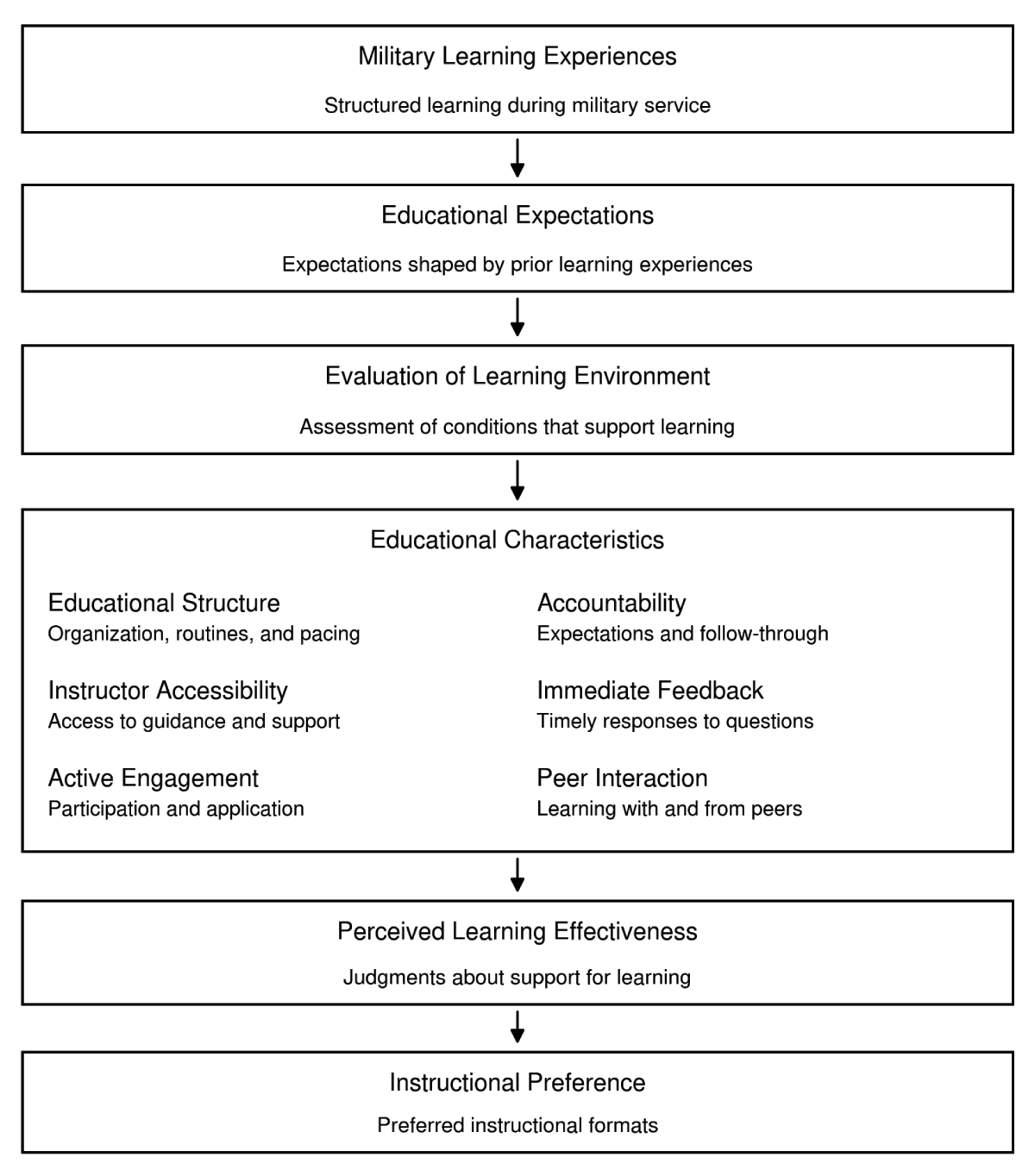
Figure 1
The Proposed Student Veteran Effective Learning (SVEL) Framework.
Note. Conceptual synthesis of the present study. Arrows represent proposed relationships, not tested causal effects. The six characteristics elaborate the four learning-related themes described in the Results section.