
The expansion of online and hybrid instruction has fundamentally changed how colleges and universities deliver education. For student veterans balancing employment, family responsibilities, commuting, and the transition from military to civilian life, online learning has increased access to higher education. Access, however, is not synonymous with educational effectiveness. As online instruction has become an integral part of postsecondary education, an important question remains underexplored: How do student veterans themselves evaluate whether a learning environment supports meaningful learning?
Student veterans represent a sizable population within higher education. In a national study of more than 2.7 million Post-9/11 GI Bill-eligible enlisted veterans, 54% had used their benefits, and 47% of benefit users in the six-year completion cohort had completed a degree (Radford et al., 2024). Unlike many traditional undergraduate students, veterans frequently enter college after years of military service, bringing leadership experience, organizational discipline, and extensive adult responsibilities (Ghosh et al., 2020; Pedersen & Wieser, 2024). Many are employed full-time, support families, commute significant distances to campus, or manage service-connected disabilities while pursuing their degrees (Brohawn et al., 2023; Klaw et al., 2021). Although flexibility is frequently identified as a primary advantage of online education for such learners (Boldon et al., 2016), flexibility alone may not explain how veterans evaluate the quality of their educational experiences.
Recent scholarship has emphasized that successful transition into higher education depends on more than academic preparedness and access to educational benefits: institutional support, faculty engagement, veteran resource centers, and peer relationships all contribute to student veteran persistence (Barmak et al., 2023; Ghosh et al., 2020; Klaw et al., 2021; Miles et al., 2025). Much of this literature, however, has emphasized access, persistence, institutional support, or academic outcomes rather than how veterans evaluate the instructional conditions that make learning effective. National engagement data suggest the question matters: Student veterans have reported lower levels of reflective learning and student–faculty interaction than their nonveteran peers (National Survey of Student Engagement, 2010). Flexibility may be a necessary condition for participation, but it may not be sufficient for learning. Understanding how veterans judge learning environments is increasingly important as institutions continue investing in online and hybrid instruction while seeking to improve student veteran success.
Accordingly, the purpose of this study was to examine how student veterans describe effective learning environments, to identify the educational characteristics they associate with successful learning across online and face-to-face settings, and to characterize the barriers they perceive to academic success. Rather than asking whether one modality is inherently superior, the study investigated how veterans evaluate the conditions for learning within different instructional formats.
The article proceeds as follows. The literature review situates student veterans as adult learners and summarizes research on veteran-friendly institutions and online learning, followed by the conceptual orientation that informed the study. The Method section describes the convergent mixed-methods case study design, participants, instruments, and analyses. The Results section reports the survey findings and the six themes generated from the interviews. The Discussion section interprets these findings in relation to the literature, introduces the Student Veteran Effective Learning (SVEL) Framework as a conceptual synthesis, and considers implications for instructional design, limitations, and future research.
Literature Review
Student Veterans as Adult Learners
Student veterans’ transitions into higher education involve reintegration, identity negotiation, institutional adjustment, social interaction, and the need for appropriate support structures (Ghosh et al., 2020; Pedersen & Wieser, 2024). These experiences provide context for how veterans approach academic work and campus engagement. The transition from military service to higher education is therefore best understood as a multidimensional process rather than a single academic event. Pedersen and Wieser’s (2024) scoping review of 137 studies identified transition challenges and support efforts as central themes in international student veteran research. Similarly, Ghosh et al. (2020) identified mental health, academic and career development, support, and identity as recurring factors influencing veterans’ reintegration into higher education. These findings suggest that student veteran success depends not only on admission and enrollment but also on the extent to which institutions create educational environments that support engagement, belonging, and persistence.
Adult learning theory provides an additional lens for understanding these experiences. In Knowles’s (1980) model of andragogy, adults differ from younger learners in that they expect to direct their own learning, draw on an accumulated reservoir of experience, approach education with immediate life and career goals in view, and are most motivated when instruction bears directly on their present responsibilities. Because student veterans typically bring years of structured occupational experience and a pragmatic orientation toward their degrees, these assumptions are especially pertinent to how they may judge instruction.
Veteran-Friendly Institutions
Over the past two decades, institutions of higher education have increasingly recognized the unique needs of student veterans and responded by developing veteran-friendly programs and services designed to facilitate successful transitions into academic life. Although the specific components of veteran-friendly initiatives vary across institutions, common practices include veteran resource centers, dedicated academic advising, faculty and staff training regarding military culture, peer mentoring, military education benefits certification, and programming that fosters community among military-connected students (Klaw et al., 2021; Miles et al., 2025).
Among these initiatives, veteran resource centers have emerged as one of the most consistently studied institutional supports. Research suggests that veteran resource centers provide more than administrative assistance; they serve as spaces where student veterans access academic resources, receive guidance regarding educational benefits, connect with peers, and develop a sense of belonging within the university community (Barmak et al., 2023). Drawing upon Schlossberg’s Transition Theory, Barmak et al. (2023) argue that veteran resource centers support successful transition by addressing veterans’ academic, social, and institutional needs simultaneously rather than treating these domains as independent challenges.
Faculty and staff also play a significant role in shaping student veterans’ educational experiences. Klaw et al. (2021), in their scoping review of veteran-support initiatives, concluded that faculty awareness of military culture, coordinated institutional services, and intentional campus support structures contribute positively to student veterans’ educational experiences. Similarly, Brohawn et al. (2023) found that veterans frequently identified knowledgeable faculty, institutional responsiveness, and accessible support services as important contributors to successful transition into higher education. Collectively, this research identifies institutional practices that improve access, facilitate navigation of university systems, and strengthen veterans’ sense of belonging (Barmak et al., 2023; Brohawn et al., 2023; Klaw et al., 2021; Miles et al., 2025).
Online Learning and Educational Access
Research on student veterans has identified flexible delivery as one way to accommodate employment, family responsibilities, and geographic constraints (Boldon et al., 2016; Pedersen & Wieser, 2024). Online and hybrid instruction can expand opportunities to participate, particularly for learners who cannot regularly attend campus. Pedersen and Wieser (2024) situated educational access within the wider transition from military service to education. Ghosh et al. (2020) similarly emphasized that reintegration involves academic, social, and identity-related concerns. Together, these reviews place instructional flexibility within a broader set of conditions affecting participation and learning.
Conceptual Orientation
Four theoretical and practice-based perspectives informed the design and interpretation of this study. First, Schlossberg’s (2011) transition theory frames the movement from military service to higher education as a process in which individuals appraise a change and marshal resources to move through it. The theory’s four resource domains (situation, self, support, and strategies) directed attention to how participants described their circumstances, their confidence and identity as learners, the institutional supports available to them, and the strategies they used to learn effectively. Second, Cross’s (1981) typology of institutional, situational, and dispositional barriers to adult participation structured the quantitative strand: The survey items operationalized each barrier type, and the typology supplied the categories used to interpret which obstacles participants perceived as most and least relevant.
Third, the veteran-friendly practices articulated by Boldon et al. (2016), including dedicated veterans centers and coordinators, faculty awareness of military culture, streamlined benefits processing, and flexible delivery options, provided a sensitizing framework for characterizing the research setting and for interpreting participants’ accounts of institutional support. Notably, this framework treats online and hybrid offerings as a means of accommodating veterans, an assumption the present study was positioned to examine. Fourth, Knowles’s (1980) andragogy supplied expectations about what adult learners are likely to value in instruction: self-direction, relevance to present responsibilities, and the opportunity to draw on prior experience.
Together, these perspectives oriented the study toward treating instructional modality as the context in which educational experiences occur rather than as the sole determinant of educational quality. They were used as sensitizing concepts (Merriam & Tisdell, 2016) that guided data collection and interpretation without imposing predetermined themes; the conceptual synthesis that emerged from the findings is presented at the end of the Discussion section.
Method
Design
This study employed a convergent mixed-methods case study design (Creswell & Creswell, 2018; Yin, 2018) and is reported in accordance with the Good Reporting of A Mixed Methods Study (GRAMMS) guideline (O’Cathain et al., 2008), which calls for a justification of the mixed-methods approach, a description of the design and each method, an account of where and how integration occurred, a discussion of the limitations of each method, and an explanation of the insights gained from mixing. The case was defined as the student veteran population of a single public university recognized for its veteran-friendly practices at the time of data collection. A case study approach was appropriate because the phenomenon of interest, how veterans evaluate learning environments, could not be separated from the bounded institutional context in which those environments were offered, because the study drew on multiple sources of evidence (survey responses, interviews, and institutional documents), and because the research questions were exploratory and descriptive rather than causal (Merriam & Tisdell, 2016; Yin, 2018). The single-site design permitted an in-depth account of one veteran-friendly institution at the cost of breadth, a trade-off addressed in the Limitations section.
Mixed methods were warranted because neither strand alone could answer the research questions. The quantitative strand, a survey of perceived barriers, characterized the conditions under which participants pursued their studies and identified which institutional, situational, and dispositional barriers they perceived as most and least relevant. The qualitative strand, semistructured interviews, explained how participants evaluated instructional environments and which characteristics they associated with effective learning. The two strands were collected during the same period, given equal priority, and analyzed separately before being integrated during interpretation, when the survey results were used to contextualize the interview themes and the interview accounts were used to explain the survey patterns.
Research Questions
The study was guided by three questions: (a) Which institutional, situational, and dispositional barriers do student veterans at a veteran-friendly university perceive as affecting their academic success? (b) How do student veterans describe an effective learning environment? and (c) Which educational characteristics do student veterans associate with effective learning across online and face-to-face instructional settings? The first question was addressed primarily by the survey and the second and third by the interviews. As described in the Conceptual Orientation section, Schlossberg’s (2011) transition theory, Cross’s (1981) barrier typology, and the veteran-friendly practices framework (Boldon et al., 2016) served as sensitizing frameworks throughout.
Research Setting
The study was conducted at Southern Connecticut State University, a public, four-year university in New Haven, Connecticut. At the time of data collection, the institution enrolled approximately 10,000 undergraduate and graduate students and served a student veteran population of more than 300. The university is widely recognized for its veteran-friendly practices and, at the time of the study, maintained a range of military-connected programs and services, including participation in the Yellow Ribbon Program, the Principles of Excellence, and the 8 Keys to Veterans’ Success, as well as a student veteran organization, military tuition assistance, distance-learning options, and a dedicated veterans center staffed by a veterans coordinator. Participants continue to be identified only by study labels to protect confidentiality.
Participants
For the purposes of this study, a student veteran was defined as an individual who reported prior service in any branch of the United States Armed Forces, including the Reserve and National Guard components, regardless of length of service, discharge characterization, deployment history, or current eligibility for education benefits, and who was enrolled as an undergraduate or graduate student at the participating university. Veteran status was determined by self-report: The survey asked respondents whether they had served in the military and, if so, in which branch and for how many years, and interview participants confirmed their service history at the start of each interview. No documentation of service (e.g., U.S. Department of Defense (DD) Form 214) was requested, consistent with the exploratory purpose of the study and the confidentiality assurances given to participants.
Two overlapping samples participated in the study. The quantitative sample comprised 26 students recruited through the veterans center who completed the survey. Twenty-three reported prior military service and constituted the analytic sample for all analyses reported below. The remaining three respondents indicated that they had never served in the military and were excluded from all analyses because they did not meet the study definition of a student veteran; all survey statistics below are therefore reported for the 23 student veterans. Respondents were predominantly male (17; 73.9%) and White (18; 78.3%), with the remaining respondents identifying as Black, Hispanic, or multiracial (5; 21.7%). Respondents ranged in age from 20 to 67 years (M = 32.35, SD = 11.74) and reported 1 to 25 years of military service (M = 7.48, SD = 6.25). The Army was the most commonly represented branch (12; 52.2%), followed by the Marine Corps (4; 17.4%), the Navy (3; 13.0%), the Air Force (3; 13.0%), and the Coast Guard (1; 4.3%). Most respondents were enrolled full-time (18; 78.3%) and received instruction primarily through hybrid courses (18; 78.3%), followed by online (3; 13.0%) and on-ground (2; 8.7%) formats.
The qualitative sample comprised eight student veterans drawn from the same population who volunteered to participate in individual interviews. All eight had served in the military, and six had deployed to a combat zone. Participants ranged in age from 25 to 45 years and represented the Army (n = 4), the Marine Corps (n = 2), and the Navy (n = 2); five were enrolled full-time and three part-time. Seven participants took courses primarily in a hybrid format, and one attended exclusively on-ground. Participant characteristics are summarized in Table 1. Throughout the article, interview participants are identified by the labels P1 through P8.
Table 1
Interview Participant Characteristics.
| ID | GENDER | AGE | BRANCH | YEARS SERVED | STATUS | MODALITY | COMBAT |
|---|---|---|---|---|---|---|---|
| P1 | Male | 25 | Army | 7 | Full-time | Hybrid | Yes |
| P2 | Female | 33 | Marine Corps | 10 | Full-time | Hybrid | Yes |
| P3 | Female | 30 | Navy | 8 | Part-time | Hybrid | No |
| P4 | Male | 25 | Marine Corps | 6 | Full-time | Hybrid | No |
| P5 | Female | 28 | Navy | 6 | Part-time | Hybrid | Yes |
| P6 | Male | 35 | Army | 8 | Part-time | Hybrid | Yes |
| P7 | Male | 45 | Army | 9 | Full-time | On-ground | Yes |
| P8 | Male | 44 | Army | 6 | Full-time | Hybrid | Yes |
[i] Note. Combat = deployed to a combat zone. All participants had prior military service. ID labels (P1–P8) are used throughout the article.
Data Collection
Participants were recruited through flyers posted on campus and email invitations distributed by the university’s veterans center. Data collection took place during the COVID-19 pandemic, which shaped several procedural decisions described below. All study procedures were approved by the Institutional Review Board at Southern Connecticut State University (IRB Protocol #107). Participants provided informed consent before completing the survey or participating in an interview.
Survey Instrument
Perceived barriers to academic success were measured using a 10-item survey adapted from the Student Success Survey developed by Oakland Community College. The instrument assessed the extent to which institutional, situational, and dispositional barriers (Cross, 1981) were perceived to affect academic success. Institutional barriers refer to university policies and procedures governing registration, enrollment, and access; situational barriers refer to circumstances such as transportation, finances, and family or childcare responsibilities; and dispositional barriers refer to intangible factors such as confidence, anxiety, and prior educational experiences. Respondents rated their agreement with each item on a five-point Likert-type scale ranging from 1 (strongly disagree) to 5 (strongly agree), with an opportunity to elaborate on each rating in an open-ended response. The 10 items were treated as independent indicators of distinct barriers rather than combined into a composite score; accordingly, item-level results are reported. For completeness, internal consistency across the 10 items (with the help-seeking and clear-path items reverse-scored as six minus the original response) was Cronbach’s α = .65; because the items were designed to sample heterogeneous barrier types rather than a single latent construct, high internal consistency was neither expected nor required for the item-level analyses reported here. The survey also collected demographic information, including military service history, branch, years served, enrollment status, and primary instructional modality.
Semi-structured Interviews
Although the study was originally designed to include focus groups, public health restrictions associated with the COVID-19 pandemic made in-person group interviews impractical. As a result, eight individual semi-structured interviews were conducted with student veterans from the public university. Interviews were conducted and recorded using Zoom and were guided by an open-ended protocol that invited participants to describe their instructional modality preferences, experiences with institutional supports, perceived strengths and limitations of the institution, and conceptions of academic success. Follow-up and clarification prompts were used to elicit deeper responses. The researcher transcribed each recording verbatim before analysis.
Data Analysis
Quantitative survey data were analyzed using IBM SPSS Statistics (Version 27). Frequencies for each response category, medians, means, and standard deviations were computed for each of the 10 items. Because the items were single, ordinal Likert-type indicators rather than summed scales, the decision to treat them as approximately continuous for inferential purposes warrants comment. Parametric tests, including the t test, can be robust to some violations of interval-scale and distributional assumptions with Likert-type data (Norman, 2010; Sullivan & Artino, 2013). On that basis, and to provide a familiar summary of central tendency, one-sample t tests compared each item mean with the scale midpoint of three, which represented a neutral response. Given the small sample, 95% confidence intervals for the mean difference and Cohen’s d (Cohen, 1988) are reported alongside each test so that readers can judge the magnitude and precision of each effect independently of statistical significance. Assumptions were examined before testing: Skewness and kurtosis values fell within the –3 to +3 range (Kline, 2011), and no outliers were identified using standardized scores. The 10 tests were exploratory; the reported p values are unadjusted for multiple comparisons and should not be interpreted as confirmatory evidence. The item-level frequency distributions and medians are reported in Table 2 so that readers may also interpret the results on the original ordinal scale.
Table 2
Response Distributions and Descriptive Statistics for the 10 Perceived-Barrier Items (N = 23).
| SURVEY ITEM | BARRIER TYPE | 1 | 2 | 3 | 4 | 5 | Mdn | M | SD |
|---|---|---|---|---|---|---|---|---|---|
| I know how to get help at the college. | Institutional | 0 | 0 | 4 | 14 | 5 | 4.00 | 4.04 | 0.64 |
| I have a clear career path in mind as I begin my college studies. | Dispositional | 0 | 0 | 3 | 12 | 8 | 4.00 | 4.22 | 0.67 |
| My job(s) might interfere with my ability to succeed in my classes. | Situational | 0 | 5 | 2 | 14 | 2 | 4.00 | 3.57 | 0.95 |
| My high school experience makes me nervous about taking a college class. | Dispositional | 6 | 9 | 4 | 3 | 1 | 2.00 | 2.30 | 1.15 |
| Transportation issues might interfere with my ability to succeed in my classes. | Situational | 9 | 8 | 2 | 4 | 0 | 2.00 | 2.04 | 1.11 |
| Family responsibilities might interfere with my ability to succeed in my classes. | Situational | 1 | 10 | 1 | 6 | 5 | 3.00 | 3.17 | 1.34 |
| Money issues might interfere with my ability to succeed in my classes. | Situational | 2 | 7 | 6 | 5 | 3 | 3.00 | 3.00 | 1.21 |
| If circumstances were different, attending college would not be my first choice. | Dispositional | 5 | 5 | 2 | 8 | 3 | 3.00 | 2.96 | 1.43 |
| My health issues might interfere with my ability to succeed in my classes. | Situational | 6 | 8 | 4 | 2 | 3 | 2.00 | 2.48 | 1.34 |
| Childcare issues might interfere with my ability to succeed in my classes. | Situational | 7 | 6 | 5 | 2 | 3 | 2.00 | 2.48 | 1.38 |
[i] Note. Values in response-category columns are frequencies. Response options: 1 = strongly disagree, 2 = disagree, 3 = neutral, 4 = agree, and 5 = strongly agree. Mdn = median; M = mean; SD = standard deviation. Barrier types follow Cross (1981). Items are ordered with those differing significantly from the neutral midpoint (see Table 3) listed first.
Qualitative interview data were analyzed using the six-phase thematic analysis procedure described by Braun and Clarke (2006). Transcripts were imported into NVivo (QSR International), which was used to store transcripts, apply and organize codes, retrieve coded excerpts, and maintain the coding audit trail. The researcher first became familiar with the data through repeated readings of the transcripts, then generated initial codes inductively, collated codes into candidate themes, reviewed the themes against the coded excerpts and the full data set, defined and named the final themes, and selected representative excerpts to illustrate each. Six themes were generated: four describing the educational characteristics participants associated with effective learning and two describing the institutional environment in which those characteristics were experienced. Themes were interpreted through the sensitizing lenses described in the Conceptual Orientation section.
Integration of the two strands occurred at the interpretation stage through a narrative weaving approach (Fetters et al., 2013): The survey findings on perceived barriers were used to characterize the participant population and were then compared with, and elaborated by, the interview themes concerning institutional support and commuting. Points of convergence and divergence between the strands are noted in the Results and Discussion section.
Trustworthiness and Researcher Positionality
Several strategies were used to strengthen the trustworthiness of the findings (Creswell & Creswell, 2018; Merriam & Tisdell, 2016). Data-source triangulation compared survey responses, interview transcripts, and institutional documents (the university’s published veteran-services materials and program descriptions) for convergence on the themes; this triangulation was conducted by the researcher and reviewed by the members of the researcher’s dissertation committee, who examined the codebook, theme definitions, and representative excerpts and challenged interpretations that were not clearly supported by the data. The interview protocol was reviewed before data collection by the dissertation committee and peer researchers, and an audit trail of analytic decisions was maintained throughout the study. The researcher is a U.S. Army veteran, a status that facilitated rapport with participants and an understanding of military culture. To guard against bias arising from this shared background, the researcher engaged in ongoing reflexivity by documenting assumptions and preconceptions in a research journal and remaining attentive to the possibility that prior military experience or rank could influence interpretation.
Results
Consistent with the convergent design, quantitative findings addressing the first research question are presented first, followed by the six qualitative themes addressing the second and third research questions. Integration of the two strands is addressed in the Discussion section.
Quantitative Results
The quantitative strand played a contextual role. Rather than supporting generalizable inference, which the sample of 23 would not warrant, the survey identified the barriers that student veterans perceived as most and least relevant to their academic success. Table 2 presents the response distribution, median, mean, and standard deviation for each of the 10 items. Medians of four on the help-seeking, career-path, and employment items indicate that most respondents agreed or strongly agreed with those statements; no respondent disagreed that they knew how to get help or had a clear career path. Medians of two on the high school, transportation, health, and childcare items indicate general disagreement that these factors posed barriers, whereas responses to the family-responsibility, money, and college-as-first-choice items were split across the scale and centered on the neutral midpoint (Mdn = 3).
One-sample t tests then compared each item mean with the neutral midpoint of three (Table 3). Participants reported mean agreement above neutral at the unadjusted .05 level that they knew how to get help at the college, t(22) = 7.84, p < .001, that they had a clear career path in mind as they began their studies, t(22) = 8.70, p < .001, and that their job(s) might interfere with their ability to succeed in their classes, t(22) = 2.87, p = .009. Conversely, participants disagreed that their high school experience made them nervous about taking a college class, t(22) = –2.91, p = .008, and that transportation issues might interfere with their success, t(22) = –4.14, p < .001. Effect sizes (Cohen, 1988) were large for the help-seeking (d = 1.64) and career-path (d = 1.81) items, large for the transportation item (d = –0.86), and medium for the employment (d = 0.60) and high school (d = –0.61) items. The remaining five item means did not differ from the midpoint at the unadjusted .05 level.
Table 3
One-Sample t Test Results for Perceived Barriers Among Student Veterans.
| SURVEY ITEM | t | p | DIRECTION | 95% CI | d |
|---|---|---|---|---|---|
| I know how to get help at the college. | 7.84 | < .001 | Agree | [0.77, 1.32] | 1.64 |
| I have a clear career path in mind as I begin my college studies. | 8.70 | < .001 | Agree | [0.93, 1.51] | 1.81 |
| My job(s) might interfere with my ability to succeed in my classes. | 2.87 | .009 | Agree | [0.16, 0.97] | 0.60 |
| My high school experience makes me nervous about taking a college class. | –2.91 | .008 | Disagree | [–1.19, –0.20] | –0.61 |
| Transportation issues might interfere with my ability to succeed in my classes. | –4.14 | < .001 | Disagree | [–1.44, –0.48] | –0.86 |
[i] Note. Test value = 3, the neutral scale midpoint; df = 22. CI = confidence interval for the mean difference from the test value; d = Cohen’s d. Only items with mean responses differing significantly from neutral are shown; positive t values indicate agreement and negative values indicate disagreement. The p values are unadjusted across 10 exploratory tests.
The survey responses indicated clear career goals and knowledge of how to obtain institutional help. Employment was the only negatively worded barrier item with a mean above neutral at the unadjusted .05 level. The sample’s average transportation and prior-schooling responses were below neutral; this does not imply that no individual experienced those barriers. These results describe perceived conditions in the survey sample and provide context for the interview accounts.
Qualitative Results
When asked about their instructional modality preferences, seven of the eight interview participants expressed a clear preference for face-to-face instruction. One participant preferred online courses, citing her age and competing responsibilities, and one preferred in-person courses but enrolled primarily in hybrid sections for scheduling reasons. Participants did not frame this preference as a rejection of the convenience online learning offered; several explicitly acknowledged the flexibility that online courses afforded for balancing employment, commuting, and family obligations. Rather, their preference reflected an evaluation of the educational characteristics they associated with effective learning. Thematic analysis generated six themes. Four describe the educational characteristics participants associated with effective learning: (a) educational structure and accountability, (b) immediate instructor feedback, (c) active classroom engagement, and (d) meaningful peer interaction. Two describe the institutional context in which those characteristics were experienced: (e) a veteran-friendly environment and (f) commuting as a persistent barrier. Each theme is described below and illustrated with representative excerpts.
Educational Structure and Accountability
Participants repeatedly described the physical classroom as a structure that held them accountable for their attention and effort. Several explained that being present in a classroom removed distractions and obligated them to engage with the material in ways that online coursework did not. P1 captured this sense of externally imposed structure when comparing the two modalities:
As far as retaining information and actually learning, I prefer face-to-face classes, because I’m forced there, obviously, at my own free will…I’m in the setting where I have no distractions; all I’m doing is taking notes, paying attention to the information. Now, with the online environment, even Zoom, …it does allow more flexibility for work, but I don’t retain information as much (P1).
Other participants echoed this theme. P4 explained that a face-to-face course “[g]ets me to the class, and actually has me take notes,” whereas in online courses “[i]t’s just easier for me to forget about assignments, or just…SparkNotes everything.” Similarly, P6 noted that in-person classes “[f]orce me to be more involved with the lectures instead of just hopping on Teams [to] listen to somebody ramble on.” For these participants, the structure and accountability of the physical classroom were not incidental features of modality but educational characteristics they associated directly with learning and retention.
Immediate Instructor Feedback
A second characteristic participants associated with effective learning was the ability to obtain immediate feedback from instructors. Participants valued being able to ask a question and receive an answer in real time, and they contrasted this responsiveness with the delays they experienced in online communication. P1 described the directness of in-person interaction:
Face-to-face is better because…you can literally just go up to the professor after class or before class, and they can’t just hide behind a computer. They have to…answer you… Versus an email…you miss an email here and there (P1).
P6 likewise reserved his most demanding courses for campus because in-person instruction “[a]llows me the opportunity to ask questions in real time,” whereas with online courses “I’ll send an email, they’ll respond back—it has not been that effective.” He added that online communication sometimes left instructors unsure of who he was, requiring him to resubmit the same information. P4 perceived a similar, if smaller, lag, observing that “[i]n person seems to be more rapid, but with online, it’s still only like maybe a day difference.” For P8, however, responsive instructors mitigated the limitations of distance: when he reached out by email, his professors “[w]ould schedule time to…elaborate on concepts I needed help with, or they would give me additional assignments so that I could practice.” These accounts suggest that the immediacy of feedback, rather than modality per se, shaped participants’ evaluations of instructional effectiveness.
Active Classroom Engagement
A third characteristic was active engagement with the learning experience. Participants described face-to-face classes as more absorbing and online classes as conducive to passive, minimal effort. P5 stated a categorical preference: “I prefer face-to-face 100%…It’s easier to follow the information. When I see the person, I can pay more attention versus sitting at a computer possibly watching a lecture if I’m lucky.” P7 drew a sharp contrast between completing coursework and learning:
Online, it seems really disjointed. I’m definitely not interested in what’s going on…I just do the minimum…so I’m not getting anything out of it…It’s not about the learning, like with in-person courses. They’re enjoyable for me. They hold my attention. I know what’s going on (P7).
For P7, the online format reduced education to task completion, whereas the in-person classroom sustained the attention and interest he equated with genuine learning. This emphasis on engagement was closely tied to the retention concerns participants raised under educational structure; as P1 observed, the immersive, distraction-free classroom was where he “[l]earned the most.”
Meaningful Peer Interaction
The fourth characteristic was meaningful interaction with peers. Participants valued hearing classmates’ questions and contributions, which they described as deepening their own understanding. P7 explained that a benefit of in-person courses was the chance to “[a]ctually hear what the other students in the class have to say,” adding, “I can hear questions that the other students are asking the professor, and it helps me better understand what’s going on…I learn a great deal from hearing the questions and the comments from other students.” Some participants also pointed to the shared discipline of fellow veterans as a source of motivation. P6 observed that “[a]nytime I’ve been in a class with another veteran; they seem to always take it so much more seriously…and I think it’s a lot of that discipline and that mindset that comes along with that veteran status.” For P1, informal peer connections eased his transition, as “[s]tudy groups form” over time. This characteristic was not universal, however. P3, the one participant who preferred online courses, explained that for her, “[t]he undergraduate college experience…in terms of interacting with peers…isn’t as relevant” given her age and competing responsibilities, a reminder that the value placed on peer interaction varied with participants’ goals and life circumstances.
A Veteran-Friendly Environment
The fifth theme captured the institutional environment within which participants experienced these educational characteristics, an environment they consistently described as supportive. Six of the eight participants identified the campus veterans center as central to their success, describing it both as a source of guidance and as a place to belong. P5 explained that the presence of a “[v]eteran’s lounge where everybody can be” distinguished the institution from others she had attended: “[t]he veteran-friendly ones…are the ones I feel more comfortable in and do better…[because] it gives me a place to go between classes.” Participants also praised the veterans coordinator; P7 described him as “[a]n absolute lifesaver,” and P8 simply stated, “[t]he veteran’s coordinator is awesome.” Academic and veteran advisors, the library, and the computer lab were likewise identified as resources that reduced barriers to success.
Commuting as a Persistent Barrier
The sixth theme concerned a barrier participants had not fully overcome: commuting. As a commuter institution, the university required many participants to travel substantial distances and to navigate limited parking, which P6 summarized bluntly: “University parking is a problem.” Yet even here, participants described the veterans center as a mitigating resource. P5, who reported an hour-long commute and long gaps between classes, explained that the center gave her “[b]oth a place to study and a place to relax,” allowing her to use otherwise idle time productively. These accounts differ from the survey’s average disagreement that transportation threatened academic success; this divergence is considered in the discussion section.
Discussion
The findings suggest that these participants evaluated instructional environments through the educational characteristics they associated with learning. Seven of the eight interview participants preferred face-to-face instruction, while also valuing the flexibility of online coursework. Their explanations emphasized structure and accountability, immediate feedback, engagement, and peer interaction. They also described veteran-specific institutional supports as sources of belonging and practical assistance.
Integrating the strands provides a more qualified account of these experiences. Survey respondents reported knowing how to obtain help; interview accounts identified the veterans center and coordinator as concrete sources of support. The strands differed on transportation: The survey mean was below neutral, whereas interview participants described commuting and parking difficulties. Accounts of using the veterans center between classes suggest one possible explanation: Commuting could remain burdensome while institutional resources helped participants manage it. Differences in sample composition and question wording may also contribute to the divergence. Integration therefore identifies a possible relationship between practical barriers and institutional support without establishing a causal explanation.
Instructional Modality as Context, Not Cause
Participants’ accounts highlight the distinction between educational access and educational effectiveness. Prior literature identifies flexible delivery as one way to accommodate veterans’ educational participation (Boldon et al., 2016; Pedersen & Wieser, 2024). The present findings complicate that framing. Participants readily acknowledged that online courses expanded access by accommodating employment, commuting, and family responsibilities, yet they did not equate that convenience with effective learning. Instead, they evaluated learning environments according to the educational characteristics embedded within them and judged face-to-face classrooms superior because those characteristics were more consistently present, not because the modality was inherently better. This interpretation treats modality as a context for perceived learning experiences; the study did not test causal effects on learning outcomes, and it cautions against assuming that the flexibility veterans appreciate is synonymous with the educational quality they seek.
Situating the Findings Within the Literature
The four educational-characteristic themes resonate with established scholarship on adult learning and engagement. Knowles’s theory of andragogy describes adult learners as self-directed and oriented toward relevant, goal-driven learning (Knowles, 1980), and participants’ emphasis on clear structure suggests that self-direction can coexist with a preference for external supports. Their accounts also align with research on student engagement, which positions engagement as a product of the interaction between motivation and active learning (Barkley, 2010). The 2010 National Survey of Student Engagement found that student veterans reported lower levels of reflective learning and student–faculty interaction than their nonveteran peers (National Survey of Student Engagement, 2010); the present interview accounts illustrate the value some veterans place on those forms of interaction and engagement.
The findings further extend the literature on military and academic learning cultures. Pedersen and Wieser (2024) identified the difference between the structured environment of military learning and the comparatively self-directed culture of higher education as a central transition challenge. Participants’ valuation of structure and accountability can be read as an expression of expectations carried over from military learning environments, suggesting that prior military learning experiences shape how veterans evaluate instruction, a premise formalized in the framework presented below. At the same time, the study both confirms and qualifies prior work on veteran-friendly practices. Consistent with research on veteran resource centers and institutional support (Barmak et al., 2023; Klaw et al., 2021), participants credited the campus veterans center and coordinator with fostering belonging and easing their transition. Yet the study departs from the assumption, reflected in some best-practice frameworks (Boldon et al., 2016), that online and hybrid offerings are themselves a primary means of better accommodating veterans. For these participants, the value of the veteran-friendly environment lay less in flexible delivery than in the structure, feedback, engagement, and interaction that supported meaningful learning.
Bridging Military and Academic Learning Cultures
The educational characteristics participants associated with effective learning can be understood as a response to the cultural distance between military and academic learning environments. Military training is highly structured, externally paced, and accountability-driven, whereas higher education places responsibility for pacing, attention, and follow-through on the individual learner (Pedersen & Wieser, 2024). For students who spent formative years in the former environment, the latter can feel disorienting, a shift that Schlossberg’s (2011) transition model frames in terms of the resources individuals marshal to move through change. Within that model, the structure, feedback, engagement, and interaction that participants sought function less as matters of taste than as strategies for managing a demanding transition. When P1 explained that he preferred face-to-face classes because he was “forced there” with “no distractions,” he was describing a way of reconstructing, within the classroom, the external structure that military service had previously supplied. Read this way, the characteristics participants valued may reflect how these veterans translated prior learning experiences into expectations for higher education.
Belonging and the Veteran-Friendly Environment
A second point worth drawing out is the relationship between belonging and the educational characteristics participants valued. Participants did not experience structure, feedback, engagement, and interaction in a vacuum; they encountered them within an institution whose veteran-specific supports they consistently credited with helping them feel that they belonged. The campus veterans center, in particular, served simultaneously as a practical hub and as a social anchor, a finding that echoes a growing body of work identifying veteran resource centers as critical to transition, persistence, and a sense of community (Barmak et al., 2023; Klaw et al., 2021; Miles et al., 2025). Ghosh et al. (2020) similarly identified support and identity as recurring factors in veterans’ reintegration, and participants’ descriptions of the veterans center as a place to belong and of the coordinator as “an absolute lifesaver” map directly onto those themes. For commuting students, the center carried added significance: It converted the dead time between classes, time otherwise consumed by long commutes and scarce parking, into space for study and connection. This suggests that belonging and learning are not separable concerns. The same physical space that fostered community also enabled the structured, distraction-free work participants associated with effective learning, implying that institutional environment and instructional effectiveness operate together rather than in parallel.
The Proposed Student Veteran Effective Learning (SVEL) Framework
Across the qualitative themes, participants evaluated learning environments according to the educational characteristics they believed supported meaningful learning. Their accounts did not suggest that instructional modality alone determined effectiveness. Instead, participants associated effective learning with structure and accountability, immediate instructor feedback, active engagement, and meaningful peer interaction. These characteristics were experienced most consistently in face-to-face classrooms, but participants’ explanations indicate that the underlying issue was not delivery format itself but whether a learning environment provided the conditions they needed to stay engaged, receive timely guidance, and learn from others.
Drawing upon these findings, this study proposes the Student Veteran Effective Learning (SVEL) Framework as a conceptual model for understanding how student veterans evaluate learning environments. Within the framework, prior military learning experiences and educational expectations shape how veterans evaluate instructional settings. Veterans then evaluate those settings according to educational characteristics embedded within the environment, comprising educational structure, accountability, instructor accessibility, immediate feedback, active engagement, and peer interaction. These six characteristics map onto the four educational-characteristic themes reported in the results section: The first theme comprises two analytically distinct elements, structure (the organization and pacing of the learning environment) and accountability (the external expectation to be present and attentive), and the second theme likewise comprises instructor accessibility (the ability to reach an instructor) and immediate feedback (the timeliness of the response). These evaluations inform perceived learning effectiveness and, ultimately, instructional preference (Figure 1).
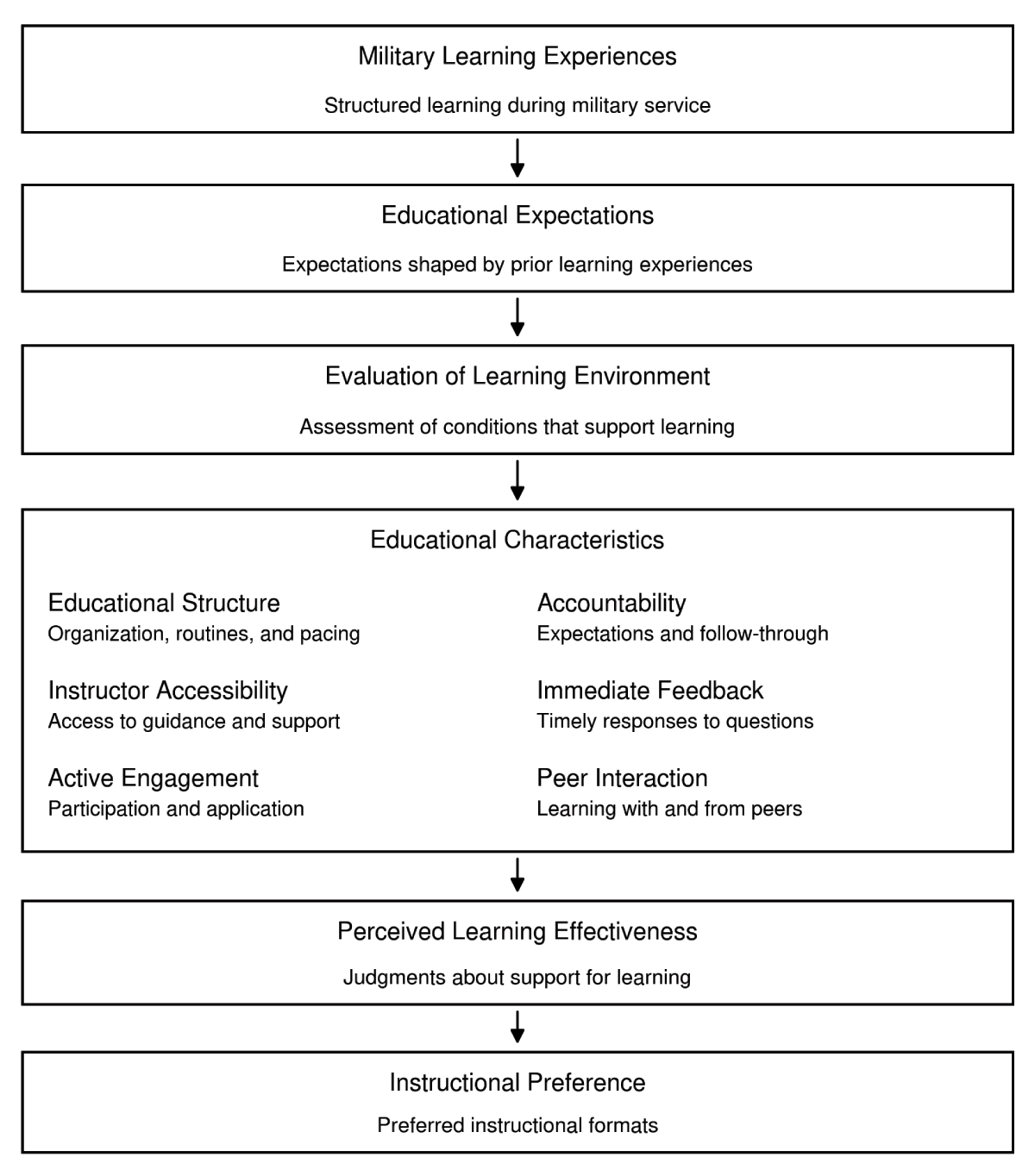
Figure 1
The Proposed Student Veteran Effective Learning (SVEL) Framework.
Note. Conceptual synthesis of the present study. Arrows represent proposed relationships, not tested causal effects. The six characteristics elaborate the four learning-related themes described in the Results section.
The SVEL Framework should be viewed as a conceptual interpretation derived from this mixed-methods case study rather than as a validated explanatory model. It organizes the empirical findings while providing a foundation for future research examining instructional design, online learning, and student veteran success across diverse higher education settings.
The SVEL Framework’s Contribution and Boundaries
Taken together, these interpretations clarify what the SVEL Framework contributes and where its limits lie. Conceptually, the framework reframes a debate that has often been conducted in terms of modality (online versus face-to-face) as a question about educational characteristics. In doing so, it draws together three bodies of scholarship that have typically been applied to student veterans separately: adult learning theory, which emphasizes self-direction and relevance (Knowles, 1980); engagement scholarship, which connects motivation, active participation, interaction, and reflective learning to educational engagement (Barkley, 2010; National Survey of Student Engagement, 2010); and transition theory, which situates veterans’ educational choices within a larger process of reintegration (Schlossberg, 2011).
The framework’s value lies in offering a single lens through which these strands can be read as describing one evaluative process. Its boundaries, however, should be stated plainly. The framework is a conceptual interpretation derived from a single veteran-friendly institution rather than a validated model, and the educational characteristics it names are interrelated rather than independent: Structure supports engagement, engagement depends on interaction, and feedback reinforces both. The SVEL Framework is therefore best understood as an empirically informed map of how student veterans appear to evaluate learning environments, offered as a foundation for the more systematic testing described below rather than as a settled account.
Implications for Practice
The SVEL Framework offers a practical lens for designing instruction that supports student veterans without sacrificing the flexibility many require. Because participants valued educational characteristics rather than modality per se, the framework implies that online and hybrid courses can be made more effective for veterans by intentionally embedding the characteristics veterans associate with learning. Structure and accountability can be strengthened through clear schedules, regular deadlines, and predictable routines that approximate the structure of the physical classroom. Immediate feedback can be approximated through synchronous office hours, prompt response-time norms, and frequent low-stakes assessment. Active engagement can be cultivated through interactive synchronous sessions and tasks that require more than passive consumption of recorded lectures. Meaningful peer interaction can be fostered through structured discussion, collaborative assignments, and, where feasible, veteran cohorts or learning communities that allow students to learn from one another’s questions and contributions. For faculty and instructional designers, the implication is not that online learning should be abandoned but that it should be deliberately designed to provide the educational characteristics that distinguish effective learning from convenient access.
At the institutional level, the findings reinforce the value of veteran-specific supports. Participants’ descriptions of the veterans center as a place of belonging and practical assistance echo research identifying veteran resource centers as critical to transition and persistence (Barmak et al., 2023). Institutions seeking to serve student veterans well may therefore benefit from pairing well-designed instruction with dedicated physical and relational spaces that sustain community, particularly for commuting students, for whom such spaces convert otherwise unproductive time between classes into opportunities for study and connection.
Limitations and Future Research
Several limitations should be considered when interpreting these findings. First, the study was conducted at a single public university in the northeastern United States, and the samples were small, particularly the eight interview participants, limiting the transferability of the findings to other institutions and populations. Second, data collection occurred during the COVID-19 pandemic, which not only constrained recruitment and necessitated individual interviews in place of the originally planned focus groups but also may have shaped participants’ perceptions of online learning at a moment of rapid, often improvised, remote instruction. Third, participants were largely drawn from veterans who were actively engaged on campus and familiar with available supports; veterans who were less connected, or who managed significant service-connected disabilities, may hold different views and were less likely to participate. Fourth, each strand carried its own limitations.
The survey relied on 10 single-item, ordinal indicators adapted from an instrument without published psychometric evidence, and the exploratory tests were not adjusted for multiple comparisons. Thus, the quantitative results describe perceived barriers in this sample rather than measure validated constructs, and the small n limits the precision of the reported estimates. The interviews were conducted by a single researcher with self-selected volunteers and, having replaced the planned focus groups, did not capture the group interaction that focus groups afford. Fifth, integration compared patterns across overlapping samples rather than linking each survey response to an individual interview account; apparent convergence or divergence cannot establish within-person relationships. Finally, as a veteran himself, the researcher brought insider knowledge that aided rapport but also introduced the potential for bias, which was addressed through reflexivity and triangulation but cannot be eliminated entirely.
These limitations suggest directions for future research. Studies with larger and more diverse samples across multiple institutions and regions would help establish whether the educational characteristics identified here generalize to other student veteran populations. Research designs that intentionally recruit less-engaged veterans and those with service-connected disabilities would broaden understanding of how learning environments are evaluated across the full spectrum of the veteran population. Because the SVEL Framework is offered as a conceptual interpretation rather than a validated model, future work might also test its propositions empirically; for example, researchers could examine whether online courses deliberately designed to provide structure, feedback, engagement, and peer interaction yield learning experiences that student veterans evaluate as favorably as face-to-face instruction.
Conclusion
This mixed-methods case study found that seven of eight interview participants preferred face-to-face instruction while valuing the flexibility of online coursework. They associated effective learning with structure and accountability, immediate instructor feedback, active engagement, and peer interaction. Survey and interview findings also highlighted institutional support and the uneven burden of practical barriers. The proposed SVEL Framework organizes these accounts into six educational characteristics that may inform perceived learning effectiveness and instructional preference. It offers a basis for testing whether those characteristics can be supported across instructional formats, rather than evidence that one modality produces superior learning outcomes.
Ethics and Consent
The Institutional Review Board at Southern Connecticut State University approved the study (Protocol #107). Participants provided informed consent before completing the survey or participating in an interview. Participant labels are retained to protect confidentiality.
Data Accessibility Statement
The qualitative interview transcripts contain information that could compromise participant confidentiality and are therefore not publicly available. De-identified data supporting the findings of this study may be available from the corresponding author upon reasonable request, subject to institutional review board requirements and participant confidentiality protections.
Use of Artificial Intelligence
Claude (Anthropic) and Microsoft Copilot assisted with language editing, reducing redundancy, and APA formatting during revision. Claude also assisted with recomputing statistics from de-identified survey responses. ChatGPT (OpenAI) assisted with the final editorial review, reference checks, formatting, preparation of the response to reviewers, and programmatic redrawing of Figure 1. ChatGPT used Python to recompute item-level descriptive statistics, t tests, confidence intervals, effect sizes, and Cronbach’s alpha from the participant-level survey data. These checks reproduced the reported results for the 23-person analytic sample, including α = .65 after reverse-scoring the two positively worded items. AI tools were not used for the original data collection or qualitative coding. The author is responsible for verifying the analysis, evaluating all editorial suggestions, and approving the final manuscript.
Author Contributions
Michael A. Kuszpa was the sole author and was responsible for the study design, data collection, analysis, interpretation, and manuscript preparation and revision.
Author Information
Michael A. Kuszpa is an educator, US Army veteran, and independent researcher. This manuscript is substantially revised and adapted from research conducted for the Doctor of Education degree at Southern Connecticut State University.