
Table 1
Services to Address Housing Instability, Justice Involvement, and Unemployment Provided Through the Veterans Health Administration.
| SERVICES TO ADDRESS HOUSING INSTABILITY | |
|---|---|
| Domiciliary Care for Homeless Veterans (DCHV) | Residential rehabilitation and treatment services for homeless veterans.i |
| Grant and Per Diem (GPD) | Transitional housing and supportive services for homeless veterans.i |
| Health Care for Homeless Veterans (HCHV) | Outreach and contracted residential treatment for homeless veterans.i |
| HUD-VA Supportive Housing (HUD-VASH) | Permanent supportive housing for homeless veterans.i |
| Safe Haven | Community-based early recovery model of supportive housing for Veterans with severe mental illness and/or problematic substance use.ii |
| Supportive Services for Veteran Families (SSVF) | Homelessness prevention and rapid re-housing for homeless veterans.i |
| SERVICES TO ADDRESS JUSTICE INVOLVEMENT | |
| Health Care for Reentry Veterans (HCRV) | Community reintegration services for incarcerated veterans.iii |
| Legal Services for Veterans (LSV) | Legal services for Veterans experiencing or at-risk for homelessness.i |
| Veterans Justice Outreach (VJO) | Direct outreach, assessment, and case management in local courts and jails to help justice-involved Veterans with mental health and/or substance use issues.iii |
| Veterans Justice Programs (VJP) | Outreach and case management for justice-involved veterans.i |
| SERVICES TO ADDRESS UNEMPLOYMENT | |
| Homeless Veteran Community Employment Services (HVCES) | Job preparedness for homeless veterans.i |
| Incentive Therapy Program (IT) | Pre-employment program supporting veterans with physical and/or mental health challenges to work at VHA facilities.iv |
| Veteran Readiness and Employment (VR&E) | Short-term supportive services to prepare veterans for the job search and employment interviews.v |
| Compensated Work Therapy (CWT) | Employment programs—including CWT-Community Based Employment Services (CBES), CWT-Individual Placement and Support (IPS), CWT-Supported Employment, CWT-Transitional Residence (TR), CWT-Transitional Work (TW), and Vocational Assistance—that provide job development and counseling services to veterans facing various employment barriers, including medical and/or mental health disorders, homelessness, or a combination of these challenges.vi |
Table 2
Qualitative Categories and Codes.
| CATEGORIES | CODES |
|---|---|
| Pre-military adversity |
|
| Military trauma and/or substance abuse |
|
| Post-military adversity, trauma, and/or relationships termination |
|
| Post-military mental illness, substance abuse, and/or medical problems |
|
| Unemployment |
|
| Justice involvement |
|
| Services to address housing instability |
|
| Services to address justice involvement |
|
| Services to address unemployment |
|
| Service limitations |
|
| Suggestions to improve services |
|
Table 3
Participant Characteristics (N = 20).
| CHARACTERISTIC | N | % |
|---|---|---|
| Age | ||
| 35–44 | 8 | 40% |
| 45–54 | 3 | 15% |
| 55–64 | 4 | 20% |
| 65+ | 5 | 25% |
| Sex | ||
| Female | 5 | 25% |
| Male | 15 | 75% |
| Race | ||
| Black | 7 | 35% |
| White | 13 | 65% |
| Ethnicity | ||
| Latinx | 5 | 25% |
| Not Latinx | 15 | 75% |
| Combat exposure | 5 | 25% |
| Military sexual trauma | 9 | 45% |
| Service-connected disability rating | ||
| None | 2 | 10% |
| None, VA Pension | 1 | 5% |
| <50% | 5 | 25% |
| >=50% | 12 | 60% |
| Medical diagnosis | 17 | 85% |
| Mental health diagnosis | 20 | 100% |
| Anxiety | 8 | 40% |
| Depression | 17 | 85% |
| Post-traumatic stress disorder | 17 | 85% |
| Psychoses | 2 | 10% |
| Substance use disorder | 16 | 80% |
| Alcohol | 12 | 60% |
| Drug | 12 | 60% |
Table 4
Pre-military, Military, and Post-military Adversity by Participant (N = 20).
| Pre-military adversity | Any | ||||||||||||||||||||
| Military trauma and/or substance abuse | Military sexual trauma | ||||||||||||||||||||
| Combat exposure | |||||||||||||||||||||
| Substance abuse | |||||||||||||||||||||
| Other | |||||||||||||||||||||
| Post-military adversity, trauma, and/or relationship termination | Death of a supportive family member | ||||||||||||||||||||
| Relationship termination | |||||||||||||||||||||
| Other | |||||||||||||||||||||
| Post-military mental illness, substance abuse, and/or medical problems | Mental health issues | ||||||||||||||||||||
| Substance abuse | |||||||||||||||||||||
| Physical health problems |
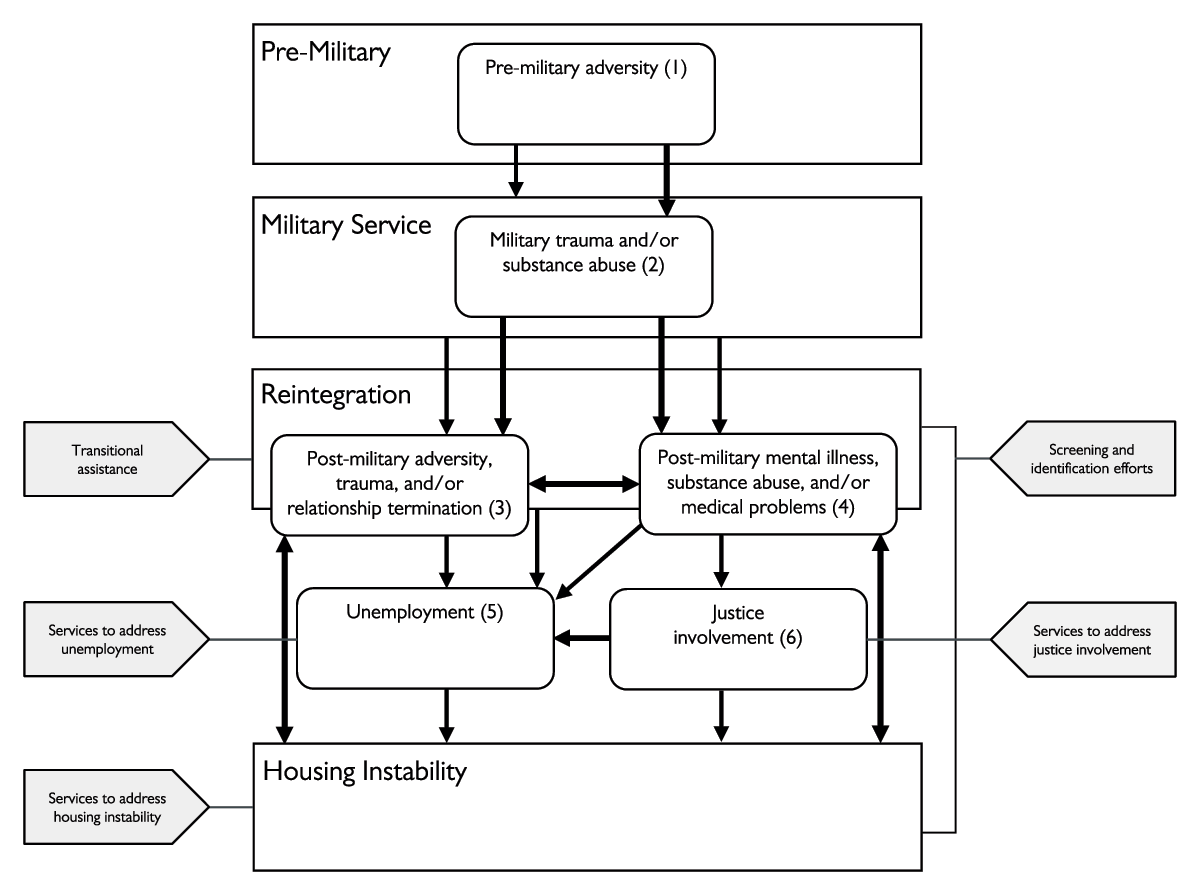
Figure 1
Modified Web of Vulnerability with Service Intervention Points.
Note. The modified web of vulnerability draws from Hamilton et al. (2011) to illustrate veterans’ interrelated pathways into housing instability, where (1) through (6) show the roots of housing instability (i.e., initiators or precipitating factors). Black arrows reflect the pathway from each root towards housing instability; the weight of the arrow conveys the strength of the relationship. Note that not all roots are present in all individuals. Gray boxes indicate intervention points for VHA services.
Table 5
Implications for Service Delivery.
| Engage veterans in services earlier |
|
| Encourage veteran help-seeking and improve identification efforts |
|
| Enhance patient-centered, trauma-informed care practices |
|
| Increase service flexibility and coordination |
|