
The U.S. Department of Veterans Affairs (VA) seeks to address veteran homelessness by providing permanent housing and connecting veterans with the wraparound services needed to remain housed (Diaz, 2023). Housing stability can be challenging for veterans who are involved with the criminal justice system and/or unemployed (Couloute, 2018; Poremski et al., 2014). Research shows a bidirectional association between homelessness and incarceration (Cusack & Montgomery, 2017), and individuals with a history of incarceration are more likely to be unemployed (Pettit & Lyons, 2009). Both landlords and employers may be resistant to working with individuals with a history of justice involvement (JI; Cusack et al., 2022), leaving veterans who experience intersecting vulnerabilities at increased risk for housing instability (HI). In addition to income-related factors, substance use disorders (SUDs) and mental illness are the strongest and most consistent risk factors for HI among veterans (Tsai & Rosenheck, 2015). Understanding the characteristics, service use, and service preferences of veterans with concurrent HI, JI, and unemployment can ensure that services are responsive to their needs.
Vulnerability Throughout the Life Course
Life course theory examines how life experiences and circumstances shape an individual’s development, emphasizing life events, trajectories, transitions, and turning points that influence the individual over time (Hutchison, 2005), and research demonstrates that individuals operate within social and environmental contexts that impact access to resources (e.g., safe housing, financial resources, employment) that shape health outcomes across the life course (Gottlieb et al., 2019). Hamilton et al. (2011) describe how interconnected factors throughout the life course can collectively form a “web of vulnerability” around veterans (p. S204). This web of vulnerability posits five predominant ‘roots’ that initiate pathways towards; HI: (1) pre-military adversity, (2) trauma and/or substance use during military service, (3) post-military violence, abuse, and/or relationship termination, (4) post-military substance abuse, mental illness, and/or medical conditions, and (5) unemployment, and indicates JI as a subsidiary factor contributing to homelessness. Importantly, these factors interact along the life course, including prior to enlistment, during military service, and following separation. Scholars of cumulative adversity suggest that adverse events early in life can lead to increased vulnerability over time, leading to disparities in individual resources, physical and mental health, and overall well-being (Alonzo, 2000), while protective factors (e.g., social support) may moderate the impact of adverse conditions (Hatch, 2005).
Services to Address Veteran Needs
The Veterans Health Administration (VHA) offers services to address social determinants of health (SDH), including HI, JI, and unemployment (Table 1), and its ‘whole health’ initiative aims to serve “the whole person including family, community, and SDH” (Gaudet & Kligler, 2019, p. S7). Veterans experiencing a crisis can also call the Veterans Crisis Line (VCL) or the National Call Center for Homeless Veterans (VA, 2023).
Table 1
Services to Address Housing Instability, Justice Involvement, and Unemployment Provided Through the Veterans Health Administration.
| SERVICES TO ADDRESS HOUSING INSTABILITY | |
|---|---|
| Domiciliary Care for Homeless Veterans (DCHV) | Residential rehabilitation and treatment services for homeless veterans.i |
| Grant and Per Diem (GPD) | Transitional housing and supportive services for homeless veterans.i |
| Health Care for Homeless Veterans (HCHV) | Outreach and contracted residential treatment for homeless veterans.i |
| HUD-VA Supportive Housing (HUD-VASH) | Permanent supportive housing for homeless veterans.i |
| Safe Haven | Community-based early recovery model of supportive housing for Veterans with severe mental illness and/or problematic substance use.ii |
| Supportive Services for Veteran Families (SSVF) | Homelessness prevention and rapid re-housing for homeless veterans.i |
| SERVICES TO ADDRESS JUSTICE INVOLVEMENT | |
| Health Care for Reentry Veterans (HCRV) | Community reintegration services for incarcerated veterans.iii |
| Legal Services for Veterans (LSV) | Legal services for Veterans experiencing or at-risk for homelessness.i |
| Veterans Justice Outreach (VJO) | Direct outreach, assessment, and case management in local courts and jails to help justice-involved Veterans with mental health and/or substance use issues.iii |
| Veterans Justice Programs (VJP) | Outreach and case management for justice-involved veterans.i |
| SERVICES TO ADDRESS UNEMPLOYMENT | |
| Homeless Veteran Community Employment Services (HVCES) | Job preparedness for homeless veterans.i |
| Incentive Therapy Program (IT) | Pre-employment program supporting veterans with physical and/or mental health challenges to work at VHA facilities.iv |
| Veteran Readiness and Employment (VR&E) | Short-term supportive services to prepare veterans for the job search and employment interviews.v |
| Compensated Work Therapy (CWT) | Employment programs—including CWT-Community Based Employment Services (CBES), CWT-Individual Placement and Support (IPS), CWT-Supported Employment, CWT-Transitional Residence (TR), CWT-Transitional Work (TW), and Vocational Assistance—that provide job development and counseling services to veterans facing various employment barriers, including medical and/or mental health disorders, homelessness, or a combination of these challenges.vi |
Specific Aims
This study draws on interviews with VHA service users to characterize the service needs and preferences of veterans with concurrent HI, JI, and unemployment, including the additional services, training, and support these Veterans need to achieve their housing, justice, and employment-related goals.
Methods
This study was approved by the Southeast Louisiana Veterans Health Care System Institutional Review Board (Protocol #759). The qualitative cohort was drawn from a larger study: Can services to address Veterans’ SDH reduce their suicide risk? (Co-Principal Investigators: Montgomery & True). The recruitment roster for the current study included 1,082 eligible veterans with indicators of concurrent HI, JI, and unemployment and documentation of VHA services to address these issues in their electronic health records between February 1, 2021, and July 31, 2022.
Researchers invited a random sample of veterans to participate in a telephone-based interview. The random sample was stratified by sex, race, and ethnicity, and recruitment targets were set to ensure adequate diversity (i.e., 15 male and five female veterans; 13 white and seven non-white veterans; and 15 non-Latinx and five Latinx veterans). Recruitment letters were mailed in waves between September 2022 and December 2022 until recruitment targets were met. The letter informed veterans about the project and provided contact information. Researchers made follow-up telephone calls to veterans who did not respond to the letter within two weeks.
Researchers enrolled veterans in the study following recorded verbal consent. Interviews, lasting 60–90 minutes, took place between September 2022 and January 2023, and were audio-recorded and transcribed. A semi-structured interview guide informed by life course theory elicited information on lifetime experiences of HI, JI, and unemployment, including the impact of experiences prior to, during, and following military service; services received from VHA and community programs to address these issues; and additional services, training, and support needed to achieve their goals. Participants received a $50 VISA gift card as compensation for participation.
Researchers conducted qualitative coding between December 2022 and February 2023. Hamilton et al.’s (2011) web of vulnerability guided coding to identify factors precipitating HI, adapted to include codes for VHA services to assess their potential to mitigate and/or respond to these risks. This framework directed the organization of qualitative data into preliminary categories (e.g., pre-military, military, and post-military adversity) and thematic coding allowed for identification of codes (e.g., military sexual trauma [MST], relationship termination, substance abuse; Table 2) and accompanying patterns and themes within these categories (Gibbs, 2007). Exemplar quotes are attributed using pseudonyms to protect participant identities.
Table 2
Qualitative Categories and Codes.
| CATEGORIES | CODES |
|---|---|
| Pre-military adversity |
|
| Military trauma and/or substance abuse |
|
| Post-military adversity, trauma, and/or relationships termination |
|
| Post-military mental illness, substance abuse, and/or medical problems |
|
| Unemployment |
|
| Justice involvement |
|
| Services to address housing instability |
|
| Services to address justice involvement |
|
| Services to address unemployment |
|
| Service limitations |
|
| Suggestions to improve services |
|
Findings
Participant Characteristics
Participants (Table 3) ranged in age from 37 to 67, with 40% under the age of 45 and 25% over the age of 65. Twenty-five percent of participants had been exposed to combat, and 45% had experienced MST. Sixty percent had a service-connected disability rating of 50% or higher and 25% had a service-connected disability rating of less than 50%, with ratings corresponding to the monthly compensation benefit veterans received (VA, 2025). The majority (85%) had at least one medical diagnosis and all (100%) had at least one mental health diagnosis; notably, 85% had depression and/or post-traumatic stress disorder (PTSD) and 40% had anxiety. Four in five (80%) had a SUD.
Table 3
Participant Characteristics (N = 20).
| CHARACTERISTIC | N | % |
|---|---|---|
| Age | ||
| 35–44 | 8 | 40% |
| 45–54 | 3 | 15% |
| 55–64 | 4 | 20% |
| 65+ | 5 | 25% |
| Sex | ||
| Female | 5 | 25% |
| Male | 15 | 75% |
| Race | ||
| Black | 7 | 35% |
| White | 13 | 65% |
| Ethnicity | ||
| Latinx | 5 | 25% |
| Not Latinx | 15 | 75% |
| Combat exposure | 5 | 25% |
| Military sexual trauma | 9 | 45% |
| Service-connected disability rating | ||
| None | 2 | 10% |
| None, VA Pension | 1 | 5% |
| <50% | 5 | 25% |
| >=50% | 12 | 60% |
| Medical diagnosis | 17 | 85% |
| Mental health diagnosis | 20 | 100% |
| Anxiety | 8 | 40% |
| Depression | 17 | 85% |
| Post-traumatic stress disorder | 17 | 85% |
| Psychoses | 2 | 10% |
| Substance use disorder | 16 | 80% |
| Alcohol | 12 | 60% |
| Drug | 12 | 60% |
Vulnerability Throughout the Life Course
During interviews, participants reflected on experiences prior to, during, and following military service (Table 4). Although the interviews followed a semi-structured interview guide that evoked the roots and factors of HI observed by Hamilton et al. (2011), each participant shared a unique narrative of his or her life and contributors to HI, JI, and unemployment. While each component is described separately, these vulnerabilities were often interwoven throughout participants’ lives and experiences of HI.
Table 4
Pre-military, Military, and Post-military Adversity by Participant (N = 20).
| Pre-military adversity | Any | ||||||||||||||||||||
| Military trauma and/or substance abuse | Military sexual trauma | ||||||||||||||||||||
| Combat exposure | |||||||||||||||||||||
| Substance abuse | |||||||||||||||||||||
| Other | |||||||||||||||||||||
| Post-military adversity, trauma, and/or relationship termination | Death of a supportive family member | ||||||||||||||||||||
| Relationship termination | |||||||||||||||||||||
| Other | |||||||||||||||||||||
| Post-military mental illness, substance abuse, and/or medical problems | Mental health issues | ||||||||||||||||||||
| Substance abuse | |||||||||||||||||||||
| Physical health problems |
Pre-military Adversity
Nearly half of the participants interviewed, all of them male, described experiencing hardship before entering the military that prompted them to enlist. Several reported unstable housing conditions as children (e.g., being shuffled between divorced parents, moving from place to place when a parent changed partners, being sent to live with extended relatives, growing up in foster care) while others reported early traumatic events that contributed to their decisions to join the military. Tony—who lived with extended relatives when he started getting into trouble at school and eventually joined the circus where he began abusing alcohol—stated his “life was basically out of control and had no real roots.” John described being sexually molested over the course of several years while a pre-teen. He never disclosed it to his parents over the threat of harm from the perpetrator and never sought therapy. When he enrolled in college, he “partied” too much, dropped out, and enlisted.
Military Trauma and/or Substance Abuse
Every participant experienced adversity during their military service, including MST, combat exposure, substance abuse, and/or other challenges (e.g., sex and/or racial discrimination). Nearly half of the participants (45%), including all but one woman and over 25% of men, reported MST during interviews. In addition, one participant described being threatened and harassed after witnessing a consensual sex act between two male colleagues, causing him to fear for his life. Several Black and Latina participants couched their experiences of sexual harassment and trauma in their encounters with sex and racial discrimination in the military.
Participants who reported MST claimed they were ostracized by their peers while perpetrators were not held accountable or faced minimal repercussions for their actions. Laura, a Latina, described daily sexual harassment and racial discrimination until she finally “blew the whistle” on her sergeant, who was investigated but maintained his rank. When she was later sexually assaulted by a different sergeant, she did not see the point in coming forward. Laura was eventually medically discharged from the military due to emotional distress caused by the trauma she experienced, which continues to impact her relationships and ability to maintain employment.
Among participants who did not report their sexual assault, some said they feared reprisal, while others pointed to stigma. Oscar was drugged and raped but never pressed charges as he “didn’t want to bring any negative light” to himself. Embarrassed, ashamed, and unaware of the prevalence of MST among men, he worked to change his appearance through weightlifting and tattoos. He self-medicated with alcohol, started getting in trouble for drinking, and jeopardized his top-secret security clearance. His drinking led to a general discharge and two Driving Under the Influence (DUI) offenses that threatened his job security. He recently connected with VHA resources after a failed suicide attempt.
Over one-third of participants reflected on the sequelae of combat exposure. Several reported multiple deployments and nearly all said they experienced post-traumatic stress. Combat experiences and PTSD led some participants to self-medicate with alcohol and drugs. Seth described this progression: “I did not want to have to deal with the real world of what I saw and did, so I became an alcoholic. I thought it would be easier just to drink all the time.”
Finally, more than half reported additional adversity, including sex and racial discrimination and harassment. While some believe they were held back from training opportunities and advancement due to their sex and/or race, others faced physical and mental anguish. For example, Adam reported suffering from Bell’s Palsy due to the torture he experienced at the hands of fellow service members who suspected he was a spy or a terrorist due to his ethnic background.
Compounding traumas and stressors during military service contributed to mental health issues, substance abuse, and/or forced exit from the military for a substantial number of participants. While some described their behavior as “self-destructive” in retrospect, most did not—or were unable to—access resources to address their issues until long after their military exit.
Post-military Adversity, Trauma, and/or Relationship Termination
Loss of social support and family dysfunction was a common thread among participant narratives. Over 75% of participants disclosed personal struggles and/or issues with intimate partners following their separation from the military that contributed to housing issues. In addition, several participants experienced homelessness after being revictimized, as was the case with two MST survivors, Alicia, who experienced homelessness when fleeing an abusive partner, and Daryl, who spent two decades “derelict” and “transient,” after he was raped in prison and faced “one tragedy after another.”
For those who lived with family members, the death of a loved one often left them simultaneously grieving and without a place to call home. Gary reported challenges maintaining relationships and employment due to his bipolar disorder. His wife left him during his first 10-year incarceration. After that, he turned to family, and when he served a second 10-year prison sentence, he once again received support from his mother upon release. When his mother died, his sister forced him to leave the house. He stayed at a local homeless shelter where he attempted suicide before being connected with VHA support.
Participants reported relationship termination as a factor contributing to their instability. Often, the loss of a partner exacerbated mental health issues and substance use. Kyle struggled with substance use and expressed “attracting the wrong ones.” After exiting the military, he found a high-paying job; however, a partner introduced him to methamphetamine and his job performance declined. He recounts: “I ended up losing my house, my car, my kid, everything. Just let myself go.” After an assault charge, he connected with Veterans Justice Outreach (VJO), completed a Veterans Treatment Court (VTC) program—a jail diversion program that addresses the needs of veterans presenting to the criminal justice system—and the charge was dropped. He was doing well, receiving housing assistance through the U.S. Department of Housing and Urban Development-VA Supportive Housing (HUD-VASH) program, and was finishing his degree, when he got involved with another woman and relapsed. Shortly after, he was evicted, fell off the balcony of a house where he was staying, fractured his foot, “literally hit rock bottom,” and was “trying to get back up.”
Post-military Mental illness, Substance Abuse, and/or Medical Problems
Every participant described challenges related to mental health and/or substance use during interviews. Mental health issues were discussed by all but three participants and permeated their accounts of HI, JI, and unemployment. Half of the participants detailed both mental illness and substance use, which, when coupled with other stressors such as a family death or relationship breakdown, caused them to “deteriorate,” as John reported, or go into a “tailspin,” as James described, leading to increased instability.
Participants with PTSD frequently turned to drugs to deal with “the flashbacks, the anxiety attacks, [and] the inability to sleep,” as Manuel recounted, or, alternatively, to keep them from sleeping and enduring nightmares. When Manuel first exited the military, he “noticed that [he] did not fit into society” and started using drugs to deal with reintegration and the impact of his partner cheating on him. Although he became more stable over time, his marriage deteriorated during the COVID-19 lockdown. Concurrently, crime and drug use in his neighborhood spiked, triggering his PTSD. He started using methamphetamines so he could “be awake to stay guard and watch the apartment.” Tensions mounted with his wife, and he eventually filed a domestic violence charge against her. That same day, he “beat the shit out of” a neighbor who was on the sex offender registry whom he felt posed a threat to his children. Manuel and his wife were evicted from the apartment and eventually separated. As part of a VTC program, Manuel entered a residential treatment facility and then a residential program. Upon discharge, he stayed in a tent in his mother’s backyard, which triggered his PTSD and caused him to enter into another treatment facility (i.e., a sober halfway house), where he now lives. He expressed concerns about finding housing when he leaves the transitional program because of his prior eviction and limited income.
Medical conditions, both related to their military experience and issues that developed as veterans aged, also impacted several participants. Often, medical issues were described as limiting employment options or keeping them from working altogether and therefore contributing to HI. Brad, disabled and unable to work, emphasized how difficult it was to get by: “I just really wish they would increase my disability percentage. I need more money because I’m barely making it.”
Unemployment
Owing in part to mental illness and substance use, participants described sporadic employment histories wherein they “don’t seem to keep a job more than a few months,” as Tony related, contributing to financial difficulties and HI. Claudia likened this to her military experience and PTSD, as she finds it difficult to work with civilians because she communicates differently. Barriers to identifying and finding employment, including age and limited technology skills, were consistent across gender and educational background. Among participants with intersecting vulnerabilities, criminal background and justice issues were pronounced, effectively making them, in the words of Yvonne, “unhousable and unemployable.” Challenges with employment led some participants to focus on increasing their service-connected disability rating to raise their VA compensation.
Yvonne stated, “Basically, I worked all my life.” However, during two periods when she was laid off, she faced HI, bouncing between friends and rooming houses to stay afloat, until she found another job and a new apartment. Later charged with a felony and incarcerated for five months, she was unable to pass a background check and remained unemployed. Further, she had difficulty finding a landlord willing to accept her as a tenant, even with a HUD-VASH voucher, forcing her to stay in a homeless hotel and couch surf with friends until she moved in with her partner.
Justice Involvement
Participants had diverse experiences with JI. Some served 10-year prison sentences, while others had their cases dismissed. Charges ranged from assault and battery to drug trafficking and possession of controlled substances to DUIs and theft. Some cycled out of prison, into HI, and back into prison. Tim reported being unstable since he lost his factory job and “got back into using drugs” and devolved into homelessness. He started stealing to support his drug habit and explained:
I’d get out, and I have no family support, and you want some kind of camaraderie…so I would hang out with the people that wanted me around, and they were usually people that was into criminal activities themselves…I stayed in that vicious cycle for a long, long time.
He reported being “unemployable” now, due to his criminal record. Although he had some job interviews, he believed that employers have no intention of hiring him due to his record. He received housing assistance through HUD-VASH while looking for work.
Seth, convicted of a sex offense, also found it challenging to find housing and work due to his criminal background:
Everywhere I applied, they are like, “We do not take your kind of people here…” I am trying to do the right thing, and I keep getting crapped on. Now I understand why people go back to prison after they leave…People still judge you for the crime that you committed or the crime that you were convicted.
After a period of instability where he bounced around and spent time in inpatient psychiatric treatment, he got a job as a mechanic that was brokered through his cousin—as he says, “some people went to bat for me and put their neck on the line”—and found housing through a landlord who was willing to overlook his criminal background given that he was working and receiving a housing subsidy.
Experiences with Services Addressing the Social Determinants of Health
Many participants only learned about services to address SDH after reaching a crisis state: one-third reported calling the VCL and getting connected with services after that. Those receiving mental health and substance use treatment often learned about available services to address HI, JI, and unemployment during inpatient stays. Upon learning that a comrade had been killed, Seth attempted suicide. His girlfriend called the police, and he spent several weeks receiving inpatient psychiatric treatment. From there, he was offered the opportunity to connect with additional resources. Of this period, he said, “I am actually kind of glad that I went in because now I am getting more help.” Similarly, reflecting on his connections with various VHA services, Tim asserted, “If I wasn’t a veteran right now, I don’t really know what I would do. I’d really be in a bad spot.”
Services to Address Housing Instability
Over half of participants accessed housing assistance through VHA or community organizations. Some reported minimal assistance (e.g., brief shelter stays, one-time move-in support), while others described using multiple VHA and/or community services over the course of many years. The latter compared programs and reflected on changes over time. Daryl—a “nomad” for over two decades—had experience with VHA housing programs across the country and believed that most have veterans’ best interests at heart. At the same time, he reported that it can be hard to pay the security deposit and up-front move-in costs associated with HUD-VASH. Further, HUD-VASH housing options are often in undesirable places, but staff “kind of got [participants] by the toe” and make them feel guilty if they voice concerns. In contrast, he described a “really nice setup” where veterans leaving inpatient treatment can stay in a repurposed hotel that serves three meals a day, allowing Veterans to save money for move-in costs and rent. Daryl described finally feeling stable after decades of instability. His VA case manager advocated for him to get into senior housing despite his criminal background, and he entered school to become a social worker.
Similarly, Tony was repeatedly turned away by family and friends when he had nowhere to stay; he sought assistance through homeless shelters, detox programs, and transitional housing programs. During his first stint in a transitional housing program, he was able to get clean and return to school, only to relapse and return to the program later. Reflecting on his second stay at the same program, he stated:
It was night and day. I went back; the two-men rooms were now four- and five-men rooms…There were bunk beds…to get more bodies in there, to get more revenue, on the premise that they were trying to help as many vets as they could, but overcrowding doesn’t help. It’s a detriment.
Since then, Tony became sober and entered HUD-VASH. He noted issues with his building and fellow tenants, but he reported a good relationship with his case manager and planned to stay.
Some participants who eventually accessed housing assistance reported having to overcome initial hurdles: Kyle, who struggled to find a shelter that would accept both him and his pregnant girlfriend, and James, who described being turned away from a domiciliary program because of a prior suicide attempt, which “kind of put some hate and discontent in [his] heart.” Participants also identified limitations of services available to address HI, including the time-limited nature of some programs and the need for ongoing support.
Other participants could not access any support. Laura was ineligible for assistance because she was not unsheltered, Ashley was told that given her 70% service-connected disability rating housing assistance would not make a difference, and it was recommended that Lloyd “just get on food stamps” because VHA did not have any programs to assist with his housing issues. Some who applied for assistance found the process confusing and complex. Although Claudia tried to apply for HUD-VASH several times and reached out for help completing her application, she eventually gave up and never heard one way or the other if her application had been processed. Yvonne was able to enroll in HUD-VASH but could not find a landlord to accept her voucher due to her criminal background.
Services to Address Justice Involvement
During interviews, half of all participants described receiving assistance with justice issues, often limited to legal advice or a letter from a lawyer advocating on their behalf. Roughly one-third of participants went through a VTC, which they overwhelmingly described as positive. Manuel initially only went through the VTC because it offered a better alternative to resolving his legal issues, but he eventually came to appreciate the impact it had on his life stating, “the connections that I made—it was the knowledge and education that I gained about addiction, recovery, and trauma. They do not just specialize in addiction treatment. They also specialize in trauma treatment.” Tony requested VTC because he understood that probation was “rougher,” and he felt he would benefit from the additional assistance. He stated, “I really wanted to get right. I was tired of all this bullshit, and I wanted a stricter road; and believe me, it is.” The first time he drank alcohol during his probation, he had to wear an alcohol monitor for one month. At the month’s end, he requested to keep the monitor on for additional time. “I call that my extra sobriety,” he explained.
Some participants, such as Yvonne, were unable to access legal assistance through either VHA or community organizations. Other participants reported there was no assistance for their given circumstances, whether it be the type of offense for which they were charged or how it appeared on their record.
Services to Address Unemployment
Three-quarters of participants reported receiving services to address unemployment, and half had been employed through Compensated Work Therapy (CWT) programs at least once. Manuel spent time in two CWT positions, which he said helped him find a “sense of purpose” and get a “taste of employment.” He has since applied for vocational rehabilitation services through the Veteran Readiness and Employment (VR&E) program stating:
The feedback that CWT provided to the VR&E was that I am doing really well. It’s all kind of like this big puzzle, with all these little pieces that are being put into place that make that bigger picture…It has helped me to build my confidence, too, in myself to be like, I can actually do this.
Other participants, while appreciative of the opportunity for employment assistance, suggested that it was not as helpful as they anticipated. Laura explained that she was simply shown how to use a search engine and informed about a couple of jobs; her vocational specialist did not help her develop a resume or assist with federal employment opportunities as she requested. To her, vocational specialists were “just getting an income with no help; it’s like nobody cares.” Several participants were unable to find jobs in the community despite receiving assistance. Others were told they were ineligible for assistance if they turned down job opportunities, even if they did so because the job was not suitable. Adam argued, “If they would’ve helped me, I would be working; that’s the bottom line.” Although he has a master’s degree, he was only ever sent job listings for minimum wage jobs that would compromise his benefits and make him “even worse off” than if he did not work, because as he said, “If I get a job that pays me enough money to lose my benefits, but not enough money to really live off of without the benefits, then I’m basically working for nothing.”
Service Limitations
Overall, participants were well-connected with VHA services to address SDH, and their experiences enabled them to consider the shortcomings of available assistance. Participants voiced minor complaints about staff: a need for more social workers, disruptions from staff turnover, and what Kyle described as “the 80/20 rule,” that is, 80% of the staff are great while the remaining 20% are mediocre. Participants also reported that it can be difficult to learn about available resources, even when connected with VHA. Alicia, who reported having to inform her provider about available services, reflected: “If I have to have a referral from you, how can you not know about the program?”
To some, VHA services simply do not go far enough. Adam felt that VHA services focused on addressing crises rather than helping with upstream issues, such as financial literacy:
The only thing the VA helps you with is catastrophic things. I was on the street…they helped me find a place to live. If I had been found guilty of a crime…they would help me. But as far as actually helping? There is no help at all.
Some participants, such as Daryl, felt that VHA offered only a revolving door through services rather than addressing veterans’ larger needs:
They see the same people over and over again. Sometimes if you keep seeing the same people over and over again, in their mind they’re saying, ‘This person just don’t get it. This person just hasn’t surrendered yet.’ But I think they need to rephrase that question and say, ‘What am I not doing, in order for this person not to come back?’ Or, ‘There’s something wrong in our system that we need; maybe we need to change our approach in order for this person not to come back.’
Suggestions to Improve Services
Participants with experiences of HI, JI, and unemployment offered insights into how VHA could improve services to address SDH. As Adam postulated:
The VA has a unique position and opportunity to pick up the slack a little bit where the military kind of leaves the soldiers on the street with no resources. I think that the VA has an opportunity to give people an opportunity to rebuild their lives, so they can focus on becoming functioning members of society.
Participant recommendations included increasing awareness of available resources, encouraging veterans to reach out for assistance, incorporating veteran preferences into programming, and providing more holistic care.
It Should Not Get That Bad Before I Get Help
The most cited suggestion to improve VHA services centered on informing veterans of available resources and eligibility, particularly during their exit from the military. According to Claudia, she was completely unaware of VHA services until another veteran informed her. Speaking about her military exit, she stated, “Never was there any mention of—that I recall—the VA, or health care, or how to enroll, or housing, or mental health, or resources.” This issue resonated with participants who were discharged from the military due to mental health or substance use issues. Seth, who started drinking so heavily due to his PTSD that he was “kicked out” of the military, suggested that he should have been connected with services immediately upon his exit:
Getting connected right away would have been better. If I am an alcoholic, it would have been better if they would have sent me to a rehab and then sent me to the VA for rehab, and be like, ‘Let the VA know this guy is getting out. He has a problem with alcohol. Can we send him to the VA to get help before we release him?’…That would have probably helped me a lot.
Participants also emphasized a general need to increase awareness of available assistance. Kyle did not start abusing drugs until he was out of the military. However, addiction eventually led him to be fired, lose his housing, and become justice-involved. He reflected:
Right before I lost everything, but after I’d gotten terminated because of my drug addiction, I called the VA, and I had no idea that I was eligible for so many services…I did not know about them, but I would have engaged them. The only way I’ve learned about most of these has been being in the system, talking to other people.
Ashley, struggling with anxiety, depression, and psychoses, started medicating with alcohol while in the army. After her exit, she pulled a knife on her mother during a psychotic episode and was arrested and sent to a psychiatric hospital. She stated:
It just took a really long time for me to get to a place where I was stable. Maybe if…I had gotten some help earlier, it would have been better….and I wouldn’t have had this mental break from reality to begin with.
Participants further insisted that veterans should not have to find themselves at a point of despair, reaching out to the VCL for emergency assistance, before becoming aware of resources to address their needs.
It is Better that People Know that You Need Help and to Talk to People About it
Participants pointed to a need to empower both military personnel and veterans to reach out for help when they need it. James, who was in and out of treatment, jail, and housing programs for most of his adult life, reported that most of the times he’s “gotten into trouble” were because he waited too long to ask for help. He suggested that one way to combat this is to encourage veterans to reach out to their case managers and “let them know you’re having some problems.” Other participants identified a need for more social workers and patient advocates to check in with Veterans and connect them with the support they need to be successful.
If They Chose to Listen, They Could Hear
Participants reported variability in the care they received and the need for VHA to promote a more “accepting culture.” Some felt that although VHA providers may have their best interest in mind, it does not always translate to on-the-ground care, which can be insufficient to address their needs. They urged VHA to listen to veterans and incorporate their preferences into care. Daryl, who had a long history of mental health issues, substance abuse, and homelessness and felt like he was “shuffled through the VA system,” suggested that VHA address the “root cause” of veterans’ problems: “You never go in there and hear a counselor talking about, ‘Let’s get down to why you keep relapsing.’ You will never go in there and hear a counselor talking about those personal issues.”
According to participants, VHA providers should be aware of available assistance—especially following routine screenings—so they can connect patients who need more comprehensive care to additional services, and providers of services to address SDH should be more transparent about program expectations. For veterans who experience trauma during their military service, participants suggested that listening may also translate to providing more community mental health care options to assuage concerns about being triggered at VHA or while receiving care among other veterans.
It’s ‘Health’ and ‘Care’ – They Provide the Health, but They Don’t Provide the Care
Additional suggestions for providing more holistic care included hiring more veterans in positions at VHA. As Lloyd, who asserted racist practices at VHA and being unable to receive assistance for SDH, pointed out:
They need to have more guys trained from the military to work in these hospitals, to supervise these nurses, to supervise these therapists, to be able to talk more to any soldier that has been in the military. He would just go to them and tell them things that he won’t tell a therapist.
Given the limitations of existing services, others suggested providing additional legal assistance and/or advice for veterans who are ineligible for existing VHA programs to address JI and extending opportunities for housing assistance to veterans living with family members since existing programs often require that veterans live alone.
Modified Web of Vulnerability
Participant narratives uphold the supposition of cumulative adversity—that adverse events earlier in life can lead to increased vulnerability over time and disparities in individual resources, health, and well-being—and the potential for VHA services to moderate its impacts (Hatch, 2005). The modified web of vulnerability (Figure 1) highlights the interconnected pathways to HI for extremely vulnerable Veterans with adverse pre-military, military, and post-military experiences. While drawing on the original framework (Hamilton et al., 2011), it also calls attention to potential intervention points as recommended by participants. It indicates the same primary roots of HI and includes JI as its own root, rather than simply a subsidiary factor. Pathways, both unidirectional and bidirectional, are depicted with arrows; the weight of the arrow conveys the strength of the relationship. In addition, the modified figure emphasizes reintegration as an integral period to inform veterans about VHA resources, which may be able to alleviate post-military adversity, mental illness, substance abuse, and/or medical problems, and highlights the need to increase screening and identification efforts and connect veterans with VHA resources throughout the life course. Further, it points to the importance of VHA resources to address SDH and respond to the contextual factors (i.e., isolation, lack of social support and resources, access barriers) depicted in the original framework.
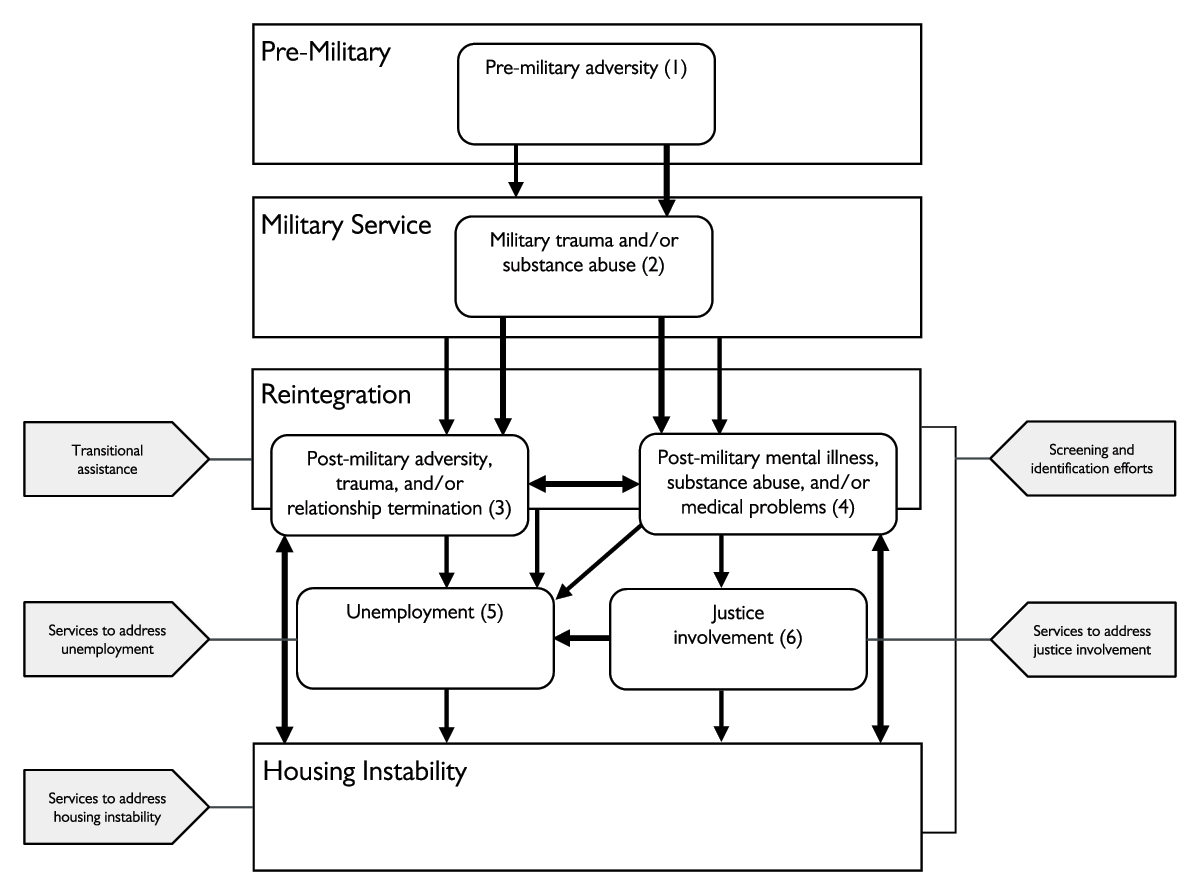
Figure 1
Modified Web of Vulnerability with Service Intervention Points.
Note. The modified web of vulnerability draws from Hamilton et al. (2011) to illustrate veterans’ interrelated pathways into housing instability, where (1) through (6) show the roots of housing instability (i.e., initiators or precipitating factors). Black arrows reflect the pathway from each root towards housing instability; the weight of the arrow conveys the strength of the relationship. Note that not all roots are present in all individuals. Gray boxes indicate intervention points for VHA services.
Discussion
Veterans’ characteristics and experiences of HI, JI, and unemployment interact over the life course and, without appropriate intervention, can contribute to cumulative adversity (Hatch, 2005), as reflected in the modified web of vulnerability (Figure 1). Embedded within these experiences are transitions and turning points related to military service and reintegration that can alter veterans’ life trajectories (Elder et al., 2003). The impact of military stressors (e.g., combat exposure, MST, PTSD) can be moderated by the development of effective coping strategies but remain impacted by veteran-specific factors such as physical health and emotional stability (Spiro et al., 2016). Similarly, for veterans with SUDs, turning points are influenced by recovery capital, or “the types and amount of both internal and external resources that can impact (either positively or negatively) one’s capacity to initiate and sustain recovery from substance abuse,” which, in turn, is impacted by personal capital, including physical and mental health (Teruya & Hser, 2010, p. 2).
While pre-military adversity (Root 1) is not within the purview of VHA, the organization is accountable for responding to military trauma and/or substance use (Root 2) and resulting post-military mental illness, substance abuse, and/or medical problems (Root 4). Further, VHA has resources available to address unemployment (Root 5) and JI (Root 6) that can lead to HI, which is an outcome of veterans’ collective disadvantage.
Implications for Service Delivery
Findings offer implications for service delivery (Table 5) including engaging veterans in services earlier, encouraging veteran help-seeking and improving identification efforts, enhancing patient-centered and trauma-informed care practices, and increasing flexibility and coordination in services that address SDH.
Table 5
Implications for Service Delivery.
| Engage veterans in services earlier |
|
| Encourage veteran help-seeking and improve identification efforts |
|
| Enhance patient-centered, trauma-informed care practices |
|
| Increase service flexibility and coordination |
|
Engage Veterans in Services Earlier
Participants articulated a lack of awareness of VHA services during their military discharge and emphasized a desire to have connected with VHA services sooner, suggesting educational interventions (e.g., awareness campaigns, social marketing) are needed both to make veterans aware of assistance and to promote engagement in treatment. Connecting returning service members with appropriate care following their military separation is especially critical for those who suffer from MST and/or PTSD. Often, service members are not identified as having mental health issues or are not adequately treated during their period of service; data suggest much lower medication rates for service members than for a comparable civilian sample despite the presence of additional stressors among service members (Office of the Surgeon General, 2011). Instead of receiving appropriate treatment, participants reported turning to alcohol and drugs, which contributed to unfavorable discharge conditions and ongoing mental health issues and substance abuse following separation. They suggested that if they had connected with care earlier, they may have been able to avoid HI, JI, and unemployment.
VA participates in the Transitional Assistance Program (TAP), which outlines VA benefits and services, including health care and education benefits and community integration resources (VA, 2022a), and the U.S. Department of Defense (DoD) requires participation in TAP by all separating service members, with few exceptions, under the Veterans Opportunity to Work (VOW) Act (VOW Act, 2011). Following the release of a 2017 U.S. Government Accountability Office (GAO) report finding that DoD lacked accurate TAP participation data, undercutting its compliance rates, DoD implemented recommendations (e.g., improved transparency in reporting TAP participation and career readiness rates and monitored certain key areas of TAP implementation) to enhance its electronic system for tracking TAP in 2019 (GAO, 2017). Since then, over 90% of separating servicemembers participated in TAP, but most did not begin a year in advance, as generally required (GAO, 2023). In addition, many servicemembers at risk for a difficult transition from military to civilian life did not receive a warm handover to the VA (GAO, 2024), and it remains unclear whether TAP is effective (GAO, n.d.). For veterans at higher risk for experiencing adverse SDH, more intensive outreach and engagement efforts should be considered.
It is important to note that not all former service members are eligible for VHA services, yet many likely face the same challenges reported by the participants studied here. The DoD should work to detect adverse conditions and experiences among service members and connect them with appropriate resources both during and following military service. For those who are ineligible for VHA benefits following their military discharge, this should include making connections to non-VHA health care and community assistance.
Encourage Veteran Help-seeking and Improve Identification Efforts
Another way to promote veterans’ earlier engagement in needed services is by encouraging veteran help-seeking and improving identification efforts. Addressing barriers to care, especially related to the use of mental health services, is particularly poignant for the vulnerable veterans studied here whose high rates of behavioral health issues contributed to HI, JI, and unemployment. Although symptom severity is correlated with the use of services to address mental health issues (Randles & Finnegan, 2022), participants suggested that if they had connected with care earlier—that is, before their problems became a crisis—they may have faced fewer enduring challenges. A recent systematic review of veteran help-seeking identified barriers to addressing mental health concerns related to stigma and a military culture of stoicism and self-reliance (Randles & Finnegan, 2022). Nevertheless, “mental health beliefs represent a potentially modifiable factor and thus hold great promise as a target of future efforts to reduce barriers to care for those who need services most” (Vogt, 2011, p. 141). Reducing stigma around mental health issues through awareness campaigns, educational sessions, and the use of veteran mentors can facilitate help-seeking behavior and encourage veterans to engage in services (Randles & Finnegan, 2022).
VHA providers conduct routine screenings to identify veterans’ needs and provide appropriate referrals (Montgomery et al., 2013), which present an opportunity for veterans to disclose these issues. During interviews, participants expressed frustration with screenings that too often were not accompanied by referrals and connections to assistance. An inability of providers to address issues following screening may explain the general underreporting of relevant concerns (Committee on the Assessment of Ongoing Efforts in the Treatment of Posttraumatic Stress Disorder, 2012). Further, providers who conduct screenings related to trauma and SDH report reticence in discussing these issues with patients if they feel unprepared to respond to disclosures and/or connect veterans with appropriate referrals, suggesting that an interdisciplinary team may be better equipped to perform screening related to trauma exposure and SDH, provide appropriate referrals, and relay findings to providers who can focus on potential clinical impacts (Chhabra et al., 2019).
Enhance Patient-centered, Trauma-informed Care Practices
Participants who were engaged in VHA care suggested that VHA needs to promote a more “accepting culture” and incorporate veteran preferences into care. This reproach is inconsistent with VHA’s commitment to patient-centered care that takes a “Veteran-first approach to health care” (VA, 2026f, Patient-centered care). Despite VA’s commitment to this approach, research shows that many veterans do not receive adequate treatment following a diagnosis of depression, MST, PTSD, and/or SUD (Golub et al., 2013; Spoont et al., 2014; Suris & Lind, 2008).
Patient-centered care is a holistic approach that emphasizes empathy, respect, shared decision-making, and coordinated care (Eklund et al., 2019), and its use has been shown to improve health outcomes, increase patient satisfaction and well-being, and promote self-management behaviors (Rathert et al., 2012). Identifying veterans’ preferences related to mental health and SUD services and integrating them into care should be a priority of patient-centered care.
For veterans with intersecting vulnerabilities, Trauma-Informed Care (TIC), which uses a patient-centered approach, can address help-seeking barriers that keep veterans from engaging in services. TIC recognizes the dehumanizing aspect of trauma—which often includes a betrayal of trust by a person or institution—and can respond to the feelings of powerlessness and fear it causes (Kelly et al., 2014). Recommendations for veteran-focused TIC include trauma awareness, an emphasis on veterans’ physical and emotional safety, providing opportunities for veterans to rebuild control and collaborate in decision-making, veteran empowerment, using a strengths-based approach, and setting clear expectations about treatment and services (Gerber, 2019).
Increase Service Flexibility and Coordination
Veterans with intersecting vulnerabilities can benefit from VHA and community services to address HI, JI, and unemployment. However, staff tasked with addressing veterans’ adverse SDH report significant barriers to connecting veterans with appropriate services, including organizational barriers (e.g., staffing challenges, resource limitations) as well as policy issues (e.g., eligibility criteria; True et al., 2026), suggesting these programs could increase flexibility and coordination to better assist veterans and help them achieve their goals.
Participants described positive experiences in HUD-VASH but also reported that move-in costs remain a barrier. While some HUD-VASH programs partner with Supportive Services for Veteran Families programs to provide move-in assistance, funding is limited, and not all programs can rely on this support (Pedersen et al., 2015). Additional resources for move-in assistance could promote better housing outcomes for vulnerable veterans. Further, veterans who do not live alone (e.g., live with family/children and/or roommates) report difficulty enrolling in programs since they are designed for veterans who live alone. For veterans who need additional support or face challenges identifying housing due to problematic background characteristics, project-based housing—where housing units are concentrated at one site, often with on-site services such as case management, nursing, and meals—may be a good option (Montgomery et al., 2019).
For justice-involved veterans, VTCs can help veterans connect with assistance to address mental health and substance use issues while simultaneously accessing support for SDH (Yerramsetti et al., 2017). This model offers “a shift in focus from a punitive to a rehabilitative stance,” by allowing for a reduction or dismissal of charges and connecting veterans with VHA resources to address housing, employment, and education, as well as community supports and mentoring programs (Yerramsetti et al., 2017, p. 514). Participants described overwhelmingly positive experiences with VTCs. Currently, VJO specialists—responsible for assessing veteran defendants’ treatment needs, linking them with VHA services, and providing updates to the court on their progress—serve 623 VTCs and other veteran-focused courts throughout the country (VA, 2022b). Data suggests that participation in VTC leads to improvement in housing and employment outcomes (Tsai et al., 2017). However, not all veterans have access to VTCs, or they face legal issues beyond the purview of courts. Increasing coordinated efforts to address legal issues and collaborating with more VTCs and legal aid providers can better support veterans with intersecting vulnerabilities.
Involvement with CWT was common among participants. However, these services seldom led to the permanent positions participants were seeking. Other participants described receiving vocational services aimed at connecting them with competitive employment, but they still faced difficulties finding work. CWT can promote SUD treatment and improve veterans’ alcohol- and drug-related problems (Kashner et al., 2002), yet these services do not appear to be effective at helping dually diagnosed veterans gain competitive employment (Penk et al., 2010), a shortcoming that should be addressed to help veterans connect with permanent employment options. In addition, employment services should better prepare veterans for their job search and work to identify employers who will hire veterans with employment challenges related to prior JI, inconsistent work histories, and/or health concerns. Research suggests that VHA needs to formalize the implementation of employment services and improve education and training opportunities for employment specialists so they can better support veterans (Cusack et al., 2022).
Finally, participants with intersecting vulnerabilities described the value of supportive relationships both with VHA providers and other veterans in helping them to remain stable and work towards their goals. Peer support specialists (i.e., veteran employees in recovery from mental illness or SUDs) may have the potential to improve veterans’ engagement in care, but “research is needed to understand when, why, and for whom peer specialists have a positive impact, what types of peer specialists have a positive impact, and how the effect of peer services differs from services delivered from nonpeer specialists” (Chinman et al., 2017, p. 956).
Efforts to support greater community integration efforts for veterans with experiences of HI, JI, and unemployment may also help them achieve greater stability. A systematic review of interventions targeting community integration among individuals who have experienced homelessness suggests that psychosocial interventions that aim to increase veterans’ sense of belonging in their community, and particularly those that incorporated peer support, showed the greatest promise (Marshall et al., 2020). Participants, especially those in recovery, also touted the benefits of recreational therapy. Recreational therapy can empower veterans, facilitate the development of social skills (DeVries & Feenstra, 2019), and provide a healthy way for veterans to connect with their community.
Limitations
This study offers context for understanding the characteristics, service use, and service preferences of veterans with intersecting vulnerabilities. Only VHA service users participated in interviews, and over half of the sample had a service-connected disability rating of 50% or higher, affording them greater access to specialized assistance; findings may not be generalizable to the larger veteran population. Moreover, veterans who participated in interviews were able to schedule and take part in an interview, reflecting access to a phone and the ability to make and keep an appointment, while veterans with greater vulnerabilities and resource needs may not have been contacted for participation.
Future Research
Future research should build on findings by examining how interventions across the life course, including during the transition from military service to civilian life, can better address veteran needs. Identifying and promoting protective factors that can moderate the impact of adverse SDH may also support stability among veteran service users. Finally, additional research should assess the implementation and effectiveness of existing programs addressing HI, JI, and unemployment, with an emphasis on identification efforts, patient-centered, trauma-informed care practices, and care coordination.
Conclusion
A constellation of factors contributes to adverse SDH among veterans, interacting over the life course and, without appropriate intervention, contributing to cumulative adversity. VHA must be more proactive in responding to military trauma and substance use that can result in post-military mental illness, substance abuse, and medical problems. Findings support the need to engage veterans in services earlier, encourage veteran help-seeking and improve implementation efforts around screening and identification, and enhance patient-centered, trauma-informed care practices. Greater flexibility and coordination in services to address SDH may also provide greater support in helping veterans reach their housing, justice, and employment-related goals, especially since connections with one type of service can lead to engagement with additional assistance.
Acknowledgements
This work was adapted from Meagan Cusack’s dissertation: Addressing Concurrent Housing Instability, Criminal Justice Involvement, and Unemployment Among Veteran Health Administration Service Users. She would like to acknowledge her committee members for their guidance and support: Dennis P. Culhane, Ying Ling Irene Wong, and Daniel A. Treglia.
Author Contributions
Meagan Cusack: conceptualization; formal analysis; data collection; methodology; visualization; writing-original draft preparation. Ann Elizabeth Montgomery: conceptualization; funding acquisition; methodology; writing-review & editing. Gala True: conceptualization; funding acquisition; methodology; resources; writing-review & editing.