
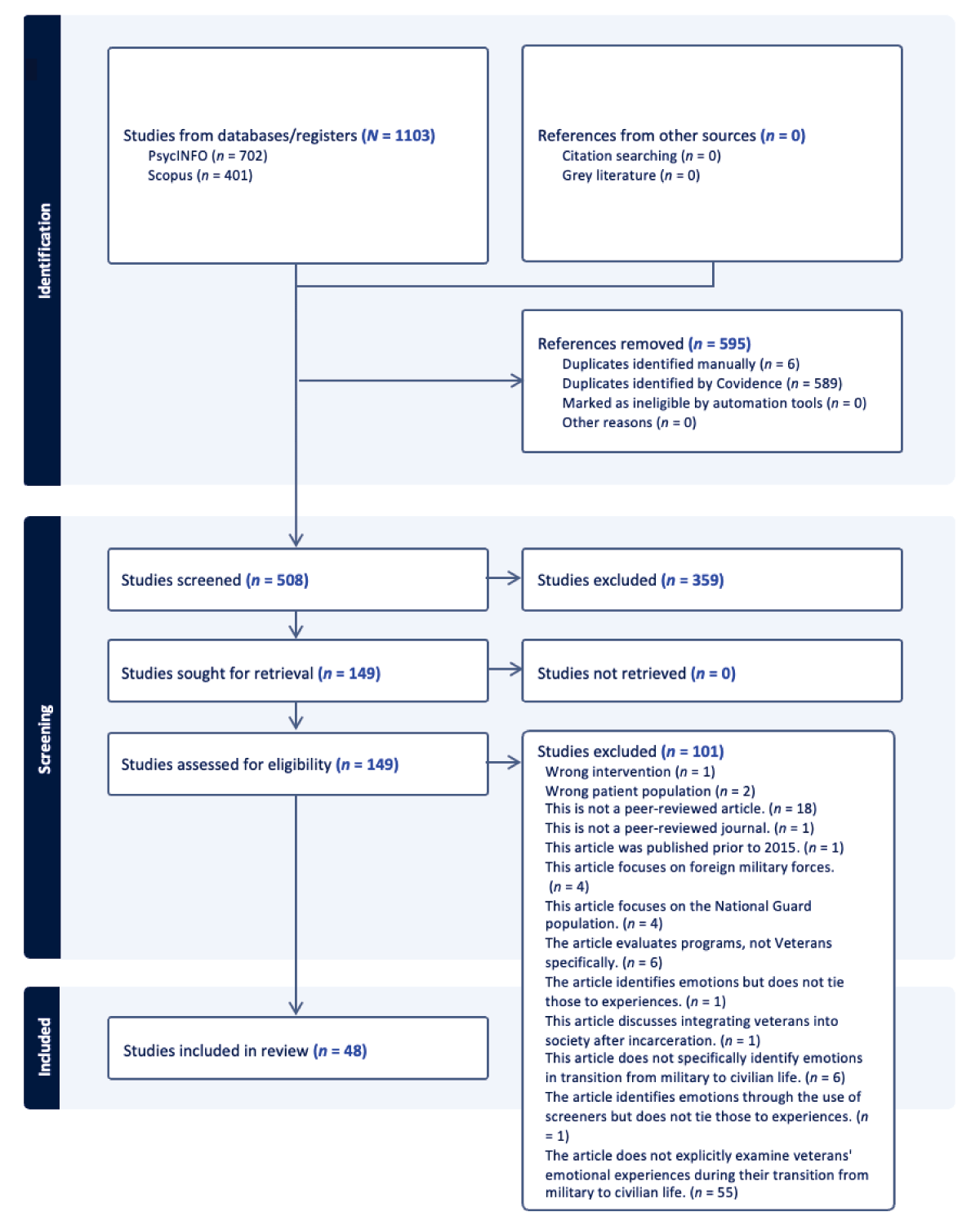
Figure 1
PRISMA Flow Diagram Showing the Process of Literature Selection.
Table 1
Included Studies.
| # | FIRST AUTHOR AND YEAR | STUDY TITLE | JOURNAL/TYPE OF STUDY |
|---|---|---|---|
| 1. | Ahmadi-Montecalvo et al. (2025) | Examining health-related social needs and their association with stress and mental health among US Veterans using 2022 behavioral risk factor surveillance system (BRFSS) data | Discover Public Health; Quantitative |
| 2. | Ainspan et al. (2018) | Psychosocial approaches to improving the military-to-civilian transition process | Psychological Services; Narrative review of quantitative, qualitative, and mixed methods |
| 3. | Albright et al. (2018) | Barriers and resources for veterans’ post-military transitioning in south Alabama: A qualitative analysis | Traumatology; Qualitative |
| 4. | Albright et al. (2019) | When women veterans return: The role of postsecondary education in transition in their civilian lives | Journal of American College Health; Quantitative |
| 5. | Alruwaili et al. (2023) | Supporting the Frontlines: A Scoping Review Addressing the Health Challenges of Military Personnel and Veterans | Healthcare; Scoping review of quantitative, qualitative, and mixed methods |
| 6. | Angel et al. (2018) | Team Red, White & Blue: A community-based model for harnessing positive social networks to enhance enrichment outcomes in military veterans reintegrating to civilian life | TBM (Translational Behavioral Medicine); Mixed-methods |
| 7. | Angel et al. (2020) | The Enriched Life Scale (ELS): Development, exploratory factor analysis, and preliminary construct validity for U.S. military veteran and civilian samples | TBM (Translational Behavioral Medicine); Quantitative |
| 8. | Bennett et al. (2015) | Survey of retired military pharmacist’s transition to a civilian pharmacy career path | Military Medicine; Quantitative |
| 9. | Bond et al. (2022) | Transition from military service: Mental health and well-being among service members and veterans with service-connected disabilities | The Journal of Behavioral Health Services & Research; Quantitative |
| 10. | Borowski et al. (2021) | Work-family conflict and subsequent depressive symptoms among war-exposed post-9/11 U.S. military Veterans | Journal of Military, Veteran and Family Health; Quantitative |
| 11. | Buzzetta et al. (2020) | Student veterans: Meaning in life, negative career thoughts, and depression | The Career Development Quarterly; Quantitative |
| 12. | Castro et al. (2015) | The combat veteran paradox: Paradoxes and dilemmas encountered with reintegrating combat veterans and the agencies that support them | Traumatology; Qualitative |
| 13. | Cheney et al. (2025) | Transitioning between institutions: Social (re)location and positionality in student veteran health and well-being | Human Organization; Mixed-methods |
| 14. | DeLucia & Kennedy (2021) | A veteran-focused art therapy program: co-research to strengthen art therapy effectiveness | International Journal of Art Therapy; Qualitative |
| 15. | Derefinko et al. (2019) | Perceived Needs of Veterans Transitioning from the Military to Civilian Life | The Journal of Behavioral Health Services & Research; Qualitative |
| 16. | Dexter (2020) | Human resources challenges of military to civilian employment transitions | Career Development International; Qualitative |
| 17. | DiGangi et al. (2018) | Differential impact of post-deployment stress and PTSD on neural reactivity to emotional stimuli in Iraq and Afghanistan veterans | Journal of Psychiatric Research; Quantitative |
| 18. | Edwards et al. (2023) | Supporting the nation’s transitioning veterans: Narrative review of practices and recommendations for psychotherapy and counseling of veterans separating from military service | Psychological Services; Narrative review of quantitative and qualitative |
| 19. | Edwards et al. (2026) | Veteran suicide thoughts and attempts during the transition from military service to civilian life: Qualitative insights | Death Studies; Mixed-methods |
| 20. | Elnitsky et al. (2017) | Military service member and veteran reintegration: A conceptual analysis, unified definition, and key domains | Frontiers in Psychology; Qualitative |
| 21. | Ferruolo (2016) | Psychosocial equine program for veterans | Social Work; Mixed-methods |
| 22. | Fischer et al. (2015) | Perspectives of family and veterans on family programs to support reintegration of returning veterans with posttraumatic stress disorder | Psychological Services; Qualitative |
| 23. | Geraci et al. (2020) | The modern-day Odysseus: How mental health providers can better reintegrate modern warriors and mitigate suicide risk | Journal of Clinical Psychology; Qualitative |
| 24. | Harrod et al. (2017) | “I’ve never been able to stay in a job”: A qualitative study of veterans’ experiences of maintaining employment | Work; Qualitative |
| 25. | Hirst (2021) | “Videogames Saved My Life”: Everyday Resistance and Ludic Recovery among US Military Veterans | International Political Sociology; Qualitative |
| 26. | Kahn et al. (2016) | Post-9/11 veterans and their partners improve mental health outcomes with a self-directed mobile and Web-based wellness training program: A randomized controlled trial | Journal of Medical Internet Research; Quantitative |
| 27. | Keeling (2024) | Stories of transition: U.S. veterans’ narratives of transition to civilian life and the important role of identity | Journal of Military, Veteran, and Family Health; Qualitative |
| 28. | Kukla et al. (2015) | Mixed methods study examining work reintegration experiences from perspectives of Veterans with mental health disorders | Journal of Rehabilitation Research and Development; Mixed-methods |
| 29. | Lake & Branson (2021) | Eusocial theory of suicide risk: Clinical presentations and commentary: Science and Practice | Clinical Psychology; Qualitative |
| 30. | Libin et al. (2017) | Perspectives of veterans with mild traumatic brain injury on community reintegration: Making sense of unplanned separation from service | American Journal of Orthopsychiatry; Qualitative |
| 31. | Mamon et al. (2020) | Connecting Veterans and Their Community Through Narrative: Pilot Data on a Community Strengthening Intervention | Community Mental Health Journal; Mixed-methods |
| 32. | Matthieu et al. (2018) | Veterans volunteering: An emerging practice and satisfaction with a civic service program for U.S. veterans returning from Iraq and Afghanistan | Best Practices in Mental Health; Mixed-methods |
| 33. | Meca et al. (2020) | The role of United States identity in adjustment among veterans | Military Psychology; Quantitative |
| 34. | Miloslavich et al. (2026) | Anger mediates the relationship between changes in alcohol use and violence: A longitudinal examination among Iraq/Afghanistan-era veterans | Psychological Trauma; Quantitative |
| 35. | Morton et al. (2025) | Loneliness after service veteran loneliness and exclusion by veterans and nonveterans in Cyberball | Journal of Psychiatric Research; Quantitative |
| 36. | Olsen & Jette (2025) | Exploring CrossFit as a Site of Transition for Wounded Veterans: A Thematic Analysis | Palaestra; Qualitative |
| 37. | Pebole et al. (2026) | Veterans’ perspectives on two transdiagnostic group workshops to improve military to civilian reintegration: A comparative thematic analysis | Psychological Services; Mixed-methods |
| 38. | Raabe et al. (2024) | Facilitating United States Service Members’ Transition Out of the Military: A Self-Determination Theory Perspective | Journal of Career Development; Qualitative |
| 39. | Rattray et al. (2023) | Learning from women veterans who navigate invisible injuries, caregiving, and reintegration challenges | BMC Women’s Health; Qualitative |
| 40. | Russell & Russell (2018) | It’s not just showing up: How social identification with a Veterans Service Organization relates to benefit-finding and social isolation among veterans | Psychological Services; Quantitative |
| 41. | Saunders et al. (2023) | Bended womanhood bended back: The intersection of race, gender, and culture in women of color veterans and their transition into higher education | Journal of Diversity in Higher Education; Qualitative |
| 42. | Senecal et al. (2021) | The Formation of Antisocial Tendencies in Veterans via Combat Excitement | Peace and Conflict; Qualitative |
| 43. | Shankle et al. (2023) | Transitioning from military to civilian life: The Ohio story | Journal of Community & Applied Social Psychology; Qualitative |
| 44. | Shue et al. (2021) | The career transition experiences of military Veterans: A qualitative study | Military Psychology; Qualitative |
| 45. | Silvestrini & Chen (2023) | “It’s a sign of weakness”: Masculinity and help-seeking behaviors among male veterans accessing posttraumatic stress disorder care | Psychological Trauma; Qualitative |
| 46. | Sokol et al. (2021) | The deadly gap: Understanding suicide among veterans transitioning out of the military | Psychiatry Research; Narrative review of qualitative |
| 47. | Stanley & Larsen (2019) | Emotion Dysregulation and Military Suicidality Since 2001: A Review of the Literature | Political Psychology; Literature review of qualitative |
| 48. | Vetro-Kalseth et al. (2021) | Treatment description and case series report of a phased music therapy group to support Veteran reintegration | Military Psychology; Qualitative |
Table 2
Emotion and Circumstance Frequencies.
| EMOTION | EMOTION COUNT | CIRCUMSTANCE | CIRCUMSTANCE COUNT |
|---|---|---|---|
| Anger | 47 | Betrayal by a trusted person | 12 |
| Anger | Feeling dismissed or ignored | 9 | |
| Anger | Injustice or unfair treatment | 11 | |
| Anger | Interrupted plans or goals | 7 | |
| Anger | Verbal attack or criticism | 8 | |
| Anxiety | 63 | Academic or work performance pressure | 14 |
| Anxiety | Financial uncertainty | 10 | |
| Anxiety | Health-related fears | 12 | |
| Anxiety | Social evaluation or judgment | 15 | |
| Anxiety | Uncertainty about the future | 12 | |
| Contempt | 18 | Encountering perceived incompetence | 6 |
| Contempt | Moral or ethical disagreement | 7 | |
| Contempt | Status or superiority perception | 5 | |
| Disgust | 22 | Ethical or moral violations | 9 |
| Disgust | Exposure to offensive content | 7 | |
| Disgust | Physical contaminant exposure | 6 | |
| Embarrassment | 29 | Failing publicly at a task | 8 |
| Embarrassment | Public correction or reprimand | 7 | |
| Embarrassment | Social norm violation | 9 | |
| Embarrassment | Unwanted attention from others | 5 | |
| Envy | 24 | Observing others’ achievements | 10 |
| Envy | Perceived unfair advantage of others | 8 | |
| Envy | Social comparison on appearance | 6 | |
| Fear | 54 | Dark or unfamiliar environments | 7 |
| Fear | Physical danger or threat | 15 | |
| Fear | Potential loss of a loved one | 12 | |
| Fear | Social rejection or exclusion | 11 | |
| Fear | Uncertainty and loss of control | 9 | |
| Grief | 38 | Death of a loved one | 16 |
| Grief | End of a significant relationship | 10 | |
| Grief | Loss of a cherished opportunity | 7 | |
| Grief | Loss of health or capability | 5 | |
| Guilt | 33 | Acting against one’s own values | 9 |
| Guilt | Failing to meet responsibilities | 11 | |
| Guilt | Harm caused to another person | 8 | |
| Guilt | Neglecting a relationship | 5 | |
| Happiness | 71 | Achieving a personal goal | 15 |
| Happiness | Acts of kindness received | 9 | |
| Happiness | Celebrations and social gatherings | 13 | |
| Happiness | Family or romantic connection | 14 | |
| Happiness | New positive experiences | 10 | |
| Happiness | Unexpected, pleasant surprises | 10 | |
| Hope | 41 | Anticipation of positive change | 13 |
| Hope | New opportunity or possibility | 14 | |
| Hope | Recovery or improvement in health | 8 | |
| Hope | Support from others | 6 | |
| Jealousy | 27 | Perceived romantic rivalry | 10 |
| Jealousy | Sibling or peer comparison | 9 | |
| Jealousy | Workplace recognition given to others | 8 | |
| Loneliness | 35 | Being in an unfamiliar place | 7 |
| Loneliness | Disconnection from social community | 10 | |
| Loneliness | Feeling misunderstood | 9 | |
| Loneliness | Lack of meaningful relationships | 9 | |
| Love | 58 | Deep friendship or platonic bond | 11 |
| Love | Parental or familial affection | 14 | |
| Love | Romantic partnership | 18 | |
| Love | Sense of belonging to a group | 9 | |
| Love | Spiritual or communal connection | 6 | |
| Pride | 46 | Academic or professional achievement | 13 |
| Pride | Helping others succeed | 9 | |
| Pride | Overcoming a personal challenge | 12 | |
| Pride | Recognition of effort by others | 7 | |
| Pride | Witnessing a loved one’s success | 5 | |
| Regret | 31 | Choosing comfort over growth | 8 |
| Regret | Failing to act when needed | 10 | |
| Regret | Missed relationship opportunities | 7 | |
| Regret | Words said in anger | 6 | |
| Relief | 36 | Completion of a stressful task | 11 |
| Relief | Danger or threat passing | 10 | |
| Relief | Positive medical or test outcome | 9 | |
| Relief | Reconciliation after conflict | 6 | |
| Sadness | 52 | Disappointment in self or others | 11 |
| Sadness | Empathy for another’s suffering | 9 | |
| Sadness | Failure to reach a meaningful goal | 10 | |
| Sadness | Separation from loved ones | 13 | |
| Sadness | Witnessing suffering or loss in the world | 9 | |
| Shame | 28 | Falling short of personal ideals | 9 |
| Shame | Perceived moral failure | 8 | |
| Shame | Public exposure of a private matter | 7 | |
| Shame | Social rejection or humiliation | 4 | |
| Surprise | 20 | Encountering an unexpected event | 9 |
| Surprise | Receiving unexpected news | 7 | |
| Surprise | Sudden change in environment | 4 | |
| TOTAL CC | 773 |
[i] Note. Emotions are organized alphabetically. EC = Emotion Count, which reflects total instances of that emotion across all circumstances. CC = Circumstance Count, which reflects instances for that specific emotion–circumstance pairing. Overall total EC Categories = 20. Overall total CC = 773.
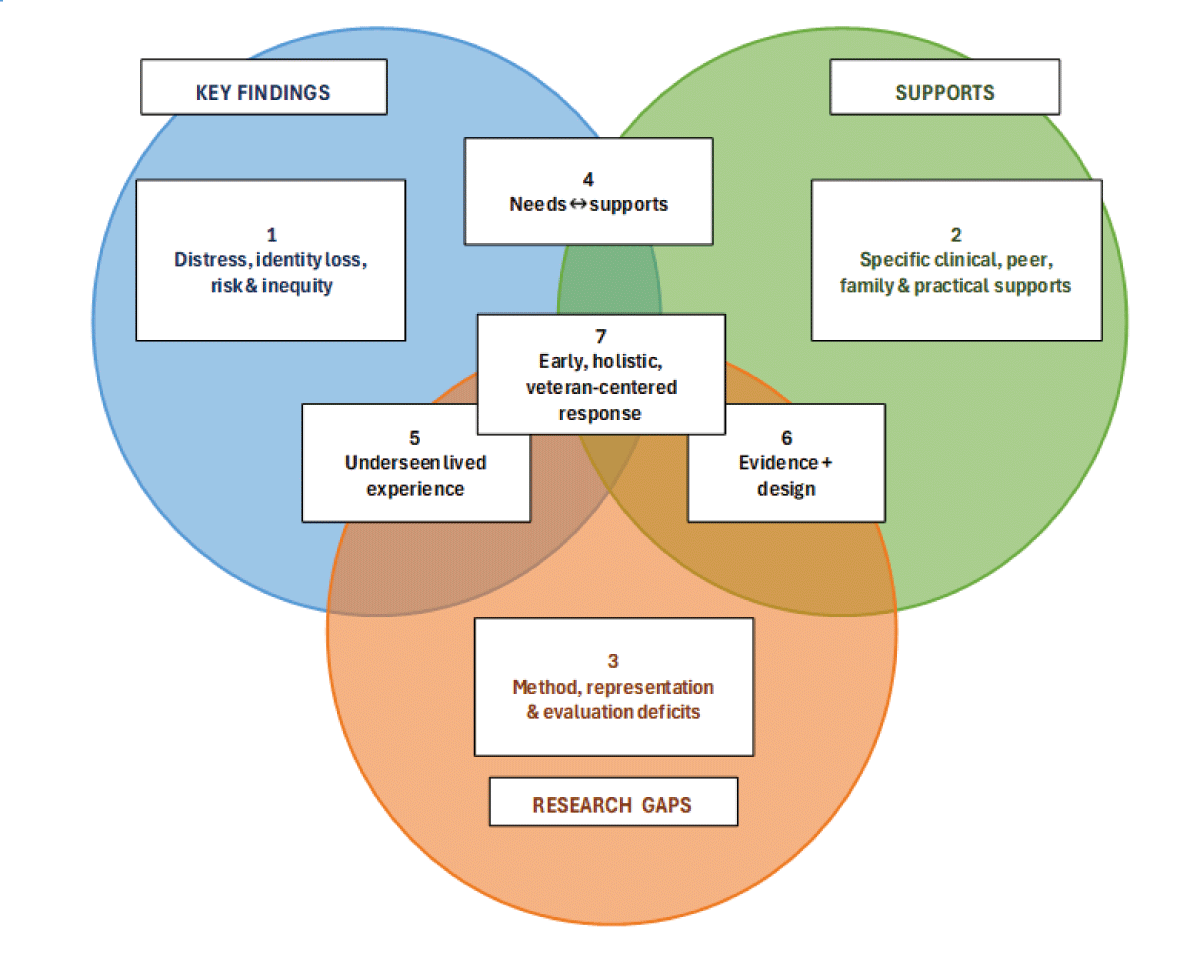
Figure 2
Military-to-Civilian Transition Venn Diagram.
Note. The seven regions represent where different parts of the transition overlap.