
Transitioning from military to civilian life presents complex challenges for service members, particularly when reentering the workforce (Shankle et al., 2023). Retired military personnel often encounter difficulty translating the leadership skills and structured decision-making processes developed during their service into the dynamic, less hierarchical environments of civilian employment (Sachdev & Dixit, 2023; Shankle et al., 2023). This study examined how professional conditioning and a career in the military influence thinking perspective and decision-making among retired military workers compared to nonmilitary peers aged 40 to 60.
This study is situated within veterans’ studies scholarship that conceptualizes workforce reintegration as a process shaped by institutional transition, identity reconstruction, and cultural adaptation (Joseph et al., 2023; Kleykamp et al., 2021). While prior research has largely emphasized psychosocial adjustment and employment outcomes, the present study extends this literature by introducing a quantitative framework to examine how institutional experience may shape cognitive orientation and decision-making processes among veterans and civilian workers.
The Department of Defense Office of the Actuary (2023) reported that over 200,000 military retirees between the ages of 40 and 60 collected retirement benefits at the end of fiscal year 2022. Their report estimated this number to grow by at least 22,500 per year starting in fiscal year 2023 and beyond (at the time of this research, fiscal year 2022 was the most recent data released). The U.S. Bureau of Labor Statistics (2025b) reported that the average worker age was 42 for both male and female workers. Because the average civilian worker is approximately 42 years old (U.S. Bureau of Labor Statistics, 2025b), and over 200,000 military retirees fall within the 40–60 age range (Department of Defense Office of the Actuary, 2023), a substantial proportion of them reenter the workforce at ages comparable to civilian peers. This demographic overlap suggests that military retirees constitute a significant, demographically aligned segment of the civilian labor force.
Historically, the process of military-to-civilian adaptation has been an enduring social and occupational phenomenon (Kleykamp et al., 2021). Many veterans face challenges aligning their military-acquired competencies with the civilian workforce’s role alignment, despite extensive training and leadership experience (Davenport et al., 2022; Kleykamp et al., 2021). Prior literature suggests that contextual factors, including culture, training, and environmental demands, influence decision-making style and cognitive orientation (Ahmed et al., 2014; Sachdev & Dixit, 2023). However, few empirical studies have examined how these attributes differ between retired military and civilian professionals within a mid-career age bracket. Although veteran unemployment rates have trended below civilian rates in recent years (U.S. Bureau of Labor Statistics, 2025a), underemployment and skill misalignment remain significant concerns (Davenport et al., 2022; Wang et al., 2023).
Beyond occupational role alignment and skill translation outcomes, veteran studies research emphasizes that the transition from military to civilian life involves broader processes of identity reconstruction and institutional adaptation (Joseph et al., 2023; Kleykamp et al., 2021). Military service socializes individuals into organizational cultures characterized by hierarchy, procedural accountability, and mission-oriented decision frameworks (Brooks et al., 2023; Ferrell et al., 2021). When veterans enter civilian workplaces, they often encounter organizational structures characterized by decentralized authority and collaborative decision-making. These institutional differences shape how veterans interpret workplace expectations and how their leadership and decision practices are perceived in civilian organizations (Joseph et al., 2023; Kleykamp et al., 2021).
Understanding how military institutional experience influences cognition and decision-making is therefore important for examining veteran workforce reintegration. Differences in decision frameworks may reflect not only occupational experience but also the enduring influence of military culture and training on professional behavior after separation from service (Sachdev & Dixit, 2023). Examining these patterns provides insight into how veterans navigate the transition from military institutions to civilian organizational contexts.
This study does not adopt a deficit-based perspective of veteran workforce transition. Although some literature highlights challenges in translating military experience into civilian contexts (Davenport et al., 2022; Shankle et al., 2023; Wang et al., 2023), national labor data indicate that veterans often have unemployment rates equal to or lower than those of civilians (U.S. Bureau of Labor Statistics, 2025a). Accordingly, this study interprets observed differences as variations in cognitive orientation shaped by institutional experience rather than as deficiencies.
Purpose and Gap in Knowledge
The purpose of this study was to examine the thinking perspectives and decision-making quality orientation of retired military personnel returning to the workforce and nonmilitary workers aged 40 to 60. The research compared the two groups to identify measurable differences and predictive relationships between thinking perspective, defined by past, present, and future thinking, and decision-making quality orientation, characterized by competence and style.
This study addressed a persistent gap in the literature surrounding how military-acquired cognitive and decision-making skills translate into civilian employment settings. While prior research has emphasized the mental health and vocational challenges faced by veterans (Joseph et al., 2023; Markowitz et al., 2023), few empirical studies have focused on cognitive dispositions and decision-making quality differences between military retirees and their nonmilitary counterparts. Scholars have explored how personality, cognition, and training influence decision-making (Bekesiene, 2023; Pu et al., 2023); however, there remains a limited understanding of how these factors shape the thinking perspectives and decision-making orientation of military retirees entering civilian work environments.
The lack of comparative data perpetuates misconceptions about veterans’ abilities, leading to underemployment and misalignment of talent in the civilian sector (Wang et al., 2023). Retired military personnel often encounter obstacles in translating skills learned during service into the requirements of civilian jobs (Shankle et al., 2023). By directly comparing cognitive profiles between retired military and nonmilitary workers, this study filled a critical research gap, providing quantifiable evidence to inform human resource practices, hiring strategies, and leadership development initiatives.
Despite substantial research on veteran transition, little empirical work has compared thinking perspectives and decision-making quality between retired military and nonmilitary adults aged 40–60. This gap limits scientific understanding of how professional conditioning influences cognition. Addressing this gap advances knowledge by providing quantitative evidence on whether military and civilian workers differ in temporal thinking and decision quality, informing theory and improving human-capital strategies. The purpose of this study was to examine these cognitive differences using validated measures.
Using the MindTime theory and the Quality of Decision-Making Orientation Scheme as guiding frameworks, this study examined whether measurable cognitive differences exist between groups. The goal was to provide actionable insights for human resource professionals and policymakers seeking to optimize workforce reintegration, development programs, and leadership succession planning for military veterans. The study also contributed to broader theoretical discussions on how experience-based conditioning shapes thinking perspectives and decision quality.
In practice, a worker with high decision competence may systematically evaluate available evidence, consider multiple courses of action, and document reasoning before committing to a choice (Donelan et al., 2015; Spetzler et al., 2016). These behaviors are well-suited to roles in strategic planning, operations management, or risk analysis. In contrast, a worker with high decision style flexibility may shift approaches based on the interpersonal or contextual demands of a situation, an asset in negotiation, client management, or team leadership (Donelan et al., 2015). Similarly, a worker with strong past thinking draws on prior experience and established precedent when solving new problems. At the same time, a worker with strong future thinking generates novel solutions and anticipates long-range consequences (Fortunato & Furey, 2009). Understanding these distinctions helps organizations match individuals to roles where their cognitive orientation provides the greatest strategic value.
Theoretical Foundations
This study was grounded in three interconnected theoretical perspectives: MindTime theory, decision theory, and human capital theory. The three together provide an integrated framework for understanding how cognitive thinking perspective orientation, decision quality, and workforce value interact to influence performance and strategic behavior.
MindTime Theory
MindTime theory posits that individuals think across three temporal dimensions: past, present, and future, which shape creativity, adaptability, and strategic orientation (Fortunato & Furey, 2009). Past thinking emphasizes reflection on experience. This reflection and engagement with past experience allows for the application of knowledge learned over time (Furey & Fortunato, 2014). Present thinking centers on structure, order, and execution. Within present thinking, individuals engage with their present environment to meet predetermined goals (Furey & Fortunato, 2014). Future thinking focuses on imagination, innovation, and long-term vision. This is where future possibilities are pondered (Furey & Fortunato, 2014). These cognitive orientations form the basis for how individuals think, plan, and make decisions. The MindTime Thinking Perspective Inventory (MTPI), derived from MindTime theory, operationalized these constructs to measure participants’ thinking perspective across the three dimensions. According to MindTime theory, each individual exhibits a unique blend of past, present, and future orientation, which results in a specific cognitive location along an orthographic spectrum (Furey & Fortunato, 2014).
Decision Theory
Decision theory has evolved over time from seminal research into how and why people make decisions (Simon, 1944, 1979), and it explains how individuals make rational choices within the limits of information and context, a principle known as bounded rationality. Decision quality depends not only on outcomes but also on the reasoning processes that produce them. The Quality of Decision-Making Orientation Scheme (QoDoS) instrument operationalizes decision theory by assessing two key constructs: competence, which reflects rational and evidence-based decision-making capability, and style, which reflects personal and contextual flexibility in decision-making (Donelan et al., 2015). The model aligns with the six tenets of decision quality: framing, alternatives, information, values, reasoning, and commitment to action (Spetzler et al., 2016). The model also provides a systematic lens for evaluating how military and civilian professionals approach complex choices and assess their orientation towards quality decision-making.
Human Capital Theory
Human capital theory interprets cognition, knowledge, and decision-making capability as valuable organizational assets (Ridley, 2024; Wesemann, 2024). Retired military personnel bring structured, experiential expertise that can enhance competence yet sometimes constrain flexibility in less hierarchical civilian systems (Wang et al., 2023). By linking individual cognitive strengths with organizational needs, human capital theory emphasizes the strategic alignment and optimization of talent, otherwise known as strategic human capital management.
Together, these theories create a cohesive conceptual foundation for this study. MindTime theory explains how individuals think; decision theory clarifies how they choose; and human capital theory identifies why those cognitive and behavioral patterns matter to organizational outcomes. This triadic model guided the examination of whether military retirees possess distinct cognitive and decision profiles compared to civilian peers and how these differences inform workforce reintegration and leadership development.
Literature Review
Military to Civilian Transition
The transition from military to civilian employment has been the focus of extensive research, as it presents enduring personal and organizational challenges. Military retirees often face underemployment, identity adjustment issues, and challenges in transferring leadership competencies to the less hierarchical culture of civilian organizations (Davenport et al., 2022; Kleykamp et al., 2021). Although veterans bring substantial technical and managerial experience, their decision-making patterns, developed within structured command systems, often contrast with the decentralized, collaborative norms of civilian workplaces. Markowitz et al. (2023) and Ameri et al. (2025) observed that such cultural mismatches can lead to misperceptions of rigidity, thereby constraining opportunities for promotion and job satisfaction. Bright (2021) added that military retirees may also struggle to redefine professional purpose and reconstruct social identity within civilian labor markets. Collectively, these findings suggest that workforce reintegration is less about skill deficiencies and more about translating decision processes across divergent organizational contexts.
The distinction between military and civilian decision environments lies primarily in the structure and logic of choice. Military systems emphasize procedural rationality, accountability, and clear hierarchies of authority; in contrast, civilian organizations often reward adaptability, shared responsibility, and creativity (Ahmed et al., 2014; Al-Hashimi et al., 2022). Within military contexts, decision quality depends on efficiency, precision, and adherence to doctrine, whereas in civilian firms it frequently involves negotiation, improvisation, and tolerance for ambiguity (Ahmed et al., 2014; Al-Hashimi et al., 2022). Understanding how these professional ecosystems shape cognitive patterns is critical for improving both reintegration and human capital deployment. Veterans’ decision-making habits are grounded in high-stakes, time-pressured environments that encourage systematic reasoning, an asset that can enhance organizational performance if effectively contextualized in civilian settings (Henderson, 2024; Sachdev & Dixit, 2023).
Veteran Identity and Reintegration Context
Military service shapes not only occupational skills but also identity, values, and socialization patterns that continue to influence veterans after separation from service (Grimell, 2024; Joseph et al., 2023; Sachdev & Dixit, 2023). The veterans’ studies literature notes that transitioning from military to civilian life requires adapting to new institutional and organizational cultures, often requiring veterans to reinterpret their professional identity in civilian contexts (Ihnatovych, 2025; Joseph et al., 2023). More specifically, having a clear career pathway and meaningful roles had a positive impact, reducing transition hardships, while a lack of social and environmental support made things harder (Hauser et al., 2025).
Military organizations emphasize hierarchy, accountability, and structured decision processes, whereas civilian workplaces often rely on decentralized authority and collaborative decision-making (Kleykamp et al., 2021). Service members undergo intense training and socialization to inculcate military culture when they join the service. When they exit, their training is not as intense or life-changing, leaving many service members to struggle and feel lost as they seek the same level of meaningful culture in civilian workspaces (Eagan & Mosely, 2025). These differences can create cultural gaps that affect how veterans interpret workplace expectations and how civilian colleagues interpret veterans’ leadership and decision styles.
Understanding these institutional differences is important for explaining veteran workforce reintegration. Successful transition often depends on translating military-developed leadership and decision skills into civilian organizational environments (Grimell, 2024). This study examined these dynamics by comparing decision-making competence and thinking perspectives between retired military and civilian workers, providing insight into how military institutional experience may influence veterans’ participation in civilian organizations.
MindTime Theory
Recent advances in cognitive psychology have illuminated how individuals conceptualize decisions in terms of temporal orientation. MindTime theory posits that people think and act within three cognitive time frames: past, present, and future (Fortunato & Furey, 2009). Past thinking emphasizes reflection and learning from experience; present thinking focuses on organization and execution; and future thinking prioritizes innovation and long-range vision. Together, these perspectives determine how individuals plan, solve problems, and respond to uncertainty. Grisham et al. (2023) and Zhao et al. (2023) demonstrated that temporal orientation predicts adaptability and creativity in professional contexts. Employees who strike a balance between short-term precision and long-term foresight tend to exhibit higher levels of innovation and job performance. However, few quantitative studies have examined whether professional conditioning, such as military service, systematically influences temporal cognition. This gap warrants an empirical comparison of thinking perspectives across occupational populations.
Prior research aligns closely with MindTime theory, which proposes that temporal thinking develops in response to environmental demands. Studies showing that veterans rely on structured, experience-based reasoning (Davenport et al., 2022; Markowitz et al., 2023) support MindTime’s prediction of stronger past and present thinking among military personnel, while research linking civilian adaptability to creativity (Zhao et al., 2023) supports higher future thinking in nonmilitary workers.
Decision Theory
Decision theory, grounded in Simon’s (1944, 1979) principle of bounded rationality, complements cognitive approaches by explaining how individuals make choices under conditions of limited information. Spetzler et al. (2016) identified six attributes of decision quality, framing, alternatives, information, values, reasoning, and commitment to action, that collectively determine the soundness of an outcome. Donelan et al. (2015) operationalized these dimensions in the QoDoS, which measures competence and style. Competence reflects evidence-based, analytical capacity, while style captures interpersonal flexibility and openness to contextual variation. Empirical studies (Wang et al., 2024) show that competence correlates with decision accuracy and consistency, whereas style predicts agility in uncertain or fast-changing situations. This duality closely maps onto the contrast between military and civilian workforces, with one emphasizing systematic rigor and the other favoring adaptive responsiveness. Research on military procedural rationality and civilian flexibility also supports decision theory. Findings that military environments emphasize precision and doctrine (Ahmed et al., 2014) align with higher decision competence. In contrast, evidence that civilian workplaces reward improvisation and contextual responsiveness (Al-Hashimi et al., 2022) supports the idea of differences in decision style.
Human Capital Theory
From a broader human capital perspective, cognitive and decision-making competencies represent vital components of organizational value creation. Human capital theory (Ridley, 2024; Wesemann, 2024) interprets knowledge, skills, and cognitive processes as productive assets that generate economic return. Ridley (2024) argued that intellectual adaptability has become as important as technical expertise in sustaining competitive advantage. Wesemann (2024) further demonstrated that cognitive diversity, the presence of multiple decision styles within a workforce, enhances innovation and organizational resilience. When applied to veteran employment, this lens reframes workforce reintegration from a remediation challenge to an opportunity for optimization. Veterans often contribute structured analytical thinking and disciplined execution, while civilians often contribute creativity and adaptive problem-solving. Blending these cognitive strengths through informed recruitment and development strategies can yield superior decision outcomes. Finally, empirical work highlighting the organizational value of cognitive diversity (Wesemann, 2024) reinforces human capital theory, confirming that differences in decision style and temporal thinking represent measurable workforce assets.
Despite these advances, a significant empirical gap persists. While prior studies have examined decision competence and cognitive orientation separately, few have integrated both constructs within a unified quantitative framework to compare retired military and nonmilitary workers. Moreover, existing research rarely focuses on midcareer adults (ages 40–60), a group that embodies both extensive professional experience and transitional career dynamics. By employing the MTPI and QoDoS instruments simultaneously, this study addresses the need for a cross-population analysis linking thinking perspectives to decision-making quality orientation. The results contribute to theory by clarifying how professional conditioning shapes cognition, and to practice by informing human resource strategies that leverage cognitive diversity to enhance organizational performance.
Prior research indicates that retired military workers and civilian professionals differ in several meaningful ways relevant to cognition and decision-making. Military personnel typically operate in structured, hierarchical environments that emphasize procedural rationality, accountability, and rapid decision-making under pressure (Ahmed et al., 2014; Al-Hashimi et al., 2022). This conditioning promotes systematic reasoning, present-focused organization, and reliance on experience when making decisions. In contrast, civilian workers are more frequently immersed in decentralized, collaborative settings that reward adaptability, interpersonal flexibility, and future-oriented planning (Davenport et al., 2022; Markowitz et al., 2023). These environments encourage creative problem-solving and tolerance for ambiguity. Collectively, these findings suggest that military retirees may demonstrate stronger past and present thinking, as well as higher decision-making competence. In contrast, civilians may exhibit greater decision-making style flexibility and stronger future-oriented cognition, supporting the rationale for comparative analysis.
This study extends prior research by integrating temporal cognition, decision competence, and workforce value into a single model. The findings contribute to both theoretical refinement and practical application in human capital management by offering evidence on how structured military cognition compares to adaptive civilian cognition in midlife professionals.
Hypothesis
Based on MindTime theory, decision theory, and prior findings on military and civilian decision environments, the following hypotheses were proposed:
H1: Retired military workers will score higher on decision-making competence than nonmilitary workers.
Rationale: Military environments emphasize structured, analytical, and doctrine-based decision-making.
H2: Nonmilitary workers will score higher on decision-making style than retired military workers.
Rationale: Civilian workplaces reward flexibility, collaboration, and contextual responsiveness.
H3: Retired military workers will demonstrate higher past and present thinking.
Rationale: Military training reinforces experience-based reasoning and present-focused execution.
H4: Nonmilitary workers will demonstrate higher future thinking.
Rationale: Civilian environments encourage innovation, planning, and long-term creativity.
These hypotheses align the predictor variable (worker status: military vs. nonmilitary) with the outcome variables (competence, style, past, present, future thinking) and reflect expected differences identified in previous research.
Data Collection and Analysis
Assumptions
According to Fischhoff (2024), assumptions provide boundaries that constrain possible interpretations of research results, and Lunenburg and Irby (2008) noted that these parameters influence every stage of inquiry. The following assumptions guided this study:
Participants’ responses were assumed to reflect their genuine cognitive orientations and decision-making tendencies.
The instruments were assumed to measure the constructs they were designed to assess.
Findings were interpreted as applicable to the study sample and similar populations, while acknowledging that convenience sampling limits generalizability beyond the study sample.
These assumptions established conceptual boundaries and ensured validity when interpreting quantitative relationships between cognition, decision quality, and employment background.
Method
Participants
A total of 235 individuals responded to the recruitment invitation. Of the 235 initial responses, 19 were removed due to incomplete data, response inconsistencies, or failure to meet inclusion criteria, resulting in a final analytic sample of 216 participants: 99 retired military workers and 117 nonmilitary workers. Participants were recruited through an online survey distributed to professional networks and veteran community channels. Inclusion criteria required participants to be currently employed in full- or part-time civilian work, including self-employment, at the time of data collection, and to be aged 40–60. Military participants were additionally required to be currently employed in a civilian role following retirement from active duty. Participants with fewer than 20 years of military service were excluded from the military group because, in the U.S. military, retirement eligibility typically requires a minimum of 20 years of active-duty service (Bright, 2021). This criterion was used to ensure inclusion of individuals who had completed a full military career and formally transitioned to civilian employment, thereby isolating the effects of long-term institutional conditioning. Years of service for the military group reflected only active-duty time. Reserve and National Guard service was not counted toward the 20-year minimum eligibility criterion. Individuals with prior military service were excluded from the civilian group to ensure the two groups had clearly distinct occupational backgrounds.
The military group consisted of individuals who had completed at least 20 years of military service, retired, and had transitioned to civilian employment. The civilian group included workers with no prior military experience. Participants provided demographic information, including age, gender, and years of full-time employment. Retired military participants additionally reported branch of service, rank at retirement, years of service, and years of full-time employment. Reporting these characteristics (Table 1) provides context for interpreting the findings and supports transparency and replicability of the study. Group membership served as the predictor variable for all hypothesis-driven analyses, with thinking-perspective scores and decision-making quality scores as outcome variables.
Table 1
Participant Demographics.
| VARIABLE | MILITARY (n = 99) | SD | CIVILIAN (n = 117) | SD |
|---|---|---|---|---|
| Mean Age | 49.8 years | 6.01 | 49.6 years | 5.96 |
| Gender (M/F) | 68/31 | 59/58 | ||
| Years of Military Service | 23.1 years average Range 20–34 years | |||
| Years of Full-Time Employment | 27.9 years average Range 20–43 years | 9.05 | 30 years average Range 20–56 years | 7.578 |
[i] Note. Not all collected demographics can be displayed in table format.
Instruments (Measures)
Two validated instruments were used to assess thinking perspective and decision-making quality. The MTPI consists of self-report items rated on a continuous 0–100 scale (0 = not at all like me; 100 = exactly like me). Participants respond to statements reflecting their typical thinking patterns, and responses are aggregated into past, present, and future thinking subscales. For example, a past-thinking item might ask how much a participant relies on prior experience when solving new problems. Internal consistency reliability, assessed using Cronbach’s alpha, was reported at α = .873 for past thinking, a α = .922 for present thinking, and α = .898 for future thinking (Fortunato & Furey, 2009, 2011, 2012).
The QoDoS includes Likert-type items rated from 0–5 and yields two sub-scores: decision competence (analytical and evidence-based reasoning) and decision style (contextual flexibility and interpersonal responsiveness). For example, a competence item might assess the degree to which a respondent systematically evaluates alternatives before making a decision. Internal consistency reliability was reported at α = .91 (Donelan et al., 2015). The MTPI has been used to examine thinking perspective in relation to personality traits and well-being (Fortunato & Furey, 2009, 2011, 2012), while the QoDoS has been validated in pharmaceutical and professional decision-making settings (Donelan et al., 2015; Wang et al., 2024). Their combined use in this study was appropriate for evaluating cognitive and decision-quality differences between the two workforce populations.
Procedure
This study was approved by the University of the Cumberlands Institutional Review Board (approval #1124-152755), and all participants provided informed consent prior to participation. Data were collected through an online survey administered to participants who met the inclusion criteria of being 40–60 years old and currently employed in the civilian workforce. After providing informed consent, participants completed demographic items followed by the two study instruments: the MTPI and the QoDoS. The survey was administered in a single session and required approximately 15–20 minutes to complete. Participants were classified into retired military or nonmilitary groups (Table 1) based on self-reported employment background. All responses were anonymized before analysis. No identifying information was collected, and no incentives were provided. Data were analyzed using Jeffrey’s Amazing Statistics Program (JASP, Version 0.19.3), an open-source statistical software platform for conducting inferential analyses, including MANOVA and logistic regression, with outputs formatted for APA-style reporting (JASP Team, 2024).
Analysis
All statistical analyses were conducted in JASP (Version 0.19.3) using a significance threshold of p < .05. Descriptive statistics were first calculated for all study variables. Preliminary assumption testing then included Shapiro-Wilk tests of normality and Box’s M test for homogeneity of covariance. Skewness and kurtosis values were examined for each dependent variable. Past thinking demonstrated skewness of 0.627 and kurtosis of –0.084, present thinking demonstrated skewness of 0.478 and kurtosis of –0.599, and future thinking demonstrated skewness of 0.309 and kurtosis of –0.769. Decision competence demonstrated skewness of 0.053 and kurtosis of –1.078, while decision style demonstrated skewness of 0.556 and kurtosis of 0.182. All values fell within the acceptable ranges of –2 to +2 for skewness and –7 to +7 for kurtosis, consistent with Hair et al. (2010), indicating that deviations from normality were not severe enough to invalidate the multivariate analysis.
Although Shapiro-Wilk tests indicated statistically significant deviations from normality, W = .979 and .973, p < .001, the W values were close to 1.0, and skewness and kurtosis values fell within the acceptable ranges recommended by Hair et al. (2010; skewness: –2 to +2; kurtosis: –7 to +7), suggesting the deviations were not of practical concern for the MANOVA analysis. A log transformation was not applied because skewness and kurtosis values for all five dependent variables fell within the acceptable ranges recommended by Hair et al. (2010), and Pillai’s trace was selected as the test statistic for its robustness to normality violations (Olson, 1976), rendering transformation unnecessary.
A one-way MANOVA was conducted to examine group differences (retired military vs. nonmilitary workers) in decision-making quality variables, including decision competence and decision style. A second one-way MANOVA was then performed to examine group differences across thinking-perspective variables, including past, present, and future thinking. Significant multivariate effects were followed by univariate ANOVAs. Finally, a binary logistic regression was conducted as an exploratory classification analysis to assess whether decision-quality and thinking-perspective scores statistically distinguished group membership. This model was not intended to test causal hypotheses.
Results
The results of this study are presented in two stages. First, descriptive statistics summarize the central tendencies and variability of the key constructs, thinking perspectives, and decision-making quality across retired military and nonmilitary workers. These values provide a foundational understanding of group characteristics before conducting hypothesis-driven inferential analyses. Following this overview, multivariate and univariate statistical tests are reported to evaluate whether the observed differences between groups are statistically significant and aligned with the study’s hypotheses.
Descriptive Statistics
Five dependent variables were examined across two constructs. Thinking perspective was assessed using three variables: past, present, and future thinking scores from the MTPI. Decision-making quality was assessed using two variables: competence and style scores from the QoDoS. Descriptive statistics were computed for all outcome variables across the two groups: retired military workers (n = 99) and nonmilitary workers (n = 117). Table 2 presents the means, standard deviations, and score ranges for decision-making competence and decision-making style, indicating that retired military participants scored higher in competence and lower in style compared to civilian workers. Group differences in past, present, and future thinking (Figure 1) illustrates central tendencies and distribution patterns across the three temporal dimensions (past, present, and future thinking). These descriptive findings provide an empirical foundation for the subsequent multivariate hypothesis tests.
Table 2
Decision-Quality Competence and Style Descriptive Statistics by Group.
| STATISTIC | COMPETENCE MEAN | STYLE MEAN | ||
|---|---|---|---|---|
| Non-MIL | MIL | Non-MIL | MIL | |
| Valid | 117 | 99 | 117 | 99 |
| Mean | 2.87 | 3.95 | 2.68 | 1.94 |
| Std. Deviation | 0.68 | 0.65 | 0.66 | 0.68 |
| Minimum | 1.71 | 1.57 | 1.10 | 1.00 |
| Maximum | 5.00 | 5.00 | 4.50 | 5.00 |
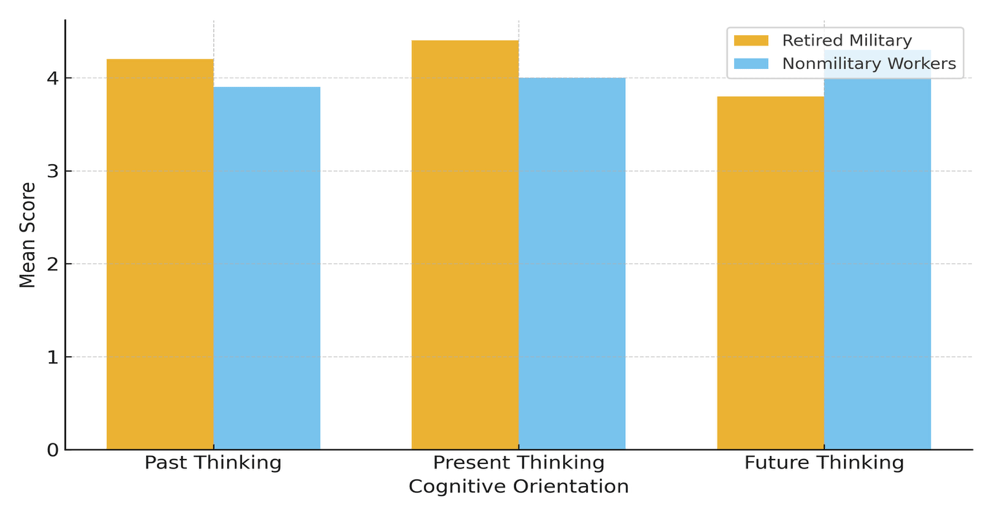
Figure 1
Distribution of Thinking Perspective Scores.
Inferential Statistics
A one-way MANOVA examined group differences across the five outcome variables. Effect sizes are reported as partial eta squared (partial eta squared). Following Cohen (1988), partial eta squared values of .01, .06, and .14 indicate small, medium, and large effects, respectively. The multivariate test showed a significant effect of worker status on decision-making quality (QoDoS), Pillai’s trace = .441, F(2, 213) = 84.09, p < .001, and on thinking perspective (MTPI), Pillai’s trace = .066, F(3, 212) = 4.98, p = .002. Follow-up ANOVAs indicated that retired military participants scored significantly higher on decision competence, F(1, 214) = 139.85, p < .001, and lower on decision style, F(1, 214) = 66.37, p < .001. Group differences also emerged for past, present, and future thinking. A logistic regression, conducted as an exploratory classification analysis, showed that competence (B = 1.81, SE = 0.29, p < .001) and style (B = –1.04, SE = 0.29, p < .001) significantly predicted group membership, whereas temporal thinking scores did not.
Assumption Testing
Normality was assessed using the Shapiro-Wilk test for each MANOVA model. Results indicated a statistically significant deviation from normality for both the decision-making quality model, W = .979, p < .001, and the thinking perspective model, W = .973, p < .001. Despite statistical significance, both W values were close to 1, suggesting only minor deviations from normality. Given the Shapiro-Wilk test’s sensitivity in large samples and the robustness of multivariate analyses, the analyses proceeded as planned. In accordance with Olson’s (1976) recommendations, Pillai’s trace was selected as the primary multivariate test statistic due to its robustness to violations of normality. Homogeneity of covariance was examined using Box’s M test for each MANOVA. For the decision-making quality MANOVA, Box’s M was not significant, χ²(3) = 0.62, p = .891, indicating that the assumption was satisfied. For the thinking perspective MANOVA, Box’s M was not significant, χ²(6) = 5.21, p = .517, indicating that the assumption of homogeneity of covariance matrices was also satisfied.
MANOVA Results
A one-way MANOVA revealed a statistically significant effect of worker status on combined decision-making orientation scores, F(2, 213) = 84.09, p < .001, Pillai’s trace = .44, partial η² = .441. This large effect indicated that approximately 44.1% of the variance in decision-making quality was explained by group membership (Table 3). Follow-up ANOVAs showed significant differences between military and civilian participants in both competence (F(1, 214) = 139.85, p < .001) and style (F(1, 214) = 66.37, p < .001).
Thinking Perspective Comparison
The MANOVA comparing past, present, and future thinking also yielded significant group differences, F(3, 212) = 4.98, p = .002, Pillai’s trace = .066, partial η² = .066, indicating small to moderate effects. Retired military participants scored higher in present and past thinking, while nonmilitary workers demonstrated stronger future-oriented thinking (Figure 1).
Predictive Analysis
A binary logistic regression tested the predictive capacity of decision-quality competence, decision style, and thinking-perspective scores on worker status (military or nonmilitary). This analysis was conducted as an exploratory classification model to examine the extent to which cognitive and decision-quality variables distinguished military retirees from nonmilitary workers and was not intended to infer causal effects. The overall combined model was statistically significant, X² = 114.49, p < .001, explaining 55% of the variance (Tjur’s R² = .55) and correctly classifying 81.48% of cases.
Three logistic regression models were examined. In the first model, past thinking (OR = 1.001, p = .943), present thinking (OR = 1.018, p = .289), and future thinking (OR = 1.010, p = .370) did not significantly predict group membership. In the second model, decision competence significantly predicted group membership (B = 1.77, SE = .27, p < .001, OR = 5.84, 95% CI [3.41, 9.99]), indicating that each one-unit increase in competence score was associated with substantially greater odds of being a retired military participant. Decision style was also a significant negative predictor (B = –1.03, SE = .28, p < .001, OR = 0.36, 95% CI [0.21, 0.62]), indicating that higher decision-style scores were associated with lower odds of retired military group membership.
In the final combined model, past thinking (OR = 1.007, p = .614), present thinking (OR = 0.981, p = .397), and future thinking (OR = 1.008, p = .545) remained nonsignificant predictors. However, decision competence remained a strong positive predictor of group membership (B = 1.81, SE = .29, p < .001, OR = 6.08, 95% CI [3.46, 10.71]), while decision style remained a significant negative predictor (B = –1.04, SE = .29, p < .001, OR = 0.35, 95% CI [0.20, 0.63]). Collectively, these findings indicate that decision-making competence and decision style, rather than cognitive time orientation, were the dominant predictors distinguishing retired military professionals from nonmilitary workers. The model’s predictive power (Table 4) supports decision-making quality orientation as a salient distinguishing factor between the two populations.
Table 4
Binary Logistic Regression Predicting Worker Status.
| PREDICTOR | B | SE | WALD | df | p | EXP (B) |
|---|---|---|---|---|---|---|
| Decision Competence | 1.81 | 0.29 | 39.06 | 1 | <.001 | 6.08 |
| Decision Style | –1.04 | 0.29 | 12.87 | 1 | <.001 | 0.35 |
| Past Thinking | 0.08 | 0.11 | 0.54 | 1 | .46 | 1.08 |
| Present Thinking | –0.03 | 0.10 | 0.09 | 1 | .77 | 0.97 |
| Future Thinking | 0.06 | 0.09 | 0.45 | 1 | .50 | 1.06 |
[i] Note. χ² = 114.49, p < .001; Tjur’s R² = .55; Model classification = 81.48%. B = unstandardized logistic regression coefficient; SE = standard error; Exp(B) = odds ratio.
Discussion and Implications
This study tested four hypotheses comparing retired military and nonmilitary workers aged 40–60 on decision-making quality and temporal thinking. Results supported H1, as retired military participants demonstrated significantly higher decision-making competence. H2 was also supported, with nonmilitary workers showing significantly higher decision-making style scores, indicating greater flexibility. The findings supported H3, as retired military personnel scored higher on both past and present thinking. H4 was confirmed, with nonmilitary workers exhibiting stronger future thinking. The MANOVA and follow-up ANOVAs showed that worker status accounted for meaningful variance across all outcome variables, and logistic regression results reinforced the distinctiveness of competence and style as classification indicators. Collectively, these results provide robust empirical support for the predicted cognitive and decision-quality differences between the two groups.
The findings of this study demonstrate that a measurable relationship exists between decision-making quality orientation and worker status (military vs. nonmilitary), while thinking perspective alone does not significantly predict group membership. The results indicated that retired military personnel scored higher on decision competence, whereas nonmilitary workers scored higher on decision-making style. These findings align with research suggesting that prolonged military service conditions individuals toward structure, rationality, and process-oriented thinking (Freeman et al., 2024; Pavicevic & Keil, 2025), while civilian work environments may cultivate flexibility and creativity through exposure to unstructured decision contexts.
The predictive significance of decision-making competence highlights the enduring influence of military experience on cognitive and behavioral processes. The structured decision-making frameworks ingrained in military training contribute to greater consistency, accuracy, and analytical rigor in decisions (Fadare et al., 2023; Grimell, 2024). Conversely, the higher decision-making style scores among civilian participants suggest greater adaptability and contextual responsiveness, skills often developed in decentralized and collaborative work environments (Khani & Baig, 2025). These patterns collectively suggest that military retirees bring strong procedural rigor, whereas civilian professionals may contribute flexible adaptability; both are valuable for organizational decision-making ecosystems.
The findings imply that organizations can strengthen human capital management by intentionally aligning job roles with employees’ cognitive orientations. Human resource departments could leverage psychometric tools, such as QoDoS and MTPI, to assess the fit between an individual’s thinking perspective and decision-making orientation before hiring or promoting. By doing so, they can foster better alignment between employees’ cognitive strengths and the organizational decision environment, thereby optimizing performance and minimizing turnover (Henderson, 2024).
A notable finding was that thinking perspective scores (past, present, and future thinking), although differing between groups, did not significantly predict worker status when analyzed in isolation in regression analysis. This suggests that while temporal thinking orientation reflects how individuals conceptualize problems, it may not independently determine occupational identity. These findings corroborate earlier work suggesting that personality, culture, and experience jointly shape cognition (Mitrulescu, 2023; Pala & Shalu, 2025). In practice, this underscores the need for a multifaceted approach to workforce analysis, integrating cognitive, cultural, and experiential factors when designing leadership pipelines or veteran reintegration programs.
From a theoretical perspective, the results extend MindTime theory and decision theory by empirically linking decision competence to structured professional backgrounds. The observed effect sizes support Simon’s (1979) concept of bounded rationality, illustrating how environmental conditioning (in this case, military training) constrains and shapes decision quality processes. Furthermore, the integration of human capital theory supports the view that cognitive traits are quantifiable assets, thereby validating the value of organizational strategies that invest in both analytical rigor and adaptive capacity.
These findings also contribute to veterans’ studies scholarship by highlighting how military institutional culture may shape decision-making patterns that persist after separation from service. Military organizations emphasize hierarchical authority structures, procedural accountability, and structured decision frameworks developed under conditions of uncertainty. Veterans transitioning into civilian workplaces may therefore bring decision approaches shaped by these institutional norms. Understanding these differences is important for interpreting veterans’ workplace experiences and for supporting successful workforce reintegration. Recognizing how military institutional training influences professional behavior can help civilian organizations better understand and leverage the leadership and decision strengths veterans bring to civilian employment.
Policy Implications for Veteran Transition and Employment Programs
Veteran transition programs and employer initiatives can benefit from understanding how military institutional experience shapes decision-making. Research suggests that the civilian workforce misunderstands military experience, and veterans struggle to translate their skills into civilian workforce language. This leads to bias and stereotyping by organizations, as well as to performance issues and dissatisfaction among veterans in the workplace (Peat et al., 2025). Programs such as the U.S. Department of Defense Transition Assistance Program (TAP) help service members translate military skills into civilian employment contexts. The present findings suggest that these initiatives may also benefit from addressing differences in decision-making environments between military and civilian organizations. Retired service members demonstrated higher decision-making competence, reflecting structured analytical frameworks developed through their years of military training and experience. Helping veterans recognize how these strengths apply in civilian roles may improve employment outcomes and reduce underemployment, dissatisfaction, and job turnover.
Employers can also benefit from greater awareness of the cognitive strengths veterans bring to civilian workplaces. Structured decision-making competence may be particularly valuable in roles that require strategic planning, fast-paced or complex operational coordination, and risk management. Employer education and mentorship initiatives that acknowledge differences between military and civilian decision-making environments may improve workplace integration and support successful veteran workforce reintegration (Joseph et al., 2023; Kleykamp et al., 2021).
Limitations of Prior Research
Although prior studies have documented structural, cultural, and cognitive differences between military and civilian work environments, these findings remain theoretically, methodologically, and empirically limited. Theoretically, existing research has not integrated MindTime theory and decision theory to explain whether differences in temporal cognition and decision quality persist across occupational groups. Methodologically, prior studies typically examined decision competence, decision style, or temporal thinking separately, using narrow or context-specific samples that prevent cross-population comparison. Empirically, little work has focused on mid-career adults aged 40–60, and no quantitative studies have applied the MTPI and QoDoS simultaneously within a single analytic framework. These gaps restrict scientific understanding of how professional conditioning shapes cognition and decision behavior. The present study addresses these limitations through a unified, hypothesis-driven comparison of retired military and nonmilitary workers.
Because this study used a cross-sectional design, causality cannot be inferred. Although military retirees scored higher on decision competence and present-focused thinking, these patterns may reflect self-selection rather than military conditioning. Individuals with stronger structure and analytical preferences, or those with a strong present/past orientation, may be more likely to join and remain in the military, suggesting that service may reinforce rather than create these cognitive patterns. Likewise, differences in decision-making style may originate before occupational choice. Future longitudinal research that measures cognition before, during, and after military service is needed to determine whether military experience influences these traits or whether individuals with particular cognitive dispositions are more likely to gravitate toward military careers.
Because MindTime theory proposes that thinking perspectives are relatively stable patterns of cognition, this study cannot determine whether military service shaped participants’ temporal orientation or whether individuals with stronger past- or present-focused thinking are more likely to self-select into military careers. Similarly, decision-making competence and style may reflect preexisting traits rather than being shaped by occupational conditioning. Without longitudinal data collected before and after military service, causal direction cannot be inferred. Future research should measure thinking perspective and decision-making orientation at enlistment, throughout service, and during transition to determine whether observed differences reflect developmental change or stable cognitive predispositions.
The recruitment approach also presents limitations. Participants were obtained through convenience sampling rather than through a controlled matching process, which means that the civilian and retired military groups may differ in ways unrelated to military experience. Civilians were recruited from general professional networks without efforts to match participants to the military group on factors such as occupation, gender, education, or specific job demands. These uncontrolled differences may have influenced scores on thinking perspectives or decision-making quality, independent of military background. Additionally, although the sample sizes were adequate for MANOVA, they may not fully represent the broader populations of retired military personnel or civilian mid-career workers. As a result, the generalizability of the findings is limited, and future studies should use stratified or matched sampling methods to reduce potential demographic confounding.
The study relied on self-reported survey data, which may introduce response bias due to participant perception or social desirability effects. The QoDoS instrument, while validated, was originally designed for pharmaceutical organizations and has not been widely applied in general workforce settings. Additionally, the study did not differentiate among military branches, ranks, or years of service, factors that likely contribute to within-group variation in decision competence and mindset. The U.S.-based sampling and use of nonprobability quota sampling further limit generalizability to broader populations.
Implications for Future Research
Future studies should address these limitations by employing randomized or stratified sampling to enhance representativeness and by differentiating among branches of service, ranks, and years of experience to capture the nuanced effects of military subcultures on cognitive development. Research could also expand internationally to test whether similar patterns emerge across different national military systems or among veterans transitioning to various industries.
Longitudinal designs would help trace whether decision competence and style evolve over time as veterans adapt to civilian roles and inculcate new cultures and workplace norms. Additionally, incorporating qualitative components, such as interviews or focus groups, could enrich understanding of how participants conceptualize and apply decision-making processes in real-world contexts. Future research should also explore whether hybrid decision environments, in which structured and flexible decision-makers collaborate, yield superior strategic outcomes.
Conclusions and Practical Application
The study confirmed that decision-making quality orientation, rather than thinking perspective alone, is the most significant differentiator between retired military and nonmilitary workers aged 40–60. Retired military participants demonstrated higher decision competence scores, indicating structured, analytical, and process-oriented thinking, while nonmilitary workers exhibited higher decision style scores, reflecting adaptability and flexibility in decision-making. These findings extend both MindTime theory and decision theory, suggesting that professional conditioning, socialization, and lived experience shape individual cognition and decision orientation.
The results have direct implications for human resource management and leadership development. Organizations should consider incorporating validated cognitive assessment tools, such as the QoDoS and MTPI, into their hiring, onboarding, and professional development processes. Such assessments can identify cognitive strengths aligned with role requirements, whether in analytical, process-driven positions suited for structured thinkers, or dynamic, innovative roles that require flexible decision-making. Tailoring job placement in this way enhances strategic alignment and supports long-term employee satisfaction and performance.
Beyond its organizational utility, this study contributes to a broader workforce strategy by reframing veteran integration not as a remediation challenge, but as an optimization opportunity. Understanding veterans’ distinct cognitive strengths allows firms to design targeted leadership pipelines, mentorship programs, and cross-functional teams that maximize collective decision quality. These interventions enhance overall organizational agility while recognizing the unique expertise that military retirees bring to the organization.
At the theoretical level, findings reinforce human capital theory by confirming that cognition and decision-making style constitute measurable assets. In conclusion, the evidence from this study advances empirical understanding of how professional conditioning influences decision competence and style. The practical applications are clear: aligning workforce composition with cognitive diversity enhances strategic performance, improves veteran reintegration outcomes, and strengthens an organization’s ability to balance precision with innovation in complex decision-making environments.
Data Accessibility Statement
The data that support the findings of this study are available from the corresponding author upon reasonable request.
Ethics and Consent
This study was approved by the University of the Cumberlands IRB Office (approval number 1124-152755) on November 8th, 2024. All participants provided written informed consent prior to participation. No identifying information was collected. The study was conducted in accordance with the ethical standards of the American Psychological Association.
Author Contributions
Dr. Joshua Denman: Conceptualization, methodology, data collection, formal analysis, writing (original draft), writing (review and editing). Dr. Amanda Tanner: Conceptualization, writing (original draft), writing (review and editing), supervision, formal analysis, and resources. Dr. Michelle Preiksaitis: Methodology, data curation, visualization, formal analysis, writing (review and editing).