
Table 1
Summary of Included Literature.
| AUTHOR | TITLE | PAPER TYPE | DATABASE | KEY OUTCOMES OF INTEREST | SUMMARY OF OUTCOMES OF INTEREST |
|---|---|---|---|---|---|
| Austin et al. 2014 USA | VA’s expansion of supportive housing: successes and challenges on the path toward housing first | Qualitative study | Google Scholar | Affordable housing portfolios Community integration and wellbeing | Difficulties are reported in securing appropriate housing types in suitable locations during the transition to a Housing First model. Delays in establishing on-site healthcare contribute to increased reliance on costly inpatient services for veterans with complex mental and physical health needs. |
| Bulanchuk et al. 2024 USA | The mediating role of social support in associations between childhood adversity, military sexual trauma, and homelessness in a nationally representative sample of US veterans | Data linkage study | PubMed | Community integration and wellbeing | Connection to VA services, local resources, and support networks enhances social reintegration. Participation in neighbourhood activities and engagement with religious or community institutions fosters a sense of belonging and stability. |
| Bamberger, 2024 USA | Housing ends homelessness | Commentary | CINAHL | Affordable housing portfolios. Mental and physical health issues. | Funding is required to bridge the gap between what a veteran can subsidise rent. Veterans with medically complex needs are not suitable for independent housing but expensive hospital-based care is unaffordable. As homeless veterans age increases, there is a greater need for assisted living facilities. |
| Barile et al. 2018 USA | A latent class analysis of self-identified reasons for experiencing homelessness: Opportunities for prevention | Descriptive survey | CINAHL | Mental and physical health issues | Financial constraints need to be reduced by streamlining disability benefits for veterans with chronic physical and mental health issues. Integrate veteran health services and traditional social services. Wraparound service model is appropriate for individuals with a disability or physical issue. |
| Bennett et al. 2019 USA | Military veterans’ overdose risk behaviour: Demographic and biopsychosocial influences | Cross-sectional survey | PubMed | Behaviour issues post discharge affecting home and family life. Community integration and wellbeing. | Unstable housing is a significant social stressor and leads to increased risk behaviour particularly in relation to opioid related overdose. Government programs need to be robust and integrated with healthcare and social services to enhance veterans’ wellbeing. |
| Betancourt et al. 2022 USA | Substance use relapse among veterans at termination of treatment for substance use disorders | Data linkage study | CINAHL | Mental and physical health issues | Clear need for SUD treatment programs in conjunction with stable housing and supported employment options. |
| Blosnich et al. 2020 USA | Differences in methods of suicide among veterans experiencing housing instability 2013–2016 | Data linkage study | PubMed | Behaviour issues post discharge affecting home and family life | Unstable housed veterans have a higher risk of suicide related to drugs and other biological substances than stable housed veterans who were more likely to use firearms. |
| Brenner et al. 2017 USA | Traumatic brain injury, psychiatric diagnoses, and suicide risk among Veterans seeking services related to homelessness | Quantitative study | CINAHL | Mental and physical health issues | Chronic homeless veterans more likely to have traumatic brain injury, psychiatric diagnosis and suicide risk affecting their housing readiness. Traumatic brain injury may affect the veteran’s ability to commit to the program or follow rules. TBI veterans are supported by Housing First programs where needs are prioritised and separate from treatment needs. |
| Carter et al. 2019 USA | Housing instability characteristics among transgender veterans cared for in the veterans’ health administration, 2013–2016 | Data linkage study | CINAHL | Transition from military | Transgender veterans leaving the military have increasingly higher rates of housing instability. |
| Chinchilla et al. 2019 USA | Community integration among formerly homeless | Data linkage study | PubMed | Community integration and wellbeing | The pursuit of mental health services to improve mental health can lead to housing stability, engagement in vocational rehabilitation and community adjustment and individual wellbeing. |
| Chinchilla et al. 2020 USA | Exploring community integration among formerly homeless veterans in project-based versus tenant-based supportive housing | Qualitative study | CINAHL | Affordable housing portfolio | Permanent housing, such as apartments in the community is only a starting point in the process of recovery for HUD-VASH participants. Benefits include long-term recovery, aided by not having close proximity to other recovering veterans although community integration occurs by social contact with other veterans and use of veteran resources. |
| Creech et al. 2015 USA | Identifying mental and physical health correlates of homelessness among first-time and chronically homeless veterans | Administrative data | Psychology and Behavioural Sciences Collection | Mental and physical health issues | Differences exist between first time homeless veterans and those whose status is considered chronic or repeat unstable homeless. Chronic homelessness is linked to long-term issues like substance use and mental illness, while first-time homelessness often stems from sudden health crises worsened by economic hardship. |
| Cretzmeyer et al. 2014 USA | Barriers and facilitators to veterans’ administration collaboration with community providers: The lodge project for homeless veterans | Qualitative case study | CINAHL | Transition housing | VA collaboration with local community provider for a supportive program for homeless veterans. Eligibility is persistent mental illness, no recent suicidality, no current substance abuse, and willing to work 20 hours/week and address AOD issues. |
| Cusack & Montgomery, 2017 USA | Examining the bidirectional association between veteran homelessness and incarceration within the context of permanent supportive housing | Administrative data study | MEDLINE | Affordable housing portfolio | Veteran care matching includes Housing First with permanent support and intensive case management (e.g. ACT, recovery housing). Most effective for veterans with SUD and criminal history to reduce re-incarceration. |
| Cusack & Montgomery, 2018 USA | Barriers and facilitators to housing access and maintenance in HUD-VASH: Participant and staff perspectives | Mixed method study | CINAHL | Transition from military | Barriers to achieving housing success include challenging processes, communication difficulties, and lack of affordable and suitable housing stock. During transition barriers to maintaining housing are described as the program rules, mental health issues, substance use, and access to resources such as household goods. |
| Cusack et al. 2022 USA | Providers’ reflections on infrastructure and improvements to promote access to care for Veterans experiencing housing instability in rural areas of the United States: A qualitative study | Qualitative study | CINAHL | Community integration and wellbeing | Rural areas have barriers for veterans facing housing instability, such as transport and internet constraints and access to healthcare and lack of housing options. |
| Dinnen et al. 2014 USA | Trauma-informed care: A paradigm shift needed for services with homeless veterans | Case management commentary | PubMed | Behaviour issues post discharge affecting home and family life | Lack of trauma-informed case management may overlook links between trauma and homelessness; care should include individual trauma histories and PTSD treatment. |
| Elbogen et al. 2023 USA | How often does homelessness precede criminal arrest in veterans? results from the U.S. survey of prison inmates | Administrative data study | MEDLINE | Veterans in corrective services | U.S. nationally representative data reported 27% of veterans experienced homelessness within 12 months before a criminal arrest. |
| Ellison et al. 2016 USA | Patterns and predictors of engagement in peer support among homeless veterans with mental health conditions and substance use histories | Quasiexperimental study | CINAHL | Community integration and wellbeing | Peer support for homeless veterans should be age-tailored, flexible, and intensity-adjusted, with older veterans more likely to engage. |
| Evans et al. 2022 USA | U.S. Department of Housing and Urban Development–Veterans Affairs Supportive Housing Program: bring all homeless veterans’ home | Commentary | CINAHL | Community integration and wellbeing | Case management with cultural competence and experience with veterans is needed for homeless veterans. |
| Fairweather & Zotterelli, 2019 USA | The Vietnam war and a legacy of veteran neglect | Media article | CINAHL | Mental and physical health issues | Despite eligibility for assistance, veterans avoid use and end up in expensive emergency care. Veterans’ village model has an on-site nurse, psychiatric nurse practitioner, and geriatrician help build trust and support health management. |
| Felder & Delaney, 2020 USA | The life course of homeless female Veterans: Qualitative study findings | Qualitative study | Google Scholar | Behavioural issues post discharge affecting home/family life | Women veterans face unique challenges, such as an increased risk of housing instability for those who have experienced intimate partner violence without tailored interventions to ensure safety and stability. |
| Finlay et al. 2019 USA | Veterans in prison for sexual offenses: Characteristics and re-entry service needs | Administrative data study | MEDLINE | Veterans in corrective services | Sexual offending is less common among homeless veterans, possibly due to survival priorities, engagement in non-violent crime, or underreporting within homeless communities. |
| Fletcher et al. 2022 USA | Stakeholder perspectives on sustainment of Housing First in a VA permanent supportive housing program | Mixed method study | MEDLINE | Affordable housing portfolios | External barriers include limited affordable housing and geographic challenges (metro vs rural). Internal constraints found are financial limits, staffing shortages, and weak leadership. Housing First needs to adapt to local conditions to support veterans’ health and safety. |
| Flike & Byrne, 2023 USA | Systematic review of access to healthcare and social services among US women veterans experiencing homelessness. | Systematic review | CINAHL | Transition housing | Emergency and transitional housing accommodations, have a need for a privacy and safety features (such as adequate lighting, working locks, and security cameras), to reduce sexual harassment, and for suitability for children. |
| Gabrielian et al. 2015 USA | Factors affecting exits from homelessness among persons with serious mental illness and substance use disorders | Administrative data study | PubMed | Affordable housing portfolios | The attainment and retention of permanent housing and independent living for veterans with cognitive impairment is impacted by relational, social, and mental health issues. |
| Gabrielian et al 2016 USA | Factors associated with premature exits from supported housing | Administrative data study | PubMed | Transition from military | Disengagement factors include challenges such as outpatient care adherence, SUD, chronic pain, justice involvement, and frequent hospital use. Disengaged individuals are more likely to remain homeless or be incarcerated. Housing-first models without rehab focus may lead to premature exits. |
| Gabrielian et al. 2017 USA | “They’re homeless in a home”: Retaining homeless-experienced consumers in supported housing | Mixed method study | CINAHL | Transition from military | Premature disengagement is more likely to be related to unmet needs for those veterans with significant mental health issues. |
| Gettings et al. 2022 UK | Exploring the role of social connection in interventions with military veterans diagnosed with PTSD | Systematic Narrative Review | Google Scholar | Community connections | Veterans have a need for unique support and treatment for loneliness and social isolation to reintegrate into the community. |
| Goggin et al. 2018 USA | Experiences of incarcerated veterans in all-veterans housing unit – A qualitative study | Qualitative descriptive study: | Google Scholar | Veterans in corrective services | Effective reintegration requires planning, training and education, mental health treatment. |
| Gorman et al. 2018 USA | Veteran coffee socials: A community building strategy for enhancing community re-integration of veterans | Commentary | Google Scholar | Community connections | Coffee social events provide a platform for engagement in activities, share information and resources and a safe place for discussion. |
| Ijadi-Maghsoodi et al. 2022 USA | Beyond housing: understanding community integration among homeless-experienced veteran families in the US | Mixed method study | MEDLINE | Affordable housing portfolios | First time homeless veterans in permanent housing become isolated and are affected by fears of losing housing. Ongoing case management, advocacy, and support after obtaining permanent housing is required. |
| Jacobs et al. 2022 USA | Improving consumer experiences in Permanent Supportive Housing Co-Located with health centers: A case study from the Department of Veterans Affairs | Qualitative study | CINAHL | Affordable housing portfolios | Limited permanent housing requires matching veterans to suitable models. Best for veterans with complex health needs, especially near healthcare services. PSH must include gender-specific accommodations. |
| Johnson et al. 2017 USA | No wrong door: Can clinical care facilitate veteran engagement in housing services? | Longitudinal survey study | MEDLINE | Transition from military | Veterans who accessed primary care were more likely to move into a stable housing program faster. |
| Jutkowitz et al. 2019 USA | Homeless veterans in nursing homes: care for complex medical, substance use, and social needs | Cross-sectional study | Google Scholar | Mental and physical health issues | Homeless veterans are more likely to be at risk of nursing home admission with chronic health conditions. |
| Keller et al. 2022 USA | Homelessness: Women veterans without billets | Commentary | MEDLINE | Community integration and wellbeing | Homeless women veteran rehabilitation requires an interprofessional case management approach to ensure the priority of individual needs. Embedding of nurses in wraparound services is a significant way to ensure progression and addressing of needs. |
| Klinge & Ollwitz, 2020 AUST | Andrew Russell: Veteran Living — Meeting the needs of homeless veterans in South Australia | Commentary | Grey Literature | Emergency accommodation | Average length of stay in ARVL emergency accommodation is around 110 nights, during which they receive support to access services to help secure long-term accommodation. |
| Mennella & Schub, 2022 USA | Case management | EBP resource | Grey Literature | Transition housing | Case management as a way to deliver healthcare to meet the complex needs of the homeless. Benefits include reintegration into housing and positive employment outcomes. |
| Montgomery et al. 2017 USA | Supporting veterans’ transitions from Permanent Supportive Housing | Mixed method study | MEDLINE | Transition from military | Case managers and their relationships with veterans impacts the ability to transition to more permanent housing options. |
| Montgomery et al. 2018 USA | Recent intimate partner violence and housing instability among women veterans | Administrative data study | PubMed | Behaviour issues post discharge affecting home and family life | Increased risk of housing instability for women veterans who have experienced intimate partner violence. |
| Nelson et al. 2018 USA | Costs associated with health care services accessed through VA and in the community through Medicare for veterans experiencing homelessness | Observational study | CINAHL | Mental and physical health issues | Veterans with housing instability have higher cost related to greater usage of outpatient, inpatient care and emergency care. |
| Nelson et al. 2024 USA | Temporary financial assistance for housing expenditures and mortality and suicide outcomes among US veterans | Cohort study | PubMed | Affordable housing portfolios. Mental and physical health issues | Veterans with financial assistance have improved health outcomes such as all-cause mortality and suicidal ideation. |
| Nichter et al. 2023 USA | Prevalence, correlates, and mental health burden associated with homelessness in U.S. military veterans | Administrative data study | PubMed | Behaviour issues post discharge affecting home and family life. Mental and physical health issues | One in ten U.S. veterans has experienced homelessness. Prevention of generational cycles of homelessness occurs through assistance of homeless veterans with dependent children. Adverse childhood events are factor associated with lifetime homelessness. |
| Novacek et al. 2022 USA | Examining racial differences in community integration between black and white homeless veterans | Cross-sectional study | PubMed | Community integration and wellbeing | Community integration is more difficult with psychiatric symptoms. Social integration affects the severity of psychotic, depression, anxiety, and agitation experienced. Cultural competence needed to ensure social support for homeless veterans and their families. |
| O’Connell et al. 2016 USA | Impact of supported housing on social relationships among homeless veterans | Longitudinal study | PubMed | Affordable housing portfolios. Community integration and wellbeing | Access to housing is a facilitator of positive change in other areas of a veterans’ life including social support. Supported housing plays a positive role in enhancing social connections and relationships between homeless veterans, other veterans, and providers of services. |
| Petrovich et al. 2014 USA | Characteristics and service use of homeless veterans and nonveterans residing in a low-demand emergency shelter | Qualitative study | PubMed | Emergency accommodation | High prevalence of alcohol and drug problems among users of emergency shelters. |
| RAAFAWA, 2023 AUST | Andrew Russell Veteran Living: Supporting veterans who are homeless or at risk of homelessness | Report | Grey Literature | Emergency accommodation | Temporary accommodation using an adapted housing first solution, with the primary goal to assist veterans to secure permanent housing. Care includes individualised care plans to support active work with external and ex service organisations. |
| Rivera-Rivera & Villarreal, 2021 USA/Caribbean | Homeless veterans in the Caribbean: Profile and housing failure | Administrative data | PubMed | Transition housing | The most prevalent characteristics of homeless veterans were low social support, unemployment, extreme poverty, substance use, and psychiatric disorders. Age, social isolation, low support, and psychiatric disorders influence readmission risk. Veterans are more prone to trauma-related and anxiety disorders (e.g. PTSD) and older cohorts had more schizophrenia and depression. Substance use link may reflect family estrangement and social isolation. |
| Roggenbuck, 2022 AUST | Housing First: An evidence review of implementation, effectiveness and outcomes | Evidence Review | Grey Literature | Emergency accommodation Affordable housing portfolios Community integration and wellbeing | Emergency accommodation for homeless veterans varies widely by country, as different nations have developed unique approaches to address veteran homelessness. Addressing housing issues for veterans requires a dual focus on community integration and well-being. |
| Roncarati et al. 2024 USA | Risk of dementia among veterans experiencing homelessness and housing instability | Cross-sectional study | CINAHL | Mental and physical health issues | Veterans with housing instability have higher risk of an eventual diagnosis of Alzheimer’s disease and related dementias. |
| Schutt et al. 2021 USA | Health service preferences among veterans in supported housing in relation to needs expressed and services used | Qualitative study | CINAHL | Mental and physical health issues | Veterans perceived the most important treatment needs were medical problems followed by mental issues and AOD. Support needed to give veteran choice of treatment to increase motivation to change when accessing programs. |
| Searle et al. 2019 AUST | Homelessness amongst Australian contemporary veterans: pathways from military and transition risk factors | Data linkage study | Google Scholar | Transition from military Behavioural issues post discharge affecting home and family life Veterans in corrective services | Homelessness is associated with childhood and more recent trauma, PTSD symptoms, psychological distress, anger alcohol issues, justice system involvement and unemployment. Financial strain, lower social support, mental health issues and difficulties in intimate relationships are also associated with homelessness. |
| Semeah et al. 2019 USA | Rental housing needs and barriers from the perspective of veterans with disabilities | Qualitative descriptive study | Google Scholar | Mental and physical health issues | Veterans accessing social services with disabilities require appropriate elements such as elevators, or systems with audio announcing features. Older housing is less likely to be modifiable, with physical barriers that affect ADLs. Financial constraints lead to challenges accessing disability benefits. |
| Schaffer, 2016 USA | Incarcerated veterans outreach program | Cross-sectional study | Google Scholar | Veterans in corrective services | Re-entry for veterans following incarceration is a collective approach requiring short, long, or intensive follow up. Readjustment issues facing veterans are medical, psychiatric, SUD, PTSD, domestic abuse, and employment challenges. |
| Spinola et al. 2021 USA | A psychosocial mediational model of homelessness among U.S. male and female veterans who served in Iraq and Afghanistan | Data linkage study | CINAHL | Community integration and wellbeing | Veterans who experience adverse childhood events may have more challenges developing social resources and supports for social connections after discharge. |
| Sreenivasan et al. 2023 USA | Reset for systematic action: Removing VA barriers to housing and treatment for military veterans with sexual offenses | Commentary | MEDLINE | Behaviour issues post discharge affecting home and family life | Veterans with sexual offences have a need for access to specific treatment to help address impulses and consequently gain employment and secure housing. Transient veterans are at risk of absconding from parole or supervision when not suitably housed, which can affect community safety. |
| Stacy et al. 2017 USA | Reasons for job loss among homeless veterans in supported employment | Quasiexperimental study | CINAHL | Behaviour issues post discharge affecting home and family life | Veterans have difficulty in the maintenance of employment with likelihood of termination because of substance and drug and alcohol use. |
| Sturtevant et al. 2015 USA | Housing and services needs of our changing veteran population serving our older veterans, female veterans, and post-9/11 Veterans. National housing conference/ Centre for housing policy | Report | Google Scholar | Transition housing Affordable housing portfolios | Affordable housing portfolios need to be reinforced through assessment of housing and service future needs. Need to sustain and expand funding for specialised supportive services that are combined with housing. |
| Tejani et al. 2014 USA | Incarceration histories of homeless veterans and progression through a national supported housing program | Administrative data study | CINAHL | Veterans in corrective services | Homeless veterans with incarceration histories have more mental illnesses than those with no incarceration history. |
| Tsai et al. 2014a USA | Client satisfaction with a new group-based model of case management for supported housing services | Cross-sectional survey | PubMed | Transition housing | Veterans engaged in a group peer support program which encouraged information-sharing and mentoring, found benefits in social interactions, and relationships with case management staff. Greater engagement addressed needs and veterans were less likely to leave the transition housing program. |
| Tsai et al. 2014b USA | Alcohol and drug use disorders among homeless veterans: Prevalence and association with supported housing outcomes | Administrative data study | PubMed | Transition housing | On admission to the HUD-VASH program, 60% of homeless veterans had a SUD, and 54% had both SUD and alcohol/drug use. The inclusion of individuals with SUD in supported housing, require special support, and findings show subsequent homelessness was slowed. |
| Tsai & Rosenheck, 2015 USA | Risk factors for homelessness among US veterans | Systematic review | PubMed | Community integration and wellbeing Transition from military | Lack of social support is a risk factor for homelessness. Income related variables such as low income and unemployment and financial mismanagement are significant risk factors for homelessness. |
| Tsai et al. 2015 USA | Characteristics and use of services among literally homeless and unstably housed U.S. veterans with custody of minor children | Administrative data study | PubMed | Transition housing Behaviour issues post discharge affecting home and family life | Homeless and unstably housed veterans are more likely to be in families with children leading to homeless families rather than individuals. |
| Tsai et al. 2020 USA | Is homelessness a traumatic event | Administrative data study | CINAHL | Community integration and wellbeing | Veterans who have extensive trauma histories, and homelessness may also be traumatic and lead to PTSD. There is a greater concern around PTSD and safety for veterans than other adults. |
| Tsai et al. 2021 USA | Is there more public support for US Veterans who experience homelessness and posttraumatic stress disorder than other US adults? | Cross-sectional survey | Psychology and Behavioural Sciences Collection | Mental and physical health issues | PTSD rates was found in one-third of veterans with a history of homelessness which is five times the respective rates found in veterans who had never been homeless. Veterans who experienced homelessness had different life histories and were exposed to more potentially traumatic events. |
| Tsai et al. 2023 USA | Unmet needs of homeless U.S. veterans by gender and race/ethnicity: Data from five annual surveys | Administrative data study | MEDLINE | Transition from military | Transition programs need to consider addressing the diverse needs of veterans such as gender, race, and ethnicity in services to meet consistent unmet needs. |
| Tsai & Byrne, 2024 USA | Rates and predictors of returns to homelessness among veterans, 2018–2022 | Administrative data study | PubMed | Affordable housing portfolios | Veterans who are successful in achieving PSH are not likely to return to homelessness within 12 months, The critical period for exiting is within 12 months. |
| Twamley et al. 2019 USA | Neurocognition, psychiatric symptoms, and lifetime homelessness among veterans with a history of traumatic brain injury | Cross-sectional study | PubMed | Mental and physical health issues | Long-term homelessness with unemployment is associated with depression, anxiety, PTSD, SUD, and post concussive symptoms. |
| Umucu et al. 2024 USA | Geographic and psychosocial correlates of homelessness or unstable housing among US veterans in the Midwest | Cross-sectional study | MEDLINE | Mental and physical health issues Transition from military | Physical health conditions and psychiatric conditions are more common in homeless veterans compared to stably housed veterans. The greater likelihood of unstable housing is related to increased visits to the emergency department, older age and risky behaviours. Strong associations between homelessness and unstable housing were incarceration and rural location. Incarceration experience may lead to more use of services post release. |
| Waddell et al. 2021 AUST | What are the risk factors for ex-serving defence force personnel to enter corrective service systems in Australia and/or other relevant jurisdictions | Rapid evidence assessment | Google Scholar | Veterans in corrective services | Veterans in corrective services were more likely than non-veterans to be sentenced for violent crimes or sexual offending. Risk factors for incarceration include male, a minority group, and exposure to trauma, lack of treatment or help-seeking behaviours and more likely than non-veterans to be sentenced for violent crimes or sexual offending. Veterans have higher rates of mental health issues related to alcohol abuse. Childhood adversity is a risk factor for adult offending in the general population. |
| Wallace et al. 2023 AUST | Veteran homelessness in Australia: What do we know? What has been done? What do we need to do? | Commentary | CINAHL | Mental and physical health issues | Australian veterans risk factors for homelessness are mental disorders SUD and include higher risk of suicidality. |
| Weber et al. 2017 USA | Understanding the health of veterans who are homeless: A review of the literature | Literature review | CINAHL | Mental and physical health issues | Homeless veterans are impacted more heavily by physical and mental issues, and SUD than other populations. |
| Winer et al. 2021 USA | Housing and social connection: Older formerly homeless veterans living in subsidized housing and receiving supportive services | Qualitative study | CINAHL | Community integration and wellbeing Transition from military | Transition to emergency housing was affected by the slow process of receiving financial aid. The stability of a home provides quality of life but can also be a source of stress and loneliness affecting social integration. Barriers to community integration include transportation. Project based housing runs social events and treatment groups such as AA. There is a reluctance to engage in opportunities for social interaction, and some avoidance of close friendships. |
| Wong et al. 2022 USA | Housing outcomes among homeless-experienced Veterans engaged in vocational services | Administrative data study | MEDLINE | Transition housing | Vocational services provided in transitional housing increased the likelihood of gaining a semi-permanent housing option. |
| Wood et al. 2022 AUST | Out of the trenches; prevalence of Australian veterans among the homeless population and the implications for public health | Administrative data study | MEDLINE | Mental and physical health issues | Higher prevalence of brain injuries or head trauma in veterans. Higher prevalence of chronic illness, cancer and mental health issues. |
| Young, 2021 USA | Study results highlight formerly homeless veterans need for case management | Media release | Media | Behaviour issues post discharge affecting home and family life | Behavioural issues post discharge include PTSD, other mental health issues and substance and alcohol use. Veterans may face a range of behavioural issues post-discharge that can impact their home and family life. Support networks are necessary but challenging for veterans. |
| Yu et al. 2020 USA | The intersection of interpersonal violence and housing instability: Perspectives from women veterans | Qualitative study | MEDLINE | Community integration and wellbeing | Safety from violence was a consideration with housing for women veterans who have experienced intimate partner violence. |
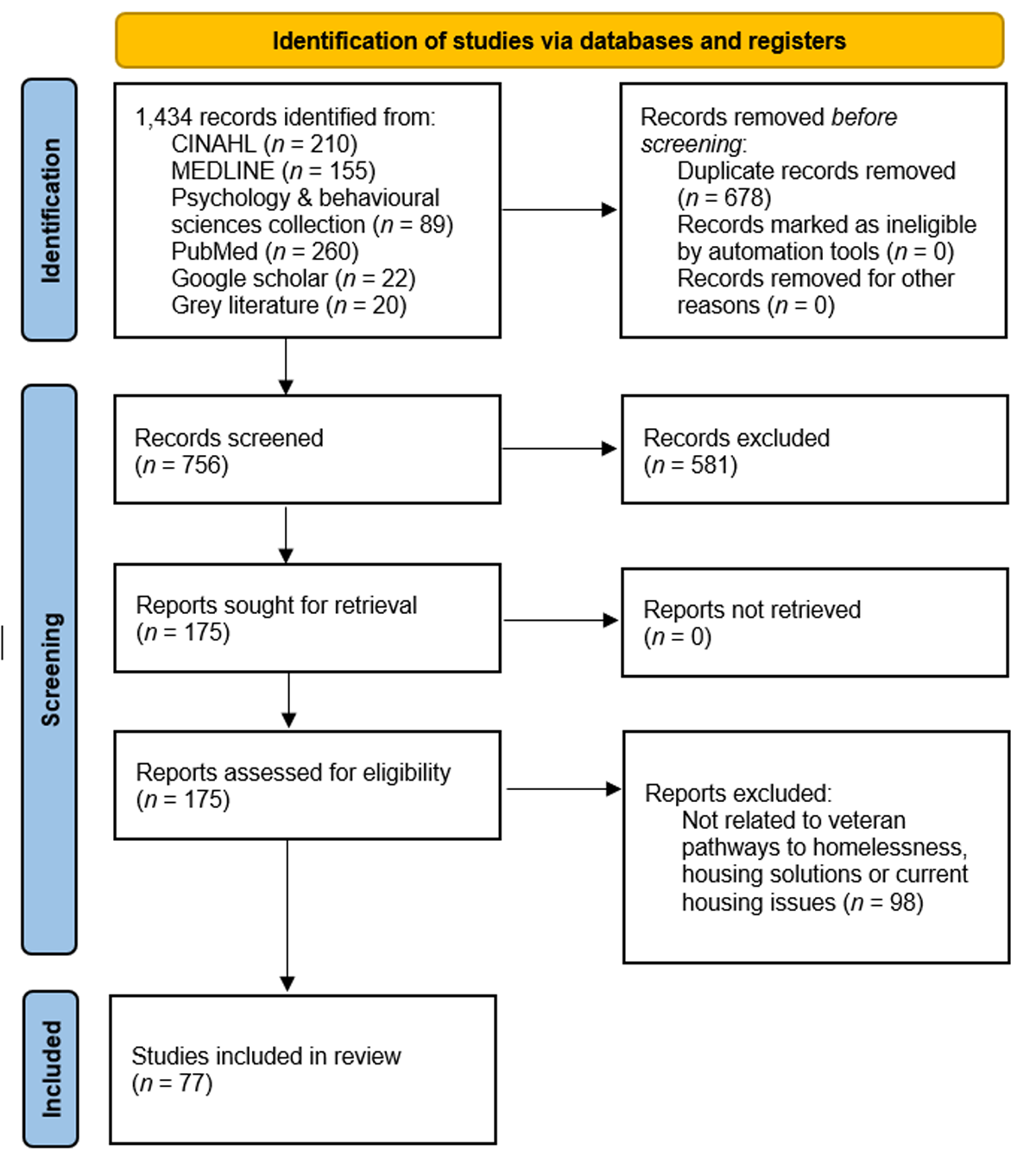
Figure 1
PRISMA Diagram.
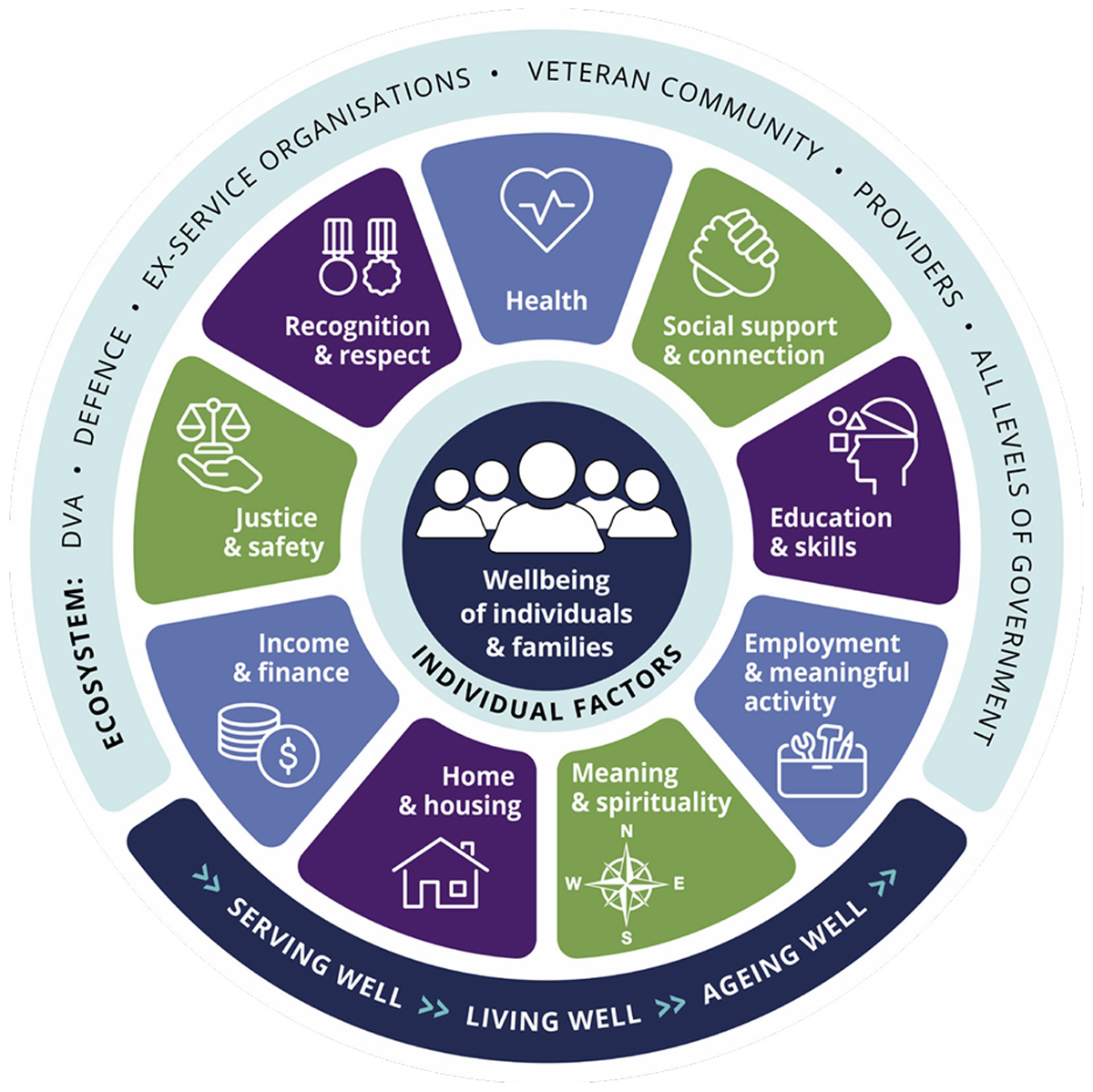
Figure 2
Wellbeing Framework.
Note. Australian Government et al. (2024).