
The U.S. military plays a vital role in national defense, upholding values such as service, sacrifice, and duty (Hall, 2011; Meyer & Wynn, 2018). Since June of 2024, over 1.2 million active-duty personnel and 761,601 reservists serve across the five military branches (Defense Manpower Data Center, 2024). Each year, about 200,000 service members transition out of the military (U.S. Government Accountability Office [GAO], 2024), joining a veteran population of roughly 17.6 million (Bureau of Labor Statistics [BLS], 2024). Recent military conflicts, including Operations Iraqi Freedom (OIF) and Enduring Freedom (OEF), have resulted in thousands of casualties and extensive psychological tolls. Over 1.9 million troops were deployed to these conflicts by 2010, with many facing multiple deployments and limited recovery time (Defense Casualty Analysis System, 2024; Department of Veterans Affairs [VA], 2023; National Academies Press, 2010). These experiences often leave veterans struggling to reintegrate into civilian society, even if they have not experienced combat.
The assumption that the military has a responsibility to support service members in their transition to civilian life is grounded in federal policy. According to the U.S. Congress (1991), the National Defense Authorization Act mandated reintegration support through the Transition Assistance Program (TAP), creating the expectation that the Department of Defense provides pre-separation counseling, employment assistance, and reintegration services to separating service members. This program has undergone several updates to improve compliance and content delivery (Kamarck, 2024). Therefore, the claim that the military holds a duty to prepare veterans for reintegration is not merely normative as it is embedded in U.S. defense policy. For the purposes of this study, “institution” refers specifically to the U.S. military organization responsible for supporting service members during and after their transition, not the Department of Veterans Affairs or external support systems.
Although active-duty military life fosters connection and purpose, veterans frequently report a loss of identity, meaning, and support upon reintegration (Andresen et al., 2019; Bloeser et al., 2021). Challenges in employment, mental health, and social reintegration are also common issues for veterans to contend with (Gross et al., 2023; Monteith et al., 2022). Emerging literature increasingly links these challenges to institutional betrayal (IB), defined as when “[a]n institution causes harm to an individual who trusts or depends upon that institution” (Smith & Freyd, 2014, p. 578). Despite the relevance of this concept, there is a lack of standardized tools to measure IB specifically in the context of military-to-civilian transition (Romaniuk et al., 2020; Tamaian & Klest, 2018). While IB has been explored in contexts such as military sexual trauma (MST), limited research addresses veterans’ post-service perceptions independent of post-traumatic stress disorder (PTSD) or MST (Andresen et al., 2019; Monteith et al., 2016, 2022; Smith & Freyd, 2013). This study contributes valuable quantitative insight into military veterans’ experience with the transition out of the military, specifically in relation to their perceptions of IB. Although much of the literature references reintegration to describe veterans’ broader adjustment to civilian life, this study specifically focuses on the institutional responsibilities at the point of separation from service. Accordingly, this research uses the term transition to emphasize the adequacy of military support during the exit process.
Background and Theoretical Framework
The following literature review highlights Betrayal Trauma Theory (BTT) and IB which extends this framework to systemic failures within institutions like the military, healthcare, and higher education. This review also addresses reintegration stressors, including mental health issues, strained social relationships, and economic barriers, with particular attention to the compounded effects of MST and PTSD in relationship to IB.
Betrayal Trauma Theory and Institutional Betrayal
Betrayal Trauma Theory, originally introduced by Freyd (1994), describes trauma inflicted by trusted individuals or entities, often resulting in unique psychological outcomes like memory repression, dissociation, and chronic distress (Birrell & Freyd, 2006; Freyd et al., 2005; Freyd, 2008). Furthermore, BTT posits that the intensity by which a negative occurrence represents a betrayal by a trusted person will influence how that occurrence is subsequently processed and recalled (Sivers et al., 2002). This theory has primarily explored the trauma associated with betrayal by trusted caregivers in interpersonal relationships. However, IB has extended this concept to systemic failures, such as when trusted organizations neglect, ignore, or perpetuate harm (Smith & Freyd, 2013, 2014). Within military contexts, IB includes both pragmatic failures—such as inadequate resources while transitioning—and psychological harm, which together compromise reintegration outcomes. Institutional betrayal is not unique to the military, as it occurs in higher education and healthcare organizations. Betrayal by trusted institutions has eroded public trust and contributed to negative outcomes, as demonstrated by Gigler et al. (2022), who found that 69% of college students reported betrayal by their healthcare providers. This is particularly relevant for nurses in the case of whistleblowing and workplace gaslighting (Ahern, 2018; Galovski et al., 2022).
Reintegration Stressors
Veterans who have reintegrated experience psychological distress and often face mental health concerns, including PTSD, depression, and anxiety, which are compounded by the abrupt shift from structured military life to civilian uncertainty (Edwards et al., 2023; Haller et al., 2016; Rivers et al., 2013). Social relationships can become strained with service members and their families reporting stress, loss of structure, and diminished emotional well-being (Ahern et al., 2015; Canfield, 2014; Corry et al., 2022; Skomorovsky et al., 2020). Economically, veterans face employment barriers, difficulty translating military experience, and unmet expectations in civilian roles (Dexter, 2020; Elbogen et al., 2022; Whybrow & Milligan, 2021). Military sexual trauma is a prominent example of IB in the military. Veterans who experienced MST and perceived institutional failure reported higher rates of PTSD, depression, and suicidality (Monteith et al., 2016, 2022; Smith & Freyd, 2013). Despite the Veterans Health Administration (VHA) offering free MST-related services, many avoid care due to prior institutional violations (Holliday & Monteith, 2019; McLean et al., 2022). Institutional betrayal also compounds the employment struggles of female veterans and marginalized groups (Gross et al., 2023; Monteith et al., 2021a, 2021b).
Method
This study employed a cross-sectional, quantitative design to evaluate U.S. veterans’ perceptions of IB during military-to-civilian transition, using a between-subjects approach to compare subgroups by military branch, service era, and service length. The primary hypothesis aimed to determine if there is an association between perceived inadequate military transition support and experiences of IB, analyzed by a chi-square (χ2) test of independence (Creswell, 2014; Mooi et al., 2018). The assessment utilized was the Institutional Betrayal Questionnaire 2-Military Version (IBQ.2-M), which was adapted by the researcher and tailored specifically for determining experiences of IB from a military-to-civilian transitional perspective (Smith & Freyd, 2013, 2014). The original creator of the Institutional Betrayal Questionnaire, Dr. Freyd, provided written permission for their measure to be adapted and used for this study’s intended population.
Sampling and Recruitment
Convenience sampling targeted honorably discharged veterans from all five U.S. military branches (Army, Navy, Air Force, Marine Corps, Space Force) who are currently residing in the United States via fliers, online links, and QR codes distributed through veteran organizations such as the American Legion and Veterans of Foreign Wars. This study was conducted in the United States, and eligibility was determined via self-report. Participants completed a structured screening questionnaire to confirm inclusion criteria; however, formal military documentation was not collected. Snowball sampling leveraged veterans’ networks to enhance participation. Eligible participants were aged 22–80 to capture the experiences of all U.S. veterans ranging back to the Vietnam War, cognitively capable of consent, and free from discharge-related medical or legal disputes. The recruitment material clearly stated that Vietnam veterans who served at least two years of military service could participate in the study.
Early separation (also known as entry-level separation) was defined as discharge from active duty before completing 180 days of continuous service (U.S. Department of Defense, 2024), and this was among the exclusion criteria. Exclusions included separations for medical or administrative reasons, discharges due to MST or PTSD, and any discharge other than honorable to focus specifically on perceptions of betrayal related to the military-to-civilian transition rather than outcomes influenced by discharge status or clinical or legal factors. Data was collected online and in-person over 105 days, adhering to American Psychological Association (2024) ethical standards, with participants allowed to withdraw at any time during the survey, no identifying data collected, and raw data stored on a secure external storage device on a password-protected drive. Approval from the Alliant International University Institutional Review Board (IRB; Protocol #IRB-AY2024-2025-105) was obtained before data collection commenced. Participants signed an informed consent document, completed an eligibility questionnaire, demographic survey, and the IBQ.2-M via Qualtrics, which was accessed through QR codes from fliers or weblinks in veteran-focused materials such as recruitment emails and social media posts. The survey process took approximately six minutes to complete, and veteran mental health resources were provided regardless of completion status.
Sample Size Determination
A power analysis using G*Power 3.1 determined a minimum sample of 144 for the chi-square test (alpha = .05, effect size = 0.3, power = .95) and 207–288 for subgroup analyses, depending on degrees of freedom (Cohen, 1988, 1992; Meyers et al., 2017). The final cleaned sample (N = 269) met these thresholds even after consolidating demographic categories and with fewer degrees of freedom required than originally projected.
Measures
The assessment utilized was the IBQ.2-M, which was adapted by the researcher and specifically tailored for determining experiences of IB from a military-to-civilian transition perspective (Smith & Freyd, 2013, 2014). Participants completed the IBQ.2-M, a 14-item tool with yes/no responses, to assess self-reported experiences of IB during transition, and one Likert-scale item assessing institutional identification. The independent variable (IV), perceived inadequacy of military transition support, was measured by an affirmative response to question six (IBQ6): “Do you feel that the military responded inadequately in preparing you for the transition process?” The dependent variable (DV), IB, was defined by six or more yes responses on 11 IBQ.2-M items (IBQ_11 variable).
Data Preparation and Screening
Of the 400 initial responses exported from Qualtrics to IBM SPSS 28, 269 were analyzed after being subjected to cleaning procedures (i.e., 38 via QR code, 231 via weblink). One case lacked IBQ6 data and was excluded from chi-square (χ2) analysis using listwise deletion. Skewness, kurtosis, and the Shapiro-Wilk test were conducted to evaluate the normality of the data. The continuous IBQ_11total variable (total number of yes responses) was examined descriptively, showing a slight negative skew (skewness = –0.650, SE = 0.149) and mild kurtosis (κ = –0.390, SE = 0.296), indicating the distribution was appropriate for descriptive analysis.
Data Analysis Procedures
Descriptive statistics (e.g., frequencies, percentages, cross-tabulations) summarized demographics and IBQ.2-M responses. The first question (IBQ1) was ultimately excluded as it directly asked the participant if they believed the current state of the transitional process to exit the military constitutes an experience of IB, potentially biasing responses. A chi-square (χ2) test of independence assessed the relationship between the IV and DV, with a threshold of six or more yes responses on 11 IBQ.2-M items indicating an experience of IB. This decision to designate and maintain a threshold of 50% of affirmative yes responses on the assessment was to strengthen the findings of the current study as previous research conducted by Smith and Freyd (2017) used a version of the Institutional Betrayal Questionnaire that was scored dichotomously and it only required a single yes answer out of the 12 available assessment items to designate the participant as having experienced IB.
The effect size was measured using the phi coefficient (Φ = –.422), and additional chi-square tests were conducted to examine associations between perceived inadequate support and collected demographic variables. Post hoc analyses of standardized residuals were performed to identify specific patterns within demographic subgroups (Beasley & Schumacker, 1995; Sharpe, 2015).
Validity and Reliability
Content validity of the IBQ.2-M was confirmed by expert review from two Licensed Marriage and Family Therapists and one Licensed Clinical Social Worker, who have all worked closely with the veteran community. The feedback from these clinically active professionals reflected that the adapted IBQ.2-M maintained relevance to the military context and accurately reflected experiences of military-to-civilian transition betrayal. The 11 core items consistently measured a single construct, with corrected item-total correlations ranging from .42 to .63, indicating each item’s significant contribution. The scale’s robust reliability supports its use for assessing IB among military veterans in this sample, consistent with prior validations (Monteith et al., 2016; Smith & Freyd, 2013, 2014).
To evaluate the construct validity of the IBQ.2-M, several strategies were implemented. First, the instrument was adapted from the original IBQ.2, which has demonstrated strong psychometric properties in prior studies examining institutional betrayal in academic and MST contexts (Smith & Freyd, 2013, 2014). The IBQ.2-M was modified to reflect the specific context of military-to-civilian transition and framed within BTT (Freyd, 1994; Smith, 2017). Construct validity was supported by strong internal consistency reliability, with the IBQ.2-M yielding a Cronbach’s alpha (α = .84), which exceeded the widely accepted minimum threshold of .70 (Taber, 2018). To enhance construct precision, a theoretically grounded threshold was applied by categorizing participants as experiencing institutional betrayal only if they endorsed six or more of 11 core items, avoiding overclassification and aligning with more stringent scoring methods than those used in prior research (Smith & Freyd, 2017).
The exclusion of a face-valid item (IBQ1), which directly asked participants whether their experience constituted institutional betrayal, further strengthened the instrument’s internal structure by minimizing criterion contamination. Convergent validity was also supported through significant associations between perceived inadequate transition support and higher IBQ.2-M scores, as demonstrated by chi-square (χ2) and bivariate analyses. Collectively, these findings provide preliminary but compelling evidence that the IBQ.2-M exhibits strong construct validity for assessing institutional betrayal in the context of military reintegration.
Results
Table 1 displays demographic and military characteristics of the participants, including age, gender, race/ethnicity, education, employment status, military branch, service era/operational history, and receipt of transition resources. Participants were primarily male (87.4%, n = 235), with females representing 11.5% (n = 31) and 1.1% (n = 3) preferring not to disclose. Most were between 25 and 44 years old, accounting for 71% of the sample. The Marine Corps was the most represented branch (52.0%, n = 140), followed by the Army (26.8%, n = 72), Navy (14.9%, n = 40), and Air Force (6.3%, n = 17). No participants identified as having served in the U.S. Space Force. Service era distribution showed a majority having served during the Global War on Terror or Operation Inherent Resolve (67.3%, n = 181). Most participants reported involvement in at least one operation (90.0%, n = 242) as indicated by the total combined operations variable. In terms of education, 35.7% (n = 96) held a high school diploma or equivalent, while 19.7% (n = 53) earned a bachelor’s degree or higher. The majority of participants identified as White (65.1%, n = 175), followed by Black/African American (18.2%, n = 49) and Latino/Latinx/Hispanic (8.6%, n = 23). Full-time employment was reported by 46.5% (n = 125), with 17.8% (n = 48) unemployed, and 13.8% (n = 37) retired.
Table 1
Demographic and Military Characteristics of the Sample (N = 269).
| CHARACTERISTIC | n | (%) |
|---|---|---|
| Age Range | ||
| 22–32 | 53 | (19.7%) |
| 33–43 | 95 | (35.3%) |
| 44–55 | 66 | (24.5%) |
| 56–66 | 35 | (13.0%) |
| 67–80 | 20 | (7.4%) |
| Gender | ||
| Male | 222 | (82.5%) |
| Female | 42 | (15.6%) |
| Non-binary/Other | 5 | (1.9%) |
| Race/Ethnicity | ||
| White/Caucasian | 175 | (65.1%) |
| Black/African American | 49 | (18.2%) |
| Latino/Latinx/Hispanic | 23 | (8.6%) |
| Asian | 7 | (2.6%) |
| American Indian | 5 | (1.9%) |
| Multiracial/Other | 10 | (3.7%) |
| Education | ||
| High school or equivalent | 96 | (35.7%) |
| Some college | 80 | (29.7%) |
| Bachelor’s or higher | 53 | (19.7%) |
| Other | 40 | (14.9%) |
| Employment Status | ||
| Full-time | 125 | (46.5%) |
| Unemployed | 48 | (17.8%) |
| Retired | 37 | (13.8%) |
| Other | 59 | (21.9%) |
| Military Branch | ||
| Marine Corps | 140 | (52.0%) |
| Army | 72 | (26.8%) |
| Navy | 40 | (14.9%) |
| Air Force | 17 | (6.3%) |
| Service Era/Operational History | ||
| Vietnam/Post-Vietnam | 33 | (12.3%) |
| Gulf War/Somalia | 44 | (16.4%) |
| GWT/OIR | 181 | (67.3%) |
| Other | 39 | (14.5%) |
| Received Transition Resources | ||
| Yes | 176 | (65.4%) |
| No | 89 | (33.1%) |
[i] Note. Percentages may not total 100 due to rounding or multiple responses. GWT/OIR = Global War on Terror and/or Operation Inherent Resolve.
Exploratory Analyses
Descriptive analyses were conducted on the IBQ_11total variable, which reflected the total number of yes responses to 11 core items from the IBQ.2-M, excluding IBQ1 and IBQ6. Scores ranged from 0 to 11 (M = 6.93, SD = 2.72). Most participants (68.4%, n = 184) endorsed six or more items, indicating a higher level of perceived IB, while 31.6% (n = 85) endorsed five or fewer (Table 2, Figure 1). The distribution of responses showed a slight negative skew and acceptable kurtosis, suggesting a near-normal spread appropriate for descriptive interpretation. Table 3 displays the percentage of yes responses for each of the 13 IBQ.2-M items, including the first item (IBQ1) and the independent variable (IBQ6), which were removed for the primary analyses.
Table 2
Frequency of Institutional Betrayal Total Scores (IBQ_11total; N = 269).
| SCORE | FREQUENCY | PERCENT | CUMULATIVE % |
|---|---|---|---|
| 0 | 14 | 5.2 | 5.2 |
| 1 | 10 | 3.7 | 8.9 |
| 2 | 6 | 2.2 | 11.2 |
| 3 | 14 | 5.2 | 16.4 |
| 4 | 14 | 5.2 | 21.6 |
| 5 | 27 | 10.0 | 31.6 |
| 6 | 30 | 11.2 | 42.8 |
| 7 | 31 | 11.5 | 54.3 |
| 8 | 38 | 14.1 | 68.4 |
| 9 | 35 | 13.0 | 81.4 |
| 10 | 39 | 14.5 | 95.9 |
| 11 | 11 | 4.1 | 100.0 |
[i] Note. IBQ_11total reflects the number of “Yes” responses to 11 core items of the IBQ.2-M (excluding IBQ1 and IBQ6).
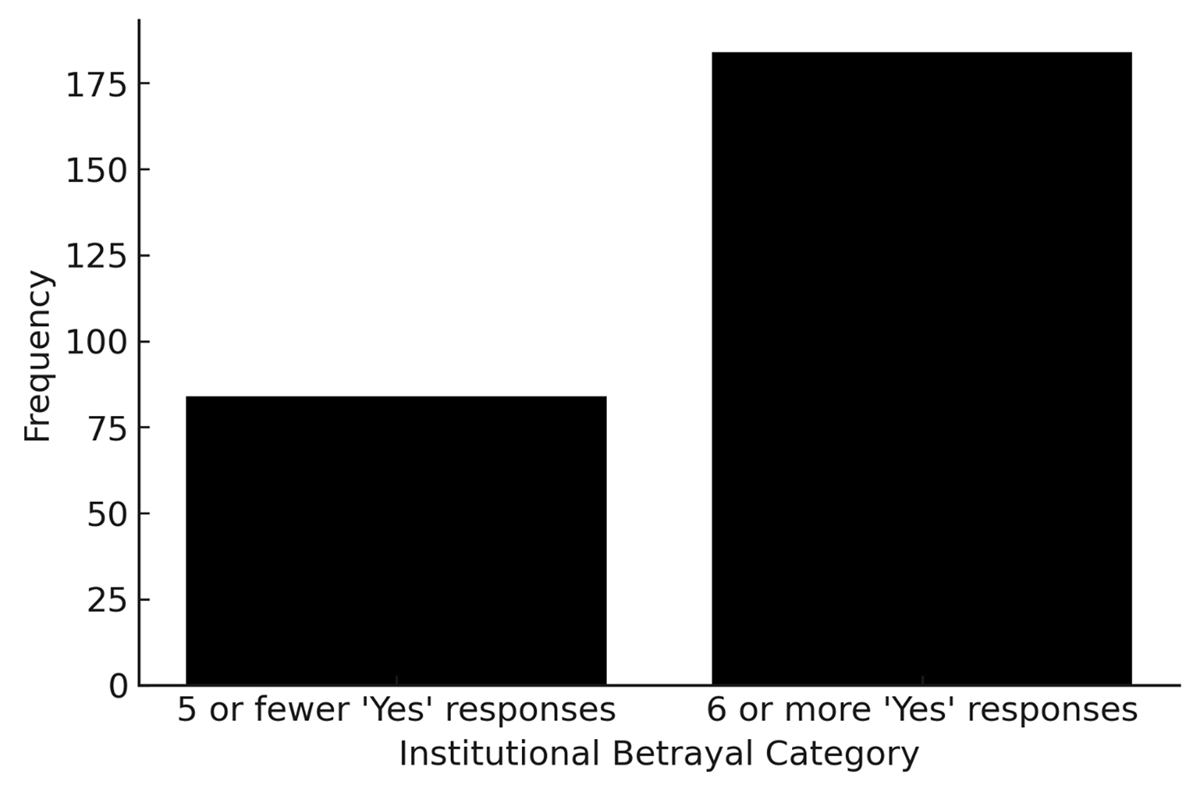
Figure 1
Distribution of Institutional Betrayal Scores.
Note. Frequency of participants who reported 5 or fewer vs. 6 or more “Yes” responses to institutional betrayal items.
Table 3
Percentage of “Yes” Responses to IBQ2-M Items Among Veterans (N = 269).
| ITEM | DESCRIPTION | n | % |
|---|---|---|---|
| IBQ1 | Current transitional process betrayal | 169 | 62.8% |
| IBQ2 | Failed to prevent challenges | 222 | 82.5% |
| IBQ3 | Difficulties seemed common/normal | 213 | 79.5% |
| IBQ4 | Difficulties more likely | 215 | 79.9% |
| IBQ5 | Difficult to report challenges | 211 | 78.7% |
| IBQ6 | Inadequate support | 205 | 76.5% |
| IBQ7 | Mishandled experience | 111 | 41.4% |
| IBQ8 | Covered up challenges | 144 | 53.7% |
| IBQ9 | Denied/minimized experiences | 154 | 57.7% |
| IBQ10 | Punished for reporting | 39 | 14.6% |
| IBQ11 | Affected reputation | 78 | 29.1% |
| IBQ12 | No longer felt valued | 207 | 77.5% |
| IBQ13 | Dissuaded from re-enlisting | 191 | 71.5% |
[i] Note. N varies slightly due to minimal missing data (267–269). Percentages reflect the proportion of “Yes” responses to each item of the IBQ-2-M.
Hypothesis Testing
To examine the study’s primary hypothesis, a chi-square (χ2) test of independence was used to evaluate the relationship between veterans’ perceptions of inadequate military transition support and their reported experiences of IB. The analysis was based on the IBQ11-halves variable, where IB was defined as six or more affirmative responses to 11 core items from the IBQ.2-M (excluding IBQ1 and IBQ6). Assumptions for the test were satisfied: all expected cell frequencies exceeded five, and observations were independent. The results indicated a statistically significant association between perceived inadequate transition support and IB, χ2(1, N = 268) = 47.76, p < .001, with a moderate effect size (ϕ = –.422). This suggests that veterans who felt inadequately supported for civilian transition were substantially more likely to report higher levels of IB (Table 4, Figure 2). Specifically, 79.5% (n = 163) of participants who reported inadequate transitional support endorsed six or more betrayal items, compared to just 33.3% (n = 21) of those who felt adequately supported. Conversely, 66.7% (n = 42) of adequately supported participants fell below the betrayal threshold, compared to 20.5% (n = 42) of those who reported feeling inadequately supported. Standardized residuals further confirmed the strength of the association. A notably high positive residual (z = 5.0) appeared in the cell representing low betrayal among those who did not perceive inadequate support, while a large negative residual (z = –3.4) was observed for high betrayal among the same group. All but one residual showed statistically meaningful deviation from expected values, underscoring the robustness of the relationship between perceived support and IB.
Table 4
Cross-tabulation Perceived Military Transition Support and Institutional Betrayal Groups.
| IBQ HALVES | INADEQUATELY SUPPORTED? YES | INADEQUATELY SUPPORTED? NO | TOTAL |
|---|---|---|---|
| 5 or fewer ‘Yes’ responses | |||
| Count | 42 | 42 | 84 |
| Expected Count | 64.3 | 19.7 | 84.0 |
| % within IBQ6 | 20.5% | 66.7% | 31.3% |
| Standardized Residual | –2.8 | 5.0 | |
| 6 or more ‘Yes’ responses | |||
| Count | 163 | 21 | 184 |
| Expected Count | 140.7 | 43.3 | 184.0 |
| % within IBQ6 | 79.5% | 33.3% | 68.7% |
| Standardized Residual | 1.9 | –3.4 | |
| Total | |||
| Count | 205 | 63 | 268 |
| Expected Count | 205.0 | 63.0 | 268.0 |
| % within IBQ6 | 100.0% | 100.0% | 100.0% |
[i] Note. Perceived military support was assessed based on participant responses to IBQ6, which addressed the inadequacy of military support for the transition process. Institutional betrayal groups were determined by the number of “Yes” responses to 11 core items from the IBQ.2-M (excluding IBQ1 and IBQ6), with a total sample of 268 participants.
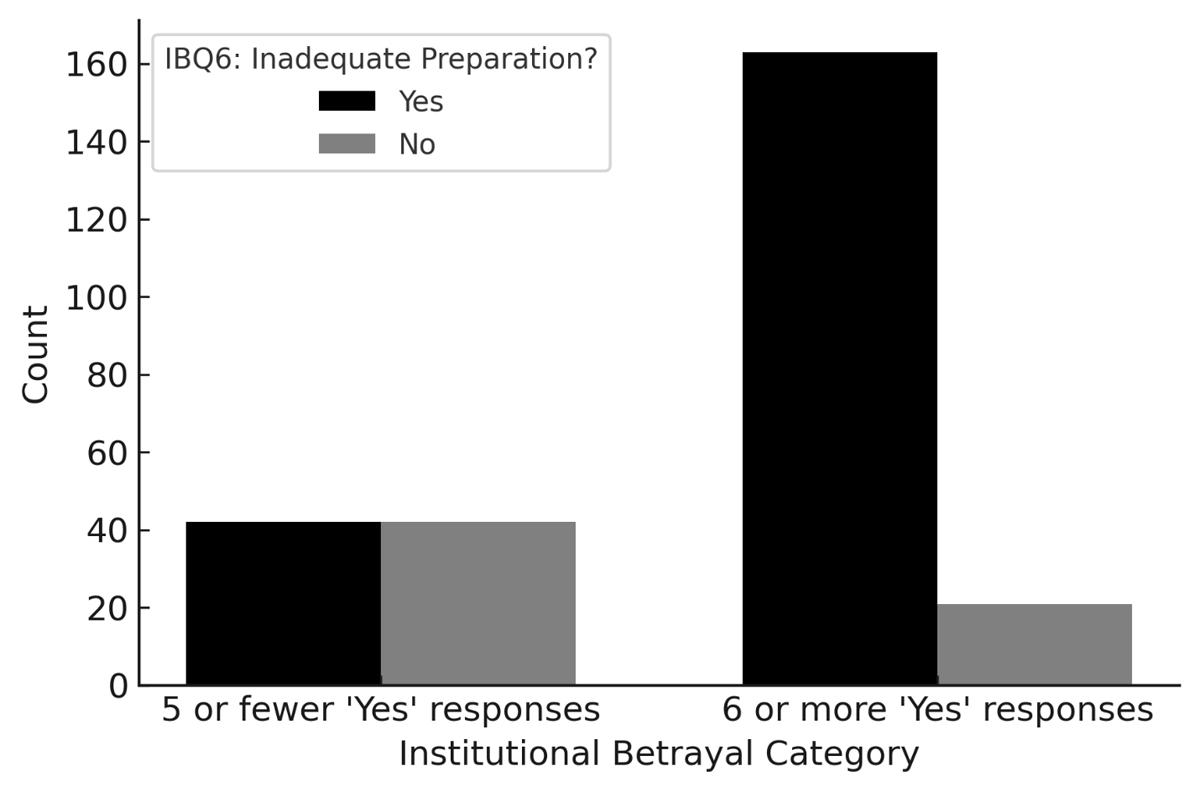
Figure 2
Institutional Betrayal by Perceived Inadequacy of Military Support.
Note. This figure illustrates the association between institutional betrayal scores and perceptions of military preparation adequacy.
Bivariate Associations
Bivariate chi-square analyses were conducted between IBQ6 and individual IBQ items (excluding IBQ1 and IBQ6). Almost all associations were significant at p < .001, except IBQ10 (χ2(1) = 0.03, p = .873) and the Likert-scale item (IBQ14). The strongest relationships were found for IBQ2 (χ2(1, N = 268) = 75.59, p < .001, ϕ = .531), which asked, “Do you feel that the military failed to take proactive steps to prevent challenges during your transition out of service?” Additionally, a strong relationship was found for IBQ5 (χ2(1, N = 267) = 62.92, p < .001, ϕ = .485), which inquired, “Did the military make it difficult for you to report challenges or concerns related to your transition?” This relevant correlation indicates that perceived inadequate support is positively associated with specific betrayal experiences, particularly those involving neglect and difficulty reporting.
Demographic Associations
Chi-square (χ2) tests between perceived adequacy of support (IBQ6) and demographic variables of age (p = .953), education (p = .563), marital status (p = .926), service era (p > .20), and military branch (p = .103) demonstrated no significant associations (p > .05). However, a marginal association emerged regarding receipt of transitional resources (χ2(1) = 3.61, p = .057), suggesting that veterans who did not receive any listed services were slightly more likely to report inadequate preparation (81.8% vs. 73.7%).
Transitional Resources
Of 269 participants, 265 (98.5%) provided valid responses regarding transition resource use. The most commonly accessed service was TAP; used by 57.4% (n = 152) of participants. However, 33.6% (n = 89) reported receiving none of the five listed services. Other programs, such as Post-9/11 Military2VA (7.2%), Solid Start (1.1%), and the VA Liaison Program (0.8%), had notably low engagement (Table 5).
Table 5
Frequencies and Percentages of Resources Received from Military (N = 269).
| RESOURCE RECEIVED | FREQUENCY | VALID PERCENT | CUMULATIVE % |
|---|---|---|---|
| Solid Start | 3 | 1.1% | 1.1% |
| Post-9/11 Military2VA | 19 | 7.2% | 8.3% |
| VA Liaison Program | 2 | 0.8% | 9.1% |
| Transition Assistance Program (TAP) | 152 | 57.4% | 66.4% |
| No, I did not receive or access any of these services during transition | 89 | 33.6% | 100.0% |
| Total (Valid) | 265 | 100.0% | — |
| Missing (System) | 4 | — | — |
| Total (All Cases) | 269 | — | — |
[i] Note. Valid percentages are based on 265 participants who provided responses. Four cases with missing data were excluded from the valid percentage calculations.
Discussion
This study’s primary hypothesis, that perceived inadequate military support for military-to-civilian transition is associated with higher levels of IB, was supported. Veterans who reported feeling inadequately supported were over twice as likely to experience high IB compared to those who felt adequately supported. Internal consistency of the IBQ.2-M was strong (α = .84), and follow-up analyses confirmed that inadequate support was significantly tied to nearly all core betrayal indicators. Demographic characteristics such as age, gender, ethnicity, marital status, education level, military branch, and service era were not found to be significantly associated with perceived inadequate support. This finding suggests that perceived IB during military-to-civilian transition may not be confined to any one subgroup of people, and that it is a widespread and general experience that transcends across service backgrounds and ethnic identities.
Much of the existing research on military IB has focused on MST and its mental health consequences (Andresen et al., 2019; Monteith et al., 2022; Monteith et al., 2016; Smith & Freyd, 2013). Other studies have explored post-service psychological conditions such as PTSD, anxiety, and depression during the reintegration process (Edwards et al., 2023; Haller et al., 2016; Rivers et al., 2013; Sayer et al., 2010). The current study fills a gap by directly examining whether perceived inadequate transition support is associated with experiences of IB. The findings revealed a statistically significant association between perceived inadequate support and experiences of IB, suggesting that insufficient transitional assistance may be meaningfully related to veterans’ perceptions of betrayal during the military-to-civilian transition; however, due to the cross-sectional design, causality cannot be inferred. This highlights the need to view transitional support not just as a bureaucratic task, but as a trust-preserving function of the military institution. The implications are substantial, given that approximately 200,000 service members transition to civilian life each year (GAO, 2024).
Acknowledging Institutional Betrayal
The finding that 79.5% (n = 163) of participants reported six or more affirmative answers for betrayal items on the IBQ.2-M reveals a troubling pattern that most veterans felt abandoned by the military they loyally served. In contrast, only 33.3% (n = 21) of those perceiving adequate support reported high betrayal, while 66.7% (n = 42) of participants who felt adequately supported reported low betrayal, suggesting preparation acts as a buffer against mistrust. The moderate association (ϕ = –.422) highlights the link between perceived institutional neglect and veterans’ experiences of the transition process. These results indicate that veterans’ perceptions of inadequate transitional support reflect more than just administrative shortcomings—they may foster a deeper sense of betrayal and erosion of trust in the military as an institution.
Although only a portion of veterans explicitly identified their transition experience as IB, a much larger number endorsed multiple indicators of institutional harm. This pattern suggests that veterans may absorb the impact of institutional failures without labeling them as betrayal—at least not initially. One explanation for this disconnect may relate to the survey structure. Since the direct question about IB appeared at the start of the questionnaire, participants may not have yet reflected on the nuances of their experience. Had it appeared later, after completing the betrayal-related items, participants might have been more inclined to recognize and name their experience accordingly. Furthermore, the analysis showed that perceived inadequate support was strongly linked to nearly every betrayal item except IBQ10, which asked whether veterans were punished for raising concerns about their transition. This outlier may reflect that transitioning service members do not always view transitional program quality as something to formally report. Alternatively, it may point to a broader trend in which veterans are more attuned to institutional neglect, invalidation, or systemic oversight than to overt punitive actions—particularly in the context of transitioning out of military service.
Recruitment Challenges
Recruitment difficulties provided additional insight into the impact of institutional mistrust. Of the initial pool, 131 participants prematurely exited the survey after encountering a comprehensive description of IB. Informal feedback suggested that some veterans were skeptical about the study’s affiliation, despite clear statements that it was unaffiliated with the VA or Department of Defense. Engagement dramatically improved after the study was promoted on a well-known veteran podcast, suggesting that trust and community endorsement are key factors in accessing this population. The hesitance to participate in betrayal-related research itself underscores the depth of disillusionment some veterans may carry, reinforcing the experiential reality of IB as more than just an academic concept.
Demographics and Broader Implications
No significant associations were found between perceived transitional support and variables such as age, gender, race, marital status, education, military branch, or service era. This consistency across demographic groups suggests that perceptions of betrayal are not isolated to specific subpopulations but may be a systemic issue within the military’s transitional processes. The finding supports the argument for broad-based improvements in separation programming rather than relying solely on targeted interventions for specific groups. There was a slight trend suggesting that lack of access to transition services may be linked to perceptions of inadequate support (81.8% vs. 73.7%), further indicating that availability and visibility of support resources can influence how service members evaluate their experiences with transition. While TAP was the most commonly accessed service, only 57.4% (n = 152) of participants reported utilizing it, and 33.6% (n = 89) reported receiving no support services, illuminating the gap in the current provision of military-to-civilian support.
Clinical Implications and Interventions
From a clinical perspective, these results call for the integration of betrayal-informed care into mental health services for veterans. Veterans frequently face losses related to identity, belonging, and meaning during the reintegration process (Andresen et al., 2019; Bloeser et al., 2021). Clinicians can play a crucial role by helping clients contextualize and name their experiences—particularly those that reflect IB. Validation of these experiences within therapeutic contexts may help reduce shame and promote healing. Considering that nearly one-third of participants reported receiving no formal transition support services, expanding access to support remains an urgent priority. Therapists can incorporate psychoeducation about institutional dynamics, trust repair, and available resources to help veterans process feelings of abandonment and restore agency in their post-military lives.
Given that IB can fracture foundational trust, therapeutic work should also address how these experiences affect veterans’ interpersonal lives. Trust injuries sustained at the institutional level can spill over into relationships with partners, friends, and family. Therapies grounded in attachment theory (e.g., Emotionally Focused Therapy [EFT]) are especially well-suited to address betrayal-related wounds. These models can help veterans understand how institutional harm may distort their relational expectations and offer tools for rebuilding emotional safety and secure attachment. Therapists should also educate clients on how betrayal trauma can influence communication patterns and intimacy. By naming the difference between institutional and personal betrayal, clinicians can help veterans reduce projection and self-isolation, thereby strengthening their capacity for connection.
Group Therapy and Policy Reforms
Group therapy offers a powerful modality for veterans to process IB in a communal setting. Research supports group-based interventions for their effectiveness in promoting reintegration, reducing isolation, and fostering shared meaning-making (Pebole et al., 2024; Yalom, 1975). Group settings create opportunities for peer validation, trust-building, and collective grieving. Structured sessions that focus on betrayal, trust repair, and post-military identity development can normalize experiences and reduce stigma. Veterans often benefit from hearing others articulate similar struggles, which can counter feelings of alienation.
Policy reforms are essential to address the systemic dimensions of perceived betrayal. All branches of the military should implement standardized, comprehensive transition programs that include psychoeducation about feelings of loss, abandonment, and institutional betrayal, which should be addressed during the official separation process. Educational components should explicitly name IB as a potential emotional response, giving veterans the language and validation to process their experiences. Systematic follow-up should also be mandated at three, six, and twelve months post-discharge to allow for early intervention and continued support. Transitioning service members should be given the opportunity to provide anonymous feedback on the adequacy and impact of their transition support services, and leadership evaluations should be tied to these outcomes. To improve visibility and accessibility, centralized digital platforms should be created that clearly outline all available resources and transition services. Priority should be given to veterans at higher risk of adverse outcomes such as those with limited social support, younger age, or minority status.
Limitations
This study’s cross-sectional design restricts the ability to determine causation, making it unclear whether feelings of betrayal stem directly from perceived inadequate support or whether veterans who already feel betrayed are more likely to interpret their transitional support as insufficient. Additionally, veterans experiencing psychological distress may be more attuned to institutional shortcomings, complicating the directionality of this relationship. The use of a single self-report instrument introduces the potential for recall bias and subjective interpretation. It is also possible that participants drew on broader experiences of IB—not necessarily limited to their period of transition—when responding affirmatively to the survey items. Regarding recruitment, 131 participants exited the survey after encountering the section that explained the concept of IB. This high attrition rate may reflect discomfort or internal conflict related to labeling their own experience as betrayal. Given the military’s cultural emphasis on loyalty and resilience, some veterans may have found it difficult to identify as having been betrayed, leading them to disengagement. Others may have harbored mistrust about the nature of the study despite clear disclaimers about its independence from the VA or Department of Defense.
Another limitation concerns recruitment methods. Although advertising the study on the Urban Valor podcast improved participation, it may also have introduced bias into the sample. Veterans who already felt betrayed by the military institution may have been more likely to self-select into the study, potentially inflating the prevalence of perceived betrayal. This challenge is not unique to the current study but reflects a broader difficulty in recruiting hard-to-reach populations where reliance on community-based platforms can inadvertently shape sample characteristics. The overrepresentation of Marine Corps veterans within the sample, despite being the smallest active-duty branch, may reflect snowball sampling biases. While this does not negate the findings, it limits generalizability. Future studies may utilize purposive sampling with stratified quotas to ensure proportional representation across branches. No participants in this study identified as members of the U.S. Space Force. Because the Space Force is the newest branch, established in 2019, and the smallest in terms of overall personnel, recruitment channels may not have effectively reached its members. As a result, findings cannot be generalized to Space Force veterans (Congressional Research Service, 2024).
In addition, eligibility for participation was determined by self-report rather than through formal verification methods (e.g., DD-214 documentation), which may have introduced selection bias. Although participants completed a structured screening questionnaire, future studies may improve external validity by incorporating third-party verification platforms such as ID.me or VetVerify to confirm veteran status. A final limitation of this study is that it did not collect demographic data regarding participants’ service status as enlisted personnel or commissioned officers. This distinction is an important variable as the experiences of transition support and perceptions of IB may differ meaningfully between these groups due to differences in training, responsibilities, and access to resources. Although this omission does not invalidate the current findings, it represents an important gap.
Future Research
Future research should include officer versus enlisted status to better capture potential variations in how institutional support, or lack thereof, is perceived across different strata of military service. Future studies that include more diverse and representative samples would be instrumental in improving generalizability. While the sample size was sufficient for the statistical analyses conducted, broader conclusions should be made cautiously due to the limited existing literature on this specific topic of military-to-civilian transition. Investigating specific components of transition programs that contribute to feelings of adequate or inadequate support could inform targeted improvements. Examining the connection between IB and mental health outcomes such as PTSD, anxiety, and depression could deepen our understanding of the psychological impact of perceived institutional neglect. Additionally, future research could experiment with a different survey design by relocating the initial direct question about IB to the end of the instrument; this adjustment would reveal whether item placement influences how participants conceptualize and label their experiences.
It would also be useful to explore whether certain subgroups of veterans are more vulnerable to experiencing or reporting IB. This focus could inform the development of more tailored prevention and intervention strategies. Future research should also include the perspectives of Space Force veterans as the branch matures and as its veteran population grows. Investigating whether Space Force members face unique transition or institutional betrayal experiences, given the distinct mission and organizational culture of the branch, will be important for ensuring the generalizability of findings across the entire U.S. military While this study offers an important step in understanding military IB during transition, continued research is needed to validate these findings across different veteran populations and service contexts to ensure a more comprehensive understanding of this complex issue.
Conclusion
This study found that perceived inadequate military transition support to civilian life is strongly associated with IB among U.S. veterans. The majority of participants reported multiple indicators of betrayal, reinforcing the need to treat military-to-civilian transition not just as an administrative process, but as a critical psychological and relational juncture. These findings call for comprehensive, betrayal-informed transition programs and therapeutic approaches that validate the lived experiences of veterans. Strengthening institutional trust, providing more accessible universal transitional resources, and supporting veterans relationally and communally are all essential for fostering successful transition back into civilian society.
Author Note
This manuscript is based on the original doctoral dissertation conducted by the author. However, the content has been substantially revised, rewritten, and reformatted to ensure originality, avoid plagiarism, and meet the publication standards of the Journal of Veterans Studies.
Acknowledgements
The author extends sincere gratitude to Carrie Petrucci, PhD, Nicole Sabatini Gutierrez, PsyD, and Manijeh Daneshpour, PhD, whose guidance, encouragement, and thoughtful feedback were invaluable throughout this research process.
Competing Interests
The author has no competing interests to declare.