
Veterans are exposed to a disproportionate number of traumatic events (approximately 94%; American Psychiatric Association [APA], 2000) compared to their civilian counterparts (69%; Resnick et al., 1993). Along these lines, research suggests a dose response relationship between increased exposure to traumatic events and posttraumatic stress disorder (PTSD) symptom severity (Kube et al., 2023). While veterans are more likely to be exposed to more traumatic events, a limited amount are diagnosed with PTSD (approximately 3% to 28%; National Center for PTSD, 2022). Among those diagnosed with PTSD, even fewer seek support as research suggests less than half seek trauma-specific treatment (Blais & Renshaw, 2013; Damron-Rodriguez et al., 2004; Department of Veterans Affairs, 2022).
Of those who do seek treatment, 68% of the veterans drop out (Amsalem et al., 2022). Moreover, dropout rates are significantly elevated among treatment-seeking veterans across various trauma-specific treatment modalities (e.g., cognitive processing therapy, prolonged exposure, mindfulness-based therapy, group therapy) (Fredman et al., 2020; Kracen et al., 2013; Polusny et al., 2015). Veterans diagnosed with major depressive disorder (MDD) and who underwent exposure techniques (i.e., prolonged exposure and cognitive processing therapy) were at a highlighter likelihood of attrition (Amsalem et al., 2022). Many veterans are hesitant to engage in therapy for fear of being misunderstood, guilt of prior actions, and military culture (Kracen et al., 2013). Indeed, most veterans seek help from para- and non-mental health professionals (Nazarov et al., 2020). These numbers exemplify a bigger problem at hand: Why are veterans not seeking treatment, and when they do, why are they leaving? Thus, it is imperative that these veterans seek and stay in mental health treatment through engaging in help-seeking behavior.
Two constructs may be associated with help-seeking behavior among veterans: trauma-related guilt (TRG) and mental-health self-stigma (MHSS). TRG in veterans is defined as a failure to prevent harm to others or causing harm to others (Kubany & Watson, 2003; Lee et al., 2001). Kubany and Watson (2003) say it consists of: (1) hindsight bias or interpreting that the trauma was foreseeable and therefore preventable, (2) perceived responsibility for a negative outcome, (3) perceived violation of values, and (4) perceived insufficient justification for actions taken. Combat veterans are at a higher risk for developing TRG because of the notions of wrongdoing and responsibility in combat-related environments (Kubany et al., 1996; Kubany & Watson, 2003). Thus, it is hypothesized that the number of traumatic events a veteran experiences would increase the TRG. Veterans exposed to traumatic events are also predisposed to irrational thinking biases similar to those who experience guilty feelings, such as exaggerating one’s role in the event (Kubany & Watson, 2003). These guilty feelings are hypothesized in part due to moral injury. Moral injury is characterized by acting in ways against one’s moral values, a concept very common in combat; acting against one’s morals can cause an increase of guilt as the combat veteran can feel that they either did something or failed to do something against their morals (Litz et al., 2009; Norman et al., 2022).
TRG tends to leave veterans feeling like they deserve the consequences resulting from their trauma (Kubany et al., 1996). Military culture tends to blame the individual for developing a mental illness—that the individual caused his disorder (Dickstein et al., 2010; Mittal et al., 2013). Since many veterans do not feel like they deserve treatment due to TRG associated with war, PTSD symptom severity may increase with increased TRG (Bannister et al., 2019; Kubany et al., 1996). PTSD distress could be exacerbated from TRG caused by a trauma-related memory in which an individual identifies that they caused the traumatic event (Bannister et al., 2019; Kachadourian et al., 2021). TRG is also associated with higher levels of PTSD among active duty populations (McLean et al., 2019). TRG has been suggested to be a barrier to help-seeking behavior due to veterans’ worry that treatment could confirm their responsibility for the trauma (Hundt et al., 2015). Utilizing PTSD treatment could be an effective way of reducing TRG among active duty populations (McLean et al., 2019). A recent study has also shown that targeting TRG in an intervention, Trauma-Informed Guilt Reduction (TrIGR), can thereby significantly reduce PTSD symptoms (Norman et al., 2022). TrIGR is a six-session psychotherapy that targets guilt, moral injury, and shame in veterans that had been deployed to Afghanistan and Iraq. Sessions one and two focus on non-adaptive guilt and shame. Sessions three and four focus on cognitive restructuring beliefs such as hindsight bias, and sessions five and six focus on adaptive ways to show values that are not through guilt. Targeting guilty feelings and validating them versus trying to convince the veterans that guilt is inaccurate through TrIGR was able to continuously reduce PTSD symptoms longitudinally for six months during the study, suggesting that TRG may have a pivotal role in exacerbating and maintaining PTSD symptomatology (Norman et al., 2022). Importantly, targeting different types of these cognitions is pivotal in TRG reduction.
MHSS is a thought process that veterans are at a heightened risk for; the individual stigmatizes themselves as their cognitions change (e.g., as the guilt increases) (Dickstein et al., 2010). MHSS is defined as self-concurrence, stereotype agreement, and stereotype awareness (Corrigan et al., 2006). People initially discriminate against themselves from a hypothesized mechanism in Corrigan et al. (2006). People initially become aware of a general negative belief through their culture, or stereotype awareness. Next, an individual may agree with the stereotype, or stereotype agreement, and, eventually, they internalize that belief unto themselves, or the thought becomes self-concurrent. An individual’s self-stigma becomes harmful when they have self-concurrence, or integrate societal cultural beliefs onto themselves, with the belief (Corrigan et al., 2006). This pattern is also seen within veterans (Vogt et al., 2014). When an individual feels guilty due to TRG mixed with feeling concurrent with the stigma of having a mental illness (i.e., veterans with PTSD), they internalize stigma and experience diminished self-efficacy (i.e., seeking mental health treatment) (Corrigan et al., 2006; Stecker et al., 2013). We hypothesize this internalized stigma could exacerbate mental health symptomatology and psychological wellbeing. This combination can lead to a “why try” effect, where higher MHSS results in lower drive to help themselves—why do this if it won’t help? (Corrigan et al., 2015).
Self-stigma, or internalized stigma, is shown to both worsen PTSD symptoms and be a barrier to treatment (Bonfils et al., 2018; Britt et al., 2015). In a veteran sample, those that felt internalized stigma felt more alienated, which exacerbated their PTSD symptomatology (Bonfils et al., 2018). In fact, veterans who had a diagnosed mental health condition had much higher MHSS (Britt et al., 2015). It is hypothesized that military culture could also increase MHSS through its values of toughness and competence (Vogt et al., 2014). As stated previously, much of the guilt and shame associated with MHSS refusal of treatment because they feel that they deserve their suffering (Sullivan & Starnino, 2018).
Britt et al. (2015) also illustrated that those with higher self-stigma have a higher dropout rate of mental health treatment or did not seek mental health treatment at all. MHSS is suggested to be a barrier to even seeking mental health treatment (Vogt et al., 2014). Veterans with MHSS had a 22% higher likelihood of dropping out of treatment. Typically, veterans are supposed to “tough it out” as they are tough, mission-focused, and self-reliant; further, they are viewed as weaker if they seek help, making self-stigma a major barrier to the veterans’ help seeking (Dickstein et al., 2010; Vogt et al., 2014). Only veterans who had positive beliefs about their mental health condition and mental health treatment, high self-reliance, and low operational barriers were shown to actually seek treatment in the first place (Britt et al., 2016). Thus, MHSS could decrease help-seeking behaviors.
Both TRG and MHSS are shown to be related to each other and relevant to both the intensity of PTSD symptoms and the barriers to help-seeking behavior among veterans (McDermott et al., 2017). TRG and MHSS are shown to be moderately associated with each other and have strong positive correlations with both help-seeking behavior and PTSD severity (Bannister et al., 2019; Britt et al., 2015). Ninety percent of military members view that mental health treatment would help; however, 70% do not seek it (Military Health System, 2025). Furthermore, Gerwell (2018) illustrate that veterans with PTSD do display higher treatment-seeking stigma beliefs than adults without trauma. Though not directly tested, PTSD symptomatology severity was also suspected to be related to self-stigma and treatment-seeking behavior among veterans (Gerwell, 2018). Thus, higher likelihood of PTSD and the number of traumatic events a veteran experiences could decrease help-seeking behaviors as well. Understanding underlying associations of reductions in help-seeking behaviors is necessary to increase adherence to evidence-based treatments. As seen, TRG and MHSS may subsequently decrease help-seeking behaviors among veterans.
Dickstein et al. (2010) highlight studies that address what the public thinks of people with mental illness. Some literature suggests that psychoeducation about self-stigma could assist in changing veterans’ views of themselves if they have mental health diagnoses (Yanos et al., 2015). Other literature suggests that utilizing group therapy focused on psychoeducation about their disorder has been effective in reducing both MHSS and treatment-seeking barriers with people with mental health conditions, primarily with a first psychotic episode (McCay et al., 2007; Yanos et al., 2015). Utilizing techniques such as motivational interviewing was shown to help reduce self-stigma among people recently diagnosed with schizophrenia (Fung et al., 2011). A telephone-based intervention utilizing motivational interviewing was able to increase treatment adherence within veteran populations (Seal et al., 2012).
Cornish et al. (2019) highlighted an intervention looking to increase help-seeking behaviors among veterans. Participants were given either an educational video or a pamphlet and brochure about help-seeking behaviors from different military members, focusing on the courage to seek professional help. Results indicated that the intervention was able to reduce self-stigma in veterans; however, some veterans did not engage well with the study materials. Thus, finding more tailored interventions for veterans is imperative to increase adherence and attendance to mental health interventions.
MHSS has been shown to interact with TRG among deployed veterans (McDermott et al., 2017). McDermott et al. (2017) highlight that these interactions could be barriers in help-seeking behavior among veterans. Furthermore, future research should attempt to identify a temporal pattern among the relationship between MHSS and TRG (McDermott et al., 2017). High levels of TRG have been shown to lead to acts of self-punishment, such as not engaging in help-seeking behaviors (Fisher & Exline, 2010). Thus, if MHSS and TRG may interact to be barriers to help-seeking behaviors, there may be a temporal association between the variables that could lead to reduced help-seeking behavior among veterans.
The Current Study
While the association between TRG and PTSD symptoms has been examined (Bryan et al., 2013), the current study explores how TRG and other cognitive mechanisms (e.g., MHSS) may impact treatment seeking among a population at higher risk for PTSD. Along these lines, previous research has examined help-seeking behavior among veterans; however, no studies to the authors’ knowledge have identified potential mediators nor directionality of the mediators as to why many veterans may not engage in help-seeking behavior. Prior studies have identified the importance of identifying these patterns (Britt et al., 2015; Bryan et al., 2013; McDermott et al., 2017).
The current study sought to find cross-sectional associations between the number of traumatic events a veteran experiences, TRG, MHSS, and help-seeking behaviors among veterans, as well as directionality among the different variables (i.e., if TRG or MHSS influence each other). Thus, the study tests four different hypotheses:
H1: An increase of traumatic events will be associated with an increase in both TRG and MHSS.
H2: Increased TRG will be associated with a decrease in help-seeking behaviors in veterans.
H3: Increased MHSS will be associated with a decrease in help-seeking behaviors in veterans.
H4: Increased TRG and MHSS together will have a significant and larger interaction to predict help-seeking behaviors than TRG and MHSS individually.
The hypothesized relationships are depicted in Figure 1.
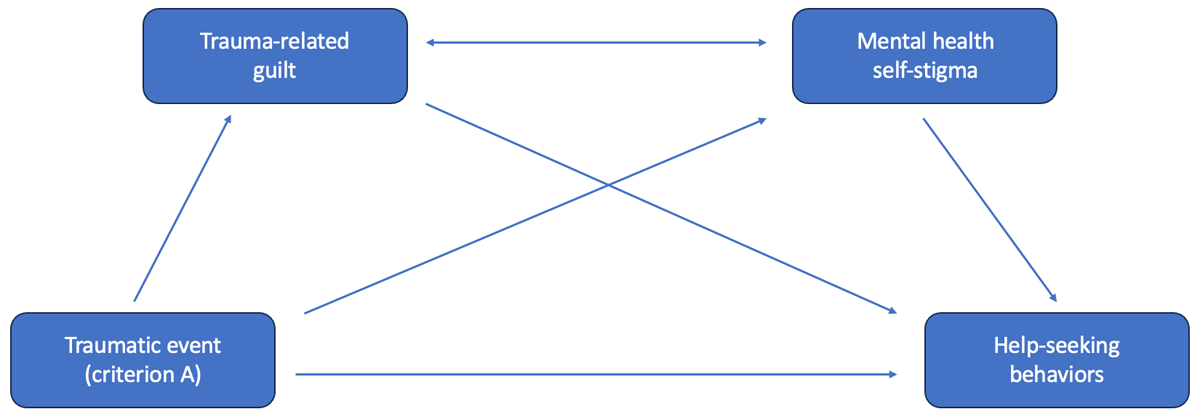
Figure 1
Hypothesized Mechanism of Help-Seeking Behaviors.
Method
Participants and Procedure
All data collection and informed consent procedures were approved by the IRB committee of Hofstra University, and all participants were consented. Participants were combat veterans (N = 211), mean age (M = 33.02, SD = 8.05) and recruited from Amazon Mechanical Turk (MTurk). Eligibility criteria for the study included being over the age of 18, having a confirmed veteran status, being specifically involved in a military conflict (to confirm they are a combat veteran), and having indicated they have experienced a traumatic event. In addition, participants were not included in the study if they did not get three out of five questions on the Veteran Status Questionnaire correct (Lynn & Morgan, 2016). Eligible participants completed an online survey assessing demographics, trauma exposure, health-seeking behaviors, PTSD symptoms, TRG, and MHSS. Upon completion, participants were compensated $5 for their time.
Measures
Demographics
Demographics were assessed via a brief questionnaire assessing age, gender, race, ethnicity, veteran status, socioeconomic status, education, military branch of service, and total years in military service.
Prior Mental Health Seeking
Engagement in prior help-seeking behaviors was assessed using a list of screening questions on the demographic questionnaire. Participants were asked about past utilization of therapy through the questions: “How many times in the past year have you seen a psychiatrist (mental health person who can prescribe medicine)?” and “How many times in the past year have you talked with a psychologist, counselor, or any other mental health professional?” (Graziano & Elbogen, 2017, p. 5). Scores were computed by the sum of how many times participants endorsed seeing a practitioner, creating a variable of the total number of mental health visits a veteran had.
Veteran Status
The Veteran Screening Questionnaire (Lynn, 2014) is a five-item questionnaire consisting of a variety of military service topics regarding rank and prior experience to screen out nonveterans. In order to be included in the study, veterans should be able to answer at least three out of five questions correctly as compared to nonveterans (Lynn & Morgan, 2016). This questionnaire was utilized to differentiate between veteran and civilian answers.
TRG
The Trauma-Related Guilt Inventory (TRGI; (Kubany et al., 1996) is a 32-item trauma event-focused measure assessing TRG among trauma survivors. It encompasses three subscales: global guilt, distress, and guilt cognitions. The questions are scored zero to four (0 = not at all true to 4 = extremely true). The TRGI is a well-validated and reliable measure that has also been validated among veteran populations. The TRGI has a high internal validity among all subscales (α = 0.94). Test-retest reliability over a two-week period was strong (r = .86) (Kubany et al., 1996). Total TRG is calculated by totaling the three subscales: global guilt (four items), guilt cognitions (22 items), and distress (six items). To further identify other types of guilt, guilt cognitions further divide into three subscales: wrongdoing (five items), lack of justification (four items), and hindsight-bias/responsibility (seven items). These scores are totaled to find the total TRG that a person experiences (Herbert et al., 2020); higher scores represent higher TRG. This questionnaire was utilized to understand TRG severity among veterans.
PTSD
The PTSD Checklist for the DSM-5 (PCL-5; Blevins et al., 2015) is a 20-item survey that assesses Criterion B through E in the DSM-5. It is rated on a Likert scale from zero to four (0 = not at all to 4 = extremely) for symptoms aligning with the DSM-5 diagnosis of PTSD. Higher scores correspond with higher PTSD symptom severity. A PCL-5 score of 31–33 was found to detect PTSD cases according to PCL-5 and DSM-5 scoring criteria. The PCL-5 has been validated in veterans. It has high internal reliability (α = 0.94) and high test-retest reliability among a two-week period (r = 0.85) (Weathers et al., 2013); higher scores represent higher PTSD symptom severity. This questionnaire was utilized to assess PTSD symptoms.
Trauma Exposure
The Life Events Checklist for the DSM-5 (LEC; Weathers et al., 2013) is a 17-item checklist that assesses the number and the types of traumatic events a survivor has experienced. Higher scores represent higher traumatic exposures. The LEC also shows associations between increased traumatic event exposure and higher PTSD symptom severity. It captures Criterion A in the DSM-5. It also has good test-retest reliability among a one-month period (r = 0.74, 1-month interval) (Weathers et al., 2013). This questionnaire was utilized to both capture types of traumatic events that may have occurred within the military and outside of combat and the total number of traumatic events an individual had experienced. The number of traumatic events was calculated through summing any traumatic event that an individual indicated on the LEC, indicated to be the most reliable form of scoring (Weis et al., 2022).
Help-Seeking Behaviors
The Inventory of Attitudes Toward Seeking Mental Health Services Scale (IASMHS; Mackenzie et al., 2004) is a 24-item survey that has people rate their attitudes based on a five-point Likert scale (0 = disagree to 4 = agree). A sample measure is “…there are experiences in my life I would discuss about with anyone” (p. 2435). It contains three subscales: The Help-Seeking Propensity Subscale, The Psychological Openness Subscale, and the Indifference to Stigma Subscale. The measure has acceptable internal consistency (α = .85) (Mackenzie et al., 2004; Shulman et al., 2019). It has shown excellent test-retest reliability over a two-week period (r = 0.90). It has also demonstrated temporal stability on total score and all subscales, ranging from r = 0.64 to r = 0.91 (Mackenzie et al., 2004). These scores are added to indicate the overall attitudes towards help-seeking behaviors (Mackenzie et al., 2004). Lower scores on the IASMHS represent lower likelihood of seeking mental health services (Gerwell, 2018). This questionnaire was utilized to measure help-seeking behaviors among veterans.
Self-Stigma of Mental Illness
The Self-Stigma of Mental Illness Scale (SSMIS; Corrigan et al., 2006) is a 29-item self-report measure that measures MHSS through various self-identifying questions. It produces a general self-stigma score through summing all items and a score for each subscale by summing their respective items: stereotype awareness, stereotype agreement, self-concurrence, and self-esteem decrement. Stereotype awareness is whether a person is aware of general negative beliefs about mental illness in their own culture. Stereotype agreement is whether people agree with the stereotypes perceived in their culture. Self-concurrence is defined as “…people believe that culturally internalized beliefs in fact apply to them” (p. 876). Lastly, self-esteem decrement is when someone’s self-esteem is diminished due to consistency with the negative belief. Higher scores on either end of a one- to nine-point Likert scale (1 = I strongly disagree to 9 = I strongly agree) represent more or less stigma against people with mental illness. Higher scores indicated higher rates of MHSS. A sample item for stereotype agreement is, “I think the public believes most people with mental illness: (1) will not recover or get better, (2) are unpredictable, (3) cannot be trusted…” (p. 877). The SSMIS has demonstrated a strong test-retest reliability over a two-week period (r = 0.80). The SSMIS has strong internal consistency (α = 0.87) (Corrigan et al., 2006).
Procedure
Study staff received Institutional Review Board approval from Hofstra University. In its entirety, the questionnaire took participants, on average, 60 minutes to complete on MTurk. The sample consisting of (N = 392) participants was recruited from MTurk. A total of (n = 211) participants were included in the analyses. Compensation was $5 per participant for a fully completed questionnaire. The study was advertised through MTurk and had simple instructions with the compensation and length of time it will take to complete.
Participants were informed about the purpose of the study and had to acknowledge that they read the entire consent form. Next, the participants completed the demographics questionnaire, followed by the Veteran Screening Questionnaire as outlined by Lynn (2014). The Veteran Screening Questionnaire helped assess who is a veteran and who is not.
After completion of the Veteran Screening Questionnaire, participants completed the LEC and PCL-5. These questionnaires helped determine if the participant had likely PTSD and what the specific traumatic events were for the individual as well as the number of events a person had experienced. Lastly, the participant completed the TRGI, SSMIS, and IASMHS. These questionnaires helped determine the amount of TRG, MHSS, and treatment-seeking behaviors that the individual engaged with. To test for attention, throughout the questionnaire there were attention questions that consist of: “select yellow if you are paying attention” to make sure that participants were reading through questions and paying attention to what the question was asking.
Data Analysis
Data were analyzed using SPSS Statistics version 29 (IBM Corporation, 2023). Study staff performed all analyses. Respondents that did not meet eligibility requirements (i.e., were under 18, were not a veteran, failed attention checks) and did not answer three out of five questions correctly on the Veteran Status Questionnaire were excluded. If participants tried to answer the questionnaire a second time, the second response was excluded. A participant was also excluded if a participant did not completely fill out a questionnaire, leading to differences between N in some analyses. Prior to conducting the multiple linear regression analyses, normality was assessed by Q-Q plot, assumptions of homoscedasticity and linearity were met, data were normally distributed, autocorrelation via the Durbin-Watson statistic was assessed, and multicollinearity was evaluated.
All multiple linear regression analyses utilized participant demographics (e.g., age, biological sex, race, ethnicity) as covariates to control for the confounding effects they may have on the model. Race (1 = White, 0 = Non-white), biological sex (1 = male, 0 = female), and PTSD likelihood (1 = above 31, 0 = below 31) were entered into analyses as dichotomous variables. PTSD likelihood was changed into a dichotomous variable due to the clinical cutoff (between a 31–33) that has been shown to equate to a high likelihood of the veteran having a PTSD diagnosis (Blevins et al., 2015). A serial mediation analysis was conducted using the PROCESS plug-in (Hayes, 2013) to analyze the interaction of TRG and MHSS in predicting help-seeking behaviors in those that had experienced traumatic events. To assess each predictor’s unique contribution to help-seeking behaviors, semi-partial correlation analyses were also analyzed and multicollinearity was checked via variance inflation factor and tolerance.
Results
Full demographics are reported in Table 1. The average age of participants was (M = 33.02; SD = 8.05). All participants indicated that they were veterans, corroborated through scoring at least a three out of five on the Veteran Status Questionnaire (Lynn, 2014). Most of the participants identified as men (71.1%), identified as white (90%) and are married or in a domestic partnership (87.2%). About 72% of individuals had received a bachelor’s degree. Participants primarily identified as heterosexual, followed by bisexual. A majority of individuals were in the Army (76.8%), followed by the Air Force (10.4%), Navy (3.8%), Marine Corps (2.4%), Coast Guard (1.9%). Demographics are reported in Table 1.
Table 1
Demographic Characteristics of Participants.
| VARIABLE | % |
|---|---|
| Biological sex | |
| Male | 71.1 |
| Female | 28.9 |
| Relationship status | |
| Single | 5.2 |
| In a relationship | 7.6 |
| Married or domestic partnership | 87.2 |
| Race | |
| White | 90 |
| Black or African American | 0.9 |
| Hispanic | 0.9 |
| Asian/Pacific Islander | 3.8 |
| American Indian/Alaskan Native | 4.3 |
| Education | |
| High school degree or equivalent | 1.9 |
| Some college but no degree | 1.9 |
| Associate degree | 0.5 |
| Bachelor’s degree | 71.6 |
| Master’s degree | 22.3 |
| Professional degree | 1.4 |
| Employment status | |
| Employed for wages | 59.2 |
| Self-employed | 23.2 |
| Out of work and looking for work | 0.9 |
| Student | 0.5 |
| Military | 14.7 |
| Retired | 0.9 |
| Yearly income | |
| Less than $20,000 | 2.4 |
| $20,001 to $34,999 | 14.7 |
| $35,000 to $49,999 | 28 |
| $50,000 to $74,999 | 31.3 |
| $75,000 to $99,999 | 21.8 |
| Over $100,000 | 12.3 |
| Sexual orientation | |
| Heterosexual | 63.5 |
| Homosexual | 1.9 |
| Bisexual | 32.2 |
| Prefer not to say | 0.9 |
| Other | 0.5 |
[i] Note. n = 211.
Most had also received some type of psychological services, with the primary services being psychological, psychiatric, and counseling (Table 2).
Table 2
Reported Help-Seeking Behaviors.
| VARIABLE | % |
|---|---|
| Received psychological services | |
| Yes | 62.1 |
| No | 37 |
| Missing | 0.9 |
| Types of psychological service received | |
| Alcohol treatment | 7.6 |
| Counseling | 21.6 |
| Drug treatment | 1.9 |
| Psychiatric | 21.8 |
| Psychological | 34.1 |
Exploratory analyses were conducted to understand the correlation between different subtypes of MHSS, TRG, help-seeking behavior, number of traumatic exposures that a person indicated, and PCL score (Table 3). According to a Q-Q plot, all data are normal.
Table 3
Means and Standard Deviations of Help-Seeking Behaviors, Total Number of Traumatic Events, Subtypes of Trauma-Related Guilt, Posttraumatic Stress Symptoms, and Subtypes of Self-Stigma.
| VARIABLE | n | MEAN | STANDARD DEVIATION |
|---|---|---|---|
| Help seekinga | 211 | 43.2 | 6.7 |
| Number of traumatic eventsb | 211 | 15.8 | 2.3 |
| Trauma-related guiltc | 211 | 66.5 | 10.9 |
| PCL totald | 211 | 50.0 | 15.1 |
| Self-stigma of mental illnesse | 211 | 207.0 | 59.8 |
[i] Notes. aHelp seeking = Total score of the IASMHS. bNumber of traumatic events = sum of traumatic events noted on LEC. cGlobal guilt subscale, distress subscale, and cognitions subscale scores summed through TRGI protocol. dPCL total = total score of PTSD Checklist for DSM-5. eStereotype awareness subscale, stereotype agreement, self-concurrence, and self-esteem decrement are all summed through the SSMIS protocol.
It was hypothesized that the number of traumatic events would be associated with an increase in both TRG and MHSS. A two-tailed Pearson correlation was run to examine the relationship among the three variables. Means and standard deviations are found in Table 3. The Pearson correlation indicated that there was a significant association between the number of traumatic events (LEC) and TRG (r(211) = .16, p = .02) and the number of traumatic events and MHSS (r(211) = .29, p < .001); results are consistent with the hypothesis.
It was hypothesized that an increase in TRG would be associated with a decrease in help-seeking behaviors in veterans through the TRGI scores and the score on the IASMHS (Mackenzie et al., 2004). A two-tailed Pearson correlation indicated that there was a significant correlation between TRGI and IASMHS score (r(211) = –0.29, p < 0.001); results are consistent with the hypothesis. It was hypothesized that an increase in MHSS would be associated with a decrease in help-seeking behaviors in veterans through the SSMIS scores and the score on the IASMHS. A two-tailed Pearson correlation indicated that there was a significant correlation between MHSS and IASMHS score (r(211) = –0.586, p < 0.001); results are consistent with the hypothesis.
A serial mediation analysis was conducted to test H4 that TRG and MHSS together will have a greater effect on help-seeking behaviors than either TRG or MHSS individually. The PROCESS plug-in (Model 6; Hayes, 2013) was used to analyze the interaction of TRG and MHSS in predicting help-seeking behaviors in those that had experienced traumatic events. Using Hayes’s PROCESS model, the authors ran a serial mediation where number of traumatic events (LEC score) (X) influences help-seeking behavior (Y) through TRG (M1) and MHSS (M2). The model was bootstrapped with 5,000 samples to estimate the confidence intervals of indirect effects.
The direct effect between the number of traumatic events (X) and help-seeking behaviors (Y) was not significant (b = –.14, p = 0.41). After adding in the indirect effects of TRG (M1) and MHSS (M2), the direct effect became significant (b = –.45, p < 0.05). The pathway of TRG alone (X → M1) did not significantly mediate the relationship of traumatic events to help-seeking behaviors (b = –0.07, p > .05). The pathway of MHSS alone (X → M2) significantly mediated the relationship of traumatic events to help-seeking behaviors (b = –0.46, p < 0.05). The overall model suggests a significant proportion of variance in help-seeking behavior among veterans (F = 15.8, p < 0.001, R2 = 0.37).
The serial indirect effect through TRG to MHSS was significant (X → M1 → M2 → Y). Path coefficients showed that as the number of traumatic events increased (X), so did the TRG (X → M1) (b = 0.67, p = 0.03) and MHSS (M1 → M2) (b = 5.77, p < 0.001). It is important to note that the mediation effect only accounted for when TRG preceded MHSS, suggesting a directional pathway in which TRG can increase MHSS, which can decrease help-seeking behaviors among veterans. The magnitude of the effect also increased with both variables versus the individual ones. These patterns still hold true when seeing the relationship of TRG and MHSS on the influence of PTSD symptom severity on help-seeking behaviors among veterans (b = –.09, p < 0.05).
Additional Analyses
It is important to note that help-seeking behaviors were moderately to highly significantly correlated with all constructs measured. A multiple linear regression was run to understand if TRG and MHSS significantly predicted help-seeking behaviors (Table 4). The overall model was significant (R2 = 0.35, adjusted R2 = 0.34, F(2, 208) = 56.10, p < .001). Both predictors demonstrated acceptable levels of multicollinearity (TRG: Tolerance = 0.873, VIF = 1.146; Self-Stigma: Tolerance = 0.873, VIF = 1.146).
Table 4
Multiple Regression Analysis Predicting Help-Seeking Behaviors.
| PREDICTOR VARIABLE | B | SE | β | 95% CI FOR B | sr2 | p |
|---|---|---|---|---|---|---|
| Trauma-related guilt | –0.054 | 0.037 | –0.088 | [–0.126, 0.018] | < 0.001 | .143 |
| Self-stigma of mental illness | –0.062 | 0.007 | –0.555 | [–0.076, –0.049] | 0.308 | < .001 |
[i] Notes. B = unstandardized coefficient; SE = standard error; β = standardized beta coefficient; CI = confidence interval; and sr2 = semi-partial squared correlation.
Discussion
The number of traumatic events a veteran experienced significantly predicted both TRG and MHSS. Interestingly, the number of traumatic events did not predict help-seeking behaviors on its own. Importantly, TRG and MHSS significantly affected the relationship between the number of traumatic events and help-seeking behaviors among veterans: an increase of the number of the traumatic events predicted an increase of TRG and MHSS, which predicts a decrease in help-seeking behaviors (Figure 2).
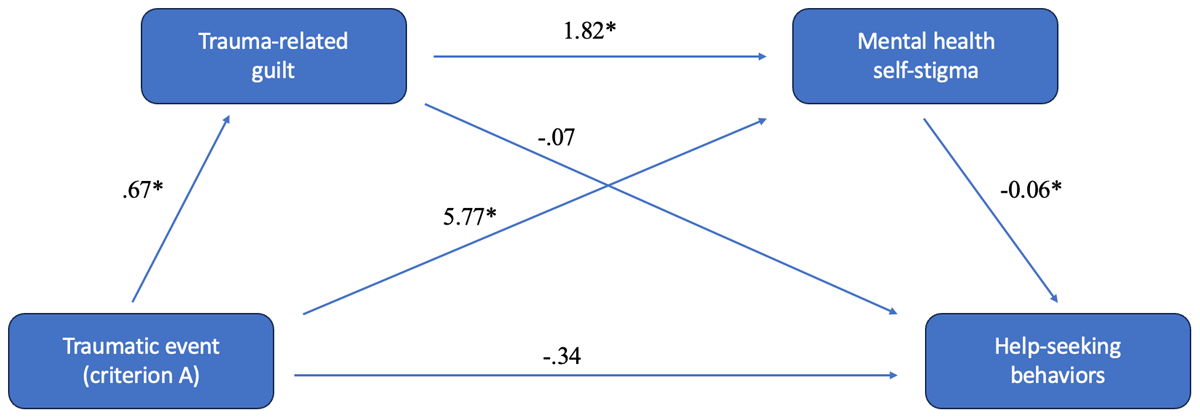
Figure 2
Pathways of Help-Seeking Behaviors.
Notes. Coefficients presented are unstandardized serial mediation coefficients. *p < .05. Indirect relationship 2 = –.34. Indirect relationship 3 = –.07.
This differs from the initial hypothesized mechanism (Figure 1). These results are consistent with current literature that suggest both MHSS and TRG individually could affect help-seeking behaviors among veterans (Bonfils et al., 2018; Britt et al., 2015; Randles & Finnegan, 2021). Though both TRG and MHSS individually influence the relationship between traumatic events and help-seeking behavior, the interaction between TRG and MHSS amplifies the help-seeking behaviors. It is important to note that these findings are modest (Table 5). However, the findings are imperative as they provide directionality to the reduction of help-seeking behaviors among veterans. Targeting TRG first could thereby reduce MHSS, which could increase help-seeking behaviors, as most veterans do not seek treatment (Kulesza et al., 2015). These findings are consistent with the development of MHSS through TRG and their influence on veteran help-seeking behaviors (Norman et al., 2022; Vogt et al., 2014).
Table 5
Correlations between Help-Seeking Behaviors, Total Number of Traumatic Events, Subtypes of Guilt, Posttraumatic Stress Symptoms, and Subtypes of Self-Stigma.
| VARIABLE | MODEL 1 | MODEL 2 | MODEL 3 | MODEL 4 | MODEL 5 |
|---|---|---|---|---|---|
| Help-seeking | – | ||||
| Number of traumatic events | –.23** | – | |||
| Trauma-related guilt | –.29** | .16* | – | ||
| PCL total | –.49** | .41** | .44** | – | |
| Self-stigma of mental illness | –.59** | .29** | .36** | . 46** | – |
[i] Notes. *p < .05; **p < .001.
This study extends on previous literature that suggests both MHSS and TRG affect help-seeking behavior among veterans (Britt et al., 2015; Norman et al., 2022). Previous studies have also not studied the directionality at which TRG and MHSS may be associated in reducing help-seeking behaviors (McDermott et al., 2017). Though McDermott et al. (2017) found TRG to potentially exacerbate MHSS, results did not show how TRG could contribute to the development of MHSS. McDermott et al. (2017) also highlight that future studies must extend and refine their model for the development of MHSS on help-seeking behaviors. This study, to the authors’ knowledge, is the only study that has evaluated the potential directionality and development of both MHSS and TRG together on their influence help-seeking behaviors, extending the current model of help-seeking behaviors among veterans.
This study has several implications. First, it highlights specific target points that current interventions can intervene at. Current interventions consist of utilizing motivational interviewing to help with MHSS (Fung et al., 2011; Seal et al., 2012). Other studies utilize psychoeducational handouts (i.e., videos and brochures) to assist with MHSS reduction; however, some veterans did not engage well with the study materials (Cornish et al., 2019). Per the authors’ hypotheses, these results could be influenced by TRG. Treating TRG has been shown to decrease PTSD and increase treatment adherence (McLean et al., 2019). For example, focusing on TRG first could help with MHSS, which could potentially alleviate some of the barriers towards help-seeking behaviors. Studies have previously shown that targeting MHSS through motivational interviewing could be an effective way to increase help-seeking behavior; however, Seal et al. (2012) acknowledges other barriers to help-seeking behaviors. Secondly, this study sheds light on the pathway of help-seeking behaviors amongst veterans that have experienced traumatic events, furthering existing research (Clary et al., 2021). Indeed, this study also shows correlations among the number of traumatic events impacting the amount of TRG and MHSS, not only PCL-5 score.
Limitations
This study has several limitations. First, this study is cross-sectional. Though the study utilizes well-validated measures and has a high number of participants, measuring them at one time point may not accurately depict what an individual feels throughout a given year. For example, their symptoms of self-stigma may change throughout day-to-day experiences. Secondly, because this study was a cross-sectional design, causality cannot be determined. Thirdly, because this study was done on MTurk, there was no way to absolutely determine the presence of bots. Since the study was completely online, study staff could not verify if the individual filling out the questionnaire was not a bot. Lastly, this study is a predominantly well-educated, white, and man-identifying population, which is very different than the general veteran population. Thus, the study may not be generalizable due to the lack of diversity within it. Veterans with lower resources (i.e., lower education, lower socioeconomic status (SES), higher stigma due to racial identity) could have vastly different MHSS, TRG, and help-seeking behaviors. For example, veterans with many intersecting identities (e.g., lower education, SES) may have much higher MHSS and lower help-seeking behaviors (Clary et al., 2021; Meade, 2020). The majority of the study population had also received mental healthcare before, which is different than the general veteran population. Because most of the population had sought mental healthcare, associations between MHSS, TRG, and help-seeking behaviors may be even stronger in the general veteran population since help-seeking behaviors are typically much lower.
Future Research
Future studies should indeed target TRG and MHSS in potential interventions to see if those add to treatment efficacy, adherence, and recruitment (i.e., treatment-seeking behaviors). For example, studies should utilize a motivational interviewing approach and online approach, as these methods have been seen to reduce MHSS and increase treatment adherence (Clary et al., 2021; Seal et al., 2012). Furthermore, future research should seek to target military culture to reduce some MHSS (Vogt et al., 2014). Having peer supports could also assist in the reduction of MHSS (Clary et al., 2021). Future studies should also further examine the specific subtypes of TRG and MHSS that could be targeted in PTSD interventions (i.e., guilt cognitions focusing on distress and how guilty cognitions can affect an individual’s perception of the public stigma of himself). For example, targeting TRG through psychoeducation and cognitive therapy could assist in guilt reduction with individuals diagnosed with PTSD (Kubany & Manke, 1995). Lastly, future studies should seek to understand fluctuations of TRG and MHSS as well as help-seeking behaviors longitudinally.
Conclusion
Findings from this study suggest that TRG and MHSS could influence the relationship between the number of traumatic events and help-seeking behavior among veterans. The number of traumatic events is associated with an increase in both TRG and MHSS. An increase in TRG and MHSS is associated with a decrease of TRG. The directionality of the mechanism, with TRG influencing MHSS, is important to note. Future studies would perhaps benefit from targeting both TRG and MHSS to increase help-seeking behaviors among veterans.
Data Accessibility Statement
Data that support these findings are available by request from the corresponding author, Elizabeth Finer.
Competing Interests
The authors have no competing interests to declare.