
Troops to Teachers (TTT), a federal government program jointly administered by the Departments of Defense and Education, is seen as a promising initiative for increasing both the number and diversity of the teacher workforce (Bank, 2007). The program supports individuals who have at least 10 years of service in the Armed Forces in their transition to careers in teaching. One rationale for the program is that members of the Armed Forces “[m]ust live and work with individuals from other cultures, quickly adapt to changing conditions, be resilient, and collaborate with others to achieve a common mission––all attributes that will serve them well as teachers” (Parham & Gordon, 2016, p. 44). Moreover, TTT participants diversify the racial demographics of the teaching force and teach in high-need areas, including Science, Technology, Engineering, and Mathematics (STEM; Nunnery et al., 2009). They are also more likely to complete five years in the classroom than preservice teachers from traditional programs (Owings et al., 2006).
Research shows that when evaluated by their school principals and other supervisors, TTT participants are rated as better teachers than others at similar stages in their career (Owings et al., 2006). Additionally, a study of the effectiveness of TTT participants in Florida schools found that TTT participants saw equal or stronger student test data and statistically significantly higher scores in reading and math (Nunnery et al., 2009). In sum, there is evidence that TTT participants are stronger teachers, both in terms of their supervisors’ evaluations and their students’ outcomes, than other teachers at similar stages in their classroom careers. This body of literature is mainly quantitative in nature, either drawing on survey data from supervisors or a corpus of state test scores linked with teachers and classrooms. While the literature establishes that TTT participants may be more effective teachers than their preservice counterparts, it does not establish the reason for their relative effectiveness.
In this case study, we focus on a TTT participant who served in the Coast Guard and who completed a year-long residency in their university’s teacher residency program. We examine the factors that contributed to their emphasis on data-based reflection, an emphasis that distinguished them from their teacher residency colleagues. We argue that their military experience acculturated them to engaging in data-based reflection and fostered a willingness to adjust their classroom practice to achieve their curricular goals. Through our efforts, the purpose of this research was to gain a deeper understanding of the potential of the TTT program.
In their seminal work on teacher education, Tomlinson and McTighe (2006) describe nine attributes and skills of teachers who help all learners and are markers of high-quality instruction: (1) Accept responsibility for learner success, (2) Develop communities of respect, (3) Build awareness of what works for each student, (4) Develop classroom management routines that contribute to success, (5) Help students become effective partners in their own success, (6) Develop flexible classroom teaching routines, (7) Expand a repertoire of instructional strategies, (8) Reflect on individual progress with an eye toward curricular goals and personal growth, and (9) Focus on the essential elements of the curriculum. Here, we focus on the first attribute, that successful teachers “[a]ccept responsibility for learner success” (p. 40). That is, teachers support all learners and take personal responsibility for unsuccessful lessons.
Successful teachers assume that the issue lies with their instruction, rather than with some faults of their students (Tomlinson & McTighe, 2006). Underlying this perspective is a belief that all students have the potential to learn the material and deserve the opportunity to do so. Teachers must therefore engage in continual assessment practices to determine whether their students are learning what is intended. This acceptance of responsibility also implies that teachers must have a variety of teaching routines and be flexible in their use. Finally, effective teachers should model high-quality work and what it takes to produce high-quality work.
Background
Troops to Teachers
In a report to the United States Congress, Shaul (2001) provided an overview of the goals and history of the Troops to Teachers program. TTT was originally established by Congress in 1992 to support military personnel who were separating from the Armed Forces to become certified as teachers. It also aimed to help them gain employment in school districts that were experiencing teacher shortages and served large numbers of high-need students. Through the program, the Department of Defense (DoD) worked with state Departments of Education (DoE) to create pathways into teaching through alternative certification programs. Initially, the TTT program offered stipends to participants and grants to school districts, with some preparation partners and school districts providing additional funds to incentivize recruitment. While the DoD has phased out most of this financial support, the program has continued and still serves its original purposes.
Shaul (2001) continued by providing details about the outcomes related to teacher demographics, noting that most program completers are men, which stands in contrast to female-dominated traditional teacher preparation programs. Also, approximately one in four program completers teach STEM classes and another one in five work in special education, both of which are high-need areas. Finally, Shaul (2001) noted that TTT completers are more likely to describe themselves as very satisfied with their teaching career and are retained in their schools for one or more years. Thus, TTT has a history of diversifying the workforce, filling hard-to-staff schools and content areas, and fostering longer-term employment than traditionally prepared teachers.
The effectiveness of TTT participants has been studied through reflective surveys of school principals that employ them, asking the principals to rate TTT participants instructional effectiveness, fit within the school culture, and responsiveness to critique. Also, through comparisons of student standardized testing outcomes of TTT participants to those of other teachers. In their survey of school leaders, Owings et al. (2006) found that school leaders believed that TTT participants had a more positive effect on student achievement than other preservice teachers, were better at working with colleagues, and were more skilled at independently handling student discipline problems. Owings et al. (2006) also claimed that the school leaders believed that TTT completers’ instruction was more closely aligned with research-based practices than other preservice teachers. As a result, the surveys suggested that TTT completers provided significant benefits to their schools and districts. Additionally, in a study of 6,500 Florida students, Nunnery et al. (2009) found that the reading and math scores of students taught by TTT completers were substantially and statistically significantly higher than those of other teachers matched by subject and teaching experience.
Advocates for TTT (e.g., Parham & Gordon, 2016) focus on the personal qualities of the participants, arguing that the maturity and leadership qualities gained in active service account for their relative effectiveness in the classroom. In this study, we take a different approach and suggest that the cultural values of the service, in this case the Coast Guard, act as mediational means for our participant’s willingness and ability to develop critical reflection skills and, consequently, adjust their practice. These two tendencies distinguished them from their teacher residency colleagues and aligned their instruction with calls for reflective practice, suggesting the likelihood of their future effectiveness.
The Coast Guard
The United States (US) Coast Guard was created in 1790 to promote national and border security, as well as engage in search and rescue operations in US waters. The Coast Guard has law enforcement, regulatory, intelligence, and first responder missions (US Coast Guard, n.d.). The Coast Guard’s value of Devotion to Duty is particularly salient and aligns with the findings of Owings et al. (2006). The Devotion to Duty states that, “Members of the Coast Guard pledge to seek responsibility, accept accountability, and commit to the successful achievement of organizational goals” (US Department of Homeland Security: United States Coast Guard Auxiliary, n.d.). Each of these are directly applicable to teaching, as teachers must be responsible for running their classrooms, accept accountability for their students’ learning outcomes, and commit to their students’ success. These responsibilities align with the emphasis on reflection that is characteristic of teacher education programs as defined by the Pennsylvania Department of Education Frameworks for Educator Effectiveness (Pennsylvania Department of Education, n.d.).
Literature Review
Teacher Reflection vs. Teacher Reflective Cycle
Teacher reflection and disposition to reflect is a distinct category of action and proficiency from teacher knowledge, yet is considered to be a critical aspect of professional growth (Alger, 2006). There are numerous reports on the positive effects of teacher reflection that range from theoretical to practical (Alger, 2006; Loughran, 2002; Loughran, 2007; Milner, 2006). Moreover, reports on potential interventions designed to foster deeper and better reflection for teachers and student teachers are common in the literature (Alger, 2006; Cavanagh & McMaster, 2015; Cavanagh & Prescott, 2010; Muir & Beswick, 2007; Zhu, 2011).
Teacher reflection has long been viewed as an important aspect of teacher professional practice. Dewey (1941) first identified evidence-based reflection as a way for teachers to explain and question their own classroom practices. More recently, teacher reflection has been seen as a tool to improve school and student performance (Goddard et al., 2007). For Dewey, reflection was an “[a]ctive, persistent, and careful consideration of any belief or supposed form of knowledge” (1933, p. 9) meant to change attitudes and beliefs. Yet, in the field of teacher education, there is evidence that changes in practice can drive changes in beliefs, and, as a result, reflection that changes practice might be equally valuable (Franke, et al., 1997). Richards and Lockhart (1994) take a broader interpretation, defining a reflective approach to teaching “[i]n which teachers collect data about teaching; examine their attitudes, beliefs, assumptions, and teaching practices; and use the information obtained as a basis for critical reflection about teaching” (p. 1).
At the same time, most of the reports, and the literature more generally, do not paint an optimistic picture of teacher reflection. For example, Otienoh (2011) goes so far as to claim that “[i]t has been realized that most teachers are unable to critically reflect” (p. 733). While not all the literature is so negative, most of it reports that it is common for both preservice and in-service teachers to primarily provide descriptions without an analysis of events, and to reflect on actions, rather than focus on the reasons for those actions (Zhu, 2011). These conclusions are drawn from interviews and evaluations of several written texts that preservice and in-service teachers have produced. As a result, we focus on Wallace’s (1991) notion of the reflective cycle, in which professional learning is the outcome of concrete experience and reflective thinking about that experience. In addition, the development of new ways of thinking, including refinements and further articulations of prior conceptions, as well as re-understanding of prior experience, support the development of professional competence. That is, it is only by critical reflection on practice, experience, and received knowledge (e.g., from classes) that teachers gain professional competence localized to their practice.
Wallace (1991) distinguishes between knowing-in-action and knowledge-in-action, claiming that knowing-in-action can be understood as the day-to-day work and actions of a teacher. While we assume that all of these are attempts to satisfy the myriad and interrelated sets of teachers’ goals and constraints, some of that knowing is implicit and unexamined, and possibly inefficient. As the teacher reflects, that knowing-in-action is examined, transformed, or even discarded. The resulting knowledge-in-action can be made explicit and reflects more mature ways of acting in the classroom, drawing the teacher upward on a trajectory of professional competence. That is, in this conceptualization (Figure 1), reflection requires specific thought about the efficacy of particular actions within the context of the classroom and school. Wallace (1991) also notes that some types of knowledge of teaching can be derived from observation, which is distinct both from knowledge derived from text/training and from knowledge derived from one’s own teaching practice. In our interviews, we sought to elicit descriptions of knowledge from each of these three sources.
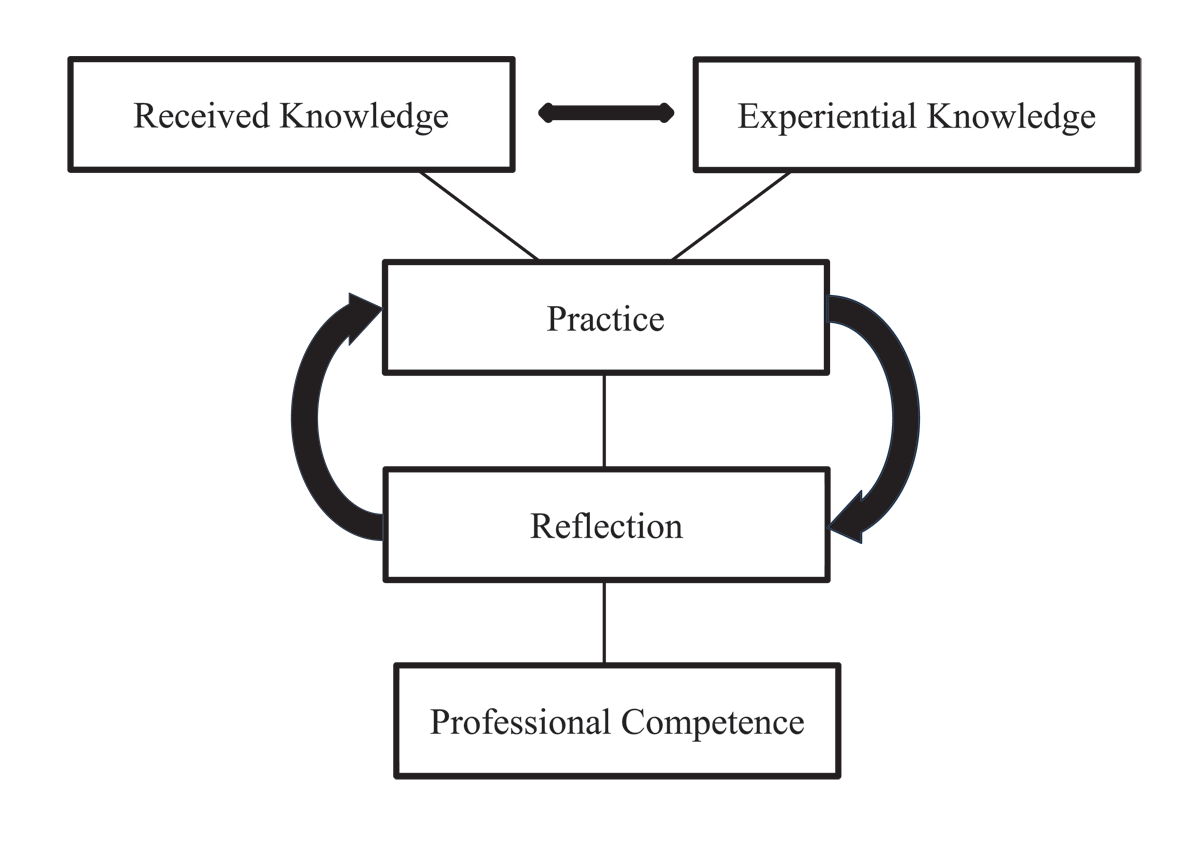
Figure 1
Reflective Cycle.
Note. Adapted from Wallace, M. J. (1991). Training foreign language teachers: A reflective approach. Cambridge University Press. Copyright 1991 by Cambridge University Press.
Choice within Constraints
A second perspective that guided the theoretical framing of this study is that teachers are “[c]omplex, sensible people who have reasons for the many decisions they make” (Leatham, 2006, p. 92). This perspective holds that although teachers may not be consciously aware of their beliefs and may not always be able to articulate them, those beliefs are part of a coherent and complex system organized by strength, quasi-logical relationships, and clustering; and, that belief systems are coherent for the individual believer (Leatham, 2006).
Guiding Theoretical Framework
The theoretical framework for pedagogical decision-making guiding this study is Ingram and Clay’s (2000) notion of choice-within-constraints, which draws on the new institutionalism theories developed in other fields of social science. New institutionalism relies on the notion that any decisions an actor makes within a system are bounded in a variety of ways. When discussing the bounded actor, new institutionalism assumes two premises. The first is that actors, in this case a STEM teacher, are rational and purposeful about their actions. The second is that actors are bounded in terms of their knowledge, worldview, and preferences (Hall & Taylor, 1996). Prior research on teaching has illustrated the importance of knowledge, beliefs, and goals or values on teacher decision-making (Calderhead, 1996). Moreover, both of these claims align with Atkinson’s (2012) findings that teacher reflection should be understood as existing within constraints and is carried out in ways that are sensible to teachers.
We use this theoretical orientation to explore claims that the participant made about their practice. As Hora (2012) argued, it is within these perceived contextual constraints that pedagogical decision-making and practice are shaped, and, while organizational factors do not completely determine teaching practices, they do shape them. Individual teachers might be understood as making sense of and negotiating the institutional and cultural factors in a variety of ways as they make instructional decisions. As a result, we adopt the perspective that instructional decisions are instances of choice-within-constraints, and we draw on the new institutionalism theories as a lens for understanding how “[a]ctors pursue their interests by making choices within constraints” (Ingram & Clay, 2000, p. 525–526). Accordingly, this study aimed to answer the following research questions: (1) How can we understand military experience as valuable preparation for teaching and how might it shape a teacher’s beliefs? and (2) How might we see aspects of Devotion to Duty as well-aligned with reflective teaching?
Methods
Participant
This study focused on the experience of a Coast Guard veteran in the Troops to Teachers program, who transitioned to middle school science teaching after serving in the military. We have assigned him the pseudonym, Neil. The data for this paper were collected as part of a larger study (Burke et al., 2025) conducted at a large, public, urban, research university in the mid-Atlantic region of the United States. The participants of that study were recruited from a cohort of graduate students enrolled in the university’s 12-month master’s Teacher Residency (TR) program, which pairs coursework with an intensive teaching residency designed to prepare participants to teach in urban, high-needs schools. We have chosen our case study because his experience was strikingly different from others in the cohort, and we wanted to understand the factors that contributed to these differences. We examined his experience to explore how his military background uniquely and meaningfully shaped his thinking and practice as a teacher.
Data Collection
Recruitment for the larger study occurred at the beginning of the fall 2020 semester. We sent an invitation email to all TR program participants and any that replied were part of the larger study. We note that the academic year was impacted by the COVID-19 pandemic, so the participants engaged in both remote instruction and limited in-person teaching. Data were collected in four phases during the 2020–2021 academic year. During all phases, participants completed semi-structured interviews that occurred via Zoom and lasted between 45–60 minutes. Interviews were conducted by four researchers on our team. Given the cumulative, reflective nature of this work, each participant was interviewed by the same researcher.
Each interview consisted of a foundational interview task, followed by an explicit discussion of the participants’ most fundamental commitments to their teaching practice (Table 1). The tasks of the first three interviews probed sources (I) and representations (II & III) of the participants’ commitments to their teaching. For example, in Interview I, participants were asked to talk about a teacher upon whose practice they wanted to model their own. This discussion provided insight on the participants’ implicit beliefs and primed them to discuss their explicit beliefs. The fourth interview’s task then prompted the participants to consider their views on educational theory. This task directly prepared them to reflect on their commitments to practice and how these commitments had evolved over their TR year. The participants were also asked to provide a theory-driven conceptualization of education, school, subject matter in school curricula, teaching method, and school and social practices. Through this interview task, we considered how the participants’ discussions of educational theory aligned with their commitments.
Table 1
Interview Timeline and Structure.
| INTERVIEW | TIME PERIOD | INTERVIEW TASK |
|---|---|---|
| Interview I | September | Reflection on prior experiences in the classroom as both a student and a teacher. |
| Interview II | November–December | Explanation of a representative teaching artifact from practice. |
| Interview III | March | Stimulated recall interview on a representative lesson. |
| Interview IV | June | Principle educational beliefs modeled on Dewey’s: “This I Believe”. |
Between periods of data collection, the researchers conducting interviews reviewed the prior interview transcripts and compiled a list of each participant’s “pillars of practice” (the fundamental beliefs about teaching that they held for their practice) that were either explicitly stated or implied. This review enabled the interviewers to continuously engage the participants in a reflection on their pillars. During interviews II, III, and IV, the researchers reminded the participants of the pillars they had identified in previous interviews and asked if these pillars had shifted. This repeated, direct discussion and reflection on the participants’ pillars of practice functioned as a type of member checking. The data for the study were collected with the approval of Temple University’s Human Subjects Institutional Research Board (#27500). Data collection followed approved protocols for ethical treatment of participants.
Data Analysis
At the conclusion of data collection, our research team began a thematic analysis (Braun & Clarke, 2006) of the interview transcripts using the qualitative coding tool Dedoose. Our unit of analysis was the content unit, a segment of discourse designed to make a single point. A single researcher open-coded the first-round interviews, providing our team with an initial codebook. This coding was later reviewed and streamlined by a more senior member of our research team. Initial codes were also developed based on our reading of the literature, as well as articulated foci of the teacher education program, such as “real-world connections” and “active learning.” Once the codebook was developed, Interview I was recoded and Interviews II, III, and IV were coded via a collaborative coding process between varying pairs of researchers. The coding pairs met synchronously via Zoom to read, discuss, and code each content unit (Miles et al., 2013). We then developed axial codes to organize similar emergent themes. The code co-occurrence function of Dedoose allowed us to track the frequency of different axial codes.
As noted above, Neil’s codes diverged in critical ways from the other TR participants in the larger study. As we describe below, he was focused on engaging students in productive struggle––in discussions that solicited both correct and incorrect ways of thinking––and in assessment and evaluation practices that included both his students and instruction. These codes were not applied to the interview data of other participants.
Results
Our data analysis resulted in three major themes that illustrated how Neil used his military experience to shape his teacher beliefs and practices: (a) Training as a foundation for teaching, (b) Shaping pedagogy and assessment with military values, and (c) Change moments as a result of reflective teaching.
Training as a Foundation for Teaching
During Interview IV, Neil discussed his transition from service in the Coast Guard to a career in teaching and how his perceptions of teaching significantly changed during his residency year, stating:
Being a career-changer, I didn’t go through my Bachelors of Education…I was in a completely different field jumping over to education. Basically, all I knew about education was what I experienced [in] K12. So, a little bit of me was like, ‘Oh I’ll just do it like [teacher name] did.’ Reflecting on two great teachers helped me, but maybe it wasn’t the best method for every student in the classroom. Or even just how I’ve been out of high school [for] 10 years and seeing that shift from right and wrong answers to critical thinking and problem solving, those in-your-brain skills. So, that was a little bit of a shock. Not that I thought it was gonna be easy, but I was like ‘Oh, you know, I’ve been to school. I know how this stuff works,’ and it’s like, ‘No, it’s completely different when you’re on the other side of the classroom.’
Here, Neil explained that prior to beginning his residency year, his experiential knowledge of K12 schools was based entirely on being a student. He then noted that drawing on his experience with two great teachers was useful, but not “[t]he best method.” Instead, he realized that he needed to shift away from thinking about whether students are giving “[r]ight and wrong answers.” During the year, Neil began to focus on engaging students in critical thinking and problem solving, and how “[t]hat was a little bit of a shock,” because he had not thought “[o]n the other side of the classroom” or as a science teacher before. By drawing on the Coast Guard values, in particular, the value of accepting responsibility, we theorize that what allowed him to do that thinking was data-based reflection and taking responsibility, as learned by his experiences in the Coast Guard.
Neil then highlighted the importance of the culture and practice of the “[t]rain your replacement” model within the Coast Guard (we note that this is common across the Armed Forces [Mastin, 2011]) and explained this practice in Interview I as helping him to realize that he enjoyed teaching:
The way the Coast Guard is structured as the smallest branch of the Armed Forces, there’s not that much money, resources, training, or facilities for training. So, they do everything in house, meaning, you show up to a place, you’re given a sponsor, and you learn that role. There’s a period of overlap––you learn the job of the person that’s leaving so that you can take over that job. Then in your last year, someone else shows up and you teach your job to them. So, when you leave, the cycle can continue…Once I became qualified, my whole existence of the Coast Guard was teaching my knowledge and skill set to people reporting to the unit…There were supplemental resources…I was sent to the National Ice Rescue School in [City, State], which was my first taste in presenting. It was not so much about the content, but more to be a public speaker, how to present. That’s where I made that transition like, ‘Oh, I kind of enjoy this,’ and I know I don’t want to do a career in the Coast Guard. So, that was my first light at teaching.
Neil then described the importance of “train-your-replacement” in his career development as motivating his career transition to teaching. It also provided him with transferable skills such as public speaking and presentation proficiency. Moreover, he realized that he was already teaching, nearly daily, and enjoyed it during his four years in the Coast Guard, stating:
Reflecting on my time in the Coast Guard, I look back and a lot of people were like, ‘Oh, you can do this, you can do that.’ I thought to myself, ‘What did I enjoy about my past four years? What do I feel comfortable doing? And what do I feel comfortable doing for a lifetime?’ And it was staring me in the face the whole time––teaching. That’s all you’ve been doing, day in and day out, taking people that show up, teaching them how to do stuff, running trainings.
Neil then specifically named feeling enjoyment and comfort in teaching, sufficient comfort that he could imagine “[d]oing [it] for a lifetime” and that teaching was “[s]taring me in the face.” That “[d]ay in and day out” when he was “[t]eaching [people] how to do stuff” and the notion of training your replacement meant that he was well-situated to begin a teacher education program.
Shaping Pedagogy and Assessment with Military Values
Neil was reflective about how his ways of thinking about pedagogy and assessment evolved during his residency year. He explained that he began the year focused on the notion of “[d]o the job” regarding whether students were giving the right answers to questions. Over time, he shifted this concern for correctness to whether the students were engaging in productive struggle. During Interview IV, Neil explained:
When I went into teaching, my mindset of what would stress me out was…I almost valued, ‘Am I a good teacher based on student responses? Are enough people raising their hand and giving the right answer?’ That is saying they’re learning, I’m doing the job, and we’re on track. That’s how I falsely attributed [it]. You know, ‘What’s the equation of acceleration?’, and if 10 kids raise their hand and they know it, I’m like ‘Okay they’re paying attention moving forward.’
In this excerpt, Neil explained his initial mindset about his goals for his students during the residency year. He said that he initially evaluated himself as a teacher (i.e., “[a]m I a good teacher?”) by whether “[e]nough people [are] raising their hand and giving the right answer.” He specifically cited engagement as his marker for success in Interview I while reflecting on his experience as a student and aspirational instructional practices, stating:
Going off personal experience from when I was in school, I have vivid memories of those experiments. There’s something to be said [that] I remember this stuff 15 years later…So, we tried doing a rocket project online. Weeks leading up to [the] project, we’re not getting that much engagement. The cameras are off. Kids are very rarely coming off mute. They’re using the chat. It was not a great environment for learning. It’s kind of mundane. You don’t want to just be lecturing to a computer screen. We start doing the rocket project…all of sudden everyone’s cameras are on. Everyone wants to hold up the rocket they’re building with a drawing they made, and it’s like, ‘Alright so these kids obviously are behind their computers.’ They want to engage. But they want to engage not when someone’s like, ‘Take your camera off and show me what’s going on.’ It’s more so, like, ‘Hey, what did you build last night for your flex assignment,?’ and they hold it up and they’re excited, and they’re talking about it…like, why did you do it, why put these things for this reason, I did this for that…
Here, Neil reflected on his experience as a student, noting “I have vivid memories of those experiments” as formative. He explained that in his experience, hands on, active, and engaging work would be formative for students. As a result, he aspired to create those kinds of activities, contrasting his time teaching a rocket project [they want to engage] with the “normal” instruction where “kids [were] very rarely coming off mute…it was not a great environment for learning.” In Interview I, Neil was clearly using engagement and excitement as a marker for successful instruction.
In addition, Neil claimed that early in the year, he used engagement to determine whether “I’m doing the job and we’re on track” (Interview IV) in terms of the curriculum. Describing his evolution as a teacher, he continued:
I’ve shift[ed] my focus…It’s not about getting the students to get the right answer and it’s more so engaging [in] productive struggle. Have conversations…debate it…if there’s some right and some wrong answers, we’ll talk about that. Even talking about why an answer isn’t correct or the best answer, there’s value in that too. So, if students are getting things wrong, it doesn’t mean I’m doing a bad job and they’re doing a bad job. It’s more so, like, ‘Alright let’s take this information for what it is. You guys are all messing up this topic and let’s dive deeper. Hold on, we’re going to go into that now.’ I think early on if students got stuff wrong, I took that as ‘Oh I missed it, better luck next time,’ and now it’s ‘Alright students are not getting the right answer? Let’s go down that rabbit hole.’
Here Neil claims to have moved away from a focus on simply using correct answers to judge his performance and students’ success to a focus on “[e]ngaging in productive struggle” and using assessment as a tool for continued and focused instruction. He noted that he and his students “[t]alked about one answer [that] isn’t correct or the best answer” as a characterization of productive struggle. Moreover, he recognized a fundamental change in his role, explaining “If students are getting things wrong…it’s more so, like ‘Alright, let’s take this information for what it is. You guys are all messing up this topic and let’s dive deeper.’” That is, Neil reconceptualized his job as a teacher from “[e]nsuring students know and can state the right answer” to one that supports students meaningfully engaging with a range of ideas and thinking deeply about even those that might not be the correct or “the best” answer.
In thinking about lesson planning, Neil repeatedly emphasized the importance of focusing on “[w]hat the students are doing” and ensuring a close relationship between the intended learning goals (i.e., standards) and classroom activities. For example, during Interview III, he said:
I found out throughout the year that this part is a little bit more important, the ‘[i]n order to’ that is relating back to the objective. For me, it was more so, ‘Alright, what are the students doing?’ I didn’t really get the relationship between these two. [For] ‘What are the students doing?’ I’d be like, ‘investigating waves’. Then okay, that’s their physical actions, that’s the activity they’re gonna be doing. But what’s the outcome of that? And I’m like, ‘Oh, the representation and describ[ing] the model of waves.’ That is what we’re trying to evaluate there––that the student can look at a wave, pick apart the different pieces, what a frequency is, what the amps are.
In this excerpt, Neil begins by emphasizing the importance of relating his objectives to meaningful subsequent work. His repetition of “[w]hat are the students doing?” is aligned with the focus of the train-your-replacement model in that the instructor needs to focus on what the learner is doing and whether they have developed the proficiency to “do the job.”
Neil provided multiple lines of reasoning for this change in proficiency that involved both thinking about students and thinking about the discipline of science. He explained:
That open discourse…you have students that aren’t confident in their answers, and they think they’re wrong, so they don’t want to share out. [There are] students that are used to getting every answer right and they aren’t sure about this, so they don’t want to share out. So, it’s promoting that. I think I’ve been doing a good job since the beginning of the year, of saying, ‘This is science, you make mistakes in science, and you make errors in science. That’s always there in science.’ For hundreds of years people believed things that were completely wrong, and they were like ‘No it’s science, you have to believe that’ like where the Earth is situated in the solar system. So, starting the year with that idea of ‘Science has this notion of being like the-end-all-be-all, but very often you make one discovery and it uproots everything we understand. So, everything we’re learning is the best supported information.’
In this excerpt, Neil first explains that when he changed his pedagogy to prioritize student-centered methods, students “[t]hink they’re wrong and so they don’t want to share out” because “[they] are used to getting every answer right and they aren’t sure about this.” That is, both Neil and the students were getting used to a new milieu, in which students were expected to share their thinking as part of the class. Neal’s claim that students would not want to share if they did not know that they were right aligns with his prior focus on prioritizing students getting correct answers. As Neil continued, he shifted his explanation to include a rationale grounded in the discipline, explaining that “[t]his is science, you make mistakes in science and make errors…for hundreds of years people believed things that were completely wrong.” Here, we interpret Neil as suggesting that scientific understanding is not linear as it does not always begin with correct explanations of natural phenomena. He implied that, within the classroom, these incorrect ways of thinking should be understood as part of the journey to more correct understandings as aligned with scientific progress.
Neil further described a pedagogical approach that includes ceding authority to the students to do “[h]eavy thinking,” while engaging them in exploration and conversation. He stated:
For this explor[ing], for the students to be engaging and doing the work, that’s my goal. I had the students do most of the heavy thinking. At the end of the class would be the time for ‘Alright let’s take some solid definitions. Let’s clear up any miscommunications or misunderstandings that we developed in that investigation.’ Because that’s always a reality, you promote student creative thinking and sometimes they’re wrong, and I’ve tried to pull the good out of that. It’s creative, critical thinking: ‘You’re taking a situation and I could see where you came up with that.’ But I also don’t want to promote that misconception because moving on throughout the unit, if that keeps popping up, they’re going to get lost when we’re talking about how radio waves are sent from one to another boat or whatever the situation is.
In this excerpt, Neil made it clear that “[his] goal [was to have] students do most of the heavy lifting” and it was only “[a]t the end of the class” that he would “[c]lear up any miscommunications or misunderstandings that [they] developed in that investigation.” He wanted to promote creative thinking and meaningful engagement and recognized that “[s]ometimes they’re wrong.” Moreover, he valued both hearing and then directly confronting his students’ misconceptions because he recognized that allowing them to go unaddressed meant “[t]hat’s going to be…a problem later on down the road,” especially when similar ideas resurfaced.
Finally, we note that Neil expected students to have different needs and respond differently to varying types of pedagogical approaches. During Interview IV, he said:
It also falls on the teacher…How they witness their students responding to different teaching methods…I personally like hands-on, student-led, and open-ended responses and discussions and talking about perspective and try[ing] to get away from that ‘right answer, wrong answer’ type mentality. So that would be [my] personal teaching method. But that would vary for subject matter. That changes how you’re going to teach it…But they’re comfortable with how the students are reacting to that method too. So, I can go into this [like], ‘This is my method. If it’s missing the target…Well, just because I’m comfortable with it doesn’t mean that students are benefitting from it.’
Neil again returned to the idea that both he and his students had previously focused on a “[r]ight answer, wrong answer type mentality.” He explained that he took a sense of personal responsibility for his learning outcomes, even if it meant leaving his comfort zone, saying, “[j]ust because I’m comfortable with it doesn’t mean that students are benefitting from it.” We interpreted this to mean that Neil felt a responsibility to ensure that his instruction included multiple types of teaching methods, especially “[h]ands-on [and] student-led” and one that “[w]ould vary for subject matter.” As such, Neil recognized that it was important to match his pedagogy to his teaching goals, and that if he wanted to ensure that students could do the job of a scientist, he had to engage in student-centered instruction and engage students in productive struggle.
Overall, we present a case of a novice teacher and Coast Guard veteran who arrived with beliefs about what it meant to achieve success in teaching, like ensuring that his students get correct answers to questions, but recognized the inadequacies of that approach in terms of long-term learning. Neil switched his instructional practices to focus on engaging students in productive struggle around questions, engaging them in conversations that solicited their critical thinking––especially valuing incorrect thinking, and supporting them via many pedagogical approaches. Fundamentally, this approach is grounded in assessment, evaluation of himself and his students, and critical reflection on his own practice. We argue that Neal’s acceptance of responsibility carried over from his Coast Guard service to his teaching practice.
Change Moments as a Result of Reflective Teaching
Neil’s pedagogy was unique in terms of his focus on supporting students’ agency and ensuring that they engaged in productive struggle. In particular, he arrived at those positions early in his residency. His desire to support students’ agency, especially, was contrasted with the more typical lecture/practice of many classes. During Interview II, the interviewer asked:
You were leaving the notes to the end because you didn’t want to provide the answers for them, and then they follow[ed] through because, how did you put it? Just to make sure they get the answer right. Yeah, [and] critically thinking about it. So, is there a moment that crystallized this for you? Did you actually see this or was this in consultation with your cooperating teacher? That was really interesting what you just said, so I’m just curious how that came to you that that was really important.
Here, the interviewer is restating some of Neil’s claims related to instruction and asking how he came to hold those beliefs, most fundamentally, that he did not want to be seen as the exclusive source of knowledge during the class discussion. Rather, Neil wanted students to leave his class having seen the issue “resolved” via notes. He was adamant that his students should have the space to be experts on their own and to seek out information while not relying on the teacher or text. Because this was during Interview II in early December, this seemed a rather unusual position for a beginning preservice teacher to have adopted. Thus, the interviewer’s question, which provided this response:
This past fall, everything [was] upended by remote learning and how we [were] gonna do things, and it’s almost like the default was to go back to worksheet teaching, kind of cookie cutter. Like, ‘start with vocab, start with this’ and then you move on. It’s safe, it’s easy, and the kids are comfortable with it. Then at some point when we [were] having conversations or it came down to taking quizzes, the kids [were] lost…Every day we do an exit ticket, a daily check for understanding, and they’re knocking them out of the park. 90s, 100s, 90s, 100s. Then we take a big quarter quiz and they’re in the 30s, 40s, or 50s. Then that’s where we kind of start piecing together like, ‘Are they just sponging the information and dumping it 40 minutes later at the end of the class? Or are they actually retaining it?’ So, then we started working around a model.
In this excerpt, Neil claims that there was not a single moment, but rather an accumulation of moments due to reflective discussions between him and his co-teacher regarding their teaching that prompted his pedagogical shifts. He described how he and his co-teacher were having conversations about the students’ performance, noting that they were assigning quizzes, daily exit tickets, and exams to evaluate their students’ learning. While the students’ responses to the exit tickets were promising, their quiz and exam results were not. Neil’s explanation for this mismatch suggested that students were “[d]umping it 40 minutes later,” running counter to his goal of meaningful learning. As a result of their analyses based on their dissatisfaction with the assessment results, Neil and his mentor teacher “[s]tarted piecing together” the need for alternative pedagogical practices.
This change in pedagogical practice continued to be coupled with responsibility and accountability on his part, stating:
If everyone’s off the mark, that’s feedback for the teachers. We have six sections. If [in] the first section no one gets it, maybe we’re not asking the right questions. Maybe we’re giving too much. Maybe we didn’t give them enough [at the] beginning. Maybe there needs to be one or two notes before they go into it. So that’s how we’ve been seeing it.
Here, Neil explained that when “[e]veryone’s off the mark, that’s feedback for the teachers.” When all the students struggle, he interpreted this as feedback indicating that the lesson or activity was not properly designed and that the students were not able to engage in the desired productive struggle. Thus, Neil viewed assessment as able to be both in-the-moment and long-term, recognizing a responsibility to systematically attend to students struggle and an accountability for creating situations where students can engage in the types of work and argumentation that result in learning. This reflecting on and analysis of the results of his teaching contributed to these “change moments” that resulted in pedagogical change.
Discussion
This research presents a case study of a former Coast Guard veteran who transitioned to middle school science teaching. It provides two additions to the existing literature and advances one theoretical claim about the potential benefits of the Troops to Teachers program. The literature that explains the potential values of the TTT program has typically extolled ideas about leadership, the idea that service members live and work with people who have different backgrounds, and are accustomed to teamwork (Parham & Gordon, 2016). Here, we argue that Neil had other desirable attributes and knowledge derived from his time in the Coast Guard.
Even at the beginning of his teaching, Neil looked for student responses as a means to evaluate whether he was doing a good job as a teacher. But, over the course of his preservice teacher residency, he shifted both the means of evaluation and the level of responsibility for student learning that he assumed. Over time, he recognized the inadequacy of this approach: his instruction was not resulting in long-term learning given that the students might do well on an immediate assessment but then do quite poorly on a delayed exam. Neil’s personal reflection on and analysis of his teaching changed his thinking and led him to focus on engaging students in problems and tasks that elicited productive struggle, valuing incorrect thinking as important, and using different pedagogical approaches. Neil adopted a mindset that assessment of both his students, and reflexively, of his instruction, was valuable and important. We claim that he sought responsibility for his students’ learning, accepted accountability, and was committed to achieving the goals of his school. That is, we saw the Coast Guard’s value of Devotion to Duty as analogous to how Neil approached teaching and learning.
We also provide a theoretical explanation for the possible value of the “train-your-replacement” model that goes beyond Neil’s claims. Training someone requires that the trainer engage in a constant cycle of training and assessment to determine readiness on the part of the trainee. The trainer must also be willing and able to change pedagogical practices and maintain instructional activities in order to achieve mission readiness. Thus, training in the military is about results and it matters whether the person being trained for a job can do it to an appropriate standard. Second, that the means of demonstrating the success, or failure, of the instruction is enacting the task, which serves as an authentic assessment of the readiness to take on the role. Third, because the trainer needs to ensure mission-readiness, if the means of instruction is not effective, they are obligated to reteach, ideally attempting some other type of instruction and treating the method of instruction as a potential issue for student learning. Thus, we see multiple avenues for transfer from the train-your-replacement model to being a K12 teacher.
In this case, while Neil’s exit tickets were easy data that signaled that his students were achieving the objective, subsequent assessment results indicated that it was temporary. Moreover, the types of questions on exit tickets and exams are typically different, and we speculate that the students may have demonstrated declarative knowledge but had not operationalized it or made it useful in context. That is, Neil’s students could not execute their mission, and so he needed to reteach. As a practical outcome, this study shows that Neil was able to critically reflect on his teaching and thus was poised to become an excellent teacher. We suggest that other veterans, especially Coast Guard veterans who translate the value of Devotion to Duty to the classroom, may be so as well, albeit for different reasons than previously found in the literature (Parham & Gordon, 2016).
The second addition we make to the literature relates to Wallace’s (1991) model and the notion of experience. It is our understanding that Wallace’s construct of experience is circumscribed within the context; that experience teaching matters, but experience in other areas, even with parallels, does not. While Neil had prior experience teaching others, it was not in a K12 classroom. He recognized that prior experience was important in his decision to pursue teaching post-military, but it appears that aspects of his prior experience influenced his thinking, beliefs, and even proficiency for teaching. Our data suggests a broader read on the notion of experience within Wallace’s model. At the same time, we note that this does create theoretical entailments and will make research more challenging to answer the questions: How might a researcher identify potentially relevant experiences in someone’s background? How broadly might potentially relevant experience be understood? How long in the past might a researcher need to probe? How would one attempt to elicit this from participants? All of these questions, and more, need further exploration at both theoretical and methodological levels.
Limitation
This study examined a single case and as a result, our conclusions, while evocative, are not generalizable. Additional research is needed to explore the phenomenon further, including a more focused probe of the impact of the Coast Guard’s core values on the beliefs and practice of other Coast Guard TTT participants, as well as an examination of the impact of the core values of other branches of service. Future research in traditional settings not impacted by the COVID-19 pandemic would also shed light on the possible influence of that unusual circumstance.
Conclusion
By exploring the reflections of a Troops to Teachers participant who transitioned from the Coast Guard to middle school science teaching, this study illuminated how and why military experience may contribute to preservice teachers’ success in the classroom. Findings illustrated that the “train your replacement” model within the military may uniquely prepare TTT participants to engage students in critical thinking, problem solving, and productive struggle. TTT participants may also use military values to shape their teaching pedagogy and assessment, which, for this study, included a commitment to reflective teaching and student-centered instruction. These contributions expand understanding of how the TTT program is poised to support the effective transition of veterans to successful careers in education.
Ethics and Consent
Temple University’s Human Subjects Institutional Research Board (#27500).
Competing Interests
The authors have no competing interests to declare.