
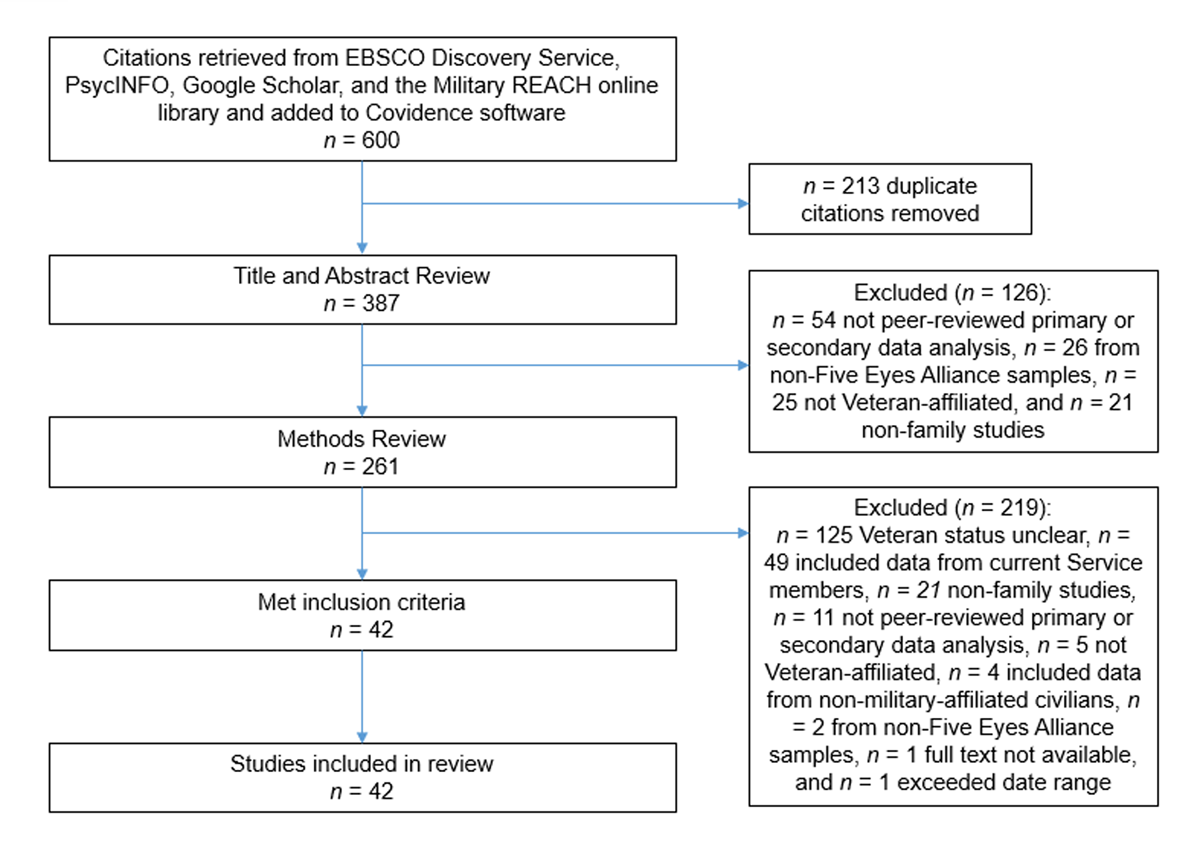
Figure 1
Flowchart of Search Strategy and Article Selection.
Table 1
Data Extracted from Veteran Family Studies Published between 2018–2023.
| ARTICLE | COUNTRY | AIM | METHODOLOGY | PARTICIPANTS | DATA SOURCE |
|---|---|---|---|---|---|
| Beks & Cairns, 2020 | CA | Explored factors that influence mental health service use among partners of veterans with posttraumatic stress disorder | Qualitative, Primary | 16 female partners of male veterans with PTSD | Partner |
| Bommersbach et al., 2022 | US | Compared children and families of veterans to children and families of nonveterans regarding sociodemographic, clinical, and school performance factors | Quantitative, Secondary | 4,028 veterans or partners reporting on behalf of their child, 38,228 civilian parents | Veteran or partner |
| Brady et al., 2021 | US | Evaluate the influence of a supportive supervisor training program on veteran couples’ relationship and family outcomes | Quantitative, Secondary | 250 veterans and their partners | Veteran and partner |
| Cathcart, 2019 | CA | Examined personal support structures of veteran family members that facilitated the transition out of the military | Quantitative and Qualitative, Primary | 55 family members of veterans, only 5 interviewed | Partner, child, or other family member |
| Corry et al., 2022 | US | Examined spouse well-being (i.e., psychological health, physical health, and family relationships) and identified protective factors for spouses after the transition out of the military | Quantitative, Secondary | 4,087 spouses of service members, of whom 1,199 transitioned out of the military by follow-up | Partner and administrative records |
| Dighton et al., 2018 | UK | Examined the impact of veterans’ gambling on family outcomes and how family factors may influence gambling | Quantitative, Secondary | 257 veterans | Veteran |
| Dockerty et al., 2020 | NZ | Examined veteran’s health status and compared the health of veterans and their adult children | Quantitative, Primary | 83 veterans, 65 adult children of veterans | Veteran or child |
| Doncaster et al., 2019 | UK | Examined civilian partners’ perceived impact of their veteran partners’ trauma symptoms on each partner and the relationship | Qualitative, Primary | 15 female partners of male veterans | Partner |
| Evans et al., 2021 | AU | Evaluated the delivery of Mental Health First Aid training for family members of Veterans with a mental health condition | Quantitative, Primary | 59 immediate and extended family members of veterans | Partner, child, or other family member |
| Forrest et al., 2018 | AU | Examined associations between Vietnam veterans’ deployment and their adult children’s mental health | Quantitative, Primary | 1,966 adult children of veterans | Child and administrative records |
| Friedman et al., 2022 | US | Examined reproductive and physical outcomes among Gulf War Era women veterans and their children and associations with deployment history | Quantitative, Secondary | 239 women Gulf War veterans | Veteran |
| Goger et al., 2022 | US | Examined whether women veterans’ perinatal psychopathology was associated with parenting stress and difficulty bonding with their child | Quantitative, Primary | 28 women veterans | Veteran |
| Gunter et al., 2020 | AU | Examined gendered associations among parent-child attachment, family emotional climate, and mental health outcomes among children of Vietnam veterans | Quantitative and Qualitative, Secondary | 133 sons and 182 daughters of veterans | Child and administrative records |
| Harper et al., 2022 | US | Examined the impact of romantic relationship functioning on veterans’ mental healthcare utilization | Quantitative, Secondary | 760 veterans | Veteran and administrative records |
| Hinrichs & Christie, 2019 | US | Examined challenges and opportunities when providing end-of-life care for an older, lesbian veteran to highlight disparities in care for LGBT veterans | Qualitative (case study), Primary | 1 partner of a veteran and their healthcare team | Partner and non-family member |
| Ijadi-Maghsoodi et al., 2022 | US | Examined the community integration experiences and barriers of homeless-experienced veteran families living in permanent housing | Qualitative, Primary | 9 homeless-experienced veterans and 7 homeless service providers | Veteran and non-family member |
| Kamdar et al., 2022 | US | Examined low-income veterans’ reflections on their experiences trying to provide adequate, nutritious food for themselves and their families | Qualitative, Primary | 17 low-income, post-9/11 veterans | Veteran |
| Karre et al., 2022 | US | Examined protective factors associated with fathers’ positive parenting behaviors and parenting satisfaction | Quantitative, Secondary | 3,810 veteran fathers | Veteran |
| Kinder et al., 2022 | US | Described veterans’ use of community-based hospice services and associations with bereaved families’ perceptions of care | Quantitative, Secondary | 2,118 partners, 1,201 children, 205 siblings, 157 other family members, and 286 non-family members of veterans | Partner, child, other family member, or non-family member, and administrative data |
| Lawrence & Matthieu, 2018 | US | Examined the perceived impact of veterans volunteering on family outcomes and compared the impact across demographic and mental health subgroups | Quantitative, Secondary | 346 post-9/11 Veterans | Veteran |
| Maguire et al., 2022 | AU | Described veteran family needs and explored service providers’ and families’ experiences of accessing and navigating support systems | Qualitative, Primary | 18 service providers, 7 veterans, 7 partners of veterans, and 2 adult children of veterans | Veteran, partner, child, other family member, or non-family member |
| McCormack et al., 2022 | AU | Examined intergenerational trauma exposure and primary combat exposure among veterans who were children of veterans | Qualitative, Primary | 4 Army veterans who had a father who served in the military | Child |
| McGaw et al., 2020 | AU | Examined partners of veterans’ perspectives of parenting and relationships in the context of their partners’ military-related posttraumatic relationship disorder | Qualitative, Primary | 8 female partners of Australian veterans | Partner |
| Min, 2021 | US | Examined whether student veteran status, deployment history, metal health conditions, substance use, and marital instability were associated with experiencing emotional, physical, or sexual abuse in an intimate relationship. | Quantitative, Secondary | 2,354 student veterans and 102,224 civilian college students | Veteran |
| Morgan et al., 2022 | US | Examined risk and protective factors for parental functioning and parenting satisfaction among post-9/11 veteran mothers after transitioning out of the military | Quantitative, Secondary | 711 Women veterans within 3 months of separating from the military | Veteran |
| Nieforth et al., 2022 | US | Investigated the emotions of partners of veterans assigned service dogs for posttraumatic stress disorder | Quantitative, Primary | 87 partners of veterans participating in a service dog clinical trial | Partner |
| Norris et al., 2022 | CA | Examined how veteran families cultivate resiliency while experiencing the challenges of the military to civilian transition and a mental health problem | Qualitative, Secondary | 6 intimate partners of Canadian veterans | Partner |
| Norris et al., 2023 | CA | Examined the experiences of family members of veterans living with mental health problems, including operational stress injuries | Qualitative, Primary | 26 family members, including 22 partners, 3 parents, 1 adult child, and 1 sibling of Canadian veterans with a mental health problem | Partner, child, or other family member |
| O’Toole, 2022 | AU | Assessed associations among veteran fathers’ posttraumatic stress disorder (PTSD), family emotional climate, and children’s PTSD | Quantitative, Secondary | 181 veterans and their 163 adult daughters and 120 adult sons | Veteran and child |
| O’Toole et al., 2018 | AU | Described the family emotional climate of adult children of Australian Vietnam veterans and examined gendered associations among family emotional climate, parents’ mental health, and children’s mental health | Quantitative, Secondary | 197 veterans and their 135 female partners, 180 adult daughters, and 135 adult sons | Veteran and child |
| Phelan et al., 2018 | US | Examined the association between stigma, discrimination, and caregiver strain, caregiver well-being, and patient community reintegration among veterans with traumatic brain injury and their caregivers | Quantitative, Primary | 347 parents, 181 spouses, and 36 other family members informal caregivers of veterans | Partner, child, or other family member |
| Portnoy et al., 2022 | US | Examined associations between veterans’ traumatic brain injury and persistent postconcussion symptoms with their perpetration of intimate partner violence | Quantitative, Secondary | 815 veterans | Veteran |
| Romaniuk et al., 2018 | AU | Evaluated the impact of equine-assisted therapy on the mental health and quality of life outcomes among veterans and their partners | 25 veterans and 11 veterans and their 11 partners participating in equine-assisted therapy | Veteran and Partner | |
| Sanders et al., 2019 | US | Examine the contributions of family stressors on veterans’ mental health above and beyond combat during deployment and whether family stressors amplified the negative effects of combat on postmilitary mental health | Quantitative, Secondary | 651 veterans who lived with a partner or had children | Veteran |
| Schwartz et al., 2021 | CA | Explored veteran families’ experiences of formal and informal support during the military to civilian transition | Qualitative, Primary | 30 spouses, 3 parents, and 2 adult children of Canadian veterans | Partner, child, or other family member |
| Shepherd-Banigan et al., 2020 | US | Described the caregiving experiences and needs of family caregivers of veterans with mental, physical, and cognitive comorbidities | Quantitative, Secondary | 1,159 family caregivers of veterans | Partner, child, or other family member |
| Sherman et al., 2018 | US | Examined the intersection of trauma, spirituality, and the impacts of trauma on partners and intimate relationships | Qualitative, Secondary | 11 male veterans and 9 female partners of veterans | Veteran and partner |
| Skomorovsky et al., 2020 | CA | Examined challenges and caregiving experiences among veteran spouses during the military to civilian transition | Quantitative, Secondary | 595 spouses of veterans who recently transitioned out of the military | Partner |
| Smith et al., 2021 | US | Examined the mediating role of dysfunctional behavior during marital conflict on the association between posttraumatic stress disorder and heightened cardiovascular response. | Quantitative, Secondary | 64 male veterans and their 64 female partners | Veteran and partner |
| Sullivan et al., 2022 | US | Examined the associations between veteran parents’ mental health and employment with adverse outcomes for their children and the moderating role of school climate | Quantitative, Secondary | 218 veteran parents of children in K-12 schools | Veteran |
| Wells et al., 2022 | AU | Explored the retrospectively reported experiences of children of veterans during the military to civilian transition | Qualitative, Secondary | 10 adult children of Australian veterans | Child |
| Whitworth et al., 2020 | US | Examined the experiences of partners of veterans with posttraumatic stress disorder participating in a service dog program | Mixed methods, Primary | 15 partners of veterans with PTSD participating in a service dog program | Partner |
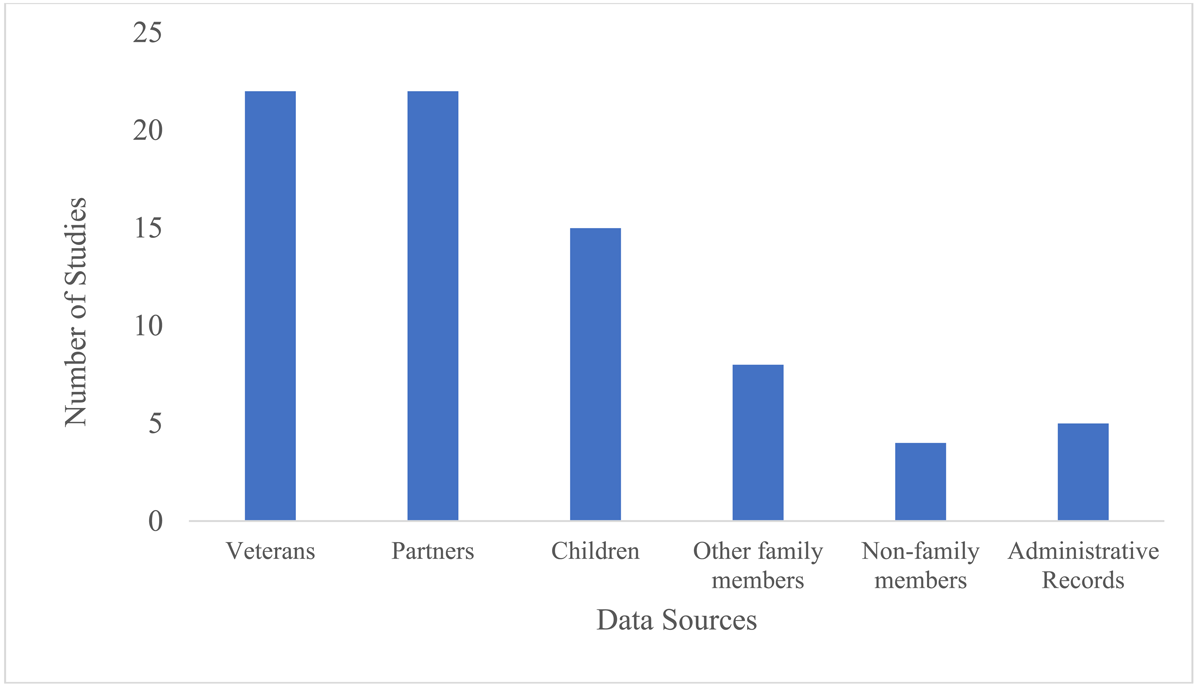
Figure 2
Frequencies of Data Sources Sampled in Veteran Family Studies Published between 2018–2023.
Note. Some studies used more than one data source; thus, the total is greater than 42.
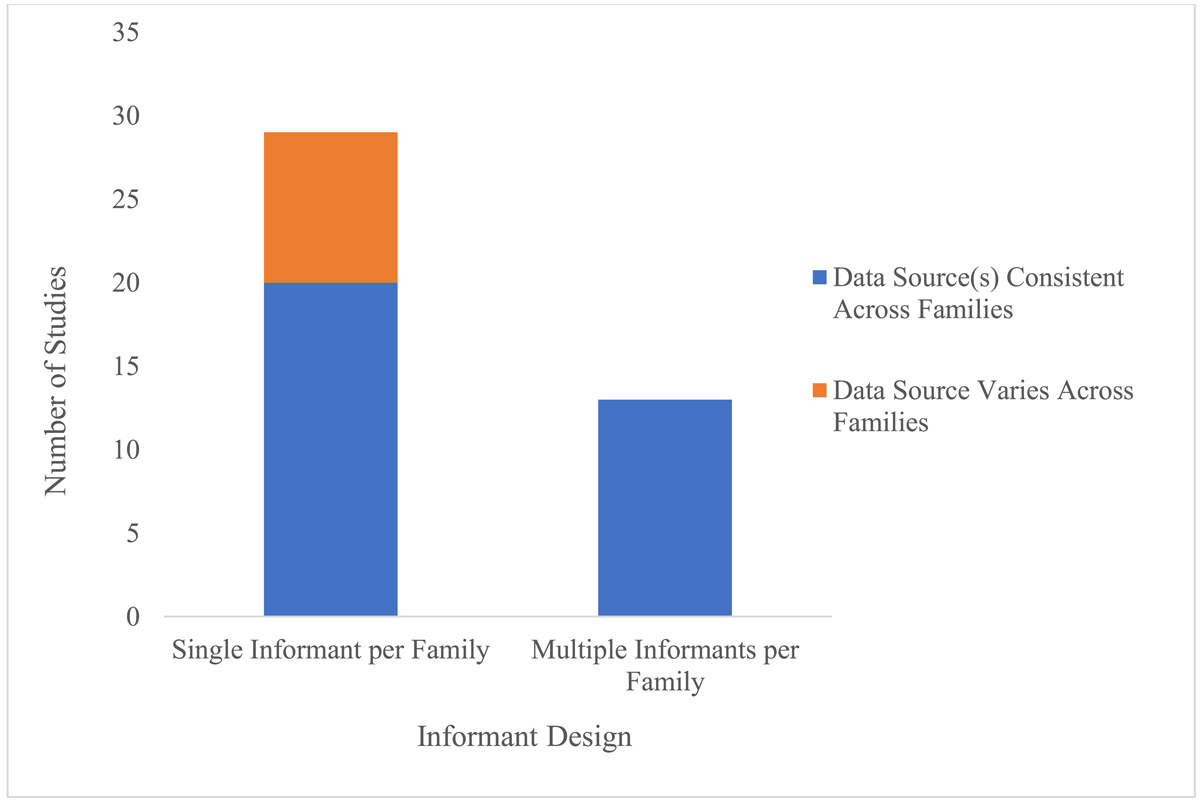
Figure 3
Frequencies of Informant Designs in Veteran Family Studies Published between 2018–2023.