
While national governments have invested in employment programs for veterans to aid a successful transition from military to civilian life, there is a lack of rigorous evidence and evaluation of military to civilian employment transition experiences (Becker & Smidt, 2022; Wang et al., 2021). Research has found that two-thirds of the United States (US) service men and women have significant difficulty transitioning from the military to other professions (Bond et al., 2022a) due to substantial changes to daily schedules, home life, and navigating the new social norms of civilian life (Mobbs & Bonanno, 2018). Barriers can also be faced when there is a lack of support with military transition to civilian employment (Keeling et al., 2018; Roy et al., 2020) and when veterans face employer stigma and discrimination; in particular, concerns about veteran mental health (Keeling et al., 2018).
Moreover, challenges can also be exacerbated by service-related mental health issues (e.g., posttraumatic stress disorder [PTSD]) and physical disability, which can affect daily functioning and the ability to engage in work and society effectively (Harris et al., 2017; Shepherd-Bannigan et al., 2021). Within the United Kingdom (UK), service leavers have been found to face “Significant and complex comorbid mental health and wellbeing difficulties, including depression, anxiety, addictions, homelessness, social exclusion, and unemployment” (Weir et al., 2017, p. 647). There is growing recognition within UK policy and practitioner spheres of the increasing health and social needs of veterans, the need to continually investigate factors preventing successful integration, and the importance of creating employability interventions for the most disadvantaged groups in the labour market (Office for Veteran Affairs, 2022; Valizade et al., 2023).
Employment and vocational-based interventions are targeted programs aiding in veterans’ employment. Existing research has only focused on the employment outcomes of veteran employment interventions, with health and wellbeing-related outcomes not well-documented. The World Health Organization (WHO) defines health as “a state of complete physical, mental and social wellbeing and not just the absence of disease or infirmity” (World Health Organization [WHO], 2020, p. 1). For this review, health and wellbeing refers to a broad definition of health explicitly encompassing wellbeing. This article aimed to review existing international literature on employment and vocational-based employment programs to understand their impact on the health and wellbeing of veteran populations to inform policy and practice on how veterans can be effectively supported in their transition from military to civilian employment.
Barriers to Veteran Participation in Employment and Vocational Practices
Broadly, researchers and policymakers concur that active participation in the labour workforce provides a range of psychosocial benefits, leading to greater wellbeing for general populations (Creed & Macintyre, 2001; Wang et al., 2021). Engaging in stable, secure, and fulfilling employment can impact individuals by providing purpose, building self-esteem, and creating new social networks (Bambra, 2011; Wheatley, 2017). Further, employment can serve as a protective factor against severe mental health issues, such as depressive disorder and suicidal ideation (Elbogen et al., 2020). At the same time, unemployment or loss of employment is commonly linked to negative health and wellbeing outcomes, including mental health problems and poor life satisfaction (Marmot & Wilkinson, 2005; Norström et al., 2014).
For veteran populations specifically, evidence suggests that employment is instrumental in enabling the successful transition to civilian life (Carra et al., 2021; Keeling et al., 2019). Veterans often struggle with civilian workplace integration due to workplace discrimination, recruiter reluctance, social exclusion, and issues with daily functioning (Gonzalez & Simpson, 2021; Tholen, 2024). Further, veteran populations face barriers in finding work that is concurrently stable, well-paid, secure, and fulfilling (Weir et al., 2017; Park et al., 2021), and that aligns with existing skills and military qualifications (Dexter, 2020; Keeling et al., 2018).
Work integration has been identified as a specific challenge for veterans with physical and mental service-connected disabilities, who constitute a significant proportion of veteran populations (Kukla & Bond, 2013). In 2016, 53% of 9,000 newly discharged veterans in the United States (US) reported chronic physical conditions, and 33% reported chronic mental health conditions (Vogt et al., 2020). In the UK, evidence also suggests a greater prevalence of common mental health problems (e.g., anxiety and depression) in military populations compared to the general population (Goodwin et al., 2015; Fulton et al., 2019). Research also shows higher unemployment rates of younger veterans, aged 18–24, in the US compared with their civilian counterparts (Loughran, 2014)—particularly for veterans with registered physical and mental disabilities (US Bureau of Labor Statistics, 2022).
Current Veteran Employment and Vocational-based Interventions
Globally, veteran populations are sizeable. In the US, there are approximately 20.4 million veterans (Gonzalez & Simpson, 2021), increasing by 200,000 every year (Bond et al., 2022a). There are approximately 2 million veterans in England and Wales (Office for National Statistics, 2021), with 15,000 people leaving the Armed Forces annually (Office for Veterans’ Affairs, 2022). Given large military forces and historical engagements in conflicts, veteran populations in China, Russia, and India are similarly substantial (Maharajan & Krishnaveni, 2017), although exact numbers are difficult to assess.
In the US, more than 20,000 public and private programs are available to help veterans with housing, healthcare, social connections, and legal services, with employment and vocational-based programs constituting the most sought-after support (Perkins et al., 2020). The Veterans Health Administration (VHA) offers a national Vocational Rehabilitation Program (VRP) that includes supported employment and transitional work experience for veterans with various health conditions (Abraham et al., 2017; Penk et al., 2010). Employment programs are also delivered by the US Department of Labor and the Veteran Benefits Administration, including job training, skills coaching, and curriculum vitae development.
Like the US, the Department for Veteran Affairs Australia and Veteran Affairs Canada manage the transition through a range of government-funded specialised units; however, they are not as well-established as in the US. The Australian Prime Minister’s National Veterans Employment Program includes training, competency mapping, job search skills, and incentives for employers to employ veterans (Australian Government, 2025). Veteran Affairs Canada offers the Prepare to Release program, which includes career transition counselling, curriculum vitae writing, and interview preparation (Government of Canada, 2025). The UK government has various measures to support the employment of veterans transitioning to civilian life (Office for Veterans’ Affairs, 2022). The Career Transition Partnership, delivered by the Ministry of Defence, provides employment-focused support, including job searches, career advice, accredited skills training, and workplace trials (Stone & Stone, 2015). This expands the transition from two years before leaving to two years after service. Additionally, services are provided by non-state organisations, such as Lifeworks by the Royal British Legion Industries (RBLI) (Royal British Legion Industries [RBLI], 2025) and the Ex-Force Employment Programs by the Forces Employment Charity (Forces Employment Charity, 2025).
Some scholars have posited that the benefits of employment and vocational services might be limited to employment-based outcomes, with health and wellbeing benefits not being prominent enough for research consideration (Hatton, 2024; Kukla & Bond, 2013; Leddy et al., 2014). However, given the emphasis on the role of employment in both generating positive health and wellbeing effects and negating mental health challenges, it is important not only to understand the impacts of employment as an end goal but also the impacts of the processes of transitioning into civilian employment on veteran health and wellbeing.
Methods
A scoping review of the literature was conducted between October 2022 and August 2023 using peer-reviewed studies to identify literature related to the impacts of employment and vocational-based interventions on the health and wellbeing of veterans. For the review, employment and vocational-based interventions were defined as targeted programs to aid the veterans’ employment. Researchers used the databases ProQuest, PubMed, Embase, Wiley Online, and Science Direct to search a combination of the following keywords: veteran, ex-service, vocation, employment, job, workplace, wellbeing, health, training programme, program, and intervention. For inclusion, articles had to (a) be peer-reviewed, (b) report primary data on health and wellbeing outcomes from studies of employment or vocational-based interventions with veterans, (c) provide evidence outcomes for veterans only, and (d) be written in English. Given the scoping nature of the review, articles were not formally assessed for quality (Arksey & O’Malley, 2005), and data was extracted using a Microsoft Excel template.
Results
The literature search identified 987 articles. After removing duplications and screening of titles and abstracts, 16 articles were reviewed as full text (Figure 1). Eight articles were excluded because the study participants were not veterans (n = 3), they only considered employment-based outcomes (n = 3), they focused on barriers to employment rather than an intervention (n = 1), or they focused on healthcare utilisation rather than health and wellbeing outcomes (n = 1). Eight articles were included in the final review (Table 1) highlighting a scarcity of articles in the field.
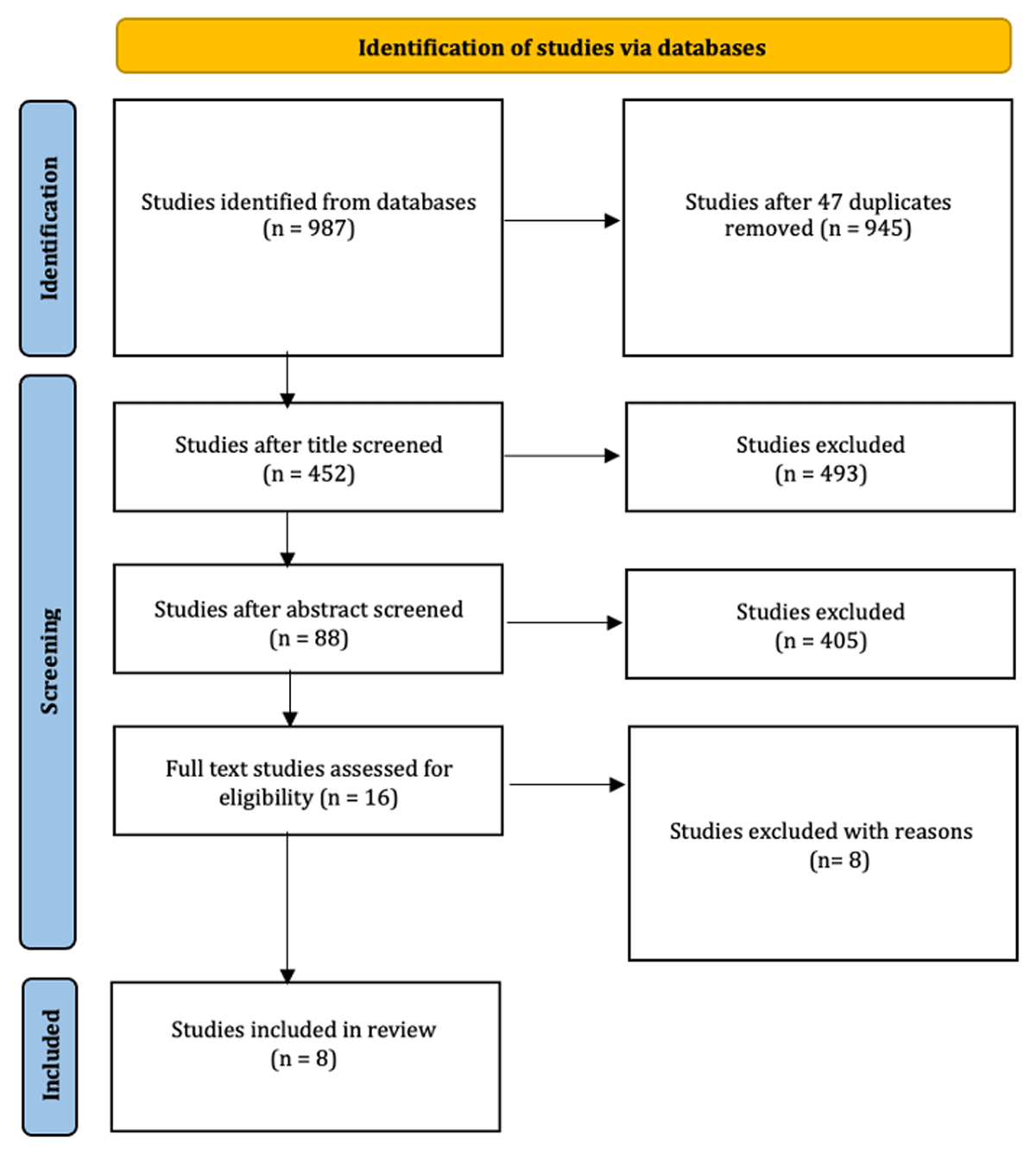
Figure 1
PRISMA 2020 Flow Diagram.
Note. See the PRISMA 2020 Statement from Page et al., 2020.
Table 1
Study and Sample Characteristics.
| STUDY | STUDY DESIGN | PARTICIPANTS | SELECTED QUANTITATIVE HEALTH AND WELLBEING OUTCOMES |
|---|---|---|---|
| Hammer et al. (2019) [1] | RCT comparing Supportive Supervisor Training (SST) to standard practice SST Group: 16 organisations taking part in SST (n = 275) Control Group 19 organisations on waiting list (n = 222) Assessment at baseline, 3 months; 9 months | Service members from the Northwest region of the US, currently employed in the civilian workforce (with some still in active contracted duty e.g., part time) National Guard members (Army and Air), Army Reserves, Marine Reserves, Navy Reserves, Air Force Reserves, Coast Guard Reserves, Army, Navy, Air Force, Marine, Coast Guard Average age 39.91 years (at baseline) 83.7% male, 16.3% female (at baseline) | Reported as Group: Baseline 3 months; at 9 months Perceived health [4 item scale, adapted from Hobfall et al., (2012). (1 (to no extent/never) to 5 (a very great extent/all the time); reported as an average response, a higher value indicates better health. SSTGroup: 3.56 (±0.88); 3.63 (±0.82); 2.54 (±0.88) Control Group: 3.67 (±0.81); 3.74 (±0.75); 3.58 (±0.84) Walter Reed Functional Impairment Scale [14 items; 1 (no difficulty at all) to 5 (extremely difficult); reported as an average response; lower score indicates less impairment] SST Group: 1.71 (±0.63);1.67 (±0.66); 1.67 (±0.69) Control Group: 1.72 (±0.63); 1.68 (±0.58); 7.64 (±0.59) Difference between groups at 3 months; at 9 months Perceived Health: NSD p = 0.519; NSD p = 0.302 Functional Impairment: NSD p = 0.526; NSD p = 0.747 |
| Mohr etal. 2021 [2] | RCT comparing Supportive Supervisor Training (SST) to standard practice Secondary analysis included only individuals who were married or cohabiting SST Group 16 organisations taking part in SST (n = 72) Control Group: 19 organisations on the waiting list (n = 72) Assessment at baseline, 6 months | National Guard members, reservists, and separated (former) service members (termed veterans) and married or cohabiting partners (referred to as spouses) from across Oregon and Southwest Washington, US Average age 38.4 years (at baseline) 91% male, 9% female (at baseline) | Reported as Group: baseline; 6 months Positive and Negative Emotion: PANAS-X [9 items (5 negative, 4 positive emotions), 1 (not at all) to 5 (extremely); reported as average response; individual emotions and composite scores, higher value indicates more emotion] Negative emotion composite score SST Group: 1.43 (±0.22); 1.40 (±0.26) Control Group: 1.40 (±0.22); 1.39 (±0.28) Positive emotion composite score SST Group: 2.48 (±0.72); 2.47 (±0.71) Control Group: 2.52 (±0.67); 2.38 (±0.52) Difference between groups at 6 months Negative composite: NSD p > 0.05 Positive composite: NSD p > 0.05 Relaxed: positive effect p < 0.001 Quiet: positive effect p < 0.001 other individual emotions: NSD p > 0.05 |
| Hammer et al. 2020 [3] | RCT comparing Supportive Supervisor Training (SST) to standard practice. Secondary analysis included individuals matched with a participating supervisor. SST Group 16 organisations taking part in SST (n = 79) Control Group 19 organisations on the waiting list (n = 110) Assessment at baseline, 3 months; 9 months | Veterans and supervisors employed within organisations (matched together) from the Northwest region of the US National Guard members (Army and Air), Army Reserves, Marine Reserves, Navy Reserves, Air Force Reserves, Coast Guard Reserves, Army, Navy, Air Force, Marine, Coast Guard Veteran Participants: Average age 39 years (at baseline) 85.5% male, 14.5% female | Reported as Group: baseline; 3 months; 9 months Pittsburgh Sleep Quality Index [selected items; sleep quality using one item on overall sleep quality 1 (very bad) to 4 (very good); sleep duration time between lights off and getting out of bed. Sleep Quality: SST Group: 2.46 (±0.71); 2.59 (±0.72); 2.59 (±0.86) Control Group: 2.46 (±0.70); 2.56 (±0.64); 2.56 (±0.65) Sleep Duration [hours]: SST Group: 7.11 (±1.24); 7.30 (±1.22); 7.26 (±1.16) Control Group: 7.23 (±1.18); 7.27 (±1.08); 7.19 (±1.17) Perceived Stress [4 item scale, adapted from Cohen et al, 1983; 1 (never) to 5 (often), reported as an average response, higher values indicate more perceived stress] SST Group: 2.38 (±0.86); 2.43 (±0.74); 2.34 (±0.92) Control Group: 2.41 (±0.84); 2.43 (±0.64); 2.20 (±0.77) Difference between groups at 3 months; at 9 months Sleep Quality: NSD p = 0.35; NSD p = 0.48 Sleep Duration: NSD p = 0.59; NSD p = 0.41 Perceived Stress: NSD p = 0.62; NSD p = 0.15 |
| Leddy et al. 2014 [4] | Observational (cross-sectional) study of Supported employment (IPS) and/or transitional work experience (TWE) Two cohorts progressing through the same Veterans Affairs (VA) centres. The Initial cohort was offered standard VA services, including TWE. The Second cohort was offered both IPS and standard VA services, including TWE. Secondary analysis combined data from both cohorts for this analysis and reported as five groups based on the support received and working status across 6 months. Group 1: no IPS, no TWE, not working (n = 100) Group 2: no IPS, TWE, not working (n = 96) Group 3: no IPS, TWE, working (n = 30) Group 4: no IPS, no TWE, working (n = 58) Group 5: IPS, no TWE, working (n = 158) | Homeless veterans with psychiatric or substance use disorders from three Department of Veteran Affairs sites across the US Age range: 44–47 years Over 90% male | Reported as, Time: Group 1; Group 2; Group 3; Group 4; and Group 5 Health Related Quality of Life measured by Short From 12 [SF-12, 12 items, reported as physical and mental composite score, range 0–100, higher scores indicate better physical and mental health functioning] SF-12 physical component (PCS) Baseline: 46.86; 47.24; 48.84; 49.47; 48.99 Changeat 6 months: –1.15; –0.72; –0.44; –0.38; –0.76 SF-12 mental component (MCS) Baseline: 42.46; 41.47; 44.90; 45.52; 45.67 Changeat 6 months: 0.53; 1.66; 5.33; 2.74; 3.68 Subjective distress [33 items from symptom checklist 90 SCL-30, 0 (not at all) to 4 (extremely), report as an average response; higher values indicate more distress] Baseline: 1.08; 1.15; 1.08; 0.95; 0.81 Change at 6 months: –0.15; –0.26; –0.38; –0.33; –0.27 Difference Between Groups at 6 months SF-12 PCS: NSD p = 0.98 SF-12 MCS: NSD p = 0.15 SCL-30: NSD p = 0.17 |
| Ottomanelli et al. 2013 [5] | RCT comparing a Supported employment program (SE) to control SE Group: Participants received supported employment (n = 81) Control Group: Participants received treatment as usual (n = 76) Assessment at baseline; 12 months | Veterans with spinal cord injury (SCI) receiving healthcare from one US Veterans Affairs Medical Center (VAMC) Average age 48.5 years 95.5% male, 4.5% female | Reported as Group baseline; 12 months Veteran specific health related quality of life VR-36 [36 items; 3-point response scale, reported as physical component and mental component sub-scores, range 0–100, higher values represent between physical and mental health functioning] VR-36 physical component (PCS) SE Group: 27.7 (±7.5); 29.3 (±7.7) Control Group: 28.1 (±8.4); 27.6 (±7.9) VR-36 mental component (MCS) SEGroup: 54.7 (±13.8); 55.1 (±14.3) Control Group: 55.6 (±12.9); 55.0 (±14.2) Functional Independence Measure [FIM, 18-items 1 (total assistance) to 7 (complete independence), report as the sum of scores, total score composed of the sum of cognitive (range 5–35) and mobility (range 13–91) components, higher scores indicate more independence FIM cognitive SE Group: 33.8 (±2.3); 33.9 (±2.2) Control Group: 33.7 (±2.8); 34.1 (±1.5) FIM mobility SE Group: 66.9 (±21.6); 70.7 (±17.4) Control Group: 66.4 (±22.2); 67.4 (±20.8) Craig handicap assessment and reporting technique (CHART) [32 items, six dimensions (cognitive independence, physical independence, mobility, occupation, social integration, economic self-sufficiency), range 0–100; higher values represent lesser degree of disability or higher degree of social/community participation] CHART economic self-sufficiency SE Group: 51.5 (±37.8); 56.8 (±36.1) Control Group: 52.6 (±36.9); 59.1 (±3.8) CHART physical independence SE Group: 85.7 (±20.9); 87.4 (±20.3) Control Group: 87.2 (±22.1); 86.7 (±23.8) |
| Bond et al. 2022a [6] | RCT comparing an intensive employment model (National Career Coach Program; NCCP) to control NCCP Group: Participants receiving NCCP intensive training scheme (n = 115) Control Group: Participants referred to local services (n = 114) Assessment at baseline, 12 months | Transitioning veterans from across the US with self-reported service-connected disabilities seeking permanent employment. Without civilian employment or unemployed or working short term jobs and receiving for a service-connected disability rating and compensation Average age 30.3 years 80.6% male, 19.2% female | Reported as, Group: baseline; 12 months [difference baseline to 12 months] Veteran specific health related quality of life VR-12 [12 items; reported as physical component and mental component sub-scores, range 0–100, higher scores indicate better physical and mental health function] VR-12 physical component (PCS) NCCP Group: 39.57 (±11.23); 12 months: 41.57 [p = 0.04] Control Group: 41.99 (±10.81); 38.39 (±11.51) [p = 0.001] VR-12 mental component (MCS) NCCP Group: 42.53 (±13.66); 45.07 (±13.70) [p = 0.04] Control Group: 45.05 (±14.52); 42.87 (±15.52) [p = 0.11] Depression: Patient Health Questionnaire-9 [PHQ-9; 9 items 0 to 3, sum to score, range 0–27, higher values indicate more severe depression] NCCP Group: 8.74 (±6.58); 8.18 (±5.67) [p = 0.29] Control Group: 8.08 (±5.92); 8.68 (±7.07) [p = 0.31] InCharge Financial Distress Financial Wellbeing [IFDFW; 8 items, 1 to 10, reported as an average response; higher values indicate less financial distress and more financial wellbeing] NCCP Group: 5.73 (±2.49); 6.52 (±2.24) [p = 0.001] ControlGroup: 5.15 (±2.68); 5.87 (±2.86) [p = 0.01] Difference between groups from baseline to 12 months VR-12 PCS: NCCP Group better p < 0.001 VR-12 MCS: NCCP Group better p = 0.02 PHQ-9: NSD p = 0.14 IFDFW: NSD p = 0.86 |
| Bond et al. 2022b [7] | RCT comparing an intensive employment model (National Career Coach Program; NCCP) to control NCCP Group: Participants receiving NCCP intensive training scheme (n = 115) Control Group: Participants referred to local services (n = 114) Assessment at baseline, 24 months | Transitioning veterans from across the US with self-reported service-connected disabilities seeking permanent employment. Without civilian employment or unemployed or working short term jobs and receiving for a service-connected disability rating and compensation. Average age 30.4 years 81.2% male, 18.8% female | This is a follow-up study from [7]; see entry in table above for tool information. Note that the analysis on a smaller sample due to dropouts, so baseline is not identical. Reported as, Group: baseline; 24 months [difference baseline to 24 months] VR-12 PCS: NCCP Group: 40.04 (±11.38); 43.80 (±10.91) [p = 0.002] Control Group: 42.22 (±11.13); 40.55 (±15.30) [p = 0.31] VR-12 MCS: NCCP Group: 43.37 (±12.80); 45.02 (±14.73) [p = 0.62] Control Group: 47.92 (±13.59); 44.39 (±15.30) [p = 0.05] PHQ-9: NCCP Group: 8.10 (±6.27); 7.59 (±5.52) [p = 0.39] Control Group: 6.61 (±5.04); 7.29 (±6.06) [p = 0.35] IFDFW: NCCP Group: 6.04 (±2.52); 7.24 (±2.57) [p < 0.01] Control Group: 5.41 (±2.91); 6.85 (±2.64) [p < 0.01] Difference between change in groups to 24 months VR-12 PCS: NCCP Group better p = 0.01 VR-12 MCS: NCCP Group better p = 0.03 PHQ-9: NSD p = 0.20 IFDFW: NSD p = 0.59 |
| Shepherd-Banigan et al. 2021 [8] | Qualitative exploration of facilitators and barriers of veterans and carers engaged in Supported employment, vocational, and educational services (VR&E). Assessment: Qualitative semi-structured one-off telephone interviews. | Veterans with disabilities and caregiving needs who were enrolled in a Veteran Affairs programme of comprehensive assistance for family caregivers (and their family members) from across the US Disabilities include musculoskeletal problems, PTSD, mental health conditions Average age 42.2 years 100% male | n/a |
[i] Note: No Significant Difference (NSD).
For this review, all articles are referenced using an identification number (1–8) corresponding to Table 1. As shown in Table 1, all the included studies were from the US. Most studies were quantitative and used validated health, daily functioning, and employment measures. Study 8, a qualitative study, used tailored questions. Five studies (1, 2, 3, 6, and 7) were Randomised Control Trials (RCTs) of a program or intervention that was created specifically for the study. Three studies (4, 5, and 8) were evaluations of existing interventions.
Veteran Demographics
Study participants were from various branches of the US Armed Forces (e.g., Army, Air Force, Navy, Marine Corps, and Coast Guard). The average veteran participants were white males aged 34.5 years, which mirrors the gender balance of the US Armed Forces (Dichter et al., 2022). Five studies (1, 2, 3, 6, and 7) included veterans with no specified health issues or none that were disclosed for the study. Study 4 sampled homeless veterans diagnosed with a psychiatric disability and substance use issues. Study 5 sampled veterans with spinal cord injury (SCI), and study 8 sampled veterans with musculoskeletal problems, PTSD, and mental health conditions. Several studies reported the same RCT (1, 2, 3, 6, and 7).
Interventions
The eight articles explored four types of employment and vocational-based interventions: Supportive Supervisor Training (SST), Supported Employment (SE), Transitional Work Experience (TWE), and a National Career Coach Program (NCCP).
Three articles (1, 2, and 3) studied the impacts of SST and described their components, which included emotional support, instrumental support, role modelling, measurement and direction, feedback and coaching, provision of resources, health protection, and creative work-family management. Three articles (4, 5, and 8) studied the impact of a form of SE. Components of SE included rapid job placement, access to competitive jobs, long-term workplace support, integration of vocational support, and integrated clinical care. SE is a commonly used approach for veterans with physical and mental disabilities, and all three of the studies (4, 5, and 8) involved veterans with issues related to spinal cord injury (SCI), PTSD, and substance misuse.
Study 4 highlighted the impacts of TWE, which is followed by SE. In this case, TWE was described as a job placement within a community or contracted company paid by compensation or minimum wage, and components included structured work settings, being accompanied by program staff members, on and off-site training, and the ability to move between different placements. Two articles (6 and 7) studied the impacts of a one-off intensive employment model— the NCCP. Components of the program included a four-day in-person employment skills seminar, 18 months of personalised job coaching, a human capital fund to pay for job expenses, bonus opportunities for employment earnings, and individual mentoring and coaching. Although the four types of interventions are studied as distinct types in the reviewed articles, the content has similarities (Table 2). For the analysis, the four types of intervention were examined separately due to a lack of detailed information about the components of each and how they might compare across interventions.
Table 2
Content of Each Employment and Vocational-based Intervention.
| CONTENT OF THE PROGRAMME | SUPERVISOR SUPPORT TRAINING (SST) | SUPPORTED EMPLOYMENT (SE) | TRANSITIONAL WORK EXPERIENCE (TWE) | NATIONAL CAREER COACH PROGRAM (NCCP) |
|---|---|---|---|---|
| Support services (including emotional, instrumental, workplace, vocational, training, skills development) | X | X | X | X |
| Measurement, monitoring, and direction (setting goals and measuring results) | X | |||
| Feedback/coaching/ mentoring/ role modelling | X | X | ||
| Resource provision (provision of finances, equipment, and/or materials to aid employment) | X | X | ||
| Health-related aspects (health protection/ integrated clinical care/ medical rehabilitation) | X | X | ||
| Family support (to help veterans meet family and personal demands) | X | |||
| Placement opportunities Access to competitive jobs/ job placement (including flexibility of placement, incentives for employment) | X | X |
Studies 1, 2, and 3 were from the same RCT of a computerised SST program designed to improve the health and work outcomes of veterans entering civilian life after the post-9/11 conflicts. These studies were quantitative and used a mixture of validated (e.g., perceived health and functional impairment scale) and non-validated measures for health and wellbeing (see Table 1). Assessments in each study were undertaken at baseline and at a 3, 6, and 9-month follow-up; however, each article reported on different sets of outcomes and follow-up points. Fundamentally, SST had no statistically significant effect on the health and wellbeing of participating veterans.
In study 1, Hammer et al. (2019) reported veterans’ functional impairment and perceived health at baseline and after 3 and 9 months. The measure of perceived health included questions about the extent of health problems and how much their health restricted participation in daily activities. In study 3, Hammer et al. (2020) reported self-reported sleep duration, sleep quality, and perceived stress after 3 and 9 months. There were no statistically significant differences in any of these outcomes in the 3- or 9-month follow-up. However, changes to perceived health at 9 months were statistically significant and moderated by the veteran’s perceptions of the supportive behaviour of supervisors leading the training program. Therefore, a more supportive supervisor was associated with improved perceived health. Additionally, sleep quality at 9 months and perceived stress at 3 and 9 months were statistically significant and moderated by the supervisor’s attitude toward veterans. Therefore, supervisors having a more positive attitude toward veteran employees was associated with better sleep quality and reduced stress. In conclusion, these studies established that in a favourable environment with higher levels of social support, SST could be more effective for health and workplace outcomes.
In study 2, Mohr et al. (2021) explored the effect of SST training on positive and negative emotions (Positive and Negative Affect Schedule [PANAS-X]) at 6 months. Training had no statistically significant effect on most emotional outcomes, but veterans who received SST reported being significantly calmer, more relaxed, and quieter. Additionally, PTSD symptoms moderated the effect of training on emotions, as individuals with higher levels of PTSD symptoms experienced a significant reduction in negative daily emotions after 6 months of training compared to those with lower levels.
Supported Employment (SE)
Three studies (4, 5, and 8) specifically examined the impacts of SE on veterans. In study 4, Leddy et al. (2014) measured the health and wellbeing of two cohorts of homeless veterans with diagnosed psychiatric disabilities and substance use problems. The first cohort received TWE, and the second cohort received TWE and SE. Data from both cohorts were combined for analysis and then separated into five groups based on a combination of support received (none, TWE, and SE) and employment situation (e.g., in commercial employment or not). There were no statistically significant differences between support/employment groups at 6 months in any of the health measures, which included substance use and addiction severity, perceived distress, and health-related quality of life. The only statistically significant difference was related to vocational outcomes, which indicated that those receiving SE rather than just TWE were more likely to end up in competitive employment.
In study 5, Ottomanelli et al. (2013) assessed outcomes of veterans with SCI every 3 months up to 1 year. Validated health measurements for this study included the Veteran- RAND 36 (VR-36), which measures health-related quality of life; Craig Handicap Assessment and Reporting Technique (CHART), which measures how veterans’ function within the community or population; and the Functional Independence Measure (FIM), which measures how veterans function independently. Although the study was an RCT with groups receiving SE or treatment as usual, results were not reported statistically for the effect of the training group, but only the joint associations between the training group and employment status. An improvement in several health and wellbeing measures at 12 months was reported for individuals in the SE group, with the largest improvements for measures of mobility. The authors reported that some changes were statistically significant but did not clearly report which outcomes were statistically different. The initial hypothesis of this study that the health-related quality of life scores of veterans receiving SE would change was not supported.
In study 8, Shepherd-Banigan et al. (2021) used qualitative semi-structured interviews with veterans with disabilities and their caregivers regarding their experiences of SE as part of a wider vocational and educational service program. Other aspects of the program included education and career counselling, financial benefits for tuition and fees, books and supplies, and a monthly stipend. For this review, only findings related to SE are included. Participating veterans had musculoskeletal problems, PTSD, and other mental health conditions, and caregivers were primarily family members. Interview questions included barriers and facilitators to engaging with the program, the value of the service, how it aligned with expectations, and how the service supported life goals.
It was found that SE improved the self-confidence of veterans by allowing them to interact with the public and refamiliarize themselves with employment processes, which guided their focus and expectations. The study also reported that SE helped veterans cope with anxiety by breaking down tasks. Finally, the study found that SE improved veterans’ quality of life by helping them to pursue goals, make plans, and increase their overall wellbeing. While the study identified specific health and wellbeing impacts, it was unclear how many of the veterans interviewed reported each outcome and whether this information came from the veterans or their caregivers. Therefore, the validity and generalisation of these findings are unclear, and causal inference is weak.
Transitional Work Experience (TWE)
In study 4, Leddy et al. (2014) studied the impacts of TWE, alongside SE, on homeless veterans with diagnosed psychiatric disability and substance use problems, and there were no statistically significant changes in any of the outcomes related to the impact of TWE on the health and wellbeing of veterans.
National Career Coach Program (NCCP)
In studies 6 and 7, Bond et al. (2022a; 2022b) evaluated the same RCT by comparing a cohort of veterans participating in an intensive employment model called the National Career Coach Program (NCCP) with a cohort participating in standardised employment services, reporting outcomes at 12 months (6) and 24 months (7). The standardised employment services included referrals to local service providers that offered veterans training, financial assistance, and paid work experience. In contrast, the NCCP model was a unique, comprehensive, and time-specific intervention. Studies reported on the Veterans RAND 12-Item Health Survey (VR-12), the Patient Health Questionnaire for perceived depression (PHQ-9), the Incharge Financial Distress/ Financial Wellbeing Scale (ICFDFW) at both time points, and substance use and disability (24 months only).
There were statistically significant changes in some health and wellbeing outcomes at 12 or 24 months compared to baseline. Physical health-related quality of life significantly improved in the NCCP group at both time points but significantly decreased in the standardised employment group at 12 months. This led to a statistically significant difference between the groups at both time points in favour of the NCCP group. There was also a statistically significant difference in favour of the NCCP group in the mental component of health-related quality of life at 24 months. However, this was driven by a statistically significant reduction in the standardised employment group compared to no change in the NCCP group. The financial distress/wellbeing score significantly increased, indicating less distress, in both groups at both time points, but there was no difference between the groups.
Both groups had a similar pattern of significant increases, but no statistically significant difference between groups was seen for disability score at 24 months. Substance use was reported to be statistically significantly lower at 12 months and continuing to decrease at 24 months for the use of prescription opioids in both the NCCP (29% reduction at 24 months) and the standardised employment (35% reduction at 24 months) group, tobacco use in the NCCP group (13% reduction at 24 months), and number of alcohol drinks in the NCCP group (–4.4 drinks/week). There were no statistically significant changes over time or differences between groups for self-reported depression. Table 3 summarises the health and wellbeing outcomes of all the specific interventions.
Table 3
Summary Table of Identified Links from a Review of Impacts of Employment and Vocational-based Interventions on the Health and Wellbeing of Veterans.
| EMPLOYMENT AND/OR VOCATIONAL INTERVENTION | HEALTH STATUS | HEALTH AND WELLBEING OUTCOMES |
|---|---|---|
| Supportive Supervisor Training (SST) | No diagnosed health issue specified | Improved perceived health moderated by perceived support [1] Improved daily emotions related to being calm, quiet, and relaxed [2] Reduced negative emotions in those without any PTSD symptoms [2] Improved sleep quality moderated by supervisor support [3] Improved perceived stress moderated by supervisor support [3] |
| Supported Employment (SE) | Spinal cord injury (SCI) Veterans with disabilities, musculoskeletal problems, and/or PTSD and/ or mental health condition Diagnosed psychiatric disability and/or a substance use problem | Improvement in mobility (unclear whether statistically significant) [5] Improved self-confidence [8] Decreased anxiety [8] Improved quality of life [8] No significant findings [4] |
| Transitional Work Experience (TWE) | Diagnosed psychiatric disability and/or a substance use problem | No significant findings [4] |
| National Career Coach Program (NCCP) | No diagnosed health issue specified | Improved physical health-related quality of life [6, 7] Maintained mental health-related quality of life [6, 7] Decreased financial-related distress [6, 7] Decreased tobacco use [6, 7] Decreased opioid use [6, 7] Decreased alcohol use per week [7] |
Limitations
Most of the studies reviewed (1, 2, 3, 5, 6, and 7) recognised that pre-intervention contexts and circumstances of individuals may have impacted the intervention’s effect on veteran health and wellbeing. However, all studies lacked data on the extent to which individuals had already been supported outside of the intervention, including other employment programs, whether they already had a high level of life or job satisfaction, and how motivated veterans were to take part in an intervention or seek/maintain employment. Therefore, there was an overall recognition in studies 1, 2, and 5 that pre-intervention circumstances may have led to baseline measurements having a “ceiling effect” where health and wellbeing variables may have already been at a positive level, resulting in less room for improvement in veteran populations.
In study 2, Mohr et al. (2021) noted limits in terms of an inability to identify whether existing PTSD symptoms might have impaired the veteran’s ability to feel any positive benefits of the intervention. In study 8, Shepherd-Banigan et al. (2021) found that veterans with disabilities may have been disincentivised to engage in the intervention if becoming employed led to a loss of disability support (i.e., benefits or therapy). Further, the three RCT studies on SST (1, 2, and 3) found that effects on veteran health and wellbeing could depend on the organisation’s experience of delivering an intervention, whether existing support structures were in place, and the attitudes and behaviours of supervisors delivering.
All the studies were further limited in their inability to identify causality between the intervention and specific health and wellbeing outcomes. For example, while verifying that the intensive employment model (NCCP), the intervention was “multi-component” (e.g., in-person workshops, remote career counselling, and bonuses), and the design of Bond et al.’s studies (6 and 7) did not infer which of the components were the most effective, or whether components might work together to elicit positive health outcomes. Short-term measurement of outcomes was recognised as a specific limitation for longitudinal studies (3, 4, and 5). In study 3, Hammer et al. (2020) felt that their short-term study of measuring outcomes at 3 and 9 months found no significant outcomes for health and wellbeing. Therefore, larger-scale changes might take longer to capture as they accumulate over time. Similarly, in study 4, Leddy et al. (2014) recognised that capturing data using a 6-month follow-up may not show meaningful change due to short-term intervention engagements.
Discussion and Conclusions
This scoping review sought to understand the impact of employment and vocational-based interventions on the health and wellbeing of veteran populations, to identify how and why these outcomes occur, and to highlight opportunities for further research. Only a scarce amount of literature was found, which is surprising considering the importance of successful veteran reintegration into societies and ensuring their good health and wellbeing and the substantial investments made to support veterans after military service. Frequently, health and wellbeing outcomes reported in the reviewed articles were not the focus of the analysis, and clear statements of the effect of different training and support models on the health and wellbeing of veterans were difficult to distinguish.
Nonetheless, this review showed that employment and vocational-based interventions could positively impact veterans by enhancing their perceived physical and mental health, improving or maintaining health-related quality of life, decreasing alcohol and substance use, increasing mobility, and improving self-confidence. Notably, impacts varied across different forms of the interventions, with some programs reporting no significant changes in health and wellbeing outcomes. As such, the composition and elements of the interventions are important when assessing their impact on health and wellbeing. Moreover, the presented findings derive from a small number of studies conducted in one country; therefore, their generalisability might be limited.
Existing studies also fail to identify how and why health and wellbeing outcomes occur, with no causal pathways identified between elements of the interventions and specific health and wellbeing impacts. Each of the four interventions discussed in the review had several crossovers regarding specific components that each delivered (See Table 2). For example, all four interventions included emotional and vocational support services. However, a distinction between program components and exploration of the effects of specific components is generally missing from all studies. Considering the presented evidence, in order to gain a better understanding and inform the development of interventions that effectively support veterans and improve their health and wellbeing, we propose a future research agenda with four key points: (a) broader geographical scope beyond the US, (b) inclusion of qualitative approaches, (c) exploration of the individual components of interventions, and (d) consideration of pre-intervention circumstances and long-term impact.
All the evidence included in this review comes only from the US, where there are more and better-established transitioning veteran employment and vocational-based programs than in other countries. However, country-specific contextual nuance is missing, and generalisable conclusions cannot be drawn. Most studies reviewed were quantitative; however, in study 8, Shepherd-Bannigan et al. (2021) demonstrated a slightly more detailed understanding of the specific causes of health and wellbeing outcomes using a qualitative approach. Exploratory qualitative approaches, such as ethnography or realist enquiry, provide more gradual descriptions of processes leading to health and wellbeing impacts, allowing for specific causation to be identified and providing clarity to policy and practice on what works, for whom, and in what circumstances. For example, a qualitative approach may build on Hammer et al. (2020) —study 3, which worked to enable an in-depth understanding of how and why supervisor behaviour influences health and wellbeing outcomes for veteran populations.
This review demonstrated that while all employment and vocational-based programs were distinct in their definition, the components of each intervention were very similar. It was not possible in the included studies to separate the effects of individual components of the intervention or specific combinations of those components on the health and well-being of the participants. Further research is required to pinpoint which components or dimensions of an intervention might lead to specific outcomes. Indeed, future studies must identify which elements of the interventions were most effective and if and how specific combinations of elements may have a greater impact on veteran outcomes. This is important to enable the effective provision of services for veterans, but in the context of limited funding can also provide information to decision-makers for prioritising services.
Finally, to effectively measure changes in health and wellbeing outcomes, future research must consider pre-intervention contexts and circumstances of veteran research participants. Consideration should be given to individual motivations, the support veterans already receive outside of the intervention, existing health conditions, and baseline life satisfaction levels. Veterans are a population with individual circumstances related to their military experiences, home life, and health status, which was rarely addressed in any articles within this review. Further, most studies considered a broad range of health conditions, making it difficult to draw out any significant findings between specific individuals and groups. This type of information is vitally important when identifying effective interventions for specific groups to promote better delivery and inform robust evaluation. This can be facilitated by long-term longitudinal studies.
The overall health and wellbeing impacts demonstrated in our review only covered positive effects, so it must also be recognised that employment programs may have the potential for negative impacts on the health and wellbeing of veterans. Employment at any cost is not always a positive experience, as work programs are often organised in the form of “therapy” (Hatton, 2024, p. 14) but can actually “intensify marginalisation and exploitation” (Hatton, 2024, p. 14). Therefore, barriers to employment, such as discrimination and social exclusion, can be exacerbated pre- and post-employment. We have proposed a future research agenda based on this scoping review but acknowledge the limitation that a scoping review is not as exhaustive as a systematic review (Munn et al., 2018).
Considering that global veteran populations are increasing annually, and a significant number of these veterans experience poor mental and physical wellbeing and struggle to successfully transition to civilian life and workplaces, further evidence is required to inform policy and define effective practice. We hope this scoping review contributes to an important and growing issue.
Competing Interests
The authors have no competing interests to declare.