
Perched atop the US Department of Education (2022) website dedicated to Veterans and Military Families sits a quote from a “letter regarding military-connected students and families” (para. 2) written by Secretary Miguel Cardona: “Our military-connected students are resilient and know how to grow and thrive in new school environments. To do so, they need the tools and resources that we, as education leaders, must provide to support them in these new environments” (para. 1). While it may be heartwarming to read that military-connected students are resilient, we are left to ponder what tools and resources are appropriate for which military-connected students.
Who, in fact, are military-connected students? Are they active-duty service members who are currently enrolled in a higher education institution? Are they veterans using their Veteran Readiness and Employment (VR&E) or G.I. Bill benefits, or no benefits at all? Are they children or spouses using the G.I. Bill that has been transferred to them? Do they all need the same tools and resources? The term military-connected begs many questions within such a complex and diverse population.
Utilizing Veteran Critical Theory (VCT; Phillips & Lincoln, 2017) and supplemented by works in sociolinguistic discourse, this paper illuminates the interplay between language and identity within the so-called military-connected space and contrasts it to the LGBTQIA+ communities. It posits that the military-connected space can garner invaluable insights from the lexical malleability, and thus the self-reflected identity (Schwandt, 2007) that exists in the identification of the LGBTQIA+ community, forging a more inclusive and evocative narrative. As a consequence of the effort to find a single, all-inclusive term that refers to all who have had a touchpoint with the US Department of Defense (DoD), the term military-connected has gained popularity in recent years. Utilizing analysis of keyword data from Google web searches between January 1, 2022, and December 31, 2023, using Google Trends (GT), the emergence of a new normative identity is evident (Cebrián & Domenech, 2022; Genoe et al., 2021; Lippi et al., 2017; Malagón-Selma et al., 2023). During that time frame and within the education and jobs category of Google, “military-connected” and “veteran” generally trended upwards at about the same rate (see Figure 1). In total there were 859 searches for “veteran” and 544 searches for “military-connected.”
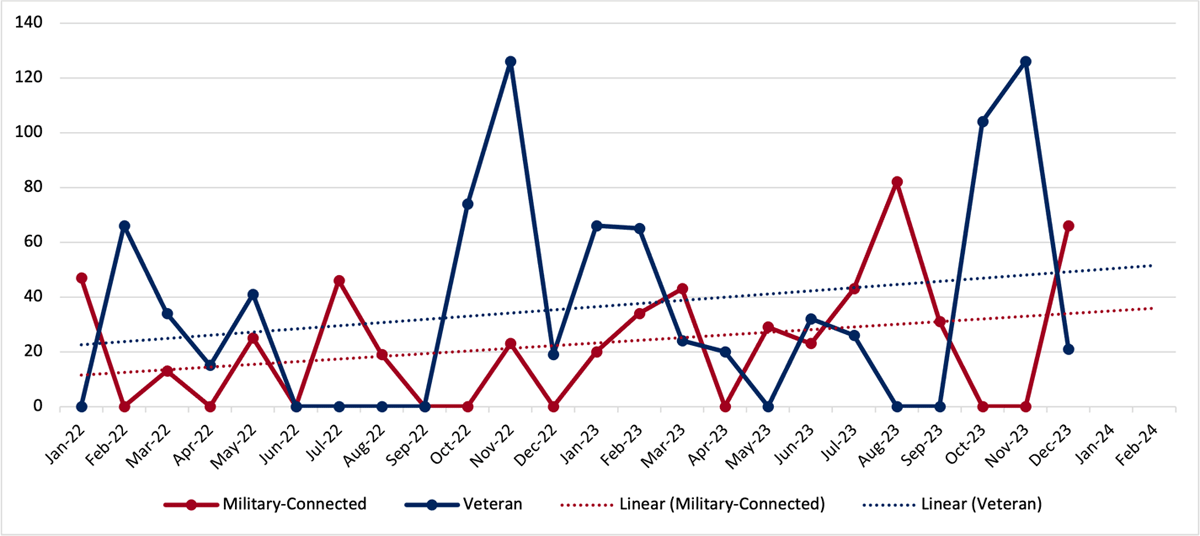
Figure 1
Trends in use of Veteran and Military-Connected in Web Searches From 2022–2023.
Note. This data was acquired using Google Trends, filtered for the category Jobs and Education. The search was done, and figures created by the first author (Abby Kinch).
However, peaks in October and November of both years indicated that Veterans Day may play a role in how prevalent the term was used. A new search was run, this time omitting web searches for “Veterans Day,” but remaining within the education and jobs category. With the omission, the more accurate representation of the increased relative popularity is evident, with the trendline of military-connected surpassing veteran (see Figure 2). In total there were 252 searches for “Veterans Day,” reducing the total searches for “veteran” to 607. While accuracy questions remain, GT is a common proxy for popularity and is valid in social and economic analyses (Cebrián & Domenech, 2022).
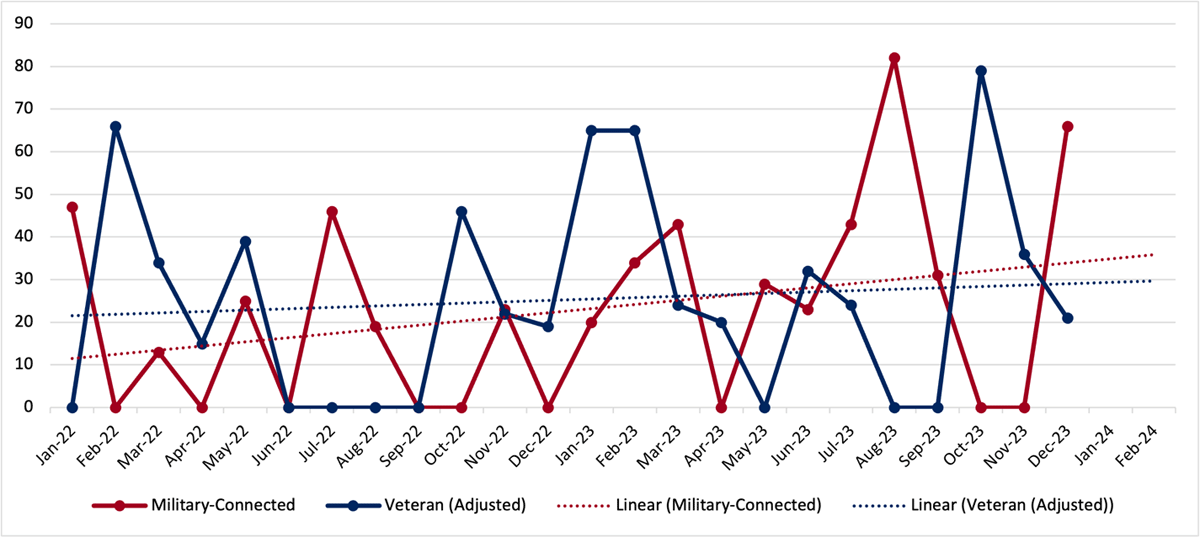
Figure 2
Trends in use of Veteran and Military-Connected in Web Searches from 2022–2023, Excluding Searches Specifically for “Veterans Day.”
Note. This data was acquired using Google Trends, filtered for the category Jobs and Education. The search was done, and figures created by the first author (Abby Kinch).
On its surface, the term appears to be a way to encompass a wide range of individuals who have some form of association with the US military—either through active-duty military service, service in the Reserve or National Guard, past military service, legal familial connection as caregivers of prior military personnel, as survivors of military personnel who have passed, or other association. Despite the intent of the term to encompass a wide range of individuals, this term fails to accurately represent the experiences of veterans, caregivers, and survivors, and often results in their exclusion. It additionally does not reflect the dynamic relationships experienced within the military.
VCT sets the stage within the broader critical theory to understand the words used to describe systems that interact with military veterans (Phillips & Lincoln, 2017; Schwandt, 2007). Additionally, VCT can be expanded to the broader group of students who are active duty, National Guard or Reserve components, family members, caregivers, and survivors, to understand how those systems are used and for whom they are successful. The term military-connected itself implies a connection to the military but doesn’t specify the nature of that connection. Such labels, as VCT identifies, can shape perceptions, and influence the treatment of individuals, potentially reinforcing stereotypes or stigmas (Phillips & Lincoln, 2017).
Further, the application of pragmatic theory offers valuable insights into the adverse consequences of shoehorning active duty, National Guard or Reserve components, veterans, family members, caregivers, survivors, and others into the overarching, homogenous term military-connected. Within this theoretical framework, the pragmatic perspective underscores that language is a tool for communication and meaning-making, deeply intertwined with social practices and context (Ariel, 2010; Õim, 1977). When the term is employed to lump together such a diverse array of individuals, it oversimplifies the complex social reality and functional roles each subgroup experiences in the community. It disregards the unique paths, needs, and contributions of each constituent, which, in turn, obstructs effective communication and understanding. Pragmatic theory emphasizes the importance of context and the situatedness of language use, and when context is stripped from language through homogenization, the result can be confusion, miscommunication, and a skewed perception of reality. To mitigate these negative effects which are explored within VCT (Phillips & Lincoln, 2017), a more context-sensitive and nuanced language should be adopted, recognizing the diversity of roles and experiences within the population, thereby enhancing both social understanding and communication efficacy. The lexicon employed to reference the LGBTQIA+ population offers an example of how this might be accomplished.
This paper explores the issues with the use of the term military-connected by focusing on the fact that veterans are no longer connected to the military at all, while survivors have also moved beyond direct military association, and caregivers may or may not have had any affiliation to the military while providing care for a veteran family member. We visit within queer theory, the evolved linguistic practices of the LGBTQIA+ space as one of inclusion, rather than neutrality or conformity. It must be noted, however, that within any identity space, to include those included in military-connected and those within the LGBTQIA+ community, identity itself is a spectrum of salience to the entirety of who an individual is, what they have experienced, and what support they may need (Dolan et al., 2022), and this identity may be navigated within the context of place of transition out of the military (Hinton, 2020).
VCT, Pragmatic Theory, and Issues in Population Identification
Critical theory, in the realm of population identification, involves a deconstruction of the categories and labels used to classify individuals or groups within society (Kellner, 1990; Roberts & Zheng, 2022; Schwandt, 2007). This deconstruction aims to uncover the hidden assumptions and power dynamics that underlie the construction of these categories. For example, critical theory might question how certain demographic markers, such as race, gender, or socioeconomic status, are defined and employed in population identification (Schwandt, 2007). Critical theorists would scrutinize the historical and cultural factors that contribute to the shaping of these categories and analyze how such identifications can reinforce or challenge existing social hierarchies (Kellner, 1990). VCT, however, looks to the relationship between those with a historical connection in any form with the US Military for similar definitions (Phillips & Lincoln, 2017). Historical and cultural factors that define these connections inform how systems interact with individuals. By unpacking the complexities of identification processes, VCT can reveal the social, political, and economic implications that result from how the catalog of those classified as military-connected populations are identified and categorized (Phillips & Lincoln, 2017).
In addition, a critical perspective on population identification involves examining the impact of these identification practices on different social groups. It questions how certain populations may be disproportionately affected by identification processes, leading to marginalization or discrimination (Schwandt, 2007). For instance, critical theorists might explore how the identification of certain communities as “other” can contribute to their exclusion from opportunities, resources, or representation (Kellner, 1990; Phillips & Lincoln, 2017). Family members are not veterans are not active-duty members are not survivors, etc. The exclusion of identification of each or any of these classifications under the umbrella of military-connected creates outliers and others within the provision of service. The intersectionality of identity factors such as race, gender, and class, becomes an additional focal point, as critical theory emphasizes understanding the interconnected nature of various forms of oppression (Kellner, 1990; Schwandt, 2007). By bringing attention to these issues, VCT encourages a more nuanced and socially conscious approach to population identification, aiming to foster inclusivity, but challenge stereotypes, and promote social justice within diverse communities.
In support, pragmatic theory, within the broader framework of social linguistics and linguistic pragmatics, offers valuable insights into the issues surrounding the renaming of a population without due consideration of self-determination. At its core, pragmatic theory emphasizes the social and contextual aspects of language use, focusing on the communicative functions of speech acts and the implications of language choices within specific social contexts (Apostel, 1972; Ariel, 2010; Õim, 1977). When applied to the act of renaming a population, particularly one that has historically been marginalized or underrepresented, pragmatic theory underscores the importance of recognizing the agency and self-determination of the affected community when the naming is done by members not within the population (Ahearn, 2001). Parallels here can be seen in second language acquisition literature, in the appropriation of power in naming (Gu et al., 2014; Ishihara, 2019). In doing so, pragmatic theory highlights how language serves as a powerful tool for the negotiation of social identity, which implies that the act of renaming must respect the community’s autonomy in shaping its own identity.
Furthermore, pragmatic theory addresses the significance of successful communication and the potential consequences of ignoring self-determination in renaming (Bucholtz & Hall, 2005). When a population is renamed without its consent or active participation, it may result in communicative misalignment and a breakdown in the social contract of linguistic communication. The act of renaming, in this context, can be seen as a speech act with pragmatic implications, where the illocutionary force, or intended effect, is crucial (Apostel, 1972). Ignoring self-determination can lead to a lack of perlocutionary success, where the intended communicative outcome, such as fostering inclusivity or recognition, is not achieved. Delineating experiences and identity from within a community with a shared quality is just as much a political speech-act in self-determination of individuality as defining a geographic boundary (Abulof, 2020). Thus, pragmatic theory underscores the ethical and social necessity of consulting and respecting the voices, preferences, and realities of the affected population in the process of renaming, emphasizing that true communicative success is contingent on aligning language choices with the social realities and self-determined identities of the community in question.
In the 2010s, the term “Latinx” was introduced as a linguistic alternative to Latino/Latina to be inclusive of the nonbinary Latin American population, who were often overlooked in traditional gendered Spanish (Miranda et al., 2023). However, two Gallup polls in 2013 (see Jones, 2013) and 2021 (see McCarthy & Dupreé, 2021) show the importance of self-determination in language adoption, as only concentrated movement within the Latin American community has been made in terms of self-identification with this term. The majority of the population, in both instances, indicated that they do not particularly mind what they are called (Jones, 2013), but later stated that they better aligned with “Hispanic” or “Latino” rather than the gender neutral “Latinx” (McCarthy & Dupreé, 2021). One view is that, while Latinx was introduced to be gender-inclusive, it became gender-neutral (del Río-González, 2021), stripping all gender identity. Although Latino/a only acknowledges two genders in a binary, it includes two spearate genders and their associated experiences. Latinx simply categorizes all genders experienced by Latin American people beneath a gender umbrella within a cultural ethnicity (del Río-González, 2021; Slemp, 2020; Trujillo-Pagán, 2018).
Alternatively, there are populations of the Latin American community that embrace Latinx, seeing it as an additional moniker to be selected as though from a menu inclusive of Latino, Latina, Latinx, Latine, Latin@, etc. (McCarthy & Dupreé, 2021). These are individuals selecting the term, however. This does not address the term when meant to encompass the entire Latin American population by those not speaking for the entirety of the population. While it may be convenient to have a single call to encompass everyone within the community as Latinx does to Latino, Latina, Latinx, Latine, Latin@, etc., it forces conformity to a diverse community with distinct experiences and discrete needs.
Consolidation of Those Once Connected to the Military Under Military-Connected
The connection between individuals who have served in the US Military is apparent (Hart & Lancaster, 2017). Within the community of those whose lives have, in some way, been touched by the US Military, there has been a similar attempt to pragmatically tidy the spectrum of experiences into an easily stated, easily understood name. The rise in the adoption of the term military-connected to encompass active-duty personnel, members of the National Guard and Reserve components, veterans, family members, caregivers, and survivors signifies a conscientious endeavor to create a more inclusive and comprehensive lexicon that recognizes the multifaceted dimensions of military life and its enduring impact on a spectrum of individuals. The intent behind the endeavor should be lauded. This linguistic evolution acknowledges the interconnectedness of these diverse groups, transcending the traditional boundaries of uniformed service and extending to the experiential, familial, and communal support structures that interlace the military experience. However, in so doing, the term displays a lack in understanding of the profound influence of military service and its aftermath on a broad demographic, while simultaneously failing to emphasize the importance of accurate and respectful language that encapsulates the diverse narratives of this interconnected community. Seemingly, in an effort to avoid repeating “active duty, National Guard or Reserve components, veterans, family members, caregivers, and survivors” throughout discourse, the community has stripped the uniqueness of each in lieu of convenience.
The Evolution of Identity and Disconnectedness From the Military
The legal definition of the term veteran in the United States is “a person who served in the active military, naval, or air service, and who was discharged or released therefrom under conditions other than dishonorable” (38 U.S.C. § 101(2)). The statutory is also exclusive, in that it disregards the service of those whose discharge was dishonorable. In passing, veterans do not often discuss discharge classifications, and so outside of earned benefits, prior military service qualifies one as a veteran when use of the United States Code is not necessary. Regardless, veterans have completed their active service and transitioned into civilian life. They have left behind the military lifestyle, the chain of command, and the daily routines of military personnel. Therefore, referring to veterans by the moniker military-connected is inaccurate, and fails to recognize their distinct identity as former service members now estranged from the military.
In fact, the DoD classifies individuals who have left active military service as “separated” (DoD 1332.14, as amended) emphasizing the disconnect between veterans and the military. This official classification contradicts the use of military-connected and underlines the importance of recognizing this distinction. Moreover, there are many who may satisfy the legal definition of veteran, but for whom associating with the term may be troublesome. For those who had a negative, traumatic, or otherwise harmful experience while serving or as a consequence of their service in the military, identifying simply as a veteran may be a challenging proposition (Dolan et al., 2022). This is more so the case for women and People of Color but can be a barrier for any who have served (Carlson et al., 2018; Dallocchio, 2021; Goldstein, 2018; Hunt et al., 2022; Thomas & Hunter, 2019). For those who endure this challenge, moving their affiliation distinctly back to the institutions with which they may associate harm does not promote inclusion, but rather reinforces exclusion. Beyond those individuals, many veterans do not identify as military-connected because they are purposefully not connected to the military anymore. In 2022, about 80,000 service members voluntarily separated while about 50,000 service members involuntarily separated from their service branch (US Department of Defense, 2022). They are, whether by their own design or by force conditions, no longer connected to the military or branch of service. By using a generic and broad label like military-connected, the unique experiences, skills, and needs of veterans are obscured.
Survivors traverse an even more nuanced relationship with the military. Survivors are legally and for benefits purposes, “the spouse, child, or next of kin of a service member who died while on active duty, or from a service-connected disability following discharge or release under conditions other than dishonorable” (Exec. Order No. 14100, 2023). However, the experiences of survivors are not bifurcated according to discharge qualifications. Those who lost a loved one who was released under a dishonorable discharge are no less affected by their loved one’s service in the military. While survivors may have had a military connection in the past, they too have moved beyond the epoch of direct military connection. Their relationship with the military may be one of memory and loss, not ongoing connection. Inclusion of survivors in a term like military-connected may bring a variety of connotations, dependent on the survivor’s relationship with their loved one’s military service and their loved one themselves. Forcing survivors to maintain a connection with the military to be counted or served as a part of the community does a disservice to those who have lost someone dear to them in service to their country. They should be counted and served as uniquely as they exist within the space.
Caregivers occupy a space between “family” members and survivors, where they have not experienced the complete loss of a loved one but are profoundly affected by the harm or injury incurred as a consequence of the military service of their family member. In order to qualify for many programs from the US Department of Veterans Affairs (VA), a “caregiver” must, among other things, be either (a) the “spouse, son, daughter, parent, stepfamily member, or extended family member of an eligible veteran, or (b) someone who lives with an eligible veteran full-time or will do so if designated as a ‘family caregiver’” (Program of Comprehensive Assistance for Family Caregivers, 2020, p. 2). Although this definition is specific to the VA and is meant as a definition for programmatic access, it is clear that military-connected does not fully encompass the caregivers’ experiences and needs, as it fails to acknowledge the distinct position of caregivers who shoulder the responsibilities of caring for wounded, injured, or traumatized service members or veterans. Caregivers are not merely connected to the military; they are deeply enmeshed in its consequences, experiencing the multifaceted challenges of providing physical, emotional, and psychological care to their loved ones. The caregivers’ lived experiences, straddling the domains of family support and the ongoing aftermath of military service, warrant a more precise and inclusive terminological framework within the realm of military discourse to adequately acknowledge their invaluable contributions and the distinct challenges they face.
For those in socially contextual circumstances in which identity is a larger factor, such as higher education, where affinity groups are largely tied to various identities carried by students (e.g., women’s student unions, PRIDE student groups, Black student groups, student veteran groups, etc.), identity within the military-connected groups may be marred by microaggressions caused by ignorance about the nuance of the experiences of those in the space (Phillips & Lincoln, 2017). Hinton (2022) found that student veteran identity is one largely comprised of navigating these microaggressions, which causes isolation. Active-duty students face challenges in reconciling not just who they are with who they were, but with who they still are (George, 2022). Within the higher education setting, disparate identities under the military-connected umbrella have proven that “A one-size-fits-all understanding of military-connected [students] may lead to support systems that overlook substantive differences in needs and characteristics of…these students” (Molina & Morse, 2017, p. 60).
Linguistic Inclusivity and Affirmation
Referring to everyone who has at one point been touched by the military as military-connected can lead to the exclusion and invisibility of individuals in discussions and policies related to their unique needs and challenges. Homogenization can have benefits. It can lead to increased efficiency in various systems, and standardizing processes and practices can reduce complexity, making it easier to manage and optimize resources. Homogenization can ensure that resources, such as information or services, are accessible to a wider range of people. In some cases, homogenization can establish common standards or norms that promote consistency and quality. However, none of these benefits outweigh the negative impacts of the practice in this space, specifically where those consequences marginalize not only those whose connection to the military may be harmful or traumatic, but also those for whom the simple concept of connection is no longer valid. Using inaccurate terms may also unintentionally stigmatize veterans, caregivers, and survivors by implying an ongoing connection to the military that no longer exists, which can have psychological and emotional repercussions (Ford, 2009; National Center for PTSD, 2024).
The LGBTQIA+ community’s concerted effort in evolving inclusive and affirming language signifies a pivotal benchmark for the active duty, National Guard or Reserve components, veterans, family members, caregivers, and survivors space. This endeavor underlines the importance of acknowledging the distinctive identities and experiences residing within the community’s purview. While there are policies and practices that may impact the entire group, there are just as often, if not more so, policies and practices that focus specifically on one group or a small portion of the whole. The grouping of active duty, National Guard or Reserve components, veterans, family members, caregivers, and survivors within the all-encompassing phrase military-connected does little to bridge the military-civilian divide (Krueger & Pedraza, 2011), and paradoxically, may even widen the gap by perpetuating a simplified and inaccurate public perception. Rather than fostering a deeper understanding of the nuanced experiences and identities within this diverse community, this homogenization perpetuates misconceptions and stereotypes, as it fails to acknowledge the distinct experiences, challenges, sacrifices, and identities that characterize these various subgroups. Flattening these intricacies into a single term inadvertently obscures the unique narratives, rendering them indistinguishable in the public eye. To bridge the military-civilian divide more effectively and to serve those within the community fully, it is imperative to employ language that reflects the complexity of this demographic, embracing diversity and specificity rather than glossing it over, and thus weaving a more authentic appreciation of the community’s rich tapestry. In addition, parallel to the plus sign’s function in the LGBTQIA+ acronym, the active duty, National Guard or Reserve components, veterans, family members, caregivers, and survivors space must remain cognizant of the evolving nature of its community. Language ought to be malleable. The community should be ready to adapt, amend, or append to effectively reflect the multifaceted experiences of all individuals, with the ability to become inclusive to members not yet discovered.
Limitations
Even this paper fails to consistently provide deference for each facet of the population, often defaulting to veteran, reflecting the authors’ own experiences. It also does nothing to add to the discourse on intersectionality within its own community. Veterans can be caregivers, active-duty members can be family members, National Guard members can be survivors, and so on in a factorial of combinations. Further, there are those pre-service who have not received deserved consideration, such as training recruits and Reserve Officer Training Corps (ROTC) cadets.
This paper has also failed to mention retirees, who straddle the fragile fence between being legally connected to the military through designation while also being separated as a veteran. Again, nuanced differentiations persist within the taxonomy of separated service members, delineated by the specific categorization of their discharge. Moreover, while spouses are technically classified as dependents, a pragmatic linguistic delineation often segregates spouses and dependents to distinctly account for the unique considerations associated within the range of spousal experiences (Van Winkle & Lipari, 2013), and with the vastly differentiated experiences of children of active-duty, National Guard or Reserve, and veterans (Hinojosa et al., 2023). Colloquially, spouse is often extended to include partner where legality is not required. The term “family member,” while frequently employed to denote immediate kin of active-duty personnel, encapsulates a broader semantic spectrum. It extends its applicability to encompass more loosely affiliated yet emotionally tethered individuals whose relational bonds are equally robust, irrespective of whether they are connected to a veteran or an active-duty service member or someone in the National Guard or Reserve components. Thus, the utilization of family member traverses beyond a rigidly structured definition, acknowledging and encompassing the diverse familial constellations that contribute to the intricate connectedness of the military community. This linguistic subtlety serves to encapsulate the expansive nature of relationships within the military context, accommodating the myriad ways in which individuals are interconnected through unique and shared experiences.
Queer Theory and the Origins of LGBTQIA+
Returning to the pragmatic support of identification in critical theory, queer theory began as an examination of multiple similar identities in that they were deviant sexual orientations from the heteronormative, but with vastly different characteristics, experiences, and needs, under the name queer, beginning with gay and lesbian studies (Jagose, 1996; Rubin, 2002). Informed by feminist theory, post-structural theory, and others in the cultural school, queer theory created a cohesive community of sexual minorities (Foucault, 1984). Some authors in the queer theory space have placed the term “community” against the individual identities within the group, where the queer community de-identifies those distinctive groups within it (Kross, 2014; Smith et al., 2018). Although specifically taking issue with the word queer as an agent of othering, “The reclaiming of the word queer and the evolution of queer theory has become an unintentional, but heavy yoke around the necks of gay, lesbian and bisexual people at this time in our history” (Kross, 2014, p. 3), which is a damning sentence for those who are active duty, National Guard or Reserve components, veterans, family members, caregivers, and survivors, as well as those others who would be included in the military-connected community (Ferguson, 2013).
Lesbians were first acknowledged in the 17th century, becoming more mainstream in the late 19th century (Blakemore, 2021; Shi & Lei, 2020). The 19th century also saw the additions of homosexuals, writ large, and bisexuals. In the mid-20th century, the term “gay” was inserted to differentiate men within homosexuality, as it was reclaimed by the community as an identifier rather than the slur it had been prior to that (Blakemore, 2021; National Academies of Sciences, Engineering, and Medicine, 2020). Transgender was added in the 1990s, which included gender differences, where once sexual orientation was the only identifying feature (Shi & Lei, 2020). Queer is another reclaimed name, where its use was once one of defamation, though some in the space have given the Q a dual hat to include “questioning,” providing space for those who still have not found their sexual or gender identity (Blakemore, 2021). Intersex and asexual were most recently added, with a plus sign acknowledging room for more identities. While the statement “No term is perfect or perfectly inclusive” (National Academies of Science, Engineering, and Medicine, 2020, p. 26) is admittedly true, it very well can be argued that some are further from inclusion than others (Smith et al., 2018).
Conclusion
Granularity within a population is seemingly limitless. To address the balance of these issues, it is essential to use accurate and respectful language when referring to those whose lives have been touched by the military with a linguistic or symbolic nod to inclusion and the inevitable growth within the population, and allow for self-identification, rather than force identification under a nonspecific term. The lexicon should reflect specific identities and experiences, rather than lumping members into a vague and misleading category like military-connected. By doing so, external stakeholders can better understand and address the unique needs and challenges faced by each as they transition from one stage of life to the next and cope with the lasting effects of military service; those internal to the space can identify with and align advocacy and support with those whose experiences and needs match their own.
The use of the term military-connected is problematic specifically for veterans, caregivers, and survivors, as it fails to accurately represent experiences, challenges, and requirements. The discrepancy between military-connected and the DoD’s classification of veterans as separated highlights the need for accurate language. To address the unique needs of these groups, language must be adopted that respects their distinct identities and experiences, fostering a better understanding of their circumstances and challenges. In the broader discourse of the active duty, National Guard or Reserve components, veterans, family members, caregivers, and survivors community, language plays a seminal role in delineating the contours of identity and experience.
By analogizing the linguistic journey of the LGBTQIA+ community, the active duty, National Guard or Reserve components, veterans, family members, caregivers, and survivors space can tap into a wellspring of insights. It is imperative that those in the space, cognizant of the inherent disconnection of the post-service experience of veterans and survivors, as well as others, move towards the adoption of a more flexible and adaptable linguistic framework, one that authentically encapsulates their experiences and exigencies. Thus, recognizing the importance of linguistic inclusivity and evolution is paramount in cultivating an atmosphere of understanding and support within the active duty, National Guard or Reserve components, veterans, family members, caregivers, and survivors community.
In finalizing this discourse on the need for a more inclusive terminology to represent the diverse constituents within the community, it is noteworthy that the military space, renowned for its penchant for acronyms, has yet to establish a unifying acronym that accurately mirrors the spectrum of roles, identities, and experiences delineated above. A simple acronym like “AGRVFCS” or “AGRVFCS+” could offer a solution. However, the potential for such an acronym to provide the starting point for an ongoing dialog that organically injects agency and self-determination in community naming, similar to the one that drove the evolution from LG to LGBTQIA+, remains to be seized, more appropriately by a poet than a cultural theorist.
The community now finds itself at a juncture where it must undertake the collective responsibility of forging more inclusive lexicons that transcend homogenization for ease to effectively represent the complexity and richness of experiences. This endeavor does not merely constitute a matter of pragmatics, but rather holds profound implications for cultural and practical understanding, recognition, and support. It underscores the imperative for unity, both in linguistics and in practice, in a community bound together by shared sacrifices, service, and resilience. Therefore, the call for greater inclusivity serves as a rallying point, galvanizing the active duty, National Guard or Reserve components, veterans, family members, caregivers, survivors, retirees, trainees, cadets, and others to embark on a purposeful journey of cultural and linguistic evolution that truly reflects the diversity of its members and their unique contributions to the nation.
Competing Interests
The authors have no competing interests to declare.