
In late 2022, my husband, a retired US Army combat veteran, received an invitation to take part in the third Operation Nightingale, Band of Brothers dig scheduled for May 2023. He had spent a significant amount of time in the 101st and 82nd Airborne Divisions, and during his time in service, he was Airborne qualified, and received similar training as the soldiers who spent time in Aldbourne, England when they deployed there in the 1940s during World War II. He has always been interested in military history; similarly, as a military spouse, veterans studies scholar, and interview editor for the Journal of Veterans Studies, I was also very interested in finding out more about this veteran initiative. After corresponding with practitioner archaeologist Richard Osgood, and receiving an invitation from him to be a participant observer, my husband and I traveled to Aldbourne, England. Between 1 May and 10 May 2023, we were part of a group of US and UK veterans, archaeologists, and civilian volunteers who took part in Operation Nightingale’s third annual Band of Brothers excavation. The entire excavation took place on a sports pitch in the center of Aldbourne village.
Within this program profile, readers will find a unique exploration of several facets that contribute to the success of Operation Nightingale’s Band of Brothers’ initiatives. I start by providing some background information on the program and the choice of investigating and excavating the sports pitch where the original Band of Brother’s hut camps were placed. I then offer insight as a participant observer during the May 2023 dig to include professional photographs taken by Harvey Mills during the dig. In addition, I include two interviews, the first, a veteran/participant and lastly, a practitioner interview with Richard Osgood. The program profile closes with additional information about the future of the digs.
Operation Nightingale
Founded in 2011, Operation Nightingale (2020) was the first veteran initiative to use archaeological fieldwork to aid the recovery of wounded veterans. Archaeologist Richard Osgood and Army Reserve Medic Sergeant Diarmaid Walshe founded Operation Nightingale, a nonprofit organization, controlled by the Ministry of Defence (MOD). In 2011, Walshe “had a soldier (a Corporal in 1 Rifles) that was suffering greatly, and dearly wanted to try some archaeology” (R. Osgood, personal communication, May 2023). Walshe reached out to Osgood, who was the lead of the MOD archaeology team, to see if they could do some archaeology with some wounded colleagues on the MOD Estate. This was the first attempt to see if archaeology had an effective role in recovery (R. Osgood, personal communication, May 2023). Operation Nightingale has inspired many other veteran-led archaeological initiatives, to include, but not be limited to: Breaking Ground Heritage, Waterloo Uncovered, and American Veterans Archaeological Recovery.
Since its founding in 2011, Operation Nightingale has been referenced in numerous archaeological veteran initiatives, research studies, and news articles. For example, Everill et. al (2020), explained about Operation Nightingale that “Since 2011, archaeology has been employed as an innovative vehicle to support military veterans and serving personnel recovering from traumatic experiences or adapting to life-changing physical injuries” (p. 212). Operation Nightingale has completed more than 70 digs with more planned. There has been a lot of coverage on veteran initiatives, and most recently, more interest, because as many have stated, “Archaeology bonds veterans because it is a lot like military service” (American Battlefield Trust, 2021, para 1).
Why Band of Brothers?
In 2019, Richard Osgood determined it would be beneficial for veterans to participate in a project that could encompass more than just the dig. He wanted to bring as many things together as he could—site visits, relevant objects or replicas, site tours, actors, places to relax, buildings related to the project, etc. Aldbourne, England was attractive in this objective, as it held a lot of history, and the immediate community were very welcoming to the idea of the archaeological project. To date, there have been three Band of Brothers digs, 2019 (see Millett, 2019), 2022, and 2023. All three digs have taken place on a sports pitch in Aldbourne, England with the main goal to locate the hut camps used by Easy Co. before deploying to Normandy.
Some Background
On the 20th of July in 1942, the 506th Parachute Infantry Regiment was activated at Fort Benning, Georgia as a result of a new organization designated Airborne Command. A little over a year later, after immense training in 1943, Easy Co, 2nd Battalion, 506th Parachute Infantry Regiment, 101st Airborne Division, deployed from Camp Toccoa, Georgia, to Aldbourne, England, to train and prepare for D-Day. Known as the Band of Brothers, Easy Co. spent 9 months living in Aldbourne, England, forming relationships with the locals, eating and drinking in the local pubs, and taking up residence in the homes of the villagers. In 1992, historian Stephen Ambrose wrote the well-known book Band of Brothers, which Steven Spielberg and Tom Hanks turned into a 10-episode miniseries in 2001.
Richard Osgood has worked tirelessly to create a new Band of Brothers, a group of veterans that are finding a renewed sense of belonging and purpose after a life in the military.
On Site in Aldbourne
I arrived to Aldbourne, England a few days after my husband. The very first thing I noticed as I made daily observations was that practitioner, Richard Osgood, continuously worked to create a safe, inclusive, and comfortable environment for all participants by encouraging conversation and collaboration not only during excavation activities, but before work activities commence for the day, and after the site is closed in the evening. During the entirety of the dig, participants spent time together in the morning drinking coffee and eating breakfast and then going to the pub together at the end of each day. As seen in Figure 1 (below), the 10-day initiative began with Richard Osgood first providing an overview of the goals and plans for the dig as well as a schedule of planned activities and then inviting all participants to introduce themselves, their backgrounds, any military affiliations, and what brought them to take part in this initiative. Participants of the dig were able to get to know each other from the start, which helped create organic conversations.
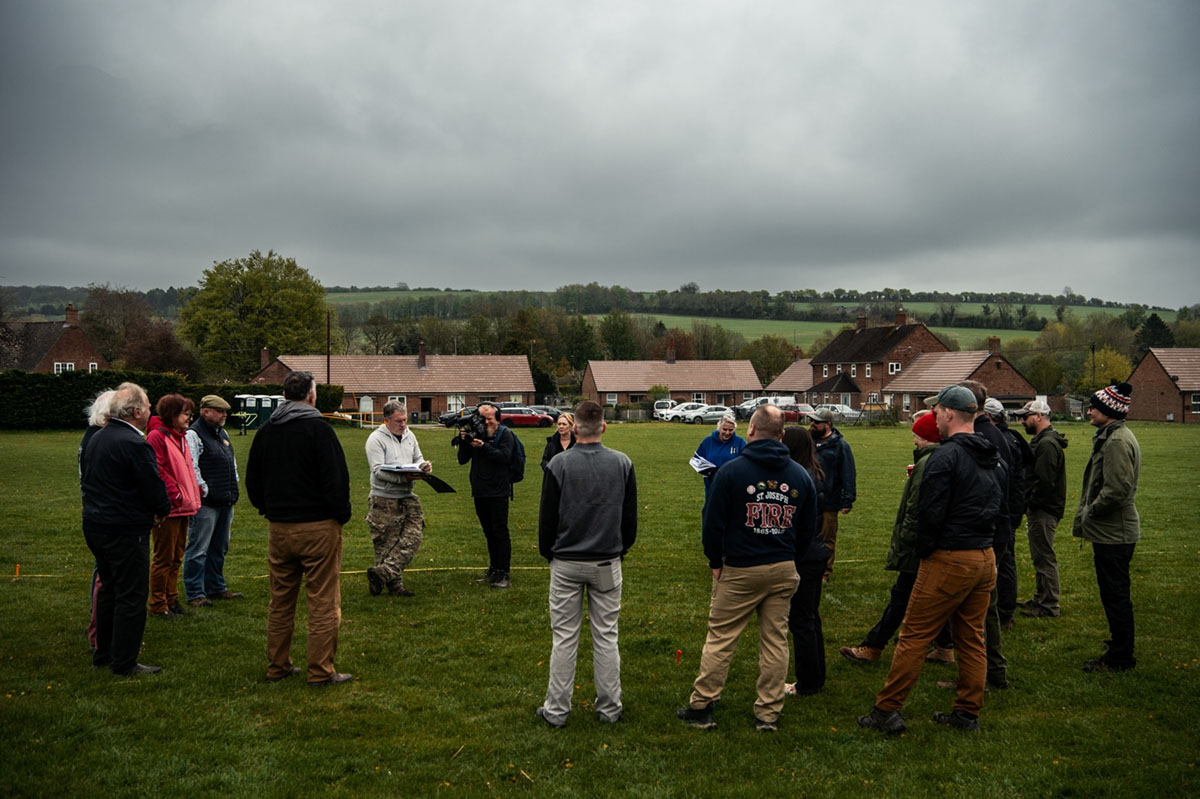
Figure 1
Day 1: Veterans, Archaeologists, and Civilian Volunteers on the Aldbourne Village Sports Pitch.
Photo Credit- Harvey Mills, 2023.
As seen in Figure 2 (below), to form community from the very beginning, US and UK veterans and active-duty US military personnel new to the Band of Brothers dig were treated to a tour of the village by the curator of the Aldbourne Heritage Center, John Dymond. The purpose of this tour was to better acquaint them with the history of Aldbourne. In doing so, participants of the tour found connection with not only the village, but a deeper insight into where some officers, such as Lt. Winters, stayed in local residences, and some enlisted members of Easy Co. were billeted in the horse stables. One of the major attractions of the village is St. Michael’s Church, with history dating back to 966 AD. Dymond mentioned during the tour that Lt. Winters of Easy Co. spent personal time in the churchyard where he could find peace and quiet. Several participants who took part in the tour of the village shared with me they were so grateful for the tour because it made them feel more comfortable while staying in Aldbourne. They felt safe and more aware of their surroundings while walking around (during the day and at night) and found that without the tour it would have taken them more time to become acquainted with the area.
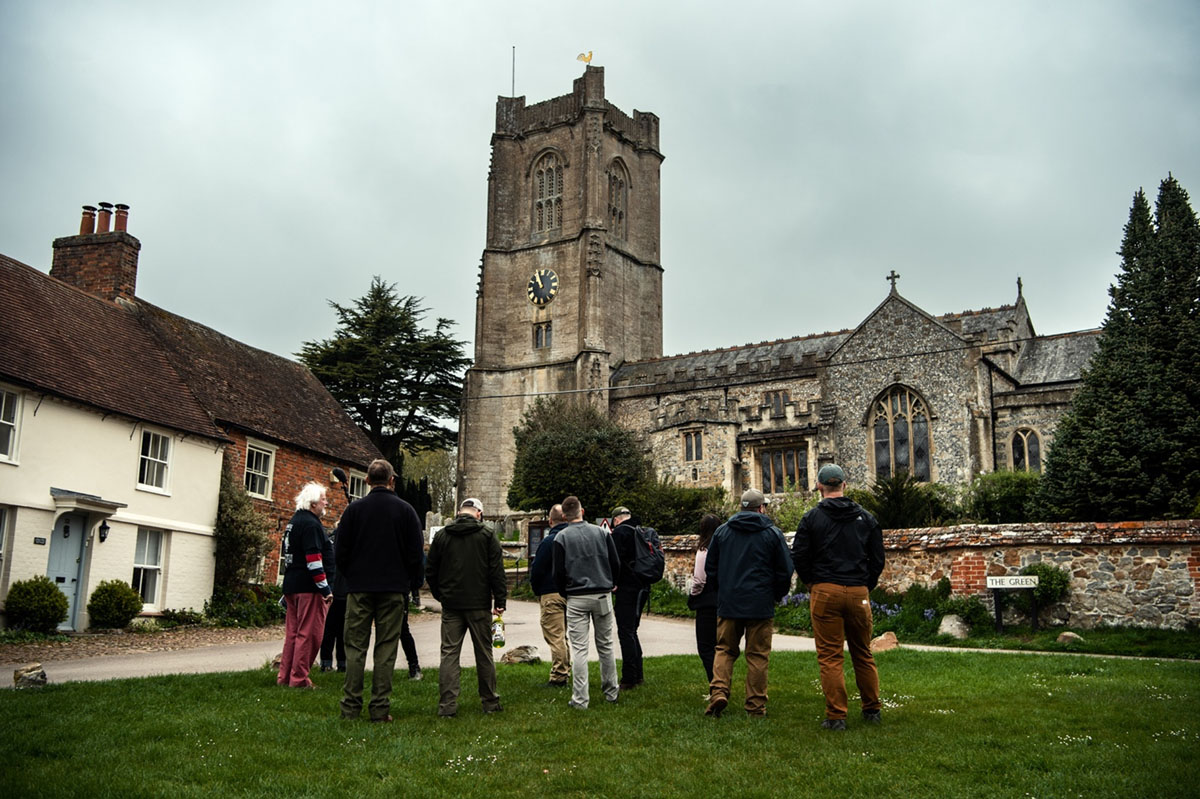
Figure 2
Tour of Aldbourne Village, St. Michael’s Church.
Photo Credit- Harvey Mills, 2023.
The Band of Brothers dig fully commenced on day one with turf cutting, removal of turf, and proper placement of turf to ensure its safety for replacement when the excavation was complete. In the following days, participants were assigned to specific locations on the pitch, and given the proper tools to excavate successfully. The first major task of the dig was to locate post pads—concrete pads that the frame of the hut (where some 101st Airborne soldiers were billeted) were grounded. Once post pads were found, archaeologists knew the Nissen huts, prefabricated steel structures, had been located. From that point on, participants worked to establish the entire structure. Figure 3 (below) showcases how veterans, archaeologists, and civilian participants worked tirelessly on the excavation.
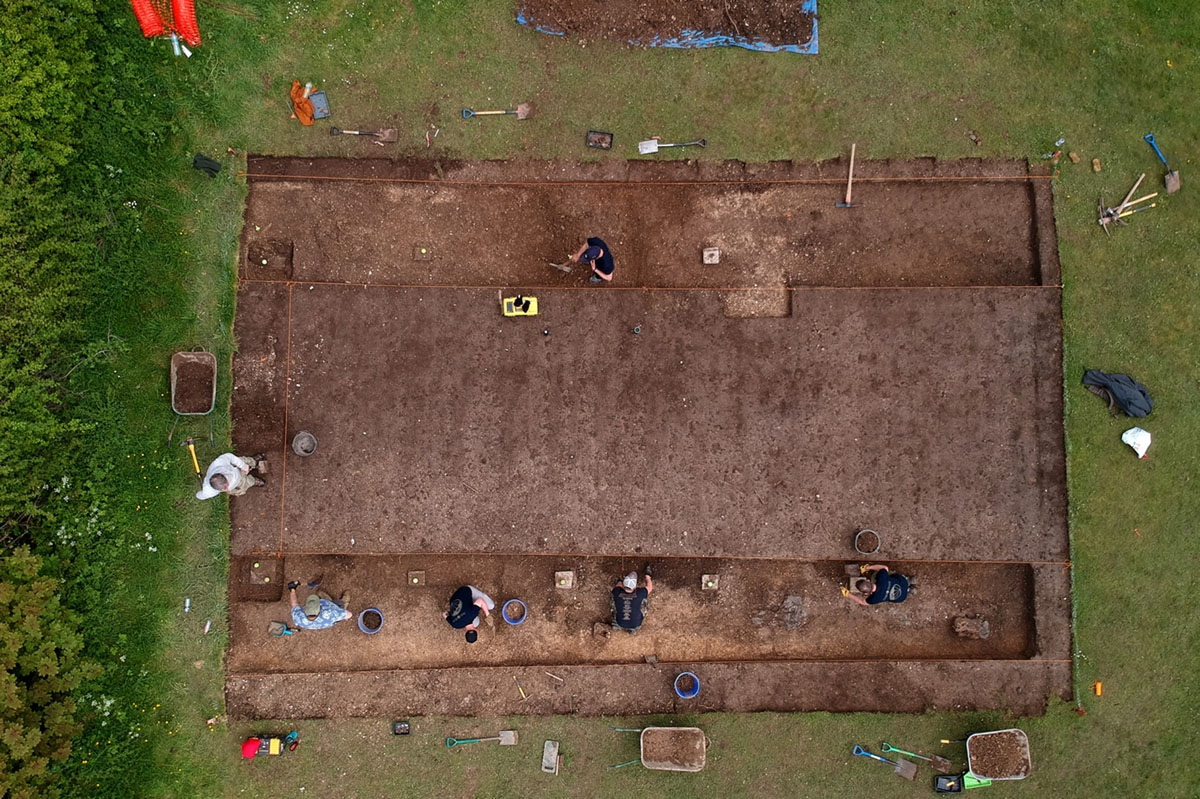
Figure 3
Locating Post Pads and Nissen Huts.
Photo Credit- Harvey Mills, 2023.
Assigning locations and “jobs” helped veteran participants settle into daily tasks and work. Many scholars have argued the difficult transitions from active duty to veteran status and have found, similarly to Anna Zogas (2017), “The military does an extremely effective job of training them to operate within the military, and an extremely poor job of reversing that training or preparing them before sending them back into civilian life” (p. 1). Providing veterans with a clear purpose and goal for the dig helps provide stability and direction, which appears to be one of the driving factors that appeals to the veterans who continue to set aside time and money so they can participate in the dig. As Hanks et al. (2021) claimed, veteran participants appreciate a “mission driven and task focused objective” (p. 253).
Throughout the entirety of the dig, Osgood stressed the main goal of connection; not only one another, but also to the project. Osgood focused a lot of attention on really building community. Veterans and other participants are together almost every waking hour; if not in the “trenches” digging together, than eating together, drinking together, and simply being with one another. Osgood feels similar to Finnegan (2016), that veteran participants working in a team at an outdoor archaeological site report improved self-esteem and confidence. During the dig it was clear from daily observations that veteran participants were connecting and building relationships through the choices of extracurricular activities such as late-night bonfires, as seen in Figure 4 (below), nightly pub excursions, and discussing objectives on site. All participants intermingled and shared their vast experiences and interests.
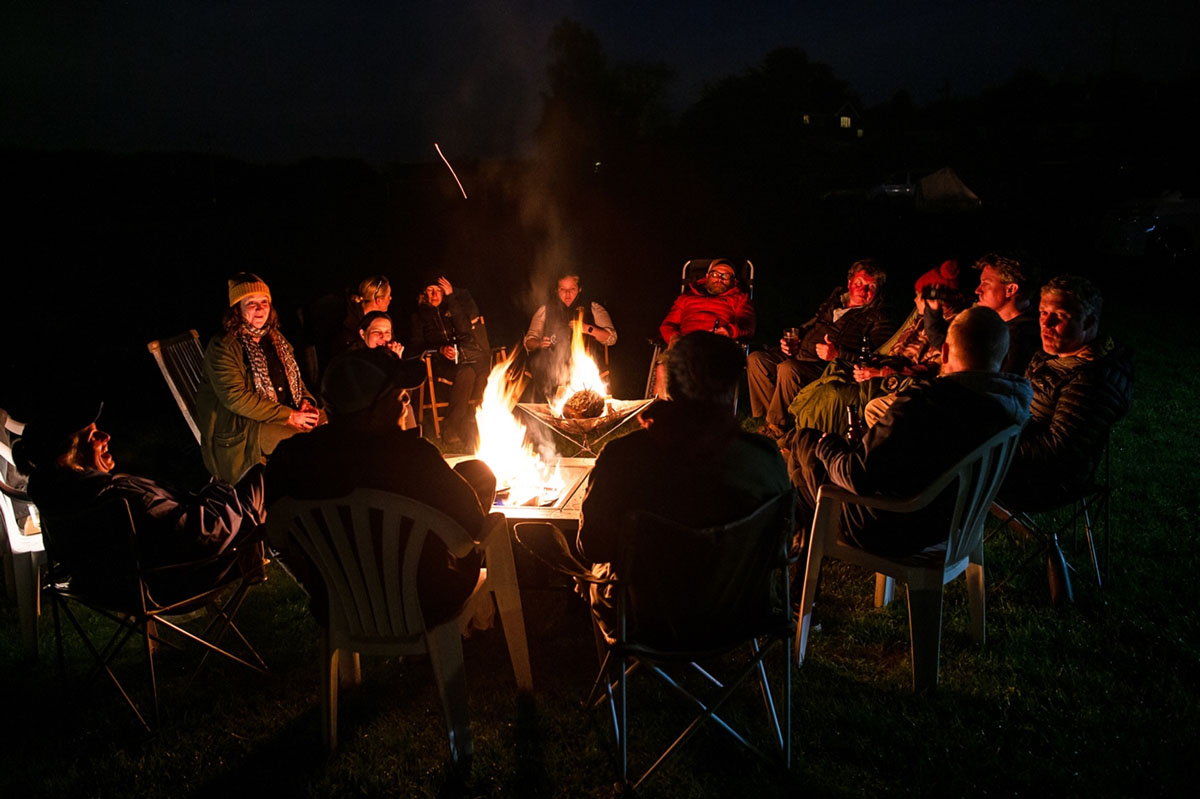
Figure 4
Participants talking around a late-night bonfire on the sports pitch.
Photo Credit- Harvey Mills, 2023.
To add to all the excitement and comradery, Time Team, a British television program specializing in archaeology, joined Operation Nightingale’s Band of Brothers’ dig.1 Time Team was on the ground, in the trenches, participating and filming every day during the dig. After daily editing of the previous day’s filming, they released daily-dig episodes on Patreon, and then YouTube (see Time Team Official, 2023). Rebecca Mumford, the communications director for Time Team, noted in a brief interview that Time Team wants to help a larger public recognize the work the veterans are doing. As seen in Figure 5 (below), the filming crew, as well as all the narrators and personalities of the show intermingled with the participants of the dig. Most of the veterans enjoyed the interactions, while some were a little skeptical of being filmed, but all continued focusing on the main goals of the dig.
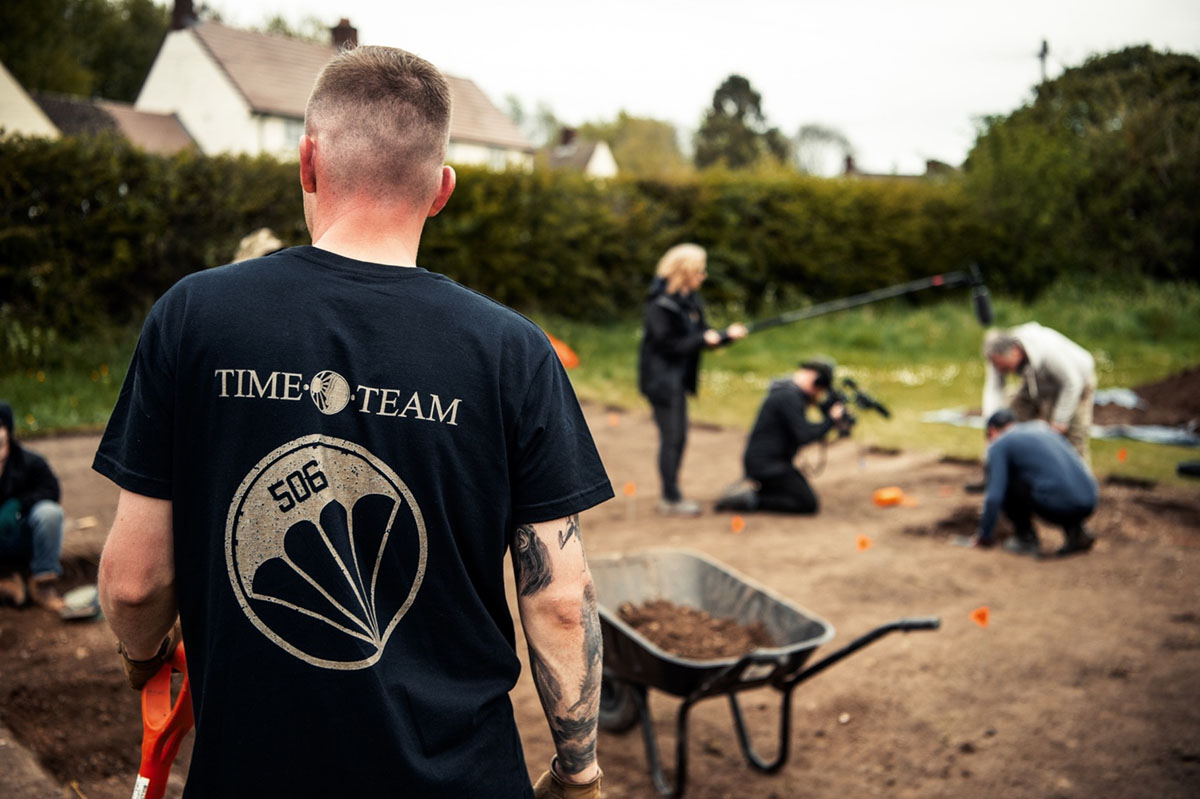
Figure 5
Time Team Filming.
Photo Credit- Harvey Mills, 2023.
At the end of each day, after digging and cleaning had subsided, Osgood gathered all participants, formed a circle, and proceeded to give an AAR (after action review) of the day’s finds and their significance as pictured in Figure 6. During this review, Osgood led the initial discussion of the progress of the day, while moving from site to site, and other participants contributed to the conversation that eventually ensued. Volunteer participants who spent time in the “finds tent” offered further overview of the present “finds” and chose significant artifacts from the dig that day to showcase.
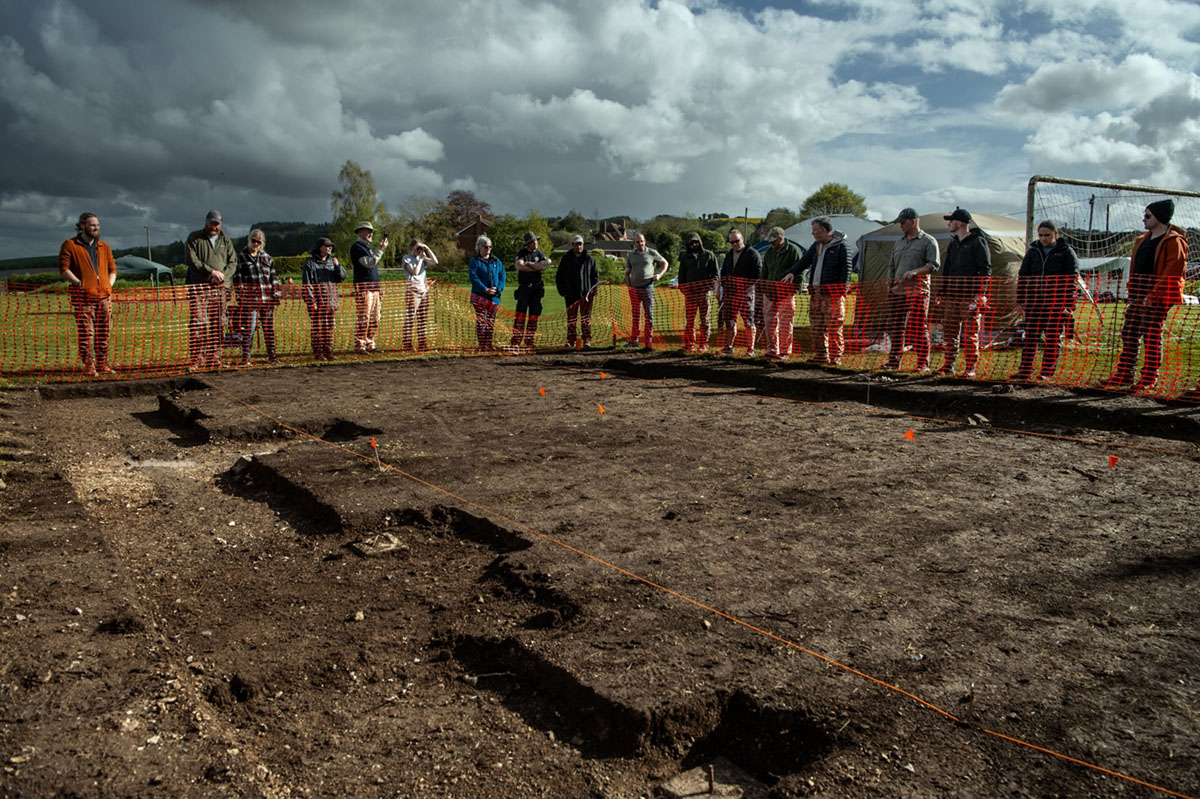
Figure 6
Band of Brothers Participants.
Photo Credit- Harvey Mills, 2023.
After the review of the day, Osgood then shared the schedule for the evening, and any events or activities that were planned. It was at this time that participants would break away to freshen up for the rest of the evening and then meet back up on the pitch to walk together into the village for dinner. The schedule, while somewhat flexible for participants, stayed organized. Osgood continuously reinforced that veteran participants should not do anything they do not want to do but encouraged them to take part in all of the activities.
While the majority of the digging was done by veteran participants, there were a few veterans who spent time completing the daily cleaning, sorting, and categorizing of artifacts. The majority of this work was done by a regular group of mostly women who spent many endless hours in what was known as the “finds tent” seen in Figure 7. The work was consistent, and the women working with the artifacts were meticulous with their work. They used toothbrushes, cleaning cloths, and special tools to ensure the artifacts would not be damaged. Everyone who worked in the finds tent was familiar with the work and had participated in previous digs.
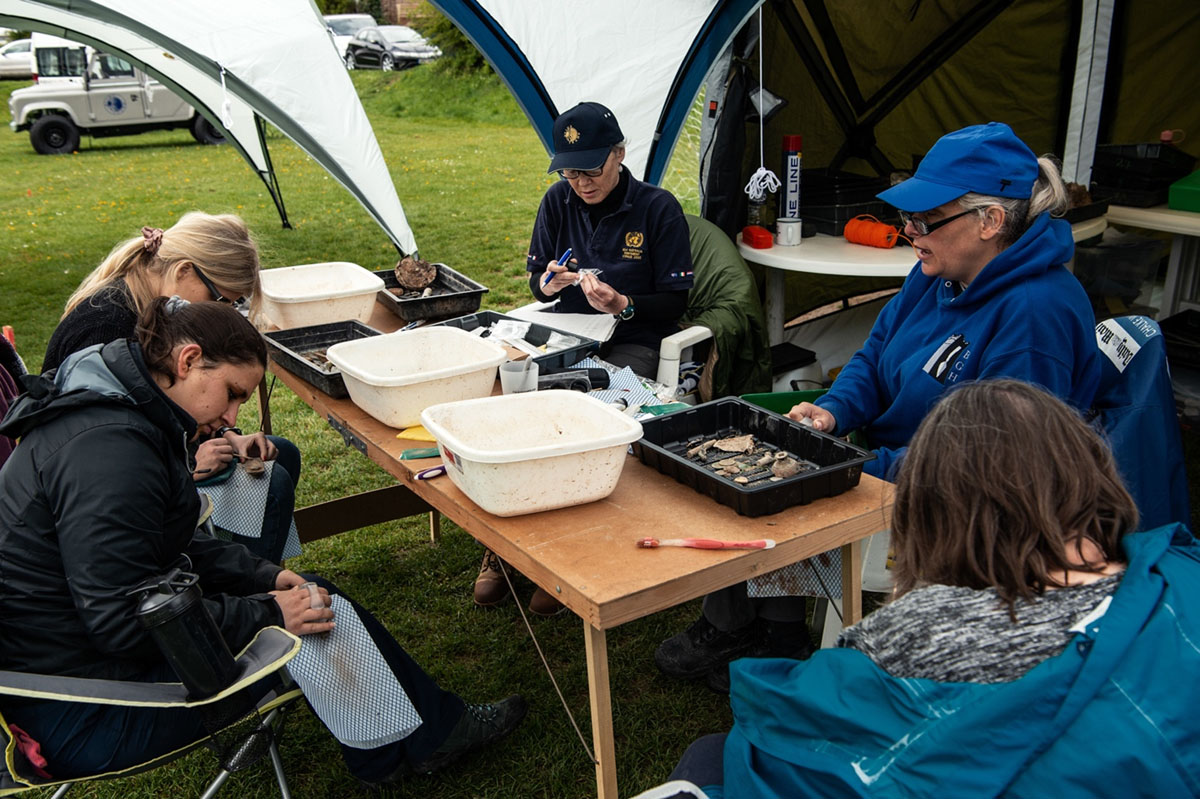
Figure 7
Volunteers in the “finds tent” cleaning artifacts from the dig.
Note: From Left bottom corner clockwise: Helen Waalbridge, Rachel Robson, Janine Peck, An Osbourne, unknown. Photo Credit- Harvey Mills, May 2023.
Over 300 artifacts were recovered during the May 2023 Band of Brothers dig. This was more than double the artifacts found in previous years. A small assortment of artifacts can be seen in Figure 8. Most of the artifacts will be housed and put on display in the Aldbourne heritage center.
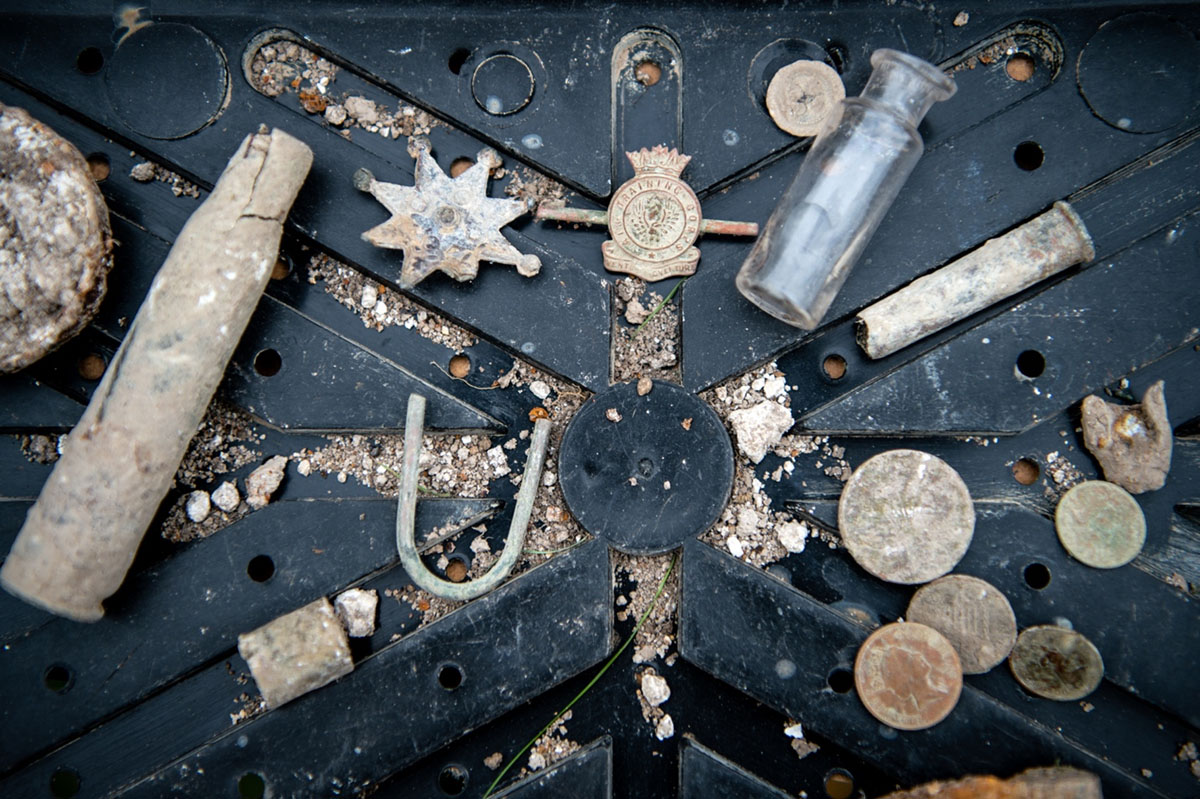
Figure 8
Artifacts found during the 3rd Band of Brothers dig.
Photo Credit- Harvey Mills, 2023.
Osgood noted that the efforts of the veterans and participants was never wavering; they worked through all weather, and only took a small break to watch the King’s coronation on May 6, 2023. As seen in Figure 9, after one of the endless rainstorms, participants could be found in the trenches with sponges soaking up as much water as they could so to not ruin the dig site.
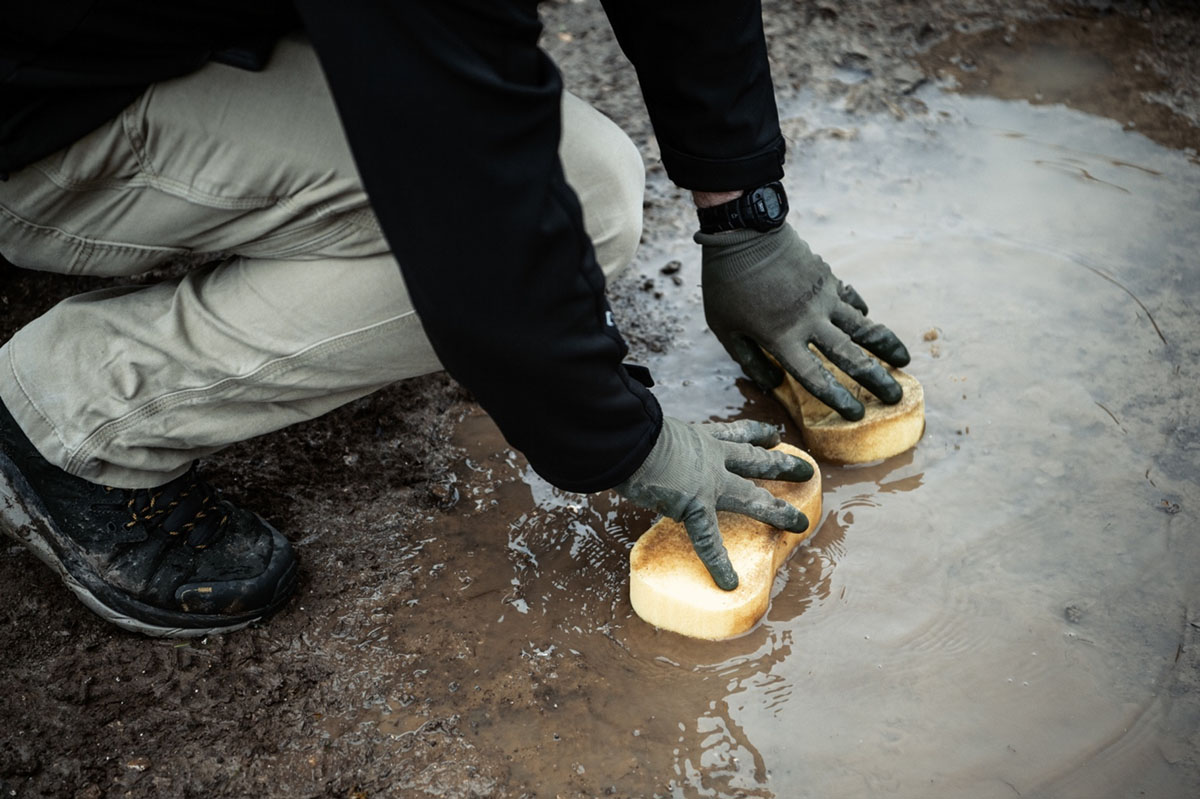
Figure 9
Participant soaks up rainwater in dig site.
Photo Credit- Harvey Mills, 2023.
On day 10 of the dig, students and staff from the local community schools were invited to observe the excavation, walk through the “finds” tent, and ask the archaeologists questions. As seen in Figure 10, students were encouraged to interact with everyone on the dig site, and some students were even invited to use some of the tools on site while being closely monitored. Many of the children were fascinated with the American veterans and active US military and asked them many questions about what they had uncovered during the dig. Inviting and encouraging participation with the local community has helped Osgood form strong relationships within Aldbourne Village. The community members are proud of their heritage and support the continued efforts Osgood makes with Operation Nightingale and the Band of Brothers digs.
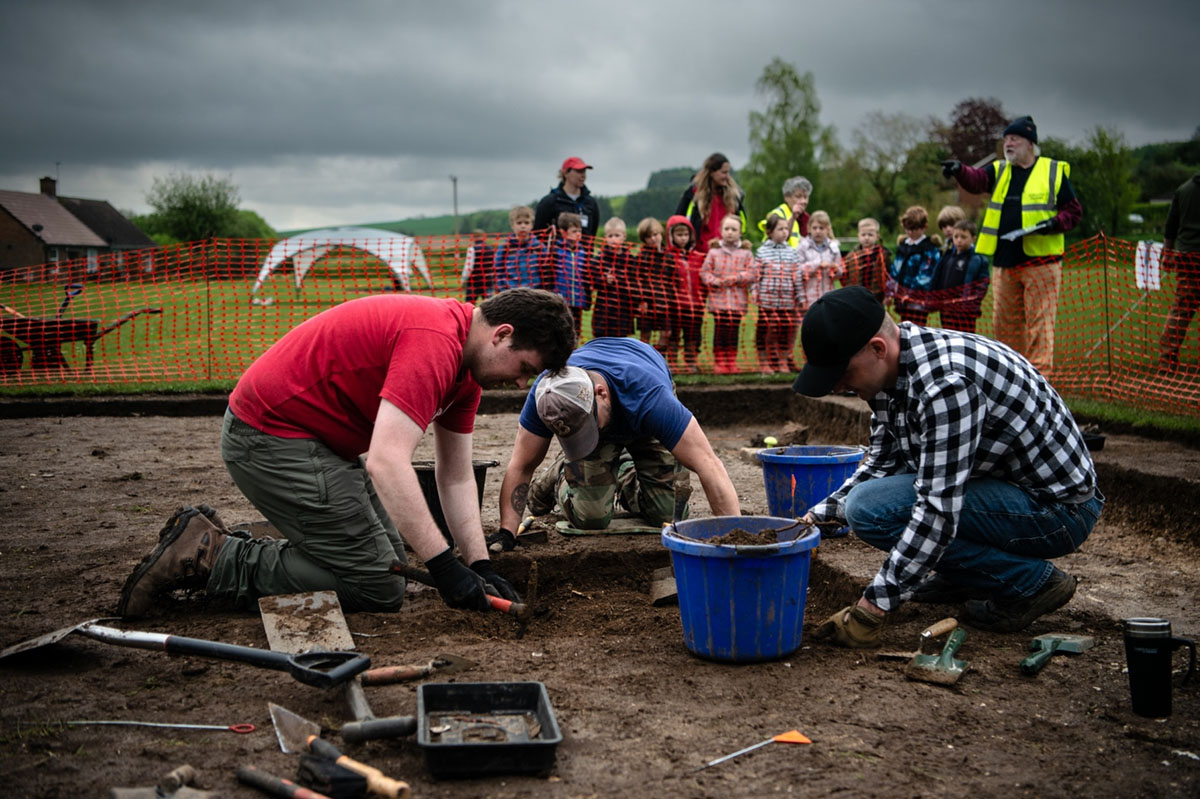
Figure 10
Band of Brothers Participants continue digging while school children look on.
Photo Credit- Harvey Mills, May 2023.
Many of the UK veterans who participated in the May 2023 Band of Brothers dig had been present for the first two digs as well, and also participate in other Operation Nightingale digs. They use their holiday so they can ensure they will be able to travel and attend the digs. Many veterans feel very similarly about the experience and make every effort to be onsite, as David Ulke, a Royal Air Force (RAF) veteran stated, “I like working with like-minded people in a safe space; this is my therapy.”
Participant Anouska Osborne Interview
Anouska Osbourne (AO), a RAF veteran, and Band of Brothers UK veteran participant provided consent for an interview with me, and shared her experiences with the military, Operation Nightingale, and the Band of Brothers’ digs in an interview in May 2023.
AO
In 1991 I started working for the Ministry of Defence as an Airframe Propulsion Technician apprentice. I did a four-year indentured apprenticeship, then worked for them for three more years where I then applied to join the Royal Air Force (RAF) in 1998. My first posting was to RAF Odiham, Hampshire with the Chinook fleet at 7 Squadron and I was on that squadron for 10 years. I left in 2009 and I went to what we called JARTS, which is Joint Aircraft Recovery in Transportation Squadron. JARTS is responsible for recovering and moving UK military aircraft around the world by land, sea and air, as well as UK Civil Aircraft if called in by the UK Air Accident Investigation Branch. I did that until I was medically discharged in 2014.
Sarah E. S. Carter (SESC)
Can you tell me a little bit about your medical discharge?
AO
I have spinal damage as well as other injuries.
SESC
When did you first hear about Operation Nightingale?
AO
In 2013, I was at Tedworth House, a recovery center operated by Help for Heroes, because I wasn’t allowed to work anymore, but wasn’t entirely out of service yet. My unit sent me there to have something to do. One day they were asking everyone what they like to do for fun, and when they got to me, I said “It’s gonna be a bit far-fetched; I used to like watching Time Team and I like history and that type of stuff” and the officer there, just went-- “I’ve got an idea; you just stay right there” and he literally disappeared out of the room. 10 minutes later, he came back with this phone number and says “this is Richard Osgood. Give him a call. You’re going to go see him tomorrow, don’t come here, go directly there. Give him a call today.” I was like, “OK”. So, I gave Richard a call, and he told me to pop down to where he was, which was about half an hour away from where I was. I had a chat with him, and he had this sword that they had dug out that year and all this other archaeology stuff all around him. I was like, oh, my God, what am I sitting in right now? The first dig I participated in was down in Dorset, a Place called Lulworth Barracks, which is a tank range. During the war they basically told the villagers of Tyneham to move out and they took that area over. This Operation Nightingale project included clearing the site to clearing paths to where participants needed to be--we had to stick to those routes because there was live ordnance everywhere. We recovered a German Bomber that time. That was my first foray into all this.
SESC
That’s really cool. And have you taken part in all of the Band of Brothers digs?
AO
All three that we’ve done so far, yes.
SESC
What is your favorite part?
AO
I love being in the finds tent because everybody brings you everything, and you get to touch, feel and see everything, whereas everybody only see their little bit only.
SESC
Have you always been in the finds tent?
AO
Yes, I can’t do the bending over and staying in that position for long periods of time.
I think everybody knows their limits. I know that will hurt. So, I just don’t do it. I just draw a line and just go right, this job needs doing.
Everything’s got a process and I like a good process.
SESC
Have you found over the years the veterans that have been involved in all of these different digs and excursions have found a place that they feel they fit in?
AO
Quite a lot of them, actually. You can see people coming that don’t leave the house often. The only time they leave the house is maybe go to the doctors, go get food and this. They come in on Monday, totally quiet, barely talking. Leave here a week, two weeks, or if it’s a three-week long dig and it’s like they’ve just come out of their shell and they’re just Chatty-Cathy’s, they just don’t stop. And then, after the dig ends, unfortunately, over time, you can see them regressing again, usually in wintertime. They’re waiting for the next dig to come along, everybody’s checking in with each other, making sure everyone is alright.
I’ve also seen some people coming along that have had injuries. There was one gentleman on one of the digs, who’d lost his left foot in Afghanistan. He was unconscious when it happened and didn’t know anything about it; woke up in the hospital back in the UK to find he had lost his foot. We were on a WWI recovery dig a few years back, and he just happened to find a boot (with a foot inside), which was the same as his lost foot.
If anyone tried touching the boot, helping or anything, he would get upset. And he said “get away; this is mine”. It was like he was saying goodbye to his foot because he never had the chance. The foot was recovered and reburied as part of the Commonwealth War Graves Commission.
SESC
Do you see this as a form of therapy?
AO
For me, this is like a reset because I can get quite stressed out.
It might be like 10 days for us, but that 10 days can last us six months or so of a reset and then you start dipping and it could be a really shallow dip. You don’t even notice it initially, but over time you do. It’s not like you go circling the drain or anything, but you do start noticing and wondering when’s the next dig will be.
SESC
Will you take part in another dig this year?
AO
I’m hoping to be on one more this year. Which could possibly be an aircraft recovery. But I don’t know yet. I’ve got to negotiate with work at the minute.
SESC
So, this is your holiday?
AO
Yes, this is a holiday to me. People always think I’m one of the people working here but I’m not. I’m one of the actual vets. It’s one of these things where everybody sort of gets on really well and you’re never on the same day with the same people all the time. I’ve gone for a day on Barrow Clump, which Paul Hemingway goes on and they’re literally camping in the middle of Salisbury Plain. There’s no protection or anything out there from the weather, and I went down for a day, and I think that was the first time I met him, probably about 2014 or 2015. There’s been some other digs I’ve been on, and he’s been there and I’m forever going up and calling him names and all the rest and he does the same with me. It’s like having military banter all over again. You can fall back into that routine because you can’t do it in normal life; people think you’re being rude or offensive. I have known David Ulke for 10 years since the dig in Lulworth Baracks, it was our first Operation Nightingale dig, he reminded me this year just before the dig when we were checking in with each other.
SESC
It sounds like a good strong community.
AO
It is, yeah, sort of letting you know you’re not alone.
You can be surrounded by people that mean well, who have not been in the military they try to be there for you, but the reality is when you try and talk to them, you’re never going to tell them everything that you’ve been through because you’re so selective about what you let past the brick walls or out of the box you have buried deep inside. Because even the smallest thing you say they can take the wrong way; I’ve seen it happen before unfortunately.
Practitioner Richard Osgood Interview
Richard Osgood (RO), Ministry of Defense Senior Archaeologist, provided consent for an interview, and shared some background and deeper insight into the Operation Nightingale initiative.
SESC
Do you have any personal or familial ties to the armed forces?
RO
Other than working for MOD and (very briefly!) being an Air Cadet – nothing personal. However, both of my grandfathers were artillerymen in the First World War, one in the British Army and the other with the Australians. The latter also served in the Boer War in South Africa. My father, too, was in the British Army in the Second World War. He was in British tanks (the 5th Royal Inniskilling Dragoon Guards) and took part in the Normandy campaign in 1944 amongst other things. He suffered long-term effects from this involvement.
SESC
In previous interviews, you mention the importance of building community among veterans—how do the archaeological digs help build community?
RO
It’s all about being part of a team again, to bring back service personnel to share ‘banter’ and stories. To have a shared goal with REAL achievements and something which you all play a part in, whatever your role on site. People share dig memories almost like battle honours – we have dig t shirts too to build ethos and an identity of presence. Friendships are built and maintained on future digs and social media.
SESC
How much of your time, could you approximate, is spent doing volunteer work with veterans?
RO
Some of the work and digs are done in my work time but I do a lot of excavation work and public speaking in my own time; I would say I spend about 40-days a year in such capacity.
SESC
What do you enjoy the most when working with veterans?
RO
Two things really – their “can-do” attitude and approach to problem solving, and then seeing their growing passion for the subject.
SESC
Is there anything specific you are hoping to find/uncover/excavate during the Band of Brothers dig?
RO
Jump wings! That’s the jokey-task I’ve set the team! Frankly the finds of the D-Day cricket parachute pull and two dog-tags (including one belonging to one of the two pathfinders of Easy Company) was way beyond my wildest expectations, so the bar has been set very high! In truth, anything that really links us with the personal humanity of those men of 1943/4 will be fantastic.
SESC
Do you have a rationale that informs Operation Nightingale? Band of Brothers specifically?
RO
Really, the main thing was trying archaeology and its various elements and seeing whether this worked, and then measuring results as we went. There was a bit of trial and error and asking participants what they enjoyed so that I now think we have a fairly established methodology of what seems to work and what you need to try and include.
SESC
Are there specific procedures or a structure that you follow?
RO
Main thing is giving everyone an opportunity to try everything and to do as much (or little) as they want so that it works for them. It has to be relaxed but with a specific framework and timetable in place so people know what will happen and when, to this end having civvy supporters is good as they can keep the work going if the vets are not able to for whatever reason. Having said that, if they find something good, it will be them doing it to completion, so it’s not pinched by a professional! It’s also good to name check them in reports etc.
SESC
What is something that you might say, if I knew then what I know now, I would have done X differently?
RO
I would expect it to be bigger than I did at the start and with more calls on my time. If I had someone to run by logistics permanently that would be so useful!
SESC
What is something you have learned from your directorship or participation in this program?
RO
I’ve learned archaeology really can help people – you have to get a core of good people around you to make it happen – a support team of the like-minded. There is a job for everyone in archaeology and hopefully we can find something to interest even the most jaundiced of veterans! Also, military-based digs (like Band of Brothers, and some of our WW1 trenches or WW2 aircraft) work incredibly well as this is their tribe.
Conclusion
As the first veteran initiative to use archaeological fieldwork to aid in the recovery of wounded veterans, Operation Nightingale has set a high precedent for other programs. For over 13 years, Richard Osgood has dedicated a great deal of time and energy on ensuring the program offers a unique and special opportunity for veterans. Specifically, Digging Band of Brothers is among one of the most unique experiences, offering collaboration between US and UK veterans, immersing all participants within the local community, and providing numerous extracurricular activities. Operation Nightingale: Digging Band of Brothers is proving beneficial to veterans while also helping to lead archaeological explorations into a past not so far behind us.
Moving Forward
The May 2023 Band of Brothers dig in Aldbourne garnered a lot of attention. As seen in Figure 11, filming and interviewing was taking place almost everyday while archaeologists, veterans, and volunteers continued with daily work. BBC published a short write-up (Parker & Hallett, 2023) and Time Team released a free documentary on YouTube. Time Team also has plans for filming and participating in future digs. In July 2023, The Telegraph newspaper published an article about Operation Nightingale, “Traumatised and wounded troops find new lease of life in Army archaeology scheme” (Stephens, 2023).
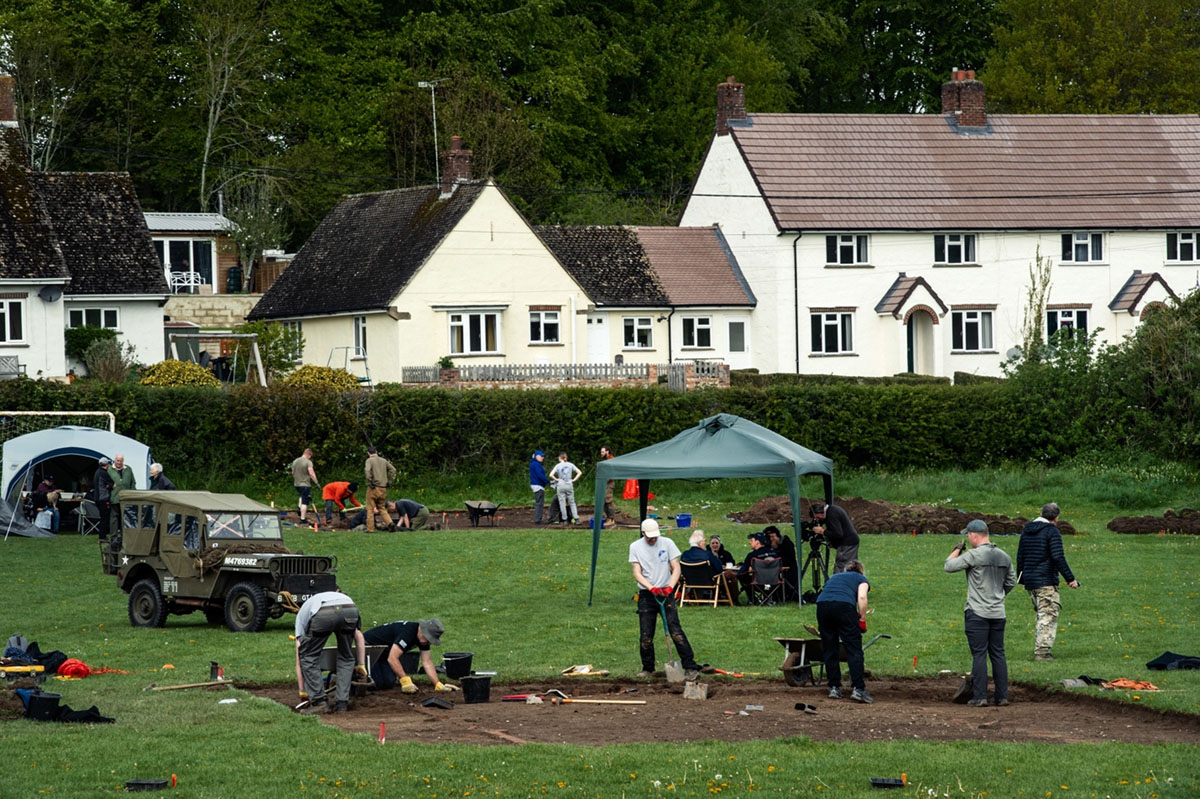
Figure 11
Veterans, Archaeologists, and Civilian Volunteers work together on the Aldbourne Village Sports Pitch.
Photo Credit- Harvey Mills, 2023.
The most recent Band of Brothers dig took place in Aldbourne, England in May 2024 and there are plans for more in the future.
Notes
Acknowledgements
The author would first like to thank Richard Osgood for the invitation to be a participant observer in the Band of Brothers dig that took place in Aldbourne, England, from May 1–10, 2023. The author would also like to thank Anushka Osbourne for her participant interview, everyone who was on the ground during the dig, and the local Aldbourne community.
Funding Information
The author received travel funding from Clemson University.
Competing Interests
The author is the interview editor of the Journal of Veterans Studies and was a participant involved in Operation Nightingale. Aside from these interests, she has no other competing interests to declare. Additionally, this Program Profile did not require IRB approval since the author was invited to attend the excavation as a participant observer and received consent from both Anushka Osbourne and Richard Osgood for their interviews.