
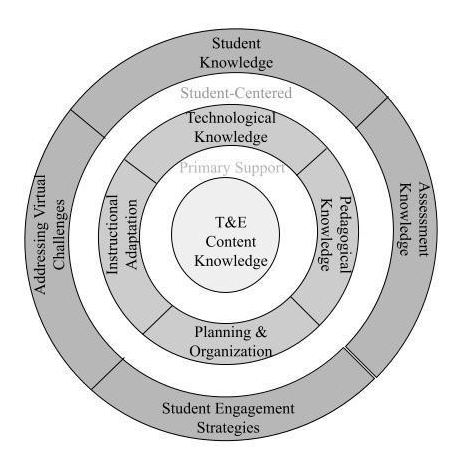
Figure 1
The learning eye: a conceptual framework for instructional interpretation in digital technology and engineering education.
Table 1
Comparison of PCK, TPACK, and the Learning Eye Framework.
| DIMENSION | PCK | TPACK | LEARNING EYE FRAMEWORK |
|---|---|---|---|
| Primary Focus | Integrating pedagogy and content | Integrating technology, pedagogy, and content | Interpreting instructional contexts to support adaptive teaching |
| Content Knowledge | ✓ | ✓ | ✓ |
| Pedagogical Knowledge | ✓ | ✓ | ✓ |
| Technology Knowledge | Limited | ✓ | ✓ |
| Student Knowledge | ✓ | ✓ | Central to instructional interpretation |
| Assessment | ✓ | Partial | Continuous formative and summative decision-making |
| Planning & Organization | Implied | Implied | Explicit instructional component |
| Instructional Adaptation | Limited | Limited | Core feature of the framework |
| Student Engagement | Indirect | Indirect | Explicit instructional component |
| Addressing Virtual Learning Challenges | Not addressed | Partially addressed | Explicitly integrated into the framework |
| Teacher Decision-Making | Knowledge domains | Knowledge integration | Continuous interpretation, reflection, and adaptation |
| Intended Contribution | Explains teacher knowledge | Explains technology integration | Explains how educators transform knowledge into responsive instructional practice in technology and engineering education |