
Introduction
Technology and engineering education (T&E) plays an essential role in preparing students to understand, design, and evaluate technological systems that shape modern society. As technology continues to evolve rapidly, educational frameworks emphasize the importance of developing learners who can think critically about technological systems and apply design-based problem-solving skills. The Standards for Technological and Engineering Literacy highlight that technological literacy requires not only technical knowledge but also the ability to analyze the relationship between technology, engineering, and society (International Technology and Engineering Educators Association [ITEEA], 2020).
Within this context, effective teaching requires more than disciplinary expertise. Teachers must possess the ability to translate complex technological and engineering concepts into meaningful learning experiences that students can understand. The concept of pedagogical content knowledge (PCK) provides a theoretical framework for understanding how teachers integrate subject matter knowledge with pedagogical strategies to facilitate student learning (Shulman, 1987).
Over the past several decades, research has expanded the PCK framework to include additional components such as knowledge of learners, curriculum, assessment, and instructional strategies. However, many existing models were developed in traditional classroom environments and do not fully account for the complexities of teaching in digital or online learning environments. As technology increasingly reshapes education, particularly in science, technology, engineering, and mathematics (STEM) fields, there is a growing need to examine how PCK functions within online and hybrid instructional contexts.
This paper reviews the literature on PCK in T&E and introduces the Learning Eye framework. Unlike existing PCK and technological pedagogical content knowledge (TPACK) models that primarily identify categories of teacher knowledge, the Learning Eye framework emphasizes the ongoing interpretive process through which educators analyze instructional contexts, make pedagogical decisions, and adapt teaching throughout learning. Rather than viewing teacher knowledge as a static collection of domains, the framework conceptualizes instructional expertise as a dynamic process of observation, interpretation, implementation, reflection, and continuous refinement within technology-rich learning environments.
Conceptual Development of the Learning Eye Framework
This article is a conceptual paper that synthesizes literature related to PCK, T&E, TPACK, and online teaching. Rather than presenting empirical findings, the Learning Eye framework was developed through iterative analysis of foundational and contemporary scholarship in these areas. Literature was selected based on its influence in teacher knowledge, engineering education, technology education, online learning, and instructional design. The framework emerged by identifying common constructs across these bodies of literature while recognizing gaps in existing models related to instructional interpretation, adaptation, and digital learning environments. The resulting framework is intended as a conceptual extension that can guide future empirical research and classroom implementation.
Development of the Learning Eye Components
The components of the Learning Eye framework emerged through iterative comparison of recurring constructs identified across the literature on PCK, T&E, instructional design, and online learning. Foundational domains such as content knowledge, pedagogical knowledge, technological knowledge, student knowledge, and assessment were consistently represented across existing frameworks. However, the literature also revealed recurring themes that were not explicitly conceptualized within traditional PCK models, including instructional adaptation, planning and organization, student engagement, and the unique pedagogical demands of virtual learning environments. These recurring themes informed the development of the outer layers of the Learning Eye framework, which collectively emphasize the dynamic processes through which educators interpret instructional contexts and respond to evolving learning conditions.
Evolution of T&E
Technology education has undergone a significant transformation over the past century. Early forms of technology education originated in manual training and industrial arts programs designed to prepare students for industrial work. These programs focused primarily on developing technical skills and craftsmanship. Over time, however, the field evolved to incorporate broader conceptual goals related to technological literacy, innovation, and engineering design (Lewis & Zuga, 2005).
Modern T&E emphasizes interdisciplinary learning that integrates science, engineering, and technological systems. This shift reflects broader developments in STEM education that prioritize problem-solving, inquiry-based learning, and design thinking. Contemporary frameworks highlight the importance of engaging students in authentic engineering practices such as identifying problems, designing solutions, testing prototypes, and evaluating technological systems (National Academy of Engineering & National Research Council, 2009).
Design and inquiry serve as central processes in technology education. Both involve iterative reasoning and exploration within a problem space, a process described by and Simon and Newell (1971) as a search for solutions through progressive refinement of understanding.
Through these processes, students learn to analyze technological challenges, explore possible solutions, and refine their designs through experimentation and reflection. Because technology education involves both conceptual understanding and practical application, teachers must integrate multiple forms of knowledge when designing instruction. This integration is captured within the concept of PCK.
As T&E evolved toward design-centered and interdisciplinary learning, the knowledge required of teachers also became increasingly complex. This evolution naturally led researchers to examine how educators integrate disciplinary expertise with effective instructional practices, giving rise to the concept of PCK.
Pedagogical Content Knowledge
The concept of PCK was introduced by Shulman (1986) as a way to describe the specialized knowledge teachers use to transform subject matter into forms that students can understand. Shulman argued that effective teaching requires more than knowledge of subject matter; it also requires an understanding of how students learn particular topics and how instructional strategies can be used to facilitate that learning.
Shulman (1987) defined PCK as:
“the special amalgam of content and pedagogy that is uniquely the province of teachers” (p. 8).
PCK includes several interconnected domains of knowledge, including content knowledge, pedagogical knowledge, curriculum knowledge, and knowledge of learners and their characteristics (Cochran, DeRuiter, & King, 1993; Shulman, 1986). These domains interact to shape instructional decisions and influence how teachers present disciplinary concepts to students.
Subsequent research expanded the PCK framework by identifying additional components of teacher knowledge. Grossman (1990) emphasized the importance of teachers’ orientations toward teaching and their understanding of student misconceptions. Magnusson, Krajcik, and Borko (1999) proposed a model of PCK that includes knowledge of curriculum, knowledge of student understanding, knowledge of instructional strategies, and knowledge of assessment.
These models emphasize the complexity of teacher knowledge and the dynamic relationship between pedagogy and subject matter (Kind, 2009).
Models of PCK
Several conceptual models have been proposed to describe how PCK operates in instructional settings. One widely recognized framework is the Pentagon Model of Pedagogical Content Knowledge, which organizes PCK into five interrelated components: orientations toward teaching, knowledge of student understanding, knowledge of curriculum, knowledge of assessment, and knowledge of instructional strategies (Park & Oliver, 2008).
In this model, PCK sits at the center of these components, highlighting the interconnected nature of teacher knowledge. Teachers draw upon these knowledge domains simultaneously when designing instruction and responding to student learning needs. Within T&E, researchers have adapted PCK frameworks to reflect the unique characteristics of engineering design and technological problem-solving. De Miranda (2008) proposed a model that integrates engineering knowledge, pedagogical knowledge, and contextual understanding. This model illustrates how teachers translate engineering concepts into classroom instruction through the interaction of disciplinary knowledge, teaching strategies, and contextual factors. The integration of these knowledge domains allows technology educators to create meaningful learning experiences that combine theoretical concepts with practical applications.
PCK in T&E
In T&E, PCK plays a particularly important role because instruction often involves complex problem-solving processes and hands-on design activities. Teachers must guide students through open-ended design challenges, facilitate collaborative inquiry, and connect theoretical knowledge with real-world applications. De Miranda (2008) emphasized that technology educators must possess deep subject matter knowledge related to engineering design processes, technological systems, and problem-solving methodologies. At the same time, teachers must understand how to present these concepts in ways that are accessible to students with diverse learning backgrounds.
Effective technology educators must also consider contextual factors that influence instruction, including classroom environments, institutional expectations, and student learning needs. De Miranda (2017) argued that this contextual understanding contributes to the development of a specialized pedagogy unique to technology education. Additionally, technology education often involves collaborative learning environments in which students contribute different forms of expertise to solve complex problems. In these environments, teachers act as facilitators of learning rather than simply transmitters of information.
PCK in Online Learning Environments
The expansion of online education has introduced new challenges for technology and engineering educators (Moore & Kearsley, 2012). Traditional PCK frameworks were developed primarily within face-to-face instructional environments and may not fully capture the complexities of teaching in digital contexts. The COVID-19 pandemic accelerated the transition to online learning across higher education institutions. Many educators were required to move courses online rapidly, often without adequate preparation or institutional support (Hodges et al., 2020).
This shift highlighted the importance of integrating technological knowledge with pedagogical and content knowledge. The TPACK framework extends PCK by incorporating teachers’ knowledge of digital technologies and their role in supporting instruction (Koehler et al., 2013; Mishra & Koehler, 2006). However, research suggests that teachers often struggle to integrate these knowledge domains effectively in online environments. Studies indicate that educators frequently prioritize content delivery rather than developing innovative pedagogical strategies for online learning. These challenges highlight the need for conceptual models that better explain how educators adapt their instructional practices in digital learning environments.
The Learning Eye Framework
To address these challenges, this study introduces the Learning Eye framework, a conceptual model that extends PCK by emphasizing the interpretive and adaptive processes through which educators design instruction in digital environments. The Learning Eye framework conceptualizes teaching as a dynamic process of instructional interpretation, in which educators continuously adjust their pedagogical decisions based on contextual factors. In this model, teaching decisions are filtered through multiple layers of knowledge that shape how educators interpret instructional situations.
Structure of the Learning Eye
As shown in Figure 1, the concentric organization of the Learning Eye is intentional and reflects the dynamic nature of instructional decision-making. At the center of the framework lies Content Knowledge, representing the disciplinary expertise that serves as the foundation for effective technology and engineering instruction. Surrounding this core are the knowledge domains that directly support instructional planning and implementation, including pedagogical knowledge, technological knowledge, planning and organization, and instructional adaptation. These components represent the educator’s immediate instructional decisions as teaching unfolds.
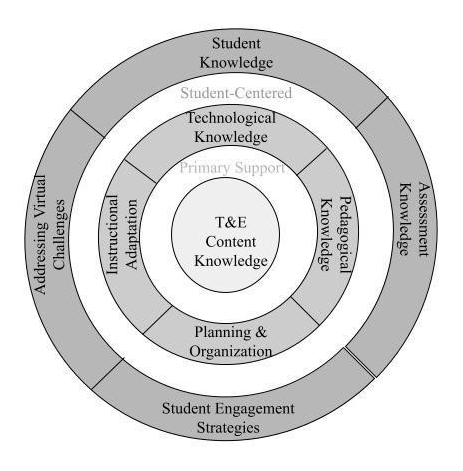
Figure 1
The learning eye: a conceptual framework for instructional interpretation in digital technology and engineering education.
The outermost layer represents contextual influences—including student knowledge, assessment knowledge, student engagement strategies, and addressing virtual challenges—that continuously shape instructional interpretation. These elements reflect the realities of teaching, requiring educators to consider learner characteristics, assessment evidence, engagement, and environmental conditions while making instructional decisions. Rather than representing a linear process, the concentric structure illustrates the continuous interaction among all components as educators observe, interpret, respond to, and refine instruction.
The Learning Eye framework includes several interconnected components of instructional knowledge:
Content Knowledge (CK)
Pedagogical Knowledge (PK)
Technological Knowledge (TK)
Instructional Adaptation (IA)
Planning and Organization (PO)
Student Knowledge (SK)
Assessment Knowledge (AK)
Student Engagement Strategies (SES)
Addressing Virtual Challenges (AVC)
Together, these components form a conceptual lens through which educators design and implement instruction.
Components of the learning eye framework
The Learning Eye framework represents instructional decision-making as a dynamic and interconnected process rather than a collection of independent knowledge domains. Each component contributes to how educators perceive instructional situations, make informed pedagogical decisions, and adapt teaching to support meaningful learning in T&E. Together, these components function as a unified lens through which teachers interpret learner needs, instructional goals, technological affordances, and contextual challenges. Rather than operating in isolation, each component continuously interacts with the others, enabling educators to design responsive, student-centered learning experiences in face-to-face, hybrid, and online environments.
1. Content Knowledge (CK)
Content Knowledge forms the foundation of the Learning Eye framework and represents the educator’s deep understanding of technology and engineering concepts, including engineering design, technological systems, computational thinking, problem-solving methodologies, and emerging technologies. Strong content knowledge enables teachers to accurately represent disciplinary concepts, anticipate conceptual difficulties, and connect theoretical knowledge with authentic engineering applications. Within the Learning Eye, all instructional decisions originate from a solid understanding of the subject being taught.
2. Pedagogical Knowledge (PK)
Pedagogical Knowledge encompasses the instructional strategies and teaching approaches that promote effective learning (Merrill, 2002). In T&E, this includes inquiry-based learning, project-based learning, collaborative problem-solving, design thinking, scaffolding, questioning techniques, and facilitation of engineering design processes. Within the Learning Eye framework, pedagogical knowledge guides how educators transform technical content into meaningful learning experiences that are appropriate for diverse learners.
3. Technological Knowledge (TK)
Technological Knowledge refers to an educator’s understanding of digital tools, instructional technologies, learning management systems, simulations, virtual laboratories, artificial intelligence tools, and collaborative platforms that support teaching and learning. Unlike traditional PCK models, the Learning Eye recognizes that technology is no longer simply an instructional aid but an essential component of instructional decision-making. Teachers must evaluate how technological tools enhance student understanding while aligning with instructional objectives and learner needs.
4. Instructional Adaptation (IA)
Instructional Adaptation is a defining feature of the Learning Eye framework and represents the continuous process of modifying instruction in response to student learning, assessment evidence, technological challenges, and changing classroom conditions. Rather than viewing teaching as a fixed sequence of planned activities, the Learning Eye conceptualizes instruction as an ongoing cycle of observation, interpretation, decision-making, and refinement. This adaptive process distinguishes the Learning Eye from traditional PCK models by placing instructional responsiveness at the center of effective teaching.
5. Planning and Organization (PO)
Planning and Organization refers to the intentional design and sequencing of learning experiences before instruction begins. This includes establishing learning objectives, organizing instructional activities, selecting appropriate resources, managing instructional time, and aligning assessments with desired outcomes (Reigeluth & An, 2021). Within the Learning Eye framework, planning provides the structural foundation that enables teachers to deliver coherent instruction while remaining flexible enough to adjust to emerging student needs and instructional contexts.
6. Student Knowledge (SK)
Student Knowledge represents an educator’s understanding of learners’ prior knowledge, experiences, misconceptions, interests, motivation, learning preferences, cultural backgrounds, and developmental readiness. Effective instructional decisions require teachers to interpret how students learn technology and engineering concepts and to anticipate the challenges they may encounter. Within the Learning Eye framework, student knowledge serves as a continuous source of information that informs instructional adaptation throughout the learning process.
7. Assessment Knowledge (AK)
Assessment Knowledge involves selecting, designing, and interpreting formative and summative assessments that accurately measure student understanding and engineering practices. In T&E, assessment extends beyond factual recall to include design processes, collaboration, creativity, problem-solving, prototype development, and reflection. The Learning Eye emphasizes assessment as an ongoing process that provides continuous feedback for both learners and instructors, allowing instructional decisions to evolve throughout instruction (Black & Wiliam, 2009; Nicol & Macfarlane-Dick, 2006).
8. Student Engagement Strategies (SES)
Student Engagement Strategies encompass the instructional practices that promote active participation, collaboration, motivation, and meaningful learning (Fredricks et al., 2004; Kahu, 2013). T&E relies heavily on authentic design challenges, inquiry, teamwork, hands-on investigations, and real-world problem-solving to engage learners. Within digital environments, engagement may also include interactive simulations, collaborative online tools, discussion forums, virtual design projects, and multimedia learning experiences. The Learning Eye recognizes engagement as an intentional instructional decision rather than a by-product of good teaching.
9. Addressing Virtual Challenges (AVC)
Addressing Virtual Challenges acknowledges the unique obstacles associated with online and hybrid instruction, including technology access, communication barriers, learner isolation, reduced opportunities for hands-on experiences, digital distractions, and varying levels of technological proficiency (Rapanta et al., 2020). The Learning Eye framework recognizes that educators must proactively anticipate these challenges and implement instructional strategies that maintain equitable access, foster meaningful interaction, and preserve the collaborative nature of technology and engineering learning. This component reflects the realities of modern digital education and further distinguishes the Learning Eye framework from traditional PCK models that were developed primarily for face-to-face instruction.
Connecting the components
Although each component represents a distinct aspect of instructional knowledge, the Learning Eye framework emphasizes that effective teaching emerges through their continuous interaction. Teachers rarely draw upon a single component in isolation. Instead, instructional decisions are shaped by simultaneously considering disciplinary content, pedagogical approaches, technological tools, student characteristics, assessment evidence, planning, engagement, and contextual challenges. The Learning Eye therefore serves not only as a representation of teacher knowledge but also as a model of instructional interpretation and adaptive decision-making, illustrating how educators continuously refine their practice to support meaningful learning in T&E across traditional, hybrid, and digital environments.
Applying the Learning Eye Framework in Practice
To illustrate how the Learning Eye framework operates, consider the example of a technology and engineering educator facilitating a hybrid engineering design project in which students are challenged to design and prototype a sustainable water filtration system. Rather than relying solely on disciplinary knowledge, the educator continuously interprets the instructional context and makes informed decisions by drawing upon multiple interconnected components of the Learning Eye framework.
The instructional process begins with strong Content Knowledge, enabling the teacher to explain engineering concepts such as filtration systems, material properties, environmental sustainability, and the engineering design process. This disciplinary expertise ensures that the learning objectives remain grounded in authentic engineering practices while maintaining technical accuracy.
Pedagogical Knowledge guides the selection of instructional strategies that promote inquiry, collaboration, and problem-solving. Instead of delivering information through lectures alone, the educator organizes students into collaborative design teams, facilitates brainstorming sessions, encourages iterative prototype development, and promotes reflective discussion throughout the design process.
Technology Knowledge supports the selection of digital tools that enhance learning. Students use computer-aided design (CAD) software to create prototype models, online simulations to evaluate filtration performance, collaborative cloud-based workspaces to share ideas, and virtual meeting platforms to communicate with teammates during hybrid instruction. The teacher intentionally chooses technologies that strengthen learning rather than simply adding digital tools for convenience.
Student Knowledge allows the educator to recognize learners’ prior experiences, misconceptions, interests, and varying levels of engineering understanding. For example, some students may possess strong scientific knowledge but have limited experience with engineering design, while others may demonstrate creativity but struggle with technical analysis. Understanding these differences enables the teacher to provide differentiated support and appropriate scaffolding throughout the project.
Assessment Knowledge is integrated continuously throughout instruction rather than being reserved for the end of the project. Students receive formative feedback through engineering notebooks, peer evaluations, design reviews, instructor conferences, prototype testing, and reflective journals. These assessments provide evidence of student thinking while informing subsequent instructional decisions.
Planning and Organization establish the structure necessary for successful implementation. Prior to instruction, the teacher aligns learning objectives with engineering standards, sequences instructional activities, prepares digital resources, develops assessment rubrics, anticipates potential challenges, and establishes project milestones. Effective planning creates a flexible framework that supports instructional responsiveness as learning unfolds.
Instructional Adaptation serves as the central decision-making process within the Learning Eye framework. As students encounter unexpected design failures or demonstrate misconceptions regarding engineering principles, the educator adjusts instructional strategies by providing additional demonstrations, modifying instructional pacing, introducing alternative design examples, or restructuring collaborative groups. Rather than following a rigid lesson plan, the teacher continuously interprets classroom evidence and adapts instruction to support student success.
Student Engagement Strategies maintain learner motivation through authentic, meaningful experiences. Rather than solving isolated textbook problems, students address a realistic engineering challenge with practical applications. Collaboration, design competitions, iterative prototyping, peer feedback, and opportunities for creativity encourage sustained engagement while promoting higher-order thinking and engineering problem-solving skills.
Addressing Virtual Challenges becomes particularly important within hybrid or online environments. The educator proactively anticipates potential obstacles such as unequal access to technology, communication barriers, reduced opportunities for hands-on collaboration, and varying levels of digital proficiency. To overcome these challenges, the instructor provides multiple communication channels, asynchronous instructional resources, virtual office hours, recorded demonstrations, and flexible submission options to ensure equitable participation for all learners.
Throughout the instructional process, these components do not operate independently. Instead, the educator continuously interprets student learning, instructional goals, technological affordances, and contextual constraints through the Learning Eye. Each instructional decision is informed by multiple interconnected forms of knowledge that collectively support adaptive, student-centered teaching. In this way, the Learning Eye framework extends traditional PCK and TPACK models by emphasizing the ongoing process of instructional interpretation and continuous pedagogical adaptation rather than viewing teacher knowledge as a static collection of domains.
The “Eye” Metaphor
The metaphor of the eye represents the dynamic nature of instructional perception. Just as the human eye adjusts focus depending on distance, lighting conditions, and environmental context, educators must continuously adjust their instructional decisions based on student needs, technological resources, and learning environments. Within the Learning Eye framework, teachers act as reflective practitioners who interpret instructional contexts and adapt their teaching strategies accordingly. This process reflects a hermeneutic perspective on teaching in which understanding develops through cycles of observation, interpretation, and reflection.
Beyond representing perception, the eye also symbolizes selective attention and continuous adjustment. Just as the human visual system constantly filters information, shifts focus, and responds to changing environmental conditions, educators continually prioritize different sources of instructional information while teaching. At one moment, student misconceptions may require immediate attention; at another, assessment evidence, technological challenges, or collaborative interactions may become the primary focus. The Learning Eye therefore illustrates that effective teaching depends not only on possessing professional knowledge but also on knowing where to focus attention, how to interpret instructional cues, and when to adapt pedagogical decisions. This dynamic process of noticing, interpreting, and responding distinguishes the Learning Eye from traditional representations of teacher knowledge by emphasizing instructional perception as the mechanism through which knowledge is transformed into practice.
Extending PCK
The Learning Eye framework extends existing models of PCK by shifting attention from teacher knowledge as a static collection of domains to the dynamic processes through which educators interpret instructional contexts, make pedagogical decisions, and continuously refine their practice. While grounded in the foundational principles of PCK and informed by TPACK, the Learning Eye offers a complementary perspective that emphasizes instructional interpretation, contextual responsiveness, and adaptive teaching within technology-rich learning environments.
Table 1 compares PCK, TPACK, and the Learning Eye framework across their knowledge components, instructional emphases, and intended contributions. Specifically, the framework extends existing models in the following ways.
Table 1
Comparison of PCK, TPACK, and the Learning Eye Framework.
| DIMENSION | PCK | TPACK | LEARNING EYE FRAMEWORK |
|---|---|---|---|
| Primary Focus | Integrating pedagogy and content | Integrating technology, pedagogy, and content | Interpreting instructional contexts to support adaptive teaching |
| Content Knowledge | ✓ | ✓ | ✓ |
| Pedagogical Knowledge | ✓ | ✓ | ✓ |
| Technology Knowledge | Limited | ✓ | ✓ |
| Student Knowledge | ✓ | ✓ | Central to instructional interpretation |
| Assessment | ✓ | Partial | Continuous formative and summative decision-making |
| Planning & Organization | Implied | Implied | Explicit instructional component |
| Instructional Adaptation | Limited | Limited | Core feature of the framework |
| Student Engagement | Indirect | Indirect | Explicit instructional component |
| Addressing Virtual Learning Challenges | Not addressed | Partially addressed | Explicitly integrated into the framework |
| Teacher Decision-Making | Knowledge domains | Knowledge integration | Continuous interpretation, reflection, and adaptation |
| Intended Contribution | Explains teacher knowledge | Explains technology integration | Explains how educators transform knowledge into responsive instructional practice in technology and engineering education |
Instructional interpretation as the foundation of teaching
Traditional PCK models describe the categories of knowledge teachers possess, such as content knowledge, pedagogical knowledge, curriculum knowledge, and assessment knowledge. The Learning Eye framework extends these models by emphasizing how educators actively interpret instructional contexts before selecting pedagogical actions. Rather than focusing solely on what teachers know, the framework highlights the cognitive decision-making processes through which teachers analyze learner needs, evaluate instructional situations, and transform professional knowledge into effective instructional practice. This interpretive perspective positions teaching as an ongoing process of observation, judgment, and informed decision-making.
Integration of digital and technology-rich learning environments
While the TPACK framework recognizes the importance of integrating technology with pedagogy and content, the Learning Eye expands this perspective by examining how educators make instructional decisions within technology-rich, hybrid, and fully online learning environments. The framework acknowledges that digital instruction requires teachers to evaluate technological affordances, address issues of accessibility and learner engagement, and intentionally select digital tools that support meaningful learning rather than merely delivering content. In doing so, the Learning Eye places instructional decision-making at the center of effective technology integration.
Continuous instructional adaptation
Traditional models often represent teacher knowledge as relatively stable domains that inform instruction. In contrast, the Learning Eye conceptualizes teaching as a continuous cycle of instructional adaptation. Teachers constantly interpret formative assessment evidence, monitor student understanding, respond to emerging misconceptions, and modify instructional strategies based on changing classroom conditions. This adaptive process reflects the iterative nature of T&E, where problem-solving, design thinking, experimentation, and reflection require educators to remain responsive throughout the learning experience rather than simply implementing predetermined instructional plans.
Student engagement as an intentional instructional decision
Although student engagement is acknowledged within many instructional frameworks, it is rarely identified as an explicit component of PCK. The Learning Eye framework positions student engagement as a deliberate instructional decision that influences every aspect of teaching. T&E relies heavily on authentic design challenges, collaborative inquiry, project-based learning, and real-world problem-solving to promote meaningful participation. The framework encourages educators to intentionally design learning experiences that foster motivation, collaboration, creativity, and sustained engagement across face-to-face, hybrid, and online environments.
A dynamic and holistic view of teacher expertise
Finally, the Learning Eye framework presents teacher expertise as an interconnected and evolving process rather than a fixed body of professional knowledge. Effective instruction emerges from the continuous interaction among content expertise, pedagogical strategies, technological knowledge, student understanding, assessment evidence, planning, instructional adaptation, and contextual awareness. By emphasizing these dynamic relationships, the Learning Eye provides a more comprehensive representation of how technology and engineering educators navigate increasingly complex learning environments while supporting meaningful student learning.
Implications for T&E
The Learning Eye framework provides several implications for research and practice. First, teacher preparation programs may need to expand their focus to include training in online instructional design and digital learning environments (Martin et al., 2019). Educators must be prepared to integrate technological tools with pedagogical strategies to support student learning. Second, professional development programs should emphasize the development of adaptive teaching skills that allow educators to interpret instructional contexts and modify their teaching practices accordingly. Finally, the framework provides a conceptual foundation for future research examining how educators develop and apply PCK in digital learning environments.
Future empirical studies should investigate how the Learning Eye framework influences instructional decision-making among technology and engineering educators across face-to-face, hybrid, and online settings. Potential research could examine its usefulness during lesson planning, teacher reflection, instructional coaching, and professional development. Validation through expert review and classroom implementation would further refine the framework and establish its practical value within T&E.
Conclusion
PCK remains a foundational concept for understanding teacher expertise in STEM education. In T&E, PCK provides a framework for examining how educators transform complex disciplinary knowledge into meaningful learning experiences. However, the expansion of digital learning environments requires new theoretical perspectives that account for the interpretive and adaptive processes involved in online teaching. The Learning Eye framework extends existing models of PCK by emphasizing how educators interpret instructional contexts and adjust their teaching strategies in response to changing learning environments.
By providing a new lens for examining instructional decision-making in digital T&E, the Learning Eye framework contributes to ongoing efforts to understand and improve teaching practices in an increasingly technological world. Rather than replacing PCK or TPACK, the Learning Eye framework extends these foundational models by emphasizing instructional interpretation as the mechanism through which teacher knowledge is translated into responsive teaching practice. By positioning adaptation, engagement, and contextual decision-making at the center of technology and engineering instruction, the framework offers a conceptual foundation for future empirical investigation and instructional innovation within digital learning environments.