
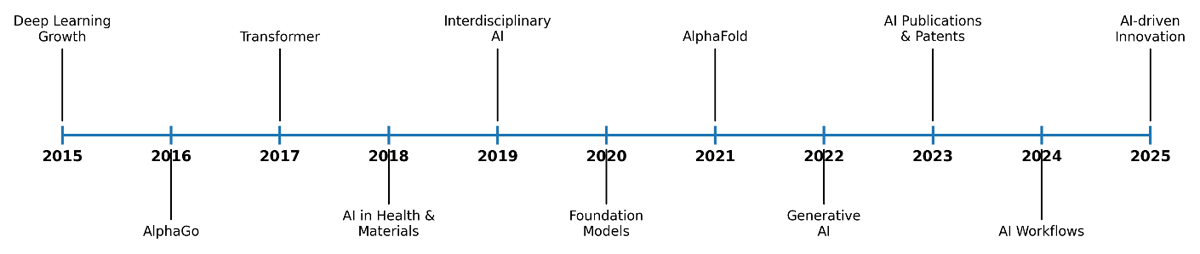
Figure 1
Timeline of major developments in artificial intelligence and their influence on scientific research and technological innovation (2015–2025).
Table 1
AI’s Impact on Scientific Productivity and Research Acceleration.
| STUDY GROUP (AUTHORS AND YEAR) | DOMAINS COVERED | METHODOLOGIES | KEY COMMON FINDINGS | RESEARCH GAPS/COMMENTS |
|---|---|---|---|---|
| Shah et al. (2025), Trinkley et al. (2024), Maqsood et al. (2024), and Thayyib et al. (2023) | Biomedicine, Materials Science, Multidisciplinary | Bibliometric, Predictive Modeling, Text Mining | AI accelerates research cycles by ~25–30%, improves data analysis speed, and enhances literature synthesis | Concentration in data-rich fields, bias toward established paradigms |
| Hazrati et al. (2024), Lin & Maruping (2025), Almeida et al. (2023) | Biomedical Science, Science Policy | Data Analytics, Citation Analysis, Policy Review | AI assists in trend detection and research prioritization, improving strategic funding decisions | Underrepresentation of niche or emerging fields |
| Mancuso et al. (2025), Hartung (2025) | Interdisciplinary Science | Surveys, Case Studies | AI-generated hypotheses often reinforce existing theories and frameworks | Potential limitation in fostering disruptive innovation |
Table 2
AI and the Science-to-Technology Translation.
| STUDY GROUP (AUTHORS & YEAR) | DOMAINS | METHODOLOGIES | KEY FINDINGS | RESEARCH GAPS/COMMENTS |
|---|---|---|---|---|
| Lin & Maruping (2025), Iqbal & Sadaf (2024), Hartung (2025) | Patent Analysis, Technology | Citation and Patent Analysis | AI-generated scientific outputs increasingly cited in high-impact technological patents | Need to better understand institutional and knowledge transfer barriers |
| Barbosu (2024), Jumper et al. (2023) | Biotechnology, Materials Science | Experimental, Case Studies | AI enables design of novel biomolecules and materials with industrial and medical applications | Commercialization processes remain inefficient |
| Campos Zabala (2023), Almeida et al. (2023), Mancuso et al. (2025) | Innovation Policy | Qualitative and Policy Analysis | Institutional bottlenecks slow technology transfer; AI integration faces organizational challenges | Need for policy frameworks to support AI-driven innovation |
Table 3
Ethical, Diversity, and Interdisciplinary Challenges in AI-Driven Science.
| STUDY GROUP (AUTHORS & YEAR) | DOMAINS | METHODOLOGIES | KEY FINDINGS | RESEARCH GAPS/COMMENTS |
|---|---|---|---|---|
| Mancuso et al. (2025), Hartung (2025) | Science of Science, Interdisciplinary | Text Mining, Surveys, Case Studies | AI tends to marginalize underexplored fields and reinforce dominant paradigms | Calls for diversity-aware AI development |
| Almeida et al. (2023), Campos Zabala (2023) | Research Policy | Policy Review, Qualitative | Challenges in integrating AI into interdisciplinary research and policy-making | Need for inclusive frameworks supporting diversity and ethics |
| Shah et al. (2025), Trinkley et al. (2024) | Ethics in AI and Science | Empirical Studies | Ethical concerns include bias amplification and transparency of AI decision-making | Urgent need for ethical guidelines and governance |
Table 4
Annual Publication Counts of AI-Related Scientific Research (2023–2025).
| YEAR | NUMBER OF PUBLICATIONS | GROWTH RATE (%) |
|---|---|---|
| 2023 | 3,200 | — |
| 2024 | 4,045 | 26.4 |
| 2025* | 5,100 | 26.1 |
[i] *Data for 2025 are for January–April only.
Table 5
Summary of Thematic Clusters in AI Scientific Development.
| CLUSTER ID | MAIN THEMES | REPRESENTATIVE KEYWORDS | NUMBER OF PUBLICATIONS |
|---|---|---|---|
| 1 | Machine Learning Methods | Machine learning, deep learning, neural networks | 4,120 |
| 2 | AI in Biomedical Sciences | Bioinformatics, medical imaging, genomics | 2,840 |
| 3 | AI for Climate and Environmental Science | Climate modeling, remote sensing, sustainability | 1,210 |
| 4 | AI in Materials Science and Nanotech | Materials design, nanotechnology, simulations | 1,540 |
| 5 | AI Ethics and Policy | AI ethics, governance, algorithmic bias | 635 |
Table 6
AI-Related Patent Counts and Citation Metrics by Technology Domain.
| TECHNOLOGY DOMAIN | NUMBER OF PATENTS | AVERAGE FORWARD CITATIONS |
|---|---|---|
| Biomedical AI | 1,250 | 8.4 |
| Materials Science | 930 | 7.9 |
| Environmental Technologies | 540 | 5.6 |
| AI Algorithms & Software | 1,100 | 6.8 |
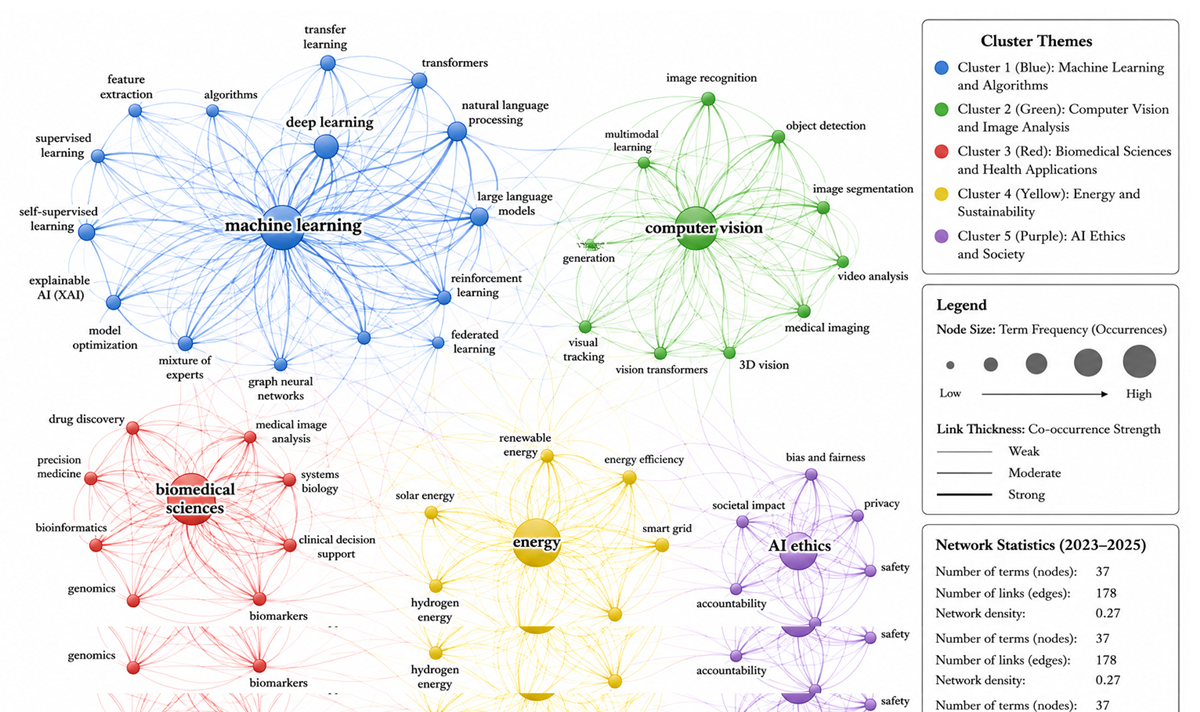
Figure 2
Co-word Network of AI-related Scientific Publications (2023–2025).
Note: Node size represents the frequency of each keyword. Links indicate co-occurrence strength between keywords in the same publications.
The network is visualized using VOSviewer with the LinLog/modularity clustering algorithm.