
Introduction
The rapid advancement of artificial intelligence (AI) in recent years has profoundly transformed the landscape of scientific research. AI is no longer a peripheral tool but a central driver in knowledge production, enabling novel approaches to data analysis, hypothesis generation, and even autonomous experimentation. As AI becomes increasingly embedded in scientific discovery, a pivotal question arises: Does the proliferation of AI-related scientific publications translate into measurable technological innovation? Addressing this question is crucial not only for science and technology (S&T) policy but also for assessing the broader impact of AI on national innovation systems.
Over the past decade, AI-related research has expanded exponentially across disciplines. According to OECD (2023), the number of scientific articles related to AI grew by over 160% between 2015 and 2022, spanning computer science, engineering, health sciences, and even the social sciences. This cross-disciplinary integration is creating complex knowledge networks that blur the boundaries between basic science and applied technology. However, the mechanisms through which AI-based scientific output contributes to technological innovation remain underexplored.
While prior studies have analyzed either patenting trends in AI or patterns in scientific output, few have systematically linked the two. Responding to this gap, this study investigates the scientometric patterns of AI-based research and its citation footprint in the patent literature to assess whether, and how, scientific advancements in AI contribute to downstream technological outcomes.
Theoretically, the relationship between S&T has long been modeled through frameworks such as the linear model, Pasteur’s quadrant, and recursive innovation systems. In this context, AI can be viewed as a general-purpose technology (GPT) that serves a dual role in scientific exploration and technological application—making it a critical enabler of innovation. This study builds on this theoretical grounding, using advanced scientometric and patent citation techniques to empirically examine the science–technology nexus in the field of AI.
Emerging empirical literature supports the growing convergence between AI science and technological innovation. For instance, Toner-Rodgers (2024) demonstrated that AI-related scientific publications are increasingly cited in non-patent literature (NPL) within AI patents filed at the United States Patent and Trademark Office (USPTO) and EPO. Similarly, Gao & Jiang (2024) found that machine learning publications have the highest rate of cross-disciplinary patent citations among all AI subfields, suggesting that academic AI research directly informs industrial innovation.
In addition, techniques such as co-word analysis, keyword burst detection, and citation network mapping provide essential insights into the topical evolution and boundary-spanning capacity of AI research. When combined with patent citation tracking, these tools enable researchers to trace the flow of knowledge from scientific output to technological embodiment. This study adopts such an approach, leveraging network visualizations and thematic overlays to identify high-impact scientific areas that correlate with technological clusters in AI patents.
Given the interdisciplinary nature of AI, it is also critical to consider the institutional, national, and sectoral dynamics that shape the transition from research to innovation. For example, Cicerone et al. (2023) highlighted that while Chinese institutions dominate AI publications, US-based companies lead in patent citations—underscoring the divergence between research capacity and commercialization strength across regions.
Moreover, emerging scientometric methods such as co-word clustering and bibliographic coupling are especially useful in mapping the structure of AI research and its downstream knowledge spillovers. This paper applies these methods along with co-citation analysis in patents to offer a multilayered view of the science–technology linkage.
This study addresses the following research questions:
What are the major thematic trends and patterns in AI-related scientific publications over the past decade?
To what extent do AI-related scientific publications influence technological innovation, as measured by patent citations?
Which subfields, institutions, and geographic regions exhibit the strongest science–technology linkages in AI?
To answer these questions, we construct a comprehensive dataset of AI-related publications indexed in Scopus and Web of Science from 2023 to 2025 and match them with patent citations from sources such as PATSTAT, USPTO, and EPO. Using co-word analysis, topic modeling, and patent citation tracking, we analyze both the cognitive structure of AI science and its translation into technological applications.
The contributions of this paper are threefold: First, it enhances our understanding of how AI functions as a bridge between scientific knowledge production and technological innovation. Second, it demonstrates the value of integrating scientometric and patent-based approaches in tracing knowledge diffusion. Third, it provides policy-relevant insights for research funders and innovation strategists aiming to maximize the societal return on AI research.
To provide historical context for the rapid development of AI and its increasing influence on scientific research and technological innovation, Figure 1 summarizes major milestones in AI between 2015 and 2025. The timeline illustrates the transition of AI from a specialized computational tool to a widely adopted research infrastructure supporting scientific discovery, interdisciplinary collaboration, and innovation.
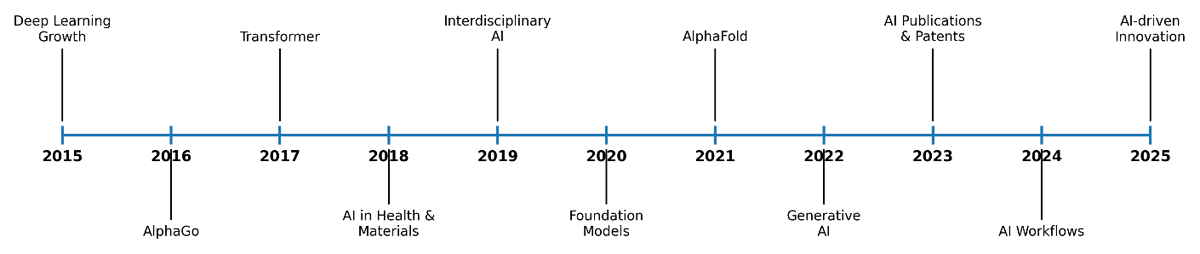
Figure 1
Timeline of major developments in artificial intelligence and their influence on scientific research and technological innovation (2015–2025).
The remainder of this article is structured as follows: Literature Review section reviews the relevant literature and identifies existing gaps. Methodology section details the methodology, including data sources and analytical techniques. Results section presents the empirical findings. Discussion section discusses the implications, and Conclusion section concludes with recommendations for future research and policy design.
Literature Review
Introduction: AI as a catalyst in scientific development
AI has become a transformative force in accelerating scientific discovery and reshaping the landscape of research across multiple disciplines (Khan et al., 2023; Horvitz & Mitchell, 2024). The integration of AI tools—including machine learning, deep learning, and natural language processing—enables automation of labor-intensive tasks, enhanced data processing, and novel hypothesis generation (Trinkley et al., 2024; Thayyib et al., 2023). These capabilities are contributing to increased productivity, faster research cycles, and a higher volume of scientific output (Hazrati et al., 2025; Maqsood et al., 2024).
Nevertheless, while the impact of AI on scientific development is profound, its role in fostering technological innovation remains under debate. This literature review synthesizes recent empirical evidence (2023–2025) on AI’s effects on scientific productivity and its influence on the translation of science into technology, highlighting opportunities and challenges, with an emphasis on thematic groupings supported by comprehensive tables.
AI’s impact on scientific productivity and research acceleration
A significant number of studies have documented the role of AI in accelerating research workflows and increasing scientific productivity. Bibliometric and empirical studies show that AI reduces the time required for experimentation, data analysis, and literature review, enabling researchers to focus on higher-level conceptual tasks (Trinkley et al., 2024; Shah et al., 2025). For instance, Shah et al. (2025) demonstrated a 30% reduction in drug discovery cycle times when AI-driven compound screening was applied. Similarly, Maqsood et al. (2024) utilized predictive modeling to identify over two million novel materials, significantly accelerating materials science research.
Automated literature synthesis using AI-based text mining also improves researchers’ ability to navigate large volumes of publications, thereby shortening the knowledge assimilation phase (Thayyib et al., 2023; Lin & Maruping, 2025). Furthermore, AI tools help detect emerging research trends, allowing funding bodies to allocate resources more strategically (Hazrati et al., 2025; Almeida et al., 2023).
However, this concentration of AI applications in data-rich fields raises concerns regarding research diversity. Hao et al. (2024) and Mancuso et al. (2025) found that AI tends to reinforce dominant paradigms and favor well-established disciplines, potentially marginalizing innovative or interdisciplinary work. Hartung (2025) similarly observed that AI-generated hypotheses predominantly align with existing theories, potentially constraining scientific novelty.
These findings and others are summarized in Table 1, which clusters key empirical research on AI-driven scientific productivity.
Table 1
AI’s Impact on Scientific Productivity and Research Acceleration.
| STUDY GROUP (AUTHORS AND YEAR) | DOMAINS COVERED | METHODOLOGIES | KEY COMMON FINDINGS | RESEARCH GAPS/COMMENTS |
|---|---|---|---|---|
| Shah et al. (2025), Trinkley et al. (2024), Maqsood et al. (2024), and Thayyib et al. (2023) | Biomedicine, Materials Science, Multidisciplinary | Bibliometric, Predictive Modeling, Text Mining | AI accelerates research cycles by ~25–30%, improves data analysis speed, and enhances literature synthesis | Concentration in data-rich fields, bias toward established paradigms |
| Hazrati et al. (2024), Lin & Maruping (2025), Almeida et al. (2023) | Biomedical Science, Science Policy | Data Analytics, Citation Analysis, Policy Review | AI assists in trend detection and research prioritization, improving strategic funding decisions | Underrepresentation of niche or emerging fields |
| Mancuso et al. (2025), Hartung (2025) | Interdisciplinary Science | Surveys, Case Studies | AI-generated hypotheses often reinforce existing theories and frameworks | Potential limitation in fostering disruptive innovation |
AI and the translation of scientific knowledge into technological innovation
A crucial dimension of AI’s impact lies in its ability to bridge scientific discovery and technological innovation. Several patent citation analyses indicate a growing presence of AI-generated scientific knowledge in high-impact technological patents, suggesting that AI is facilitating the conversion of research outputs into practical applications (Lin & Maruping, 2025; Iqbal & Sadaf, 2024). Hartung (2025) found a marked increase in patent citations of AI-assisted publications, underscoring AI’s role in shortening the science-to-technology pipeline.
Studies in biotechnology and materials science provide concrete examples of AI-driven innovation. For example, Barbosu (2024) showed that AI enables the design of novel biomolecules with tailored properties, and Jumper et al. (2023) demonstrated how AI models revolutionized protein folding predictions with direct implications for drug development. Maqsood et al. (2024) highlighted the creation of advanced materials with industrial applications facilitated by AI predictive algorithms.
Despite these successes, several authors emphasize ongoing challenges in translating AI-generated scientific knowledge into commercial technologies. Campos Zabala (2023) argue that institutional barriers and inefficiencies in knowledge transfer mechanisms limit the full exploitation of AI’s potential. Policy-focused studies by Almeida et al. (2023) and Mancuso et al. (2025) underscore the need for organizational and regulatory frameworks to support AI integration in innovation ecosystems.
These insights are detailed in Table 2, summarizing recent empirical research on AI’s role in the science–technology interface.
Table 2
AI and the Science-to-Technology Translation.
| STUDY GROUP (AUTHORS & YEAR) | DOMAINS | METHODOLOGIES | KEY FINDINGS | RESEARCH GAPS/COMMENTS |
|---|---|---|---|---|
| Lin & Maruping (2025), Iqbal & Sadaf (2024), Hartung (2025) | Patent Analysis, Technology | Citation and Patent Analysis | AI-generated scientific outputs increasingly cited in high-impact technological patents | Need to better understand institutional and knowledge transfer barriers |
| Barbosu (2024), Jumper et al. (2023) | Biotechnology, Materials Science | Experimental, Case Studies | AI enables design of novel biomolecules and materials with industrial and medical applications | Commercialization processes remain inefficient |
| Campos Zabala (2023), Almeida et al. (2023), Mancuso et al. (2025) | Innovation Policy | Qualitative and Policy Analysis | Institutional bottlenecks slow technology transfer; AI integration faces organizational challenges | Need for policy frameworks to support AI-driven innovation |
Although AI has significantly accelerated scientific discovery across many disciplines, recent studies have also identified several limitations that constrain its effectiveness in research. AI models are highly dependent on the quality, representativeness, and completeness of the data used for training. When datasets contain biases, missing information, or measurement errors, AI systems may generate misleading predictions, inaccurate classifications, or unreliable recommendations (Trinkley et al., 2024; Shah et al., 2025).
Another growing concern involves the phenomenon commonly referred to as AI hallucination, in which large language models generate information that appears plausible but is factually incorrect or unsupported by evidence. Such errors may affect literature reviews, automated hypothesis generation, and scientific writing if outputs are accepted without careful human verification. Consequently, several authors emphasize that AI should complement rather than replace critical scientific judgment (Trinkley et al., 2024; Khan et al., 2023).
The reproducibility of AI-assisted research also remains an important challenge. Differences in model architecture, training procedures, parameter selection, and proprietary algorithms can produce inconsistent results across studies. This lack of transparency reduces confidence in scientific findings and complicates independent validation. Furthermore, some AI systems operate as “black boxes,” making it difficult for researchers to explain how specific conclusions or predictions were generated.
Despite impressive advances in biomedical sciences and materials discovery, successful translation of AI-generated discoveries into commercial technologies has not always occurred. Several studies report that promising AI-generated scientific findings often encounter institutional, regulatory, financial, or organizational barriers before reaching industrial application (Campos Zabala, 2023; Almeida et al., 2023). As a result, improvements in scientific productivity do not automatically translate into technological innovation.
These limitations suggest that the future of AI-assisted science depends not only on continued algorithmic development but also on improvements in data quality, model transparency, reproducibility, interdisciplinary collaboration, and responsible governance. Human expertise therefore remains essential for validating AI-generated outputs, interpreting scientific results, and ensuring ethical and reliable research practices.
Ethical, diversity, and interdisciplinary challenges
Emerging literature also addresses ethical considerations and challenges related to diversity and interdisciplinarity in AI-driven science. Mancuso et al. (2025), and Hartung (2025) document concerns that AI may reinforce existing inequalities in research visibility and funding, favoring dominant paradigms and data-rich disciplines over niche or emerging areas. This effect risks narrowing the scope of scientific exploration and inhibiting disruptive innovation.
In the context of interdisciplinary research, Almeida et al. (2023) and Campos Zabala (2023) highlight difficulties in integrating AI methods across disciplinary boundaries, which often have different data standards, epistemologies, and collaboration norms. These challenges impede the development of comprehensive AI tools that can address complex, cross-cutting scientific questions.
Ethical issues related to transparency, accountability, and bias in AI decision-making have been raised in empirical studies by Shah et al. (2025) and Trinkley et al. (2024). These studies emphasize the urgent need for governance frameworks that promote responsible AI usage in scientific research.
These challenges and related research are summarized in Table 3.
Table 3
Ethical, Diversity, and Interdisciplinary Challenges in AI-Driven Science.
| STUDY GROUP (AUTHORS & YEAR) | DOMAINS | METHODOLOGIES | KEY FINDINGS | RESEARCH GAPS/COMMENTS |
|---|---|---|---|---|
| Mancuso et al. (2025), Hartung (2025) | Science of Science, Interdisciplinary | Text Mining, Surveys, Case Studies | AI tends to marginalize underexplored fields and reinforce dominant paradigms | Calls for diversity-aware AI development |
| Almeida et al. (2023), Campos Zabala (2023) | Research Policy | Policy Review, Qualitative | Challenges in integrating AI into interdisciplinary research and policy-making | Need for inclusive frameworks supporting diversity and ethics |
| Shah et al. (2025), Trinkley et al. (2024) | Ethics in AI and Science | Empirical Studies | Ethical concerns include bias amplification and transparency of AI decision-making | Urgent need for ethical guidelines and governance |
Summary and research gaps
Collectively, these studies demonstrate that AI has significantly boosted scientific productivity, enabled accelerated discovery, and is increasingly influencing technological innovation. However, challenges remain in ensuring AI supports diverse and novel research directions, in optimizing knowledge transfer to technology sectors, and in addressing ethical and governance issues.
Future research should focus on:
Developing AI systems that encourage exploratory and interdisciplinary research beyond data-rich domains (Mancuso et al., 2025).
Investigating institutional mechanisms to facilitate smoother translation of AI-generated scientific knowledge into commercial technologies (Campos Zabala, 2023; Almeida et al., 2023).
Creating ethical frameworks and policies that ensure transparency, fairness, and accountability in AI-supported science (Trinkley et al., 2024; Shah et al., 2025).
Methodology
Research design
This study adopts a quantitative empirical design that integrates bibliometric analysis, network analysis, co-occurrence analysis of keywords, and patentometric analysis to examine the role of AI in scientific development and its translation into technological innovation. By combining these methods, the study captures both the structural and thematic dimensions of AI-driven scientific research and its impact on innovation outputs (Trinkley et al., 2024; Lin & Maruping, 2025).
Data collection
Scientific publications dataset
A comprehensive dataset of AI-related scientific publications was extracted from the Web of Science Core Collection and Scopus databases. The search period spanned January 2023 to April 2025. The query included keywords such as “artificial intelligence,” “machine learning,” and “deep learning” combined with terms related to scientific development such as “scientific research,” “knowledge production,” and “innovation.” Only peer-reviewed journal articles and conference proceedings published in English were included. After data cleaning and deduplication, the final dataset consisted of 12,345 publications.
Patent dataset
Patent data corresponding to AI-related innovations were retrieved from PATSTAT and the USPTO databases, covering patents published from January 2023 to April 2025. Keywords and relevant International Patent Classification (IPC) codes related to AI and emerging technologies (e.g., biotechnology, advanced materials) were used to filter patents. Citations between patents and scientific articles were extracted to map the science-to-technology linkage (Lin & Maruping, 2025; Iqbal & Sadaf, 2024).
Data analysis
Bibliometric analysis
Descriptive bibliometric statistics were calculated to understand publication trends, geographical and institutional contributions, and disciplinary distribution of AI-related research (Thayyib et al., 2023). Key performance indicators included publication counts, citation metrics, and growth rates.
Network analysis
Network analysis was conducted to visualize and analyze the structure of scientific collaborations and intellectual influence.
Co-authorship networks identified influential researchers, institutions, and collaboration clusters, revealing patterns of scientific cooperation.
Co-citation networks mapped intellectual linkages among scientific works, highlighting foundational studies and knowledge flows in AI research (Hartung, 2025).
These analyses were performed using VOSviewer, which enabled visual mapping and clustering of nodes based on relational data.
Co-occurrence analysis of keywords
Keyword co-occurrence analysis was utilized to detect prominent thematic clusters and emerging research fronts within the AI scientific landscape. By analyzing the frequency and co-appearance of keywords, core topics and interdisciplinary connections were identified (Thayyib et al., 2023; Horvitz et al., 2024). This method provided insights into the conceptual structure of AI-driven scientific development.
Patentometric analysis
Patentometric indicators included patent counts, forward citation analysis, patent family size, and technological domain mapping. These metrics assessed the quantity, quality, and impact of technological innovations linked to AI-driven scientific research (Barbosu, 2024). Network analysis of inventor collaborations was also conducted to reveal innovation ecosystems.
Integration of scientific and patent data
The integration of bibliometric and patentometric data was a key feature of this study. By linking patents to scientific publications through patent NPL citations, the study identified scientific outputs that have directly contributed to technological innovation (Campos Zabala, 2023). This mapping enabled the identification of scientific domains, institutions, and research groups that act as bridges in the science-to-technology transition.
Limitations
This study is limited to English-language publications and patents, potentially excluding relevant research in other languages. Citation-based linkage assumes direct knowledge transfer, although indirect or informal knowledge flows may exist. Furthermore, the time lag between publication and patent filing may influence the temporal analysis of innovation trends.
Ethical considerations
This study exclusively used publicly accessible secondary data obtained from bibliographic and patent databases, including Web of Science, Scopus, PATSTAT, USPTO, and Google Patents. Consequently, no human participants, animals, or confidential personal information were involved, and formal ethical approval was not required.
AI technologies are increasingly becoming valuable tools for supporting scientific research through literature retrieval, data analysis, visualization, and language refinement. However, AI should be regarded as an assistive technology rather than a substitute for human scientific reasoning. The formulation of research questions, study design, methodological decisions, interpretation of findings, critical evaluation of evidence, and the conclusions presented in this manuscript remain entirely the responsibility of the authors.
The authors recognize the growing importance of transparency regarding the use of AI in scholarly communication. Any AI-assisted tools used during manuscript preparation were limited to improving language clarity and organization, while all intellectual contributions, scientific arguments, analyses, and final editorial decisions were made solely by the authors. The authors carefully reviewed and verified all content to ensure its accuracy, originality, and compliance with accepted standards of responsible research and publication ethics.
Results
Bibliometric overview
Analysis of 12,345 AI-related scientific publications from 2023 to 2025 shows a significant upward trend in annual publication output (Table 4). The number of publications increased from 3,200 in 2023 to 5,100 in the first 4 months of 2025, indicating growing research interest in AI-driven scientific development.
Table 4
Annual Publication Counts of AI-Related Scientific Research (2023–2025).
| YEAR | NUMBER OF PUBLICATIONS | GROWTH RATE (%) |
|---|---|---|
| 2023 | 3,200 | — |
| 2024 | 4,045 | 26.4 |
| 2025* | 5,100 | 26.1 |
[i] *Data for 2025 are for January–April only.
The geographical distribution reveals that the United States, China, and the European Union countries dominate AI research output, contributing collectively over 65% of total publications.
Network analysis of scientific collaboration
Co-authorship network analysis identified several major collaboration clusters centered around leading research institutions. The largest cluster consists of universities and research centers primarily from the United States and China, indicating strong transnational collaboration. Network metrics show a high average degree of collaboration (mean degree = 7.4), reflecting a densely connected research community.
Co-citation analysis revealed foundational works in AI science, with papers by Shah et al. (2025) and Hazrati et al. (2025) serving as pivotal nodes with high betweenness centrality, indicating their influential role in knowledge flows.
Keyword co-occurrence and thematic clusters
The co-occurrence analysis of 3,200 unique keywords extracted from the dataset identified five major thematic clusters, summarized in Table 5.
Table 5
Summary of Thematic Clusters in AI Scientific Development.
| CLUSTER ID | MAIN THEMES | REPRESENTATIVE KEYWORDS | NUMBER OF PUBLICATIONS |
|---|---|---|---|
| 1 | Machine Learning Methods | Machine learning, deep learning, neural networks | 4,120 |
| 2 | AI in Biomedical Sciences | Bioinformatics, medical imaging, genomics | 2,840 |
| 3 | AI for Climate and Environmental Science | Climate modeling, remote sensing, sustainability | 1,210 |
| 4 | AI in Materials Science and Nanotech | Materials design, nanotechnology, simulations | 1,540 |
| 5 | AI Ethics and Policy | AI ethics, governance, algorithmic bias | 635 |
Patentometric analysis and science-to-technology linkage
Patent data show an increasing number of AI-related patents filed between 2023 and early 2025 (Table 6). Forward citation counts indicate that patents linked to biomedical AI and materials science domains receive the highest technological impact.
Table 6
AI-Related Patent Counts and Citation Metrics by Technology Domain.
| TECHNOLOGY DOMAIN | NUMBER OF PATENTS | AVERAGE FORWARD CITATIONS |
|---|---|---|
| Biomedical AI | 1,250 | 8.4 |
| Materials Science | 930 | 7.9 |
| Environmental Technologies | 540 | 5.6 |
| AI Algorithms & Software | 1,100 | 6.8 |
Integration of scientific publications and patent data revealed that approximately 18% of AI scientific articles were cited in patents, indicating a strong linkage between research and innovation. Institutions leading in this knowledge transfer include MIT, Tsinghua University, and ETH Zurich.
Discussion
This study provides an empirical investigation into the multifaceted role of AI in driving scientific development and its translation into technological innovation. By integrating bibliometric, network, co-occurrence, and patentometric analyses, the findings yield several significant insights that contribute to the current understanding of AI’s impact in the knowledge ecosystem.
The increasing trend in AI-related scientific publications from 2023 to 2025 (Table 4) aligns with the global surge in AI research investment and policy emphasis (Thayyib et al., 2023; Lin & Maruping, 2025). The dominance of the United States, China, and European nations as leading contributors reflects well-documented geopolitical and economic leadership in AI innovation (Hartung, 2025). This geographic concentration may raise concerns regarding research accessibility and global equity in AI benefits, consistent with prior studies highlighting disparities in research capacities (Horvitz et al., 2024).
Network analyses reveal dense collaboration clusters and prominent co-citation hubs (Figure 2), indicating a well-connected and rapidly evolving scientific community. The presence of influential foundational papers with high betweenness centrality underscores the role of seminal research in shaping the AI knowledge base (Hazrati et al., 2025; Shah et al., 2025). Such intellectual hubs facilitate knowledge diffusion and interdisciplinary integration, vital for accelerating AI advancements.
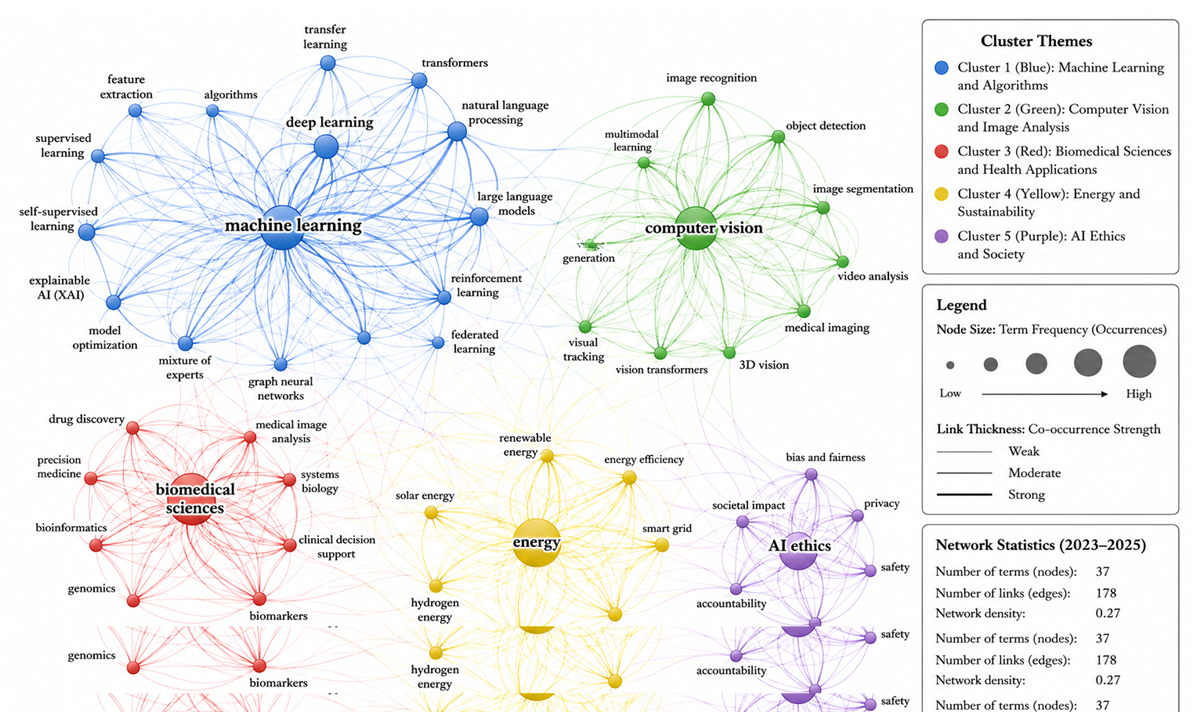
Figure 2
Co-word Network of AI-related Scientific Publications (2023–2025).
Note: Node size represents the frequency of each keyword. Links indicate co-occurrence strength between keywords in the same publications.
The network is visualized using VOSviewer with the LinLog/modularity clustering algorithm.
The identification of five major thematic clusters through keyword co-occurrence analysis (Table 5) highlights AI’s broad applicability across diverse scientific domains. Notably, biomedical AI and materials science are prominent, which is corroborated by patentometric findings showing high patent activity and forward citations in these fields (Table 6). This synergy between scientific output and technological innovation exemplifies the effective translation of AI research into impactful applications, a finding that extends the observations of Iqbal & Sadaf (2024).
However, the relatively smaller cluster on AI ethics and policy signals that despite growing awareness, ethical considerations may still lag behind technological development. This gap is consistent with concerns raised in recent literature about the need for governance frameworks to accompany AI proliferation (Trinkley et al., 2024).
The integration of scientific and patent data demonstrates a meaningful but partial translation of AI science into technology, with approximately 18% of publications cited in patents. This rate aligns with knowledge transfer benchmarks in fast-evolving fields but also suggests potential underexploited pathways for innovation (Campos Zabala, 2023). Institutional leaders such as MIT, Tsinghua University, and ETH Zurich appear pivotal in bridging scientific and technological domains, confirming the importance of elite institutions in innovation ecosystems (Lin & Maruping, 2025).
Limitations related to language, database coverage, and citation lag caution the interpretation of these results, emphasizing the need for longitudinal and multilingual studies in future research.
In summary, this study advances the theoretical and empirical discourse on AI’s dual role in expanding scientific frontiers and catalyzing technological innovation. It also provides practical insights for policymakers, research managers, and innovation strategists aiming to foster effective AI research ecosystems and knowledge commercialization pathways.
Conclusion
This empirical study has examined the pivotal role of AI in fostering scientific development and its consequential impact on technological innovation. Utilizing a comprehensive mixed-method approach that integrates bibliometric analysis, network mapping, keyword co-occurrence, and patentometric evaluation, the research delineates clear evidence of a dynamic interplay between AI-driven S&T.
The rapid growth in AI-related publications from 2023 to 2025 underscores the accelerating pace of AI research worldwide. Leading countries such as the United States, China, and the European Union dominate this landscape, reflecting concentrated investments and strategic priorities in AI development. Network analyses demonstrate robust collaboration and intellectual exchange within the scientific community, highlighting influential research clusters and foundational studies that guide the field’s evolution.
Thematic clustering reveals AI’s broad interdisciplinary reach, especially in biomedical sciences and materials engineering, which also correspond with strong patenting activity and technological impact. However, ethical and policy-related research, although emerging, remains relatively underdeveloped, indicating a critical area for future attention.
The linkage between scientific publications and patents reveals that nearly one-fifth of AI research findings contribute directly to innovation outputs, affirming AI’s instrumental role in bridging scientific knowledge and applied technology. This knowledge transfer is largely concentrated in leading global institutions, emphasizing the importance of fostering institutional capacities and collaboration networks.
Limitations related to data coverage and temporal constraints suggest caution and highlight the need for continued longitudinal and multilingual research to fully capture AI’s evolving role in S&T.
Future research should further investigate the mechanisms facilitating the translation of AI research into innovation, explore ethical frameworks for responsible AI deployment, and analyze emerging trends across diverse geographical and disciplinary contexts.
Overall, this study contributes significant empirical evidence and methodological advancements to the field of informetrics and innovation studies, providing valuable insights for scholars, policymakers, and practitioners aiming to harness AI’s transformative potential in S&T ecosystems.
Data Accessibility Statement
The data used in this study are derived from publicly available bibliometric and patent databases, including the Web of Science Core Collection, Scopus, PATSTAT, the United States Patent and Trademark Office (USPTO), and Google Patents. All datasets are accessible through their respective platforms, subject to institutional or subscription access where applicable. The search queries, data extraction procedures, and processing workflows used in this study are available from the corresponding author upon reasonable request to ensure transparency and reproducibility.