
Introduction
Powder metallurgy (PM) is a generic term including techniques for producing solid metal-based products from powders. Powder metallurgy part manufacturing (PMPM, or PM2) forms metal parts by sintering metal powders compacted in dies under pressure (James, 2015). ‘Sintering’ is the process of heating a so-called ‘green compact’ metal powder that was die-pressed into a shape (Rahaman, 2015). Sintering heats a green compact part just below its melting point in a furnace with a controlled, gas-enriched atmosphere to produce a finished metal part.
Background
The history of applying PM2 principles extends back as far as ≈3000 BCE (Adams, 2015), although commercial production of PM2 accelerated in the late 1800s. In 2022, PM2 accounted for only 6.5% of revenue generated by the United States (US) metal stamping and forging industry (Haupt, 2022, p. 18), of which PM2 is a part. However, PM2 has historically been the most profitable product segment of the metal stamping and forging industry (Haupt, 2022, p. 12).
The PM2 industry is a significant part of the history of the economy and technology of Pennsylvania. Powder metallurgy part manufacturing in the US is highly concentrated in the north-central region of Pennsylvania. The history and performance of this geographic concentration of PM2 offer examples of how a geographic cluster of human, natural, technological, and capital resources can establish a niche in the national economy and exert technical leadership globally. Although small, PM2 holds a significant position in the history of metal part manufacturing in the US.
North-central Pennsylvania PM2 is rooted in the late 1800s production of pressed carbon in St. Marys, Pennsylvania, to make metal graphite brushes for the then-emerging electric power industry. Carbon pressing techniques developed to make these parts were modified to make carbon electrodes for deployment in electric arc steel furnaces in Pittsburgh. Then, inspired by porous carbon bearings exhibited at the 1932 World’s Fair in Chicago, carbon producers began exploring the growing possibilities of PM2 after World War II. After gaining on-the-floor experience, employees of these producers spawned their own companies for PM2. As production expanded, technology advanced, and PM2 expertise clustered around St. Marys. North-central Pennsylvania began branding itself as the ‘Powder Metallurgy Capital of the World.’
Scope of our perspectives
In the remainder of this article, we offer perspectives on the nature and operations of the PM2 industry. First, we explain common processes for PM2. Next, resource and product markets for PM2 are described. Then, US Census Bureau data are analyzed to document the dense concentration of PM2 in north-central Pennsylvania. Also delineated are some forces affecting the competitiveness of PM2 in the US.
Our reflections about technology practices in PM2 are based on interviews, meetings, and collaborative research activity with almost every PM2 firm in north-central Pennsylvania, suppliers and customers for PM2, and industry trade groups in the US and internationally.1 Our process for gathering information followed the close-knit—in many cases, family-centered—community of PM2 in north-central Pennsylvania, where PM2 often is viewed more as a craft than as science or engineering. Not surprisingly, little formal guidance has been diffused from this tight community to integrate PM2 into the industrial design of products. Powder metallurgy part manufacturing also is often neglected in the education of engineers. For instance, engineering students at Penn State receive approximately one-half hour of lecture devoted to PM2 during their undergraduate experience.
Processes
Conventional pressing
A process, diagrammed in Figure 1, known as press–and–sinter is the core, conventional PM2 process. Custom–blended metal powders are fed into a die, compacted by a punch into the desired part, ejected from the die, and then sintered in a controlled atmosphere furnace at a temperature below the melting point of the base material. Press–and–sinter processes offer relatively low manufacturing and tooling costs and produce close tolerances in the finished parts.
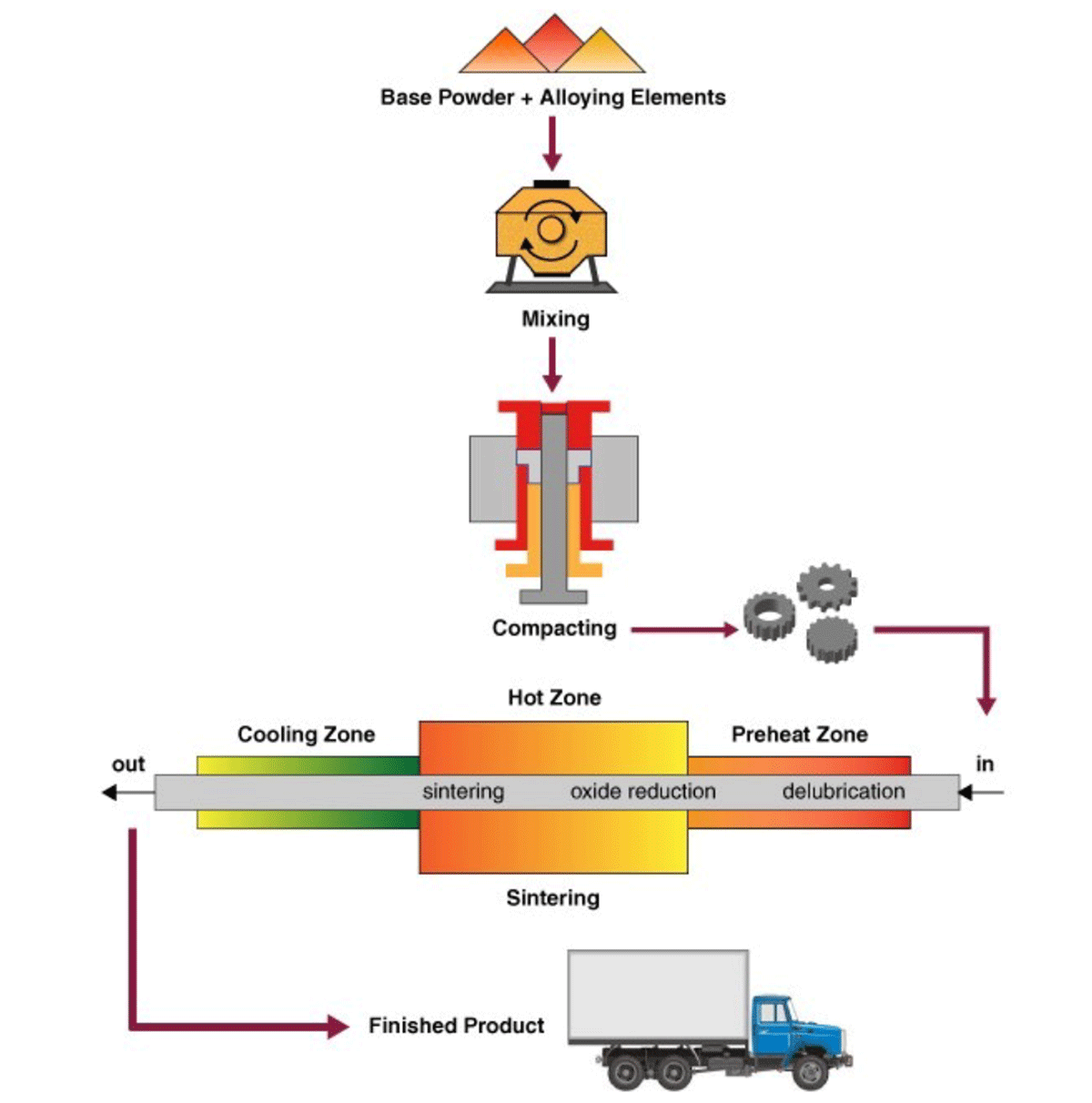
Figure 1
Conventional powder metallurgy process from metal powder to finished part.
Note: Used by permission from the Metal Powder International Foundation.
General attributes of the PM2 process include elimination or minimization of machining; reduction of scrap and waste due to ‘net shape’ processes; close dimensional tolerances; relatively low energy use (e.g., metal need not be melted); and ability to produce complex shapes. However, ejecting the pressed green compact part from the die imposes certain part design constraints. For example, parts with undercuts, grooves, threads, knurls, reverse tapers, or orifices at angles to the direction of pressing are ill-suited for PM2. A green compact part resembles the greenware stage of ceramics production, so the part ejected from the die must have enough structural integrity to withstand handling and transportation. Sufficient radii of inner and outer flanges and the overall thickness of parts are required to maintain the integrity of a green compact part before sintering. Gear design for PM2 is another example of a design constraint. An adequate modulus of gear teeth is necessary to allow powder to fill a die and to maintain sturdiness before sintering. As a result of these and other constraints, attention to part design is essential.
Metal powders are elemental or alloyed metals mixed before pressing with binders, lubricants, deflocullates, and additives. A binding mixture consolidates the loose powder. Lubricants are necessary because clearances between punches and dies used for powder pressing typically are less than 0.001 inches. Deflocullates stop the metal powder from clumping. Introducing additives can improve PM2 part machinability, wear resistance, or lubricity.
The force necessary for pressing for most parts typically varies between 10,000 lbs/in2 (70 MPa) and 120,000 lbs/in2 (800 MPa). Parts for this type of manufacture are mostly small (under 5 lbs), and press requirements are under 100 tons typically. Presses with capacities of several thousand tons sometimes are used for work requiring more force. Double action presses, with opposing top and bottom punches, are common to reach the level and distribution of powder desired for compaction. The pressure the press can deliver dictates the upper limit of the size of a part. Increasing the speed of pressing enhances productivity, but pressing too fast can trap air that can prevent the part from compacting properly.
In 2019, press-and-sinter processes produced approximately 93% of the volume of worldwide PM2 industry output. However, other PM2 processes are emerging, some of which can add high market value but have correspondingly high production costs. In metal injection molding, metal powder is conventionally injection molded to produce a green compact for sintering. Isostatic pressing confines metal powder inside a flexible membrane surrounding a mold which acts as a barrier between the metal powder and a liquid or gas pressurizing medium. Isostatic pressing is adapted especially to relatively large, complex-shaped parts. Powder forging compacts metal powders into a ‘preform’ shape in a die. The preformed shape is sintered. The sintered preform is coated with a lubricant and is closed die forged. Forging causes plastic flow, resulting in a dense, non–porous, dimensionally–precise, low–waste part that possesses desirable mechanical properties. Spray forming is used to produce semi-finished mill products in the form of billets, tubes, and sheets through high–rate deposition of atomized powder metal layer-by-layer onto a substrate to form, after their solidification, a bulk product or thick coating. An innovative PM2 process generating considerable attention is additive manufacturing, a group of fabrication processes through which three-dimensional parts are constructed by adding layers of materials on point, line, or planar surfaces (Hassanin & Jiang, 2015)—i.e., 3D printing using fine-grade metal powders. Metal injection molders are researching potential manufacturing marriages with additive manufacturing processes.
Sintering
Sintering creates metallurgical bonds between the powder particles, adding desirable mechanical and physical properties to the part. Sintering occurs in a sintering furnace in a controlled atmosphere that can enhance PM2 part properties by, for instance, regulating oxidation, reduction, and carbon content, making heating and cooling uniform, producing a uniform microstructure of the product, and adding corrosion resistance. Since the late 1970s, a nitrogen/hydrogen mix has become the atmosphere of choice for most PM2 sintering.
The typical sintering furnace contains a continuous mesh belt moving through three operating zones: (a) a pre-heat zone that burns off binders and lubricants added at the pressing phase and increases the temperature of the green part; (b) a hot zone in which the part raised to 70% to 90% of its melting point; and (c) a cooling zone, in which the part’s temperature is gradually lowered. Post–sintering processes also can occur, such as machining, repressing (for decreased porosity and increased hardness), impregnating with oil or resin (to produce a self–lubricating part), infiltrating with another metal (to remove residual porosity and enhance part strength), plating, coating, deburring, welding, steam treating (to oxidize surfaces for strength and density improvement), or furnace brazing with other parts. However, an efficiency feature of PM2 is that most finished parts require little or no secondary machining operations, such as are necessary for most stamped or forged parts.
A practical and distinguishing metallurgical feature of PM2 processes is that parts for sintering are not subject to Gibbs’ phase rule (Verret et al., 2020, p. 227) that would apply if these metals were alloyed by melting. This feature means that PM2 does not face many of the same chemical, thermal, and containment restraints placed on materials alloyed by melting due to intersections and disjunctions of their various liquid and solid phases.
Markets
For resources
PM2 purchases many of the inputs to processes from suppliers, just as most complex manufacturing operations do. PM2 producers purchase two critical sets of supplies. One set of inputs includes metal powders, lubricants, binders, additives, and other raw materials that go into making finished parts. Another set comprises tooling, process equipment, industrial gases, and related services. Some PM2 producers might choose to outsource post-sintering product finishing.
Metal powder is a unique and essential input to PM2 processes. In north-central Pennsylvania, ferrous metal powder is dominant in production. Ferrous powder accounted for 89% of the global volume share of metal powder purchased in 2019. Atomization is the most popular method of metal powder production. Molten metal is forced through a nozzle, where it is atomized by an inert gas jet. This inert gas jet separates the molten metal into small metal dimples. These dimples solidify to produce metal powder. The powder can vary by shape, porosity, flow and friction characteristics, surface chemistry, and bulk density and is mixed before packing to include lubricants, binders, deflocculates additives, and additional materials.
Tooling is another critical input to PM2 processes. A close fit of a punch with a die is necessary so that pressed metal particles do not become stuck in the clearance between the punch and die. Most punches and dies are made from hardened tool steels, the surfaces of which are ground and polished or lapped in the direction of tool movement. Tungsten carbide is used---- to make punches and dies for more powerful powder-pressing operations. These features demand high tolerance production of machine tooling and dictate careful tool use and maintenance.
Many PM2 suppliers—gas furnace fabricators, gas suppliers, machine shops—are proximal to PM2 producers in the north-central Pennsylvania region. Metal powder is typically supplied from outside the region (until recently, Scandinavia).
For products
The global PM2 market was valued at $7.49 billion (US) in 2020 and is projected to reach $12.63 Billion by 2028, growing at a compound annual growth rate of 6.77%. The increasing demand for PM2 parts in manufacturing automotive components is a significant factor in this global growth, particularly in China and India. The automotive industry is the customer for most of the PM2 parts produced in north-central Pennsylvania.
According to the Metal Powder Industries Federation, the typical US light-duty vehicle contains about 37 pounds of PM2 parts. Pickup trucks average about 60–95 pounds, depending on the configuration. The standard US passenger sedan averages 20 pounds. More than an estimated 1.5 billion PM2 forged connecting rods have been made for light-duty vehicles produced in the US, Europe, and Japan. Commercial aircraft engines contain 1,500–4,400 pounds of PM2 per engine.
The automotive industry and its consumers are moving quickly away from the internal combustion engine in favor of fully electric vehicles and hybrids, however. Increased sticker prices have made new vehicles less affordable for some consumers. Not surprisingly, the average income of a new US. vehicle buyer was $124,000 in 2021. And, with global supply disruptions and rising inflation, the number of vehicles sold in the United States in early 2022 plummeted. Consequently, the demand for PM2 connecting rods, main bearing caps, and other internal combustion engine components is likely to decline.
The PM2 industry hopes to leverage its extensive experience in supplying the automotive industry experience to supply electric vehicle producers. For instance, some firms are innovating to respond to the increasing demand for a stable supply of permanent magnets, which are vital components of electric vehicle motors. Fiodin and Kianan (2021), based on a teardown of a Tesla vehicle, found that the use of PM2 parts in transmissions of electric vehicles could lower manufacturing costs by approximately 20% (p. 50).
In the future, the PM2 industry must evolve if it is to meet changing market demands. Shifts from vehicles powered by internal combustion engines to electric vehicles and hybrids will require a creative design response from the industry to maintain PM2 market shares in the automotive manufacturing industry. Limiting this effort will be the lack of information and experience about PM2 among vehicle design teams, even though automotive manufacturing teams have long integrated PM2.
Other markets are emerging to which PM2 in north-central Pennsylvania might transfer its expertise from the manufacturing of automotive parts. For instance, the demand for PM2 parts for aerospace and defense industries is an increasing share of the PM2 market, even overtaking the vehicle market for PM2 parts in many regions. Almost all PM2 firms in north-central Pennsylvania produce steel parts, although markets untapped in the region exist for brass, copper, titanium, and aluminum alloys. Innovative uses of PM2 processes are emerging using ceramics rather than metals, especially for small pieces with intricate designs in medical applications such as inner ear bone replacements.
Concentration in North-Central Pennsylvania
Employment and wages in PM2 in the United States are highly concentrated in just three rural counties in north-central Pennsylvania: Jefferson, Elk, and Cameron (See Figure 2). The Economic Research Service of the US Department of Agriculture classifies these three counties as rural due to relatively low population density and distance from metropolitan areas. Our analysis of Economic Research Service data sets (USDA ERS, 2022) revealed that two counties (Jefferson and Cameron) experience moderately high household poverty levels. Twenty percent of the population of these two counties have completed high school only. All three counties have experienced long–term population declines. These socioeconomic conditions accent the importance of PM2 activity for the economic well-being of residents in the three-county region.
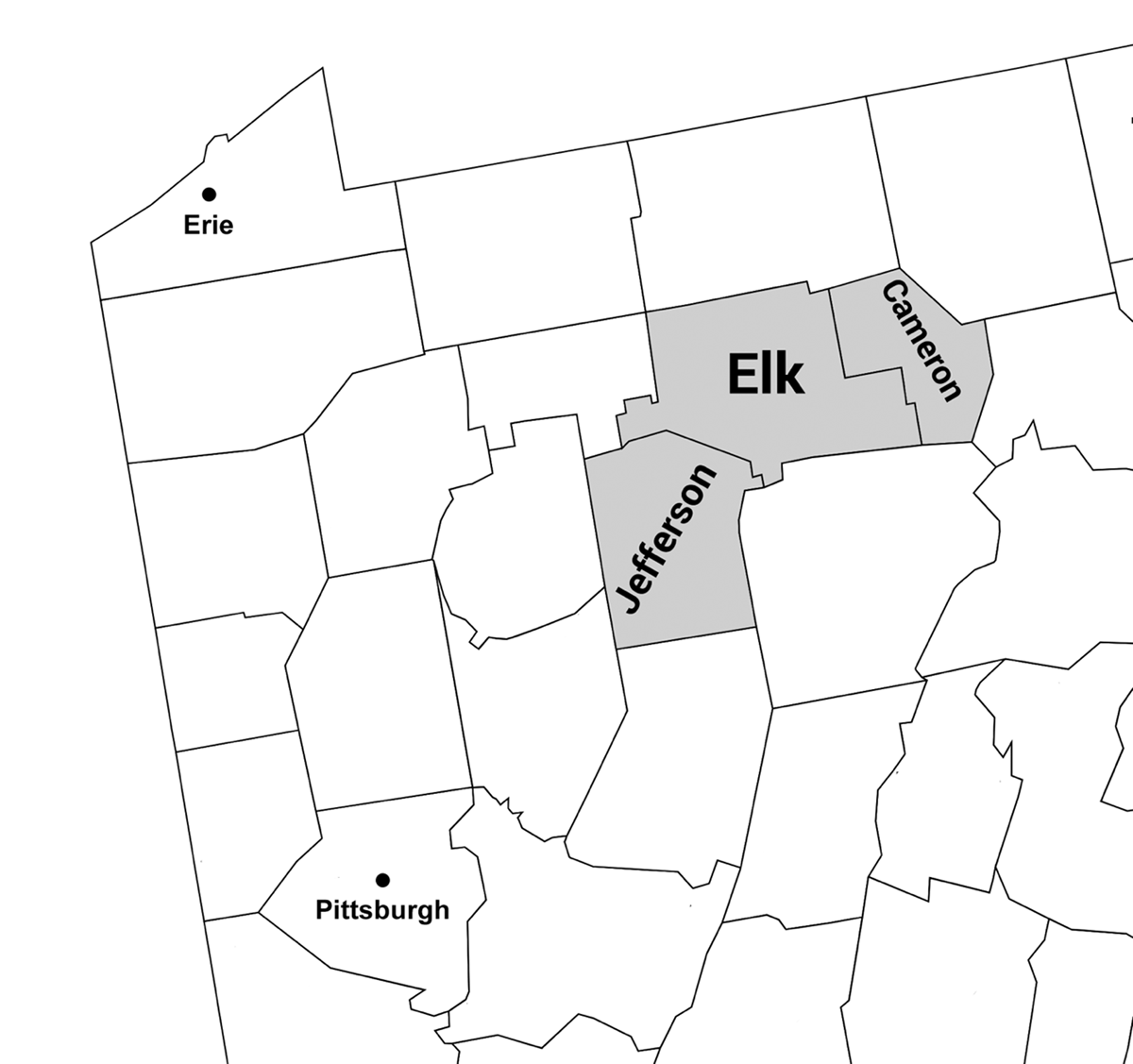
Figure 2
Rural Jefferson, Elk, and Cameron Counties in Pennsylvania contained 38% of establishments, employed 38% of workers, and paid 36% of wages in PM2 (NAICS 332177) in the US, 2021 4th Quarter.
Note: Shares of establishments, employment, and wages were calculated using data from Bureau of Labor Statistics (2022). NAICS 332177 is a six-digit code used by the Bureau of the Census (2022) for classifying PM2 industry activity and output within the US economy.
Documented in Table 1 is the high concentration of employment and wages in PM2 in north-central Pennsylvania. The PM2 industry makes up a much larger share of Pennsylvania’s employment total than it does for the nation. The concentration of PM2 employment and wages in Pennsylvania is more than 13 times the concentration of employment and wages for PM2 in the US workforce.
Table 1
PM2 Establishments, Employment, Wages, and Employment and Wages Location Quotients in the US, Pennsylvania, and Selected Pennsylvania Counties, 2021 4th Quarter.
| REGION | ESTABLISHMENTSA | DECEMBER EMPLOYMENT | TOTAL WAGESB | EMPLOYMENT LOCATION QUOTIENTC | WAGES LOCATION QUOTIENTD |
|---|---|---|---|---|---|
| US Total | 167 | 8,702 | $130,033 | 1.00 | 1.00 |
| Pennsylvania | 63 | 4,622 | $64,025 | 13.56 | 13.18 |
| Pennsylvania Counties | |||||
| Cameron | 5 | 388 | $8,014 | 3,882.58 | 7,833.02 |
| Elk | 32 | 2,276 | $30,685 | 2,899.67 | 3,838.84 |
| Jefferson | 6 | 655 | $8,377 | 758.76 | 996.84 |
[i] Source: Bureau of Labor Statistics (2022).
a An establishment is generally a single physical location where business is conducted or where services or industrial operations are performed (Bureau of the Census, 2022). b In thousands of nominal US dollars. c Employment Location Quotient = local concentration/national concentration, where local concentration = local PM2 employment/local all-industry employment, and national concentration = national PM2 employment/national all-industry employment. d Calculated same as Employment Location Quotient, but substitute total wages for employment in calculations. Refer to Bureau of Labor Statistics (2021) and Wheeler (2005) for additional detail about calculation and interpretation.
Even more remarkable are the extraordinarily high concentrations of PM2 employment and wages in the three counties—i.e., concentrations of employment and wages between 758 and 7,833 times higher than in the nation. These very dense employment and wage concentrations indicate the dominance of PM2 in north-central Pennsylvania in the national PM2 industry. Jefferson, Elk, and Cameron counties in Pennsylvania contained 38% of establishments, employed 38% of workers, and paid 36% of wages in PM2 in the US during 2021.
High industry employment and wage concentrations in PM2 within the region, relative to the nation, highlight the importance of the industry for exports from the north-central region. An exporting industry not only meets the demand for its products, but also produces enough so it can sell outside the region. A location quotient greater than 1.0 indicates that the economy is self–sufficient, and may even be exporting the good or the service of that particular industry. Industries such as PM2 sell exports outside a region to contribute to the region’s economic base. Economic base theory (explicated in Munroe & Biles, 2005) suggests that the means for strengthening and growing a local economy is to develop and enhance the exporting sectors (Klosterman, 1990, p. 115). In this way, PM2 is a driving ‘engine’ for the north-central Pennsylvania economy.
Competitive forces
We analyzed competitive forces affecting PM2 in north-central Pennsylvania using techniques specified by Porter (1998). The analysis drew on information from structured face–to–face and telephone meetings, gleaned during plant tours and over informal lunches, and captured in confidences revealed in unstructured personal conversations. Competitive forces identified were summarized around five themes: the threat of entry of new competitors; bargaining power of customers; bargaining power of suppliers; the threat posed by substitute products; and the nature of competitive rivalry within the PM part manufacturing industry. We conclude that the environment for PM2 in north-central Pennsylvania is highly competitive.
The threat of entry of new competitors
The potential of profitable markets can draw firms to the region’s PM2 industry either through acquisitions and mergers or through start-ups. New entrants can affect the competitive climate in many ways. For example, new entrants can bring additional capacity to the PM2 industry in the region, capture market share from incumbents, bid down industry prices, or inflate incumbent’s costs, and, in these ways, effectively affect the profitability of incumbents in the north-central region of Pennsylvania.
Bargaining power of customers
The sizeable automotive industry is the primary customer for PM2 parts from north-central Pennsylvania. These PM2 customers enjoy strong bargaining power for PM2 part prices. In some cases, customers drive the industry’s prices down, bargain for more or better service at the same or lower prices, and pit PM2 firms against one another. PM2 firms in north-central Pennsylvania produce standard, undifferentiated PM2 parts almost with the same features as commodities, so buyers face low costs of switching among PM2 producers.
Bargaining power of suppliers
A small number of metal powder and gas furnace fabricators, gas, and machine shop suppliers affect the PM2 industry in north-central Pennsylvania. For example, suppliers can raise prices in response to changes in their own markets or reduce the quality of their products without lowering prices. At the extreme, some suppliers refuse to work with a firm (due to sub rosa agreements with other PM2 firms) or charge excessively high prices for unique resources. Because few suppliers are available, few substitutes for supplies exist, and costs to the PM2 firms for switching suppliers are high. As such, suppliers hold strong bargaining power.
The threat of substitute products
Substitutes for PM2 parts increase the propensity of customers to switch to alternative products in response to price increases. High elasticity of substitution for some PM2 parts by product alternatives limits the potential returns in the PM2 industry by capping price changes. Attractive price/quality substitutes for PM2 parts place a tight lid on PM2 firm profits in north-central Pennsylvania.
Competitive rivalry within the industry
North-central Pennsylvania is home to a close community of PM2 firms. Rivalry among firms is a significant factor in the PM2 competitive climate in the region. Rivalry for advantage in product and resource markets often occurs along price dimensions, not quality dimensions (which are dictated by customers in the integrated automotive industry). Regional rivals also compete aggressively on non–price dimensions such as innovation, marketing, branding, and public recognition, often fueled by long-standing PM2-producing family rivalries.
Conclusions
The PM2 industry is a small niche within the metal stamping and forging industry in the US PM2 firms in north-central Pennsylvania hold a large, highly competitive and concentrated portion of that small niche. PM2 in the region depends mainly on the automotive industry for demand for press-and-sinter parts for internal combustion engines, although the rapid movement toward hybrid and electric vehicles will require PM2 firms to adapt and innovate with new products and materials to maintain their market share in automotive manufacturing.
The PM2 industry cluster in north-central Pennsylvania is an example of a regional agglomeration of unique manufacturing activity over the previous 150 years that resulted in regional economic advantage and technological leadership. Advantages and leadership emerged from a cauldron of competition. The threat of new firms entering the market and the threat of products that could substitute for PM2 products heighten competition among firms in the region. Also, the competitiveness of PM2 firms is moderated by the strong bargaining power of PM2 suppliers and customers. Parts manufactured are treated as commodities, so competition in pricing is limited. Rather, PM2 firms in the region have strong competitive rivalries along non-price dimensions.
Notes
[2] The PM2 research literature published in refereed journals focuses on physics, chemistry, engineering, and metallurgy applications to PM2 processes that go well beyond an introductory discussion of PM2. Few textbook resources are available about PM2, primarily because PM2 receives such scant attention in the education of engineers. Information about the organization, economics, and finances of PM2 resides primarily in a vast gray literature not published in academic books or refereed journal articles. This gray literature is found in industry market reports sitting behind paywalls and in non-refereed conference presentations, audiovisual works, occasional papers, blogs posted on company websites, and in the literature distributed by professional associations. Passmore (2023) supplements the information offered in this article by listing, classifying, and citing some of this PM2 gray literature.
Acknowledgements
We received helpful advice about this article from Paul Sedor, Vice President of Member and Industry Relations for the Metal Powder Industries Federation in Princeton, New Jersey.
Competing Interests
The authors have no competing interests to declare.