
The major aim of the development of the Lean Six Sigma (LSS) curriculum for healthcare industry administration majors is to utilize the lessons learned from its applications in applied engineering. Upon successful completion of this course, students will develop an understanding of how the lean methodologies can be implemented into a healthcare-service organization or company to improve processes and profitability by reducing waste. The common belief is that the longer a patient is in the process of receiving care and the more it is moved about for services, the greater the ultimate cost. LSS tools and techniques are used to standardize work and remove waste and non-value-added activities. Additionally, they are commonly used in applied engineering to attack the variation present in processes. In a healthcare center or hospital, Lean benefits can be realized in a) reduced patient service-cycle times, b) increased revenue, c) improved customer responsiveness and service, and d) improved quality with higher profit margins.
The mainstream media often overlook the quality problems with the delivery of patient care when some high-profile incidents take place in the United States. Many Americans know and, according to the Current Population Survey Annual Social and Economic Supplement and the American Community Survey, before the Affordable Care Act (ACA) the uninsured rate hovered around 15 percent of the population. By 2019, that rate dropped to 7.0 percent, resulting in 21.86 million more people with coverage (Starkey & Bunch, 2020). But very few know that according to a study by Johns Hopkins, more than 250,000 people in the United States die every year because of medical mistakes, making it the third leading cause of death after heart disease and cancer (Makary & Daniel, 2016). However, the U.S. Institute of Medicine Committee on Quality of Health Care in America (2000) estimates that half of the errors are preventable. The LSS is to reduce the variability in current patient-care service processes with the goal to reach 3.4 errors per million opportunities over the long term.
Lean cannot be a magic silver bullet for the healthcare industry, but it is different in that people learn how to look at the detail value-stream processes instead of jumping through the same well-known hoops every day. Formal use of Lean in healthcare may be seen for a short time, as applied engineering management has been used for a century to improve manufacturing industry. Frank and Lillian Gilbreth’s work on human factors published many studies in medicine and applied to hospitals—such as having a surgical nurse hand instruments to surgeons as called for, instead of the surgeon taking time from the patient to search and retrieve them (Weinger et al., 2003).
Nevertheless, the proposed coursework may contribute to the knowledge of readiness for the implementation of LSS in healthcare organizations. While obstacles to LSS implementation exist, the process improvements and resulting cultural changes are necessary to provide an appropriate climate for its long-term success. Other researchers and practitioners may use the paper as a guide to apply LSS in the hospital setting to improve processes in patient-care services.
Background
The Lean Six Sigma (LSS) methodology is a well-adopted quality- and process-improvement approach used in applied engineering such as production and manufacturing of household items, HVAC, automotive, and so on. Likewise, this technique was successfully applied in distribution, supply chain, and other service industries. The LSS system can further be rearranged based on the field of applications. For example, DMAIC (Define, Measure, Analyze, Improve, and Control) is primarily an improvement system for existing processes for incremental improvement, whereas DMADV (Define, Measure, Analyze, Design, and Verify) is used to design or develop new products or processes (Pendokhare & Quazi, 2015).
In the era of fierce competition, especially in the automobile industry, the innate LSS culture provides the ability to respond quickly to customer needs through process improvement to attain competitive advantage by minimizing manufacturing costs and lead time to launch new products in the market and delivering better product performance over competitors. Let us consider the arrival of a seven-year-old girl to the emergency room (ER) at Children’s Medical Center. The girl suffered a broken finger while roughhousing with her younger brother, and now the parents are hoping for prompt medical attention so they can return home quickly. In the absence of Lean, the family may experience a long, frustrating wait, with treatment for their daughter’s injured finger delayed while ER staff attend to more-serious cases. The young child will likely receive timely treatment and the family will be heading home in approximately one hour if process improvements are achieved through Lean because process improvement is vital to building kaizen culture or continuous improvement within the healthcare industry (Chopra & Fernando, 2020).
There are endless possibilities of the application of LSS in business operations, along with applications of waste elimination in the healthcare field. However, such application requires an understanding of how these tools and techniques translate to the people-intensive processes of patient care. Building trust among the users of these tools and prioritizing culture building over LSS project results can be challenging because, ‘culture eats strategy for breakfast’ (Drucker, 1959). Managers are required to understand culture types for a holistic approach to implement six sigma practices effectively in their organizations (Zu et al., 2010). These possibilities point to a need for graduate students in healthcare management and administration programs who take strategic leadership process coursework to gain deeper insight into the formulation, leadership, and strategic-implementation initiatives to prepare them for future roles in the healthcare workforce. However, a literature review on the topic shows a dearth of articles pertaining to the type and level of leadership and sustainability content required in healthcare-management programs to prepare students for these future roles. This paper presents a course creation by integrating LSS concepts to engage students in thinking more deeply about strategic leadership-implementation issues of continuous improvement. Using examples of the applied engineering curriculum, content is recommended, and Bloom’s taxonomy is applied to suggest evaluation approaches.
Methodology and Approach
This course will focus on continuous improvement and the elimination of waste in a healthcare facility by empowering individuals to identify waste and non-value-added activity as well as identifying and improving value streams to reduce costs. Students will also learn to create better flow for patients and processes, thereby preventing errors and improving quality in a systematic way. Even though Lean methods started in applied engineering for its production-process improvements, they have proven successful in many functions in service industries, including healthcare (Antony et al., 2019; Souza et al., 2020; Trakulsunti et al., 2020).
The Lean Six Sigma (LSS) curricula in healthcare will incorporate a thorough understanding of several applied concepts, including leadership for LSS, value and waste, value-stream maps, visual management, 5S, Takt time, standardized work, Just-in-Time (JIT), kanban, jidoka, kaizen, poka-yoke, Hoshin planning, Plan-Do-Study-Act (PDSA), root-cause analysis, A3 process of problem solving, Failure Modes and Effects Analysis (FMEA), and total productive maintenance. The following subsections will elaborate on the body of knowledge of these LSS concepts and methodologies.
Lean Six Sigma Methodologies
Leadership for Lean Six Sigma
Leadership and management skills are important for implementing Lean methods because leaders develop people to surface problems and to solve problems to better serve the customer. Moreover, Lean implementation must be supported by the executives. They are required to understand it, buy in to it, and support it. Without leadership, employees might not understand why improvement is necessary and why Lean methods can help. Once Lean methods have been adopted, consistent leadership and a management system are required to keep those improvements and to continue improving. The Lean team should be composed of all of the key stakeholders who are part of the internal and external operational processes.
The world-renowned Toyota Production System (TPS) is the most-cited successful LSS example in applied engineering. The TPS is an integrated system of three key elements: philosophy, technical, and managerial roles, all focused on people development (Ohno, 1988, p. 6). Its managerial part recommends leaders build an organizational culture that surfaces and solves problems while being active in the gemba, that is, go and see or genchi gembutsu.
Value and Waste
From a healthcare center or hospital customer’s standpoint, neither quality, cost, or schedule always comes first. When customers evaluate the products and services they receive, they make trade-offs between all three key factors in order to maximize value. An effective healthcare-service provider talks to customers, translates what its customers say into appropriate actions, and align its key patient care-service processes to support what their customers want. In today’s healthcare industry, the business environment is extremely competitive, where consumers demand quality more than ever before. They are more willing to switch hospitals, not only to get a better price but also for better service in terms of reliability, accessibility, and courtesy. Some business gurus say it is significantly (five times) cheaper to retain existing customers than to attract new ones (Wertz, 2018). Capturing the voice of the customer is the key to drive changes in the way the healthcare industry does businesses.
Womack and Jones (2003) claimed that a product’s or service’s value can only be defined by the ultimate customer. Since the patient-care activities and priorities create value for a customer, the hospital or health center’s goal should be creating new ways of doing things that are simpler, and staff members are encouraged to work together seamlessly for the process to move continuously. Sayer and Williams (2007) coined their lean methodology with three general rules for an activity to be accounted as value added: (1) The customer must be willing to pay for the activity; 2) The activity must transform the product or service in some way; 3) The activity must be done correctly the first time. Graban (2016) proposed some value-added and non-value-added activities that may take place at a healthcare center from the perspective of products, patients, employees, and caregivers. Table 1 shows some examples.
Table 1
Value-added and non-value-added activities in a hypothetical healthcare facility.
| ENTITY | PERSPECTIVE | VALUE ADDED ACTIVITY | NON-VALUE-ADDED ACTIVITY |
|---|---|---|---|
| Surgery room | Surgeon | Operating on a patient | Re-opening a patient to retrieve a retained surgery kit |
| Pharmacy | Technician or prescription | Creating an intravenous formulation | Reprocessing medications that were returned from patient units |
| Inpatient room | Nurse | Administering medications to a patient | Copying information from one computer system into another or to paper |
| Radiology | Technician | Performing MRI procedure | Performing a medically unnecessary scan |
| Exam room & laboratory | Sample collector or Medical technician | Interpreting test results | Fixing a broken instrument |
| Food & nutrition | Cook or server | Preparing food for inpatient customers | Stacking and restacking plates and trays |
| Emergency room | Patient | Admitting, evaluating and treating | Unnecessary waiting to be seen |
| Clinical laboratory | Patient specimen | Being centrifuged and evaluating results | Specimen waiting to be moved to next station as a batch |
| Post-operative procedures | Patient food tray | Food is being cooked or tray is being prepared | Reworking because tray was made incorrectly |
Reducing waste is a better choice to cut costs in healthcare centers and hospitals. These service providers have focused on trying to reduce costs for a long time, but costs are rising. Lean can provide a different way to look at cost by not directly focusing on it. In healthcare, wastes are needless hassles such as miscommunication of test results, wasted motion, and multiple phone calls to track lab-work orders from a physician’s office. Medical and surgical nurses may waste their time unnoticed on direct patient care involving hygiene and toileting, administering medication, and giving medical guidance (Graban, 2016). Wastes are categorized in eight different categories. Liker (2004) projected some examples, as shown in Table 2.
Table 2
Various types of waste and their hypothetical examples from healthcare perspective.
| WASTE TYPE | DESCRIPTION | EXAMPLE FROM HEALTHCARE PERSPECTIVE |
|---|---|---|
| Defects | Time and effort spent doing something incorrectly, inspecting for errors, or fixing errors | Surgical case cart missing an item; wrong medicine or wrong dose administered to patient |
| Overproduction | Doing more than what is needed by the customer | Conducting unnecessary diagnostic procedures; producing medications that are not used before the orders change or patient is discharged |
| Transportation | Unnecessary movement of the ‘product’ (patients, specimens, materials) in a system | Poor layout, such as the catheter lab being located a long distance from the emergency room, patients moving from building to building to receive various treatments |
| Waiting | Waiting for the next event to occur or next work activity | Employees waiting for a patient, information, or work to do; patients waiting for an appointment, care, or discharge |
| Inventory | Excess inventory cost incurred by finance charge, and costs for storage, movement, or spoilage | Expired supplies that must be disposed of, such as out-of-date test kits or medications |
| Motion | Unnecessary movement by employees in the system | Nurse dragging a bag of dirty linen down a hallway instead of housekeeping; lab employees walking miles per day due to poor layout; walking to find missing supplies, equipment, or medications; unnecessary clicks in an EMR system |
| Overprocessing | Doing work that is not aligned with patient needs | Entering data into a computer system that is never seen or used; excessive warnings in an EMR system that physicians and nurses just click through |
| Human potential | Waste and loss due to not engaging employees or listening to their ideas | Employees get burned out and stop giving suggestions for improvement or quit their job |
Value-Stream Mapping
Value-added process mapping is an LSS tool in which a process takes inputs and performs value-added patient-care activities on those inputs to create an output. A value-stream map (VSM) is a structured diagram that originated with Toyota as something used for material and information flow mapping (Rother & Shook, 2003). A process map is a graphical representation of all the steps involved in an entire process or in one segment of a process.
In a healthcare center, all of the activities—both value-added and non-value-added—performed to treat patients from initial arrival through discharge are parts of value stream. Calculation of the percent value added in a healthcare interaction can be done using the formula (Minutes receiving treatment/Total time elapsed). In a hospital, even if a group of excellent departments—like the best pharmacy sitting right next to the very best laboratory or a very-best X-ray exam room sitting right next to the very-best nursing group—the hospital may not run smoothly because a group of excellent departments does not lead to a system that performs at its best. These issues require redesign and improvement upon evaluations by using the LSS tool value-stream mapping. This tool will see the entire picture across departmental boundaries.
Figure 1 depicts a simplified high-level current state VSM for an outpatient-surgery patient’s journey. Looking at the VSM, one may notice the possible locations of waste, and the information flow among different people, departments, and information systems. It is notable that the black triangles represent the surgery patient’s waiting time between the processes. In creation of the current VSM, the LSS team needs to identify problems that require fixing, such as long wait time between steps of the process or a high amount of rework or redundant work. After identifying improvement spots, the LSS team creates a future-state VSM to illustrate how the processes should work in order to become lean or eliminate wastes. VSMs can be created either electronically by employing standard office software or the analog way, using sticky notes on large pieces of butcher paper.
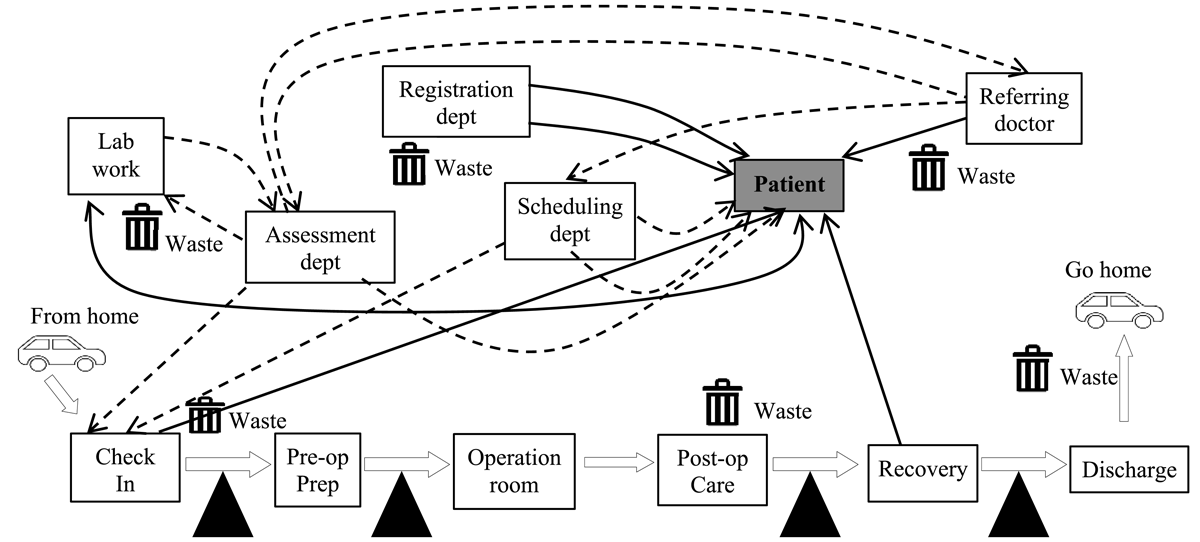
Figure 1
A simplified high-level value stream map for an outpatient surgery patient.
In order to improve a production or service process, it is necessary to follow five steps to construct a current-state map and follow another five steps to propose a future-state map. Details of these steps are demonstrated by Summers (2011).
Visual Management
Visual Management or Transparency refers to enabling anyone to have the ability to see, in real time, what is happening with a process. In order to successfully adopt the Six Sigma methodology, a healthcare center or hospital must have both visible management commitment and visible management involvement. From the instantaneous information gathered, one should also be able to determine whether anything has changed or needs to be changed. In such cases, visual management enables someone looking at a job or a workspace and know at a glance that something has been misplaced or mismanaged. Moreover, visual management encourages a place for everything and everything in its place.
Real-time visual management is more effective than waiting for daily or even monthly reports and metrics to measure the performance of a process (Graban, 2016). For example, the check-in staff in the radiology department can adopt simple visual management to prevent idle equipment by clipping together multiple color-coded laminated cards and attaching them to the patient’s shirt. This gives a clear indicator to the nurse or technician of the first modality that the patient must move to a second procedure. It is also a method of mistake proofing or poka-yoke.
In a healthcare center lab, simple visual-management methods can be used to prevent specimen-testing delays. Certain specimens may need to be transported from the front lab department to the microbiology department through a pass-through box built into the wall that divides the departments (Graban, 2016). Once used by microbiology, the specimen is placed back in the box for the front lab to preserve for further assessing, if any. Often, the specimen would sit for up to one hour in the pass-through box, waiting to be taken back out by the front lab. The delay was caused partly by an information deficit or incorrect signals of a specimen being seen in the box. The front lab staff may incorrectly assume the specimen is still waiting to be taken into the microbiology department when the testing was done and waiting to be returned to the front lab. A simple visual control, such as a laminated sheet that the microbiology department could place in the lab side of the pass-through window when a specimen was coming back in that direction, would prevent that incorrect assumption. When the front lab took the specimen back, they could take the sign down until it was needed the next time. Visual management is not a single perfect system, but things work better with the sign than without.
5S: Sort, Set-in-order, Shine, Standardize, and Sustain
In a healthcare center, workplace waste might be evident when questions such as: 1) Where are the soft pillows? 2) Why did we run out of cotton bandages? 3) Where did the sleeping medications go? 4) Why do patients need to walk so far when care can be given within the emergency room? 5) Why does it require so much time looking for supplies needed in this department? The LSS 5S (sort, store, shine, standardize, and sustain) methodology can reduce waste though improved workplace standardization and visual management. One study reported that 5S implantation had helped reduce the amount of wasted time in an average nurse’s eight-hour shift from 3.5 hours to one hour per day (Toussaint, 2014).
Sort is to go through the entities or department areas looking for equipment or supplies that are no longer needed but are taking up space. Expired specimen-collection tubes in the cabinet should be thrown away, recycled, or donated without controversy or the risk of someone later using one by mistake. When unneeded items take up valuable workspace, the department ends up being larger than it needs to be, which results in excess storage space and maintenance costs. These space and resources can be used for materials and supplies that are used more frequently or for value-adding activities.
Set-in-order organizes for the reduction of waste. This activity involves properly organizing the material and equipment, identification of frequently used items, and storage in closets close to the point of use. For example, latex gloves in an exam room or emergency department are a frequently used item. They can be stored at multiple points, which will reduce waste of motion. When a nurse cannot see an item where it is supposed to be located or is located in closed drawers or cabinets, wastes occur. A rule of thumb rule is that hourly use items should be stored at arm’s reach, shift-use items a short walk, daily-use items a bit further away, monthly-use items at the department’s storage space, and annual-use items can be stored at hospital storage (Graban, 2016).
Shine keeps the workplace clean. The centralized housekeeping department can be relied on for major cleaning, such as floors or trash cans and the handling of biohazard trass, but the dust accumulated on lab equipment or pharmacy medicine packs are the responsibility of the people who work there. In the 5S approach, the department itself should take responsibility for light cleaning and the overall cleanliness of its work area.
Standardize develops a consistently organized workplace. Clearly marked locations for specimen drop-off and supply storage, for example, are the key to eliminating waste from misplacing supplies in hospitals. When supplies are located at standardized storage spots within a department or across departments, it brings much relief for the nurses and doctors who work in multiple units. A standardized supply location has many benefits, including being able to find instantly when an item is missing or replenishment is needed, minimal time to look for an item, and subtle psychological comfort for employees.
Sustain is the system for ongoing support of the first four Ss because they are not one-time events or repeated annual events. A formal audit plan can check if the new standards are being followed. The visual-management methods also helpful, as supervisors can scan the department as they are walking through. Man, machine, and processes such as doctor, specialist, X-ray, MRI, pharmacy, and physiotherapy need to be closer together and eliminate the obstacles that hinder the flow of value.
Safety as the sixth S is imparted later. It is an underlying philosophy of the healthcare organizations, which should be the focus of all 5S stages. It signifies that safety should not just be delegated to the teams who are implementing the Lean, but it should be a culture owned by the upper-level administrators in the organization. Various case studies on real-life safety situations in hospitals such as the emergency department, laboratory, surgery, dialysis, or respiratory supply room can be studied.
Takt Time and Standardized Work
There is an axiom, “When a process is out of balance, it fails.” Takt time is here to balance the workflow. Takt is a German word meaning beat. It refers to matching the rate of production to customer demand (no faster, no slower). When the work steps are in balance, this produces maximum productivity and saves cost. Once the available processing time of a patent care process (Ta) and number patients per day or demand for that specific care (Td) are known, Takt time (T) can be determined with the formula T = Ta/Td (minutes of work per patient delivered to create value). This concept is used in applied engineering to balance workflow across work steps and to meet demand.
Standardized work is the concept where companies begin to falter. For example, insurance claims for patient-care services can be daunting work due to a variety of carriers and a multitude of rules. The hospital finance department needs to establish a standard of work for this ever-changing process. The basic vision is to have standard daily one-touch resolution and standard work for processing all claims. Ultimately, the essence of standardized work is to prevent any process from returning to its original disorganized state. This is typically accomplished by using standardized tools, such us check sheets, cleaning schedules, and so on.
Kanban: A Lean Approach to Managing Materials
Kanban is a Japanese word that can mean signal, sign, or card. It is often referred to as a physical signal in the form of a paper or plastic card that indicates when it is time to order, from where, and in what quantity. It may be understood as a low inventory level by mistake, but the goal of this technique is to support patient services. Moreover, it assures employee(s) by ensuring needed supplies are in the right place, in the right quantity, at the right time, and in order to make materials or supplies available with the lowest required inventory levels. Kanban techniques typically have fewer stockouts and better availability of materials than traditional materials-requirement planning.
Toyota and other western automakers adopted Kanban as a method for moving parts to assembly lines and as an active method that helps them to not run out of supplies. Kanban is a direct relationship with visual management and 5S for managing supplies and serving patients in tandem. In a healthcare center, Kanban can be used to pull materials from central storage of the hospital or department to the point of use. This method allows quantification of an optimal reorder point for supplies.
The Kanban system answers several questions such as 1) how long there is demand for an item, 2) how frequently supplies should be reordered, 3) how long the vendor lead time is, and 4) what the safety stock quantity should be, based on usage and replenishment time. In informal materials-inventory management at a healthcare facility, the responsibility for ordering supplies might fall on a single person. When that key person is on vacation or another temporary person places orders for supplies, the system may fall apart, leading to stockouts on key supplies or oversupply.
As illustrated in Figure 2, the Kanban signal is meant to be simple and visual, such as an empty bin, a card, or a message sent by a bar-code scanner. Another interpretation of Kanban may call for a two-bin system. In this system, anyone can take materials for use, but when a bin becomes empty, it sends the signal to order more. When one bin is empty, the process still can continue. Such a system does not require manual counting of par-level systems. The standardized Kanban bins or cards can be collected by a single person from the inventory-management department on a regular basis, which can eliminate unplanned multiple trips to the stockroom. One person makes one trip, the materials are pulled as needed, and the hospital does not need to waste the time of skilled technicians, nurses, or doctors time, who do value-added work in their respective areas. In a Kanban system, any stockout needs to be investigated to determine the root cause.
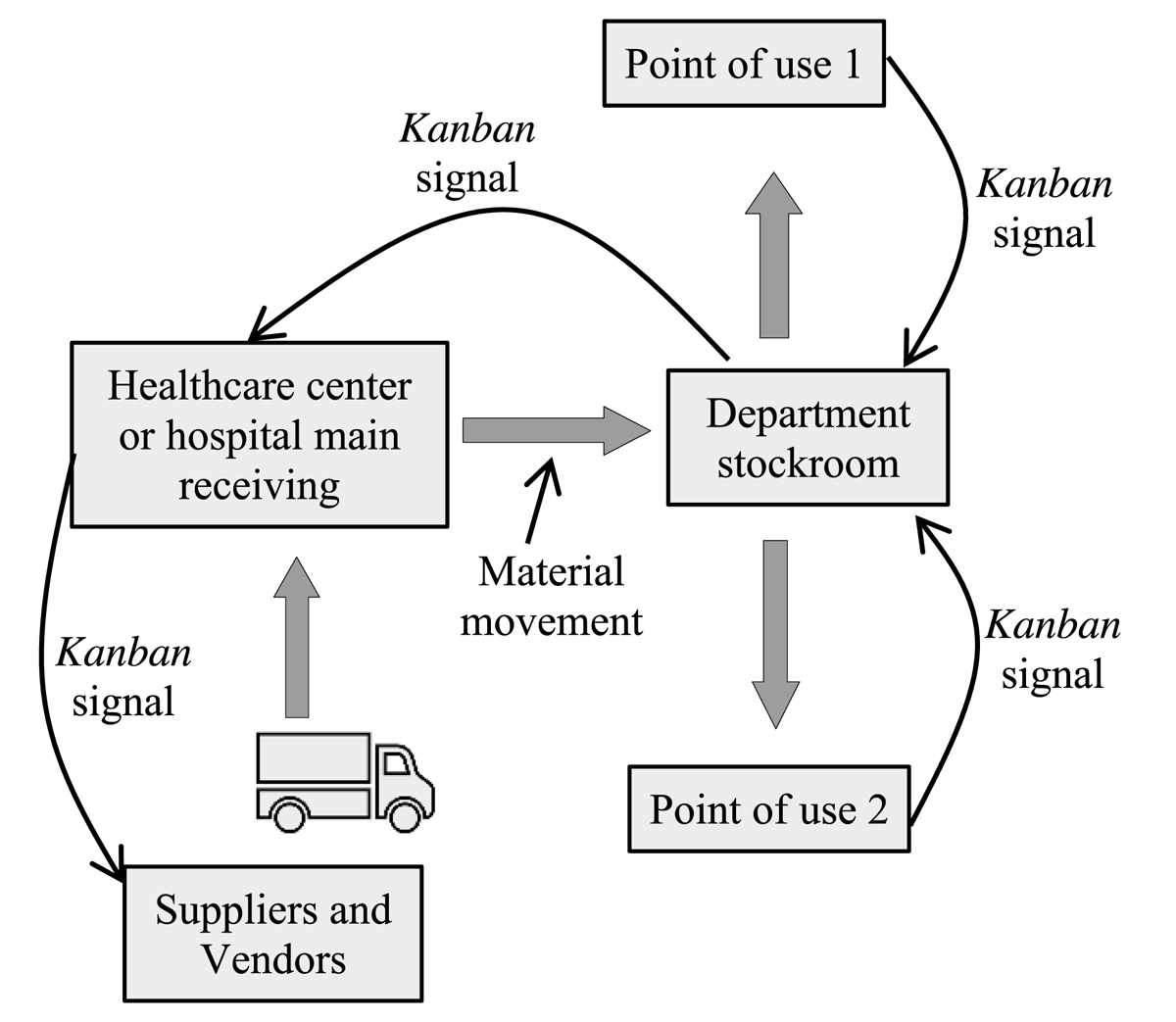
Figure 2
An illustration of the supply flow structure linked with multistage Kanban system in which each downstream area pulls material from an upstream location.
One of the LSS principles that is probed or gets confusing in a healthcare center is push versus pull. Using the Kanban system applied-pull strategy as a straightforward solution for materials management, supplies are pulled only when they are needed in the right quantities as opposed to being pushed regardless of need. However, when an emergency room (ER) pushes patients so that they wait in the hallway for an inpatient room to be ready or vacated, it should not be misunderstood. This is, rather, a pull to improve flow process by inpatient-unit personnel to complete the discharge process for other, earlier patients, freeing up the room. The main goal of the Kanban system is the right care at the right place at the right time.
Just-in-Time
In the world-renowned Toyota Production System of applied engineering, just-in-time (JIT) is one of the two pillars, along with jidoka. The Japanese philosophy JIT refers to the idea of making what is needed, when it is needed, in the amount needed. From a healthcare perspective, the JIT system means that emergency room (ER) patients arrive, check in, receive service to the point of need, became in-patients or follow-up out-door-care patients, and through value-added care services become ready to go home by driving away on their own or being picked up by relatives. But the system requires three basic components, including 1) a pull system, 2) continuous-flow processing, and 3) adherence to Takt times.
Jidoka: Build in Quality at the Source
Jidoka is a Japanese word for autonomation, which is one of the two main pillars of the Toyota Production System. Similarly, LSS can implement the Jidoka system in a healthcare center or hospital. For example, the alternate oxygen-supply machine must start when a problem is detected in the currently running machine. Any operator on the line also has the power to stop production. Jidoka systems alert the worker when a defective item is produced or a machine malfunction has occurred. This allows the problem to be dealt with immediately, preventing the production and passing of defects. Thus, problems that can be caused by these defects can be more quickly localized, isolated, and corrected.
The fundamental principle behind Jidoka is to be notified of any defect and solve problems one by one immediately as they occur while the situation is still fresh (Harada, 2015). Jidoka and its component concepts such as poka-yoke, total involvement, zone control, and so on have enormous potential in the healthcare industry. Consider the administration of wrong medications, which is implicated in more than 100,000 deaths each year in American hospitals (CQHAIM, 2000). This is what a nurse needs to know before delivering an intravenous drug: right patient, right drug, right dose, drug in the correct diluted form, information on whether patient is taking other drugs that might make this drug dangerous.
Kaizen: Continuous Improvement
Kaizen is the combination of two Japanese words, where kai means continuous or ongoing and zen means for the better or improvement. Kaizen or continuous improvement has been practiced in some healthcare-management systems in limited cases instead of with a grand plan for systemic transformation. There are three levels of kaizen improvements, as shown in Figure 3. Franciscan St. Francis Health (Indianapolis, USA) adopted all three types of kaizen, which are required and fit together (Liker & Meier, 2006).
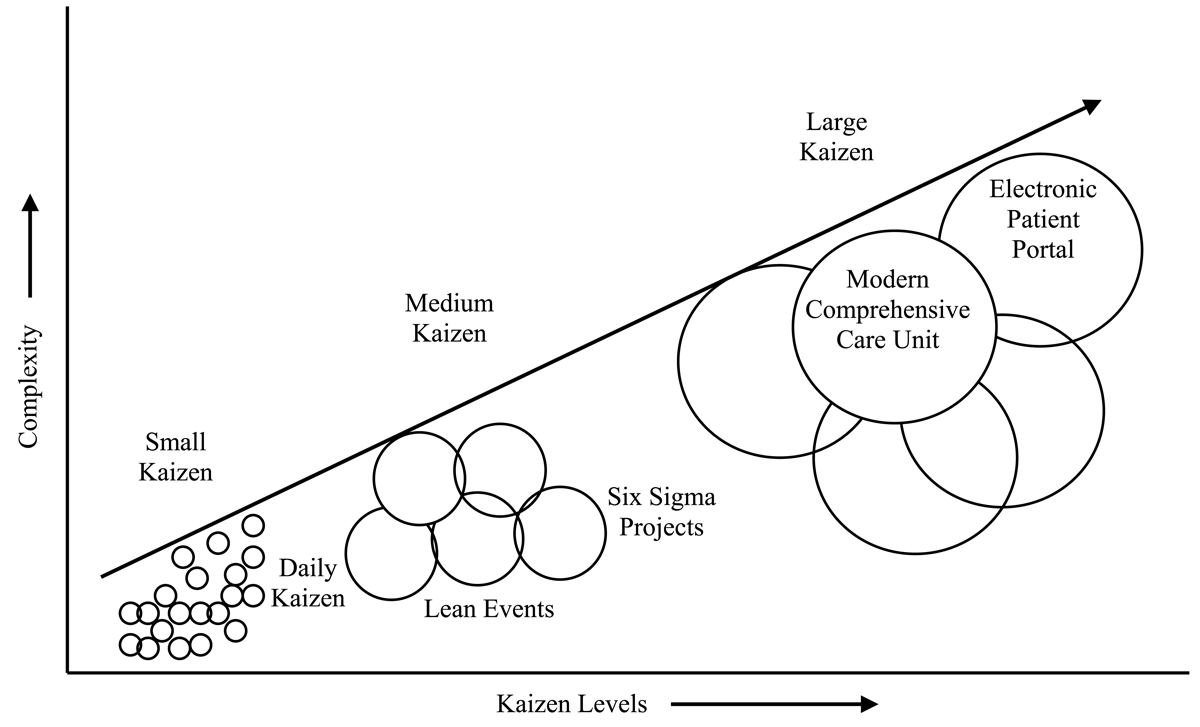
Figure 3
An illustration of three levels of kaizen, where bubble size roughly represented relative effort size.
In the healthcare center, there can be four types of kaizen events: 1) Standard five- or three-day kaizen is the PDCA phase meetings for three to five days that include a beta or pilot program of process change; 2) Rolling kaizen, where all phase meetings are spread over three months; 3) Today’s kaizen is a one-day planning-phase meeting with key personnel to determine next steps to solve a known problem; 4) Web-based kaizen, in which all phase meetings are conducted via web conferencing communication applications such as Zoom, Huddle, Skype, Infinite Conferencing, GoToMeetintg, and so on. A healthcare organization cannot remain truly competitive unless it strives to continually enhance its business processes that provide the services their customers want. By removing barriers that rob people of their right to pride in workmanship, leadership creates an environment supportive of their employees and the continuous improvement of their day-to-day activities.
Poka-Yoke: Mistake Proofing or Foolproof Mechanism
Poka-yoke is the Japanese term for foolproof mechanism or mistake proofing. In the healthcare-service industry, mistakes or errors (often unintentional) are very costly. When poka-yoke is implemented, patient-service quality will be high and wasteful activities will be low. Mistake proofing can be defined as the creation of habits or practices that either prevent defects or automatically inspect the outcomes of a process to determine if quality is acceptable. Poka-yoke should not be mistaken for a specific technology. Rather, it is an organizational approach that requires creativity among those who design equipment, design processes, or manage processes (Graban, 2016).
There are many examples of mistake-proofing approaches that already exist in healthcare-service facilities, with varying degrees of effectiveness. For example, poka-yoke or mistake-proofing tools on oxygen and nitrogen gas lines make it impossible to misconnect gas lines. Staying in healthcare, hand hygiene is a major factor in the infections that kill tens of thousands of Americans each year. Some hospitals may turn to poka-yoke in the form of buzzers, lights, and other trackers that signal annoyingly when workers fail to sanitize. Many of the examples of poka-yoke are achieved through standardized work of the 5S concept, a method that is more likely to reduce errors than to prevent them altogether.
Poka-yoke is used to counteract human variation, errors, or mistakes. Kaizen events often focus on error proofing by developing simple methods of preventing human errors from occurring in a process. However, error-proof designs do not hinder worker performance, instead they eliminate the chance for error by putting mechanisms in place that prevent wrong action. Poka-yoke works five principles, including: 1) elimination; 2) replacement; 3) facilitation; 4) detection; and 5) mitigation. Poka-yoke seeks to improve a health-center worker’s ability to do their job by improving how they do their work.
Hoshin Kanri or Hoshin Planning
Hoshin is made up of two Chinese words: ho, which means method or form, and shin, which means shiny needle or compass. Kanri means control or management. It is a very systematic, step-by-step, top-down, bottom-up planning process that breaks down strategic visions or objectives of a hospital against daily management tasks and activities. Hoshin is an annual planning process that is used to develop a plan or policy for the short term (one year) or the long term (three to five years). Indeed, the PDSA cycle of quality problem solving employs hoshin planning to address small daily kaizen events to medium and large problems. It can be used to set the direction of the patient-care or financial-process improvement activities within the organization.
Plan-Do-Study-Act (PDSA) Cycle
Coordinated and directed quality problem-solving techniques that are employed by the Lean team come from many sources. Dr. Shewhart’s Plan-Do-Study (Check)-Act (PDSA or PDCA) cycle is often employed to isolate and remove the root causes of service variation. In implementation of LSS at a healthcare center or hospital, PDSA can be an effective tool. PDSA is an interactive, four-step problem-solving and improvement process, typically used to implement business-process improvements. The potential benefits that it can bring are: (1) minimizing the possibility of errors, (2) implementing real-time corrective action, (3) optimizing utilization of available time, and (4) improving productivity immediately.
Define, measure, analyze, improve, and control (DMAIC) is a modified form of PDSA followed in many LSS-implementation projects in the manufacturing and applied engineering industries (Sharma & Rao, 2014). Figure 4 illustrates the intertwining relationships between PDSA and DMAIC. During the Plan step, the LSS team decides what will be done, who will do it, and so on. In the Do step, the team executes the decision or makes improvements as planned. The Study step involves examination of the intended improvements, whether those were realized or not, and analysis of the outcome. The Act step involves standardizing the new process if it worked, returning the process back to its original condition, or trying alternate approach.
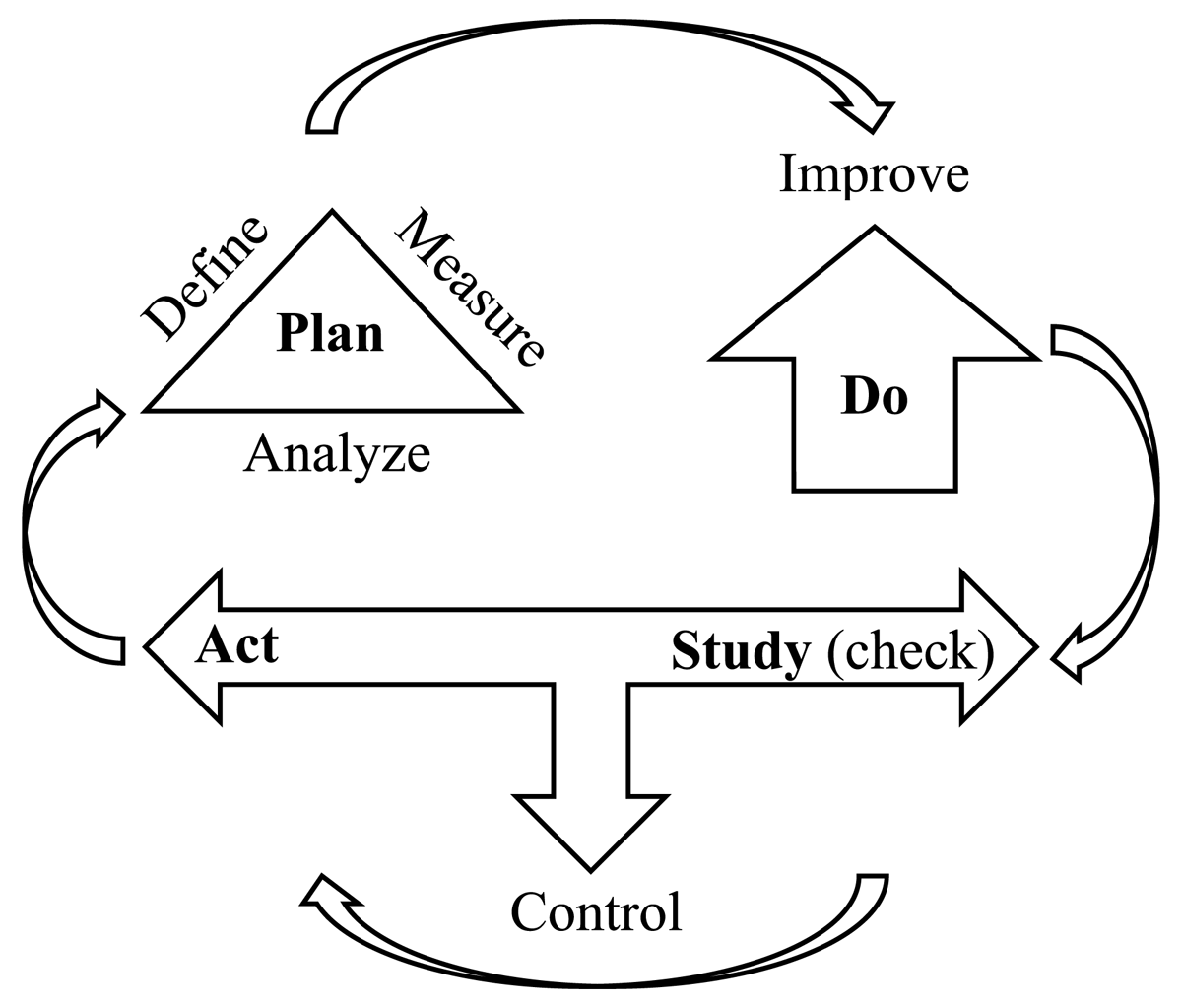
Figure 4
Interrelationships between Plan-Do-Study-Act and Define-Measure-Analyze-Improve-Control cycles.
Root-Cause Analysis
Root-cause analysis (RCA) is the searching out and correcting of all of the slight defects in an existing problem, issues, or testing laboratory machine and accessories involved in delivering services. In a healthcare center, the prime goal should be 100 percent of the right medications given in the right dose at the right time. Unfortunately, errors still occur. Errors include events when things go wrong even when every party involved had the best intensions and was performing accordingly. A hospital pharmacy that had not yet implemented Lean may find a number of preventable process defects such as: 1) orders that did not match with patient’s chart; 2) medication doses that were not appropriate for the patient’s age, weight, or condition; or 3) medications conflicting with recorded patient allergies. Any time an error occurs, there needs to be a signal and an immediate problem-solving response to find A) What allowed that error to occur? B) What can we do so the error never occurs again?
It is often found that managers look to assign blame and punish to show they are addressing the problem. This is a counterproductive response, because placing blame is often unfair to employees, resulting in frustration, resentment, and hiding problems. Lean managers start with the assumption that people are trying to do their best. When a hospital employee reports a problem to their supervisor, the first step for a Lean manager is to take the discussion and problem solving to the place where the problem occurred, the gemba. LSS shows that problems are more effectively solved at the gemba instead of in meeting rooms. Going to the gemba permits the Lean team to see with its own eyes and to talk with other people who are directly involved in that process.
At Toyota, a simple but powerful method for getting to the root cause(s) of a problem is the five whys method, asking a sequential series of why questions until the Lean team gets an answer that seems like a correctable root cause. This method is mostly effective in a group setting, where people can build cases combining each other’s ideas and gain shared understanding across department boundaries. The five whys can be applied in response to a specific process defect. Here are some examples: 1) Why did a blood specimen arrive at the lab unlabeled? 2) Why did a nurse step back to the station instead of using the portable laptop? 3) Why are patients being boarded in the ER? When the Lean team notes multiple contributing root causes, it can employ a cause and effect diagram. Another name of such a diagram is called Fishbone or Ishikawa diagram. A cause-and-effect diagram allows a rapid process improvement to brainstorm different contributing causes, as shown in Figure 5. It is also a useful LSS tool of root-cause analysis to find out why patients are in the hospital longer than necessary.
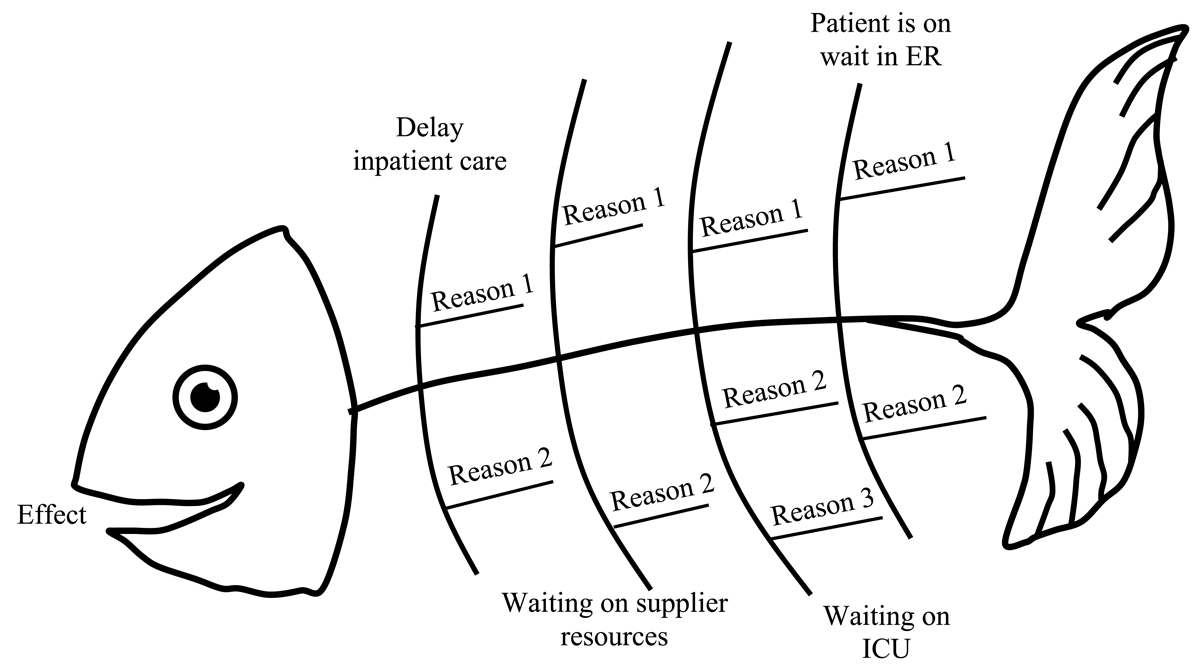
Figure 5
An illustration of the fishbone or cause and effect or Ishikawa diagram.
The root-cause analysis is necessary to critically examine the system, divide the system into its various components, record the ways the component may fail, rate potential degrees of hazard, examine all potential failures for each individual component, and decide what effect the failures may have. However, RCA has a weakness, in that it often misses the human error component (Summers, 2011).
A3 Process of Problem Solving
In order to effectively achieve a solution to a problem in a healthcare facility, staying on an organized, systematic path is very important, otherwise new issues could arise. In such instances the increasingly popular LSS approach called A3 becomes handy. An A3 problem-solving approach should be embedded with Lean thinking and practice. A3 gets its name from the international paper size eleven by seventeen inches. The method began in the 1960s as part of Japanese quality circle. It is a structured template for problem analysis and solving in an IDEAL (identify, define, explore, action, and look back) cycle, as illustrated in Figure 6.
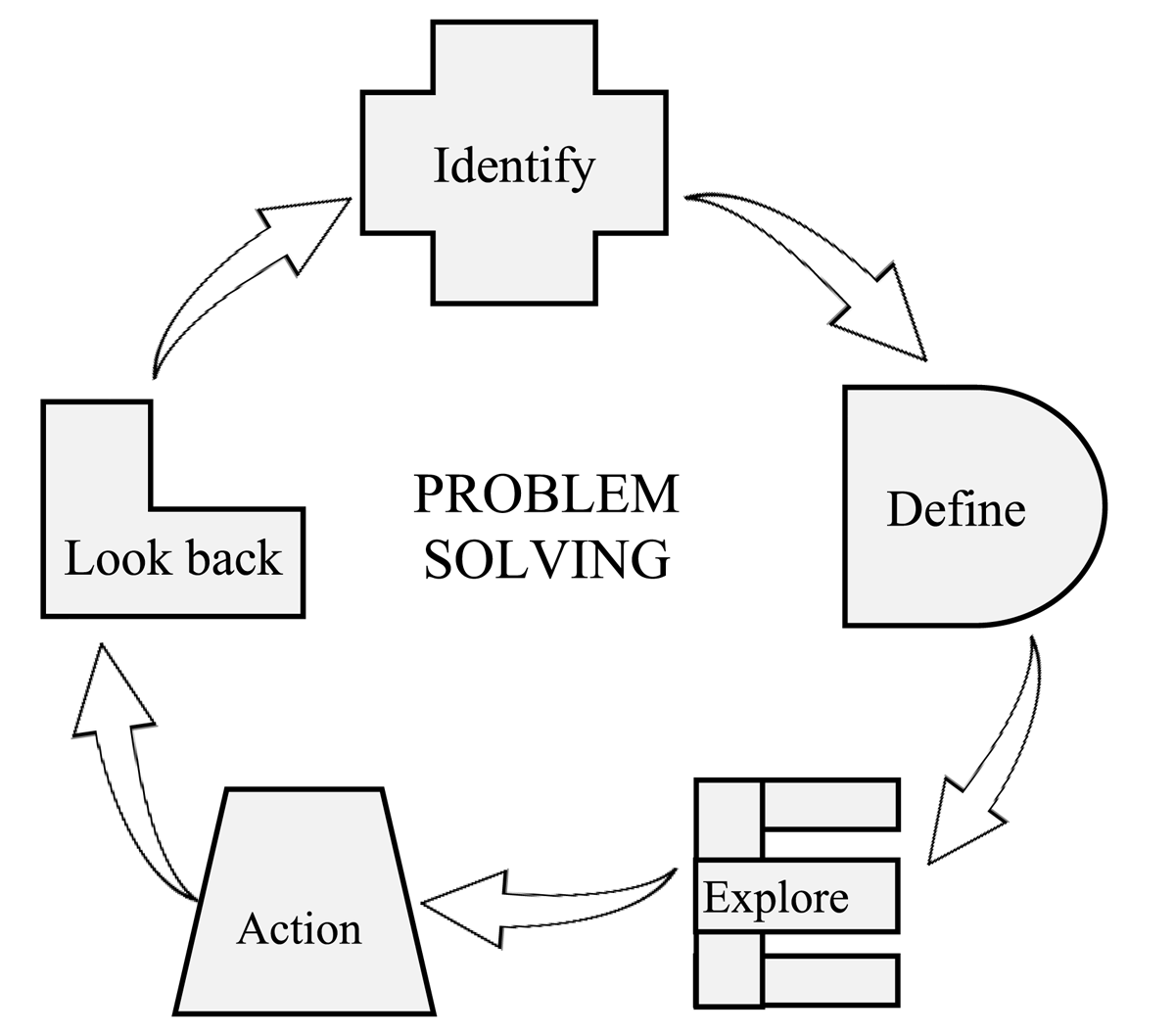
Figure 6
An illustration of the interconnected steps of the A3 problem-solving approach.
The A3 process of problem solving consists of the following interconnected steps, as shown in Figure 6.
Identify an issue that needs to be resolved. State how it affects financials, business, customers, and production or service processes.
Define or make a detailed statement of the issue. Quantify exact, detailed specifics so that the LSS team understands the effect of the issue.
Explore goals to accomplish through the A3 project and conduct a thorough root-cause analysis as to what might be causing this issue. Additionally, list countermeasures needed to make necessary changes.
Act by developing diagrams of well-thought-out, workable implementation programs. Discuss with affected parties how the process will improve and share concerns. Get approval by making sure everyone is on board.
Look back at the plan by regularly evaluating the measures taken to eliminate root causes and that the target goals are met.
Failure Modes and Effects Analysis
When an incident occurs, rather than just reacting, failure modes and effects analysis (FMEA) is a useful LSS tool that may be applied for identifying and prioritizing errors. Though FMEA was developed by the US military in 1949, it was widely applied in the automotive industry in the 1970s. The FMEA method ensures that the design will be changed and tested so that the failures do not continue to occur. FMEA is used to identify the process and product controls that must be implemented to ensure that the product can be produced within specifications. This tool can have uses in a health center or pharmacy’s transfusion medicine. As with standardized work and kaizen, FMEA is most effectively done by the people who actually do the work, although the FMEA process could be facilitated by someone experienced with that methodology.
The LSS concept of FMEA opens the scope for discussion about existing or possible future potential problems at a healthcare center. The Lean team must keep in mind that if participants in an FMEA feel somehow pressured to understate the likelihood or severity of an error or overstate their ability to detect the error, the team’s problem prevention might not be as effective. In such cases, upper management or leadership must take the responsibility for creating an environment of openness in the name of patient safety and error prevention.
Total Productive Maintenance
Total Productive Maintenance (TPM) is a methodology pioneered by a member of the Toyota group that works to ensure that every machine in a production process is always able to perform its required tasks, such that production is never interrupted (Kubiak & Benbow, 2016). TPM maximizes equipment effectiveness by using a combination of predictive and preventive maintenance throughout the life of a piece of equipment. There are four major parts of TPM’s contribution to improve the overall effectiveness of a health center’s equipment, including: (1) elimination of equipment losses; (2) preventive maintenance, which maintains the equipment in good condition so that unexpected downtime does not occur; (3) periodic inspection of equipment to detect conditions that might cause breakdowns and then follow-up action to reverse such conditions; and (4) scheduled maintenance (Summers, 2011).
The standardized work of predictive maintenance schedules routine maintenance so that employees know and can plan for equipment availability, whereas autonomous maintenance—such as daily cleaning, inspecting, lubricating, and bolt tightening, for example—is performed by equipment operators. It may be fifteen minutes per day, but it prevents equipment deterioration and transfers ownership to the person running machine. TPM has many advantages. It reduces costs, inventories, lead time, injuries, and breakdowns, thus it returns improved customer satisfaction, productivity, quality, and eliminated waste.
LSS experts often say that 5S naturally leads to TPM. In a healthcare center, nurses and technicians are usually involved in basic maintenance activities. TPM targets the six big losses that afflict hospital equipment or machines that are employed to scan, image, or analyze patients’ limbs, brains, and fluid samples. Any equipment’s six big losses include: 1) equipment breakdown; 2) setup and adjustment delay; 3) idling and minor stoppage; 4) reduced speed; 5) high scraps; and 6) reduced yield (Pascal, 2015).
The fatality pyramid (Figure 7) shows that there are many opportunities to react to minor incidents, solving the underlying problems that might have otherwise later caused a major injury or fatality. Rather than only reacting to nurse or technician fatalities, healthcare management may focus on learning from near misses, minor injuries, and unsafe behaviors. Unsafe behaviors might include rushing through work, acceptance that risk is part of the job, being distracted, or being fatigued. This same idea can apply to hospital systems, for both patient care and employee safety. For example, it is estimated that for every drug mistake there are 100 near misses (Bates, et al., 1995). TPM consists of preventive and predictive maintenance, which lead to the total involvement. Pascal (2015) proposed four stages to implement TPM: 1) stabilize and restore equipment; 2) measure six big losses; 3) eliminate losses; 4) improve design.
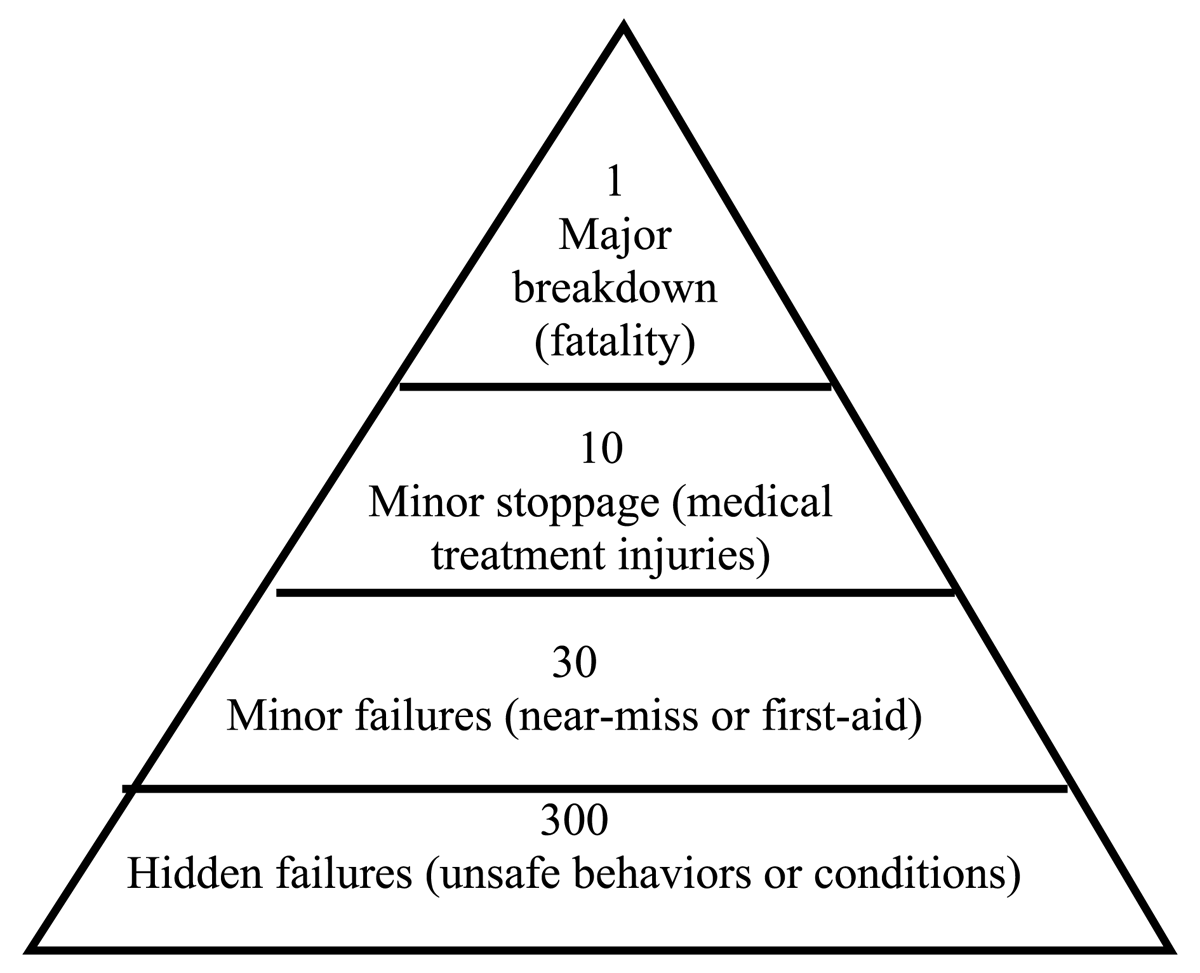
Figure 7
Fatality pyramid in a healthcare center to illustrate analogous to machine losses.
Discussion
LSS has established its appropriateness in applied engineering, where it creates the goals and metrics, analyzes the available metrics tied to operational efficiencies, develops and implements interventions, and documents a control plan so that the achieved improvements are sustained for the long run because LSS eliminates non-value-added activities and waste, which eventually save time and money. As a result, improving processes increases patient satisfaction and reduces errors. Thus, the organization becomes successful by incorporating Lean into everyday processes.
In a healthcare organization, implementation of Lean starts with the formation of the LSS team. The team begins the Lean journey by selecting value-stream event in the organization, maps the current state, identifies non-value-added processes and issues, and then develops an ideal route as the future state for the organization. While some may view Lean as a method to reduce cost or trim the workforce, the LSS team foresees Lean as freeing up capacity and listening to the voice of the customer. The team should be composed of all of the key stakeholders who are part of the internal and external operational processes. Moreover, higher management and executives must support Lean implementation. They are required to understand it, buy in to it, and support it.
Lean is a path, not an initiative or a pilot program, because it will change how the hospital or health system does business. The organization’s culture and soft skills are just as important as the Lean tools. Lean principles may become so engrained in the culture that eventually a department’s employees can conduct mini-Lean events in their work cell to make small improvements. In applied engineering, great advantages were realized when a team works in a cell. First, it enhances communication and helping each other among employees of the department. Second, there is instantaneous quality feedback from team members in the adjacent process. Third, because cells are compact, work-in-process is reduced, which means proportionately lower lead times and operating expenses. Finally, a team working elbow to elbow in a cell inevitably starts to cross-train one another. Over time, all team members can come to know all of the jobs in the cell, which improves quality and makes for a more humane workplace. LSS application in the healthcare industry requires an understanding of how the tools and methodologies translate to the people-intensive processes of patient care. Once it is applied, the possibilities are endless.
Bloom’s Taxonomy
Bloom’s taxonomy in hierarchy is a framework for categorizing educational goals. It has been applied by generations of K–12 teachers and college instructors in their instruction curriculums (Anderson, Krathwohl, & Bloom, 2001). Likewise, Bloom’s taxonomy needs to be applied in this coursework, as listed in Table 3.
Table 3
Lean management for healthcare contents fitting with Bloom’s taxonomy.
| BLOOM’S LEVEL | BLOOM’S TAXONOMY | LEARNING LEVEL | LEVEL OF THINKING |
|---|---|---|---|
| 1 | Remember | Recognize and recall LSS facts, concepts, theories, definitions, formulas, dates, events. | Lower level convergent* |
| 2 | Understand | Understand LSS facts mean; identify, classify, describe, and provide examples of the facts. | Higher level convergent |
| 3 | Apply | Apply LSS tools, rules, concepts and the use of organization specific situation to approach as well as implementation. | Lower level divergent** thinking |
| 4 | Analyze | Break down information into LSS component parts; draw connections among ideas and concepts. | Higher level divergent |
| 5 | Evaluate | Judge the value of LSS information or ideas; justify a stand and appraise positions. | Higher level divergent |
| 6 | Create | Combine LSS parts to make a new whole work; respond creative scenarios towards process improvement. | Higher level divergent |
[i] * Convergent thinking is the cognitive process of assembling or combining elements of a topic together.
** Divergent thinking is the disintegrating capability on a topic into its constituent parts (Lawrence, 2020).
The reasonable limitations of this work are important to recognize here. The purpose and intentionality of this LSS curriculum is derived from the checklist of educational objectives as guidelines for curriculum planning. Educational objectives presented in this paper are learnings or achievements of students that this course should bring about. These objectives are foreseen for the students to be behavioral achievements through the knowledge gained by completion of this coursework or body of knowledge. These objectives are no doubt several useful ones, but they carry some limitations as well. For example, it will be too optimistic if this course should be taken for granted, or advanced as universally applicable to all healthcare administration and management programs. Customization to fit the sole purpose of the total healthcare education of the institution needs to be considered always.
Conclusion
LSS, a structured quality-improvement system, has been successful in applied engineering fields by reducing bottlenecks and can be successfully applied in the healthcare-service industry. This data-driven methodology has been recommended by many professional organizations, including the American Society for Quality (ASQ) or Association of Technology, Management, and Applied Engineering (ATMAE) for eliminating waste from processes, services, and other business activities while having a positive impact on financial performance. As a crucial requirement of this successful methodology, the LSS project team leader is required to engage employees into Lean culture by emphasizing initiatives and alignment.
The presented LSS curriculum for healthcare industry administrators and managers is developed based on the lessons learned in applied engineering. Since healthcare administrators and health-service managers oversee the day-to-day operations of hospitals and healthcare facilities, LSS has potential applications for process improvements. Here the LSS coursework content or body of knowledge is developed while keeping in mind that the administration and management majors should attain the necessary understanding. Various LSS tools and techniques to improve effectiveness and efficiency by incurring value-added activities while eliminating non-value-added activities or wastes are discussed with examples and case studies. Students who successfully complete the course will not only complete their course requirement to graduate but will also be prepared for certifications administered by the ASQ or ATMAE.
Funding Information
This work was supported in part by a Bridge Internal Research Grant of the Office of Research and Scholarship at the University of Texas at Tyler.
Competing Interests
The author has no competing interests to declare.
Author Information
Dr. Mohammed Ali is an Associate Professor in the Department of Technology at The University of Texas at Tyler, USA. He is a Trustee for Delta Gamma Chapter of Epsilon Pi Tau.