
1. Introduction
Besides the ways of privatization and state’s coercion imposed by external authorities, self-governance is the third way of governing the commons, based on social rules supplied by users themselves (Ostrom 1990, 183). Originated from cases of the bottom-up self-organizing rules (Ostrom 1990, 180), a series of Design Principles (DPs) have been identified as characteristics of institutions which can sustainably resolve common-pool resources (CPRs) dilemmas. Recent scholarship demonstrates that the more DPs that are present, the more the likelihood of success (Cox et al. 2010; Baggio et al. 2016).1
However, there is no panacea and the DPs should be applied according to local context (Ostrom et al. 2007; Ostrom 2010). While national institutions and policies provide preconditions and constraints on local institutions (North 1990), few empirical studies in the commons literature have studied the connections between external political factors and self-governance (Lam 1996a; Clement 2010). What is more, most examined cases were from the western world, i.e. countries with liberal democratic systems but very few came from non-western countries with authoritarian political systems (Cox et al. 2010; Baggio et al. 2016).2 Self-governance under authoritarianism exists in reality, but it is rarely studied (Tsai 2007; Yu et al. 2016; Chai and Zeng 2018). Over the last two decades, self-governance has been promoted by authoritarian governments as an important policy instrument, to be rebuilt and integrated into the broader administrative system for managing the “last mile” affairs (Mustafa et al. 2016; Xia and Guan 2017). Therefore, the institutional design principles of self-governance under authoritarianism need to be explored to enrich the DP theory and to understand the sustainability of CPR management regimes.
Besides, there are still two aspects of research space in the CPR literature. On one hand, explaining outcomes by diverse measurements is needed to help analyse social dilemmas (Agrawal 2014). Instead of vague measurements, multiple dimensions can enhance the understanding of the characteristics of social dilemmas, such as provision and appropriation problems (Wang and Wu 2018). On the other hand, it also requires more comparative case-by-case studies to understand various configurations of design principles in specific conditions, since no single principle is necessary and sufficient condition for success (Cox 2011; Baggio et al. 2016).
To fill in the above research space, this paper examines the impact of authoritarianism on self-governance in China to address the following two research questions: First, whether Ostrom’s DPs are applicable for self-governance under authoritarian context, and second, how authoritarian context affects self-governance and associated outcomes. We adopt methods of the one-tail Barnard (1945)’s test and the crisp-set Qualitative Comparative Analysis (csQCA) (Ragin 1987) for both variable-by-variable study and case-by-case study based on a dataset of autonomous institutions and outcomes, collected from nine water users associations (WUAs) of the Hetao Irrigated Area (HIA) in northern China.
China is identified as an authoritarian country with top-down policy implementation to reform rural natural resources (Lieberthal 1992; Klein 2010). As an autonomous institution of irrigation management, WUA was conducted on a trial basis in the year of 1995 and further expanded nationwide in 2005 to improve local irrigation management. As a result, the number of WUA dramatically increased from 20,000 to 83,400 within the following 10 years (Ministry of Water Resources 2017). However, outcomes of most WUAs in China have not presented any advantages compared with other management institutions (Wang and Wu 2018). How to understand such an under-performance of self-governance in China? And how to make the self-governance work under authoritarian context? It can be given some insights from the examination of the applicability of DP theory in China.
The theoretical contribution of this paper is to demonstrate that in general, the design principle theory rooted in a western context can be a real guidance to design successful autonomous institutions (Ostrom 1990; Cox et al. 2010), but in specific practical situations, the self-governance under authoritarianism cannot conform with the theory completely. Institutional design needs to meet the criteria of congruence, not only among DPs of the institution, but also between the institution and the context. Under different contexts there exists a diverse set of configurational elements (DPs) and the institutional context. Therefore, the context dependency of the institutional design principles may require developing design principles embedded in a specific social-ecological context.
The rest of the paper is organized as follows: Section 2 gives a theoretical discussion on how authoritarian context affects local institutions, based on the “politicised” Institutional Analysis and Development (IAD) framework. Section 3 presents a contextual description of WUAs in HIA for clarifying the institutional situations of the cases. Section 4 develops the comparative strategy, theoretical framework and specific methods of concept measurements, data collection and analysis. Section 5 presents the analysis results of description, Barnard’s test and csQCA. Section 6 concludes with a discussion of results to craft an account for characteristics and design principles of self-governance under authoritarianism.
2. Theoretical review
2.1. Political context and the design principle theory
The state regime is the precondition of local institutions (North 1990) in terms of financial, technological, legal and political support and constraints (Sarker 2013). The local institution and its outcomes depend on the various interplays between the state and the local (Ribot et al. 2006; Verbrugge 2015) due to various key variables (van Laerhoven and Barnes 2014). The “politicised” IAD framework (Clement 2010) provides an analytical foundation to learn how the political regime context affects the local self-governance institution featured by the DP variables, which can be divided into three groups – substance of rule itself, power of rulemaking arena and authority of rule enforcement (Ostrom 1990, 224; Table 1). According to the DP theory, when the rules are crafted collectively by users and legally supported by external authorities (DPG3), the rules can be enforced by the users or accountable to them by using graduated sanctions with low-cost conflict resolution mechanisms (DPG2) that clearly define who has rights to withdraw from a well-defined resource. Costs proportionate to benefits (DPG1) are effectively assigned in ways that make CPR dilemmas of collective action and monitoring problems solved in a reinforcing manner (Ostrom 2005, 267). The power of the rule-making arena is related to collective-choice rule-in-use of self-governance, distributed by the external state regime while the aspects of the rule and the authority of rule enforcement are related to the operational rule-in-use (Clement 2010).
Table 1:
Three groups of the design principles for CPR self-governance institutions.
| DP Group | DP | Description |
|---|---|---|
| DPG1: Rules | 1A | Clearly defined user boundaries |
| 1B | Clearly defined resource boundaries | |
| 2A | Congruence between local ecological and social conditions | |
| 2B | Congruence between provision and appropriation conditions | |
| DPG2: Rule enforcement | 4A | Effective monitoring users by other accountable users |
| 4B | Effective monitoring resources by accountable users | |
| 5 | Graduated sanctions for users who disobey the collective rules | |
| 6 | Effective and low-cost mechanism of conflict resolution | |
| DPG3: Rule-making arena | 3 | Participation of users in collective decision-making |
| 7 | Minimal recognition of rights to self-governance | |
| 8 | Multiple layers of nested enterprises |
Source: Based on Ostrom (1990) and Cox et al. (2010).
The external political factors may impact local self-governance institutions related to presence or absence of DPs, including authority and mechanisms of election, decision-making, coordination, monitoring, sanction and conflict resolution among others. For substance of rule itself, political and spatial factors may shape the rules of access (dp1a)3 (Tucker 1998; Blaikie 2006), make the resource boundaries fluid (dp1b) (Berkes et al. 1998) and change the nature of the goods (dp2a and dp2b) (Kiser and Ostrom 1982) as well as trigger internal-external conflicts on powers or benefits (Klooster 2000; Gautam and Shivakoti 2005). Regarding authority of rule enforcement, recent scholars argue that monitoring (dp4b), sanctioning (dp5) and conflict mediating (dp6) by administrators or courts of justice, or being financially supported by outsiders may increase the costs of information and coordination (Gautam and Shivakoti 2005; Cinner 2007; Cox 2010) so as to weaken the outcome of governance (Ghate and Nagendra 2005; Chhatre and Agrawal 2008; Cox et al. 2010). Other studies claim that external politicians may have agency to operate wider political processes for balancing unequal power conflicts or for addressing internal distrusts for better internal rule compliance (Suhardiman and Giordano 2014; Nagrah et al. 2016; Ricks 2016). In terms of power of rule-making arena, it is generally considered that power based on external interventions of knowledge, resources and rules (dp3, dp7, dp8) may ignore local features and fail in essential local rulemaking processes (Cleaver 1999; Turner 1999; Pagdee et al. 2006).
Studies of the configurational nature of DPs (Cox 2011; Baggio et al. 2016) explores how patterns of DPs relate to outcomes across diverse CPR settings (Schlager 2016). Baggio et al. (2016) developed knowledge on the perspective of coupled infrastructure system (CIS), i.e. the fit between institutional configurations and technology investment with mobility of resources. They found that combinations that include all DPs except for nestedness (dp8) or collective choice arrangement (dp3) lead to successful local irrigation outcomes, which suggests that self-institutions can be supplied either by the collective selves (DP3) or by the nestedness supports (DP8). Institutions across multiple levels may also have various combinations (Basurto 2013; Lam and Chiu 2016).
2.2. Self-governance institutions under authoritarianism
“Authoritarianism” is a form of government opposite to liberal democracy. According to the most typical concept made by Alexander de Tocqueville, the extreme authoritarianism is despotism, where power is external to society. There is no distinction between the two polar definitions in reality, existing hybrid or soft or comparative authoritarianism which are developed and located at South America, Africa, Middle East, East Asia and Southeast Asia (Geddes 1999; Levitsky and Way 2002; Pepinsky 2014). Authoritarian states have everything with top-down promotion and control in the processes of implementation, structural distribution of resources and authority, and value integration (Lieberthal 1992, 6) with characteristics of limited political pluralism, emotional legitimacy, minimal social mobilization, formed institutions, and informal defined executive power (Yu 2002; Klein 2010). The authoritarian government usually pursues good governance for the maximum of control and stability by gaining popular support (Linz 1964, 255). Authoritarianism is a term widely used denoting the political system in the literature of governance in China.
Local institutions may be also established rapidly in form by the mode of top-down rule implementation, power and resource distributions. While there is a strong government with authority to administratively distribute local resources (e.g. total water volume control system, timber harvest control system) and power (e.g. appointment of local officials or even civil group leaders) under authoritarianism in China, an increasing number of studies point out, that communities are able to be involved in local governance through bargaining (Lee and Zhang 2013) and participatory (Teets 2013; Yan and Xin 2016a,b) ways. The involvement ways are combined of mechanisms of economic exchange, rule regulation, and social network bound between the state regime and society. Therefore, there may be three basic influence ways in authoritarianism on local self-governance institutions and their outcomes, such as top-down policy implementation, resource intervention, and leadership intervention. While top-down policy implementation is promoted according to the logic of rule standardization, resource intervention and leader interventions are respectively accordance to the logics of the economic exchange and the social network.
Under top-down rule implementation, the local institution may have features as follows: users and resources units of local self-governance may usually be administrative departments or divisions (dp1-2) (Lieberthal 1992; Mao and Zhang 2018); local leaders are usually appointed by top administrations to represent authoritarian intentions and mediate power structure on positions (dp3, dp7) (Mertha 2009; Klein 2010; Yan and Xin 2016a,b); the top-down administration usually tightly controls local elections (dp3), close external monitoring (dp4), formal sanction and conflict resolution (dp5-6), and frequent external-internal conflicts (dp6-8) (Mosse 1997; Truex 2014; Schnegg and Linke 2015). The lack of diverse and independent information sources may make social participation of little legality and transparency (dp7) (Chan and Zhao 2016; Yan and Xin 2016a).
3. Case background
3.1. Broader context: WUAs under authoritarianism in China
Since ancient times, irrigation systems of big rivers were emphasized and invested by central governments, while on-farm irrigation was usually self-organized based on villages (Wang 2018). With the reform and opening up, a total water use volume control system and a state-led market-based water trade system were gradually established and developed since the 1988 Water Law. The on-farm irrigation affairs were gradually self-managed led by village committees or WUAs (Wang et al. 2010, 2018; Wang 2017).4 The village committee is the statutory rural self-organization and its irrigation management is called collective management, for it represents its collective to make decisions and manage common affairs of the collective. The WUA is a pattern of direct democracy for primary-level irrigation management. Most WUAs were transformed from the village committee pattern. Under the total water use volume control system, the water quota of each self-organization is based on external decisions.
The WUA was initially introduced to China by the World Bank in 1995 as an experiment in farmers’ participatory irrigation management (World Bank 2003), and subsequently promoted by top-down policy implementations throughout the country in 20055 (Wang and Wu 2018). By the end of 2016, a total of 83,400 WUAs had been established to manage 20 million hectares of irrigated land, accounting for 29.8% of China’s total irrigated area (Ministry of Water Resources 2017). According to the central policy document “The Opinion on Strengthening Construction of Water Users Associations” and the World Bank suggestions, the aims of promoting WUA institutions are to resolve local conflicts, charge water fees, organize internal water allocation, enhance infrastructure maintenance and water saving, and relieve local administration’s burden among others. The design of WUA in China and other countries are in accordance with the following design principles: legally (DP7) self-governing organizations; they are usually encouraged to elect their leaders (DP3), participatory management (DP4-6) by the users-themselves (DP1A) across hydraulic boundaries (DP1B), volumetric water use (DP2A), responsibility and self-maintenance on-farm delivery infrastructures and collect water charges from members to cover water costs (DP2B), and contracts with suppliers (DP8) for improving the efficiency of water use, productivity and income (Meinzen-Dick et al. 2002; World Bank 2003; Wang et al. 2010). However, several studies demonstrate that WUAs in China did not show superiority in terms of improving irrigation management outcome compared with other management methods (Li 2009; Li and Cheng 2014; Zhou et al. 2015; Wang and Wu 2018). A survey covering 307 WUAs in Jiangxi (Zhou and Weng 2017) reported that only 0.9% were established by farmers themselves; 86.9% were supported by governments in financial, policy and technological aspects; 57.9% attained the property certifications of their infrastructures; 95.1% of WUA leaders were cadres, and 43.3% of leaders were elected. According to the Chinese Rural Survey conducted by the China Institute for Rural Studies (CIRS) in 2015 in HIA, only 33.5% of households thought their irrigation affairs were managed by the WUAs, while others thought the committees of their villages were the managers, for many WUA leaders were cadres.
3.2. Micro-situation: total water use volume control system and WUAs in HIA
The HIA is China’s largest canal irrigation area, including 1 general canal, 13 truck canals, 48 sub-truck canals, and 372 branch canals as well as nearly 10 thousand sub-branch canals and ditches (Figure 1). The water source for irrigation is the Yellow River, which is under the total water use volume control system by the Yellow River Conservancy (YRC) of the Ministry of Water Resources. The general canal is managed by the HIA administration (comparable to a city-level bureau), which is in charge of coordinating the total volume of the area with the YRC and making allocation plans for the stations (comparable to county-level bureaus). The truck or sub-truck canals are managed by the stations, which enforce the top-down policies and allocation plans to WUAs, charges state-administrated water fees and manages water users through the WUAs, the primary-level governance organizations for the irrigated area.
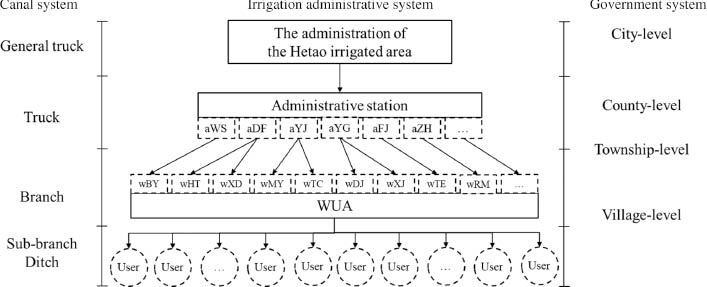
Figure 1:
Organization structure of the HIA.
Before the year 2005, the primary-level irrigation was organized directly by the administrative stations or by village committees. Largely based on their tight social network, station officials and village cadres coordinated water use. Only a few villages or canals organized their irrigation affairs using the WUA institution (e.g. wTC). Most of WUAs were set up by top-down promotion in 2005 or later. After the reform, some WUAs (e.g. wTC, wXJ, wDJ, wBY, wHT, wTE) did not gain the infrastructure property, but they received management responsibility and also financial support or working places from the administration. The other WUAs (e.g. wMY, wXD, wRM, wTE) who possessed the infrastructure property, were operated as a part of village committees or water administration by electing or appointing the village cadres or station officials who were familiar with local irrigation and administrative affairs. Both resource interventions (material offerings such as financial support, infrastructure property control and working place provision) and leadership interventions (using village cadres or station officials of the authoritarian regime) were two approaches for the administration to co-work with the WUAs as well. The WUAs shall manage primary-level irrigation affairs, maintain infrastructure, allocate and monitor water use, and impose water fees on water users. The fees collected by the WUAs include two parts, state-administrated water fees for purchasing water from the HIA administration, and WUA-managed water fees for WUA operation and infrastructure maintenance.
The total volume control system decides water prices and prorates by using quotas for the WUAs to encourage water saving through two policies: step water price institution, and water right exchange program. Under the step water price institution, if water use volume is below the quota, the WUA can enjoy a lower price; otherwise it needs to pay a higher price for the excess volume. The quotas are prorated on registered farmland area level-by-level, to the stations and then to the WUAs. The area of the registered farmland can’t be easily changed unless WUA or village committees organizes the measurement under monitoring by the water administration and township government. All the water stations implement a policy of water release only after the state-administrated fees are paid off. The “water rights exchange program” is another kind of water saving policy promoted by the YRC since 2004 based on the total volume control system. It might be implemented in the WUAs area although they do not have the infrastructure property, if the HIA administration decides that the infrastructure should be enhanced. The costs of the enhancement in the program is be paid by enterprises in industry for exchanging the water quota of the WUA in agriculture. Two WUAs of our cases compliantly conducted the program.
In the interviews we were told that, there was a gap of 1 billion m3 water between the total quota distributed by the YRC and the whole irrigation demand of the HIA. Crops in spring and summer seasons needed separately three runs of irrigated water and in autumn irrigation seasons needed another one run, but the lower price quota was usually inadequate in the first run in each season in two thirds of WUAs. Therefore, WUAs in HIA faced decreasing water quotas and increasing water prices. Many WUAs borrowed from their bank in order to pay off the state-administrated fees in advance for releasing water in time, but some of their water users could not afford the increasing water fees for a long time, causing several WUAs to not repay their bank loans and went bankrupt. Nevertheless, there was still a certain opportunity to organize collective action to save water, such as adopting water saving technology to improve irrigation efficiency and adjusting the planting structures to declining water demand. The government also had a technology extension program, ecological conservation plan and related financial support policies. However, it needed to firstly have or craft self-governance institutions to gain bottom-up support to challenge vested interests, cultivate new irrigation custom and invest in infrastructure for the WUAs.
To sum up, issues of water fees and quotas became sensitive causes of complaint and conflict between farmers with the WUAs, the township government, the water station and the administration. In the face of the total volume control system that promoting, the water saving policies, as well as the limitation of the resource or the leadership interventions, the WUAs in HIA should craft their institutions to manage water saving of farmers and reach the aims of maintaining their infrastructure in good status (provision outcome) as well as managing enough and fair water use (appropriation outcome). This study examines what kind of configurational institution design will work well in this context.
4. Research strategy and methods
4.1. Research strategy, case selection and data collection
Since Ostrom (1990), a comparative strategy of multiple cases was used to examine and explore the design principles of the self-governance under context, most based on one-by-one DP comparison (Sarker and Itoh 2001; Quinn et al. 2007; Cox et al. 2010; Yu et al. 2016). This approach is principle-oriented, which may easily ignore the connections and structures among the design principles. To date, only few case-studies of configurative comparison (Baggio et al. 2016; Dell’Angelo et al. 2016) have explored diverse application of institutions according to contexts. Hence, in the case-oriented research, every case is equally important and “outliers” are of specific importance, rather than interpreting population mean in econometrics. In this paper, after understanding the broader context and the micro-situation, we use both strategies to compare multiple cases to explore the configurative WUA institutions under administrative interventions and policy implementation.
A case dataset on WUA institution and outcome was collected in a survey conducted at the HIA in Inner Mongolia province in July 2015, by the China Institute for Rural Studies (CIRS) of Tsinghua University. This dataset (Table A1) included variables of DPs and outcomes in terms of survey data for 9 WUAs and 332 farming households along with interview transcripts of WUA leaders and administrators. The 9 WUAs were selected from 3 of 5 of the sub-areas of the HIA with the greatest population density according to a theoretical sampling approach of “polar types” (Eisenhardt and Graebner 2007; Rihoux and Ragin 2009; Yin 2009). All the questionnaires and interview outlines were designed based on the Nepal Irrigation Institutions and Systems (NIIS) database (e.g. Lam 1996b). The outlines of in-depth interviews to the officials and the WUA leaders included establishment processes, operative status, roles and outcome and stakeholder networks. The questionnaires of WUA leader and farming user contained natural conditions, demographic statements, participatory methods and processes, as well as outcome assessments.
4.2. Theoretical framework and variable measurements
We organize the research based on the IAD framework (Ostrom 2005, 15; Clement 2010) to conduct a contextual case-oriented study. The dependent variable is the outcome of the WUA, which is a result of the incentives under the local WUA institution. The WUA institution accounts for the independent variables of the DPs, which are partly impacted directly by the contextual variables of authoritarianism and partly by the variables of community and natural attributes of the irrigation system (Figure 2).
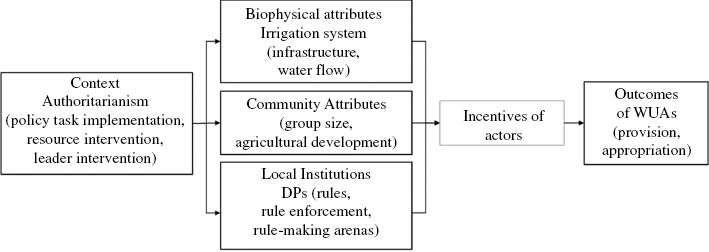
Figure 2:
Theoretical framework.
Note: Based on Ostrom (2005, 15) and Clement (2010).
4.2.1. Outcomes
Generally, there are two ways to measure the outcomes of WUAs – consequences, such as participation, financial and physical conditions, delivery and productivity (Uysal and Atiş 2010; Zhang et al. 2013; Verzijl and Dominguez 2015), and activities (Garces-Restrepo et al. 2007; Ricks 2016). Since WUAs need to solve at least two-dimensional questions – provision and appropriation – with respect to free-riding and overuse (Ostrom 2005), this paper recodes and constructs the WUA outcomes into three dimensions based on a 7-item outcome assessment of 332 farmer users by a factor analysis method, (Table 2). The detailed process can be found in Appendix 1 and the generated new outcome variables are prepared in the Table A3 for the further analysis.
Table 2:
Measurements of outcome dimensions and descriptive statistics.
| Dimension | Survey questions (5 points: 1=absolutely no; 5=very yes) | Mean | S.D. |
|---|---|---|---|
| Provision – infrastructure | The status of irrigation infrastructure is good | 3.48 | 1.28 |
| The status of irrigation infrastructure is constantly improving | 3.73 | 1.38 | |
| Appropriation – sufficiency | The water use is adequate to me | 3.33 | 1.39 |
| The rule of water allocation can be complied efficiently | 3.58 | 1.37 | |
| Appropriation – equity | The process of water allocation is fair to me | 3.77 | 1.44 |
| There are few disputes related to water use | 4.06 | 1.39 | |
| The water use is usually timely for my irrigation needs | 4.20 | 1.27 |
4.2.2. DPs
There are at least four kinds of measurements of DPs: case descriptions in a long phrase (Ostrom 1993), binary variables with presence or absence (Cox et al. 2010; Baggio et al. 2016; Gari et al. 2017), multi-value variables with several degrees of presence (Delgado-Serrano et al. 2017), and binary variables in specific forms (Dell’Angelo et al. 2016; Ratajczyk et al. 2016). This paper employs the last measurement because it is comparable and easily illustrates localized features. Table 3 lists the variables of the DPs, including 11 DPs with 19 variables designed based on the previous literature. The values are evaluated by the WUA leaders in the questionnaire surveys and the in-depth interviews. In Table A3, we have listed all the values of the variables and presence of DP is assigned as 1 unless the DP is absent in the case.
Table 3:
Variables of the DPs, descriptive statistics and the results of Barnard’s test.
| DPG | DP | Variable | Definition | N | % of Present cases | P | AS | AE |
|---|---|---|---|---|---|---|---|---|
| DPG1 rules | DP1A clear user boundary | DP1A | The group of users is according to a traditional village (0=no; 1=yes) | 9 | 67% | n | ||
| (4 DPs, 8 Var.) | DP1B clear resource boundary | DP1B | The resource boundary is according to statistics of basin area (0=administrative; 1=hydraulic) | 9 | 44% | p | ||
| DP2A social-ecological fit | DP2A1 | The WUA was established by whom (0=top-down pushed; 1=made by user-selves) | 9 | 44% | ||||
| DP2A2 | Plans of water allocation and crops are made by whom (0=intervened or made by top-down authorities; 1=made by user-selves) | 9 | 67% | |||||
| DP2A3 | Plans of maintenance are made by whom (0=intervened or made by top-down authorities; 1=made by users themselves) | 9 | 56% | |||||
| DP2B cost-benefit fits | DP2B1 | The tasks of management are assigned by whom (0=intervened or made by top-down authorities; 1=made by user-selves) | 9 | 56% | ||||
| DP2B2 | The rules of service fees for users are made by whom (0=intervened or made by top-down authorities; 1=made by user-selves) | 9 | 56% | p | ||||
| DP2B3 | The rules of mainly financial issues for the whole WUA are made by whom (0=intervened or made by top-down authorities; 1=made by users themselves) | 9 | 33% | p | p | |||
| DPG2 rule enforce-ment | DP4A good resource monitoring | DP4A | There is monitoring on irrigated lands in accordance with bases of water pricing (0=no; 1=yes) | 9 | 33% | |||
| (4 DPs, 6 Var.) | DP4B good user monitoring | DP4B1 | Water payments are announced to WUA users (0=no; 1=yes) | 9 | 100% | – | – | – |
| DP4B2 | The WUA is self-monitored by internal monitors (0=no; 1=yes) | 9 | 56% | |||||
| DP5 graduated sanctions | DP51 | There are sanction measurements for water theft or interruption (0=non; 1=exist) | 9 | 44% | p | n | ||
| DP52 | There are compulsory measurements for collecting water payments (0=non; 1=exist) | 9 | 22% | n | ||||
| DP6 low-cost conflict solution | DP6 | There is a final mechanism for solving conflicts (0=non; 1=exist) | 9 | 100% | – | – | – | |
| DPG3 local rule-making arenas | DP3 collectively rule making | DP31 | The leader of the WUA was elected by (0=administrative appointment; 1=voting) | 9 | 78% | |||
| (3 DPs, 5 Var.) | DP32 | A total users conference was organized when the WUA was established (0=no; 1=yes) | 9 | 78% | ||||
| DP7 external recognition | DP7 | How long is the work duration for the WUA staff (0=shorter; 1=longer) | 9 | 67% | p | p | ||
| DP8 nested multiple governance | DP81 | The water supply contract is made with external water supply organization (0=no; 1=yes) | 9 | 56% | p | |||
| DP82 | There is collaboration with other organizations (0=no; 1=yes) | 9 | 11% | |||||
| DPG1 | Average presence of DPG1 | 9 | 56% | |||||
| DPG2 | Average presence of DPG2 | 9 | 56% | |||||
| DPG3 | Average presence of DPG3 | 9 | 67% |
Note: The columns of P, AS and AE are the results of the one-tail Barnard’s test (1945) between the DP variable presence and successful outcome dimensions, where “P” stands for “Provision”; “AS” stands for “Appropriation – Sufficiency”; “AE” stands for “Appropriation – Equity”; the p-values of the Barnard’s test (p<0.1) are marked there; “p” means significant positive correlation, while “n” means significant negative correlation. The full results of tests on the relations between each DP variable and outcomes can be found in Table A4.
Rules. In the HIA, the users and the resource boundary of each WUA are clear but in different degree. The WUA, whose user boundary is according to a traditional village (1A), will be much clearer than others, for there is a long history and a network of cooperation within a traditional village (Klooster 2000; Tsai 2007), while the hydraulic boundary for resources (1B) will be more appropriate for the outcomes (Wang et al. 2010). The social-ecological fits (2A) and the cost-benefit fits (2B) are represented by the founder and the manager of the WUA – the users themselves will theoretically better understand the rule-congruence degrees. The plan makers of water allocation, crop cultivation, maintenance, service fee payment and mainly financial issues are also coded as variables of DP2. These variables of DP2 cover the WUA establishment and management rules in all the processes (Merrey 1996).
Rule enforcement. The rules of resource monitoring (4A) are coded by whether the monitoring mechanism is related to water price, for the price base will incentivize users to oversee water usage. The user monitoring (4B) is related to the payment announcement and the internal monitors, which are indicated from the two perspectives of monitoring information and social structure (Cinner 2007; Cox et al. 2010). The sanction measurements (5) are related to water theft and payment behaviours, which are the two-key free-rider behaviours that should be sanctioned (Adams et al. 1997; Yu et al. 2016). According to previous discussion, the conflict resolution (6) is coded with the final mechanism (Cox et al. 2010).
Rule-making arena. The collective rule making (3) is indicated by the manner of leader selection and the organization of the total users’ conference (Cleaver 1999). The minimum external recognition (7) is measured by the duration of the WUA staff (Pagdee et al. 2006). The nested multiple governance (8) is represented by variables of both vertical and horizontal linkages with external organizations (Cox et al. 2010).
4.2.3. Context
Table 4 lists the variables of the context, including authoritarianism, biophysical and community attributes based on the previous literature. The values of each variable for cases are listed in Table A3.
Table 4:
Variables of the context, descriptive statistics and the results of Barnard’s test.
| Context | Variable | Definition | N | % of Present cases | P | AS | AE | |
|---|---|---|---|---|---|---|---|---|
| Biophysical attributes | Water scarcity | C1WS | Water resource conditions are good in the WUA (0=no; 1=yes) | 9 | 67% | |||
| Community attributes | Group size | C2GS | The number of users in the WUA is relatively small (0=no; 1=yes) | 9 | 44% | |||
| Agricultural dependency | C2AD | The agricultural income of farmers in the WUA has a higher percentage in the total income (0=no; 1=yes) | * | 44% | n | |||
| Authoritarianism | Resource intervention | C3RF | The WUA has financial support from government (0=no; 1=yes) | 9 | 33% | n | n | |
| C3RP | The property of infrastructure belongs to the government or the HIA (0=no; 1=yes) | 9 | 56% | n | ||||
| C3RW | The place of working is provided by the government or the HIA (0=no; 1=yes) | 9 | 56% | |||||
| C3R | There is resource input externally. (0=no; 1=yes) | 9 | 67% | n | ||||
| Leadership intervention | C3L | The identity of the leader of the WUA is the farmer or the cadre (0=farmer; 1=cadre) | 9 | 44% | p | p |
Note: The columns of P, AS and AE are the results of the one-tail Barnard’s test (1945) between the DP variable presences and successful outcome dimensions, where “P” stands for “Provision”; “AS” stands for “Appropriation – Sufficiency”; “AE” stands for “Appropriation – Equity”; the p-values of the Barnard’s test (p<0.1) are marked there; “p” means significant positive correlation, while “n” means significant negative correlation. The full results of tests on the relations between each DP variable and outcomes can be found in Table A4.
*The data are calculated from the 332-user questionnaire surveys. They were asked of their agricultural income and the total income. Then, the agricultural dependency of the 9 WUAs averaged the user data by each WUA, came to divide the two and it is transferred into binary one, assigning as 1 when the value is larger than the average and as 0 when smaller.
Authoritarianism. When the authoritarian context presents the variable, it will be assigned the value 1; if absent, it will be assigned 0. According to previous literature reviews, the leader and the resource interventions are chosen to depict the two ways of the authoritarianism linked to the WUAs. The station officials or village cadres are the leadership way. The external financial supports, property control and working place provisions are the three methods of support to the WUAs from the external governments and the HIA. A total variable of resource inputs is set by assigning 0 for the WUA of no external material resource input or control; otherwise, it is set as 1.
Other contextual variables. Water scarcity is selected as the key biophysical attribute in the paper because it is the result of the location in a canal irrigation system, and it may impact participation in collective action and related outcomes (Araral 2009). The community attributes include group size (Poteete and Ostrom 2004) and agricultural dependency (Ostrom 2000), which are features associated with self-organization and associated outcomes.
4.3. Data analysis
Qualitative comparative analysis is an approach for the small-N study, and we conducted the steps of analysis in the following order: description, Barnard’s test and csQCA (Rihoux and Ragin 2009). Descriptive statistics and Barnard’s test (1945) were used to variable-by-variable describe and examine whether self-governance institutions significantly related to the outcomes for each DP variables. A case-by-case distribution description (Baggio et al. 2016) and csQCA was employed to explore how context influences self-governance and its outcomes for each case.
Since the sample size of nine is too small to form relatively circumscribed sets for necessary condition analysis and fuzzy-set QCA, we used Barnard’s test and crisp-set QCA (csQCA) instead. The significant variables are also understood as the necessary conditions for further csQCA, an analytical technique of the QCA approach. In QCA, necessary conditions analysis is crucial for the logical minimization process of csQCA, a sufficient condition analysis in essence (Schneider and Wagemann 2010). The necessary condition is a super-set of the outcome and if the consistency of the condition on outcome is above a certain threshold value it can be seen as a necessary condition for the outcome to occur (Ragin 2000). The consistency value might be similar to the significance value of inferential statistics. Since the number of cases is too small to give an appropriate benchmark to test the necessary conditions in a small-N study (Ragin 2000, 114), we chose the Barnard’s test and believe the significant variables of Barnard’s test are relative consistent with the outcome. The positive significant conditions are set as present and the negative significant conditions are set as absent in the logical minimization process of the csQCA.
Therefore, all the variables are transferred into crisp sets for analysis, whose details with the full dataset for analysis can be found in Appendix 1. The technical details of the Barnard’s test and the csQCA are reported in Appendix 2 and Appendix 3.
5. Results
5.1. Data description
Based on the outcome measurement questions (Table 2), the total means of the original factors are higher than 3 but lower than 4.5, indicating the underperformance of the WUAs. The “Equity” dimension scored highest, “Sufficiency” dimension lowest, and the “Provision” got a middle score, which conveys that WUA cases under authoritarianism may more emphasize equity for stability maintenance is the first governance target the government pursue. Equity and justice are important for governance (Linz 1964; Lee and Zhang 2013).
Tables 3 and 4 shows the percentage of presence on outcomes for each DP and each context variable. In over 50% cases, there were 12 chosen DP variables out of total 19 present: in nearly all the case WUAs, the variables of collective choice arena (DP3), payment announcement (DP4B1) and final conflict resolution mechanism (DP6) were always present; in over half cases, clear users boundary (DP1A), internal-made agricultural and service rules (DP2A2, DP2A3, DP2B1, DP2B2), internal monitoring (DP4B2), external recognition (DP7) and contracting with the administration (DP8) were present. At the same time, most of them were established by top-down promotion (dp2a1) with administrative boundaries (dp1b) and authority-made mainly financial rules (dp2b3), a lack of internal enforcement mechanism (dp4a, dp5), which was consistent with the results of the previous Chinese WUA surveys (e.g. Zhou and Wen 2017). Although all of them were under the total volume control system, most of the WUAs had relatively good water conditions, large group sizes and low agricultural dependency. Two thirds of case WUAs (wTC, wXJ, wDJ, wHT, wBY, wTE) had external resource interventions (financial support, infrastructure property control and working place provision). Nearly half of the WUA leaders (wMY, wRM, wXD, wTE) had authoritarian identities as either officials or cadres.
Figure 3 illustrates that DPs presences in the cases did not have an obvious relation with the outcomes. However, there is still a general trend in DP-outcome relations, if the cases are categorised by the two authoritarian interventions – resource and leadership. Two third of the WUAs under resource invitation (wTC, wXJ, wDJ) reached better sufficiency but lower provision and equity outcomes, while most WUAs under leadership intervention (wMY, wXD, wRM) gained higher provision and equity outcomes but lower water sufficiency. Cases of wBY and wHT under resource interventions were worse in all outcomes. wTE intervened by both contextual variables was better in appropriation dimensions but worse in provision dimension.
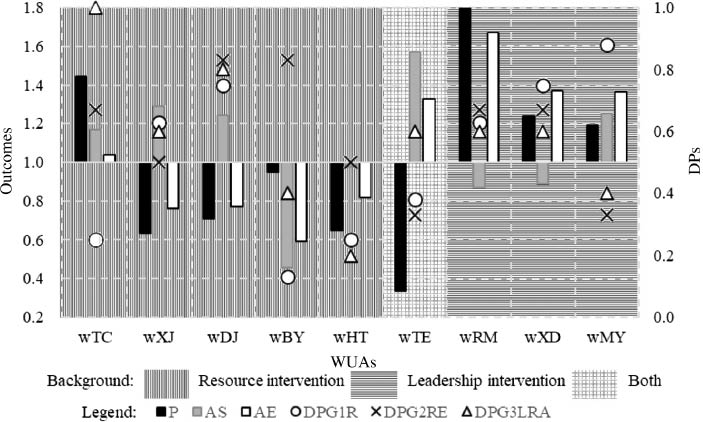
Figure 3:
The Outcomes (Rotated Factor Scores) and the DPGs of the WUAs.
Note: “P” stands for “Provision”; “AS” stands for “Appropriation – Sufficiency”; “AE” stands for “Appropriation – Equity”; “DPG” stands for “design principle group”.
Through case-by-case description, Table 5 and Figure 4 indicates that in general trends of each outcome dimension, the case WUAs support the DP theory (Ostrom 1990; Cox et al. 2010; Baggio et al. 2016), particularly in provision and equity dimensions. Fewer principles lead to worse outcomes in all dimensions. The presence of more DPs is associated with higher probability of success. However, various performance by outcome dimensions for the same WUA suggests that contextual factors affect the outcomes through influencing institutions.
Table 5:
Difference in success rating depending on outcome dimensions and number of DPs.
| Provision – Infrastructure | Appropriation – Sufficiency | Appropriation – Equity | |
|---|---|---|---|
| Less than 6 | 0.00% | 20.00% | 0.00% |
| More than 8 | 100.00% | 60.00% | 80.00% |
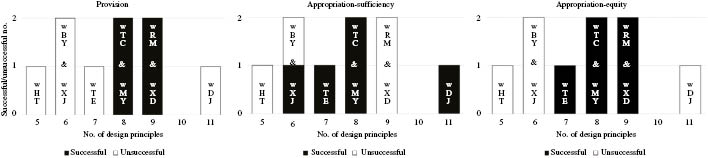
Figure 4:
Number of successful and unsuccessful cases by number of DPs, and by outcome dimension.
5.2. Barnard’s test
Table 3 shows that most DP-outcome relations are not all notable,6 although most DPs present in most cases. It suggests that the roles of key institutional elements (significant DP variables) under authoritarianism might be different from the DP theory (Ostrom 1990) which was grounded from democratic situations, but also represents that some elements of the institution were formed and implemented as authoritarianism studies illustrates (Yu 2002; Klein 2010). 12 DP variables out of 19 were present in over 50% of the cases, but only half of the 8 significant DP variables were present in over 50% of cases (1A, 2B2, 7, 81) and the other half were present in a few cases (1B, 2B3, 51, 52). Hydraulic boundary (DP1B), service fee rules (DP2B2), water-theft punishment (DP51) and external recognition (DP7) are significantly positive to the provision. Financial issue rules (DP2B3) and nestedness (DP8) are significantly positive while traditional village boundary (dp1a) and water-theft punishment (dp51) are significantly negative to the sufficiency. Financial issue rules (DP2B3) and external recognition (DP7) are positive while water-fee imposition (dp52) is significantly negative related to the equity outcome. Table 4 illustrates that authoritarian contextual variables are significantly related to the outcomes. The resource intervention variables are significantly and negatively related to the outcomes, particularly to the provision dimension, while the WUAs with authoritarian leaders are significantly and positively related to the provision and the equity outcomes.
Table 6 demonstrates that under different authoritarian interventions, the DPs of the institution may play various role in producing outcomes. Except the DP52 (water-fee imposition) and DP81 (formal contracting with administration), all other significant DP presences were in more cases intervened by leadership, which means DPs functioned better in the cases intervened by leadership. Hence, it is necessary to find out whether authoritarianism or other contextual variables influence the outcome dimensions, and which configurations of DPs under authoritarianism will lead to successful outcomes. We will conduct csQCA first to get a glance and then carefully analyse each related configuration in cases in the discussion section.
Table 6:
Percentage of present cases contributing to the significance by authoritarian interventions.
| Total | R | L | B | R | L | B | R | L | B | R | L | B | ||
|---|---|---|---|---|---|---|---|---|---|---|---|---|---|---|
| DP1A | 67 | 60 | 100 | 0 | Success | – | – | – | 33 | 100 | 0 | – | – | – |
| Failure | – | – | – | 100 | 100 | – | – | – | – | |||||
| DP1B | 44 | 40 | 67 | 0 | Success | 100 | 67 | 0 | – | – | – | – | – | – |
| Failure | 25 | – | 0 | – | – | – | – | – | – | |||||
| DP2B2 | 56 | 40 | 67 | 100 | Success | – | – | – | 67 | 100 | 100 | – | – | – |
| Failure | – | – | – | 0 | 50 | – | – | – | – | |||||
| DP2B3 | 33 | 0 | 100 | 0 | Success | 0 | 100 | 0 | – | – | – | 0 | 100 | 0 |
| Failure | 0 | – | 0 | – | – | – | 0 | – | – | |||||
| DP51 | 44 | 40 | 67 | 0 | Success | 100 | 67 | 0 | 33 | 0 | 0 | – | – | – |
| Failure | 25 | – | 0 | 50 | 100 | – | – | – | – | |||||
| DP52 | 22 | 40 | 0 | 0 | Success | – | – | – | – | – | – | 0 | 0 | 0 |
| Failure | – | – | – | – | – | – | 50 | – | – | |||||
| DP7 | 67 | 40 | 100 | 100 | Success | 100 | 100 | 0 | – | – | – | 100 | 100 | 100 |
| Failure | 25 | – | 0 | – | – | – | 25 | – | – | |||||
| DP81 | 56 | 60 | 33 | 100 | Success | – | – | – | 100 | 33 | 100 | – | – | – |
| Failure | – | – | – | 0 | 0 | – | – | – | – |
Note: (1) The variable definitions, the direction and the significances of the Barnard’s test can be found in Tables 3 and 4 and Table A4. (2) The “P”, “AS”, “AE”, “R”, “L” and “B” stand respectively for “Provision”, “Appropriation – Sufficiency”, “Appropriation – Equity”, “Resource Intervention”, “Leadership Intervention” and “Both”. (3) WUAs intervened by resource interventions are wTC, wXJ, wDJ, wBY and wHT, by leadership interventions are wRM, wXD and wMY. The WUA of wTE is intervened by both. (4) The variables of highlight blanks are significantly negative related to the outcome; others are significantly positive to the outcome. (5) The % of present cases contributing to the significance is counted based on the original data in Table A2; For each significant DP variable, the value is the number of DP present and success/failure cases divided by the number of total success/failure cases under the intervention.
5.3. csQCA
The csQCA processes in Appendix 3 shows that the resource and the leadership interventions influence the outcomes of the DPs. Table 7 illustrates the final configurations. First, under resource intervention, only one configuration is sufficient to produce all outcome dimensions. Non-self-crafting rules and internal rule enforcement mechanisms in combination with maintaining nested autonomous rule-making arena are sufficient. In addition, self-crafting congruent rules in combination with maintaining a nested autonomous rule-making area is sufficient to achieve the outcome of interest. The solution formulas also suggest that self-crafting rules may have negative relations to provision and equity dimensions under a resource intervention context. Second, under leadership intervention, one configuration is identified. Users self-crafting congruent rules in combination with non-internal rule enforcement and maintaining loose autonomous rule-making arena are sufficient to contribute to all the outcome dimensions. Moreover, internal rule enforcement mechanisms and maintaining nested autonomous rule-making arena are also sufficient conditions to produce the provision and equity outcomes. The solution formulas suggest that under leadership intervention context, internal rule enforcement mechanisms may be negatively related to sufficiency dimension. Third, under both leadership and resource interventions, only maintaining a nested autonomous rule-making arena is sufficient to produce the sufficiency and the equity dimensions.
Table 7:
Success configurations for each outcome dimension by interventions.
| Interventions | Provision | Appropriation – Sufficiency | Appropriation – Equity |
|---|---|---|---|
| Only resource | Non-self-crafting rules | (1) Non-self-crafting rules | Non-self-crafting rules |
| AND | AND | AND | |
| Internal rule enforcement | Internal rule enforcement | Internal rule enforcement | |
| AND | AND | AND | |
| Nested autonomous rule-making arena | Nested autonomous rule-making arena | Nested autonomous rule-making arena | |
| OR | |||
| (2) Self-crafting rules | |||
| AND | |||
| Nested autonomous rule-making arena | |||
| Only leadership | (1) Self-crafting rules | Self-crafting rules | (1) Self-crafting rules |
| AND | AND | AND | |
| Non-internal rule enforcement | Non-internal rule enforcement | Non-internal rule enforcement | |
| AND | AND | AND | |
| Loose autonomous rule-making arena | Loose autonomous rule-making arena | Loose autonomous rule-making arena | |
| (2) Internal rule enforcement mechanisms | (2) Internal rule enforcement mechanisms | ||
| AND | AND | ||
| Nested autonomous rule-making arena | Nested autonomous rule-making arena | ||
| Both | – | Non-self-crafting rules | Non-self-crafting rules |
| AND | AND | ||
| Non-internal rule enforcement | Nested autonomous rule-making arena | ||
| AND | |||
| Nested autonomous rule-making arena |
6. Discussion
6.1. Variable-by-variable study: characteristics of the self-governance under authoritarianism
The one-by-one DP variable analysis can identify the characteristics of self-governance under controls or interventions of authoritarianism, including formalized institution and low participation, intervened self-crafting rules under the resource intervention, high external recognition under the leadership intervention, and inefficient formal sanctions.
6.1.1. Formalized institution and low participation
The DPs that were most or always present were required or supported by the administration according to the central policy document, so the variables of collective choice arena (DP3), payment announcement (DP4B1) and final conflict resolution mechanism (DP6) were always present. Hence, the user participation was low in most WUAs and most of the users conferences were a formed institution of the users collective legitimized by the top authority, instead of a real collective choice mechanism that was expected to enlarge participation, exchange information, make congruence rules and enhance manual monitoring well (Cleaver 1999; Chan and Zhao 2016). Therefore, the further analysis will understand the DPs of the institution and the outcomes as the results of power dynamics in the local irrigation governance.
6.1.2. Intervened self-crafting rules under the resource intervention
The WUAs under resource intervention (wTC, wXJ, wDJ, wBY, wHT, wTE) were controlled through intervened rules, particularly through co-planning financial rules (0% cases had DP2B3 present and less % had DP2B2 than those of leadership intervention). They were thus upward accountable to implement the formal “standard” WUA institutions, with “standard” formal water using contracts (more % had DP81) but lack of efficient rule enforcement (less % had positive significance of DP51 but more % had negative significance of DP52). Therefore, if the WUA could not establish a real collective choice arena (wXJ, wDJ, wBY, wHT, wTE),7 the leader who was elected or appointed from ordinary farmers, might be easily understood as an agent of the HIA administration to charge water fees, but also had conflicts or no collaboration with the related village committees, who had more power of governing the public affairs (Mosse 1997; Mao and Zhang 2018). For example, some farmers in wXJ rejected to pay the fees on the excuse that they did not get subsidies decided by their village committee. It followed that without the supports of the village committee, the rules of new crop extension, precision water saving irrigation or new water saving technology adoption could not be implemented and became formalized issues (high present rating but no significant in DP2A2, DP2A3 and DP2B1).
Therefore, it was lack of incentive for most of these WUAs to enforce water saving rules to decrease their water costs and the complaints of increasing water fees. As a result, imposing water fees became the only function of the WUAs. Under the water release policy, the WUAs might borrow money to pay off their state-administrated fees to provide water sufficiency if farmers could not pay before the first spring irrigation run (wXJ, wDJ, wBY, wHT, wTE). However, when farmers returned the water fees to the WUAs after autumn, they felt the real water costs increased and many of them refused to pay. The farmers also did not think they had the responsibility of improving infrastructure due to the unclear financial responsibility boundary between the WUAs and the administration. They felt unequal and had less willingness to pay the water fees that were managed by WUAs. Thus, the WUAs had inadequate money to maintain their infrastructure and water was wasted year by year. If the leaders punished the free-rider users who refused to pay water fees (wDJ, wBY), the increasing pressure of stability maintenance lowered the equity outcome (40% presented DP52). Hence, they were got not bad in sufficiency but unsuccessful in provision and equity outcomes, even in the case of a full DP present (wDJ in Figure 4). If the administration used the “water rights exchange program” to renew the infrastructure whose property still belonged to the administration, ignoring the local real situation, the WUAs with weak connections with the administration (wBY, wHT) could do nothing other than accept the program and reduce their water use quota, so that they failed either in sufficient outcome.
6.1.3. High external recognition under the leadership intervention
The WUAs under leadership intervention (wMY, wXD, wRM, wTE) were controlled through the leaders as connections between the administration and villages (Lee and Zhang 2013; Ricks 2016), more than minimum external recognition (Ostrom 1990). The leaders of the WUAs were all cadres who had high external leader recognition (100% cases had DP7 present). The leaders had close administrative relations and even political party relations with the HIA administration. They were familiar with administrative affairs including water saving targets, and the paternalistic power of leaders was strengthened when they received the responsibility of water fee charging and allocation. They could balance all administrative affairs of the village well, in which water management was just one of their responsibilities. So, all the WUAs were financially self-managed according to the traditional village boundary (100% presented DP1A and DP2B3), even as well as most of the WUAs did not make water supply contracts with the HIA administration (less % presented DP81).
As the elites or the public entrepreneur of the villages, they were expected to organize their villagers to improve the welfare. They knew very well that their villagers would not refuse to pay off the fees on hostile purpose unless they were confused with the situation of increasing prices, so they would fully or to a lesser extent, use the formal sanctions (0% had DP52 and more % had DP51), but more used persuasion based on their social networks. It was told in the interviews, the leaders usually visited every household to understand family situations, crops planting plans, customary irrigation methods and so forth. They even bought alcohol to drink8 with those who disobeyed the rules of WUAs and persuade them in order to solve a public problem by private methods. After the visit, the reputation of the leader would increase, because his sense of justice was well understood. In some cases (wMY, wXD), the leader would even sacrifice his salary to charge less WUA-managed water fees. Therefore, using the social network method, the WUAs (wMY) could manage to organize adaptation rules to the water saving target under the total volume control system to reach higher outcomes.
Following the above analysis, wTE under both interventions can be also understood. It reached better sufficiency and equity outcomes but lower provision, also because of formalized collective arena that could not make users automatically save water to decrease total water fees and leave more balance to maintain their infrastructure, but due to the leader who could operate his social network to maintain the sense of equity.
6.1.4. Inefficient formal sanctions
The uses of sanction methods were sensitive to the outcomes by different interventions. Most of the cases who used formal sanctions had lower performance in some outcome dimensions (wRM, wXD; wDJ, wBY). There were three methods in the cases for punishing the disobey behaviours: social persuasion (wMY, wRM, wXD), water-theft punishment (wTC, wRM, wXD, wBY), and water-fee imposition (wDJ, wBY). The WUAs by leadership intervention used the first two methods, while the WUAs by resource intervention used the last two. Different from the other formal sanctions, the social persuasion method is based on the leader’s informal social network and mainly focuses on changing the intentions of the users. The success of wMY was supported by the paternalistic leader who operated his social network to persuade users to save water.
On the contrary, the water-theft punishment and the water-fee imposition are based on formal power of water allocation. The water-theft punishment focuses on disciplining the behaviours, while the water-fee imposition focuses on punishing the benefits directly. Therefore, if the power of water allocation cannot be supported by bottom-up understanding of water saving rules, operating the formal sanctions may decline the informal method and the social network (Schnegg and Linke 2015). The water-theft punishment was used as an additional method to the leader’s persuasion to build up the water saving institutions in the WUAs (wRM, wXD), because the social network is less useful without a smaller kinship and acquaintance group and the population of the WUAs were larger by nearly 1000 villagers than wMY’s. However, the enforcement of sanctions made farmers of the WUAs perceive water insufficiently. They assess the outcome of water sufficiency lower. The cases of wDJ and wBY also shows that the water-fee imposition was easily becoming a crisis trigger and lowered the equity outcome.
6.2. Case-by-case study: design principles of the self-governance under authoritarianism
Analysing one-by-one case and their configurations of the successful WUAs under the total volume control system improves our understanding of the design principles of self-governance under authoritarianism. Based on the analysis above, the key problems of the WUAs under the resource intervention were power conflicts within the villages, and the unclear responsibility boundary due to their intervened rules of infrastructure and financial affairs. Although the WUAs under the leadership intervention seemed have better influence on outcome dimensions, the key element of this kind of WUA was the leader, who should be required with the paternalistic power on users and the capacity of understanding the water saving policy situations and enforcing rules that he or the collective made. Moreover, in most of the WUAs under authoritarian interventions, the user conference is just formalized and cannot support the collective choice mechanism to promote participation, making all the users understand the water saving situation and self-craft rules to incentivize users to decrease water use volume. The institutional design principles should point out and overcome the key problems intervened by the authoritarian context. While Ostrom’s design principle theory can guide us to grasp key elements of crafting the self-governance institutions, its application under authoritarianism should be adjusted by interventions. Together based on the cases of wTC and wMY with all better outcome dimensions, Table 7 demonstrates that self-governance can emerge and survive under authoritarianism as long as there is conditional accordance with some principles.
With regards to leadership intervention (e.g. wMY), if a competent leader was chosen as a mediator connecting between the administration and the self-governance (Lee and Zhang 2013; Ricks 2016), the self-crafting rules on water saving, the rule-making arena and enforcement mechanisms could be integrated into the whole village governance system. The leader could use his paternalistic social network methods to communicate information, enlarge participation, discuss rules, make promises and persuade compliance; but the formal rule enforcement method should be adaptive to the social network (Schnegg and Linke 2015).
In terms of resource intervention (e.g. wTC), the WUA was rebuilt as another system in the village. It was necessary to build a nested autonomous rule-making arena to receive the power and the responsibility of irrigation management as well as to motivate and organize users collectively, thereby stimulating mutual monitoring to achieve better institutional outcomes. Besides, to co-plan rules with not only users but also the staff of the administration was a crucial way to craft congruence rules and adapt to the changing and uneasy requirements of water saving (Lam and Chiu 2016; Chai and Zeng 2018).
The two configurations are different from the results of Baggio et al. (2016)’s research, which can be understood as that the self-governance institution can be provided by either the collective choice arena (DP3) or the nested institution of the broader context (DP8). However, the self-governance under authoritarianism has a limited users participation arena which provides neither collective decision-making process nor clear power and responsibility structure nested within the local WUA and the administration. Hence, to promote self-governance, the first step should be to integrate power structure, clarify responsibility and enlarge participation. The cases and the configurational analysis of the paper highlights two ways to trigger the users participation under authoritarianism: organizing an efficient collective choice arena (DP3), or appointing or electing a competent leader who can develop his public entrepreneurship (DP7 and DP8). In practice, the HIA used the leadership intervention to improve lower outcomes of a small-group WUA (wHT). A new leader who was the head of the village with good reputation was appointed just before we conducted field research, and the users had good expectations that the new leader would bring good irrigation management.
7. Conclusion
We employ a Barnard’s test and Crisp-set Qualitative Comparative Analysis which are based on nine WUA cases in China to examine the influence of authoritarianism on self-governance. Our results show that self-governance under authoritarianism generally conform with the design principle theory (Ostrom 1990). More presence of DPs increases the probability of success.
However, due to the controls and interventions of the authoritarian regime, self-governance institutions have unique characteristics, including formalized institution and low participation, intervened self-crafting rules under the resource intervention, high external recognition under the leadership intervention, and inefficient formal rule enforcement. First, some self-governance rules may be provided or required by the regime, such as collective choice arenas, information disclosure (e.g. payment announcement) and final conflict resolution mechanisms. These rules may usually upward accountability, so as to become formalization with low participation (Yu 2002; Klein 2010). Second, some rules may depend on the authoritarian interventions. Under the resource intervention, the self-governance is resource controlled and supported by the external authority. Its financial rules are decided or co-made by the authority rather than autonomously. The resource intervention may easily lead to unclear boundary of power and responsibility in making rules, as well as conflicts with local power structures (e.g. village committee), causing the inefficient rule enforcement mechanisms and the lower outcomes. Under the leadership intervention, a village cadre or grassroots official of the authoritarian regime is appointed or elected as the leader of the self-governance, who is well recognized both in the authoritarian regime and within the self-governance groups, more than the principle of minimum recognition (Ostrom 1990, 183). By integrating their governance aims and increasing their innovation, the leaders will be encouraged to use their social network institutions to enlarge participation, communicate information, create and enforce rules, usually bringing better outcomes in provision and equity. Third, the formal rule enforcement mechanism may weaken the informal social mechanism operated by leaders and lower the governance outcomes, if the power of self-governance can not be bottom-up supported (Schnegg and Linke 2015). Hence, the institution of self-governance under authoritarianism reflects the characteristics of legality and nestedness within the regime and the participatory feature of the autonomy, implying that authoritarianism characterizes strong central power and limited political participation (Linz 1964).
Therefore, under authoritarianism, to design and establish a self-governance mechanism to enhance the commons governance, it is useful to apply the Ostrom’s design principle. At the same time, it is important to pay attention to both configurations of the institution-context fit and the inter-principles fit. There should be two crucial institutional congruences, namely, i) among the elements (DPs) of the institution; ii) between the institution and the context. On account of the authoritarian features of central power and limited participation, the first step is to gain the support of local powers to enlarge participation and clarify responsibility, and the next key step is to set up a co-governance area between the external authority and the autonomous institution for information communication and decision making. There are concrete methods that: organize a real collective choice arena and use co-plan rules with the authority under the resource intervention, while appointing a leader who is familiar with both the regime and the local social network under the leadership intervention.
As a preliminary study, this paper cannot provide a revised version of design principles for self-governance under authoritarianism, which requires further empirical studies and literature accumulation. Even so, it still provides basic guidance for exploring the institutional design in authoritarian context, in which enlarging participation, clarifying responsibility and internal-external interactive communication are key issues when policy is top-down implemented. This can explain why the resource support and the leadership strategy are usually used to construct local institution in commons governance in contemporary China. Therefore, the evidence based on the nine WUA cases in this paper has provided new insights for understanding the significant impacts of the authoritarian context on crafting design principles in commons governance.
Acknowledgements
This work is jointly supported by the National Natural Science Foundation of China (71573151; 71721002), the Major Program of the National Social Sciences Foundation of China (15ZDB164), the National Key Research Program (2016YFC0401408), the Tsinghua University Initiative Scientific Research Program (2017THZWYX02) and the International Postdoctoral Exchange Fellowship Program. Also thanks a lot for all the constructive suggestions and encouragement from the anonymous reviewers, Prof. John Marty Anderies, Prof. Frank van Laerhoven, Dr. Sergio Villamayor-Tomas, Prof. Weijie Wang, Prof. Yixin Dai, Dr. Bohua Li, Dr. Yiqing Su, Mr. Quanfeng Shu, Mr. Anders Jesper Marcus Svensson, participants both on Panel 665 “Practicing Water User Association for a Better Commons Governance” on IASC 2017 at Utrecht University, and 2018 Commons Workshop at Tsinghua University.
Notes
[1] The DP theory were proposed based on multiple case comparisons (Ostrom 1990), and then tested by hundreds of various case studies, e.g. Ostrom (1993), Sarker and Itoh (2001), Quinn et al. (2007), Yu et al. (2016). The recent researches of Cox et al. (2010) and Baggio et al. (2016) are based on qualitative meta-analysis of 69 cases in 91 papers. Their conclusions are all related to “the more DPs presence the more probably success”
[2] According to the country list on Wikipedia of “authoritarianism” in the year of 2018, there are only 3.8% studies coming from authoritarian regions in the reviewed list of the 91 papers.
[3] For better understanding and easily linking theories, if related, the DPs will be marked by the numbers in brackets after the related literature descriptions. The mark with all uppercase letters stands for the DP presences, while with all lowercase letters for absences.
[4] The researches also mentioned another pattern of individual contractors based on market mechanisms. Since farmers feel unequal when the contractor earns money while the contractor may escape when he suffers loss, in some irrigated administration like HIA, contractor pattern was banned in about the year of 2010 and gradually replaced with the WUA institution, a non-profitable pattern. Hence, we ignore this pattern in the paper.
[5] A policy document “The Opinion on Strengthening Construction of Water Users Associations” was jointly issued by the Ministry of Water Resources, the National Development and Reform Commission and the Ministry of Civil Affairs in late 2005, which formalized or established grassroots small-scale WUAs to receive water management responsibility of transference from government water organizations. (The document can be browsed on the webpage in Chinese: http://www.ndrc.gov.cn/fzgggz/ncjj/nczc/200603/t20060309_62403.html).
[6] The Barnard’s test demonstrates that conformity and ratio calculations reflect the same result (Table A4).
[7] The case of wTC that had established a real collective choice arena and reached all higher outcomes, will be explained in 6.2.
[8] Drinking alcohol is a kind of action of true friendship building in rural China. “In wine there is truth” is a common saying.
[9] The former databases include the Common Pool Resources (CPR) Database at Indiana University, the Social-Ecological Systems (SES) Library at Arizona State University and the Social-Ecological Meta-Analysis Database at Dartmouth University.
[10] The necessary analysis can be done by fsQCA software by calculating the benchmark proportions. In Ragin’s book (2000, 107–115), there is a probabilistic criterion to assess necessity and sufficiency to give a benchmark value to decide whether the condition is necessary or not. The table on page 114 suggest that if the total case number (N) is 9, the successful case number (Ns) should be more than 7 to get a smallest benchmark proportion that decides which condition can reach the criteria to be the necessary condition. However, the data of the paper can not satisfy the requirement. Nevertheless, the data of the DP conditions still show significance to the outcomes by exact test of Barnard’s test (1945). We use the Barnard’s test to replace the necessary analysis. According to the calculations of the benchmark proportion and the Barnard’s test, the later one uses more information of the data than the former one, so the results of Barnard’s test can provide significant information but the necessary analysis can not.
Appendices
Appendix: How does context affect self-governance? Examining Ostrom’s design principles in China
Appendix 1: Data preparation
A1.1. Data collection
There are few Chinese cases in the former databases9 for studies on the DPs and outcomes. The information of the dataset on WUA institution and outcome of China is listed in Table A1.
A1.2. Outcome measurement
7-item outcome assessments of 332 farmer users are analysed by factor analysis method. With confirmations of a Bartlett test of the sphericity=199.534, p=0.000 and a high Kaiser-Meyer-Olkin (KMO) statistic=0.674, the set of the original factors indicates the presence of interrelationships and an acceptable normality as well as passes the test of sufficiency of the number of factors, showing that they can further be conducted by the factor analysis. The factors are assigned into three groups of “Provision”, “Appropriation – Sufficiency” and “Appropriation – Equity”, each of which comprises the factor loadings that exceed 0.55. The total groups explain 60% of the variance, and the internal consistency of each group was acceptable without very small Cronbach’s alphas (all higher than 0.4).
Table A1:
Information of the case WUAs and related users.
| County | Town | Admin. station | WUA | Number of users | Admin. village | Number of sampled users | Date of field researches | |
|---|---|---|---|---|---|---|---|---|
| W | XGZ | aZH | wRM | 2915 | YL | 4 | 4 | A.M., July 22, 2015 |
| TEH | aFJ | wTE | 4702 | CG | 14 | 14 | P.M., July 22, 2015 | |
| L | WLTK | aYG | wXJ | 5467 | DX | 22 | 31 | A.M., July 23, 2015 |
| XG | 9 | A.M., July 23, 2015 | ||||||
| WLTK | wDJ | 2974 | XM | 23 | 23 | P.M., July 23, 2015 | ||
| WLTK & XH | aYJ | wTC | 2704 | LS& LQ | 94 | 94 | ALL, July 24, 2015 | |
| XH | wMY | 2385 | LS | 13 | 13 | A.M., July 24, 2015 | ||
| D | DK | aDF | wXD | 3165 | XD | 21 | 48 | A.M., July 25, 2015 |
| YS | 27 | A.M., July 25, 2015 | ||||||
| LSH | wHT | 2850 | HTTH | 33 | 61 | P.M., July 25, 2015 | ||
| XC | 6 | P.M., July 25, 2015 | ||||||
| HZY | 14 | P.M., July 25, 2015 | ||||||
| HQ | 8 | P.M., July 25, 2015 | ||||||
| SJTH | aWS | wBY | 3416 | BYMD | 44 | 44 | A.M., July 26, 2015 | |
| 3 Counties | 7 Towns | 6 Stations | 9 WUAs | 14 Villages | 332 Users | |||
Note: (1) The dataset includes 332 questionnaires of farming households and 9 questionnaires of WUA leaders along with in-depth interview transcripts of 9 WUA leaders and 6 administrators. (2) They were collected by China Institute for Rural Studies (CIRS) of Tsinghua University at the Hetao Irrigated Area (HIA) in Inner Mongolia province in July 2015. (3) The source of the number of users of each WUA was provided by the HIA in 2015.
The results adopted are considered as balances, not only between an acceptable internal consistency of new factors and a relevant higher variance explanation, but also between a relatively acceptable grouping and a theoretical meaning. The provision dimension includes both indicators of the status and improvement constancy of the infrastructures, which are referred to as free-rider prevention institutions. The groups of “Sufficiency” and “Equity” attribute to the appropriation dimension. The sufficiency dimension comprises water use sufficiency and efficient rule compliance, regarding the efficient governance of overusing. The equity dimension includes fair allocation, few disputes and timely using, referring to the equity governance of overusage. These indictor settings of the WUA outcomes may be more appropriate for analysing how the self-governance institutions help address the CPR governing problem based on the CPR theory. Three new variables with the rotated factor scores are generated for the further analysis, listed in the Table A3.
A1.3. Binary variables preparation
Table A3 lists all the measurements and transferred binary variables of the authoritarian contexts, the DPs and the outcomes that are prepared for further test and csQCA. For the three new outcome variables, it is assigned the value 1 when the score is higher than average and is assigned 0 otherwise, because after standardization in the factor analysis process the average scores can be as threshold value to distinguish the better and the worse outcomes. In the csQCA process, we first group the 19 DP indicators into the three DPGs and then analyse the results in detail in order to solve the problem of too many conditions but a few cases. The DPGs are also responded to the three principles groups in literature review. So, for the DPGs, after averaging the DP indicators by the groups we re-assign 1 when the score is higher than 0.5 and assign 0 otherwise. Set 0.5 as the threshold value for the DPGs because higher than 0.5 means there are more than half number of that DP group present and after the grouping csQCA, the present DPG condition can obviously lead to discuss the related present DPs in the DPG.
Table A2:
Rotated factor loadings for the outcomes of the WUAs.
| N=332 | Mean | S.D. | Infrastructure | Sufficiency | Equity |
|---|---|---|---|---|---|
| The status of irrigation infrastructures is good. | 3.48 | 1.28 | 0.815 | ||
| The status of irrigation infrastructures is constantly improved. | 3.73 | 1.38 | 0.851 | ||
| The water using is adequate to me. | 3.33 | 1.39 | 0.800 | ||
| The rule of water allocation can be complied efficiently. | 3.58 | 1.37 | 0.780 | ||
| The processes of water allocation are fair to me. | 3.77 | 1.44 | 0.761 | ||
| There are few disputes in water using. | 4.06 | 1.39 | 0.698 | ||
| The water using are usually timely for my irrigation needs. | 4.20 | 1.27 | 0.551 | ||
| Cronbach’s alpha (internal consistency) | α0.609 | α0.458 | α0.409 | ||
| Variance explained (total: 60%) | 30% | 13% | 17% |
Note: Bartlett test of the sphericity=199.534, p=0.000, Kaiser-Meyer-Olkin (KMO) statistic=0.674.
Extraction method: principal component analysis. Rotation method: varimax with Kaiser normalization.
Table A3:
Crisp-set values of all the authoritarian context, the DPs and the outcomes.
| Dimension | Variable | wTC | wXJ | wDJ | wBY | wHT | wTE | wRM | wXD | wMY |
|---|---|---|---|---|---|---|---|---|---|---|
| Outcomes (rotated factor scores) | ||||||||||
| Provision | P | 1.44 | 0.64 | 0.71 | 0.95 | 0.65 | 0.33 | 1.82 | 1.24 | 1.19 |
| Appropriation | AS | 1.17 | 1.29 | 1.24 | 0.46 | 0.98 | 1.57 | 0.87 | 0.89 | 1.25 |
| AE | 1.04 | 0.76 | 0.77 | 0.59 | 0.82 | 1.33 | 1.67 | 1.37 | 1.36 | |
| Outcomes (transferred to crisp sets) | ||||||||||
| Provision | Pcs | 1 | 0 | 0 | 0 | 0 | 0 | 1 | 1 | 1 |
| Appropriation | AScs | 1 | 1 | 1 | 0 | 0 | 1 | 0 | 0 | 1 |
| AEcs | 1 | 0 | 0 | 0 | 0 | 1 | 1 | 1 | 1 | |
| DPs | ||||||||||
| Rules | DP1A | 0 | 0 | 1 | 1 | 1 | 0 | 1 | 1 | 1 |
| DP1B | 1 | 0 | 1 | 0 | 0 | 0 | 0 | 1 | 1 | |
| DP2A1 | 1 | 1 | 0 | 0 | 1 | 1 | 0 | 0 | 0 | |
| DP2A2 | 0 | 1 | 1 | 0 | 0 | 1 | 1 | 1 | 1 | |
| DP2A3 | 0 | 1 | 1 | 0 | 0 | 0 | 1 | 1 | 1 | |
| DP2B1 | 0 | 1 | 1 | 0 | 0 | 0 | 1 | 1 | 1 | |
| DP2B2 | 0 | 1 | 1 | 0 | 0 | 1 | 0 | 1 | 1 | |
| DP2B3 | 0 | 0 | 0 | 0 | 0 | 0 | 1 | 1 | 1 | |
| Rule enforcement | DP4A | 0 | 0 | 1 | 1 | 0 | 0 | 1 | 0 | 0 |
| DP4B1 | 1 | 1 | 1 | 1 | 1 | 1 | 1 | 1 | 1 | |
| DP4B2 | 1 | 1 | 0 | 0 | 1 | 0 | 0 | 1 | 0 | |
| DP51 | 1 | 0 | 0 | 1 | 0 | 0 | 1 | 1 | 0 | |
| DP52 | 0 | 0 | 1 | 1 | 0 | 0 | 0 | 0 | 0 | |
| DP6 | 1 | 1 | 1 | 1 | 1 | 1 | 1 | 1 | 1 | |
| Local rule-making arena | DP31 | 1 | 1 | 1 | 1 | 0/1 | 1 | 1 | 1 | 0 |
| DP32 | 1 | 1 | 1 | 1 | 1 | 0 | 1 | 1 | 0 | |
| DP7 | 1 | 0 | 1 | 0 | 0 | 1 | 1 | 1 | 1 | |
| DP81 | 1 | 1 | 1 | 0 | 0 | 1 | 0 | 0 | 1 | |
| DP82 | 1 | 0 | 0 | 0 | 0 | 0 | 0 | 0 | 0 | |
| No. of DP presence | 8 | 6 | 11 | 6 | 5 | 7 | 9 | 9 | 8 | |
| DPs’ grouping | ||||||||||
| DPG1R | 0.25 | 0.63 | 0.75 | 0.13 | 0.25 | 0.38 | 0.63 | 0.75 | 0.88 | |
| DPG2RE | 0.67 | 0.50 | 0.83 | 0.83 | 0.50 | 0.33 | 0.67 | 0.67 | 0.33 | |
| DPG3LRA | 1.00 | 0.60 | 0.80 | 0.40 | 0.20 | 0.60 | 0.60 | 0.60 | 0.40 | |
| DPs’ grouping (transferred to crisp sets) | ||||||||||
| DPG1 | 0 | 1 | 1 | 0 | 0 | 0 | 1 | 1 | 1 | |
| DPG2 | 1 | 0 | 1 | 1 | 0 | 0 | 1 | 1 | 0 | |
| DPG3 | 1 | 1 | 1 | 0 | 0 | 1 | 1 | 1 | 0 | |
| Context | ||||||||||
| Biophysical | C1WS | 1 | 1 | 1 | 0 | 1 | 0 | 0 | 1 | 1 |
| Community | C2GS | 1 | 0 | 1 | 0 | 1 | 0 | 0 | 0 | 1 |
| C2AD | 1 | 0 | 0 | 1 | 1 | 0 | 0 | 1 | 0 | |
| Authoritarianism | C3RF | 0 | 1 | 0 | 1 | 1 | 0 | 0 | 0 | 0 |
| C3RP | 1 | 1 | 0 | 1 | 1 | 1 | 0 | 0 | 0 | |
| C3RW | 1 | 1 | 1 | 1 | 0 | 0 | 0 | 0 | 0 | |
| C3R | 1 | 1 | 1 | 1 | 1 | 1 | 0 | 0 | 0 | |
| C3L | 0 | 0 | 0 | 0 | 0 | 1 | 1 | 1 | 1 | |
Appendix 2: Variable-by-variable test
Besides descriptive statistics whose results are listed in Tables 3 and 4 in the main text, Barnard’s test, conformity and ratio calculations are used to variable-by-variable test the relations between each DP, DPG, context and outcome, whose results are listed in Table A4. The test methods are referenced to Cox et al. (2010), using Fisher’s exact test, ratio and phi statistics. Since our sample size is too small to use other most effect size methods like phi statistics, analysis of variance (ANOVA) and so on.
We choose to use Barnard’s test, because it is a more powerful alternative than Fisher’s exact test and other e to test whether there is dependence of rows and columns in a contingency table, when the number of cases is small and when margin totals of the rows and the columns are unconditional (Mehta and Hilton 1993). The one-tail p-value of the Barnard’s test can be calculated by an online calculator (https://scistatcalc.blogspot.com/2013/11/barnards-test-calculator.html).
The conformity and the ratio calculations are the same meaning to show how percentage of the cases supports the DP theory. The “conformity” is the ratio of supportive case number (main diagonal) to the total case size (9 case WUAs). The “ratio” is the number of supportive cases (main diagonal) to unsupportive cases (off-diagonal).
Appendix 3: Case-by-case analysis
csQCA uses Boolean algebra to treat cases as configurations of particular conditions and outcomes, providing all the logically possible configurations of conditions to the outcome (Ragin 1987). Therefore, it can help to explore how contexts influence the self-governance and its outcomes. fsQCA 3.0 was used to process the analysis.
The logical relations between conditions and outcomes are established based on set relations. A condition is necessary if it is a super-set of the outcome; a condition is sufficient if it is a sub-set of the outcome; a condition is neither necessary nor sufficient if it is just one condition of a sufficient combination on the outcome (Ragin 1987). Consistency assesses the degree to which the cases sharing a given condition or combination of conditions agree in displaying the outcome in question. Coverage, by contrast, assesses the degree to which a cause or causal combination “accounts for” instances of an outcome (Ragin 2006). Since the case size is small, all the solution coverages and solution consistencies are required to be 1 in all the csQCA processes (Ragin 2000).
Necessary conditions analysis is very crucial for the logical minimization process of csQCA, a sufficient condition analysis in essence (Schneider and Wagemann 2010). The consistency value might be similar to the significance value of inferential statistics. Since the supportive case number is too small to give an appropriate benchmark to test the necessary conditions in such small-N (Ragin 2000, 114),10 and Barnard’s test can give a similar and powerful guidance, we accept the significant variables of Barnard’s test are relative consistent with the outcome. Set the positive significant conditions present and the negative significant conditions absent in the logical minimization process of the csQCA.
Table A4:
Relation between each DP, DPG, context and outcome in the cases analyzed.
| 1 | 0 | 1 | 0 | 1 | 0 | |||||||||||
|---|---|---|---|---|---|---|---|---|---|---|---|---|---|---|---|---|
| DP1A | Success | 3 | 1 | 0.39 | 56% | 1.3 | 2 | 3 | 0.04* | 22% | 0.3 | 3 | 2 | 0.41 | 44% | 0.8 |
| Failure | 3 | 2 | 4 | 0 | 3 | 1 | ||||||||||
| DP1B | Success | 3 | 1 | 0.09* | 78% | 3.5 | 3 | 2 | 0.20 | 67% | 2.0 | 3 | 2 | 0.20 | 67% | 2.0 |
| Failure | 1 | 4 | 1 | 3 | 1 | 3 | ||||||||||
| DP2A1 | Success | 1 | 3 | 0.20 | 33% | 0.5 | 3 | 2 | 0.20 | 67% | 2.0 | 2 | 3 | 0.46 | 44% | 0.8 |
| Failure | 3 | 2 | 1 | 3 | 2 | 2 | ||||||||||
| DP2A2 | Success | 3 | 1 | 0.39 | 56% | 1.3 | 4 | 1 | 0.25 | 67% | 2.0 | 4 | 1 | 0.25 | 67% | 2.0 |
| Failure | 3 | 2 | 2 | 2 | 2 | 2 | ||||||||||
| DP2A3 | Success | 3 | 1 | 0.20 | 67% | 2.0 | 3 | 2 | 0.46 | 56% | 1.3 | 3 | 2 | 0.46 | 56% | 1.3 |
| Failure | 2 | 3 | 2 | 2 | 2 | 2 | ||||||||||
| DP2B1 | Success | 3 | 1 | 0.20 | 67% | 2.0 | 3 | 2 | 0.46 | 56% | 1.3 | 3 | 2 | 0.46 | 56% | 1.3 |
| Failure | 2 | 3 | 2 | 2 | 2 | 2 | ||||||||||
| DP2B2 | Success | 2 | 2 | 0.46 | 44% | 0.8 | 4 | 1 | 0.09* | 78% | 3.5 | 3 | 2 | 0.46 | 56% | 1.3 |
| Failure | 3 | 2 | 1 | 3 | 2 | 2 | ||||||||||
| DP2B3 | Success | 3 | 1 | 0.01* | 89% | 8.0 | 1 | 4 | 0.25 | 33% | 0.5 | 3 | 2 | 0.04* | 78% | 3.5 |
| Failure | 0 | 5 | 2 | 2 | 0 | 4 | ||||||||||
| DP4A | Success | 1 | 3 | 0.39 | 44% | 0.8 | 1 | 4 | 0.25 | 33% | 0.5 | 1 | 4 | 0.25 | 33% | 0.5 |
| Failure | 2 | 3 | 2 | 2 | 2 | 2 | ||||||||||
| DP4B1 | Success | 4 | 0 | 0.50 | 44% | 0.8 | 5 | 0 | 0.50 | 56% | 1.3 | 5 | 0 | 0.50 | 56% | 1.3 |
| Failure | 5 | 0 | 4 | 0 | 4 | 0 | ||||||||||
| DP4B2 | Success | 2 | 2 | 0.46 | 56% | 1.3 | 2 | 3 | 0.46 | 44% | 0.8 | 2 | 3 | 0.46 | 44% | 0.8 |
| Failure | 2 | 3 | 2 | 2 | 2 | 2 | ||||||||||
| DP51 | Success | 3 | 1 | 0.09* | 78% | 3.5 | 1 | 4 | 0.09* | 22% | 0.3 | 3 | 2 | 0.20 | 67% | 2.0 |
| Failure | 1 | 4 | 3 | 1 | 1 | 3 | ||||||||||
| DP52 | Success | 0 | 4 | 0.50 | 56% | 1.3 | 1 | 4 | 0.50 | 44% | 0.8 | 0 | 5 | 0.06* | 22% | 0.3 |
| Failure | 0 | 5 | 1 | 3 | 2 | 2 | ||||||||||
| DP6 | Success | 4 | 0 | 0.50 | 44% | 0.8 | 5 | 0 | 0.50 | 56% | 1.3 | 5 | 0 | 0.50 | 56% | 1.3 |
| Failure | 5 | 0 | 4 | 0 | 4 | 0 | ||||||||||
| DP31 | Success | 3 | 1 | 0.46 | 44% | 0.8 | 4 | 1 | 0.50 | 56% | 1.3 | 4 | 1 | 0.50 | 56% | 1.3 |
| Failure | 4 | 1 | 3 | 1 | 3 | 1 | ||||||||||
| DP32 | Success | 3 | 1 | 0.46 | 44% | 0.8 | 3 | 2 | 0.13 | 33% | 0.5 | 3 | 2 | 0.13 | 33% | 0.5 |
| Failure | 4 | 1 | 4 | 0 | 4 | 0 | ||||||||||
| DP7 | Success | 4 | 0 | 0.05* | 78% | 3.5 | 4 | 1 | 0.25 | 67% | 2.0 | 5 | 0 | 0.01* | 89% | 8.0 |
| Failure | 2 | 3 | 2 | 2 | 1 | 3 | ||||||||||
| DP81 | Success | 2 | 2 | 0.46 | 44% | 0.8 | 5 | 0 | 0.00* | 100% | – | 3 | 2 | 0.46 | 56% | 1.3 |
| Failure | 3 | 2 | 0 | 4 | 2 | 2 | ||||||||||
| DP82 | Success | 1 | 3 | 0.18 | 67% | 2.0 | 1 | 4 | 0.32 | 56% | 1.3 | 1 | 4 | 0.32 | 56% | 1.3 |
| Failure | 0 | 5 | 0 | 4 | 0 | 4 | ||||||||||
| DPG1 | Success | 3 | 1 | 0.20 | 67% | 2 | 3 | 2 | 0.46 | 56% | 1.25 | 3 | 2 | 0.17 | 56% | 1.25 |
| Failure | 2 | 3 | 2 | 2 | 2 | 2 | ||||||||||
| DPG2 | Success | 3 | 1 | 0.20 | 67% | 2 | 2 | 3 | 0.20 | 33% | 0.5 | 3 | 2 | 0.17 | 56% | 1.25 |
| Failure | 2 | 3 | 3 | 1 | 2 | 2 | ||||||||||
| DPG3 | Success | 3 | 1 | 0.39 | 56% | 1.25 | 4 | 1 | 0.25 | 67% | 2 | 4 | 1 | 0.05 | 67% | 2 |
| Failure | 3 | 2 | 2 | 2 | 2 | 2 |
| 1 | 0 | 1 | 0 | 1 | 0 | |||||
|---|---|---|---|---|---|---|---|---|---|---|
| C1WS | Success | 3 | 1 | 0.39 | 4 | 1 | 0.25 | 3 | 2 | 0.46 |
| Failure | 3 | 2 | 2 | 2 | 3 | 1 | ||||
| C2GS | Success | 2 | 2 | 0.46 | 3 | 2 | 0.20 | 2 | 3 | 0.46 |
| Failure | 2 | 3 | 1 | 3 | 2 | 2 | ||||
| C2AD | Success | 2 | 2 | 0.46 | 1 | 4 | 0.09* | 2 | 3 | 0.25 |
| Failure | 2 | 3 | 3 | 1 | 2 | 2 | ||||
| C3RF | Success | 0 | 4 | 0.05* | 1 | 4 | 0.25 | 0 | 5 | 0.41 |
| Failure | 3 | 2 | 2 | 2 | 3 | 1 | ||||
| C3RP | Success | 1 | 3 | 0.09 | 3 | 2 | 0.46 | 2 | 3 | 0.46 |
| Failure | 4 | 1 | 2 | 2 | 3 | 1 | ||||
| C3RW | Success | 1 | 3 | 0.20* | 3 | 2 | 0.20 | 1 | 4 | 0.46 |
| Failure | 3 | 2 | 1 | 3 | 3 | 1 | ||||
| C3R | Success | 1 | 3 | 0.01* | 4 | 1 | 0.25 | 2 | 3 | 0.01* |
| Failure | 5 | 0 | 2 | 2 | 4 | 1 | ||||
| C3L | Success | 3 | 1 | 0.09* | 2 | 3 | 0.46 | 4 | 1 | 0.20 |
| Failure | 1 | 4 | 2 | 2 | 0 | 4 |
Note: (1) The “DP” stands for “design principle”, whose variables were formulated following the of Cox et al. (2010) and the contents of the variables can be found on Tables 3 and 4 of the main text. (2) the column of “p-values” is one-tail Barnard’s test (1945) between the DP variable presences and successful outcome dimensions and “*” is marked as “p<0.1”; the p-values are produced by an online calculator (https://scistatcalc.blogspot.com/2013/11/barnards-test-calculator.html). (3) The “Conformity” means the ratio of supportive case number (main diagonal) to the total case size (9 case WUAs) according to the DP theory. (4) The “ratio” means the number of supportive cases (main diagonal) to unsupportive cases (off-diagonal).
Table A5:
Truth table (1).
| DPG1 | DPG2 | DPG3 | P | AS | AE | ||||
| 1 | DPGsÔP | ||||||||
| 1 | 1 | 1 | 3 | C | 0.667 | wRM, [wDJ], wXD | |||
| 1 | 0 | 1 | 1 | 0 | 0.000 | wXJ | |||
| 1 | 0 | 0 | 1 | 1 | 1.000 | wMY | |||
| 0 | 1 | 1 | 1 | 1 | 1.000 | wTC | |||
| 0 | 1 | 0 | 1 | 0 | 0.000 | wBY | |||
| 0 | 0 | 1 | 1 | 0 | 0.000 | wTE | |||
| 0 | 0 | 0 | 1 | 0 | 0.000 | wHT | |||
| 2 | DPGsÔAS | ||||||||
| 1 | 1 | 1 | 3 | C | 0.333 | [wRM], wDJ, [wXD] | |||
| 1 | 0 | 1 | 1 | 1 | 1.000 | wXJ | |||
| 1 | 0 | 0 | 1 | 1 | 1.000 | wMY | |||
| 0 | 1 | 1 | 1 | 1 | 1.000 | wTC | |||
| 0 | 1 | 0 | 1 | 0 | 0.000 | wBY | |||
| 0 | 0 | 1 | 1 | 1 | 0.000 | wTE | |||
| 0 | 0 | 0 | 1 | 0 | 0.000 | wHT | |||
| 3 | DPGsÔAE | ||||||||
| 1 | 1 | 1 | 3 | C | 0.667 | wRM, [wDJ], wXD | |||
| 1 | 0 | 1 | 1 | 0 | 0.000 | wXJ | |||
| 1 | 0 | 0 | 1 | 1 | 1.000 | wMY | |||
| 0 | 1 | 1 | 1 | 1 | 1.000 | wTC | |||
| 0 | 1 | 0 | 1 | 0 | 0.000 | wBY | |||
| 0 | 0 | 1 | 1 | 1 | 0.000 | wTE | |||
| 0 | 0 | 0 | 1 | 0 | 0.000 | wHT | |||
Note: The square brackets in the column of cases stands for that the outcome of the case is 0, and “C” in the column of outcomes means a contradictory configuration.
Table A6:
Truth table (2).
| DPG1 | DPG2 | DPG3 | C3R | C3L | P | AS | AE | ||
|---|---|---|---|---|---|---|---|---|---|
| 1 | 0 | 0 | 0 | 1 | 1 | 1 | 1 | 1 | wMY |
| 1 | 1 | 1 | 0 | 1 | 2 | 1 | 0 | 1 | wRM, wXD |
| 1 | 1 | 1 | 1 | 0 | 1 | 0 | 1 | 0 | wDJ |
| 0 | 1 | 1 | 1 | 0 | 1 | 1 | 1 | 1 | wTC |
| 0 | 0 | 1 | 1 | 1 | 1 | 0 | 1 | 1 | wTE |
| 1 | 0 | 1 | 1 | 0 | 1 | 0 | 1 | 0 | wXJ |
| 0 | 1 | 0 | 1 | 0 | 1 | 0 | 0 | 0 | wBY |
| 0 | 0 | 0 | 1 | 0 | 1 | 0 | 0 | 0 | wHT |
Note: All the consistency of the configural conditions are 1.
Table A7:
Configurations leading to the outcomes.
| P1 | P2 | P3 | AS1 | AS2 | AS3 | AS4 | AE1 | AE2 | AE3 | AE4 | |
|---|---|---|---|---|---|---|---|---|---|---|---|
| DPG1 | ⊗ | ● | ● | ● | ⊗ | ⊗ | ● | ● | ⊗ | ||
| DPG2 | ● | ● | ⊗ | ● | ⊗ | ⊗ | ● | ● | ⊗ | ||
| DPG3 | ● | ● | ⊗ | ● | ● | ⊗ | ● | ● | ● | ⊗ | ● |
| C3R | ⊗ | ⊗ | ● | ● | ⊗ | ● | ● | ⊗ | ⊗ | ● | |
| C3L | ● | ● | ⊗ | ⊗ | ● | ● | ● | ● | ● | ||
| Solution formulas | P← | AS← | AE← | ||||||||
| dpg1*DPG2*DPG3 | DPG2*DPG3*C3R *c3l | dpg1*DPG2*DPG3*C3R | |||||||||
| +DPG2*DPG3 | +DPG1*DPG3*C3R *c3l | +DPG1*DPG2*DPG3 | |||||||||
| *c3r *C3L | +DPG1*dpg2*dpg3 *c3r | *c3r *C3L+DPG1*dpg2* | |||||||||
| +DPG1*dpg2* | *C3L+dpg1*dpg2*DPG3 | dpg3*c3r *C3L+dpg1*DPG3 | |||||||||
| dpg3*c3r *C3L | *C3R *C3L | *C3R *C3L | |||||||||
| Number of Cases | 1 | 2 | 1 | 2 | 2 | 1 | 1 | 1 | 2 | 1 | 1 |
| Cases | wTC | wRM | wMY | wTC | wXJ | wMY | wTE | wTC | wRM | wMY | wTE |
| wXD | wDJ | wDJ | wXD | ||||||||
| Consistency | 1 | 1 | 1 | 1 | 1 | 1 | 1 | 1 | 1 | 1 | 1 |
| Raw coverage | 0.25 | 0.5 | 0.25 | 0.4 | 0.4 | 0.2 | 0.2 | 0.2 | 0.4 | 0.2 | 0.2 |
| Unique coverage | 0.25 | 0.5 | 0.25 | 0.2 | 0.2 | 0.2 | 0.2 | 0.2 | 0.4 | 0.2 | 0.2 |
| Overall solution consistency | 1 | 1 | 1 | ||||||||
| Overall solution coverage | 1 | 1 | 1 |
Note: (1) ● indicate the presence of a condition, and ⊗ indicate its absence. Blank spaces indicate “don’t care”. (2) On the solution header, “P”, “AS” and “AE” stands respectively for the outcome dimensions: “Provision”, “Appropriation – Sufficiency” and “Appropriation – Equity”; the numbers stand for the number of solutions for each outcome dimension. (3) On the row header, “DPG” stands for “design principle groups”; “C3R” and “C3L” stands for resource and leadership interventions. (4) This form reports the intermediate solutions. (5) conditions shown by lowercase means “absent” while by uppercase means “present”.
If only putting DPGs as causal conditions and the three dimensions of outcomes, all the processes have conflict configurations (Table A5); it is also shown that the DPs alone cannot explain all the relations between the self-governance institutions and the outcomes in all the cases. The WUAs with all DPG presences (wRM, wXD, wDJ) do not have fully higher outcomes. Moreover, in the WUAs with fully higher outcomes (wTC, wMY), some DPGs are absent, while the WUA with all DPGs absent (wHT) gains fully lower outcomes, but the WUAs with fully lower outcomes are not always absent in DPGs (wBY). Checking all the chosen contextual variables in Table 4, we found that the authoritarian variables of resource intervention and leader identity can address the conflict configurations of Table A5, and then we added them separately into the processes, resulting in the second truth table (Table A6).
According to Barnard’s test, the three DPGs are not significant to the outcomes, while C3R is significantly negative to the provision, positive to the equity, and C3L is significant positive to the provision outcomes. Hence, in the logical minimization process, when the outcome is provision dimension, we set C3R “absent” and C3L “present”; when the outcome is equity dimension, we set C3R “present”; the other conditions “absent or present”. Then we get all the sufficient configurations to the related outcomes. Table A7, the notation system developed by Fiss (2011), presents the intermediate solutions, with assumptions of all the condition presences.
Literature cited
M Cox G Arnold S Villamayor A Review of Design Principles for Community-Based Natural Resource ManagementEcology and Society201015438https://doi.org/38
P. C Fiss Building Better Causal Theories: A Fuzzy Set Approach to Typologies in Organization ResearchAcademy of Management Journal2011542393420https://doi.org/10.5465/AMJ.2011.60263120
C. R Mehta J. F Hilton Exact Power of Conditional and Unconditional Tests: Going Beyond the 2 × 2 Contingency TableThe American Statistician1993479198doi:10.1080/00031305.1993.10475946
C. C Ragin The Comparative Method: Moving beyond Qualitative and Quantitative Strategies1987BerkeleyUniversity of California Press
C. C Ragin Set Relations in Social Research: Evaluating Their Consistency and CoveragePolitical Analysis2006143291310