
Table 1:
Comparing the two institutions for agricultural drainage systems in Ohio.
| Key distinctions | Mutual Agreement | County Petition |
|---|---|---|
| Level of govt. involvement | Minimal | Maximum |
| Scope | To construct a group drainage improvement | To construct and provide future maintenance for a group drainage improvement |
| Nature of involvement of landowners | Voluntary (disagreeing landowners in the watershed cannot be forced to contribute) | Non-voluntary (disagreeing landowners in the watershed can be forced to contribute) |
Table 2:
Bundles of property rights (Source: Schlager and Ostrom 1992).
| Property right | Description | Bundles of property rights |
|---|---|---|
| Access (P1) | The right to enter a defined physical property | Authorized user (P1 + P2) |
| Withdrawal (P2) | The right to obtain the “products” of a resource | |
| Management (P3) | The right to regulate internal use patterns and transform the resource by making improvements | Claimant (P1 + P2 + P3) |
| Exclusion (P4) | The right to determine who will have an access right, and how that right may be transferred | Proprietor (P1 + P2 + P3 + P4) |
| Alienation (P5) | The right to sell or lease the right of management, exclusion, or both | Owner (P1 + P2 + P3 + P4 + P5) |
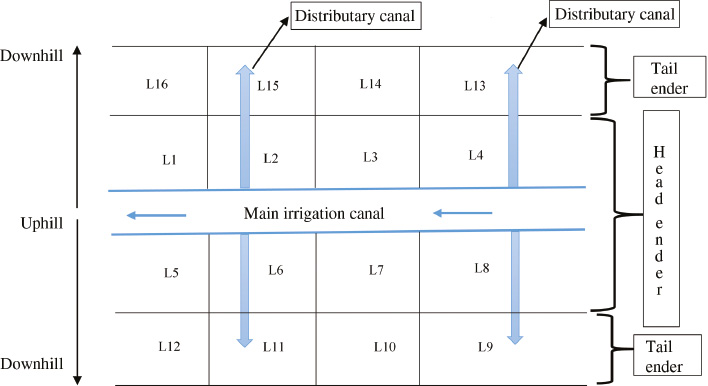
Figure 1:
A schematic representation of users along an irrigation canal.
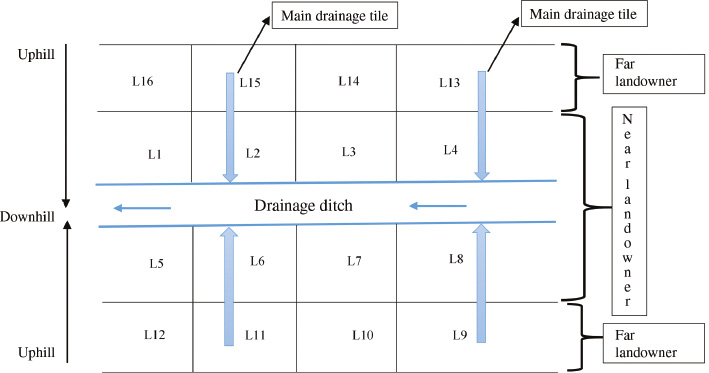
Figure 2:
A schematic representation of users along a ditch.
Table 3:
Comparative analysis of two asymmetric resource dilemmas.
| Attributes | Irrigation | Drainage |
|---|---|---|
| Resource system (RS) | Main irrigation canal + distributary canals | Drainage ditch + main drainage tiles |
| Resource unit (RU) | Allocated water | Drained water |
| Type of collective action problem | Joint investment and water allocation | Joint investment and removal of excess water |
| Resource user distribution | Head-enders and tail-enders | Near-landowner and far-landowner |
| Incentive structure for maintaining RS | Head-enders: little incentive Tail-enders: high incentive | Near-landowners: high incentive Far-landowners: little incentive |
| Preferred position of resource user | Uphill, physically near, i.e. to be a head-ender | Uphill, physically distant, i.e. to be a far-landowner |
Table 4:
Property rights in agricultural drainage systems.
| Property right | Description | Property right pertains to… |
|---|---|---|
| Physical access (P1) | The right to enter a defined physical property | Infrastructure (conflicts with right to the land) |
| Use (P2) | The right to obtain the “products” of a resource system | Drained Water (a product of using the resource system) |
| Maintenance (P3) | The right to maintain the resource system | Infrastructure |
| Exclusion (P4) | The right to determine who will have a right to use the resource system without contributing | (use of) Infrastructure |
| Alienation (P5) | The right to grant the right of maintenance, exclusion, or both | Infrastructure (conflicts with right to the land) |
Adapted from Schlager and Ostrom (1992) and drawing on insights from Meinzen-Dick (2014).
Table 5:
Comparing agricultural drainage system property rights across the two cases.
| Case | Property right holder | Bundles of property rights |
|---|---|---|
| Mutual agreement | Near-landowner | P1i + P2 + P3 + P5ii |
| Far-landowner | P1i + P2 + P3 + P5ii | |
| Local government | None | |
| County petition | Near-landowner | P1i+iii + P2 |
| Far-landowner | P1i+iii + P2 | |
| Local government | P1iv + P3 + P4 | |
Notes: P1: Physical Access; P2: Right to use (drain); P3: Right to maintain; P4: Right to exclude use without contributing; P5: Right to alienate.
iPhysical access restricted to the section of drainage system on a landowner’s property.
iiBoth near- and far-landowners continue to hold alienation rights pertaining to maintenance but not exclusion from use.
iiiBoth near- and far-landowners in the watershed can physically access the section of the drainage system with drainage issue during the viewing stage of the project.
ivA local government agent has the right to physically access the area with drainage issue in order to conduct surveys, assess the problem, and if the project is approved, to carry out maintenance activities.
Table 6:
Property right interactions in drainage systems.
| Case | Property rights interactions | Implications for collective action (+, –) |
|---|---|---|
| Mutual agreement | Absence of P4 impacts P2 | (–) Since it is difficult to exclude anyone in a given drainage basin to exercise his “right to drain”, in the absence of an authority to force everyone to contribute, all landownersa in a drainage basin can exercise P2 regardless of their contributions. This increases the likelihood of free riding; decreases the likelihood of collective action. |
| Private land ownership impacts P3 | (–) If a landowner sells his land, the new owner is under no obligation to maintain his part of the drainage system. This reduces certainty of future benefits and thus decreases the likelihood of collective action. | |
| County petition | Presence of P4 impacts P2 | (+) Local government agency draws the boundary of a group drainage improvement, based on the drainage area; everybody who benefits from the improvement, pays for it. This decreases the likelihood of free riding; increases the likelihood of collective action. |
| Private land ownership does not impact P3 | (+) Change in land ownership does not impact maintenance of the drainage system; local government agency maintains it through a permanent easement. This increases certainty of future benefits and thus increases the likelihood of collective action. |
Notes: Sign inside parenthesis indicates expected impact on collective action: (+) Helps; (–) Hinders.
PR: Property Right; CA: Collective Action; P1: Physical Access; P2: Right to use (drain); P3: Right of maintenance; P4: Right to exclude use without contributing; P5: Right to alienate.
aHowever, near-landowners will have an interest in regular maintenance of the system, given that they would want to avoid flooding risk.