
1 Introduction
With the success of its series Bridgerton (Chris van Dusen, 2020—present), the platform Netflix has promoted and labelled a new aesthetic style named Regencycore. In 2022, Netflix adapted one of Jane Austen’s novels, Persuasion1, by following this new pattern. In this production (Carrie Crackness., 2022), the audience discovers Anne Eliot (Dakota Johnson), living in a rewritten Regency era (Figure 1.). Despite the fidelity to the story of the novel, the bright aesthetics, and the first-person narration contrast with previous adaptations of the novel, creating mixed reactions among the audience. This adaptation, diverging from the ones previously made, engages in a contemporary style, a crossover between series and film adaptation on a streaming platform, which questions the depiction of national English heritage. It redefines how English past and heritage are grasped by an international production and how the cultural legacy of Jane Austen is adapted in our contemporary context. The streaming platform’s adaptation exposes current issues of diversity, heritage legacy and the blurry distinction between film and series. I contend that this strategy leads to a new process in the relationship between streaming and representation of national past.
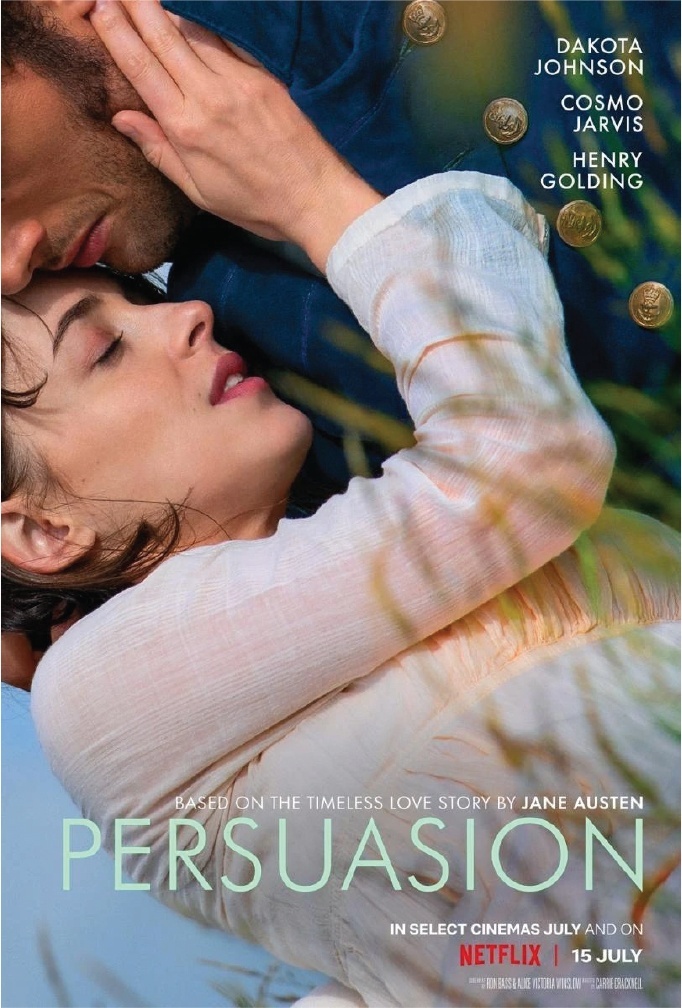
Figure 1
Promotional poster of the film Persuasion by Carrie Cracknell with Anne and Captain Frederick Wentworth (Cosmo Jarvis), Netflix, which contrasts with previous adaptations of period dramas, Source: Screenshot from the library of IMDb.
2 Regencycore Style: the Renewal by Netflix
Period dramas must be considered regarding their contemporary context of production to understand their approach to the representation of the past. The American platform conveys an anachronic vision of the Regency era to its contemporary viewers through the adaptation, and revision, of one of the most famous English novels named Persuasion. To do so, it uses its own serial codes, created with the phenomenal success of its series Bridgerton, to appeal to its audience. Because the aesthetic resemblance is patent in both productions, I contend that the platform bears its own vision of the English past in this Regency era revisited, promoting the ‘Regencycore’.
Regencycore constitutes a commercial and aesthetic marketing movement that has been popular since the 2020s.2 Inspired by the Regency and Victorian eras, it has mostly been stylised in housing or dressing fashions. It reflects a popular and cultural appeal of this period, promoted by social media and the success of Netflix series, while romanticising the English past.
In a sense, it recalls the Heritage Film, a cinematographic movement that originally happened during the 1980s and 1990s.3 It mentions period dramas representing the English past, from the 19th to the middle of the 20th century, criticised for promoting an idealised, conservative, and material depiction of English heritage. On top of that, an important number of 19th-century novels were adapted during this period, which culminated during the middle of the 1990s with the ‘Austenmania’, demonstrating how Jane Austen is linked to the representation of the English past. In each case, it leads us to ponder on the influence of contemporary values and issues on the aesthetics representing the National English past.
2.1 A Post-Modernist Adaptation
When adapting Jane Austen, one of the most notorious English authors, one may wonder what the most essential element may be to transpose on screen. It can range from the fidelity to the story, the characters, or the spirit of the author, depending on the debates. This is a central question to adaptation studies, as exposed by the theorists of the subject, such as Brian McFarlane:
Novel and film can share the same story, the same ‘raw material’, but are distinguished by means of different plot strategies which alter sequence, highlight different emphases, which - in a word - defamiliarize the story.4
Adapting a Jane Austen’s novel in our contemporary context means asking how the ‘raw material’ can be kept. In a sense, Persuasion by Netflix has maintained the narrative contents, but its strategies of distribution have fostered diverse changes. The issue was to please many Netflix viewers with the adaptation of an English classic novel. Hence, the creators of the adaptation decided to modernise the dialogues and expressions used in the novel, to better fit a contemporary audience, even using very recently made-up expressions:
Video 1
Youtube Short of the scene when Anne says ‘He is a Ten. I never trust a Ten’ in subtitles to her friend Lady Russell (Nikki Amuka-Bird), in a carriage to Bath, from Persuasion by Carrie Cracknell, Netflix, 2022.
Source: Youtube, @StillWatchingYoutube, (last accessed: 24/12/2025).
The discrepancy between the historical settings shown and the modern conversations sheds light on the techniques used in this film adaptation: keeping the universe visually recognisable and verbally accessible. Netflix employs cultural and visual assets identifiable as belonging to the Regency and Jane Austen era, while revising dialogues for a contemporary audience.
2.2 Irony and Adaptation
But the adaptation goes further in its adaptation of irony, which is a crucial aspect of the original novel. Jane Austen’s wits and sarcasm are apparent on screen using a filmic process: the address to the camera (see Figure 2.). Throughout the film, Anne shares her thoughts, her opinion, her glances toward the audience by directly addressing the camera, the characters around her being oblivious to the process, which is noticeable during the introductory sequence:
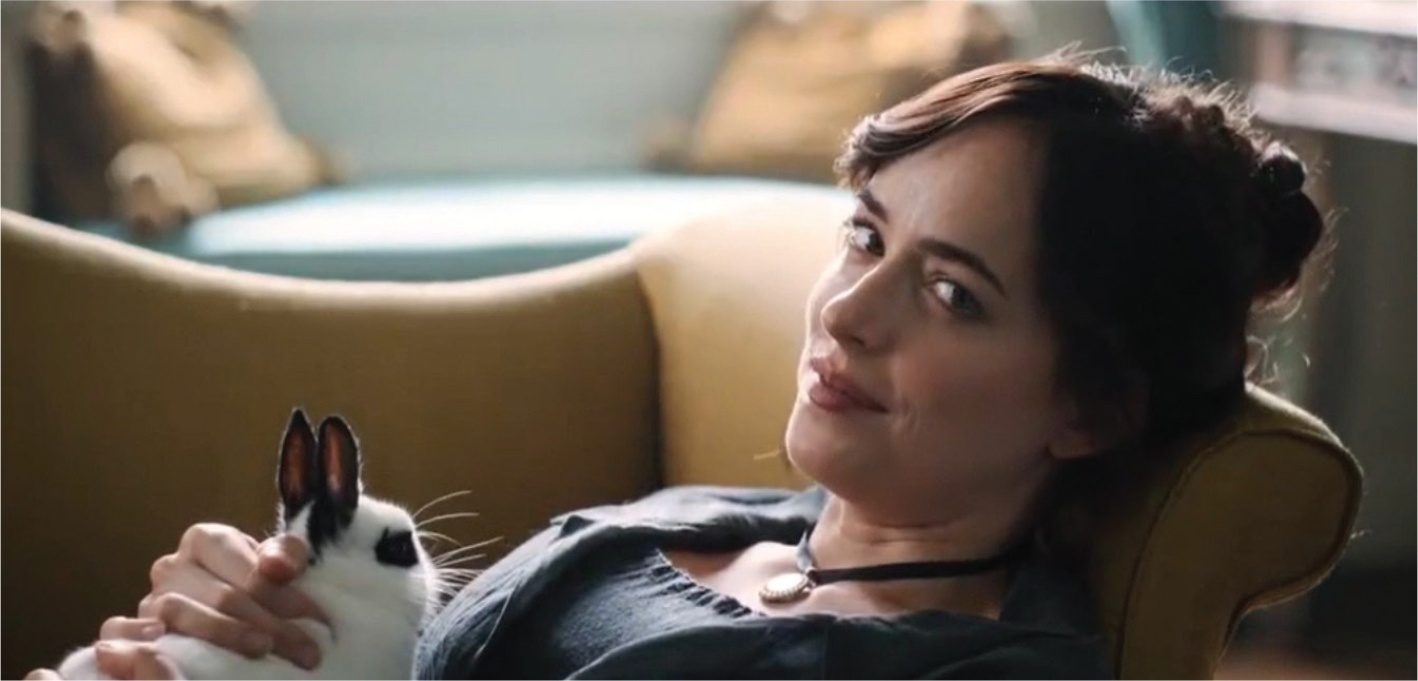
Figure 2
Screenshot of Anne looking directly at the camera while explaining her feelings to the viewer at the beginning of the film, from Persuasion by Carrie Cracknell, Source: Netflix, 2022.
Anne becomes the witness of her ridiculous family and learns to apprehend it through sarcasm and wistful glances, with the complicity of the audience. She transforms into a relatable woman, who cynically views her life, like another woman in a contemporary series. Indeed, who does not think about the series Fleabag5 when noticing how Anne looks at the camera after one of her relatives says something astonishing, like in Figure 3.?
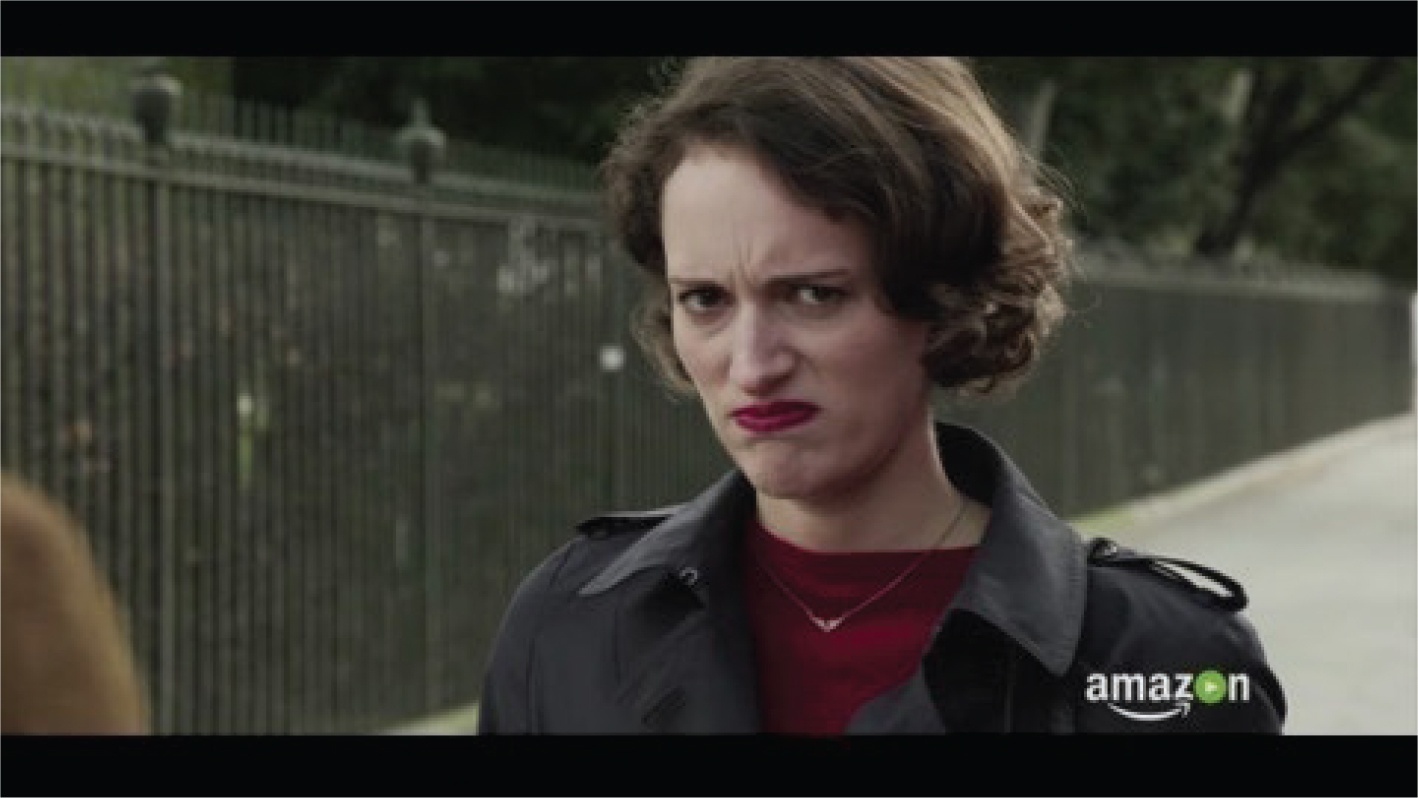
Figure 3
Screenshot of the series Fleabag with the main protagonist looking at the camera in an equivalent way, from Fleabag, ‘Pilot’, 1:1, by Phoebe Waller-Bridge, Source: Amazon Prime Studio, 2016-2019.
Anne resembles the main character of this series, making the parallel between the film and series process more visible (see Figure 4.). The adaptation of a Jane Austen’s novel becomes intertwined with serial contemporary references. I contend that the aesthetic resemblance, such as the looks delivered to the camera, reflects a new approach to adapting a Jane Austen novel by referencing contemporary series:
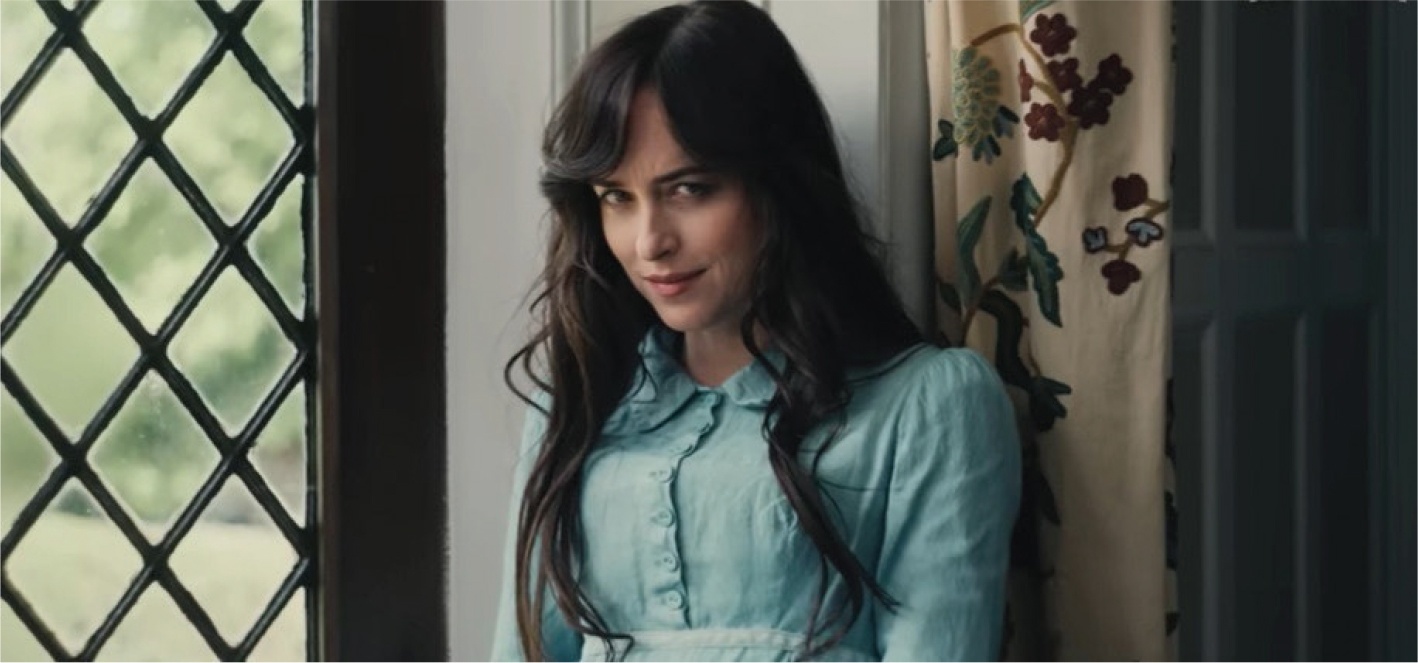
Figure 4
Screenshot of Anne looking at the camera after her sister Mary Musgrove (Mia McKenna-Bruce) said something astonishing, but no one in the scene reacted to it, from Persuasion by Carrie Cracknell, Source: Netflix, 2022.
Like the series Fleabag, the adaptation relies on a form of proximity with the viewers to underline the ridiculous aspect of some protagonists, as if Anne were to say, ‘you see what I have to deal with?’
The editing also accentuates her expressive glances. On various occasions, the scenes convey a comedic timing reminiscent of sitcom or comedy shows, adapting Jane Austen’s ironic comments in a visual way. For instance, when Sir Walter Elliot (Richard E. Grant) is ecstatic at the idea of meeting nobility, the editing illustrating how the encounter lacks ‘greatness’…
Video 2
Sir Walter’s comments about meeting greatness, the editing contrasting his emphasised speech with the silent exchange with Lady Dalrymple, from Persuasion by Carrie Cracknell, Source: Netflix, 2022.
But how does it change the irony of Jane Austen? It appeals to visuality rather than subtlety in dialogues. This modernisation of Jane Austen’s irony is not the first one made. Previous adaptations of the novelist already challenged in diverse ways the irony present in the novels, such as the 1995 adaptation of Emma under the title Clueless.6 This production offers a rewriting of the original novel and reshapes the ironic tone through the sarcastic remarks of Cher (Alicia Silverstone) and her friends. For the critics, adapting Jane Austen’s witty style unarguably transforms the stylistic process:
But there is a significant difference between the ironic point of view from which Austen began writing in the 1790s and the ironic style that is widespread two hundred years later. Irony at its simplest, today, is not saying one thing and meaning another, but not being sure if you mean what you say. Austen’s irony was a moralist’s; postmodern irony refuses to acknowledge the moral.7
This quote highlights the discrepancy between the two visions of irony, from their purposes to their forms. In Persuasion, irony is enhanced through the complicity of the audience in its delivery. While looking at Anne’s life, we become the sole witnesses of her witty comments and ironic reactions toward her family.
Those choices of adaptation highlight the influence of the streaming platform over content decisions. On top of that, I suggest that the aesthetic codes used in this production participate in creating a parallel with the series Bridgerton.
3 Netflix Serial Codes on a Film Adaptation
The length of time does not presume anything but a film. And yet, from the rhythm of the editing to the visuals employed, the adaptation relies on serial codes created by the streaming platform, suggesting an evolution in the aesthetic of period dramas.
3.1 Introducing the Characters: a Sequence Worthy of a Pilot
The introductory sequence immediately brings quick presentations of the characters present in the film adaptation, the rapid editing recalling a pilot episode of a new series:
Video 3
Anne presenting and commenting on her relatives’s behaviours, from Persuasion by Carrie Cracknell, Source: Netflix, 2022.
As Anne embarks on psychoanalysing her close relatives, the beginning sets the dynamic between the characters, like a presentation of the characters in a new series in which each personality must be clearly shaped and defined from the beginning. Each one has a role assigned, and a personality defined, illustrating Anne’s description as she speaks.
3.2 The Spatialisation of the Actions
Throughout the film, names of the cities in bold letters announce where the story is taking place. A new name appears each time a new location comes into view for the audience, establishing a sequential order. The editing of the sequences follows a clear pattern, like episodes succeeding one another, which is independent from music, voice-over, or glances, but relies on scenery only, such as Kellynch Hall in Figure 5.
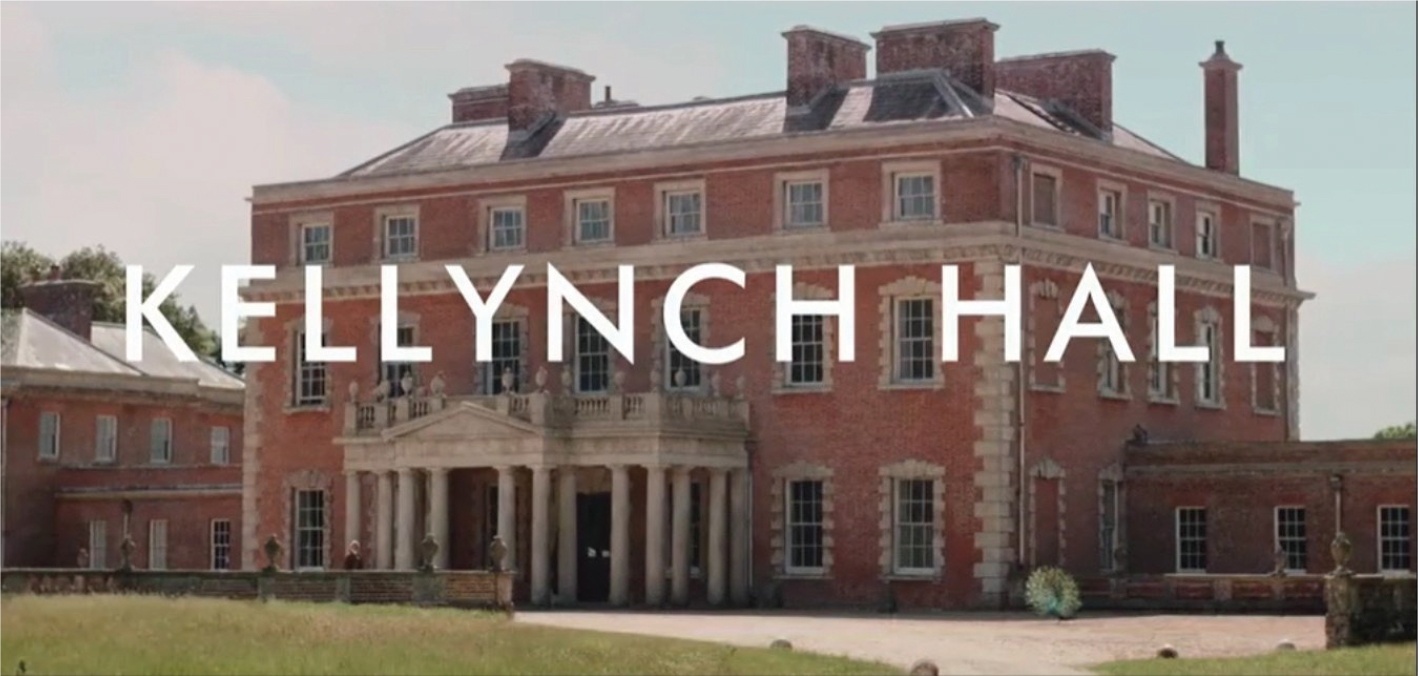
Figure 5
Screenshot of the settings Kellynch Hall before the action takes place inside, from Persuasion by Carrie Cracknell, Source: Netflix, 2022.
This shot illustrates the editing strategy, in which buildings are presented as the scenery place for the next scene. It is reminiscent of Bridgerton: each new sequence taking place inside a character’s house is preceded by an exterior shot of the building to contextualise the location. And it is not the only similarity with the series.
3.3 Visual Colorimetry
The visual identity of the adaptation is well-established: pale blue, white, beige colours are predominant in this movie (Figure 7.). And that is no coincidence, as it is a visual reminder of the series Bridgerton in terms of tones and colorimetry (Figure 6.).
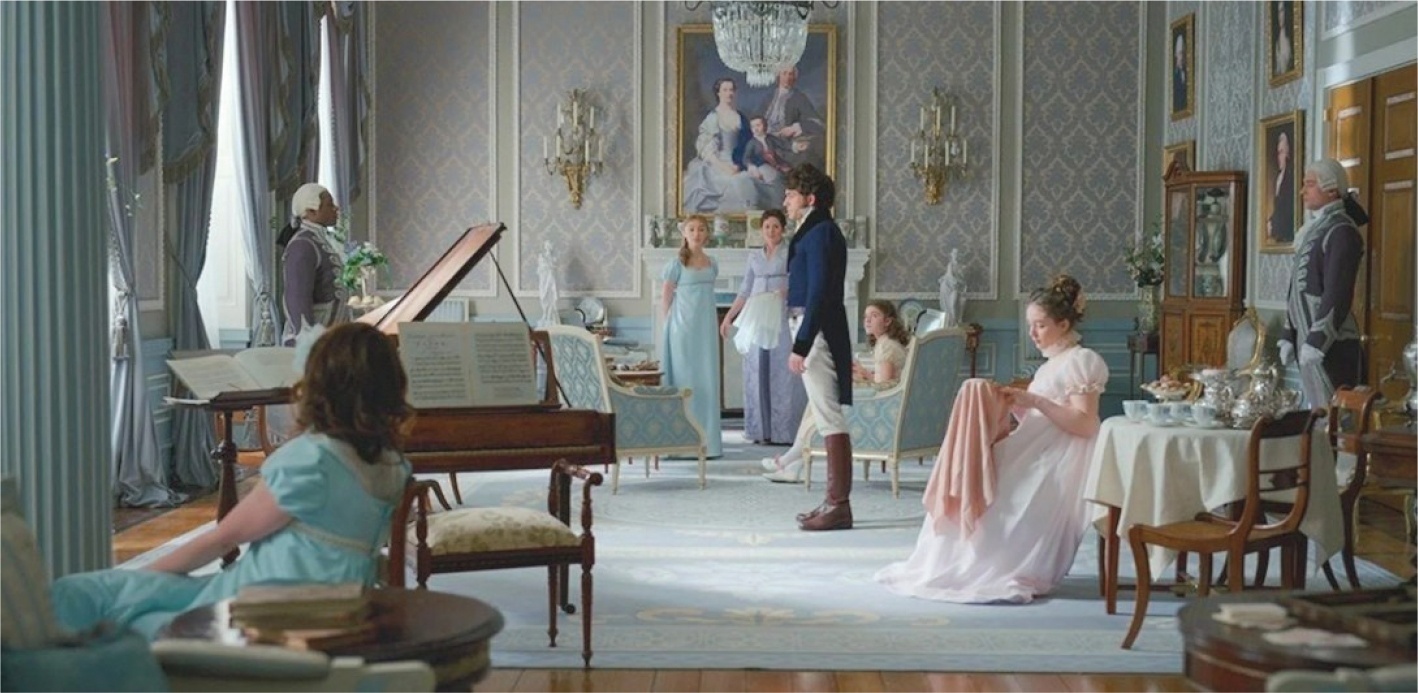
Figure 6
Screenshot of Bridgerton’s house with the morning room, from Bridgerton by Chris Van Dusan, ‘Diamon of the First Water’ 1:1. Source: Netflix, 2020.
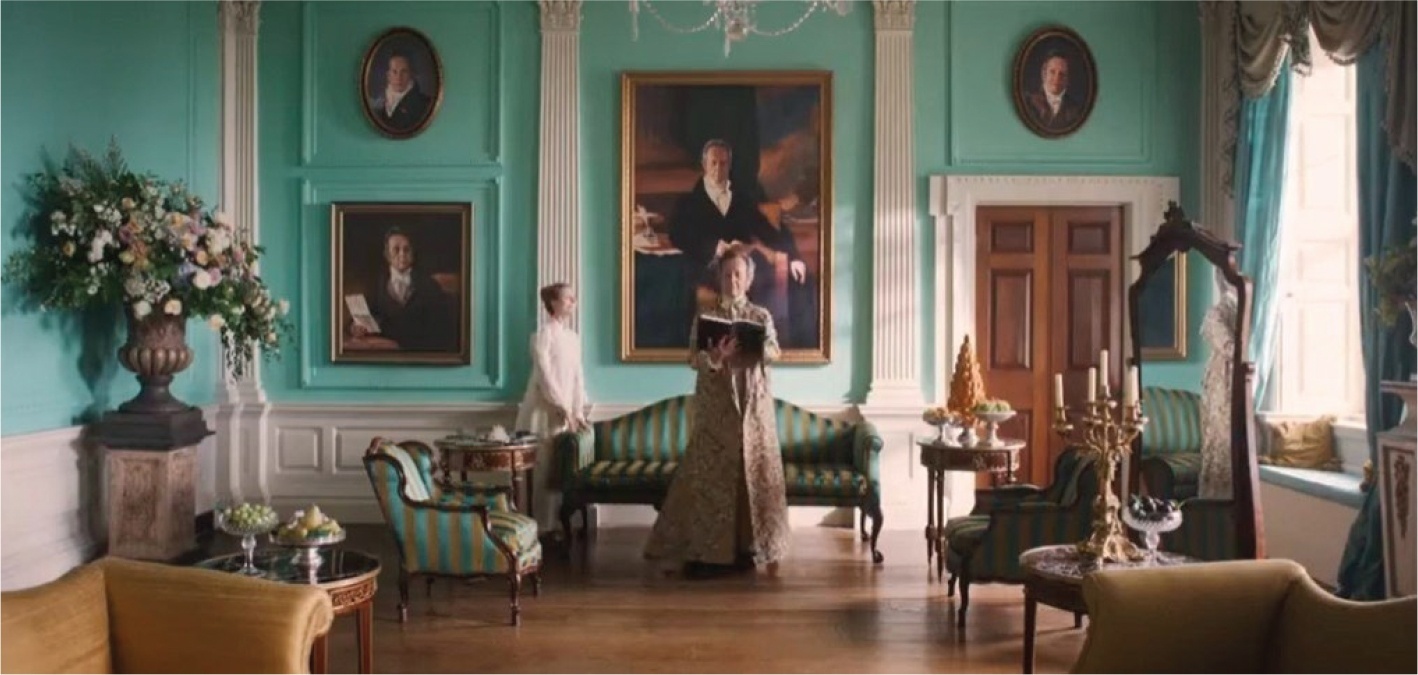
Figure 7
Screenshot of the Elliott’s house in the same colours, from Persuasion by Carrie Cracknell, Source: Netflix, 2022.
Those two shots bring a parallel aesthetic through various elements: pastel walls, vertical lines, centrality of the portraits and columns, arrangements of flowers and furniture as well. Further than representing an historical setting from the Regency era, the film adaptation relies on a visual universe already established in the well-known series to engage with its audience.
3.4 Colour-blind Casting
Beyond aesthetics, the choice of colour-blind casting in this newest adaptation is in accordance with the diversity politics of Netflix. Anne is played by an American actress, Lady Russell by Nikki Amuka-Bird, who has Nigerian origins, Mr Elliot by Henry Golding with Malaysian origins. Like with Bridgerton, the American platform affirms a political choice of inclusion and representation. But for the series, the reactions were lukewarm: some applauded the cultural diversity promoted by Netflix; others criticised this strategy as a sense of erasure of the past and an absence of political perspective:
Ultimately, Bridgerton is representative of the cultural clash of our times. It attempts to be better than its predecessors - to be progressive and inclusive - but it ultimately upholds the status quo and the neoliberal tradition.8
Regarding its treatment of diversity, the film adaptation Persuasion seems similar: the adaptation chooses to incorporate multicultural casting without showing a political or a social awareness of the historical implication. But it puts forward the representation of the past in a self-conscious way and differs from previous period dramas and white-only castings.
Hence, the adaptation relies on Netflix serial codes to render Anne’s journey for an audience used to the Regency era created by the platform. It modernises the irony and creates a discrepancy with the contemporary dialogues for a younger audience. It means that this Jane Austen’s novel is adapted while following the guidelines of a Netflix series. On a transnational scale, the fictional representation of a national past using those codes leaves us asking: how does this 19th-century novel abide by a visual and fictional world created by Netflix?
4 National Past and Transnational Series
By using the same aesthetic codes as the series, the adaptation blurs the line between the two media and reinforces the visual identity of the platform regarding the Regency era. Rather than relying on period drama codes, the adaptation promotes Netflix’ codes as a new form and targets an international audience used to the series made by the platform. But by doing so, Netflix redefines what is culturally associated with the Regency era.
4.1 Real Places for Fictional Representations
The English period of the 1810s is turned into a fictional context, through a specific aesthetic addressed to the audience of an international platform. The Regencycore becomes a full aesthetic brand, cut out from its political and social context.
Despite filming in the UK, with historical places shown such as Bath, the reinvention of the period interrogates on the line between historical fiction and revision. Like in this screenshot (Figure 8.), in which Bath emerges as a blurry background for Anne’s story. While period dramas have been criticised for portraying English heritage as displaying the materiality of the past, one can perceive in the Netflix version a less significant focus on heritage.
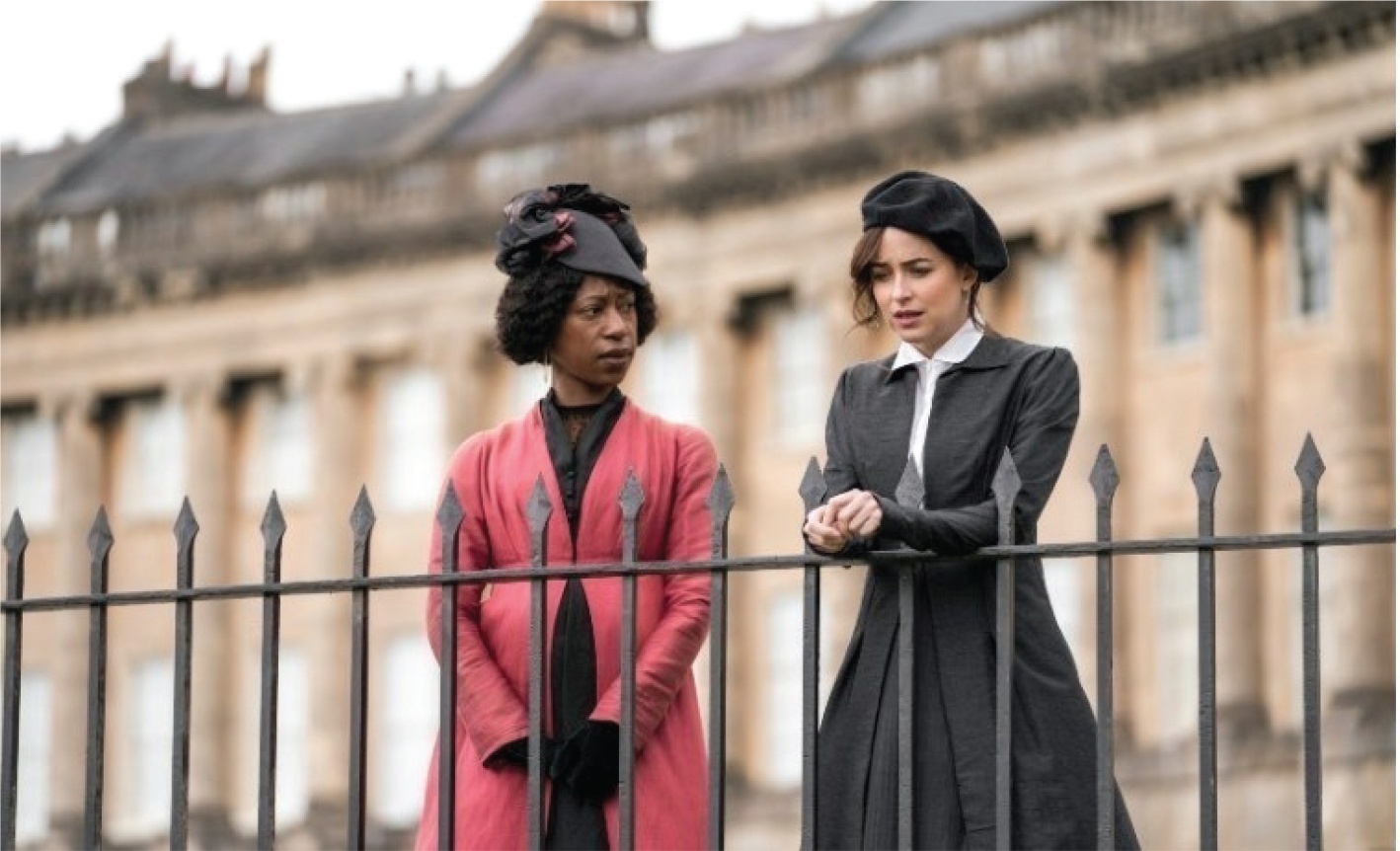
Figure 8
Screenshot of Anne and Lady Russell in the famous Royal Crescent in Bath, from Persuasion by Carrie Cracknell, Source: Netflix, 2022.
In a sense, monuments and buildings, such as the Royal Crescent in Bath, lose their historical interest, becoming a general setting recognisable for the audience. And if a viewer does not recognise it, that does not challenge their narrative comprehension.
4.2 A ‘Glocal’ Ambition
Thus, Netflix offers a national past accessible, and comprehensible, for its international audience. The national elements are identifiable only through real places and historical English buildings put in the background. It encapsulates a modern English accessible for all, a visual aesthetic familiar to an international audience, and a serial style understood transnationally. In a sense, the streaming platform rewrites the past as conveniently as possible for current and transnational issues.
This participates in the ‘glocal’ strategy, promoted by the platform. Critics have noted how the platform tries to attain a form of cultural authenticity in which a transnational audience may identify itself. In an article reflecting on the methods used by Netflix to attract a global audience, the authors M. Wayne and D. Castro argue how Netflix conveys universal stories where cultural authenticity is only partial:
In Netflix’s industrial discourses, cultural authenticity is broadly understood to be a reflection of the local culture in which a series’ narrative is situated. Within these discourses, cultural authenticity is discursively constructed as the result of a series’ production, its reception, and its textual characteristics.9
The cultural authenticity of the Regency era does not define itself through historical or political facts, but through the streaming platform’s process. By making an adaptation of Jane Austen similar to a series and to the Bridgerton universe, Netflix builds its own cultural authenticity. I contend that it creates a cultural authenticity detached from the political, social and historical context of the national past depicted, by enhancing a marketing image.
5 Conclusion
Overall, the article aims to demonstrate how Netflix promotes a visual and marketing strategy influencing the cultural legacy of the English past. Netflix manages to convey its own vision of the Regency era by implementing specific references, while still presenting a narrative relevant for an audience unfamiliar with the cultural aspects of the English Regency period. This process questions the ambivalence of such representation, in political and cultural terms. Like Heritage Film debates interrogate the displaying of a fictional past, the Regencycore aesthetic enhanced by Netflix leads us to examine our relationship with a national past in a transnational context. The American streaming platform redefines what is at stake in the definition of Englishness, in visual and political terms. I suggest that, beyond this example, Netflix’s use of significant images, such as the Regency era, shows its influence over the historical and cultural values of a visually established national past.
And yet, for the film adaptation, the outcome was not favourable, as the production was harshly criticised both by the critics and the viewers. On the website Rotten Tomatoes, the rating score has an average of 30%,10 positioning the adaptation as one of the least popular among the audience. Interestingly, it counteracts the high success of the series Bridgerton, which is currently at four seasons and a spin-off. So, why this discrepancy in success? The response might lie in the cultural weight of Jane Austen. While Clueless is popular in its contemporary rewriting11, the blending of Regencycore and ultra-modernist revision of a streaming platform has failed. Jane Austen’s weight remains too strong in the balance between the national English past and transnational ambitions as the audience might remain attached to cultural authenticity in dialogues and witticism.
At the beginning of 2025, the platform announced the release of a new Jane Austen’s adaptation, Pride and Prejudice, in the form of a series, which will be released after the fourth season of Bridgerton programmed in 202612. In this announcement, they already declared that this adaptation will ‘hew closely to the original text’, showing the importance of viewers’ opinion in their crusade for the perfect ‘Regencycore formula’.
Notes
[2] Maya Ernest, “Bridgerton, TikTok, and the revival of ‘Regencycore’ fashion”, INPUT, February 28, 2021, https://www.inverse.com/input/style/netflix-bridgerton-regencycore-fashion-dresses-corsets-tiktok-trend.
[3] See for instance Andrew Higson, English Heritage, English Cinema: Costume Drama Since 1980 (Oxford: Oxford University Press, 2003).
[7] Rachel M. Brownstein, “Out of the Drawing Room, Onto the Lawn”, in Jane Austen in Hollywood, eds. Linda Troost and Sayre N. Greenfield (Lexington: University Press of Kentucky, 2001), 19.
[8] Tracy H. Z. Reese, “Beyond the Pale: Genre, Race and Intersectional Feminist Tensions in Bridgerton,” in Adapting Bridgerton, Essays on the Netflix Show in Context, ed. Valerie Estelle Frankel (London: McFarland, 2024), 9–21.
[9] Michael L. Wayne and Deborah Castro, “Cultural Authenticity as Netflix Televisuality: Streaming Industry Discourse and Globally Commissioned Original Series”, Media and Communication 13, (2025): 5, https://doi.org/10.17645/mac.9407.
[10] “Persuasion | Rotten Tomatoes”, n.d. https://www.rottentomatoes.com/m/persuasion.
[11] “Clueless | Rotten Tomatoes”, n.d. https://www.rottentomatoes.com/m/clueless.
[12] Brookie McIlvaine, “Final Cast Announced for Dolly Alderton’s Pride and Prejudice”, TUDUM, October 28, 2025, https://www.netflix.com/tudum/articles/pride-and-prejudice-cast-photos-release-date-news.