
1 Traumatic Material and Rates of Audiovisual Archivist Mental Health Difficulties
‘WARNING: This article includes graphic descriptions of the Russia-Ukraine war.’ Content warnings, such as this one, are becoming more commonly seen at the beginning of news articles posted online. Much of this comes from an ever-increasing awareness on mental health, and the rising statistics of people that experience some sort of mental health issue. In 2019, the World Health Organization reported that one in six Europeans had some sort of mental illness. Post-COVID 19, that number is now closer to one in four.1 Content warnings acknowledge such mental health difficulties. If, as they imply, broadcast media content can impact mental health, how does traumatic material impact all those who work with it? Broadcast media archivists, in particular, have received scant attention to mental health in their line of work. These archivists care for news footage that never makes it to air, which can be extremely graphic, particularly when regarding war, famine, and human rights violations. Broadcast media is fast-paced and constant, with timeline demands that are not as common in other types of archives. A person-centered approach is necessary to remind everyone that archives do not just exist. Those of us who work to preserve and make material accessible face emotional tolls. Initiatives to support the mental health of archivists in broadcast media archives in Europe and elsewhere are vital.
In 2021, the Association of Moving Image Archivists (AMIA) salary and demographic survey revealed 36% of over 500 respondents reporting issues with their mental health (see figure 1).2 Though AMIA leans North American-centered, a survey incorporating questions about mental health for European media archivists has not been done as of 2025.

Figure 1
Graph from the 2021 AMIA Salary and Demographic Survey addressing rates of depression, anxiety, or other mental health issues (e.g. bipolar disorder, post-traumatic stress disorder).
2 Concepts in Archivist Mental Health
Several concepts help convey the importance of advocacy of archivist mental health: types of archival trauma, archival bias, the person-centered archive, and archival silences.
Archival trauma has different levels. ‘Traumatic material’ is the material within the archive, including records and finding aids as well as the footage itself. ‘Secondary trauma’, most relevant to this article, is the negative mental health effects that archivists and others experience while working with traumatic material. ‘Institutional trauma’ refers to ways the archive itself contributes to trauma. ‘Tertiary trauma’ can refer to outdated or derogatory language used to describe people, or effects of an archives’ physical layout, such as accessibility barriers.3
Kirsten Wright and Nicola Laurent define trauma-informed archival practise as an approach ‘that acknowledges the pervasiveness of trauma and the risk and potential for people to be retraumatized through engagement with organizations such as archives and seeks to minimize triggers and negative interactions.’4 Eliminating triggering material entirely for a broadcast media archivist may not be possible but a work atmosphere of support and care can minimize its negative effects.
The state of a broadcast archivist’s mental health emerges in their work. Burnout and overwork lead to mistakes or missed details. Individuals may also bring experiences of previously traumatising collections into future projects. Discomfort with problematic subject matter and a lack of appropriate support and training can also result in archival silences. I have certainly experienced these feelings firsthand when working with material depicting my own disability.5
It is critical that the field take a person-centered approach when drafting policies and procedures. This approach moves past previous notions that archives are about objects and not people, focusing on everyone who engages with archival material, including archivists as well as users.6 A culture of care, empathy, and affect has been developing within archives through the lens of feminist ethics and social justice.7 Unfortunately, little of this work has yet to be applied specifically to audiovisual archives.
3 Survey on Mental Health Training within European Broadcast Media Archives
In early 2025, I did a callout on social media and directly contacted 15 European broadcast media archives, including the BBC, DR, and RTÉ, to get a sense of current initiatives addressing archivist mental health, seeking qualitative responses over quantitative data. Questions included:
- Does your archive offer any specific training or initiatives that addresses mental health concerns? If so, are these sessions specifically focused on archives or are they more geared to a workplace more generally? What might be included in this type of training?
- Is there training that journalists receive at your institution that may help archivists as well?
- Is there any type of conversations or training that you’d like to see included in broadcast media archival training?
I received seven replies total. Though the respondent response rate was unfortunately small, a central issue was clear: little to nothing exists regarding mental health training for European broadcast media archivists. One archivist managing an archive in Southern Europe said that they were ‘very curious about the results because I have worked for 20+ years in this kind of archives, and I have never heard about any such initiative.’8 Another respondent in Western Europe said: ‘the only training or initiative that we have that comes comes close to what you are looking for is a preventive burnout training.’9 While important, such training relates to working conditions and productivity and is not content specific.
One archivist from a prominent European media broadcaster in Northern Europe stated that their employer offered mental health support:
It is not very often that it is necessary for us to seek help, but we work as researchers for our journalists and we often curate content from news agencies. In 2022 when the war in Ukraine started, (archive name redacted) covered the war very tightly, and we looked at violent war content every day. Because of that we were offered a group session with a crisis psychologist, and this session helped us a lot. If a similar occasion should happen, we will be offered help again. I haven’t tried anything like that more than this single time (and I have been in the archive for almost 25 years).10
This quote highlights the rarity of the occasion: the group session referenced is the first and only time they have held such training in ‘almost 25 years’.
The speaker also emphasises the need to seek help. When addressing traumatic material, proactivity is vital to ensure archivists are given support before they need to ask for help, a point where their mental health may already be severely impacted. The session referenced also appears to have been group-focused, risking minimalization of singular, personal, trauma. People will have different emotional triggers and conceptions of what is traumatic.
In a 2015 blog post, an intern for the archival media human rights group WITNESS described their trauma archiving material relating to police brutality to protesters in Brazil during the 2014 World Cup.11 They underline ways common material can mess with archivist mental health, especially given the pre-conceived notion that there is no room for emotions in archival work. As an intern at the time of writing, this individual may have felt uncomfortable asking about archival mental health support or even knowing where to look. A person-centered approach means proactively speaking with new professionals about working with problematic material and where to find supportive material.
The New York Times, in 2022, posted a compilation of articles and material addressing traumatic war crimes happening to the Ukrainian people, including photographs, audio, and video of deceased victims, bombings and executions.12 While the compilation includes a graphic warning for viewers, we do not know if this courtesy was provided to archivists or researchers. Someone compiled this material, and it will be catalogued for future reference. Archivists will potentially spend more time with this material than the general public. They must review, catalog and make the material accessible for future research. A person-centered approach would ensure appropriate measures are in place to take care of the individual(s) compiling such material. We cannot be certain that The New York Times did not provide mental health support, but based on survey data and a field-wide unfamiliarity with archivist trauma, that support appears unlikely.
4 Professional Archival Organisations’ Role
In the last decade, professional archival organisations have begun addressing archivist mental health. The Archives and Record Association (ARA), based in the UK and Ireland, has mental health well-being guides on secondary trauma and compassion fatigue.13 The International Council on Archives has hosted a course on trauma-informed archival practise taught by Kirsten Wright and Nicola Laurent.14 The Australian Society of Archivists hosts a similar course titled A Trauma-Informed Approach to Managing Archives, also led by Wright and Laurent with the assistance of Genevieve Wauchope and Dr. Cate O’Neill.15 The Australian Society of Archivists includes a Vicarious Trauma and Immediate Support page on its website with contact information for emergency support and immediate action items when experiencing trauma relating to problematic material.16 The Society of American Archivists has a Crisis, Disaster, and Tragedy Response Working Group that provides resources and templates relating to Immediate Response, Collection Management, Administrative Policies & Agreements, Digital Content, Emotional Support, Oral Histories.17 The Association of Canadian Archivists has a Trauma-Informed Archives Resource List section on their website, with links on trauma-informed archival practise and general workplace mental health.18 (See figures 2 to 7).
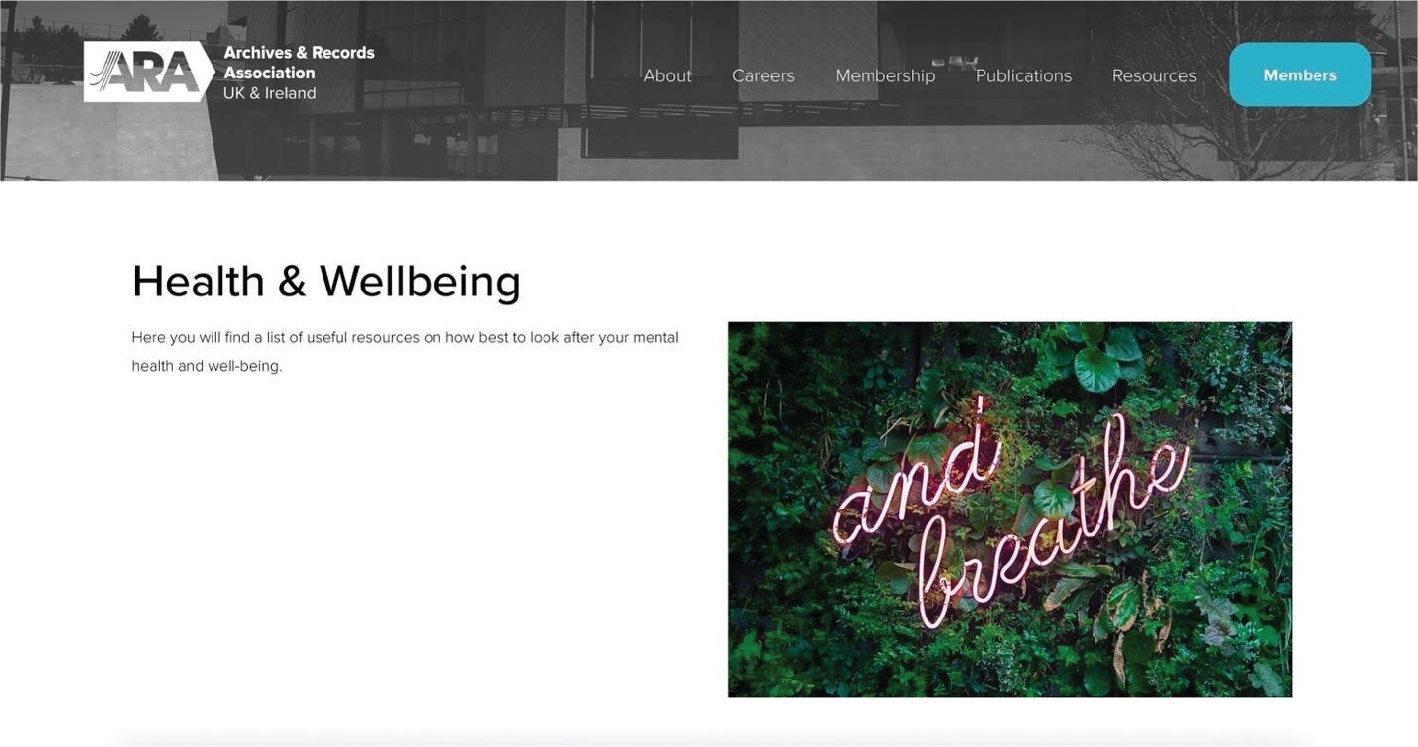
Figure 2
A screenshot from the Archives and Record Association (ARA)’s Health & Wellbeing page.
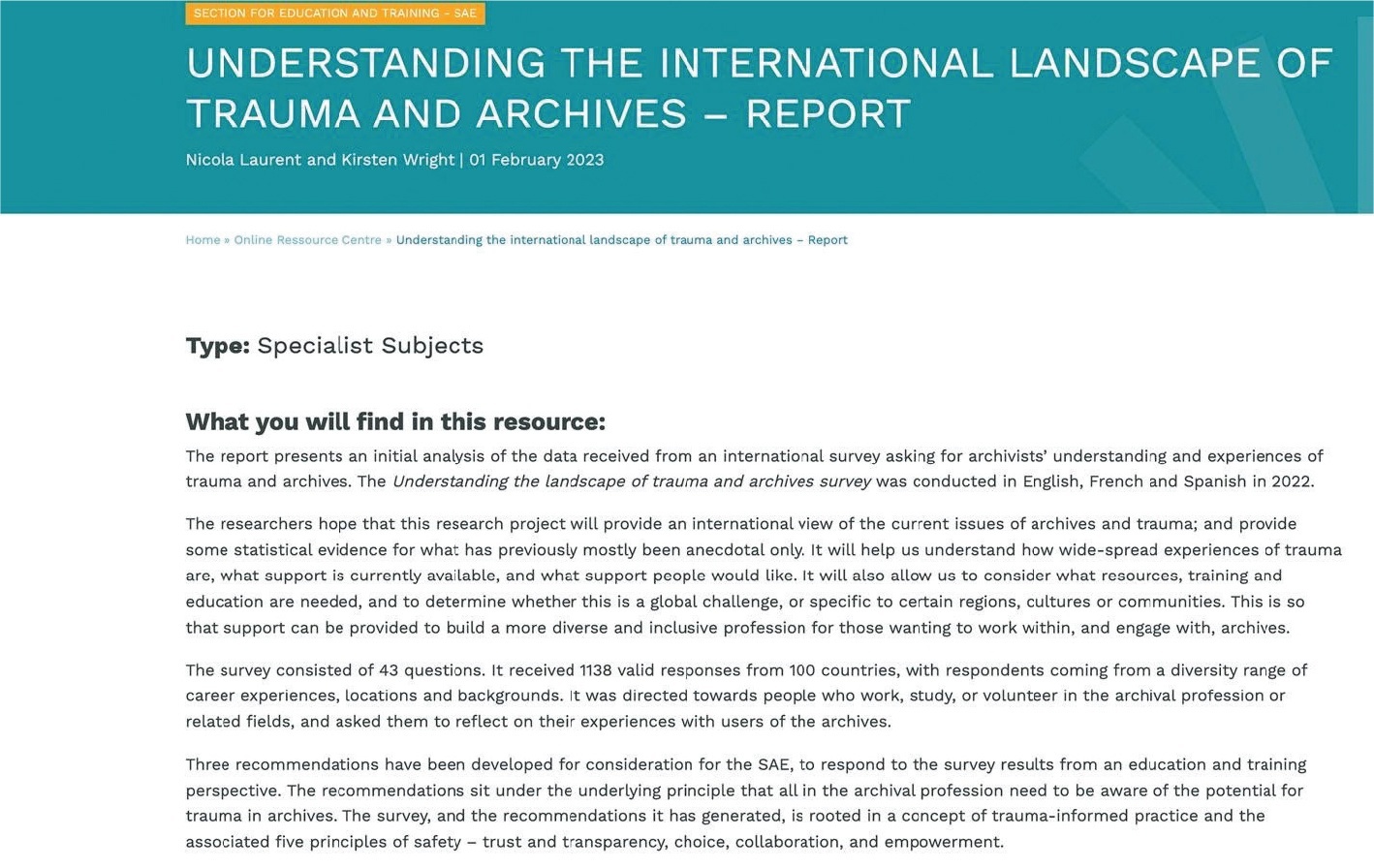
Figure 3
A screenshot outlining the Understanding the International Landscape of Trauma and Archives report.
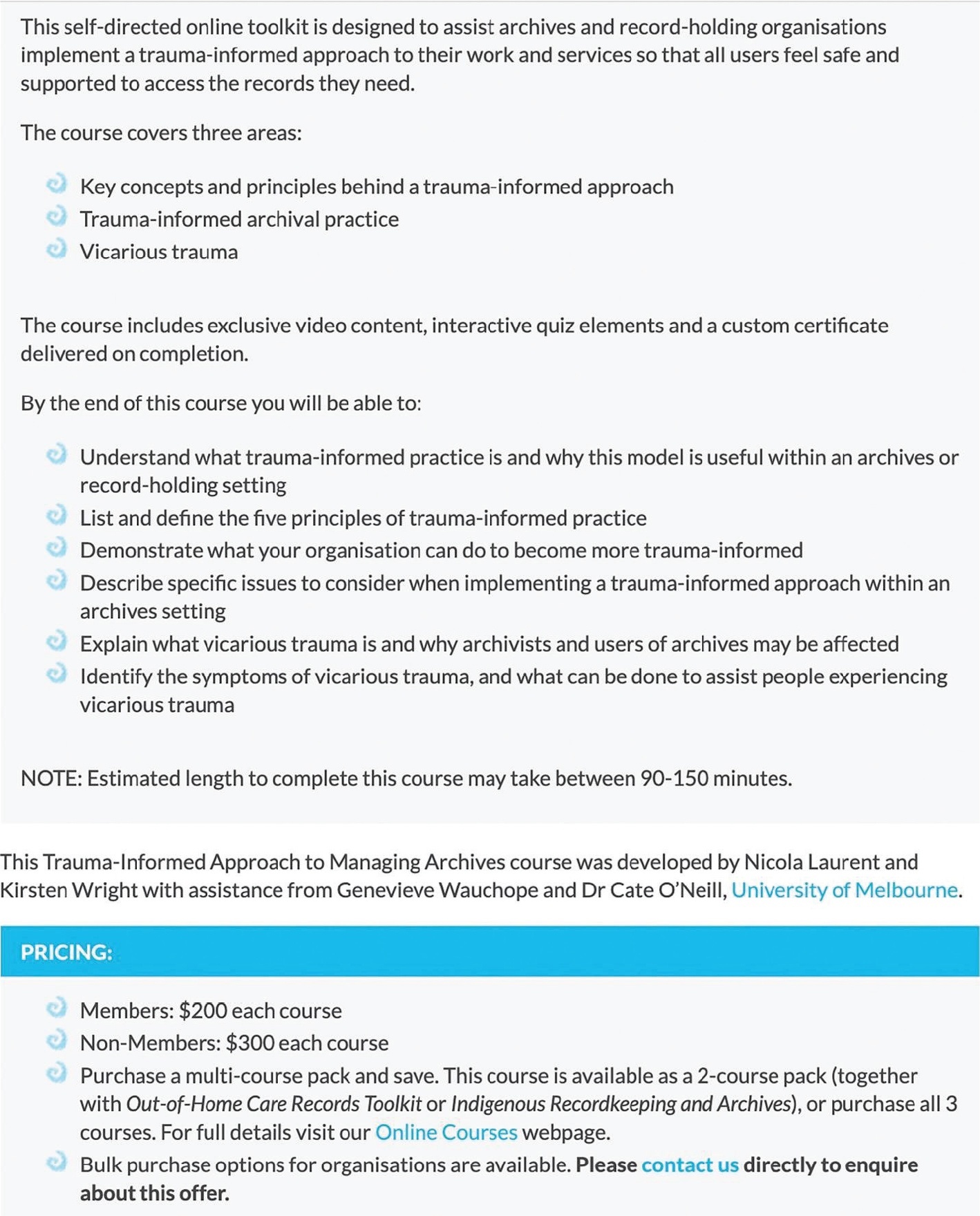
Figure 4
A screenshot from the Australian Society of Archivists A Trauma-Informed Approach to Managing Archives self-directed course outline.
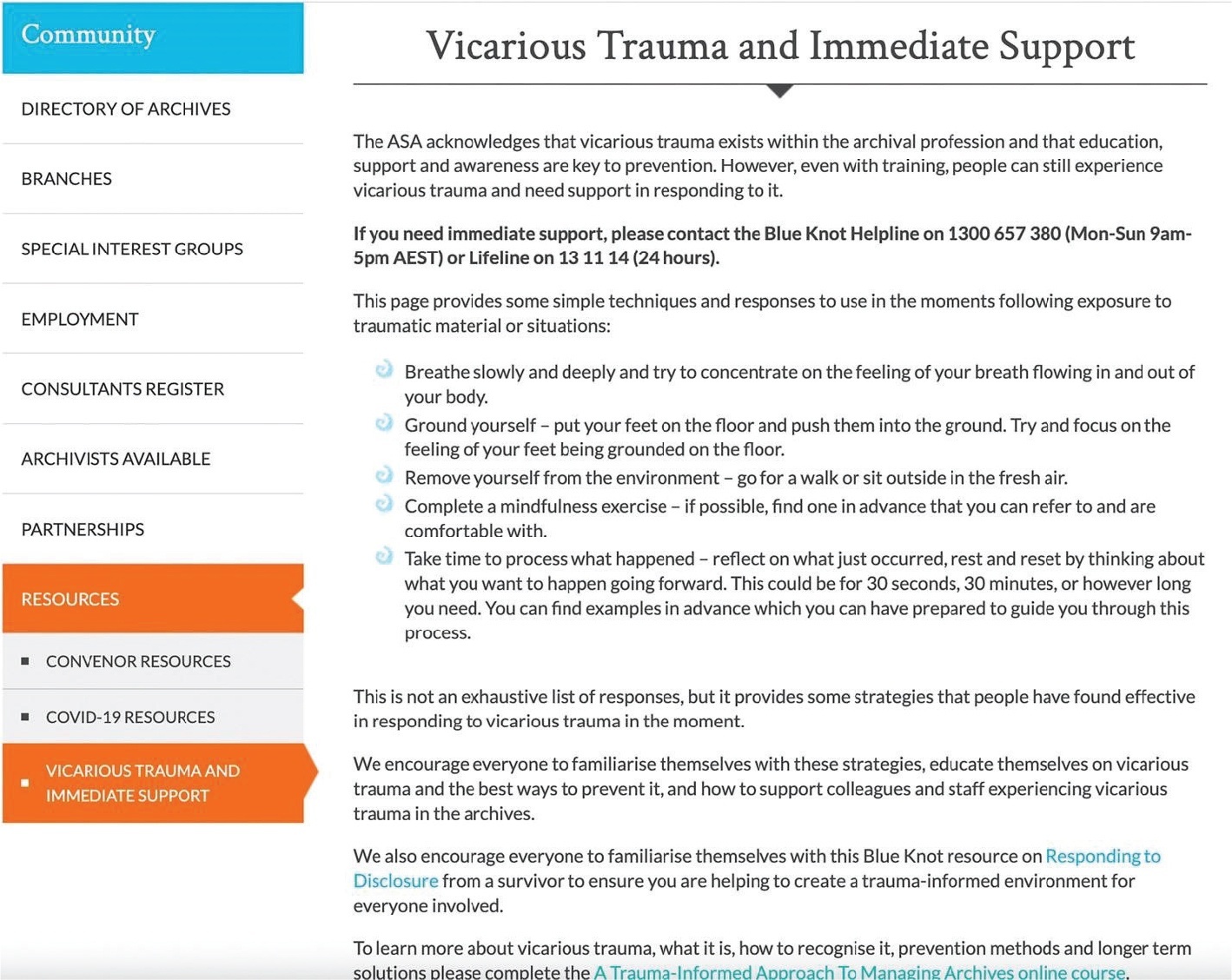
Figure 5
A screenshot from the Australian Society of Archivists Vicarious Trauma and Immediate Support page.
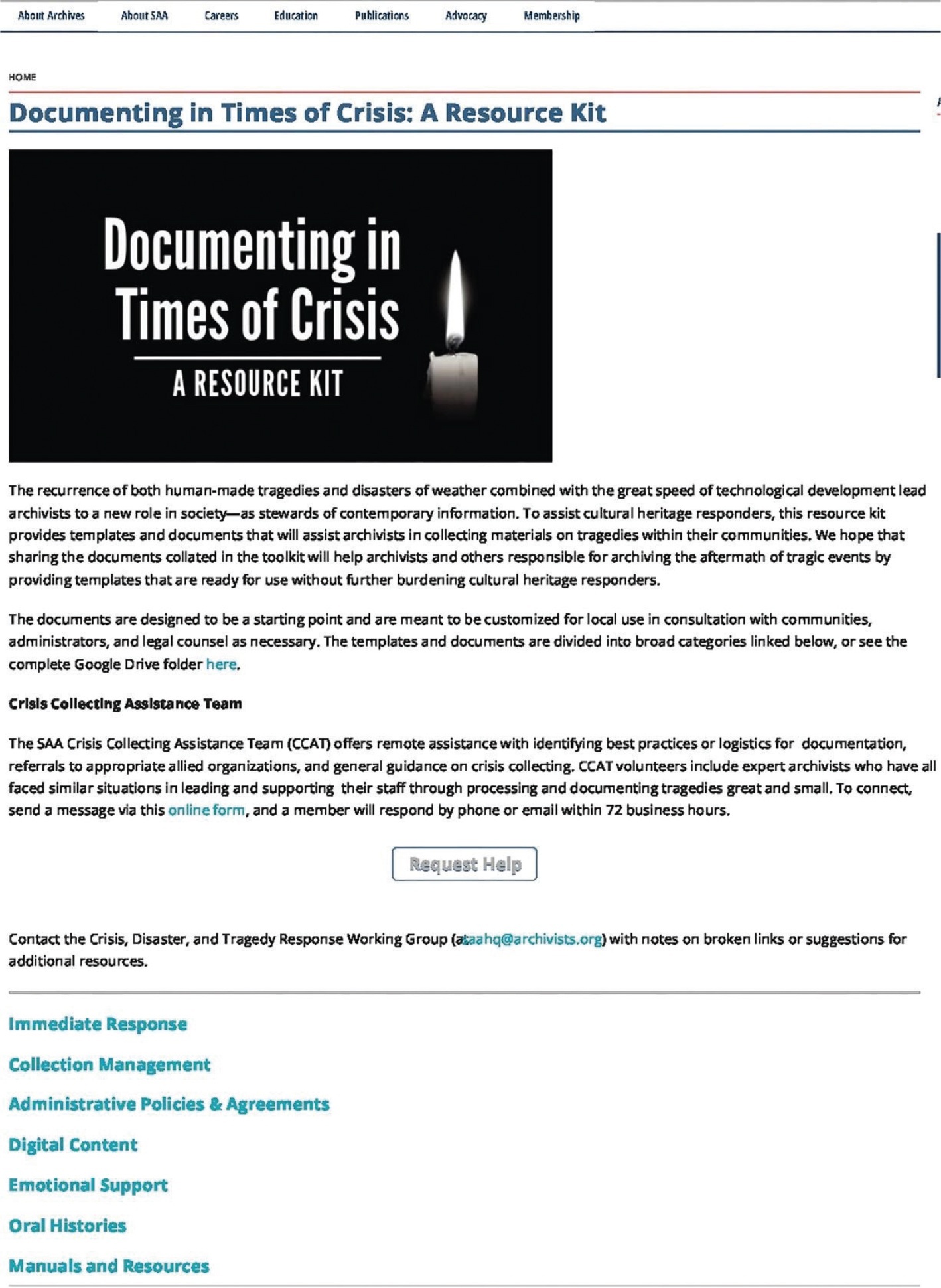
Figure 6
Screenshot from Documenting in Times of Crisis: A Resource Kit by the Society of American Archivists (SAA).
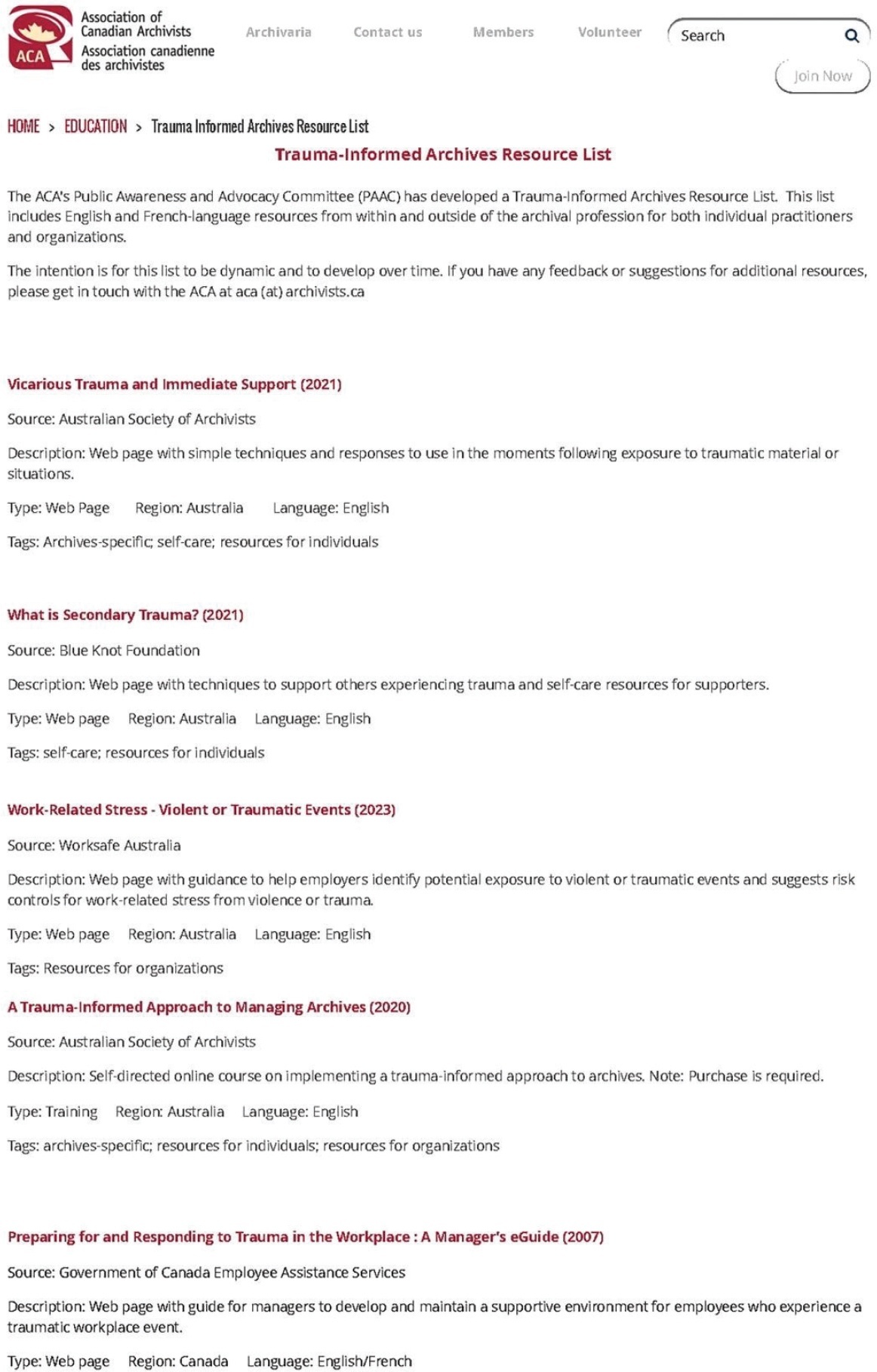
Figure 7
Screenshot from the Trauma-Informed Archives Resource List by the Association for Canadian Archivists (ACA).
Perhaps the most influential document to date that addresses archivist mental health is the Understanding the International Landscape of Trauma and Archives report done by Wright and Laurent for the International Council of Archives. 1138 responses from archivists covered trauma-related archival questions, situated around demographics, trauma awareness, trauma experiences, sharing experiences, and resources (see figures 8 and 9).19 Wright and Laurent’s report snapshots the current state of mental health in the archival field, identifying concerns for employers to address. Further research is needed investigating the impacts of different types of traumatic material on archivists, with news media one of the most pressing.
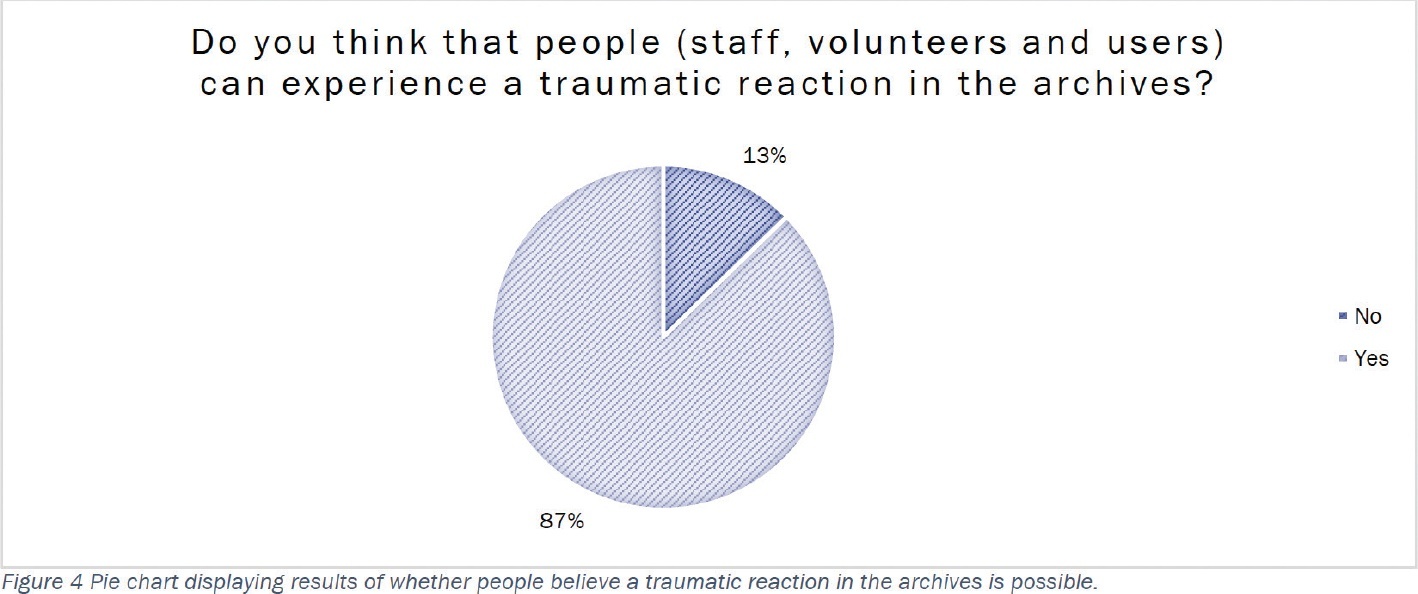
Figure 8
A chart from the Understanding the International Landscape of Trauma and Archives report regarding potential of traumatic reactions in archives
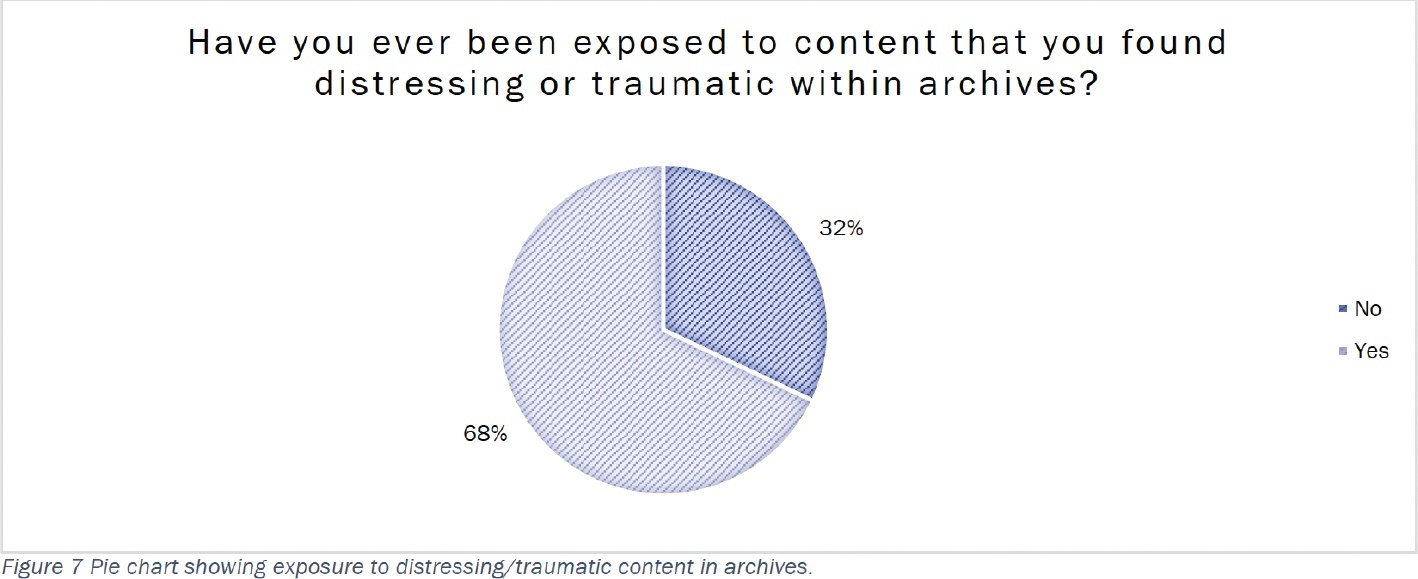
Figure 9
A chart from the Understanding the International Landscape of Trauma and Archives report asking respondents about traumatic content exposure in archives
The resources provided by archival professional organisations are helpful, but there are gaps. The first is medium specificity. None of the above resources address audiovisual content. There is no reference to challenges felt by particular types of archives. Wright and Laurent’s survey includes a demographic question asking respondents the type of archive where they are currently employed, but without further analysis. The only option in the survey for broadcast media archives and/or audio/visual archives, was ‘other’. However, audiovisual collections offer specific challenges, with material that forces the archivist into the moment through multi-sensory engagement. Audiovisual material also has a fixed duration which the archivist needs to experience within its entirety.
Despite this growing body of resources, none of the respondents to my European broadcast media archivist call-out referred to any of the resources listed above, including the Understanding the International Landscape of Trauma and Archives report. Improved awareness of the few existing resources is clearly needed.
More work must examine archival mental health, expanding on the same few resources that are always shared. Continued work must specifically address traumatic audiovisual material through publications, conferences, and collaboration with archivists and mental health professionals. Best practice guides must directly address working with particular types of problematic archives, such as broadcast media archives, engaging with trauma-informed archival practices (see video one).
Video 1
A Trauma-informed Approach to Managing Archives webinar hosted by Kirsten Wright and Nicola Laurent. Last accessed: 17/04/25.
Wright and Laurent based trauma-informed archival practises on the principles of safety, trust and transparency, choice, collaboration, and empowerment.20 Archivist agency regarding engagement with traumatic material is a crucial support mechanism.
One archivist who responded to my callout stated:
There have been no courses as you describe specifically for (archives) staff. A more recent example of training offered for journalists and news teams was a course Psychosocial hazard associated with News, Current Affairs and handling sensitive content. This training was led by Bruce Shapiro, Executive Director of the Dart Center for Journalism and Trauma at Columbia Journalism School.21
Of note is that the broadcaster housing this archive did have mental health training, though the respondent did not say if archivists were invited to attend. The Dart Center’s course demonstrates current initiatives by the news media when it comes to mental health (see video two).
Video 2
Trauma-Informed Reporting Best Practices webinar hosted by Bruce Shapiro. Last accessed: 17/04/25.
5 Broadcast Journalism Initiatives
How are other professionals addressing work with potentially traumatic news material? Most relevant are journalists themselves. The last decade has seen numerous publications and webinars on the mental health of journalists, addressing journalist health, well-being, reporting on problematic material, and even specific themes like AI’s impact on journalist mental health.22 No similar material examines broadcast archivist mental health, though they work with much of the same material (see video three).
Video 3
A webinar titled Prioritizing Mental Health in the Newsroom: How to Create a Culture of Well-being hosted by the Shorenstein Center. Last accessed: 17/04/25.
Archivist mental health advocacy must extend beyond written articles to direct action. The Dart Center for Journalism and Trauma, mentioned above, was founded in 1999 at Columbia University. The Centre provides journalist mental health related resources, including recorded webinars, best practice guides, written articles, and more.
According to their official mission statement, the Centre:
advocates ethical and thorough reporting of trauma; compassionate, professional treatment of victims and survivors by journalists; and greater awareness by media organizations of the impact of trauma coverage on both news professionals and news consumers. Educates journalists and journalism students about the science and psychology of trauma and the implications for news coverage. Provides a professional forum for journalists in all media to analyze issues, share knowledge and ideas, and advance strategies related to the craft of reporting on violence and tragedy. Creates and sustains interdisciplinary collaboration and communication among news professionals, clinicians, academic researchers and others concerned with violence, conflict and tragedy.23
These goals can inspire archives and professional organisations, combining them with Wright and Laurent’s ideas surrounding trauma-informed archival practise to create an environment of care specifically for broadcast media archivists.
I asked the Dart Center directly if trauma and broadcast media archives had ever been a topic of discussion or if there had ever been any archivist involvement. The response I received was that:
while the Dart Center does provide training in handling graphic imagery and traumatic content which includes some content on working with archival material, we don’t necessarily have a training module that’s specific to broadcast archives, though we certainly recognize the need and the high levels of vicarious trauma exposure amongst broadcast archivists.24
European broadcast media archives can collaborate with the Dart Center on a person-centered approach for handling traumatic and graphic material, which would help in supporting journalists, archivists, and even the general public when making traumatic material accessible.
6 What Remains to Be Done
While initiatives have begun, more proactive steps must address mental health issues in broadcast media archives. More work must look specifically at mental health rates in broadcast media archives, including interviews of archivists on the most pressing issues facing them. The European broadcast media archivist call-out demonstrated how little is currently done.
Archival professional organisations and archival graduate programmes need to further emphasise the importance of archivist mental health, especially for those who work with problematic material on a consistent basis. Mental health initiatives can take the form of guest lectures, publications, conferences, and workshops.
The archival field must learn from the current work in journalism mental health advocacy and apply it to their own profession. One suggestion is the creation of an archive-specific centre for mental health and trauma. A potential subsect of this should focus on archivists working with audiovisual content, given its strong ability to retraumatise the viewer.
Creating a person-centered archival culture of care requires work at a systemic level. Further qualitative and quantitative studies in our field need to be done to examine the long-term impact graphic, and problematic material has on archivist mental health. Media caretakers deserve the necessary support needed to preserve this important material.
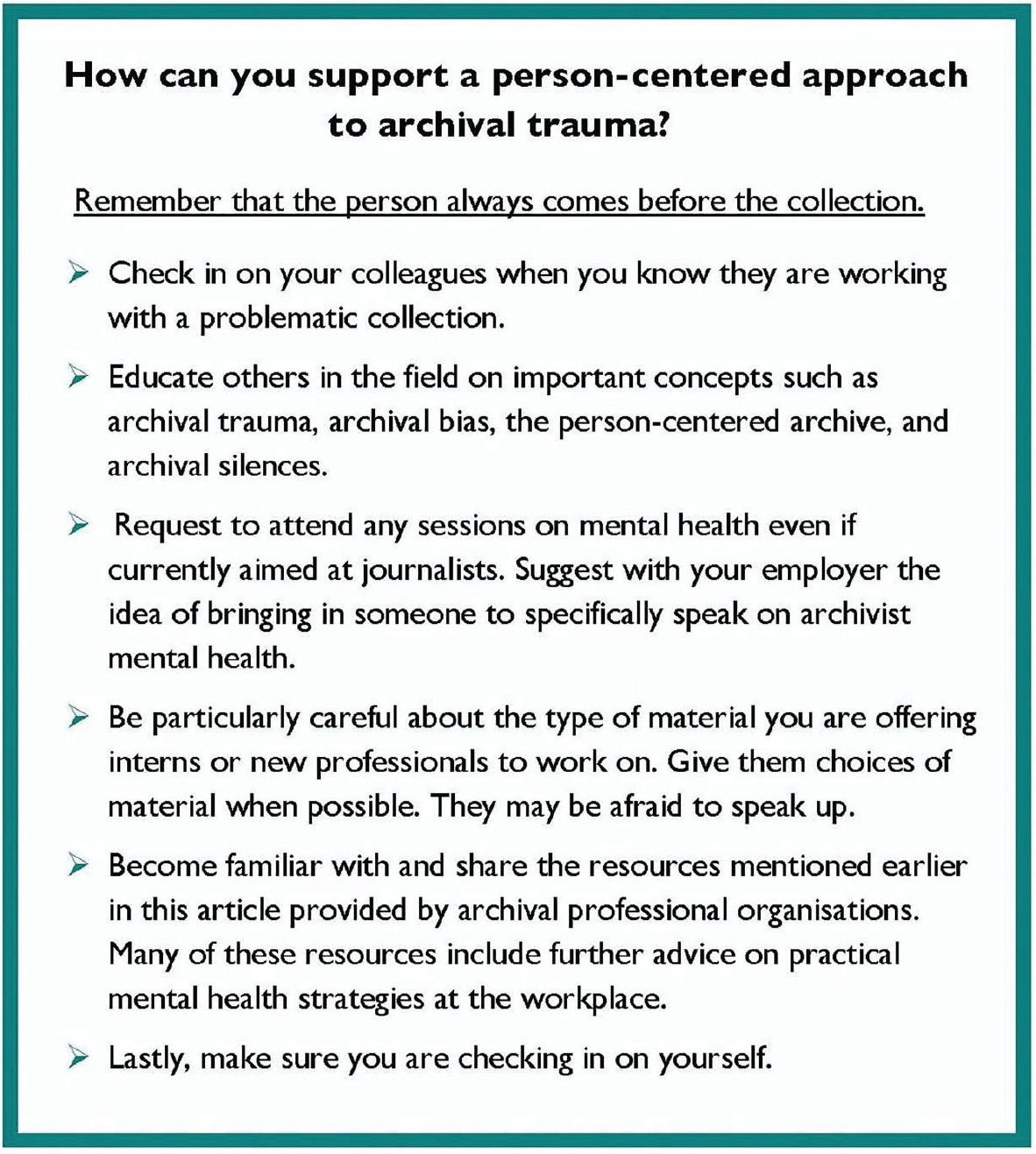
Figure 10
A bullet-point list I created that outlines steps that can be taken to support archivist mental health.
Notes
[2] Michael Marlatt, “Accessibility Can’t Wait: The Need for Disabled Voices in the Film Archive”, Journal of Film Preservation, no. 107 (2022): 24.
[3] Devon Murphy, “Working with Harmful Materials Guide”, The University of Texas at Austin, November 8, 2024, https://cloud.wikis.utexas.edu/wiki/spaces/utlmetadata/pages/28278818/Working+with+Harmful+Materials+Guide.
[4] Kirsten Wright and Nicola Laurent, “Safety, Collaboration, and Empowerment: Trauma-Informed Archival Practice”, Archivaria 91 (June 2021): 38, https://archivaria.ca/index.php/archivaria/article/view/13787.
[5] Michael Marlatt, “‘But Don’t Those Cause You Seizures!?’: Epilepsy Activism through Film Archiving”, in Preserving Disability: Disability and the Archival Profession, eds. Gracen Brilmyer and Lydia Tang (Sacramento, CA: Library Juice Press, 2024), 551–78.
[6] Jennifer Douglas, Mya Ballin, and Jessica Lapp, “Introduction”, Archivaria 94 (December 2022): 5, https://archivaria.ca/index.php/archivaria/article/view/13861.
[7] Michelle Caswell and Marika Cifor, “From Human Rights to Feminist Ethics: Radical Empathy in Archives”, UCLA, 2016, https://escholarship.org/uc/item/0mb9568h.
[11] Wanett Clyde, “The (Unexpected) Emotional Impact of Archiving”, WITNESS, August 2015, https://archiving.witness.org/2015/08/the-unexpected-emotional-impact-of-archiving/.
[12] “Documenting Atrocities in the War in Ukraine”, The New York Times, May 22, 2022, https://www.nytimes.com/interactive/2022/05/22/world/europe/ukraine-war-crimes.html
[13] “Health & Wellbeing”, Archives & Records Association UK & Ireland, 2025, https://www.archives.org.uk/health-wellbeing.
[14] Nicola Laurent and Kirsten Wright, “Trauma-Informed Archival Education”, workshop hosted by the International Council on Archives, virtual, November 17, 2022.
[15] Nicola Laurent, Kirsten Wright, Genevieve Wauchope, and Dr Cate O’Neill, “A Trauma-Informed Approach to Managing Archives”, self-directed workshop hosted by the Australian Society of Archivists, virtual, 2025, https://www.archivists.org.au/events/event/a-trauma-informed-approach-to-managing-archives.
[16] “Vicarious Trauma and Immediate Support”, Australian Society of Archivists, 2025, https://www.archivists.org.au/community/vicarious-trauma-and-immediate-support/vicarious-trauma-and-immediate-support.
[17] “Documenting in Times of Crisis: A Resource Guide”, Society of American Archivists, September 5, 2019, https://www2.archivists.org/advocacy/documenting-in-times-of-crisis-a-resource-kit#digitalcontent.
[18] “Trauma-Informed Archives Resource List”, Association of Canadian Archivists, 2023, https://archivists.ca/Trauma-Informed-Archives-Resource-List.
[19] Nicola Laurent and Kirsten Wright, “Understanding the International Landscape of Trauma and Archives”, International Council on Archives, February 1, 2023, https://www.ica.org/resource/understanding-the-international-landscape-of-trauma-and-archives-report/.
[22] Naseem Miller, “Trauma-informed Journalism: What it is, Why it’s Important and Tips for Practicing it”, The Journalist’s Resource, April 13, 2022. https://journalistsresource.org/home/trauma-informed-journalism-explainer/; Ovidiu Damian, “Journalism and Trauma Workshop”, Workshop presented at Central European University, Budapest, Hungary, June 2019, https://cmds.ceu.edu/sites/cmcs.ceu.hu/files/attachment/basicpage/1545/traumaflyer.pdf; Jovana Gligorijević, Ignjatović Džamonja, Čečen Tamara, Branko, Matić, Veran, and Miroslav Janković, “Analysis: Mental Health of Journalists”, Organization for Security and Co-operation in Europe (2023): 1–41, https://www.osce.org/files/f/documents/a/2/545761.pdf; Kaan Göktaş, “The Unspoken Truth about Journalists’ Mental Health”, Media Diversity Institute, March 24, 2023, https://www.media-diversity.org/the-unspoken-truth-about-journalists-mental-health/; Matthew Pearson, Dave Seglins, Tracey Lindeman, and Cassandra Yanez-Leyton, “Taking Care: A Report on Mental Health, Well-being and Trauma Among Canadian Media Workers”, Canadian Journalism Forum on Violence and Trauma (2022): 1–49, https://static1.squarespace.com/static/60a28b563f87204622eb0cd6/t/628556ab6053c80a9e1d668d/1652905646075/TakingCare_EN.pdf; André Picard, “Mindset: Reporting on Mental Health”, Mindset (2020): 1–85, https://static1.squarespace.com/static/60c0df36ba596c14b0e34bb8/t/60c9fbcb41d5a153e7f7d33c/1623849933974/Mindset+third+edition_2020.pdf; Naseem Miller, “Self-care Tips for Journalists-Plus a List of Several Resources”, The Journalist’s Resource, July 1, 2021, https://journalistsresource.org/home/self-care-tips-for-journalists-plus-a-list-of-several-resources; Akshay Upadhyay, Bijale, Mayura, and Hasan Kashif, “Impact of AI Integration on Journalists’ Mental Health: A Quantitative Study”, Annals of Neurosciences (2024): 1–6, https://doi.org/10.1177/09727531241278909; Anne O’ Brien, “Reporting on Mental Health Difficulties, Mental Illness and Suicide: Journalists’ Accounts of the Challenges”, Journalism 22, no. 12 (2021): 3031–47. https://doi.org/10.1177/1464884920903855; Christiane Eichenberg, Lilian Strobl, Tina Jaeger, Alla Kirsha, Richard Laugharne, and Rohit Shankar, “Comparison of Attitudes to Media Representation of Mental Illness Between Journalists and Mental Health Professionals in Russia with German-Speaking Countries of Switzerland, Germany, and Austria”, International Journal of Social Psychiatry 69, no. 5 (2023): 1113–20, https://doi.org/10.1177/00207640221141589; Kate Holland, “Making Mental Health News: Australian Journalists’ Views on News Values, Sources and Reporting Challenges”, Journalism Studies 19, no. 12 (2018): 1767–85, https://doi.org/10.1080/1461670X.2017.1304826; Suzanna M Koster, Hans M Koot, Jamil A Malik, and Marit Sijbrandij, “Associations among Traumatic Experiences, Threat Exposure, and Mental Health in Pakistani Journalists”, Journal of Traumatic Stress 35, no. 2 (2022): 581–92, https://doi.org/10.1002/jts.22772; Natalee Seely, “Journalists and Mental Health: The Psychological Toll of Covering Everyday Trauma”, Newspaper Research Journal 40, no. 2 (2019): 239–59, https://doi.org/10.1177/0739532919835612; Hannah Selby, “Continuity and Change in British Public Service Television’s Engagement with Mental Health”, VIEW. Journal of European Television History and Culture 9, no. 18 (2020): 1–14, https://doi.org/10.18146/view.226; Yuta Aoki, Estelle Malcolm, Sosei Yamaguchi, Graham Thornicroft, and Claire Henderson, “Mental Illness Among Journalists: A Systematic Review”, International Journal of Social Psychiatry 59, no. 4 (2013): 377–90, https://doi.org/10.1177/0020764012437676; Valérie Bélair-Gagnon ed., Happiness in Journalism (Abingdon, England: Routledge 2024); Hannah Storm ed., Mental Health and Wellbeing for Journalists: A Practical Guide (Abingdon, England: Routledge 2024).
[23] “Mission and History”, Dart Center For Journalism & Trauma, 2025, https://dartcenter.org/about/mission-history.