
1 Introduction: Wireless Television, avant la lettre
In June 1924, around the time of August Karolus’s photoelectric cell, John Logie Baird’s Televisor, and Vladimir Zworykin’s Iconoscope patent, a short report on a different kind of ‘Wireless Television’ was published in the liberal daily newspaper, Vossische Zeitung, and reprinted in the avant-garde journal, G—Materials for Elemental Form-Creation:
Dr. [Edmund Edward] Fournier d’Albe, a Frenchman, the inventor of the Optophone, reveals his newest invention, to which his assistant, the Englishman Grindell Mathews, has also contributed. His device permits television—that is, the wireless transmission of the image of a person speaking in front of the transmitter.1
Rather than simultaneously transmitting sounds and images in the current sense of ‘television’, the technical process required multiple audiovisual conversions: a ‘selenium cell’ translates the image into ‘sound waves’, ‘the broadcast is made using a conventional transmitter for wireless telephones,’ and a ‘specially constructed receiver […] transforms the sound waves back into light waves’ (fig. 1).2 The report is significant not only for imagining the birth of wireless television out of the spirit of the ‘optophone’, an early-twentieth-century mechanical light-to-sound encoding system,3 but also for inspiring artistic research. Reprinted in G—Materials for Elemental Form-Creation, the report was positioned between a parascientific manifesto by ‘Dadasoph’ Raoul Hausmann, titled ‘Prospect’, and an essay by architect Ludwig Mies van der Rohe on ‘Industrial Building’.4 In the context of the little journal’s print-run, it further served to validate Hausmann’s earlier artistic research essay, ‘From the Sound Film to Optophonetics’, which had been published in the first issue, and to anticipate Ludwig Hilderseimer’s call, in the final issue, for ‘making film immediately visible to people by means of wireless transmission, beyond all borders, beyond all censors’.5
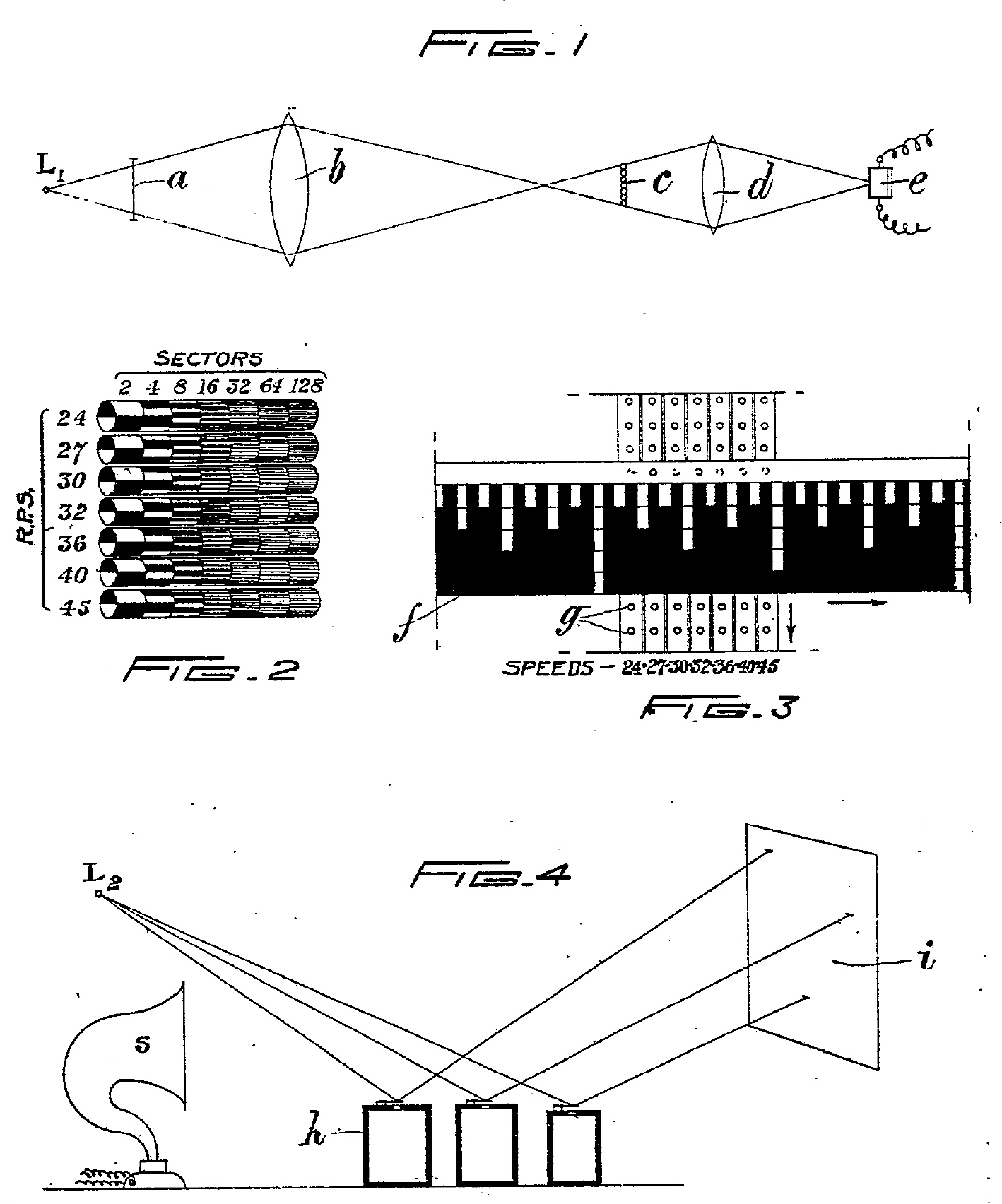
Figure 1
Fournier d’Albe’s televisual system, consisting of recording lenses (top, labelled ‘FIG. 1’), two alternative methods of frequency encoding (middle, ‘FIG. 2’, ‘FIG. 3’), and a receiver and projector (bottom, ‘FIG. 4’). Source: Edmund Edward Fournier D’Albe, “Telegraphic Transmission of Pictures and Images”, British Patent No. 233,746, filed on 15 January 1924.
From 1923 to 1926, members of the so-called G Group, an international Berlin-centred network of artists, architects, designers, and writers that was only loosely and temporarily connected through filmmaker Hans Richter and designer Werner Graeff, explored the elemental aspects of perception, mobilised the modernist ethos of engineering for artistic purposes, and aimed to provide materials for collectively redesigning everyday life.6 Published by Richter and Graeff in collaboration with van der Rohe, El Lissitzky, and Frederick Kiesler, G—Materials for Elemental Form-Creation contained contributions from those named above as well as Hans Arp, Walter Benjamin, Theo van Doesburg, Viking Eggeling, Naum Gabo, George Grosz, John Heartfield, László Moholy-Nagy, Piet Mondrian, Antoine Pevsner, Man Ray, Ernst Schön, Kurt Schwitters, and Tristan Tzara. Though their work is primarily associated with the medium of film, the G Group also made optical experiments across media, including Hausmann’s own version of an optophone, Richter and Eggeling’s abstract movement films, and Moholy-Nagy’s conceptual work on television in the sense of ‘new vision’, all of which aimed at exploring imperceptible frequencies beyond the visible spectrum.7 The famous quotation from Karl Marx’s Theses on Feuerbach, printed vertically in oversized letters in the first issue of G, underscores the Group’s broader social aspirations: ‘Art should not explain life but change it’.8
This essay reconsiders several of the G Group’s televisual experiments – with a focus on Hausmann’s ‘optophonetics’ – and resituates them within the sociotechnical imagination of experimental television in German modernism.9 As suggested by the report on ‘Wireless Television’ reprinted in G, one of the emergent medium’s main attractions was less the etymological sense of ‘seeing at a distance’ than that of harnessing untapped energies, experimenting with imperceptible frequencies, and enabling new forms of perception. Engaging with the then-emergent scientific conception of the eye as an electrical organ, modernist artists were fascinated with the possibilities of the ‘electric eye’, or photocell (fig. 2), which propelled research into ‘seeing by electricity’ (fig. 3). Significantly, several early-twentieth-century artists and critics who will be analysed further below in this essay even cited the same late-nineteenth-century source, a pamphlet on The Future of Electrical Television, as the inspiration for their experimental and often utopian projects.10 Rather than a straightforward audiovisual medium, television was thus understood as part of a longer philosophical tradition of speculations on the unity of matter and the elements of sensation and perception.
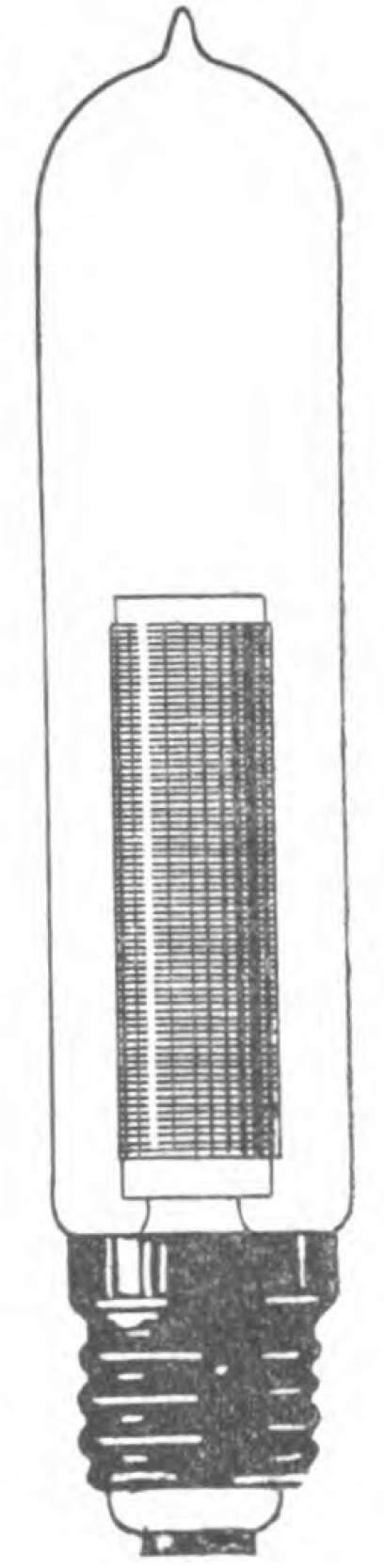
Figure 2
Ernst Ruhmer’s cylindrical photocell, modelled on the light bulb, was the key component in early television. Source: Ernst Ruhmer, Das Selen und seine Bedeutung für die Elektrotechnik (Verlag der Administration der Fachzeitschrift Der Mechaniker, 1902), 11.
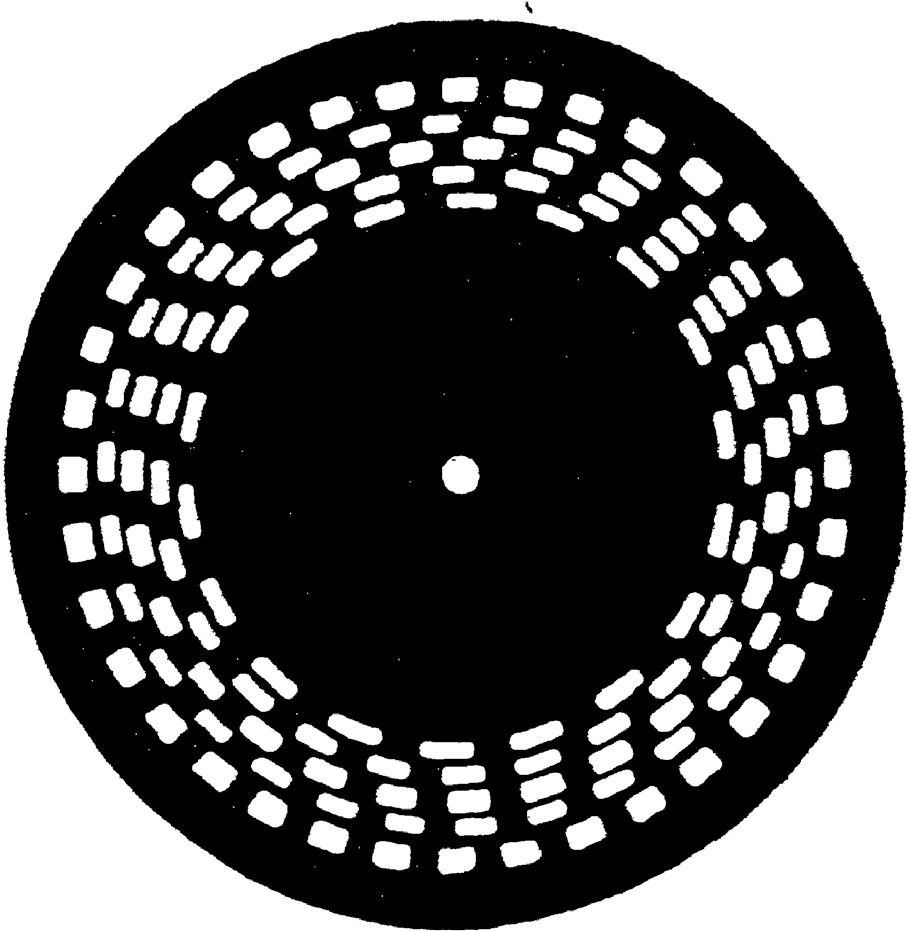
Figure 3
An optophone disc revolved at a rate of 30RPS above a light source and thereby filtered it onto a selenium detector. Source: Edmund Edward Fournier D’Albe, The Moon-Element: An Introduction to the Wonders of Selenium (D. Appleton, 1924), 127.
Although several texts and artworks examined in this essay are canonical objects of analysis in modernism studies, they have traditionally been studied through the inadequate frameworks of ‘visual music’, ‘colour music’, ‘light art’, and related terms.11 Only rarely and recently have they started to be studied in relation to televsion and other media – most relevantly, in Ina Blom’s work on Hausmann’s ‘televisual imaginary’.12 Today, ‘visual music’ provides an umbrella term for almost any artwork made of images or light that bears some relation to musicality. For some scholars, visual music still contains the imaginative power of an intermedial art form; for others, it remains a possible art form with no real historical or philosophical potential.13 There is historical precedence for the term ‘visual music’, coined in 1913 by British art critic Roger Fry to describe Wassily Kandinsky’s abstract oil paintings – presumably following Walter Pater’s apophthegm, ‘all art constantly aspires to the condition of music’.14 In German modernism, analogies to music were widely used for paintings in the 1910s and films in the 1920s.15 What Theo van Doesburg called ‘visible music’ (sichtbare Musik) and Bernhard Diebold called ‘music for the eyes’ (Augenmusik) would come to be codified, in Richter’s influential memoirs of the Dada movement, as ‘visual music [visuelle Musik], which we were talking about, working on, and realising in film.’16
Though pioneered by visual artists experimenting with film, the genre now known as the ‘visual music film’ was not merely the logical conclusion of experiments in the visual arts, nor did the screen simply substitute for the canvas.17 In retrospect, the modernist discourse of ‘visual music’ remains striking because it seems so inadequate for describing the period’s actual theory and practice of intermedial arts. Interrogating long standing assumptions about the filmic a priori, recent scholarship has emphasised the multiple origins of abstract film in a wide range of experiments across media, including light sculptures, colour organs, kinetic devices for the stage, and mathematical graphs plotting out the movements of shapes.18 Whether modelled on the ideals of synaesthesia or those of the Wagnerian Gesamtkunstwerk, the category of visual music often fails to account for modernist artists’ ways of knowing, minimising their projects’ technical aspects and reinforcing audio/visual binaries.
Rather than categorising media based on the human senses, Friedrich Kittler once argued that television, as the first electronic image, constitutes a decisive turning point in the history of ‘optical media’, an argument developed further by Lorenz Engell in his theory of television as the ‘switch image’.19 From this media-philosophical perspective, the electrified televisual image represents the first kind of image that can be switched on, off, or over—like a light bulb. To the extent that such ‘ontographic’ operations ‘write’ (-graphic) the medium into existence (onto-), its distinguishing feature is not only distant vision but also switchability and its modus operandi not only transmission but also inscription. In this respect, the media genealogy of television is closer to computer-graphics than to film, painting, or photography. For the medium’s early history, however, it is crucial to avoid essentialising electronic television at the expense of the plurality of systems from mechanical television to intermedial setups involving filmic technologies.20 While the modernist imagination of television in terms of touch, inscription, switching, and conversion coincided with the emergent commercial development of television as a (wireless) transmission and communications system, the two traditions largely remained distinct, and the para-tele-visual medium imagined by modernists often exceeded, challenged, or sought to overcome increasingly commonplace understandings of ‘television’ as ‘national broadcasting’.
2 The Physiology of Synaesthesia
Although analogies between the elemental perception and formal aspects of images and sounds date back to classical antiquity, the concept of synaesthesia was codified only in the nineteenth century. One of the main speculations in physiological research was that the evolution of species had led to the differentiation and separation of once-unified sense organs with the result that human beings lost the ability to perceive light and sound simultaneously; phylogenetically, the idea was recapitulated in the assumption that adults gradually lost the synaesthetic abilities they had as children.21 In an influential 1872 lecture on ‘The Limits of our Knowledge of Nature’, German physiologist Emil du Bois-Reymond reviewed what he would later famously term the ‘world riddles’ of modern science, including the origin of qualia, consciousness, and simple sensations.22 After describing one physiological experiment with severing nerves, du Bois-Reymond imagined the consequences of ostensibly rewiring the central nervous system:
With the nerves of vision and of hearing severed, and then crossed with each other, we should with the eye hear the lightning flash as a thunderclap, and with the ear we should see the thunder as a series of luminous impressions.23
Developing the ideas of his doctoral advisor Johannes Müller, du Bois-Reymond speculated further on the existence of some primordial substance that seemed necessary to ground and transmit all sensation and perception: ‘in place of sound and light, we have only the vibrations of a primitive, undifferentiated matter, which here has become ponderable, and there imponderable’. In Birgit Schneider’s analysis, ‘du Bois-Reymond’s thought experiment not only showed the limits of scientific knowledge but also brought the imaginative faculty to its limits’. Instead of a ‘visualisation of thunder’ or a ‘sonification of lightning’, du Bois-Reymond imagined ‘an eye that can hear and an ear that can see’, and it was a short step from there to the invention and industrialisation of prosthetics capable of fulfilling those two functions.24
Inspired by du Bois-Reymond’s 1872 lecture, along with accounts of Alexander Graham Bell and Charles Sumner Taintner’s ‘photophone’ (fig. 4–5) and of Paul Nipkow’s ‘electrical telescope’ in the 1880s, Maximilian Plessner greatly shaped the emergent discourse of audiovisual conversion with his 1892 pamphlet, The Future of Electrical Television (Die Zukunft des elektrischen Fernsehens).25 Alongside the then-typical understanding of electroscopic television as a two-way telegraphic or telephonic communications system, Plessner imagined several ‘auxiliary inventions of considerable value’: the ‘optophone’ would record images as sounds; the ‘optograph’ would play them back, like a phonograph; and the ‘phonoptograph’ would increasingly become a replacement for reading and writing.26
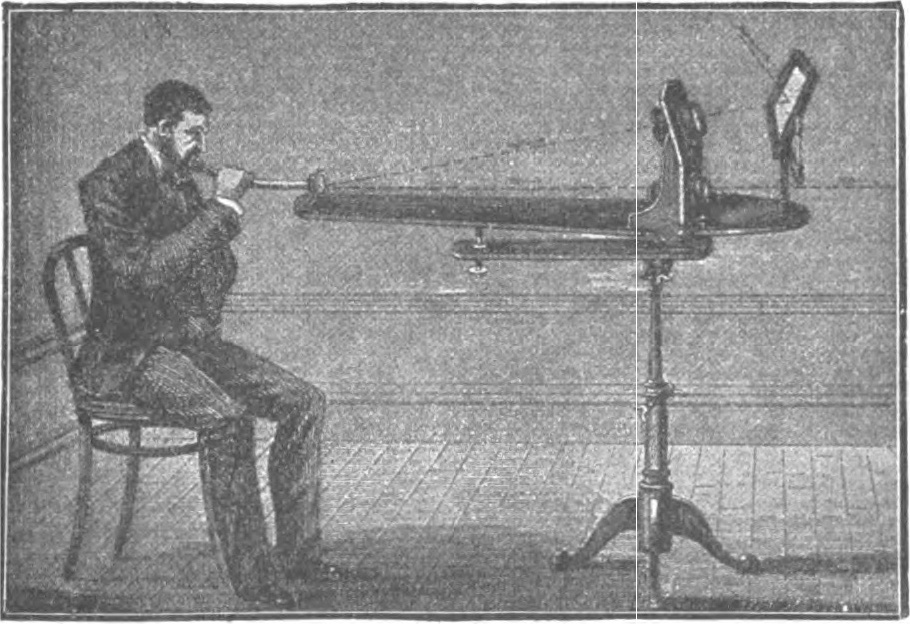
Figure 4
The transmitter for Bell and Taintner’s Photophone. Source: Ruhmer, Das Selen, 31.
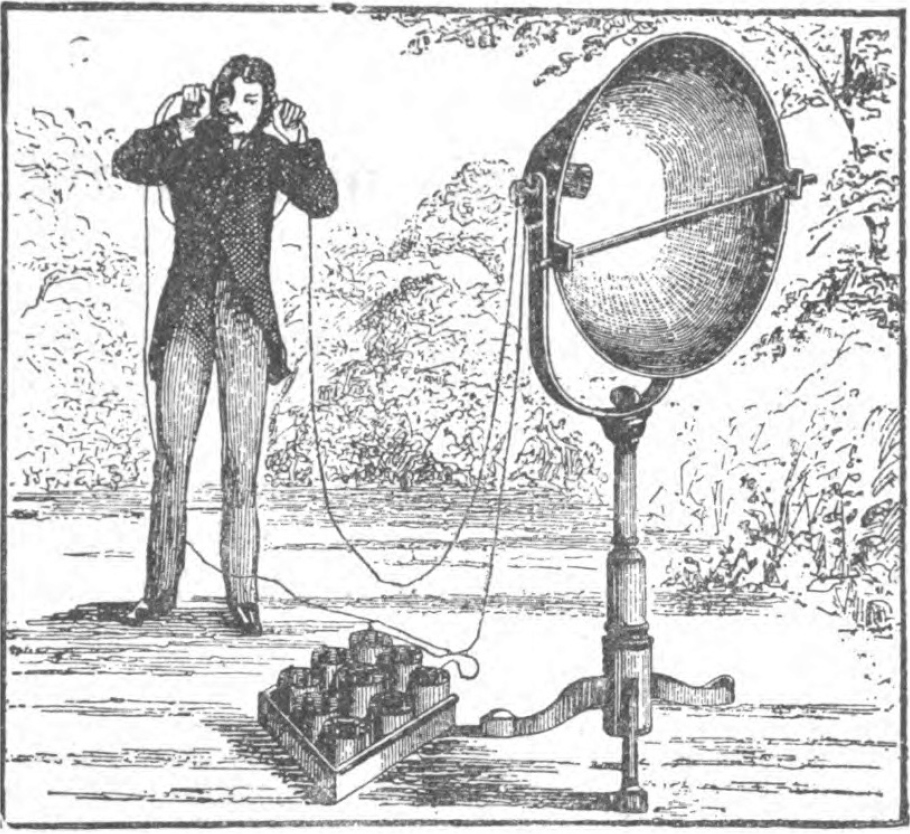
Figure 5
The receiver for Bell and Taintner’s Photophone. Source: Ruhmer, Das Selen, 32.
Foregoing technical details, Plessner elaborated on these imaginary media’s potential applications as both medical prostheses and scientific instruments (e.g., transforming print into sounds for people who are blind, or translating the spoken word into images for people who are deaf). ‘What surprises can natural scientists expect when all visible things in the physical world can be made audible by illumination and, by reversing the energy conversion process, all audible phenomena can also be made visible,’27 Plessner proclaimed, appealing to the laws of thermodynamics. New media ‘will actually make it possible to make thunder visible phonoptographically as a series of light phenomena, and lightning audible optophonically as a bang.’28
As Doron Galili observes, Plessner’s imagined media differ from related instruments like colour organs, which aimed at producing synaesthetic effects by combining tones and colours in a harmonic order. By contrast, Plessner’s imagined media imitated the spirit of synaesthesia by switching between one sense impression and another.29 His comments also pushed the physiological discourse of elemental perception into the realm of the aesthetic, suggesting that new technologies might reveal hidden laws of art and confirm ancient speculations about aisthesis. Adhering to the classical philosophical tradition of harmonics, Plessner assumed that there would be a natural equivalence between the ‘visibly beautiful’ and the ‘audibly beautiful’, and that sonifying ‘Apollo’ or ‘Aphrodite’ would produce ‘harmony’, whereas sonifying ‘Polyphemus’ or ‘Medusa’ would create ‘disharmony’.30 In subsequent years, however, artists and critics engaging with his work in the avant-garde context would question its fundamental assumption that Nature, if only recorded and played back with some cutting-edge phonoptographic machine, would necessarily generate beautiful audiovisual compositions.
Although The Future of Electric Television was largely ignored by other scientists in the late-nineteenth century, it proved to be more influential in the early-twentieth century after being picked up by cultural critic Alexander Moszkowski and other popular science writers who were attempting to explain complex technical experiments with ‘electrical television’.31 In an essay on ‘Art in 1000 Years’, published in 1910 and revised in 1921, Moszkowski presented a grand narrative of television as modernity’s near-realisation of an ancient dream, while also reporting on scientific and industrial experiments from researchers who would have had far more resources and capital than even the savviest avant-garde artists:32
The apparatus we want to use to trick Nature into giving up the greatest mysteries of art admittedly does not yet exist. But it is, in principle, the same as the electrical television, for which the experiments of [Jan] Szczepanik, [Ernst] Andersen, [Ernst] Ruhmer and [Arthur] Korn’s telephotography have laid the practical foundations. We stand here on the cusp of a magic that seems capable of unlocking new mysteries of art. It opens the possibility, dreamed of since primeval times, of building a bridge between sound and light, or to establish the most audacious expression for it, directly converting images into sounds and sounds into images.33
After supporting his predictions about the para-televisual medium on these pioneering inventors, Moszkowski concentrated on “the selenium cell, which offers a different degree of resistance corresponding to different degrees of exposure to light.”34 The accidental discovery of selenium’s photoelectric properties and the preparation of the element known as the ‘selenium cell’ or ‘photocell’ fuelled interest and research activity in early television and ‘seeing by electricity’.35
A decade after the first edition of Moszkowski’s untimely meditations was published, an expanded edition appeared under the title Wavering Parnassus, referring to the unsteady ground of poetry and the arts in the age of industrial modernity,36 an event ironically accompanied by a book tour. In attendance at a reading on May 4, 1921 was Austrian journalist Joseph Roth, who commented in a review for the Berliner Börsen-Courier on the book section on ‘visible sounds and auditory images’:
The idea that it might be possible to translate light-based phenomena into sound waves and, conversely, sounds into light-based phenomena or images, is grotesque and funny. The fact that art would then look different is self-evident. I, for one, do not want to be alive in a thousand years and hear the trees turning green in spring.37
The following year, Hausmann further negotiated the developing discourse and attempted to legitimate his own intermedial experiments as the apex of this tradition:
If the ancient occult sciences talked about how light and sound belong together, then modern technology provides proof of it in the form of photographed music, the optophone, and the research concerning living beings’ sense of space [Raumgefühl].38
Even though Hausmann, Moszkowski, Roth, and others were all responding to the same passage from The Future of Electrical Television, their responses could not have been more different. Here is the original passage in Plessner’s pamphlet:
If the light beam can (by means of a selenium cell) be made to produce or vary induction currents, then a telephone plugged into such a current would have to transform the phenomena thus induced into sounds. Hence, that which enters the receiving station as an image would appear in the intermediary apparatus as sound, and when moving images—that is, visible processes—are recorded at the origin, they would have to be revealed in the form of a sequence of sounds, and vice versa. In its acoustic transformation, a rectangular shape would necessarily produce a different sound image than a triangular or a circular one; a cube would necessarily sound different than a cone or a prism. Crystals and stars will begin to speak, but in what language, with what intonation? That is still purely a matter of speculation, but someday understanding will rise out of this lack of knowledge.39
Although Hausmann clearly rejected what he called Plessner’s “naturalism,” it is unclear whether it was motivated by an anti-mimetic impulse or a fascination with vibrations. Assuming that music and painting no longer corresponded to modern experience, in Hausmann’s simultaneously apodeictic and cryptic phrasing, ‘We must therefore find new laws that are valid for us, a new functionality for both. We must communicate in a fundamental way that this functionality of form arises from the intensity of oscillation so that a new formal norm can be put forward that surpasses everything arbitrary.’40 In search of what he called the ‘universal functionality principle in optics’, Hausmann researched emergent theories of electromagnetism, often preferring summaries in the Zeitschrift für Feinmechanik, which contained technical articles and diagrams describing a wide range of optophonetic apparatuses.41
3 From Optophonetics to Telehaptics
As its name suggests, an ‘optophone’ essentially makes images (opto-) audible (–phone), and yet no single device has ever seemed to exhaust the possibilities of optophony or optophonetics. In the years around World War I, a wide range of optophones were imagined, designed, and patented.42 Using a selenium detector and a sound output, one of the earliest models, the ‘exploring optophone’, was intended as a prosthetic to help people who are blind find illuminated windows and doors (fig. 6a–6b). The best-known model, the ‘type-reading optophone’, slowly converted entire sequences of visible characters into patterns of audible tones (fig. 7a–7b). Despite all being based on photoacoustic principles, optophones varied from Mary Jameson’s demonstrations through Francis Picabia’s optophone portraits to a cryptic passage in James Joyce’s Finnegan’s Wake (‘’Tis optophone which ontophanes’). For Marshall McLuhan, Joyce’s ‘optophone principle in art provides the key for future literary and social education’, insofar as it signals a departure from visual print culture and provides future-oriented training in ‘tactility’ and ‘acoustic space’.43 In recent years, optophones have attracted renewed scholarly attention in media studies as potential precursors to optical character recognition (OCR) and data sonification techniques.44 As is less widely recognised, however, the sociotechnical imagination of optophones also contributed significantly to the televisual imaginary.45
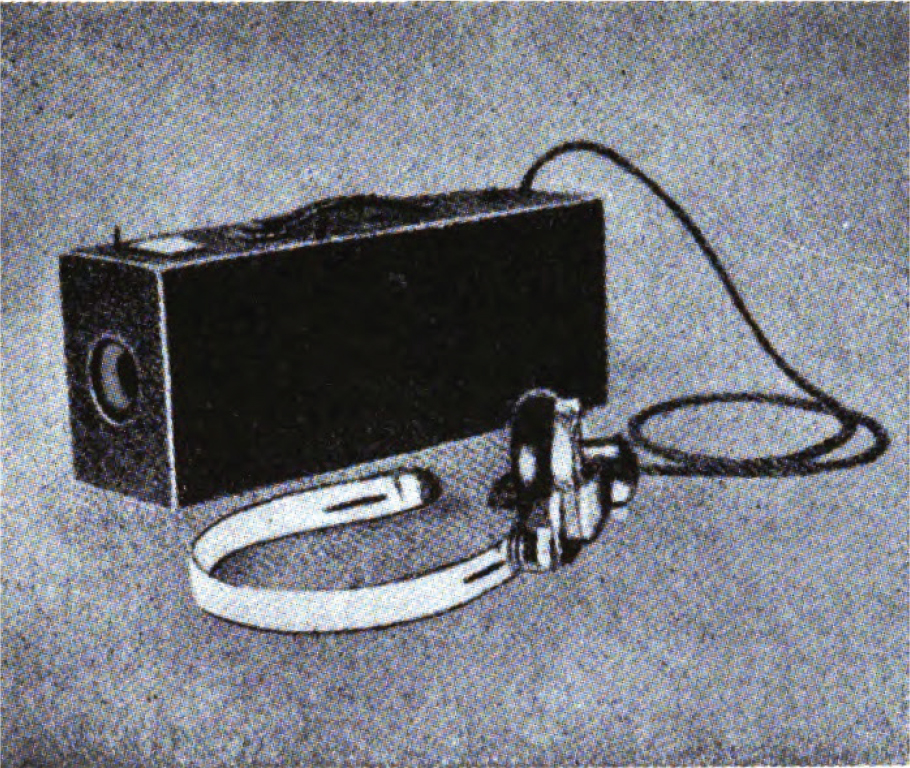
Figure 6a
Exploring Optophone; Source: Fournier D’Albe, The Moon-Element, 98.
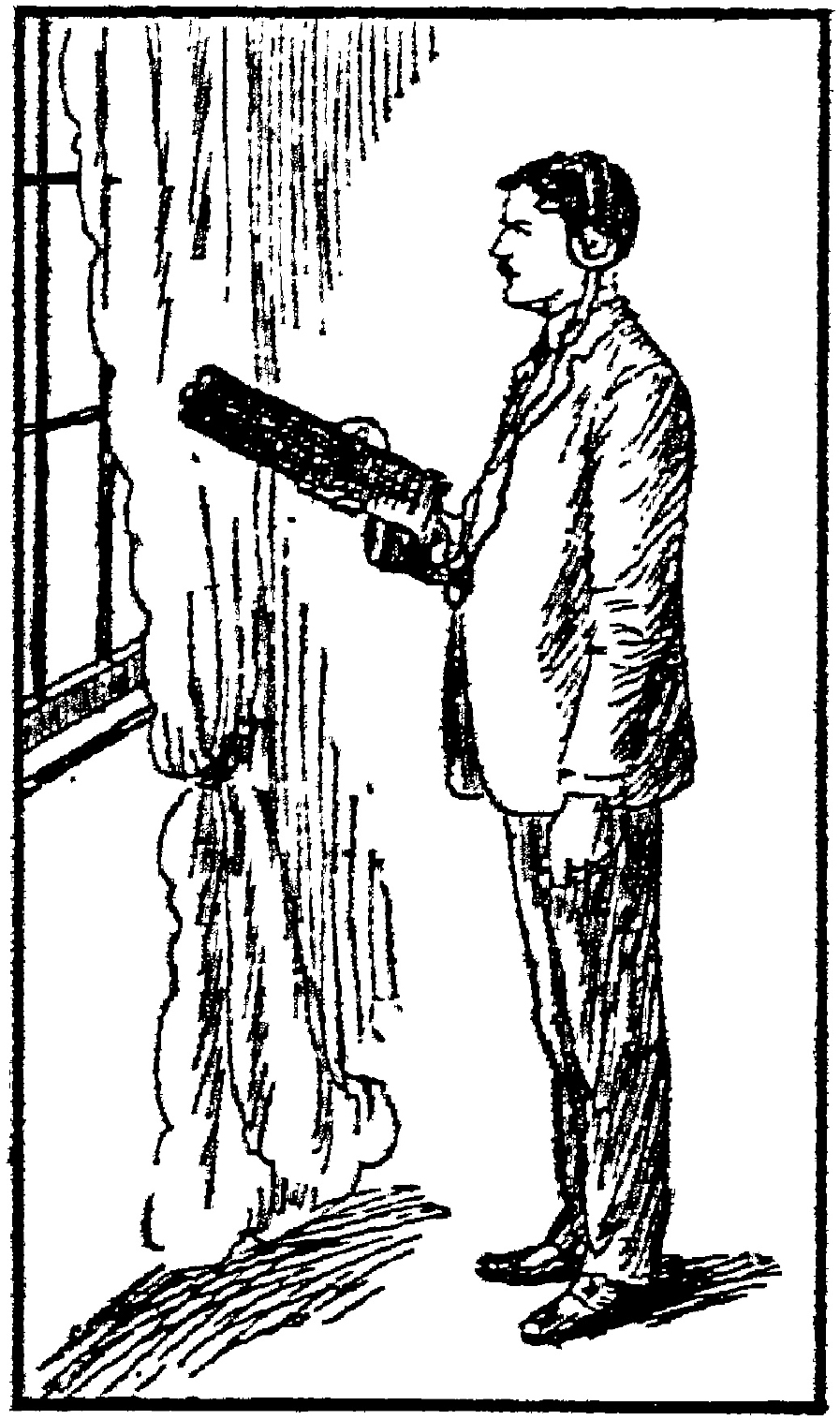
Figure 6b
Exploring Optophone; Source: Fournier D’Albe, The Moon-Element, 102.
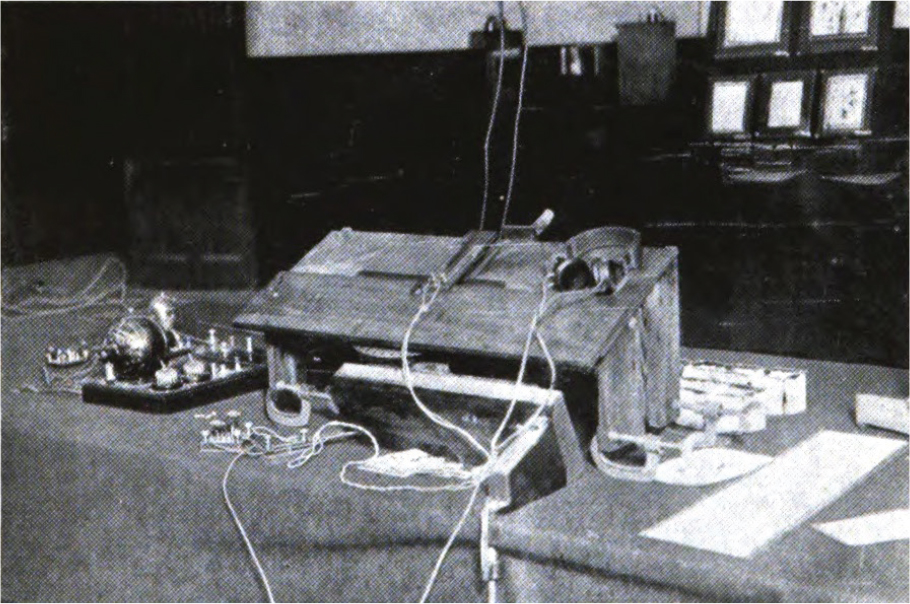
Figure 7a
Type-Reading Optophone; Source: Fournier D’Albe, The Moon-Element, 98.
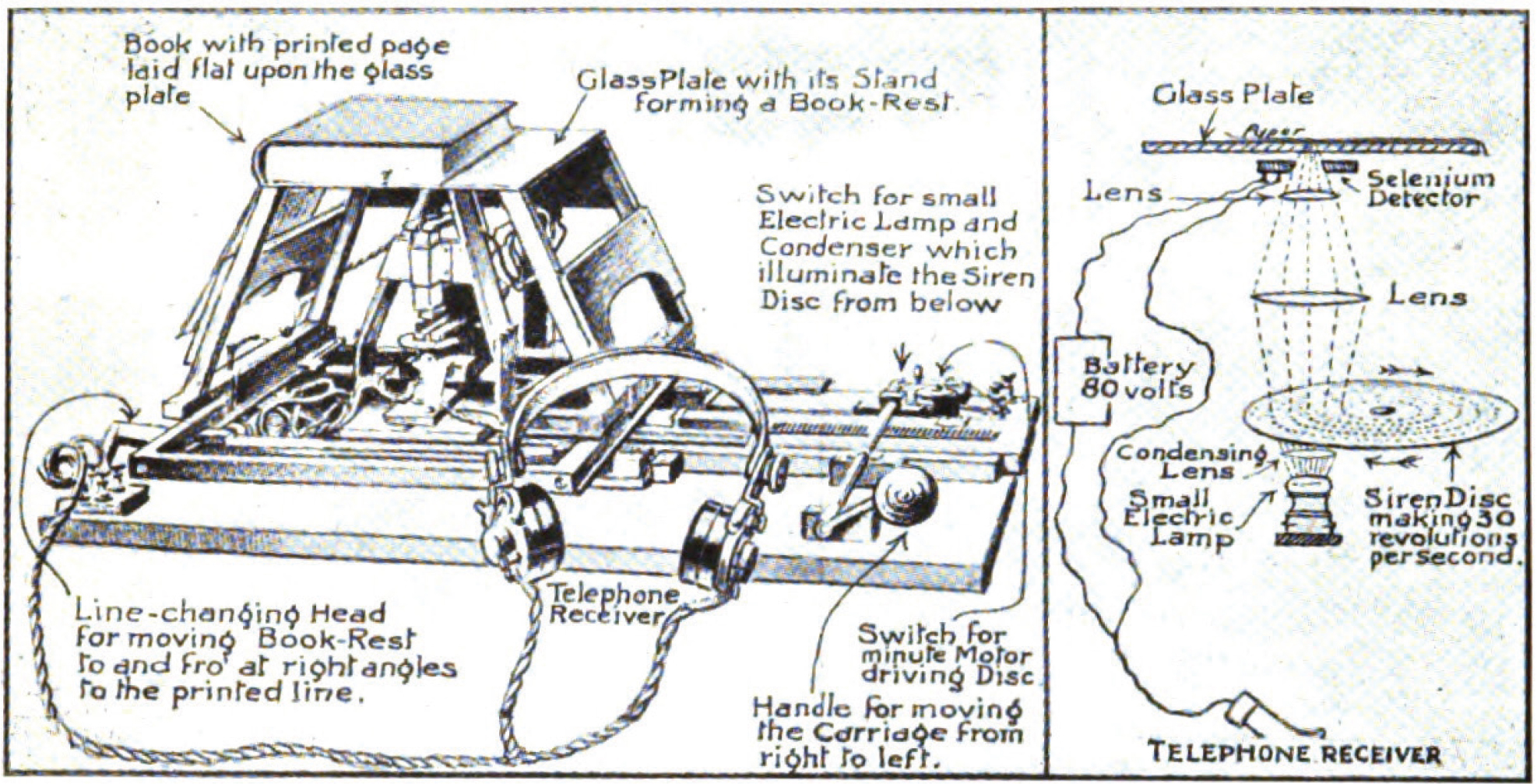
Figure 7b
Type-Reading Optophone; Source: Fournier D’Albe, The Moon-Element, 124.
Hausmann’s ideal Optophone would have probably been a keyboard capable of simultaneously generating abstract colour patterns and sounds of various pitches . However, the optophonetic projects Hausmann conducted in a wide range of media, from concrete poetry to electrotechnical circuit design, remain difficult to interpret, contextualise, and categorise. For instance, Hausmann once described the Optophone as a ‘colour organ’, an instrument for playing ‘optical-phonetic compositions’, but then immediately again as an ‘electrical spectrophone’, a spectrum analysis device based on the principle of the photophone.46 There is no evidence that any such apparatus was ever demonstrated in public or even fully constructed. Based on Hausmann’s most detailed description, the ideal Optophone would have consisted of a ‘keyboard, like that of a calculator with around 100 keys’, which controlled a cylinder divided into ‘100 fields’ and printed with a series of lines using a collotype process.47 In front of the cylinder, there was a ‘quartz plate’ and a glass ‘prism’; opposite the cylinder, a ‘neon lamp’; next to it, a ‘photocell’ pointed at the lamp controlled an amplifier and a loudspeaker. By ‘operating the keyboard’, the performer would generate ‘the most varied series of spectral colour groupings and bands of lines’ in the optical projection system; simultaneously, the photoelectric cell would transform the brightness and darkness values into electrical impulses and transmit them to the loudspeaker, producing an ‘acoustic effect’. No recordings of Hausmann’s Optophone survive, only simplified sketches and vague descriptions, and it is likely that the imaginary medium only ever existed as an idea on paper. In this respect, Hausmann’s planned optophonetic machine is usually understood as the extension and culmination of his realised optophonetic concrete poetry, where larger letters suggest sounds of greater intensity (fig. 8).48 To differentiate his optophonetics from related projects, Hausmann emphasised that it did not successively transform sounds into images, or vice versa, but produced sounds and images simultaneously.
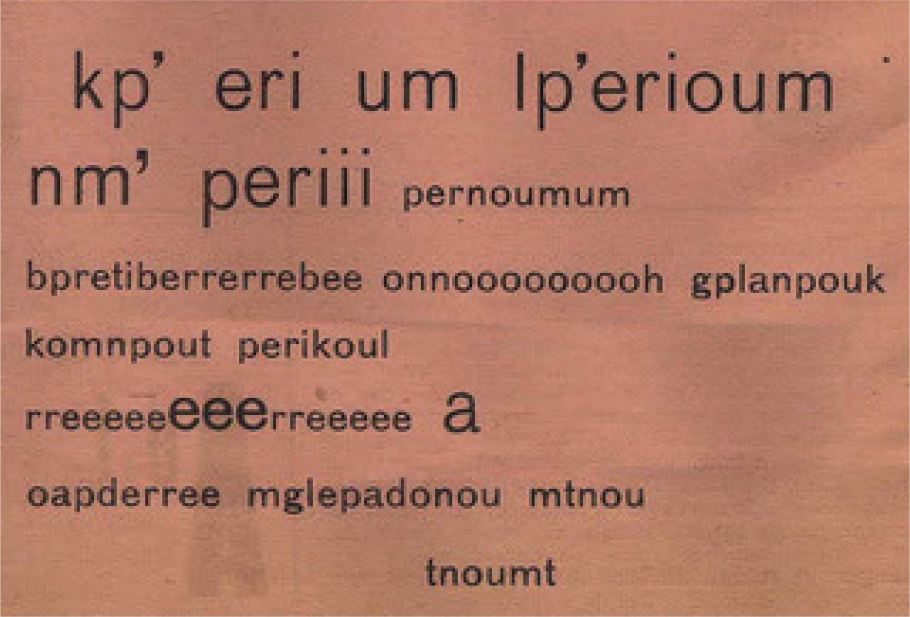
Figure 8
Hausmann’s optophonetic poem, ‘Kp’erium’ (later reworked as ‘Kp’erioum’); Source: Der Dada 1 (June 1919): 2.
Hausmann’s Optophonetics was not merely a literary or technical device but an entire program for retraining the senses and expanding the limits of human perception. ‘Other living beings obviously do not have isolated apparatuses for hearing and seeing,’ Hausmann once reflected. ‘For example, bees have both in one—that is, they have a wonderful optophone.’49 From 1921 to 1923, Hausmann wrote three significant texts on his envisioned program: ‘PRÉsentismus’; ‘Optophonetics’; and ‘From Talking Films to Optophonetics’.50 The ‘PRÉsentismus’ manifesto, co-signed by Eggeling, called for ‘electrical, scientific painting! The waves of sound and light and electricity only differ from each other in terms of their wavelengths and frequencies!’51 Twisting around du Bois-Reymond’s and Plessner’s naturalistic imagination of visible thunder and sonic lightning, Hausmann and Eggeling envisioned a new monumental art: ‘At night, giant light dramas will be performed against the heavens, in colour, and during the day, these transformers will be changed over to sound waves that make the atmosphere thunder.’52 As support for this project’s feasibility, the two artists referenced the ‘sound experiments of the American and German wireless stations’ and Thomas Wilfred’s Clavilux.53 For Hausmann and Eggeling, such artistic and scientific experiments together showed that it is possible ‘to transform all our haptic emanations into mobile colours, into sounds, into a new kind of music’.54 Referencing and rejecting F. T. Marinetti’s so-called ‘tactilism’, the PRÉsentists ‘demand[ed] the expansion and conquest of all our senses! […] Let us realise that the sense of touch, the haptic sense, is mixed with all of our senses or is almost their decisive basis, and its emanations travel outwards as an eccentric receptivity.’55 Inspired by Salomo Friedlaender’s literary grotesques about “telehaptics” and Ernst Marcus’s theory of ‘eccentric perception’, Hausmann and Eggeling ultimately called for “haptism” and imagined ‘build[ing] haptic and telehaptic transmission stations’.56
As Hausmann’s (mis)understanding of the equivalencies of light waves and sound waves developed, the measurements he provided for their wavelengths and frequencies also changed. In his 1922 essay on ‘Optophonetics’, Hausmann provided an approximate range of visible frequencies, or ‘vibrations from 400 billion [Hz] per second of the slowest red to the 800 billion [Hz] of violet’, and audible frequencies, ‘from roughly 32 [Hz], starting at the range of singing, to 41,000 [Hz], in the musical tones’.57 The following year, Hausmann not only respecified the range of audible frequencies (‘oscillations at a rate between 16 per second and about 20,000 per second’) and visible frequencies (‘between 760 billion and 360 billion oscillations per second’) but also conflated ‘acoustics, optics, and electrokinetics’ as ‘merely different forms of energy transfer’.58 On the one hand, light, sound, and electricity all seemed to belong to the same energetic spectrum. In an unpublished essay on the ‘Biodynamic Contemplation of Nature’, Hausmann revealingly and erroneously claimed that ‘light is an electrical wave and sound is also an electrical wave’, when most physicists were already describing the former as an electromagnetic wave and the latter as a mechanical one.59 On the other hand, there seemed to be a gap between light and sound, due to their differing frequencies, and it was in this very gap that Hausmann sought to deploy his avant-garde creations.
The common form, or Gestalt, taken to unite the diverse phenomena across the electromagnetic spectrum, was that of the wave, captured in popular images of vibrations, undulations, and oscillations of the luminiferous ether. ‘The processes that determine light, sound, electricity, warmth, etc. are oscillation phenomena’, Hausmann asserted in his 1923 essay, ‘From the Sound Film to Optophonetics’. ‘These phenomena differ by degree but are similar in terms of the laws they obey’.60 In his account of the German Tri-Ergon system, which had used a photoelectric recording process to create synchronised film sound as early as 1919, Hausmann reflected that ‘the step from the sound film to optophonetics is still a large one’, reminding readers of early experiments with electrical television almost thirty years earlier, including those conducted by Plessner.61 In 1927, Hausmann reportedly attempted to patent five different optophone constructions, but his application was rejected, allegedly with the explanation that “nothing humanly pleasant would come out of it.”62 Perhaps reprocessing the Patent Office’s critique, Hausmann subsequently addressed the invention to future generations: ‘My dear musicians, my dear painters: You will see with your ears and hear with your eyes and in the process you will lose your minds’.63 In a letter dated August 6, 1930 and addressed to the engineer Daniel Broido about their failed collaboration on a related patent, Hausmann emphasised his knowledge of television and photo-electrical devices, citing Nipkow and Ruhmer as support for his belief that media technology grounds the optophonetic extension of the human body, but he no longer mentioned optophonetics.64
In his last optophonetic essay from the period, ‘On Colour Organs’, Hausmann ultimately lamented: ‘All subsequent experiments were always doomed to failure because of a false scientific theory that believed, and still believes, that sound and light ‘waves’ have different physical properties’.65 Although it would exceed the scope of this essay to examine Hausmann’s “electrical eidophony” and other attempts to update optophonetics well into the 1960s,66 it is important to note that the para-tele-visual imaginary continued to inspire intermedial thinking and practice in the national broadcasting era.
4 Conclusion: Dada Television, Haptic Broadcasting, and the Para-Tele-Visual
Optophonetics, telehaptics, and other modernist imaginations of synaesthesia andaudiovisual conversion media challenge the tendency to essentialize television as a universal form of ‘seeing at a distance’. The logic of a continuum – not only between light and sound but also different forms of energy and organic life – was an important foundation for the G Group’s investigations of the elemental forms of vision, audition, and haptic perception. Hausmann’s attempts to make different vibration intensities perceptible with his Optophone finds an unexpected corollary in contemporaneous films experimenting with the intensity of projected light in search of what Richter called ‘optical rhythm’. According to Richter’s influential manifesto, published in G, called ‘The Badly Trained Soul’, sensations are not formless expressions of dreams or of unconscious desires. ‘Feeling is a process as precisely organised and mechanically exact as thinking; but the consciousness of this process, or rather the identity with it, has been lost, is missing’.67 To retrain the ‘badly trained soul’, the pulsating flashes and optical rhythms in Richter’s abstract films attempted to create vibrations, or resonances, with the viewer’s internal rhythms, providing elementary lessons in experiencing different forms of oscillatory movements.
In the final issue of G, published in 1926 and ostensibly devoted to the medium of film, the editors reprinted another newspaper report from the Vossische Zeitung, this time about Georges Lakhovsky’s ‘research on the origin of life’, under the title ‘Shortwave Life’.68 While the excerpt omitted details about the research process, it highlighted his ‘conclusion that the basis of organic existence is infinitely shortwaves at infinitely high frequency. The combination of an immense number of waves of various shortness—voilà, that is life’.69 Reprinted in G, the report about Lakhovsky’s attempts to prove that a cell functions in analogy to a wireless station, receiving and transmitting various signals, gains new significance within a suggestive constellation of other texts and artworks, including Eggeling’s rhythmization of a natural object, Marcel Duchamp’s hypnotic spirals, and Man Ray’s photograph of a pile of film strips as a mountain range (fig. 9). Taken together, these multi-sensory experiments can hardly be understood as ‘visual music’ and correspond more to the principle of ‘vibratory modernism’, a critical term coined recently for the modernist ‘fascination with vibrations as the unseen force that mediated all interactions between the interior self and the exterior environment’.70
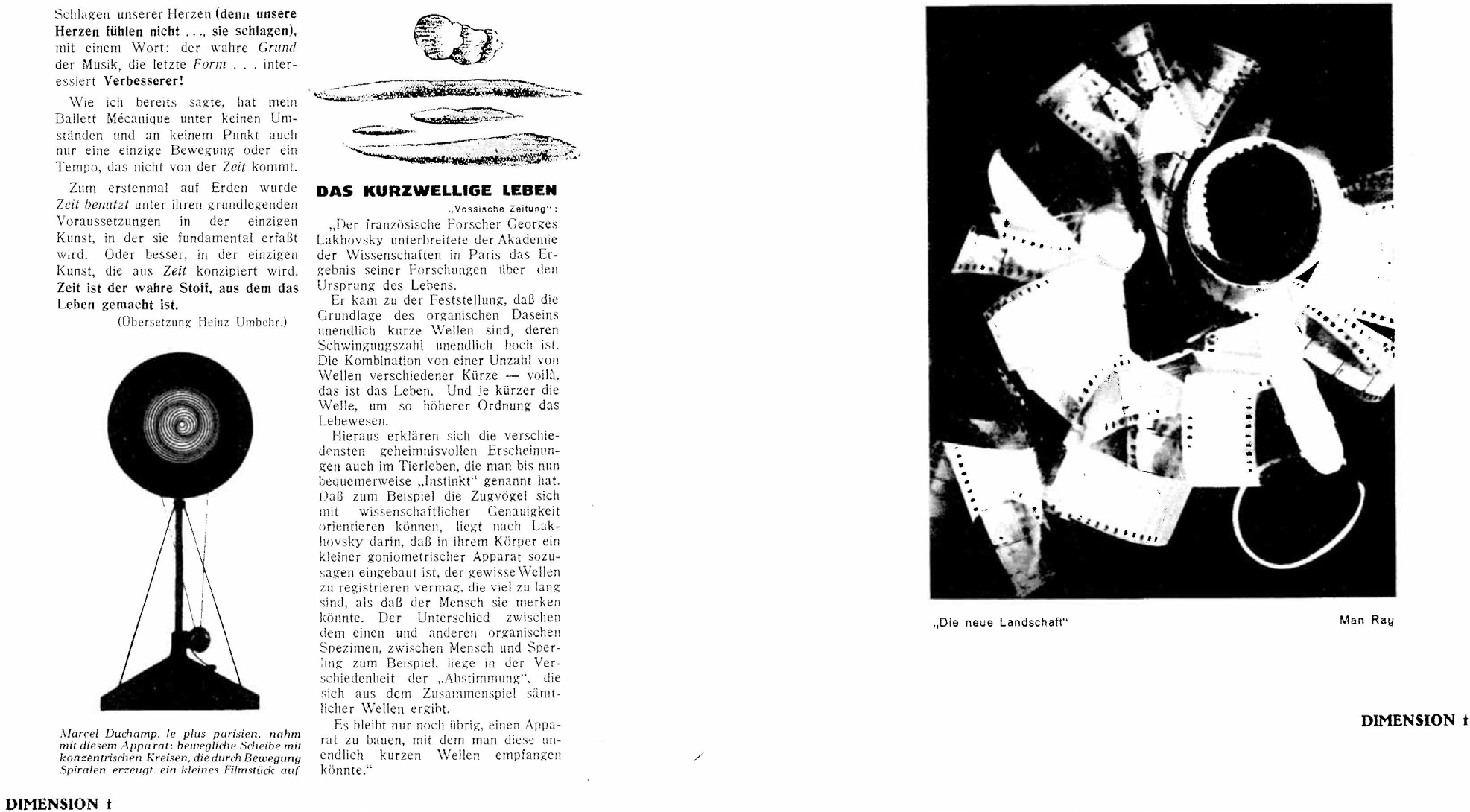
Figure 9
‘Vibratory modernism’, suggested by Marcel Duchamp’s spirals (left), Viking Eggeling’s drawing (centre top), a reprinted newspaper report on ‘Shortwave Life’ (centre bottom), and Man Ray’s photograph (right); Source: Hofacker, ed., G – Material zur elementaren Gestaltung, 120–121.
The main challenge of para-tele-visual media for the avant-garde was the following paradox: the apparently natural force of electromagnetic radiation could only be created artificially. As an artificial energy source, however, electromagnetic radiation created the opposite of what was a dominant theme of aesthetic discourse around 1900 – namely, Gestalt, an organic, well-organised whole perceived to be greater than the sum of its parts. Electromagnetic radiation challenged the limits of Gestalt thinking: it definitely existed, as Heinrich Hertz’s experiments had shown, but beyond the limits of appearance and perception, as Hertz’s Scheinbildtheorem proposed. While the G Group and other international constructivists addressed issues of form and formlessness in their search for the elemental, other optophonetic experiments were conducted in different contexts, resulting in early electrical music instruments, such as Jörg Mager’s Spherophone and Leon Theremin’s Etherophone.
Rather than revisiting the vast body of scholarship on dada aesthetics, this essay will conclude by considering three potential implications of intermedial and interdiscursive approaches to studying the early history of television. First, the experiments examined in this essay provide an impetus to keep expanding concepts of the ‘paratelevisual’. Adapting Gérard Genette’s concept of the “paratextual,” Andrew Burke uses the phrase to describe ‘public service announcements, station identifications, test cards, colour bars, promotional bumpers, interval junctions, tests of the emergency broadcast system, and closedowns of the broadcast day’.71 Beyond the edges of televised content, Wolfgang Hagen has traced the “parasocial” relation between TV actors and viewers in relation to the history of parapsychology.72 In an expanded sense, the paratelevisual might thus describe not only techniques and technologies surrounding or extending standard television hardware but also their cultural representation and sociotechnical imagination.
Second, the paratelevisual experiments examined in this essay occupy a pivotal position in media history. Looking forward, they can be understood not only as part of the early history of television, emphasising its intersections with image-based telegraphy and early fax machines, but also as part of the prehistory of video and computer graphics and as a sort of ‘television art’ (Fernsehkunst) avant la lettre.73 Before the invention of video, television lacked a storage function and remained restricted to transmission; before ‘TV’ became synonymous with the transmission of synchronised sounds and moving images in an endless flow of content programmed for a national audience, it also meant the conversion of light into sound and vice versa. Shifting our understanding of avant-garde experiments from ‘visible music’ to ‘optical media’ contributes not only to avant-garde and modernism studies but also to recent work connecting the pre-history and post-history of television. Studying the development of television before and after the dominant model of national broadcasting creates new intermedial and interdiscursive perspectives on the ontology of the medium beyond liveness, flow, and mass address.
Third and finally, as emphasised in the contributions to this special issue, the concept of ‘tele-visions’ makes more sense in the plural than the singular and in this case describes not only distant vision but also proximate audition and not only wireless transmission but also haptic broadcasting. It is perhaps fitting that Raymond Williams’ influential concept of ‘flow’ was inspired by a dadaistic experience of watching TV in a hotel room where the broadcast film was mixed with unmarked commercials and trailers and resulted in ‘a single irresponsible flow of images and feelings’.74 To the anti-modernist, all television is dada television.
Acknowledgments
I presented an early version of this essay in a conference paper, ‘Durchs Spektrum denken’, at the University of Vienna’s ‘Mediologie’ Conference, ‘Medien Denken’, in 2014; and in my dissertation, ‘Sparks to Signals: Literature, Science, and Wireless Technology, 1800–1930’, University of California, Berkeley, 2016. For the invitation to contribute to this special issue, I would like to thank the research group IMAGO-Cultures Visuelles, especially Pierre J. Pernuit; for critical feedback, Jeremy Braddock and the anonymous peer reviewers; and for editorial work and critical insights, the entire team at VIEW: Journal of European Television History and Culture.
Notes
[1] “Wireless Television”, in G: An Avant-Garde Journal of Art, Architecture, Design, and Film, 1923–1926, ed. Detlef Mertins and Michael William Jennings (Getty Research Institute, 2010), 119. Despite exhaustive research, I have been unable to locate the original newspaper report in the Vossische Zeitung and suspect that it could have been fabricated by the G Group.
[3] See Edmund Edward Fournier D’Albe, “Telegraphic Transmission of Pictures and Images”, British Patent, No. 233,746 (filed on 15 January, 1924); R. W. Burns, Television: An International History of the Formative Years (IET, 2007), 104–109.
[4] Raoul Hausmann, “Prospect”, in G, 116–19; Ludwig Mies van der Rohe, “Industrial Building”, in G, 120–123. Between Hausmann’s manifesto and van der Rohe’s essay, there is an editorial message in French, Russian, and English: ‘The governing, materialistic perspective on life is of a mecanical [sic] order. To this one we are opposing the one of universal organism.’
[5] Raoul Hausmann, “From the Sound Film to Optophonetics”, in G, 102–3; Ludwig Hilberseimer, “Do Not Read – Banned Film!”, in G, 234.
[6] The name of the group and their journal, ‘G;, stands for ‘Gestaltung’, a complex term for ‘design’, ‘composition’, ‘construction’, or ‘creating (elementary) forms’. See the introductory essays in Mertins and Jennings, eds., G, 3–99; Emily Hage, Dada Magazines: The Making of a Movement (Bloomsbury Visual Arts, 2021), 167–177.
[7] For a period source connecting early abstract films by Richter, Eggeling, and Walter Ruttmann to moving light displays by Hausmann, Ludwig Hirschfeld-Mack, and Alexander László, see László Moholy-Nagy, Painting, Photography, Film [1925], trans. Janet Seligman (Lund Humphries, 1969), 20–24. Moholy-Nagy glosses the German word for “television” (Fernseher) not with the Latin ‘television’ but the Greek ‘telehor’, a term also used previously in the name of Dénes Mihály’s company, Telehor AG, and subsequently in the title of the little journal, Telehor: The International Review [of] New Vision.
[9] On studying ‘imaginary media’, see, among others, Eric Kluitenberg, ed., The Book of Imaginary Media: Excavating the Dream of the Ultimate Communication Medium (NAI, 2006); Simone Natale and Gabriele Balbi, “Media and the Imaginary in History: The Role of the Fantastic in Different Stages of Media Change”, Media History 20, no. 2 (2014): 203–18.
[10] Maximilian Plessner, Die Zukunft des elektrischen Fernsehens, vol. 1 of Ein Blick auf die großen Erfindungen des 20. Jahrhunderts (Dümmler, 1892).
[11] See, among others, William Moritz, “Visual Music and Film as an Art before 1950”, in On the Edge of America: California Modernist Art, 1900–1950, ed. Paul J. Karlstrom (University of California Press, 1996); Kerry Brougher, Jeremy Strick, Ari Wiseman, Judith Zilczer, eds., Visual Music: Synaesthesia in Art and Music since 1900 (Thames & Hudson, 2005); R. Bruce Elder, Harmony and Dissent: Film and Avant-garde Art Movements in the Early Twentieth-Century (Wilfrid Laurier University Press, 2008); Cornelia Lund and Holger Lund, Audio.Visual — On Visual Music and Related Media (Arnoldsche Art Publishers, 2009); Aimee Mollaghan, The Visual Music Film (Palgrave, 2015).
[12] Daniel Gethmann, “Zwischen Optophonie und Phonovision. Die technische und künstlerische Synthese von Ton- und Bildspeicherung als Vorgeschichte der Videokunst”, in REC—Video als mediales Phänomen, ed. Ralf Adelmann, Hilde Hoffmann, and Rolf F. Nohr (VDG, 2002), 147–164; Marcella Lista, “Raoul Hausmann’s Optophone: ‘Universal Language’ and the Intermedia”, in The Dada Seminars, ed. Leah Dickerman and Matthew S. Witovsky (National Gallery, 2005), 83–101; Birgit Schneider, “On Hearing Eyes and Seeing Ears: A Media Aesthetics of Relationships between Sound and Image”, in See This Sound: Promises in Sound and Vision, ed. Cosima Rainer and Manuela Ammer (W. König, 2009), 609–33; Ina Blom, “Temps technologique/tempts historique: l’imagination télevisuelle de Raoul Hausmann”, in Raoul Hausmann et les avant-gardes, ed. Timothy Benson, Hanne Bergius, and Ina Blom (les presses du réel, 2014), 135–168; Doron Galili, “Postmediales Wissen um 1900. Zur Medienarchäologie des Fernsehens”, montage AV. Zeitschrift für Theorie und Geschichte audiovisueller Kommunikation 25, no. 2 (2016): 181–200; Johannes Hess, Selen. Eine Materialgeschichte zwischen Industrie, Wissenschaft und Kunst (Mohr Siebeck, 2019); Graziele Lautenschlaeger, Sensing and Making Sense: Photosensitivity and Light-to-Sound Translations in Media Art (transcript, 2021), 159–186.
[13] Wendy Everett, “Image, Music, Film”, Studies in European Cinema 5, no. 1 (2008): 7–16; Jerrold Levinson, “Non-existent Artforms and the Case of Visual Music”, in Contemplating Art: Essays in Aesthetics (Oxford, 2006), 129–142.
[14] Roger Fry, “The Allied Artists” [1913], A Roger Fry Reader, ed. Christopher Reed (The University of Chicago Press, 1996), 153.
[15] See Malcolm Cook, “Visual Music in Film, 1921–1924: Richter, Eggeling, Ruttman”, in Music and Modernism, c. 1849–1950, ed. Charlotte de Mille (Cambridge Scholars Publishing, 2011), 206–228.
[17] Mollaghan, The Visual Music Film; cf. Standish D. Lawder, The Cubist Cinema (New York University Press, 1975), 35–64.
[18] See, among others, Elder, Harmony and Dissent, 39ff.; Karin von Maur, Vom Klang der Bilder. Die Musik in der Kunst des 20. Jahrhunderts (Prestel-Verlag, 1985); Erik Born, “Notation: From Scrolls to Scores”, in Hans Richters Rhythmus 21. Schlüsselfilm der Moderne, ed. Forschungsnetzwerk BTWH (Königshausen & Neumann, 2012), 115–125; Pierre-Jacques Pernuit, “Luminances comparées. Une archéologie plastique de l’image télévisuelle et digitale”, Transbordeur 8 (2024): 154–167
[19] Friedrich Kittler, Optical Media: Berlin Lectures 1999 (Polity, 2009); Lorenz Engell, The Switch Image: Television Philosophy (Bloomsbury, 2021).
[21] Schneider, “On Hearing Eyes and Seeing Ears”; Christian Filk and Michael Lommel, “Media Synaesthetics: Eine Einleitung”, in Media Synaesthetics. Konturen einer physiologischen Medienästhetik, eds. Christian Filk, Michael Lommel, and Mike Sandbothe (Halem, 2004), 9–21.
[22] Emil du Bois-Reymond, “The Limits of our Knowledge of Nature” [1872], Popular Science Monthly 5 (May 1874).
[31] See Alexander Moszkowski, “Erfinder, die im Schatten blieben”, Neues Wiener Journal, vol. 31, no. 10,631 (24 June 1923): 10–11.
[32] Alexander Moszkowski, Die Kunst in tausend Jahren. Betrachtungen und Prognosen (Alfred Kröner, 1910).
[35] See Ernst Ruhmer, Das Selen und seine Bedeutung für die Elektrotechnik mit besonderer Berücksichtigung der drahtlosen Telephonie (Harrwitz, 1902); cf. Burns, Television, 35–59.
[36] Alexander Moszkowski, Entthronte Gottheiten, vol. 1: Der wankende Parnass. Neubearbeitung von Die Kunst in tausend Jahren (Hoffmann & Campe, 1921).
[37] Berliner Börsen-Courier (May 5, 1921), reprinted in Joseph Roth, Das journalistische Werk, vol. 1: 1915–1923 (Kiepenheuer & Witsch, 2009), 915.
[38] Raoul Hausmann, “Optophonetik” [May 1922], in Hausmann, Sieg Triumph Tabak mit Bohnen: Texte bis 1933, ed. Michael Erlhoff, 2:50–57 (Edition Text + Kritik, 1982), 53.
[41] Lista, “Raoul Hausmann’s Optophone”, 89; Hess, Selen, 139–143; Ghislain Lauverjat, “Visions optophoniques (1919–1971): Raoul Hausmann et les sources scientifiques de l’optophonie. Exemple de L’inflexion constructiviste au travers de la nature physique de la lumière”, in Raoul Hausmann et les avant-gardes, ed. Timothy Benson, Hanne Bergius, and Ina Blom (les presses du réel, 2014), 169–194.
[42] See, among others, Gethmann, “Zwischen Optophonie und Phonovision”; Lauverjat, “Visions optophoniques”; Elder, Harmony and Dissent, 69–77; Cornelius Borck, “Blindness, Seeing, and Envisioning Prosthesis: The Optophone between Science, Technology, and Art”, in Artists as Inventors, Inventors as Artists, eds. Dieter Daniels and Barbara U. Schmidt (Hatje Cantz, 2008), 108–129; Tiffany Chan, Mara Mills, and Jentery Sayers, “Optophonic Reading, Prototyping Optophones”, Amodern, https://amodern.net/article/optophonic-reading/;
[43] Marshall McLuhan, “New Media as Political Forms”; in Explorations: Studies in Culture and Communication, vol. 3, ed. Edmund Carpenter and Marshall McLuhan (University of Toronto Press, 1954), 115.
[46] Raoul Hausmann, “Die überzüchteten Künste. Die neuen Elemente der Malerei und Musik” [June 1931], in Sieg Triumph Tabak mit Bohnen, vol. 2: Texte bis 1933, ed. Michael Erlhoff, 133–144 (Edition Text + Kritik, 1982), 143, 144.
[50] Raoul Hausmann, “PRÉsentismus. Gegen den Pffkeismus der teutschen Seele” [February 1921], in Hausmann, Sieg Triumph Tabak mit Bohnen, 2:24–30; Hausmann, “Optophonetik,” [May 1922], in Sieg Triumph Tabak mit Bohnen, 2:50–57; Hausmann, “From the Sound Film to Optophonetics”.
[56] Hausmann and Eggeling, “PRÉsentismus”, 29; Mynona (Salomo Friedlaender), “Idee vom Ferntaster”, Der Sturm 4, no. 170–171 (July 1913); Ernst Marcus, Das Problem der excentrischen Empfindung und seine Lösung (Sturmverlag, 1918).
[59] Hausmann, “Biodynamische Naturanschauung”, in Scharfrichter der bürgerlichen Seele: Raoul Hausmann in Berlin 1900–1933. Unveröffentlichte Briefe, Texte, Dokumente aus den Künstler-Archiven der Berlinischen Galerie, ed. Eva Züchner, 170–175 (Hatje, 1998).
[68] “Shortwave Life”, in G, 218. I have also been unable to locate this original report in the Vossische Zeitung. However, the third and final report that claims to have been reprinted in G from the Vossische Zeitung, on Alexander Archipenko’s “Mobile Painting” (G 238), corresponds closely but not verbatim to “Bewegliche Gemälde”, Vossische Zeitung, no. 374 [Morgen-Ausgabe] (10 August 1926): Unterhaltungsblatt. This philological detail complicates the standard dating of the combined fifth and sixth issue of G to April 1926.
[71] See Andrew Burke, Hinterland Remixed: Media, Memory, and the Candian 1970s (McGill-Queen’s University Press, 2019).
[72] Wolfgang Hagen, “Para! Epistemologische Anmerkungen zu einem Schlüsselwort der Medienwirkungsforschung”, Zeitschrift für Medienwissenschaft 2, no. 1 (2010): 53–63.