
1 Introduction: Archive, Network, and Algorithmic Personalisation
Let’s go back to August 23, 2009. On the occasion of the concert by the English band Radiohead in Prague, a large group of fans engaged in filming the event. Nataly coordinated them with the aim of directing the collective effort towards creating a single feature film that could use all the footage and be distributed in various formats, primarily a DVD edition. The final edit was also collaboratively made by a smaller team, while others took care of colour correction and DVD graphics. Finally, the essential contribution came from the band, which joined the project and provided the original audio masters. Surprisingly, considering the general ephemerality of websites, the trace or testimony of this collective work is still available online (http://radiohead-prague.nataly.fr/Main.html) and is presented as ‘Strictly not for sale – by the fans for the fans. Please share and enjoy.’
Staying on the topic of the DVD format, in an Italian campaign that, also in 2009, aimed to promote it during a time of significant decline (the Italian market for physical home video dropped from 993 million euros in 2005 to 680 million in 2009), the headline (‘DVD. Much more than a movie’) and the tagline (‘The show must go home’) were accompanied by a third text that detailed the benefits and advantages of the DVD and the related viewing experience:
Rent a DVD and choose the evening as you like. It’s a special moment, the pleasure of living each evening as a different one, without imposed schedules and times, simply by going to the video store to choose your favourite title to watch with whomever you want.
In the campaign, the text is accompanied by a visual part: a photographic image of the DVD that highlights its logo and is reinterpreted in multiple versions with a stylised drawing. In the version we chose (Figure 1), the DVD becomes the support of a big file cabinet or ‘repertoire’ accessed by a ladder and associated with the idea of an endless ‘archive’ from which one can choose their favourite title.
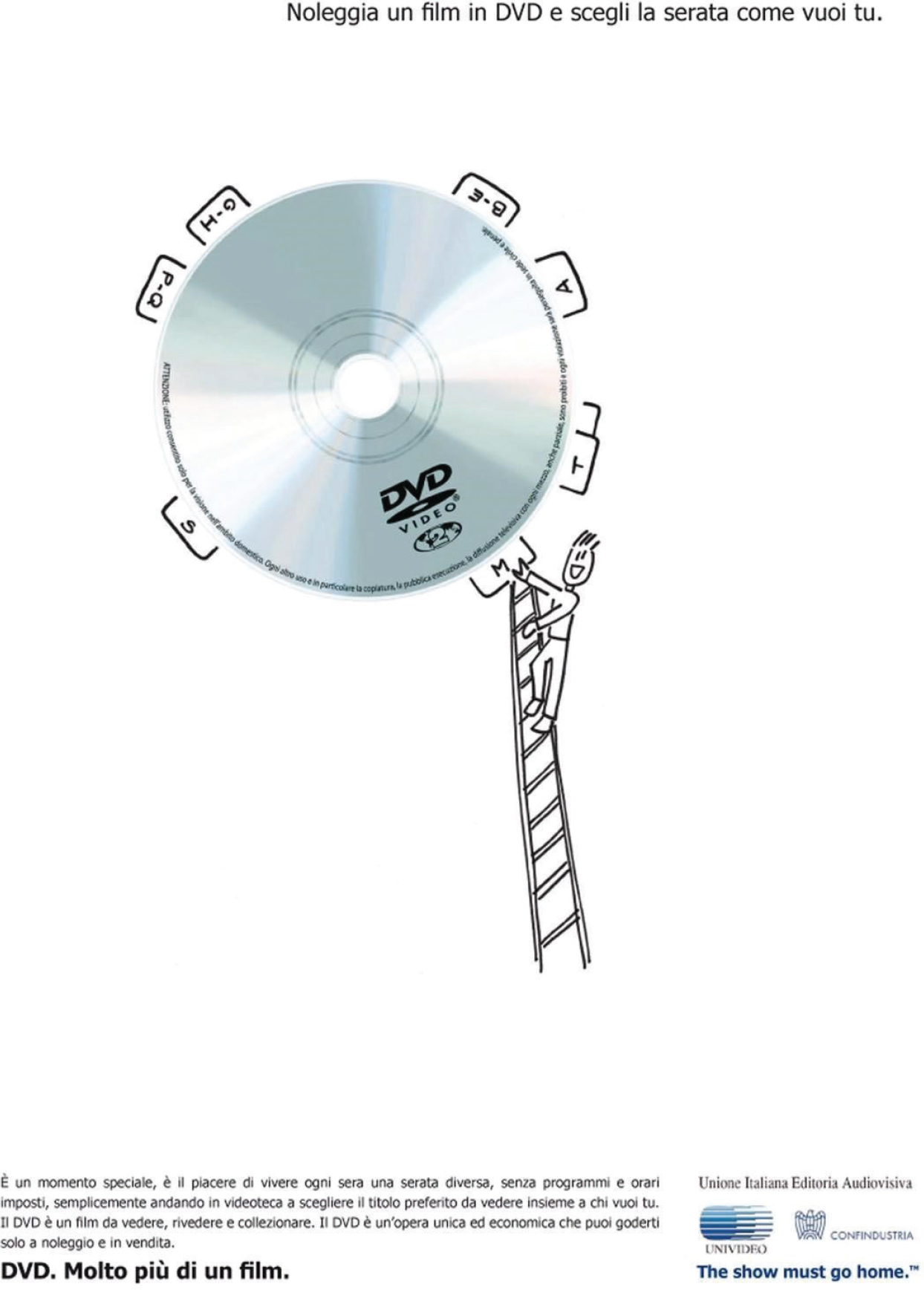
Figure 1
Promotional campaign “DVD. Much more than a movie,” promoted by Univideo (currently: Italian Agency for the Development of Audiovisual Publishing) in 2009.
On the one hand, the campaign clearly shows how cinema is literally ‘domesticated’ in the sense that technological innovations begin to make the home space comparable to that of the movie theatre, with the advantage of being able to enjoy the film more freely; on the other hand, it highlights how television, traditionally structured as a ‘flow industry,’ gradually begins to be reconfigured also and simultaneously as a ‘publishing industry.’1
2009 was the beginning of what we now know as ‘streaming television’ (YouTube was launched in 2005 and Netflix streaming service in 2007),2 but streaming was already widespread within digital piracy. In 2002, the famous peer-to-peer software eMule was launched; 2003 saw the emergence of The Pirate Bay, a hugely popular file-sharing website based on BitTorrent; and in 2005, Megaupload was launched, a file-hosting site that, together with linking sites, made it possible to stream video content. Early YouTube itself represented a remarkable blend of user-generated content and copyrighted material that audiences reworked or circulated without authorization. The issue of digital piracy is an unprecedented challenge to the audiovisual industry and the windows release system, and the early 2000s coincides with the phase of the toughest crackdown on all forms of file-sharing, realised through campaigns of criminalisation and legislative repression initiatives, epitomised by the infamous 2004 campaign, ‘Piracy. It’s a crime.’ In 2010, the promotional campaign for the DVD and the DVD edition resulting from the collective experiment of the Radiohead concert allowed us to make two observations that, at that time, we had not connected.3
Firstly, we interpreted the DVD of the concert (partly based on a voluntary passion, partly the result of specific professional skills) as a good example to consider in the attempt to conceive in a non-contradictory way the principles of authority and selection on the one hand, and those of participation and network on the other, without automatically associating the former with material support and the ‘formal’ circuit of distribution, and the latter with file sharing and ‘informal’ circulation practices.4 From our perspective, it meant distinguishing between two models of knowledge construction and circulation, the ‘archive model’ and the ‘network model,’ without establishing hierarchies and fostering interconnections.
The ‘archive model’ is finite, albeit expandable; it is organised based on relevance criteria; it carries out selections and hierarchies and proposes an order recognised as valid, although subject to renegotiation. ‘The condition for the archive,’ writes Jacques Derrida,5 is the ‘constitution of an instance and a place of authority (the archon, the archeion, often the State […])’:
Arkhē, we recall, names at once the commencement and the commandment. This name apparently coordinates two principles in one: the principle according to nature or history, there where things commence – physical, historical, or ontological principle – but also the principle according to the law, there where men and gods command, there where authority, social order are exercised, in this place from which order is given – nomological principle.6
The ‘archontic function’ or ‘archontic power’ is therefore topological (archons ‘ensure the physical security of what is deposited and of the substrate’7), nomological (archons ‘have the power to interpret the archives’8) and ‘of consignation,’ ‘that is, of gathering together’: ‘Consignation aims to coordinate a single corpus, in a system or a synchrony in which all the elements articulate the unity of an ideal configuration.’9
On the contrary, the ‘network model’ is inherently unfinished; it does not (in theory) carry out selections or hierarchies, nor does it organise (except partially and temporarily) since the user determines the relevance criteria during the process.
The two models can also be approached through the categories made popular by Henry Jenkins and labelled as ‘expert paradigm’ (from Peter Walsh) and ‘collective intelligence’ (from Pierre Lévy). The expert paradigm is based on a ‘bounded body of knowledge’10 that ‘creates an “exterior” and “interior”11 and establishes ‘rules about how you access and process information.’12 Conversely, collective intelligence is ‘disorderly, undisciplined, and unruly. […] Debates about the rules are part of the process.’13 It implies ‘open ended questions’14 and ‘assumes that each person has something to contribute’15 (no ‘credentialized’16 experts).
Secondly, the DVD campaign struck us for its emphasis on personalisation understood as ‘disintermediation,’17 that is the possibility of choice and control of the viewing experience in all its aspects: what to watch, when to watch it, with whom, and, especially for films, where. In retrospect, the personalisation of consumption thus represents a common thread connecting two ‘ages,’ that of the DVD and that of streaming, which in other respects show significant fractures and discontinuities.
In this article, I want to connect the relationship between the two models of the archive and the network with the common thread of personalisation to discuss the hypothesis that algorithmic personalisation, so typical of streaming television, removes (or replaces) the major collective problem of how a culture conceives the formation and transmission of knowledge (the tension between the archive model and the network model, between the paradigm of the expert and collective intelligence), reducing it (at least in large part and perhaps temporarily) to a matter of taste and individual choice to be ‘taken care of.’
2 Metaphors of the Archive and Digital Utopias
Employed in a more or less literal or metaphorical sense, the notion of archive has played a fundamental role in expressing the digital utopia of a revolutionary possibility of preserving and accessing culture. More precisely, all the different declinations or functions of the archive are variously (although not always explicitly) activated: preservation (associated with ideas of repository, depository, storage), classification or cataloguing (as an operation of selection, interpretation, and ordering, related to ideas of database, library, catalogue, collection), and that of ‘consignation’ (as a further operation of interpretation and associated with ideas of display, access). These three correlated functions guarantee the preservation, accessibility, and discoverability of a particular community’s culture and history, ultimately determining what history and culture should be preserved.
More than twenty years ago, Lev Manovich claimed that the logic of database, defined ‘as a structured collection of data […] on which the user can perform various operations: view, navigate, search,’ should be considered the ‘new symbolic form of a computer age.’18 He extensively reported ‘the dominance of database form in new media’,19 arguing that the Internet ‘can be thought of as one huge distributed media database.’20 In the era of streaming television, the Internet continues to be referred to as ‘a distribution channel and archive for a diverse range of content, scattered unevenly across hundreds of platforms and portals.’21
In 2004 Lawrence Lessig, a reference point in studies on non-commercial piracy, enthusiastically embraced the digital revolution by proclaiming that ‘for the first time since the Library of Alexandria, it is feasible to imagine constructing archives that hold all culture produced or distributed publicly,’22 and that the failure to adapt copyright law to technological changes was the only obstacle preventing ‘to preserve and assure universal access to this knowledge and culture.’23
In the following years, YouTube became a privileged site for theoretical reflections on the archive and is defined as a massive ‘unfiltered bottom-up cultural archive,’24 ‘an archive awaiting curators’ or a ‘digital Wunderkammer.’25 Robert Gehl leaves no doubt in defining YouTube as an archive based on its storage function (differently from peer-to-peer sharing programs, ‘there are central servers which hold the video content that users have uploaded’26) and affirming that the notion of archive is the most appropriate to locate YouTube in the digital media ecology: ‘Instead of contrasting this with television or film, we could discuss YouTube in terms of flows of people, much as they flow through any other library or collection.’27
YouTube becomes, above all, an opportunity to rethink the traditional model of the archive or, to use the terms mentioned in the introduction, to observe how the model of the archive hybridises with that of the network and collective intelligence. As Gehl observes,28 YouTube could be seen as serving a democratic, public good by providing a platform where the collective intelligence of large groups determines which media objects are preserved and how these objects are interpreted.
Just as digital media use the notion of archive to highlight their operating dynamics, the notion of archive is rethought in light of the push towards the network model that comes from digital media. ‘The control of content and the authorial voice of the institutional archive require contestation and reconfiguration,’ writes Simon Popple.29
One of the early volumes dedicated to ‘the Netflix effect’ precisely invokes studies on archives in the digital age to understand the criticisms directed towards ‘the idea of “on-demand utopia” and the Internet as an infinite archive.’30 For example, archivists are concerned that forms of ‘bottom-up’ curatorship may compromise the collective sense of historicity preserved by the traditional archive and favour forms of ‘commodification’ of artworks for individual use, and YouTube is the main polemical target:
The YouTube model is questioning the very raison d’étre of film archives and museums in their current form: every user becomes the curator of his or her own visual preferences in a growing collection put together by everyone with a computer. […] The curatorial principle is individual, idiosyncratic, and collective at the same time […] We – archives, museums, curators – believe ourselves to have authority over the ways in which moving pictures can be encountered, interpreted. […] This runs counter to the idea of consumption, where moving images become a commodity that is disseminated in the most convenient and economical wrapper, for instant, individual use.31
Similar concerns also emerge today in studies on the archive. Grazia Ingravalle, for example, highlights how the pushes towards democratisation of culture can turn into rhetorics that shift ‘the public attention from the often-invisible work of archival preservation as a whole (inextricably encompassing finding, identification, indexing, conservation, restoration, and exhibition) to access alone,’32 and warns against the dangers arising from the need for archives to ‘compete’, in the new media ecology, with ‘commercial video-sharing and streaming platforms such as YouTube, Vimeo, and Netflix’ (notice that they are never referred to as ‘archives’).33
Over the years, several studies have highlighted and deconstructed the commercial and profit implications and the rhetoric of democratisation regarding YouTube being considered an archive. Gehl, for example, already noted in 2009 a ‘tension between democratic storage and display for profit’34 and explains how, despite the functions of ‘storage’ and ‘classification’ performed voluntarily and non-commercially by collective intelligence, the execution of the ‘display’ function (i.e., the ‘exhibition’ of archived content outside of YouTube, on other websites) can generate significant profits for entrepreneurs and large media companies.
More recent studies have also sought more rigorous formulas to define the impact of the network model on the archive model, focusing, for example, on ‘born-digital archives’ as in Abigail De Kosnik’s book dedicated to Internet fan fiction archives defined as ‘rogue archives’ voluntary managed by ‘rogue memory workers’35 such as amateurs, fans, and pirates. De Kosnik’s work has two main objectives: firstly, to critique the general impression of the Internet as a vast archive, showing how the category of rogue archives is constructed based on more rigorous parameters that exclude sites like YouTube or Wikipedia; and secondly, to respond to the criticisms and fears of professional archivists by demonstrating all the ‘dedicated archival labor’ (referred to as ‘techno-volunteerism’36) that underlies rogue archives. The concept of rogue archives represents a radical contamination between the models of the archive and the network and, as De Kosnik crucially underlies, ‘there can be no “canon” of rogue digital archives […] such archives are intrinsically opposed to the very notion of canonicity.’37
3 Transactional Archives and the Power Through the Algorithm
In both the canonical form of the traditional archive associated with public institutions and the anti-canonical form of the digital, networked, and collaborative archive, the notion of archive retains a predominantly non-profit value (or at least free access for the end user), a service function for a community, and the mission to safeguard memory and provide access to cultural heritage in its broadest sense.
In the era of streaming television, however, the notion of archive prominently enters the cycle of commercial exploitation of cultural products, and what is being sold is precisely (though in some cases not exclusively) the archive or, more accurately, the experience of accessing an archive. Unlike TVOD (Transactional Video On Demand) services, which, in continuity with traditional forms of distribution, offer the purchase or rental of single items of music, film, and television, SVOD (Subscription Video On Demand) services precisely ‘build and sell access to a library. They succeed when users derive value from the library rather than from transacting particular goods.’38
In some cases, commercial aims have been a critical element for contesting the application of the notion of archive to streaming services. ‘The problem with the library metaphor for Netflix,’ writes for instance Sudeep Sharma, ‘is that it assumes the service has some larger interest beyond commercial needs.’39 Conversely, ‘unlike a library or another non-profit entity, which maintains collections and material on the basis of scholarly need or historic purpose, Netflix’s choices are driven by commercial needs.’40
Several scholars have also explicitly linked the issue of profit to the ethical, political, and cultural question of content ‘discoverability,’ defined as a specific type of ‘media power.’ Contrary to the proclamations of democratisation, disintermediation, and freedom of choice, streaming services implement multiple strategies to ‘actively attempt to guide how and when users discover content’:41 ‘These platforms provide a dynamically unfolding, personalised architecture of choice […] – importantly, one whose orientation toward profit is distinct from the public service mission of a library – within which users discover content.’42
Alexa Scarlata and Ramon Lobato have explicitly highlighted how the ‘complex amalgam of discovery mechanisms that interact to serve particular commercial objectives’43 is far from ‘neutral’ and corresponds to a ‘specific logic of inclusion/exclusion’ that clearly illustrates ‘the gatekeeping functions of digital services.’44 They further argue the importance of carefully considering whether and how ‘these discovery environments require a policy response’45 (see, for example, the prominence obligations established by the 2018 EU revised AVMSD).
In an article widely used to analyse the self-representation that Netflix provides of its own algorithmic recommendation system, Carlos Gomez-Uribe and Neil Hunt46 do not remove the commercial dimension of the recommendation system, nor do they deny that recommendation systems play a pivotal role in a business plan that, at least until the introduction of ads, was based on the constant growth of the customer base. They explain that recommender systems increase audience engagement and reduce subscription cancellation rates when produced and used correctly. However, the commercial value of recommendations seems to be subordinate to the more general and unselfish aim of providing social and cultural benefits.
Over the last two decades, SVOD has emerged as the most appropriate answer to the needs of the so-called ‘on-demand culture,’47 or, in other words, the consumer’s appetite for access when I want it, how I want it, where I want it. ‘The tension between transactional and subscription services – or download-to-own versus streaming’ commented Michael Gubbins in 2014 ‘may prove as significant for film as it has been for music, where most analysts see a clear shift, particularly among younger audiences, from ownership to access.’48 Given the offering of ‘access rather than ownership at a low cost’,49 the idea of ‘archive’ has also proven to be a key concept in interpreting streaming services. In his pivotal book about on-demand culture, for instance, Chuck Tryon precisely refers to SVOD services like Netflix as ‘archives of videos available for streaming.’50
The most prominent issue in discussions about streaming television that has directly concerned the notion of archive has been the one centred on algorithmic recommendations and personalisation.
In 2013, David Beer and Roger Burrows defined services like iTunes, Spotify, Amazon and the BBC iPlayer as ‘transactional archives.’ The term transactional is not defined, as it is in TVOD services, as a traditional business model based on the user’s single payments to access content through purchase or rental. In this case, the term transactional serves to define archives that have both a ‘visible’ dimension – they ‘contain materials that can be searched and purchased, viewed or streamed from the source’51 – and an ‘invisible’ dimension composed of ‘data about the transactions that occur’:52 transactional archives are commercial archives in the sense that ‘they are responsible for generating a kind of back-end archive about users as data is generated through acts of consumption and is captured for harvesting by commercial organisations.’53 In other words, ‘the transactional archive is a site of circulation of cultural information instantiated in performative consumer activity’:54 The ability to capitalise on the data produced by every user behaviour and minor interaction, collected in users’ profiles and used to record tastes and preferences and to operate predictive analytics and automated recommendations of accurately classified content, can be referred to as ‘power through the algorithm.’55
4 ‘Power’ Disguised as ‘Assistance’: Netflix and the Critique of Algorithmic Culture
What Netflix’s rhetoric has sought to do is transform ‘power through the algorithm’ into ‘assistance through the algorithm,’ as if the algorithm were not a tool for exercising power but, on the contrary, the condition through which consumers can free themselves from ‘power,’ that is, from editorial and commercial logics, enjoying culture in a free and autonomous manner. ‘Humans’, Gomez-Uribe and Hunt claim, ‘are facing an increasing number of choices in every aspect of their lives,’56 but they ‘are surprisingly bad at choosing between many options.’57 These limitations can generate frustrations as the possibilities for choice expand and/or result in inappropriate decisions, if not in the impossibility of choosing, a situation that John Ellis has labelled as ‘choice fatigue’58 and Gubbins later as ‘illusion of choice.’59
Democratization and disintermediation are other rhetorical strategies adopted by Netflix to justify the benefits of algorithms. In this respect, recommender systems are conceived as a tool for the democratization of culture. Gomez-Uribe and Hunt write:
Personalization enables us to find an audience even for relatively niche videos that would not make sense for broadcast TV models. […] Recommender systems can democratise access to long-tail products, services, and information, because machines have a better ability to learn from vastly bigger data pools than expert humans.60
The opposition between ‘machine agency’ and ‘human agency’ is the third element of Netflix’s rhetorical strategy. This strategy emphasises the efficiency, objectivity, and technological ‘neutrality’ of machine agency. It removes all the economic and industrial implications that contribute to shaping the algorithmically composed interfaces and omits the role of meta-data programmers and the underlying classification system.
This rhetoric of personalisation and democratisation has been vigorously scrutinised and criticised. Twenty years ago, in a contribution analysing how ‘changes in television’s technology and cultural form’61 have transformed, rather than removed, the idea of flow originally elaborated by Raymond Williams,62 William Uricchio focused on the most recent of these transformations, which derived from the ‘application of metadata systems and filtering technologies to the process of program selection.’63 Uricchio defines this ‘new, technologically ordered concept of flow’64 as ‘a never-ending stream of custom-tailored pleasure’65 or, more precisely, ‘a steady stream of programming designed to stay in touch with our changing rhythms and moods, selected and accessible with no effort on our part, anticipating our every interest and nearly infinite in its capacities.’66 Uricchio ends his essay by drawing our attention to the role that metadata and filtering technologies, or recommendation systems, will play in the future. Uricchio focuses on the human component of this new technological or algorithmic flow, namely meta-data programmers and protocols. ‘Neither of these factors are neutral,’ he writes:
Metadata protocols, much like a catalog in an archive or index in a book, determine how we conceptualise program categories and what texts we will be able to locate. Consequently, there is a great deal at stake for both producers and viewers in terms of precisely what will be labeled and how, and thus what will be seen.67
The notion of archive is fundamental in this passage and directly relates to the Derridean distinction between ‘archiving’ and ‘archivable,’ that is, to the fact that ‘the archivization produces as much as it records the event.’68 In other words:
The archive […] is not only the place for stocking and for conserving an archivable content of the past which would exist in any case […]. No, the technical structure of the archiving archive also determines the structure of the archivable content even in its very coming into existence and in its relationship to the future.69
The fact that the act of archiving is also, and at the same time, a determination of what is archivable makes the issue of the archive, for Derrida, ‘the question of the future itself’70 and raises the problem of ‘responsibility for tomorrow,’71 because ‘what is no longer archived in the same way is no longer lived in the same way.’72Uricchio also grasps the ethical and epistemological challenge (in the sense of knowledge construction) of the new filtering technologies. ‘Who will determine metadata protocols?’ he asks. ‘How will program forms be conceptualised, categorised, and articulated? How will information and access be structured?’
Uricchio’s analysis was forward-looking. In recent years, similar concerns have been expressed through the idea of data-driven ‘algorithmic culture,’ where ‘human beings have been delegating the work of culture – the sorting, classifying and hierarchising of people, places, objects and ideas – to data-intensive computational process.’73 This passage by Ted Striphas is extraordinary because, although it does not directly mention the notion of archive, it is in fact to archival work itself that it relates ‘the work of culture’ in its entirety and complexity, precisely ‘the sorting, classifying and hierarchising of people, places, objects and ideas’. Indeed, Striphas remarks, ‘culture as authoritative principle is […] chiefly operative in and around algorithmic culture.’74 Scott Kushner75 and Tarleton Gillespie also reflected on the new algorithmic culture, with the latter arguing that our reliance on ‘algorithms to identify what we need to know is as momentous as having relied on credentialed experts, the scientific method, common sense, or the word of God.’76
5 All About Me. Netflix and the Replacement of Archival Caretaking
The delegation of cultural work to algorithmic data processing needs to be appropriately defined so as to differentiate streaming platforms from both traditional archives and open, collaborative archives impacted by digital media. In this respect, Patrick Vonderau introduced the idea of ‘content aggregators.’ Aggregation, Vonderau explains,
[s]tands for a techno-social trend that combines an ever-expanding scope of culture […] with new systems to sort, aggregate and filter. […] As a business operation, aggregation connects traditional institutional ideas of aggregation – think of the ‘library’ or ‘catalogue’ metaphors used to explain online services – to the promise of new media – and particularly the promise of personalised access to content.77
MJ Robinson also uses the term aggregation but takes it a step further by arguing that processes of ‘aggregation’ are often falsely presented as ‘curation,’ in the sense that the notion of aggregation is precisely defined as ‘machine-based algorithmic choice masquerading as human input, agency, or discernment.’78 Human agency and evaluation are indeed the two elements that distinguish aggregation from curation, which ‘relies upon expertise and connoisseurship – an understanding of the criteria by which a collection is being assembled – because ultimately the role of the curator is to impart value through contextualisation.’79 Robinson concludes that we should replace the term ‘curatorial’ most often used for streaming services with the term ‘choosetorial,’ which precisely ‘refers to giving audiences the power to make “choices” from a pre-curated or gatekept selection of items.’80
The prominent place for exercising the reintermediation ‘choosetorial’ functions is the interface, algorithmically structured and personalised. Starting from the relevance assigned by Manovich to the notion of ‘cultural interface’81 to understand the impact of new media, numerous studies have investigated how the interface communicates its functions to the user and shapes the latter’s behaviour, with particular attention to designed action patterns and the possible deviations from them, how the interface determines the discoverability of content, and how to account for its high instability (or ephemerality) both over time (diachronic dimension) and from one user or device to another (synchronic dimension).82
Furthermore, recent qualitative empirical studies have sought to investigate how users experience the interface in consumption practices, navigate its components, and perceive recommendation systems and their impact on their autonomy of taste and choice.83 More particularly, the results of an empirical research conducted in Italy in the autumn of 2019 with a panel of 60 Netflix users84 confirmed the hypothesis that, in streaming aggregators, the tension between the archive model and the network model characteristic of digital media is replaced by algorithmic personalisation, and that the ‘choosetorial’ function may be described as a shift in curatorial activity from content to the users.
The research suggested to divide into two main groups the categories used by Netflix to organise, present, and suggest its content: combinatory and relational categories. On the one hand, simple and complex ‘combinatory’ categories (depending on whether they are composed of one element or more) result from the juxtaposition between film and TV genres and other elements (such as the emotional dimension, character features, themes, the content’s reference target, geographic origin, critical appraisal and so on) and convey the effect of a rich, tailored, and comfortable environment. This first group of categories (including for instance labels like ‘Procedural TV Dramas,’ ‘Documentaries,’ ‘British Movies & TV’ or ‘Critically Acclaimed Bingeworthy TV Dramas’) primarily comes from classification systems historically associated with a traditional idea of archive (Figure 2).
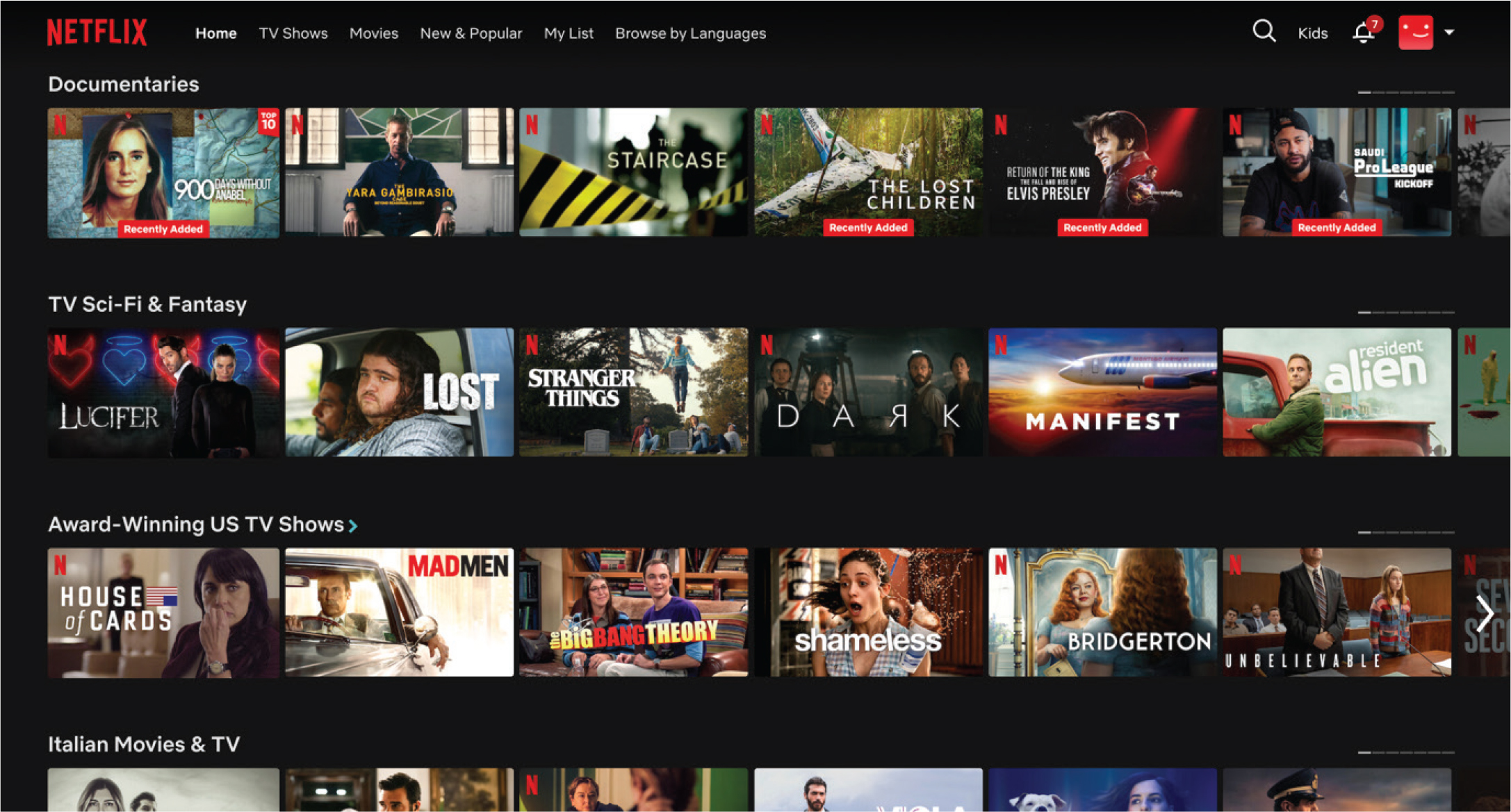
Figure 2
Some examples of ‘combinatory’ categories (Netflix, desktop interface, November 2024).
On the other hand, a second group of innovative categories, which we can define as ‘relational categories,’ use as leverage the context of usage and enhance a relationship with the platform based on proximity, knowledge, and sharing that the user can trust and rely on. This group includes all the categories that provide temporal references (‘Recently added’, ‘Trending now’, ‘Watch in one weekend’, etc.) and directly address a simulacrum (‘Top picks for… ,’ ‘Gems for you,’ ‘Because you watched…,’ etc.) (Figure 3). These categories foster a sense of belonging to a community centered around shared tastes and trends while simultaneously highlighting the uniqueness and individuality of each subscriber by informally addressing them through their avatars’ nicknames.
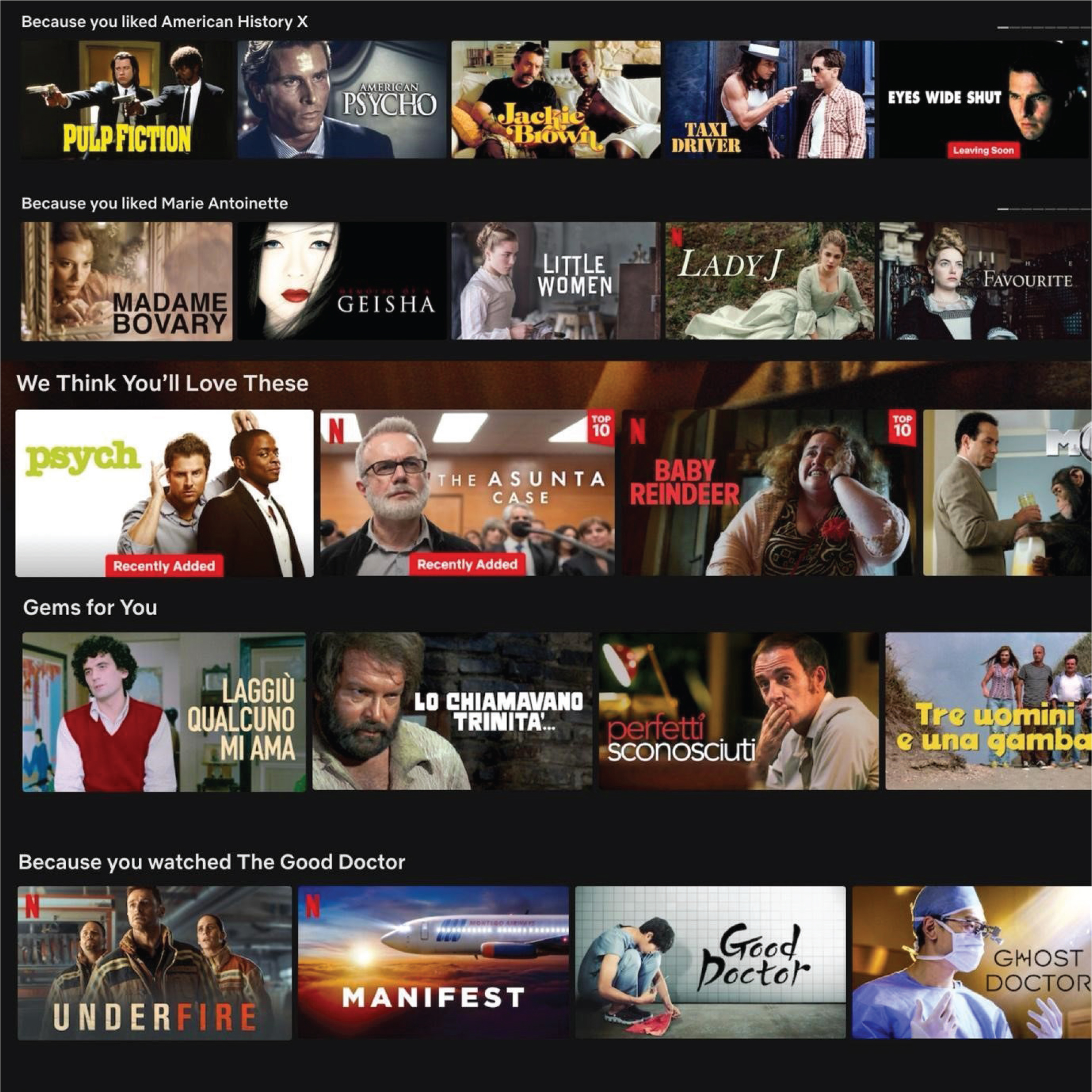
Figure 3
Some examples of ‘relational categories’ (Netflix, desktop interface, May 2024).
No other streaming service has dedicated such a significant effort to refining these relational categories and enhancing their effect to the extent that it renders the functioning of combinatory categories entirely subordinate. Combinatory categories work precisely by becoming invisible, with only the recommended content that matters ‘for me.’ Netflix creates the illusion of dialogue and conceals the automation by using the informal ‘you’ and the nickname of their avatar with their subscribers. The platform’s advice can be trusted precisely because it knows its users (or, at least, such is their perception). As also Jonathan Cohn underlines,
[r]ather than present their recommendations as curated by experts, many sites like Netflix and Amazon present their recommendations without any sign of how generally well liked or esteemed the items are. Instead, they just announce that the site thinks ‘you’ specifically would like them […]. It is all about ‘you’ as an individual.85
This is confirmed by the research conducted with Italian users. One for instance observed: ‘I don’t like unoriginal content and Netflix really helps find more unusual stuff. It’s not easy to get my “genre.”’86 The recurrence of the expression ‘my genre’ to indicate ‘my kind of thing’ is emblematic of how algorithmic personalisation, which replaces curation based on collective, recognised, and certified criteria, tends to attenuate the criterion of genre as a system of collective and codified expectations and instead highlights genre as an expression of identity and personal and individual tastes.
The resulting feeling is that Netflix precisely knows me and my tastes (Netflix is a competent subject) and that it takes care of me (Netflix is a caring subject). This is precisely the main point: the curatorial or ‘caretaking’ activity of the aggregator shifts from content to consumers, from criteria of selection, classification, and presentation of content to the effectiveness and attentiveness of automated processes masked as ‘caregiving’ practices and user assistance. In this way, the primary collective issue of transformations in cultural work (algorithmic culture) and how a culture conceives the formation and transmission of knowledge (the tension between the archive model and the network model, between the paradigm of the expert and collective intelligence) is removed, or reduced to a matter of taste and individual choice.
Observations of consumers’ practices confirm these hypotheses. Users rarely pay attention to the specific denomination of the categories, therefore to the criteria at the basis of ‘archiving’ and ‘archivable’ (Derrida), to what is labeled and how, and thus what is discoverable and seen (Uricchio). Focusing almost exclusively on the content and showing a general appreciation of the recommender system, users feel comfortable in a trusted environment where they feel they are being cared for.
6 The Archival Work of Culture in Informal Streaming Portals
The hegemonic position of Netflix, which drives this shift from content curation practices to individual user caretaking practices, does not exclude the possibility that the streaming television landscape also presents different curatorial strategies, albeit minority ones, and trends towards the collective dimension of consumption. For example, the practice and philosophy of a service like MUBI have been interpreted as ‘renewed emphasis on curation […], consciously replicating the long-standing practices of repertory theatrical exhibitors.’87
At the same time, non-linear television shows an intense and persistent tension towards collective and synchronised usage, although expressed in innovative forms compared to linear television. In addition to top-down and bottom-up practices that coexist outside the platforms (both online and offline) in building multiple senses of community and favouring the alignment on the trends and ‘must-sees’ of the moment, relational categories don’t just consolidate the Netflix-user relationship and perform user care activities. As mentioned above, they also refer to proximity, temporal sharing, collective wait (‘Coming next week,’ ‘Worth the wait’) and emphasise the users’ belonging to broader communities of tastes and trends (‘Popular on Netflix’) (Figure 4).
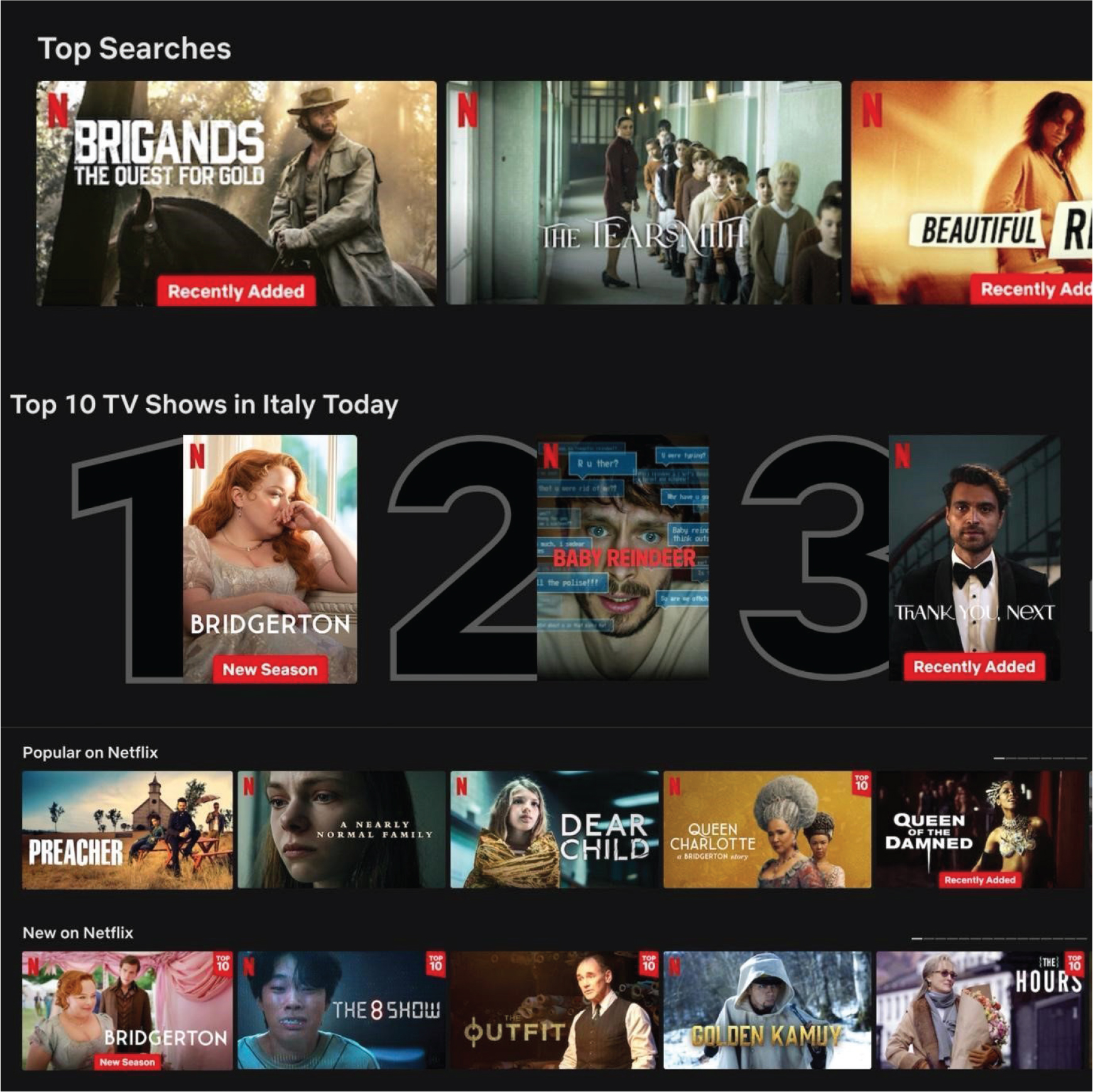
Figure 4
The collective dimension of ‘relational categories’ (Netflix, desktop interface, May 2024).
Taking all of this into account, I suggest that it’s in the grey zone of digital ‘piracies’ and informal circulation where the work of culture as archival work and the tension between the archive model and the network model are active and productive, and a ‘curatorial’ impulse on the part of viewers emerges as a ‘collective archival activity’88 that creates catalogues shared by communities.
The classical idea of the archive has historical relevance in piracy studies. In his impressive volume on piracy, for example, Adrian Johns conceives a form of ‘moral piracy’ associated with opera and jazz buffs. This piracy is not defined based on the ‘gift economy’ idea and the absence of profit but rather on the goal of remedying the shortcomings of cultural industries, preserving artistic heritage, and ‘furnishing a public archive of classics.’89
At the same time, the classical idea of the archive can only be challenged by and contaminated with the network model in the plural practices of digital piracy. ‘The Internet Archive is a sharing economy,’ writes for instance Lessig in Remix,90 and in another fundamental book, Shadow Economies of Cinema, Lobato describes ‘how pirate circuits can also be networks for film preservation and archiving’91 and claims that piracy performs ‘archival functions.’92 ‘Informal’, ‘pirate’ or ‘rogue’ archives compel us to question and renegotiate the ideas of ‘archiving’ and ‘archivable,’ challenging the archive model without relinquishing the principle of authority but redefining it and proposing decentralised, open-ended, and collaborative forms of classification and quality control (network model).
Archival responsibility was widespread in sharing economies before the advent of streaming television, as demonstrated by two Italian cases in the 2000s. The guidelines provided in 2008 to use the AngelMule forum claimed that the forum’s main goal was to collect and catalogue the thousands of files available on the eMule network (Figure 5). The cataloguing process produced very detailed files presenting every movie and providing technical information about the available version. The forums also served to promote and guide film consumption through specific sections like ‘Filmography’ or ‘Reviews,’ while at the same time proving self-awareness about their activity and its implications through sections like ‘News from the file sharing universe.’
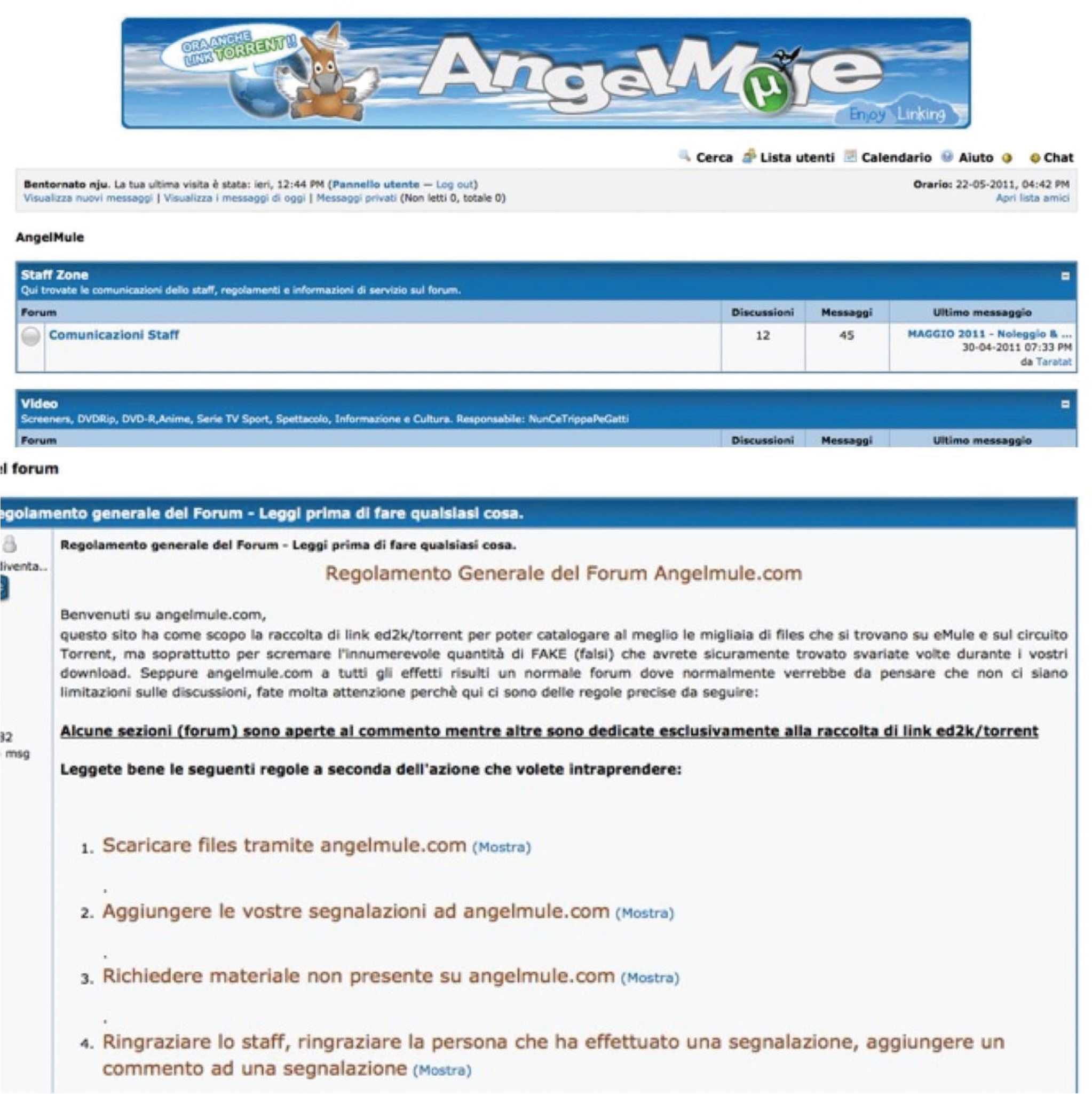
Figure 5
AngelMule, ‘General guidelines,’ 2008 (screenshot 2011).
Furthermore, file-sharing communities like TNT Village proposed a model of ‘ethical sharing’ (Figure 6), claiming that there was an ‘essential and urgent need’ for a ‘substantial reformulation of the copyright law,’ based on the belief that ‘the long duration of the rights’ protection was a hindrance to culture and the spreading of knowledge.’ In this respect, ‘ethical sharing’ was file sharing with a few self-imposed restrictions. As the Statute (published in 2005) claims, ‘It is strictly forbidden to publish torrent files related to: […] Music more recent than 12 months since its release date. Movies, Anime & Cartoons more recent than 12 months since the release date in the same language of the shared files.’93
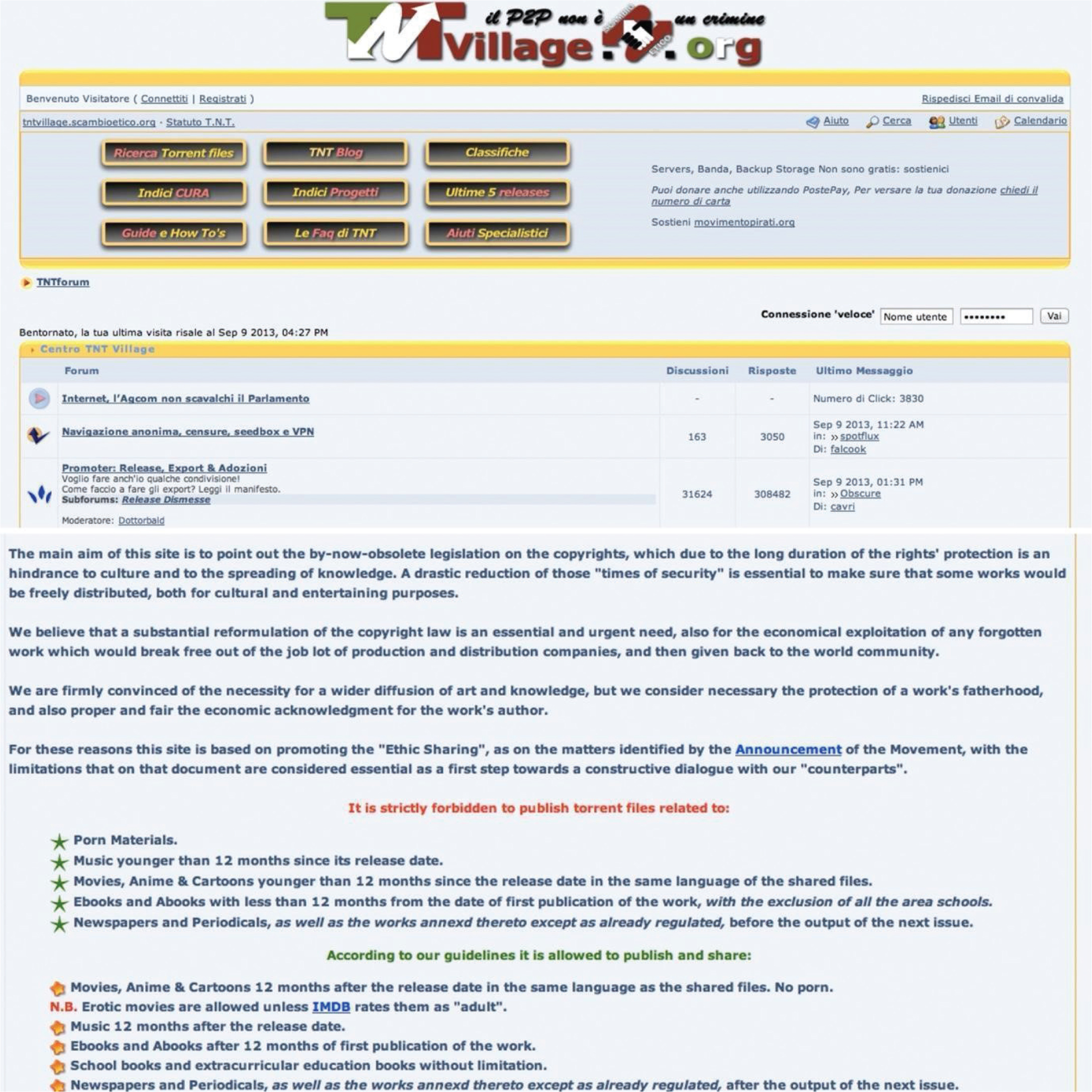
Figure 6
TNT Village, ‘Statute,’ 2013.
The spread of streaming television has significantly reconfigured this scenario, reducing and altering the role of piracy and diverting the attention of public debate and academic research. Consequently, curatorial functions and forms of ethical sharing in contemporary informal practices of circulation and consumption remain largely underexplored. Yet, archival and curatorial collaborative practices in ‘pirate’ forums and streaming portals represent an essential alternative to the ‘choosetorial’ functions of platforms like Netflix and a significant site for observing the tension between the archive and network models in the contemporary scenario.
Without custom-tailored interfaces and personalised recommendations (although recommendations based on popularity and heterogeneous forms of content similarity can be found), unauthorised forums and streaming portals are not ‘transactional archives’ since they do not rely on user profiles’ data. Informal services are more interested in allowing their users to dig into the catalogue and provide very detailed search interfaces that meet the needs of the autonomous viewer who wants to access specific content, and largely differ from how Netflix builds the search experience around algorithms so as to recommend titles for a given query as alternative results for a failed search. Furthermore, in contrast to Netflix’s decision to remove all user reviews from their website,94 informal platforms emphasise human recommendations more (Figure 7). Closely linked to comment and discussion activities, informal platforms have an inherent human, relational component (where content is also a medium for interaction) that characterises their archival nature and differentiates them from the simulated and automated Netflix-user relationship.
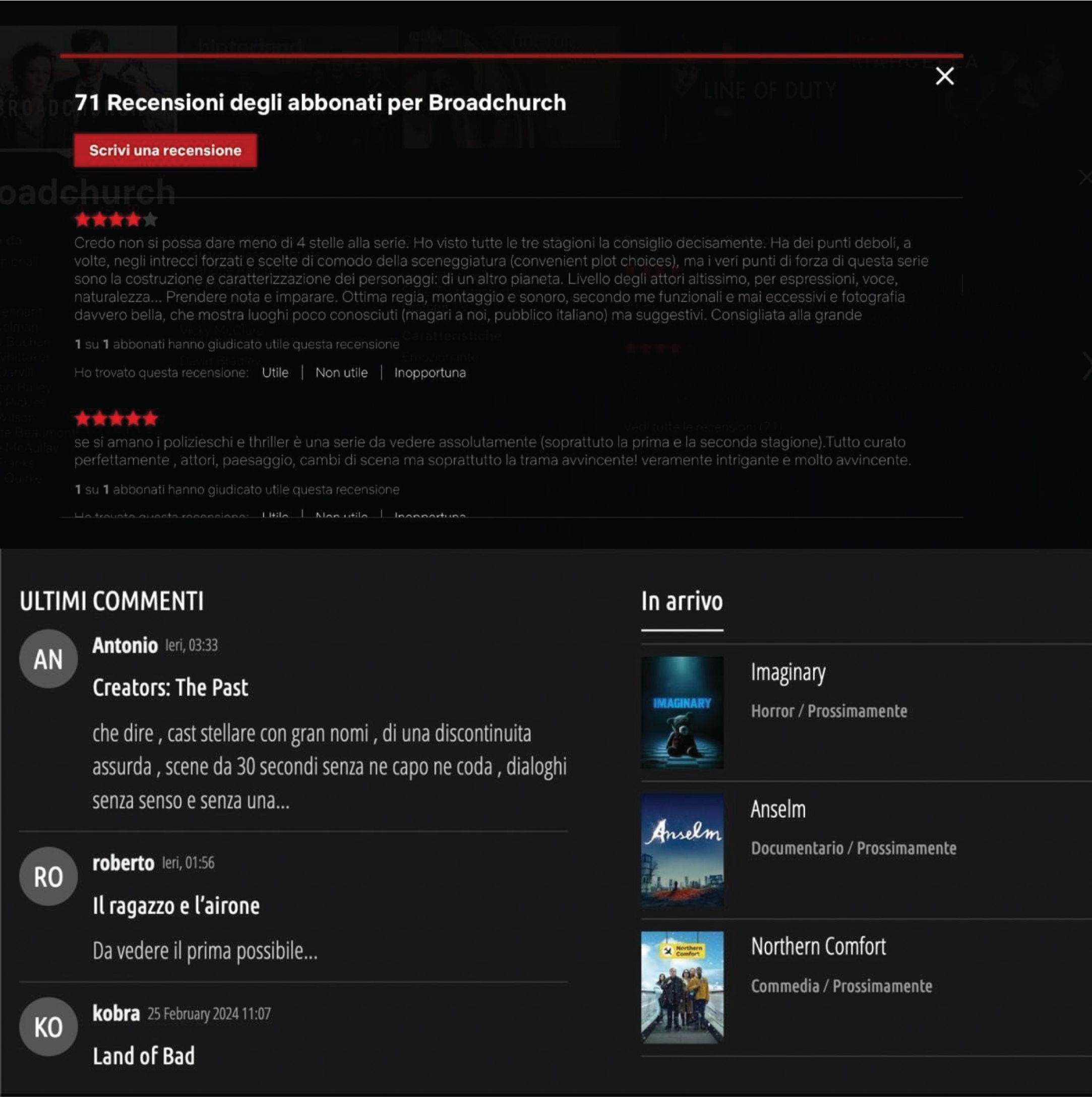
Figure 7
Subscribers’ reviews on Netflix (July 2018) and last comments on the informal portal Altadefinizione (March 2024).
7 Conclusion
In this essay, I have critically examined how the concepts of archive and curation – or caretaking – along with related notions such as repository, library, and catalogue, have been used to interpret the impact of digital media on the circulation of audiovisual products. At the same time, I have explored how these concepts have been redefined through their interaction with digital media. I then turned my attention to how the models of archive and network, as well as the idea of curation, are not merely reinterpreted but more fundamentally delegitimised and replaced by algorithmic personalisation in formal streaming platforms like Netflix. By shifting the function of ‘caretaking’ from content to the user – or at least creating the impression of such a shift – Netflix significantly alters, and arguably invalidates, the theoretical discourse on culture as ‘archival work.’
Finally, I have demonstrated that research on hybrid forms combining the archive and network models remains productive, particularly in examining portals where personalisation is absent and instead supplanted by ‘multi-user, collaborative forms of archival practices,’95 as observed in informal forums and streaming portals.
Although the spread of streaming media and the hegemonic role of Netflix have largely shifted public debate and academic focus away from curatorial practices and ethical forms of sharing in contemporary informal circulation and consumption, informal forums and streaming portals remain a crucial alternative to the ‘choosetorial’ functions of platforms like Netflix. They also serve as an important space for examining the tension between archival and network models.
In conclusion, I argue that the dialectic between formal and informal practices, and between the archive and network models, represents a vital area of inquiry for the study of streaming media that still deserves to be thoroughly scrutinised. This line of research is crucial because it engages directly with the fundamental work of culture as archival work: ‘The sorting, classifying, and hierarchising of people, places, objects, and ideas.’ Reclaiming this dialectic enables us to critically interrogate the evolving mechanisms of cultural mediation, access to culture and preservation in the digital age.
Notes
[1] See: Derek Kompare, “Publishing Flow: DVD Box Sets and the Reconception of Television”, Television & New Media 7, no. 4 (2006): 335-360; Amanda D. Lotz, The Television Will Be Revolutionized (New York & London: New York University Press, 2014).
[2] Stuart Cunningham and Jon Silver, Screen Distribution and the New King Kongs of the Online World (London: Palgrave Macmillan, 2013).
[3] Leonardo Quaresima, Valentina Re, “Il DVD e la logica dell’ambivalenza” [The DVD and the logic of ambivalence] and “Fatevi il vostro Antonioni da soli. Il DVD, l’archivio e la rete” [Make your own Antonioni by yourself. The DVD, the archive, and the internet], in Play the Movie. Il DVD e le nuove forme dell’esperienza audiovisiva [The DVD and the new forms of audiovisual experience], eds. Leonardo Quaresima and Valentina Re (Torino: Kaplan, 2010), 7-13 and 162-173.
[4] Ramon Lobato, Shadow Economies of Cinema (London: BFI-Palgrave, 2012); Ramon Lobato and Julian Thomas, The Informal Media Economy (Cambridge and Malden: Polity Press, 2015).
[5] Jacques Derrida, “Preghiera da inserire” [Prayer to insert], in Mal d’archivio. Un’impressione freudiana [Archive Fever. A Freudian Impression] (Napoli: Filema, 1995/2005), 1, my translation.
[6] Jacques Derrida, Archive Fever. A Freudian impression (Chicago and London: The University of Chicago Press, 1996), 1.
[17] Dina Iordanova and Stuart Cunningham, eds., Digital Disruption: Cinema Moves On-line (St. Andrews: St. Andrews Film Studies, 2012).
[21] Ramon Lobato, Netflix Nations: The Geography of Digital Distribution (New York: New York University Press, 2019).
[24] Jean Burgess and Joshua Green, YouTube: Online Video and Participatory Culture (Cambridge and Malden, MA: Polity Press, 2009), 88.
[25] Robert Gehl, “YouTube as Archive. Who Will Curate This Digital Wunderkammer?”, International Journal of Cultural Studies 12, no. 1 (2009): 45.
[29] Simon Popple, “The New Reithians: Pararchive and Citizen Animateurs in the BBC Digital Archive”, Convergence 21, no. 1 (2015): 134.
[30] Neta Alexander, “Catered to Your Future Self: Netflix’s ‘Predictive Personalization’ and the Mathematization of Taste”, in The Netflix Effect, eds. Kevin McDonald and Daniel Smith-Rowsey (New York and London: Bloomsbury, 2016), 95, note 22.
[31] Paolo Cherchi Usai, David Francis, Alexander Horwath, and Michael Loebenstein, eds., Film Curatorship: Archives, Museums, and the Digital Marketplace (Wien: Synema, 2008), 214-215.
[32] Grazia Ingravalle, Archival Film Curatorship (Amsterdam: Amsterdam University Press, 2024), 19-20.
[35] Abigail De Kosnik, Rogue Archives. Digital Cultural Memory and Media Fandom (Cambridge, MA: The MIT Press, 2016), 2.
[37] Ibid., 18. Similarly, in relation to Indian cinema, Kuhu Tanvir has highlighted how pirate archives challenge institutional archives, official film history, and their ‘canons.’ See Kuhu Tanvir, “Pirate Histories: Rethinking the Indian Film Archive”, BioScope 4, no. 2 (2013): 131.
[38] Daniel Herbert, Amanda D. Lotz, and Lee Marshall, “Approaching Media Industries Comparatively: A Case Study of Streaming”, International Journal of Cultural Studies 22, no. 3 (2018): 8; see also Terje Colbjørnsen, “The Streaming Network: Conceptualizing Distribution Economy, Technology, and Power in Streaming Media Services”, Convergence 27, no. 5 (2021): 1264-1287.
[41] Fenwick McKelvey and Robert Hunt, “Discoverability: Toward a Definition of Content Discovery Through Platforms”, Social Media + Society 5, no. 1 (2019): 2.
[43] Ramon Lobato and Alexa Scarlata, “Regulating Discoverability in Subscription Video-on-Demand Services”, in Digital Platform Regulation, eds. Terry Flew and Fiona R. Martin (Cham: Palgrave Macmillano, 2022), 211.
[44] Ramon Lobato, “On Discoverability”, Flow, 29 May, 2018.
[45] Lobato and Scarlata, “Regulating Discoverability in Subscription Video-on-Demand Services”: 210.
[46] Carlos A. Gomez-Uribe and Neil Hunt, “The Netflix Recommender System: Algorithms, Business Value, and Innovation”, ACM Trans. Manage. Inf. Syst. 6, no. 4 (2015): 1-19.
[47] Chuck Tryon, On-Demand Culture: Digital Delivery and the Future of Movies (New Brunswick NJ: Rutgers University Press, 2013).
[48] Michael Gubbins, Audience in the Mind, report commissioned by Cine-Regio, 2014, 69.
[51] David Beer and Roger Burrows, “Popular Culture, Digital Archives and the New Social Life of Data”, Theory, Culture & Society 30, no. 4 (2013): 52.
[55] Ibid., p. 61. See also Scott Lash, “Power After Hegemony: Cultural Studies in Mutation?”, Theory, Culture & Society 24, no. 3 (2007): 55-78.
[58] John Ellis, Seeing Things: Television in the Age of Uncertainty (London and New York: I.B.Tauris, 2000), 171.
[59] Gubbins, Audience in the Mind: 78.
[61] William Uricchio, “Television’s Next Generation: Technology/Interface Culture/Flow”, in Television after TV, eds. Lynn Spigel and Jan Olsson (Durham and London: Duke University Press, 2004), 177.
[62] See Raymond Williams, Television. Technology and Cultural Form (London and New York: Routledge, 2003, or. ed. 1974).
[66] Ibid., 177. I have already applied to Netflix Uricchio’s notion of ‘never-ending stream of custom-tailored pleasure’ in ‘Médias en streaming et plateformes VOD: reconsidérer l’idée de flux’ [Streaming media and VOD platforms: Reconsidering the idea of flow], in Formes et plateformes de la télévision à l’ère du numérique [Forms and platforms of television in the digital age], ed. Marta Boni (Rennes: PUR, 2020), 76-93.
[73] Ted Striphas, “Algorithmic Culture”, European Journal of Cultural Studies 18, no. 4-5 (2015): 396.
[75] Scott Kushner, “The Freelance Translation Machine: Algorithmic Culture and the Invisible Industry”, New Media and Society 15, no. 8 (2013): 1241-1258.
[76] Tarleton Gillespie, “The Relevance of Algorithms”, in Media Technologies: Essays on Communication, Materiality, and Society, eds. Tarleton Gillespie, Pablo J. Boczkowski and Kirsten A. Foot (Cambridge MA: The MIT Press, 2014), 168.
[77] Patrick Vonderau, “The Politics of Content Aggregation”, Television & New Media 16, no. 8 (2014): 4-5.
[78] MJ Robinson, Television on Demand. Curatorial Culture and the Transformation of TV (New York and London: Bloomsbury, 2017).
[82] See at least: Daniel Chamberlain, “Television Interfaces”, Journal of Popular Film and Television 38, no. 2 (2010): 84-88; Catherine Johnson, “Beyond Catch-Up: VoD Interfaces, ITV Hub and the Repositioning of Television Online”, Critical Studies in Television 12, no. 2 (2017): 121-138; Lobato, Netflix Nations; David Hesmondhalgh and Amanda D. Lotz, “Video Screen Interfaces as New Sites of Media Circulation Power”, International Journal of Communication 14 (2020): 386-409.
[83] See for instance: Daniela Varela and Anne Kaun, “The Netflix Experience: A User-Focused Approach to the Netflix Recommendation Algorithm”, in Netflix at the Nexus: Content, Practice, and Production in the Age of Streaming Television, eds. Theo Plothe and Amber M. Buck (New York: Peter Lang, 2019), 197-211; Mattias Frey, Netflix Recommends: Algorithms, Film Choice, and the History of Taste (Oakland: University of California Press, 2021); Marika Lüders and Vilde Schanke Sundet, “Conceptualizing the Experiential Affordances of Watching Online TV”, Television & New Media 23, no. 4 (2021): 335-351; Valentina Re, “Netflix all’italiana: The Netflix experience as narrated by Italian users”, The Italianist 42, no. 2 (2022): 1-14.
[84] The methodology and key findings of the research are described in Valentina Re, “Netflix all’italiana: The Netflix Experience as Narrated by Italian Users”. See also, in Italian, Massimiliano Coviello, Paola De Rosa, Valentina Re, and Marica Spalletta, “Scelgo dunque sono? L’esperienza Netflix nel racconto degli utenti” [I choose, therefore I am? The Netflix experience as narrated by users], Imago, no. 23 (2021): 57-74.
[85] Jonathan Cohn, The Burden of Choice: Recommendations, Subversion, and Algorithmic Culture (New Brunswick: Rutgers University Press, 2019), 34.
[87] Roderik Smits and E. W. Nikdel, “Beyond Netflix and Amazon: MUBI and the Curation of On-Demand Film”, Studies in European Cinema 16, no. 1 (2018): 14.
[88] Rayna Denison, “Redistributing Japanese Television Dorama: The Shadow Economies and Communities around Online Fan Distribution of Japanese Media”, The Velvet Light Trap 75, no. 1 (2015): 63.
[89] Adrian Johns, Piracy: The Intellectual Property Wars from Gutenberg to Gates (Chicago and London: The University of Chicago Press, 2019), 436.
[93] Quoted in Valentina Re, “Online Film Circulation, Copyright Enforcement and the Access to Culture: The Italian Case”, Journal of Italian Cinema and Media Studies 3, no. 3 (2015): 251-269.
[94] Todd Spangler, “Netflix Has Deleted All User Reviews from Its Website,” Variety, 17 August, 2018.